   What?

   Who?

   In the Classroom

   My Classroom
 Focuses on inner mental activities.
 Incorporates mental structures and
  processes into learning.
 Activities like thinking and remembering
   are behaviors.
 As behaviors they allow us to measure their
  effect on learning.
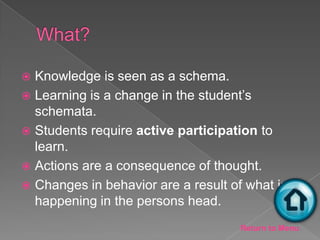
 Knowledge is seen as a schema.
 Learning is a change in the student’s
  schemata.
 Students require active participation to
  learn.
 Actions are a consequence of thought.
 Changes in behavior are a result of what is
  happening in the persons head.
                                     Return to Menu
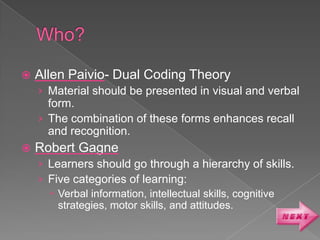
   Allen Paivio- Dual Coding Theory
    › Material should be presented in visual and verbal
      form.
    › The combination of these forms enhances recall
      and recognition.
   Robert Gagne
    › Learners should go through a hierarchy of skills.
    › Five categories of learning:
       Verbal information, intellectual skills, cognitive
        strategies, motor skills, and attitudes.
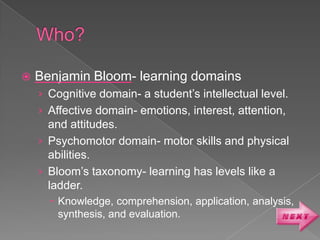
   Benjamin Bloom- learning domains
    › Cognitive domain- a student’s intellectual level.
    › Affective domain- emotions, interest, attention,
      and attitudes.
    › Psychomotor domain- motor skills and physical
      abilities.
    › Bloom’s taxonomy- learning has levels like a
      ladder.
       Knowledge, comprehension, application, analysis,
        synthesis, and evaluation.
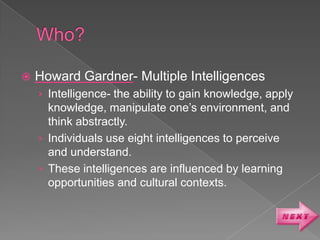
   Howard Gardner- Multiple Intelligences
    › Intelligence- the ability to gain knowledge, apply
      knowledge, manipulate one’s environment, and
      think abstractly.
    › Individuals use eight intelligences to perceive
      and understand.
    › These intelligences are influenced by learning
      opportunities and cultural contexts.
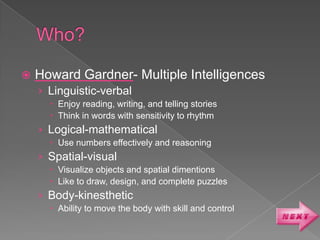
   Howard Gardner- Multiple Intelligences
    › Linguistic-verbal
       Enjoy reading, writing, and telling stories
       Think in words with sensitivity to rhythm
    › Logical-mathematical
       Use numbers effectively and reasoning
    › Spatial-visual
       Visualize objects and spatial dimentions
       Like to draw, design, and complete puzzles
    › Body-kinesthetic
       Ability to move the body with skill and control
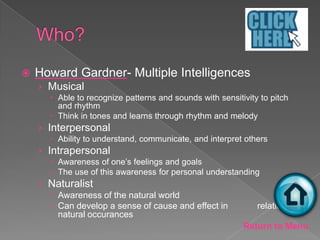
   Howard Gardner- Multiple Intelligences
    › Musical
       Able to recognize patterns and sounds with sensitivity to pitch
        and rhythm
       Think in tones and learns through rhythm and melody
    › Interpersonal
       Ability to understand, communicate, and interpret others
    › Intrapersonal
       Awareness of one’s feelings and goals
       The use of this awareness for personal understanding
    › Naturalist
       Awareness of the natural world
       Can develop a sense of cause and effect in            relation to
        natural occurances
                                                          Return to Menu
 Teachers can incorporate Gagne’s Nine
  Events of Instruction to improve student
  learning.
 Because cognitivism emphasizes active
  participation in learning, teachers can:
    › Play games with students to improve memory
    › Use Bloom’s taxonomy to motivate students to
     reach higher learning levels
 Teachers can use Gardner’s multiple
  intelligences to personalize assessment and
  instruction.
 Teachers can use Bloom’s taxonomy to
  monitor the level at which they are
  challenging students.
    › This allows teachers to ensure that they are
     challenging students at a higher level.


                                          Return to Menu
   I think that cognitive ideas fit very well into
    my philosophy of education.
    › I agree that different students learn in different
      ways.
    › I also believe that students who are actively
      involved in learning are more likely to internalize
      the information they are given.
   I think that I will use many cognitive ideas in
    my future classroom.
    › One of my favorite activities to teach students
      spelling words is a game called sparkle.
    › I think that I will try to address as many learning
      styles as I can through games, group activities,
      videos, puzzles, etc.
Sources:
   •The book
   •http://en.wikipedia.org/wiki/Cognitivism_(psycholo
   gy)
   •http://en.wikipedia.org/wiki/Learning_theory_(edu
   cation)#Cognitivism
   •http://www.learning-theories.com/cognitivism.html
   •http://www.youtube.com/watch?v=SFIgVAMfz64&
   feature=relmfu

Cognitivism

  • 2.
    What?  Who?  In the Classroom  My Classroom
  • 3.
     Focuses oninner mental activities.  Incorporates mental structures and processes into learning.  Activities like thinking and remembering are behaviors.  As behaviors they allow us to measure their effect on learning.
  • 4.
     Knowledge isseen as a schema.  Learning is a change in the student’s schemata.  Students require active participation to learn.  Actions are a consequence of thought.  Changes in behavior are a result of what is happening in the persons head. Return to Menu
  • 5.
    Allen Paivio- Dual Coding Theory › Material should be presented in visual and verbal form. › The combination of these forms enhances recall and recognition.  Robert Gagne › Learners should go through a hierarchy of skills. › Five categories of learning:  Verbal information, intellectual skills, cognitive strategies, motor skills, and attitudes.
  • 6.
    Benjamin Bloom- learning domains › Cognitive domain- a student’s intellectual level. › Affective domain- emotions, interest, attention, and attitudes. › Psychomotor domain- motor skills and physical abilities. › Bloom’s taxonomy- learning has levels like a ladder.  Knowledge, comprehension, application, analysis, synthesis, and evaluation.
  • 7.
    Howard Gardner- Multiple Intelligences › Intelligence- the ability to gain knowledge, apply knowledge, manipulate one’s environment, and think abstractly. › Individuals use eight intelligences to perceive and understand. › These intelligences are influenced by learning opportunities and cultural contexts.
  • 8.
    Howard Gardner- Multiple Intelligences › Linguistic-verbal  Enjoy reading, writing, and telling stories  Think in words with sensitivity to rhythm › Logical-mathematical  Use numbers effectively and reasoning › Spatial-visual  Visualize objects and spatial dimentions  Like to draw, design, and complete puzzles › Body-kinesthetic  Ability to move the body with skill and control
  • 9.
    Howard Gardner- Multiple Intelligences › Musical  Able to recognize patterns and sounds with sensitivity to pitch and rhythm  Think in tones and learns through rhythm and melody › Interpersonal  Ability to understand, communicate, and interpret others › Intrapersonal  Awareness of one’s feelings and goals  The use of this awareness for personal understanding › Naturalist  Awareness of the natural world  Can develop a sense of cause and effect in relation to natural occurances Return to Menu
  • 10.
     Teachers canincorporate Gagne’s Nine Events of Instruction to improve student learning.  Because cognitivism emphasizes active participation in learning, teachers can: › Play games with students to improve memory › Use Bloom’s taxonomy to motivate students to reach higher learning levels
  • 11.
     Teachers canuse Gardner’s multiple intelligences to personalize assessment and instruction.  Teachers can use Bloom’s taxonomy to monitor the level at which they are challenging students. › This allows teachers to ensure that they are challenging students at a higher level. Return to Menu
  • 12.
    I think that cognitive ideas fit very well into my philosophy of education. › I agree that different students learn in different ways. › I also believe that students who are actively involved in learning are more likely to internalize the information they are given.
  • 13.
    I think that I will use many cognitive ideas in my future classroom. › One of my favorite activities to teach students spelling words is a game called sparkle. › I think that I will try to address as many learning styles as I can through games, group activities, videos, puzzles, etc.
  • 14.
    Sources: •The book •http://en.wikipedia.org/wiki/Cognitivism_(psycholo gy) •http://en.wikipedia.org/wiki/Learning_theory_(edu cation)#Cognitivism •http://www.learning-theories.com/cognitivism.html •http://www.youtube.com/watch?v=SFIgVAMfz64& feature=relmfu