Cognitive Technologies
Artur Gunia, Bipin Indurkhya
Institute of Philosophy, Jagiellonian University
Ul. Grodzka 52, 31-044 Kraków, Poland
Email: artur.gunia@uj.edu.pl
18.04.2018 Lecture at the Department of Computer Science, AGH, Kraków
Slides, videos, code
https://bit.ly/2H3yno9
Motivation
• IT was developed for delegating human mental abilities to
machines. But technology can also improve our own
mental powers.
Research objectives: To show that
• Mixed reality technologies are tools for cognitive
enhancement.
• Even simple mixed reality solution can enhance such
subtle mental states as the sense of one’s own body and
the sense of aesthetics.
• The enhancement features of technologies strongly
impact on lifestyle and everyday events.
Background: transhumanism
More, M. (1990). Transhumanism: towards a futurist philosophy. Extropy,
6, 6-12.
https://humanityplus.org/philosophy/transhumanist-faq/
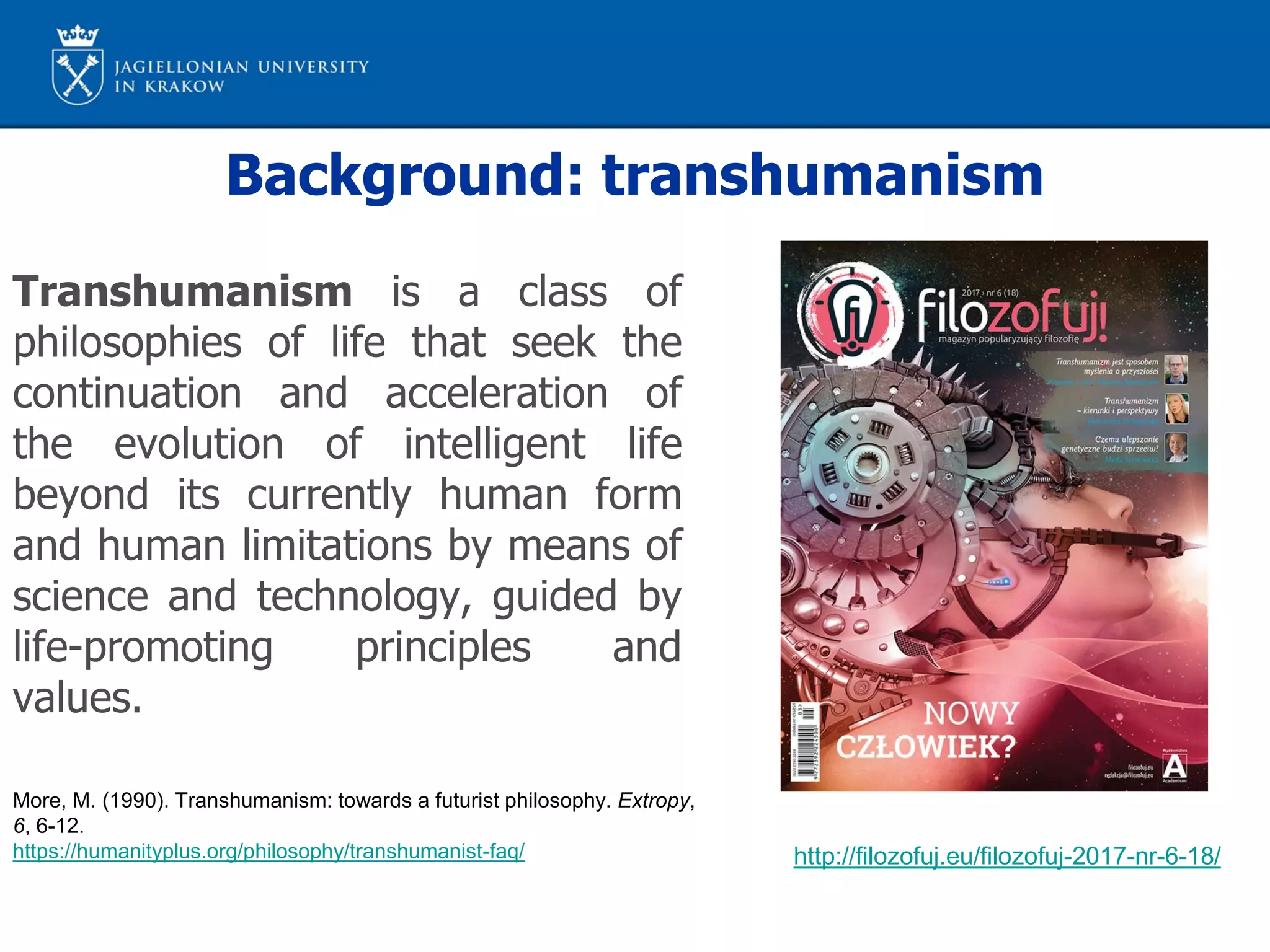
Transhumanism is a class of
philosophies of life that seek the
continuation and acceleration of
the evolution of intelligent life
beyond its currently human form
and human limitations by means of
science and technology, guided by
life-promoting principles and
values.
http://filozofuj.eu/filozofuj-2017-nr-6-18/
Background: cognitive enhancement
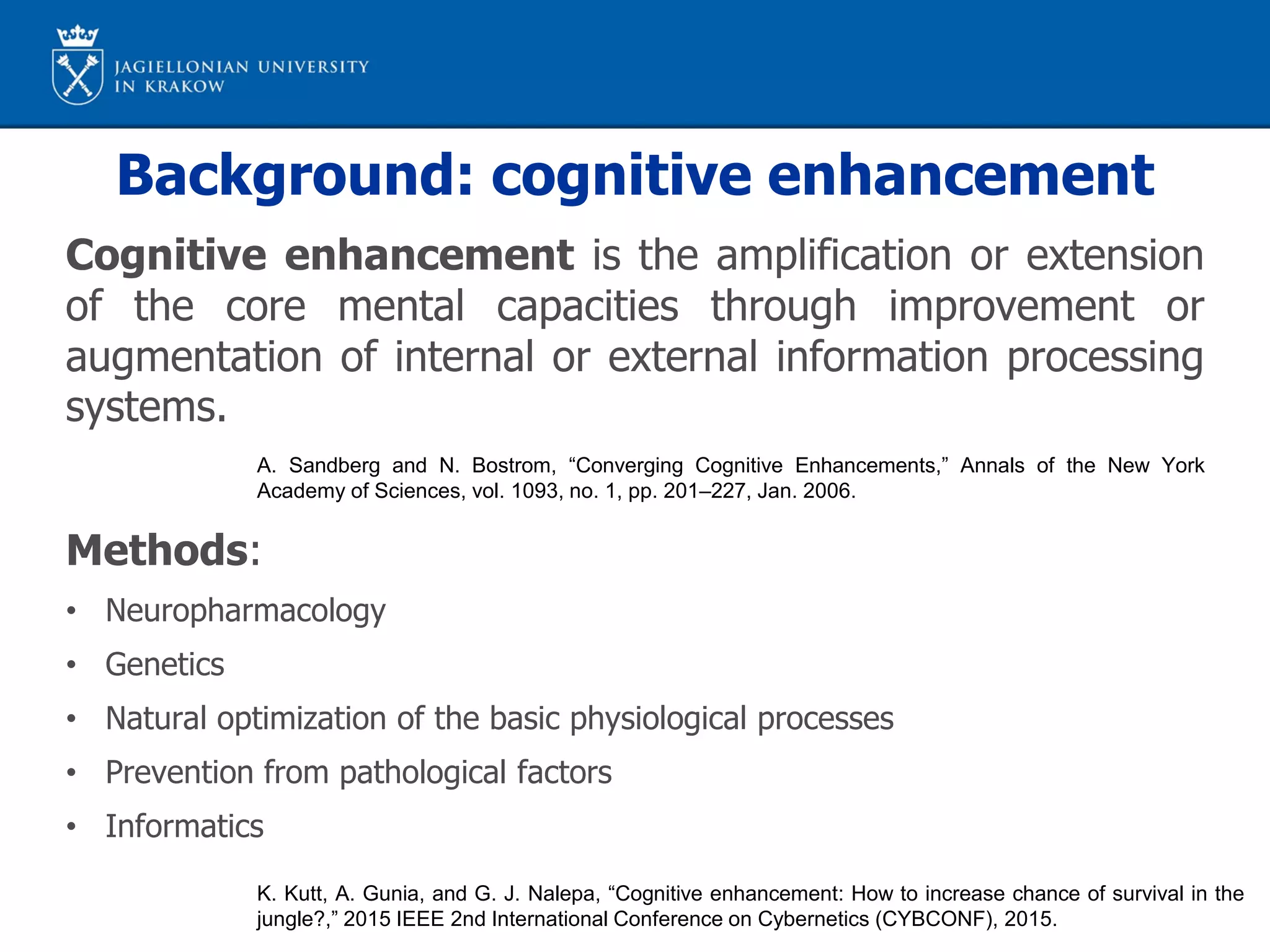
Cognitive enhancement is the amplification or extension
of the core mental capacities through improvement or
augmentation of internal or external information processing
systems.
Methods:
• Neuropharmacology
• Genetics
• Natural optimization of the basic physiological processes
• Prevention from pathological factors
• Informatics
A. Sandberg and N. Bostrom, “Converging Cognitive Enhancements,” Annals of the New York
Academy of Sciences, vol. 1093, no. 1, pp. 201–227, Jan. 2006.
K. Kutt, A. Gunia, and G. J. Nalepa, “Cognitive enhancement: How to increase chance of survival in the
jungle?,” 2015 IEEE 2nd International Conference on Cybernetics (CYBCONF), 2015.
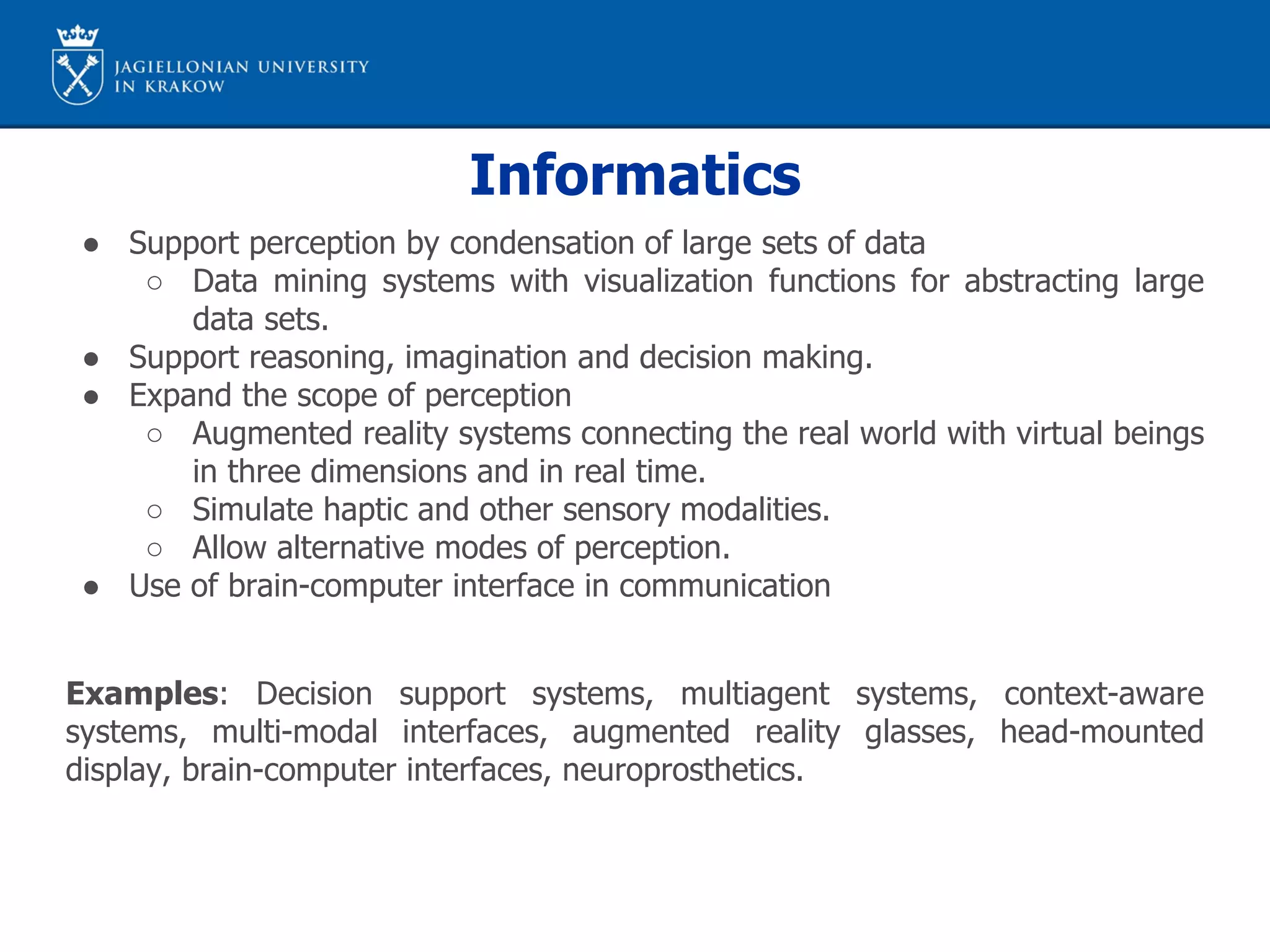
Informatics
● Support perception by condensation of large sets of data
○ Data mining systems with visualization functions for abstracting large
data sets.
● Support reasoning, imagination and decision making.
● Expand the scope of perception
○ Augmented reality systems connecting the real world with virtual beings
in three dimensions and in real time.
○ Simulate haptic and other sensory modalities.
○ Allow alternative modes of perception.
● Use of brain-computer interface in communication
Examples: Decision support systems, multiagent systems, context-aware
systems, multi-modal interfaces, augmented reality glasses, head-mounted
display, brain-computer interfaces, neuroprosthetics.
Cognitive powers
Cognitive powers are holistic mental and biological
processes through which we get to know/ cognize /
recognize the outside world and internal conscious
states.
A. Gunia. „Wzmocnienie poznawcze w kontekście transhumanistycznym. Teoria, praktyka oraz
konsekwencje wpływu technologii kognitywnych na człowieka” (thesis).
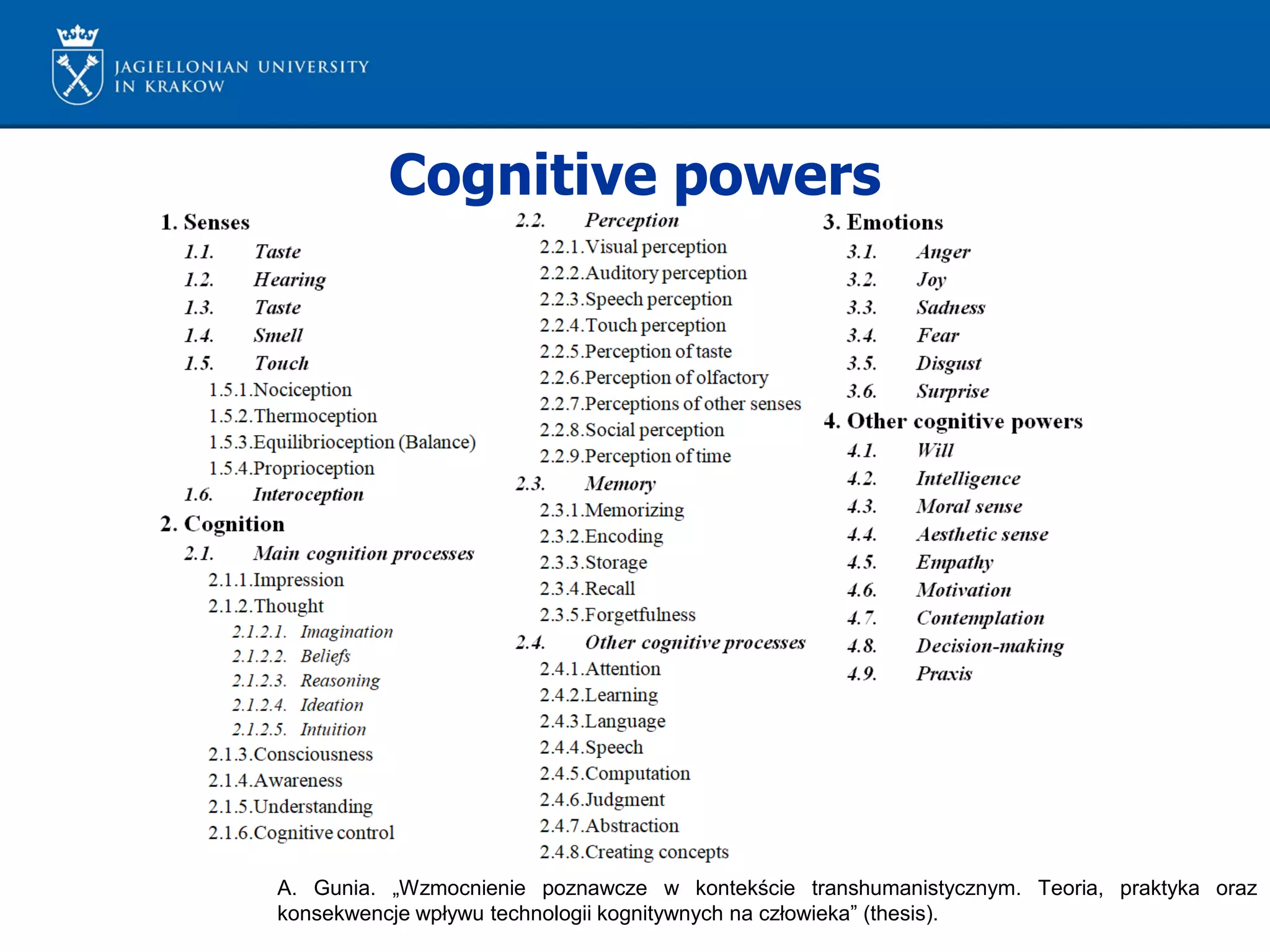
Cognitive powers
A. Gunia. „Wzmocnienie poznawcze w kontekście transhumanistycznym. Teoria, praktyka oraz
konsekwencje wpływu technologii kognitywnych na człowieka” (thesis).
Methodology: Cognitive technologies
● Technologies that actively affect human cognitive
processes and daily activities.
● Can change the body schema and body image.
● Are emotionally effective.
● Relate with immersion and cyborgization.
Features:
• Modulating and optimizing human behavior (self-tracking).
• Creating immersive and augmented environments to affect or change human
perception (virtual, mixed, augmented realities).
• Creating intelligent and automated environments (ambient intelligence
systems).
• Technology implantation inside human body (cyborgization).
Cognitive enhancement via cognitive
technologies
• Motivational enhancement
• Informational enhancement
• Aesthetic enhancement
• Affective enhancement
• Perceptual enhancement
• Quantitative and qualitative enhancement
A. Gunia. „Wzmocnienie poznawcze w kontekście transhumanistycznym. Teoria, praktyka oraz
konsekwencje wpływu technologii kognitywnych na człowieka” (thesis).
Motivational enhancement
• Motivation is the reason for people's actions, desires, and needs.
• Motivation is the reason for engaging in a behavior, or what causes a
person to repeat a behavior.
• An individual is not motivated by another individual. Motivation
comes from within the individual.
• It is a system of perceptions, emotional attitudes, and beliefs
pertaining to one's own body.
Motivational enhancement
• To support self-motivation
○ Focusing on the goal of motivating oneself to realize the goals
set for oneself.
• To allow better recognition of needs.
• To optimize and control capabilities to meet the needs.
• To stimulate and supplement cognitive processes and emotional
feelings for better performance of motivated tasks.
Technologies of motivational
enhancement
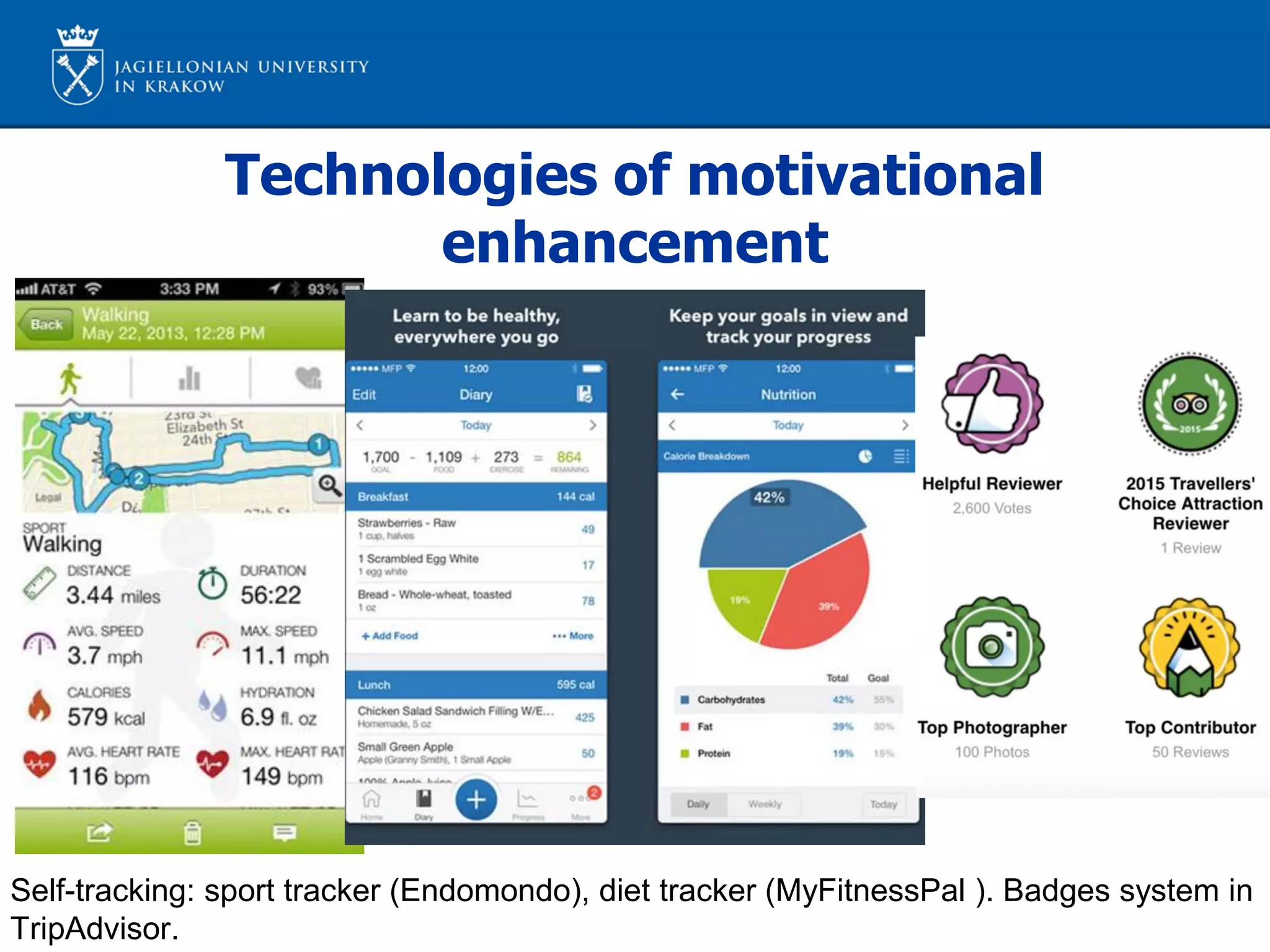
Self-tracking: sport tracker (Endomondo), diet tracker (MyFitnessPal ). Badges system in
TripAdvisor.
Informational enhancement
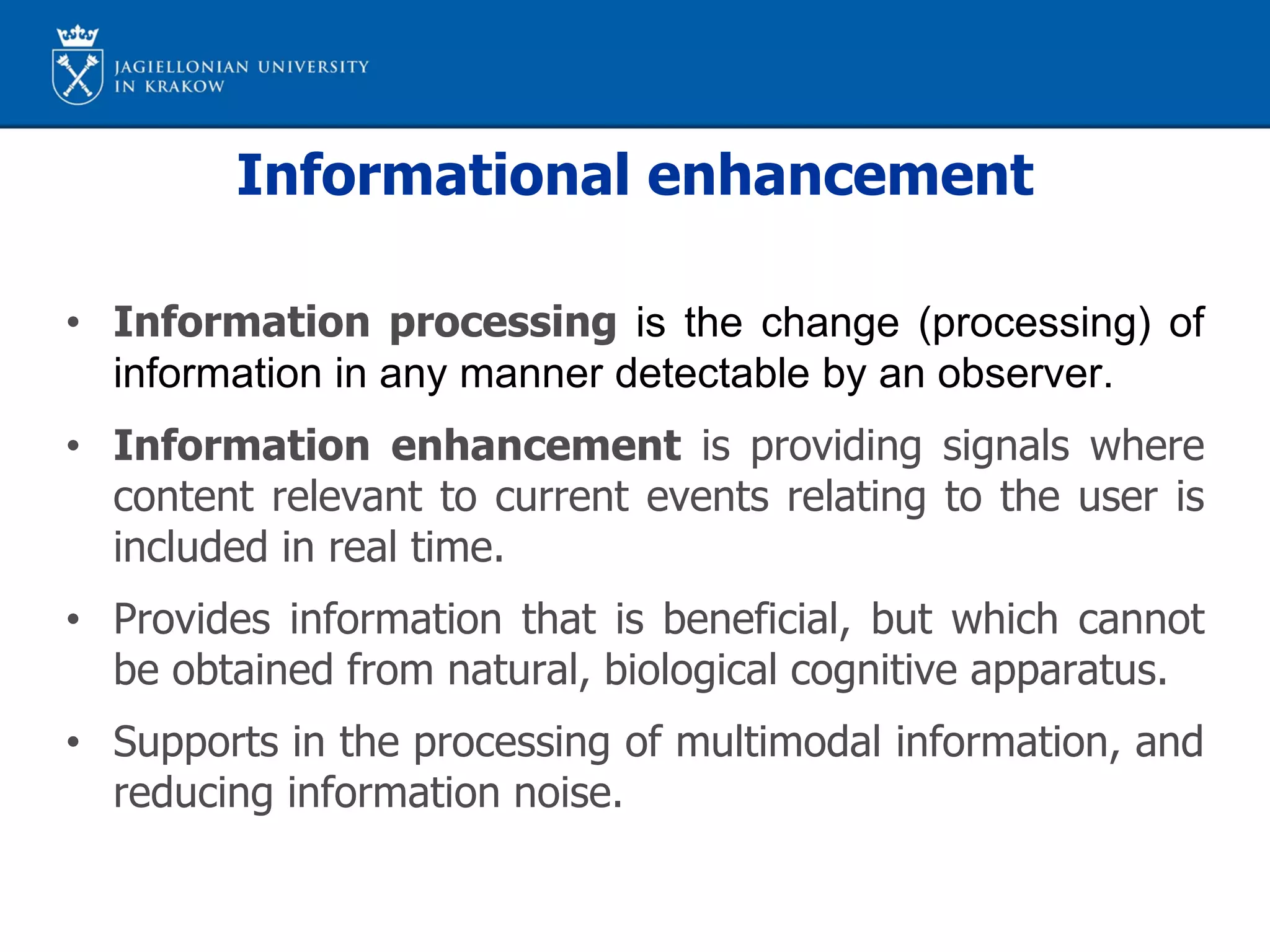
• Information processing is the change (processing) of
information in any manner detectable by an observer.
• Information enhancement is providing signals where
content relevant to current events relating to the user is
included in real time.
• Provides information that is beneficial, but which cannot
be obtained from natural, biological cognitive apparatus.
• Supports in the processing of multimodal information, and
reducing information noise.
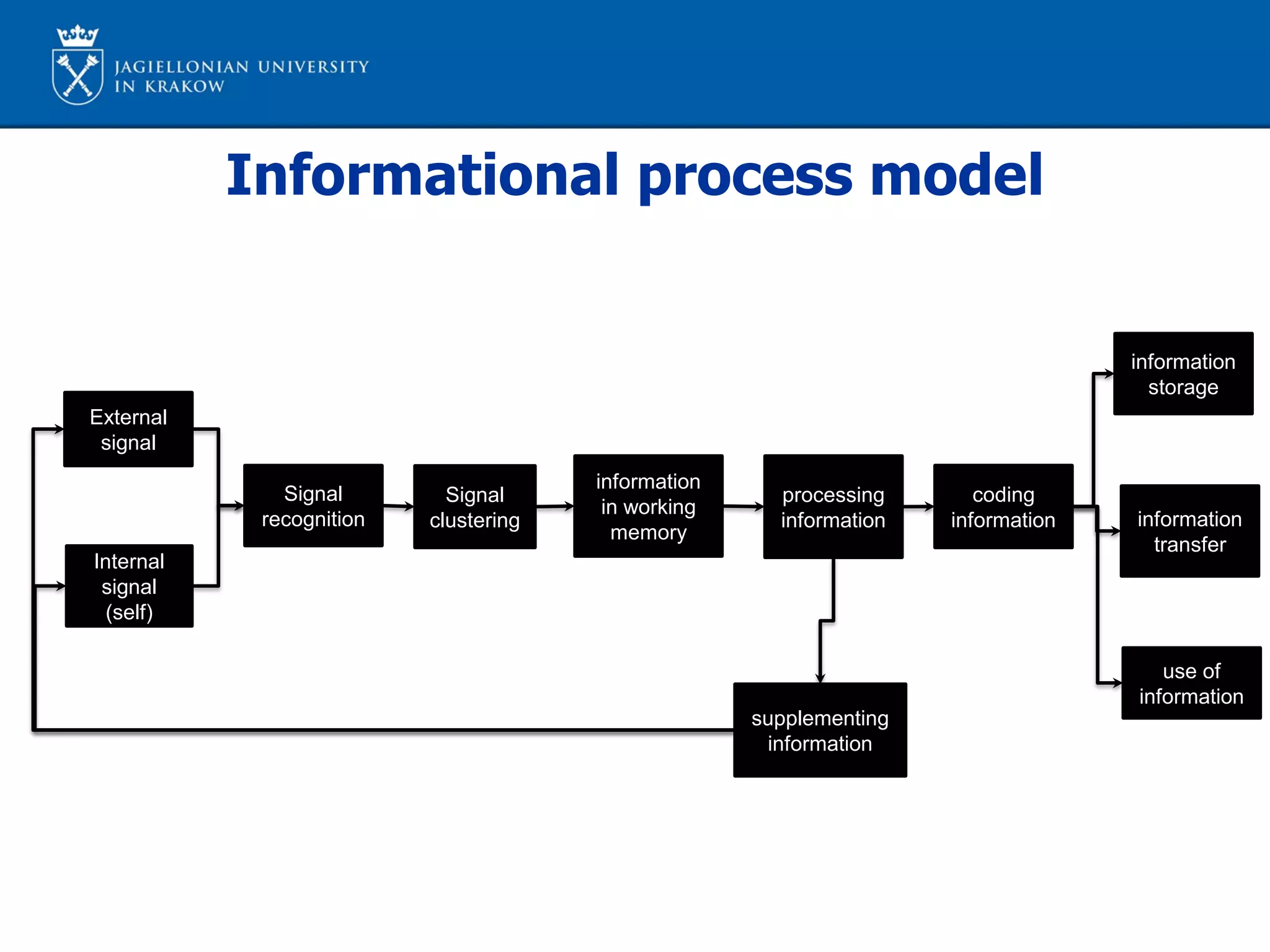
Informational process model
External
signal
Internal
signal
(self)
Signal
recognition
Signal
clustering
information
in working
memory
processing
information
supplementing
information
coding
information
information
storage
information
transfer
use of
information
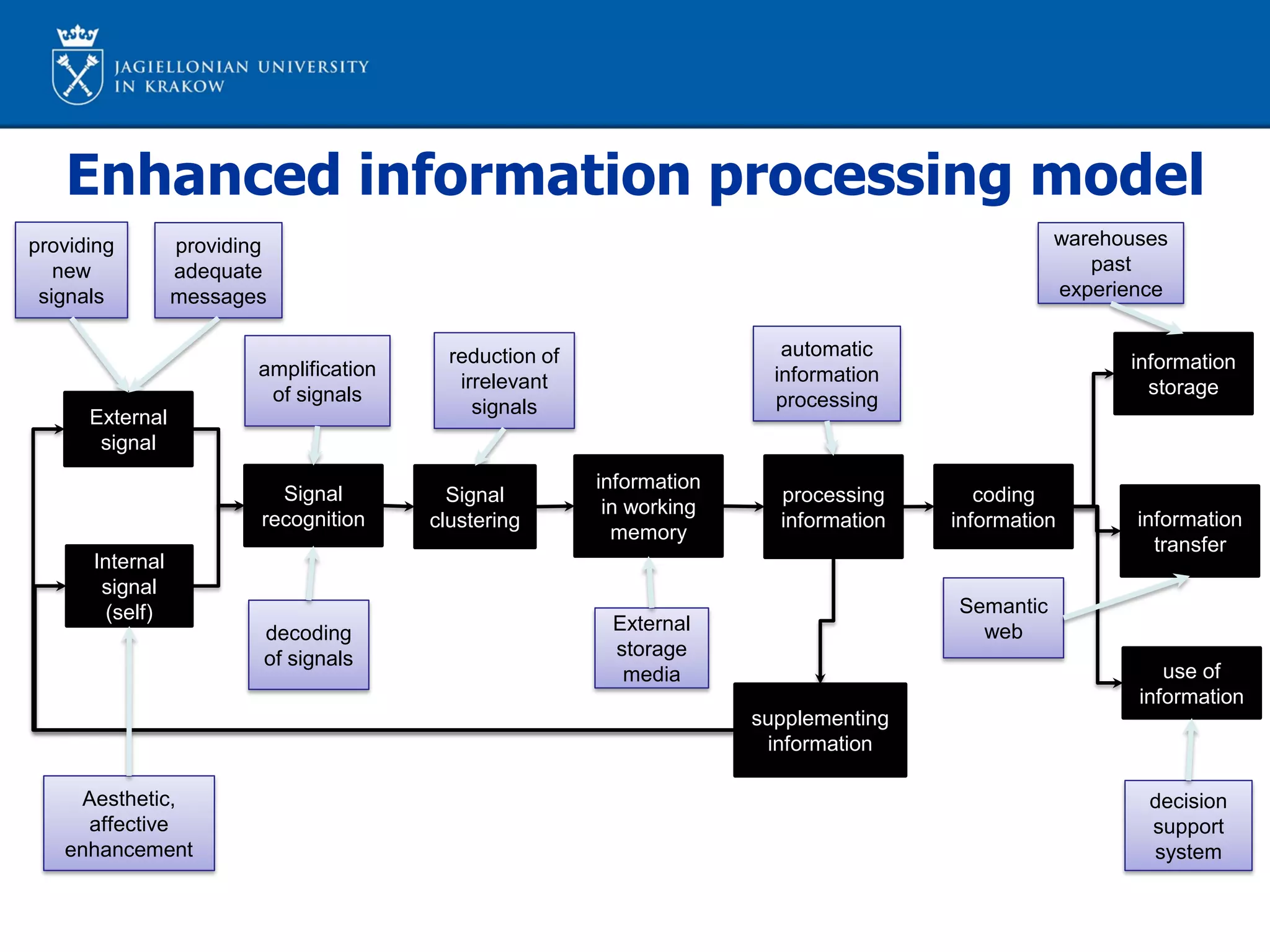
Enhanced information processing model
External
signal
Internal
signal
(self)
Signal
recognition
Signal
clustering
information
in working
memory
processing
information
supplementing
information
coding
information
information
storage
information
transfer
use of
information
providing
new
signals
providing
adequate
messages
Aesthetic,
affective
enhancement
decoding
of signals
amplification
of signals
reduction of
irrelevant
signals
External
storage
media
automatic
information
processing
warehouses
past
experience
decision
support
system
Semantic
web
Examples of information
enhancement technologies
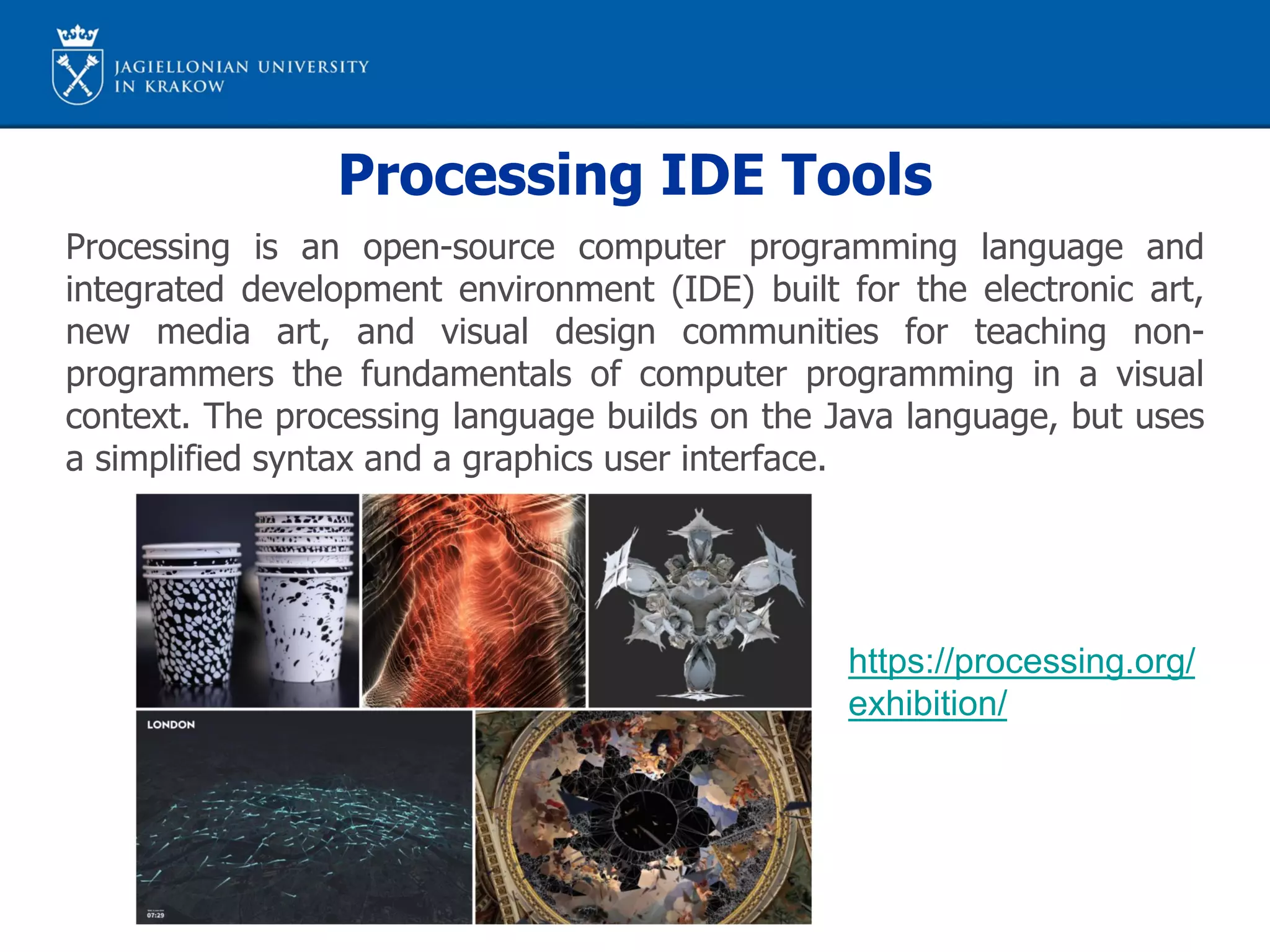
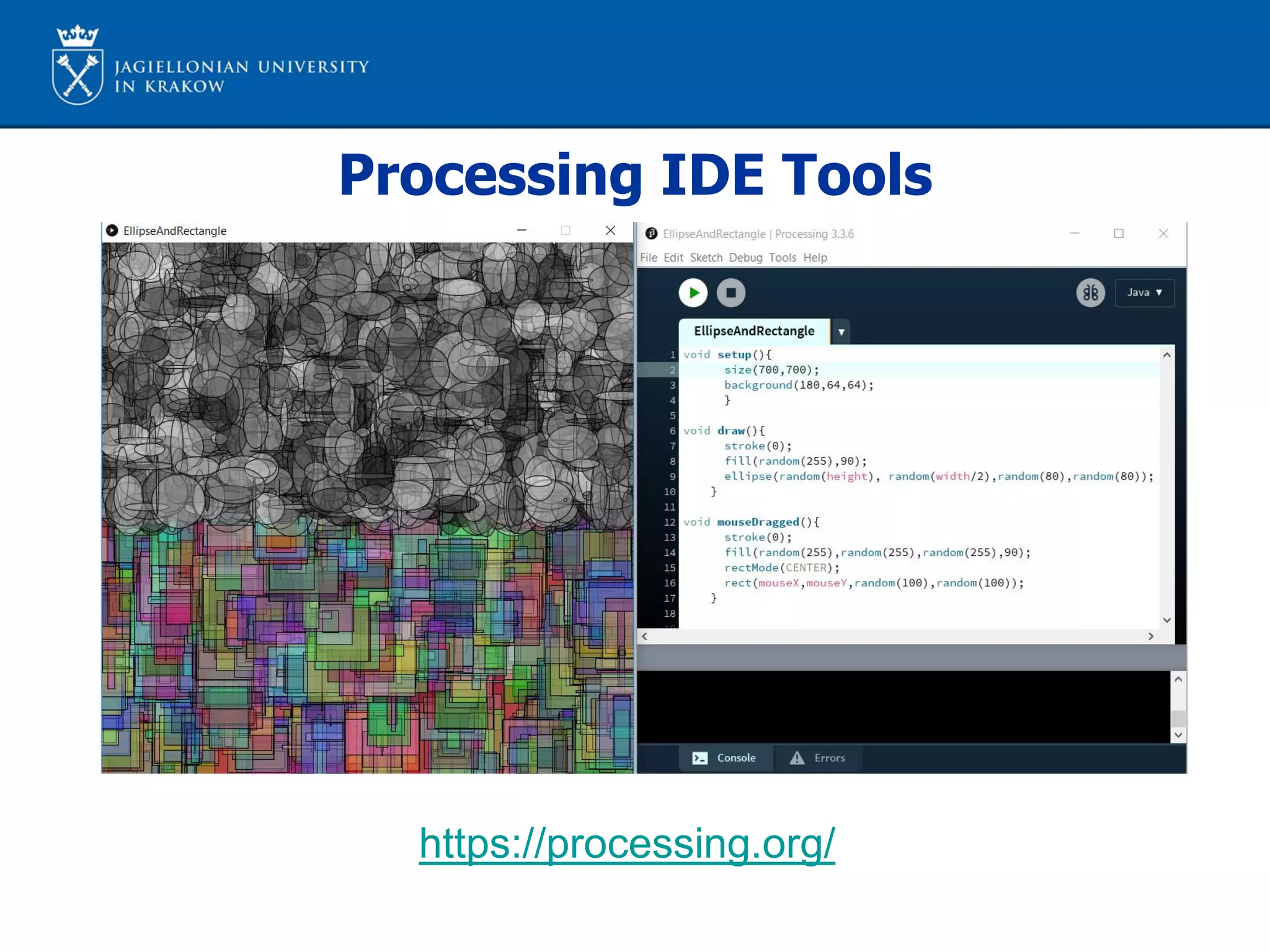
Processing IDE Tools
Processing is an open-source computer programming language and
integrated development environment (IDE) built for the electronic art,
new media art, and visual design communities for teaching non-
programmers the fundamentals of computer programming in a visual
context. The processing language builds on the Java language, but uses
a simplified syntax and a graphics user interface.
https://processing.org/
exhibition/
Processing IDE Tools
https://processing.org/
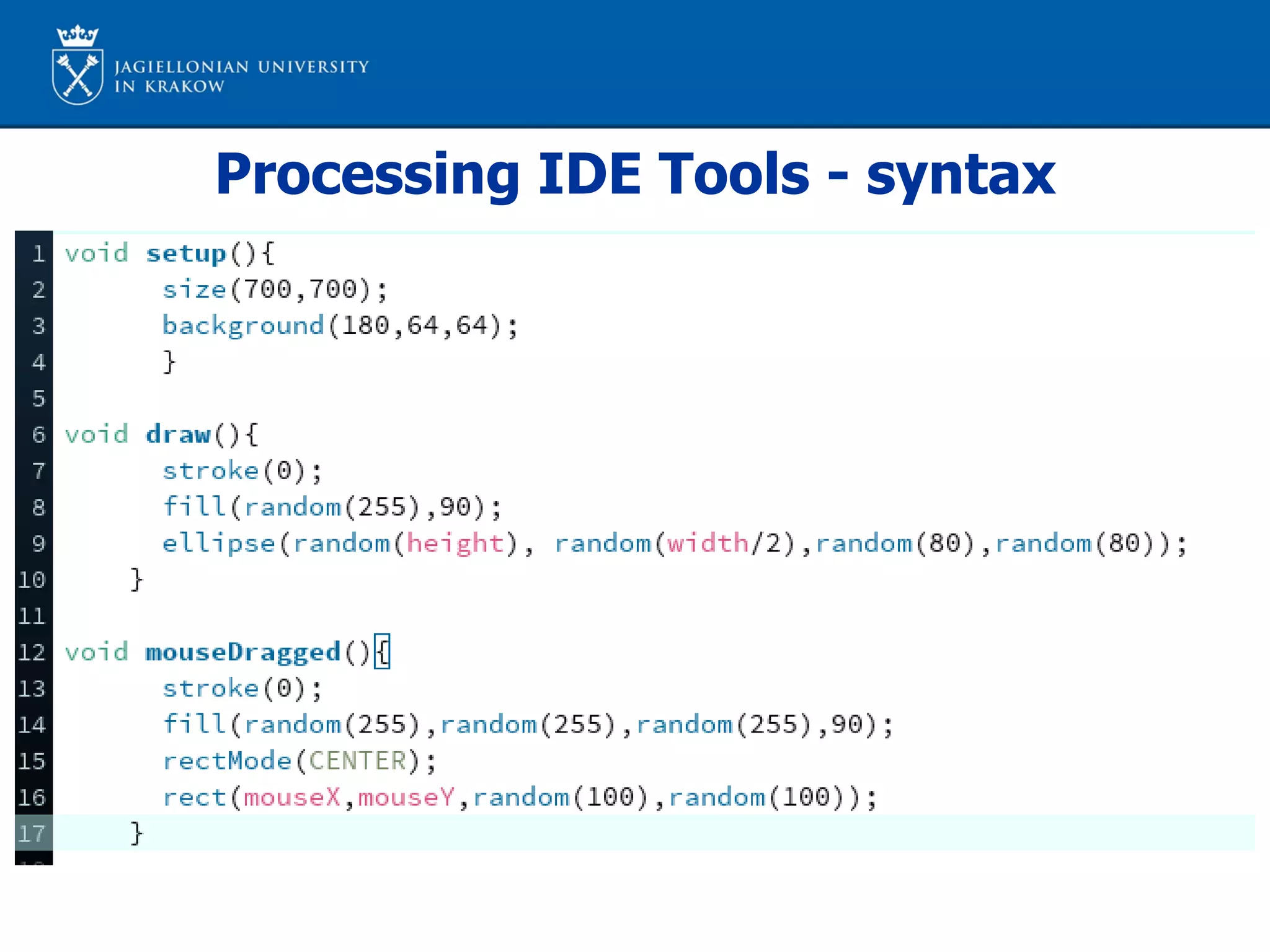
Processing IDE Tools - syntax
Extended information
Extended information with augmented
reality
https://www.youtube.com/watch?v=9PMMPTMtiOc
Or look below, slide 23
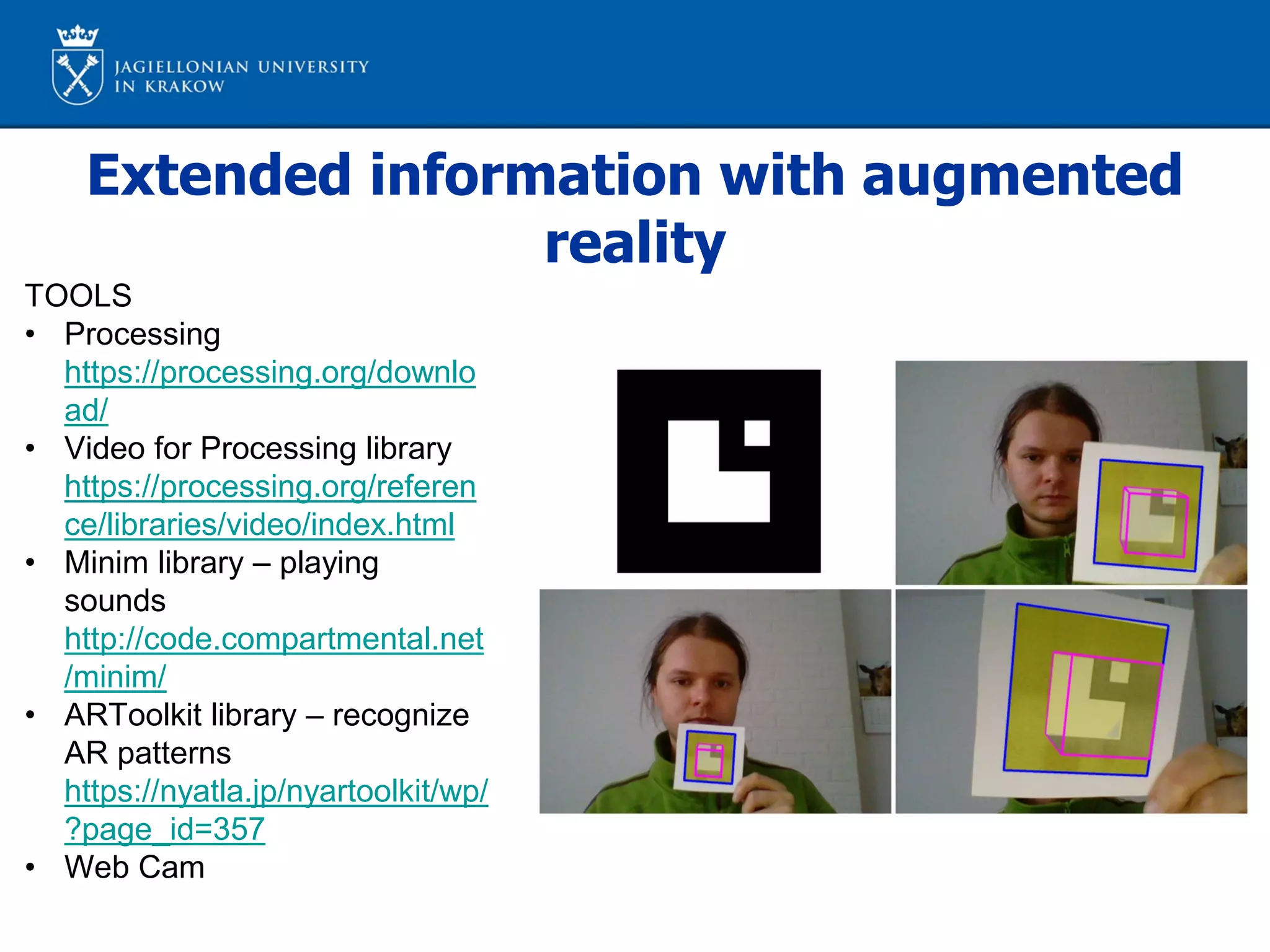
Extended information with augmented
reality
TOOLS
• Processing
https://processing.org/downlo
ad/
• Video for Processing library
https://processing.org/referen
ce/libraries/video/index.html
• Minim library – playing
sounds
http://code.compartmental.net
/minim/
• ARToolkit library – recognize
AR patterns
https://nyatla.jp/nyartoolkit/wp/
?page_id=357
• Web Cam
Extended information with augmented
reality - syntax
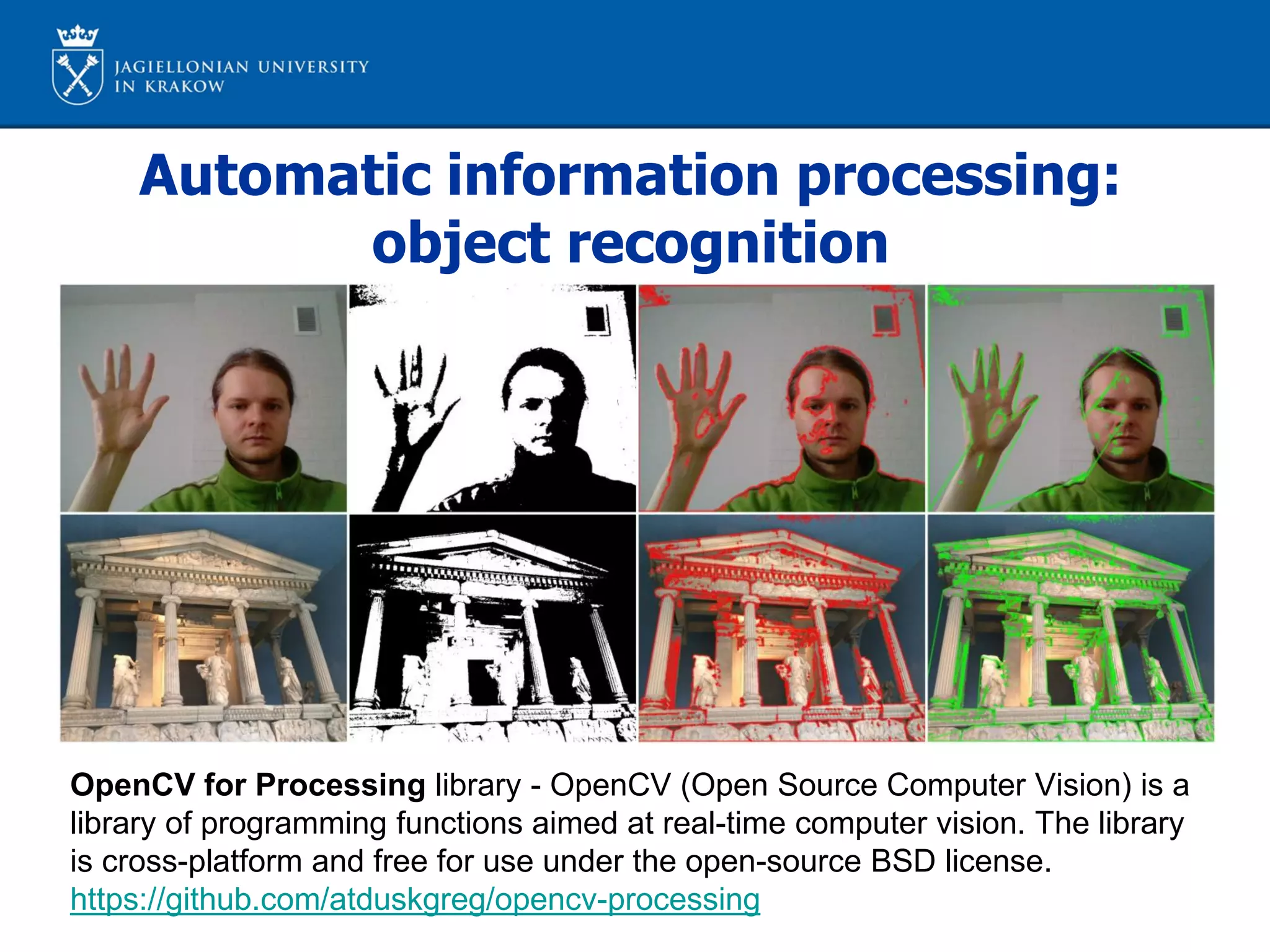
Automatic information processing:
object recognition
OpenCV for Processing library - OpenCV (Open Source Computer Vision) is a
library of programming functions aimed at real-time computer vision. The library
is cross-platform and free for use under the open-source BSD license.
https://github.com/atduskgreg/opencv-processing
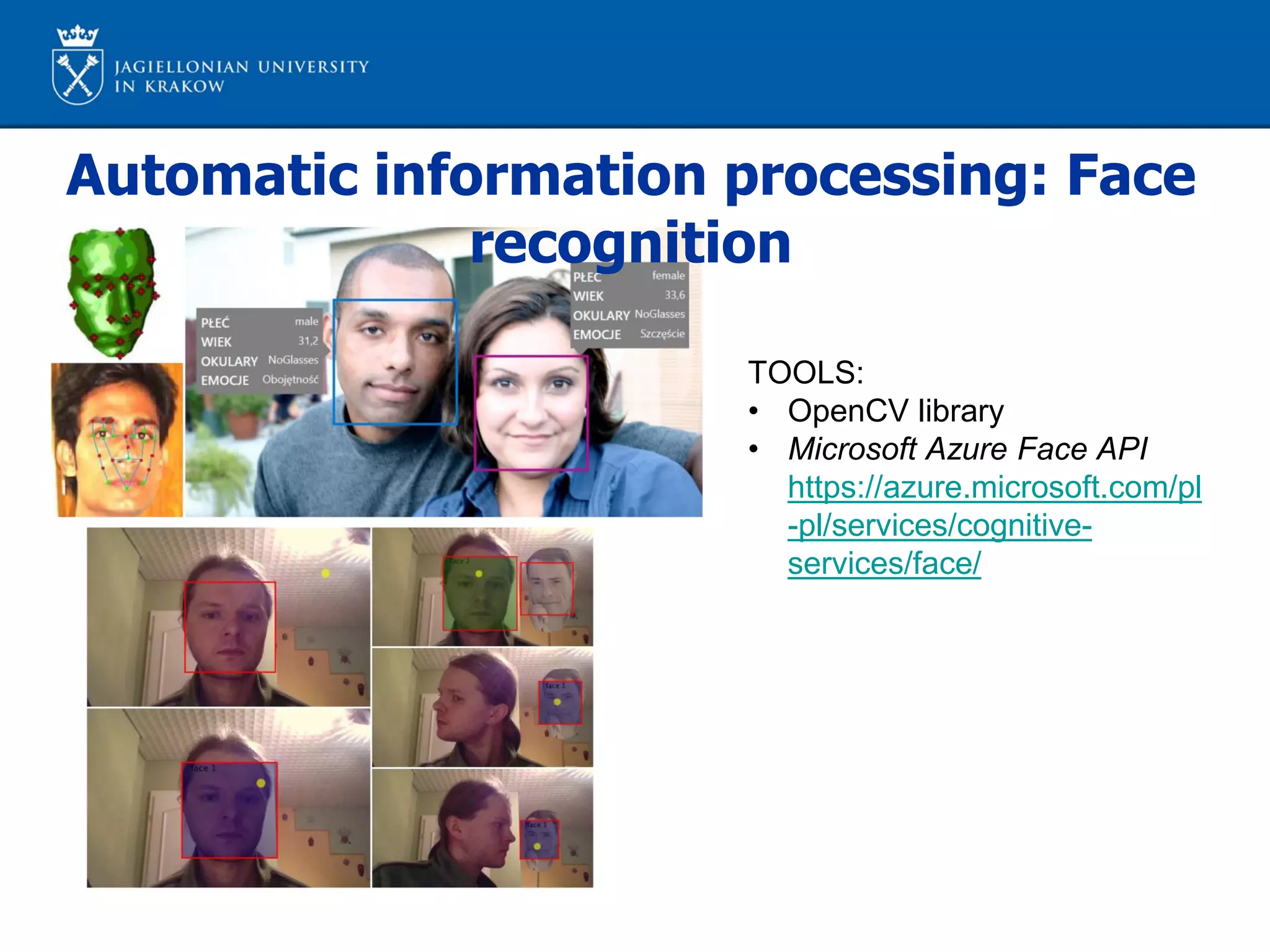
Automatic information processing: Face
recognition
TOOLS:
• OpenCV library
• Microsoft Azure Face API
https://azure.microsoft.com/pl
-pl/services/cognitive-
services/face/
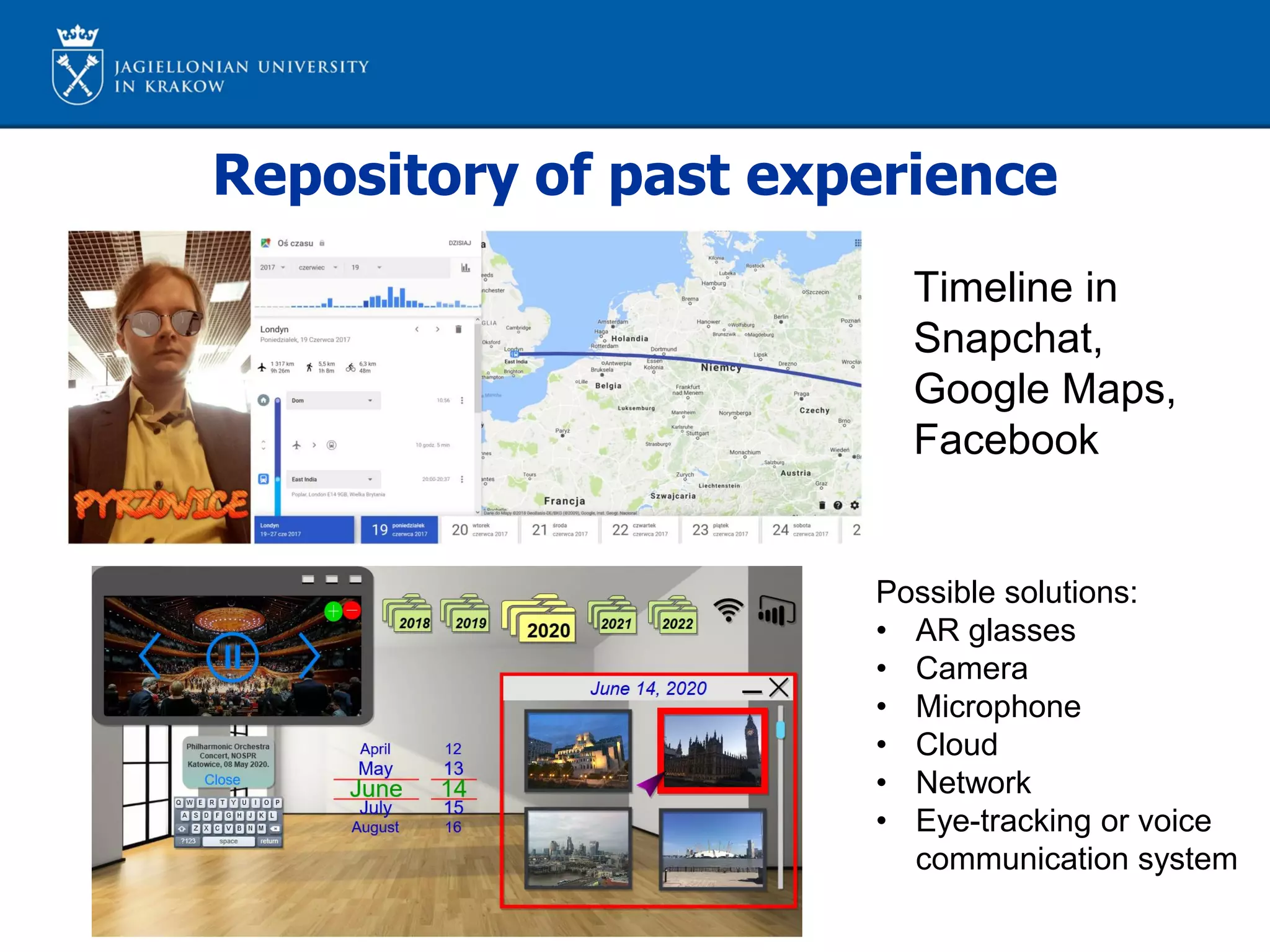
Timeline in
Snapchat,
Google Maps,
Facebook
Repository of past experience
Possible solutions:
• AR glasses
• Camera
• Microphone
• Cloud
• Network
• Eye-tracking or voice
communication system
Aesthetic enhancement
• Aesthetics is a field of philosophy that explores the nature
of art, beauty, and taste.
• Sense of aesthetics is a function of perception, which
distinguishes beauty from ugliness, or good taste form
bad taste.
• Aesthetic enhancement is the ability to influence
technology on the mood, sense of aesthetic, and positive
emotions.
Aesthetic enhancement
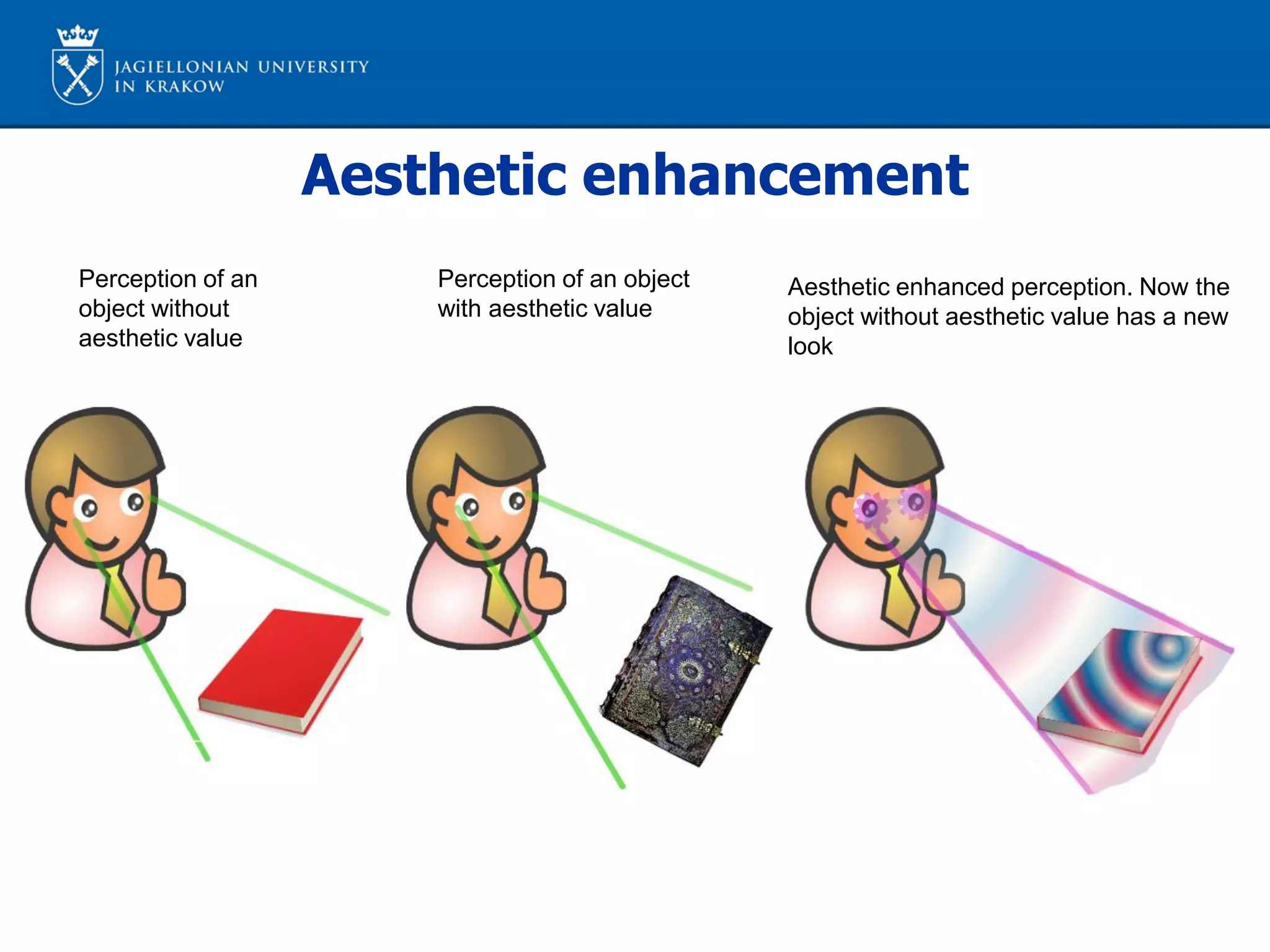
Perception of an
object without
aesthetic value
Perception of an object
with aesthetic value
Aesthetic enhanced perception. Now the
object without aesthetic value has a new
look
Aesthetic enhancement
https://www.youtube.com/watch?v=TWMSIJ6U93Q
Or look below, slide 31
Aesthetic enhancement: Program
https://www.youtube.com/watch?v=Z6Ptv1muuTQ
Or look below, slide 32
Aesthetic enhancement: Problems
YOLOCAUST Project
https://yolocaust.de/
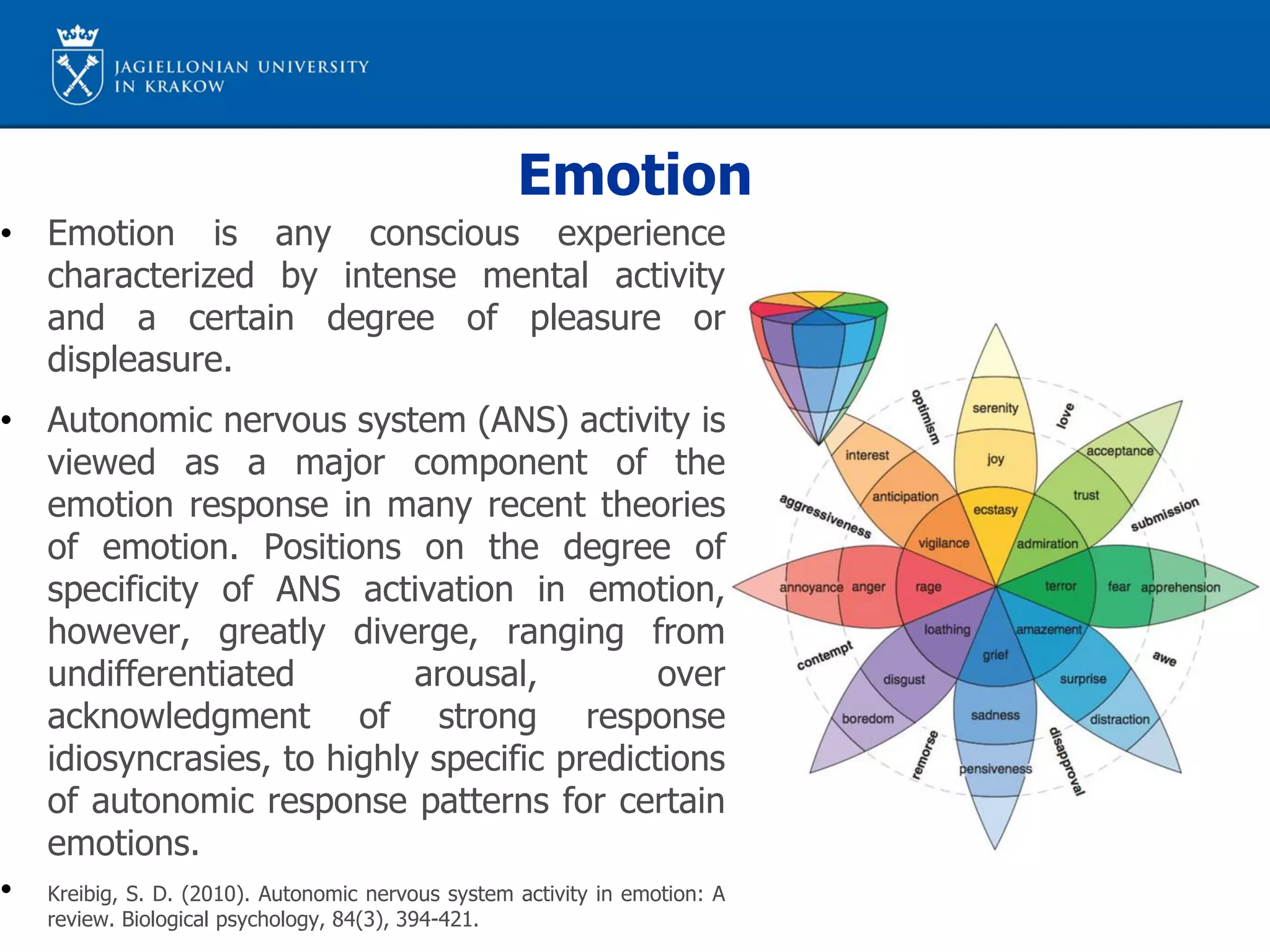
Emotion
• Emotion is any conscious experience
characterized by intense mental activity
and a certain degree of pleasure or
displeasure.
• Autonomic nervous system (ANS) activity is
viewed as a major component of the
emotion response in many recent theories
of emotion. Positions on the degree of
specificity of ANS activation in emotion,
however, greatly diverge, ranging from
undifferentiated arousal, over
acknowledgment of strong response
idiosyncrasies, to highly specific predictions
of autonomic response patterns for certain
emotions.
• Kreibig, S. D. (2010). Autonomic nervous system activity in emotion: A
review. Biological psychology, 84(3), 394-421.
Affective enhancement and affective computing
• Affective enhancement is stimulating positive emotions and reduction of
negative emotion.
• Affective computing is computing that relates to, arises from, or deliberately
influences emotion or other affective phenomena
1. Designing new ways for people to communicate affective-cognitive states, especially
through creation of novel wearable sensors and new machine learning algorithms that
jointly analyze multimodal channels of information;
2. Creating new techniques to assess frustration, stress, and mood indirectly, through
natural interaction and conversation;
3. Showing how computers can be more emotionally intelligent, especially responding to
a person's frustration in a way that reduces negative feelings;
4. Inventing personal technologies for improving self-awareness of affective state and its
selective communication to others;
5. Increasing understanding of how affect influences personal health
Picard, R. W. (1995). Affective computing.
Perception
• Perception is the organization, identification, and interpretation of
sensory information in order to represent and understand the
presented information, or the environment.
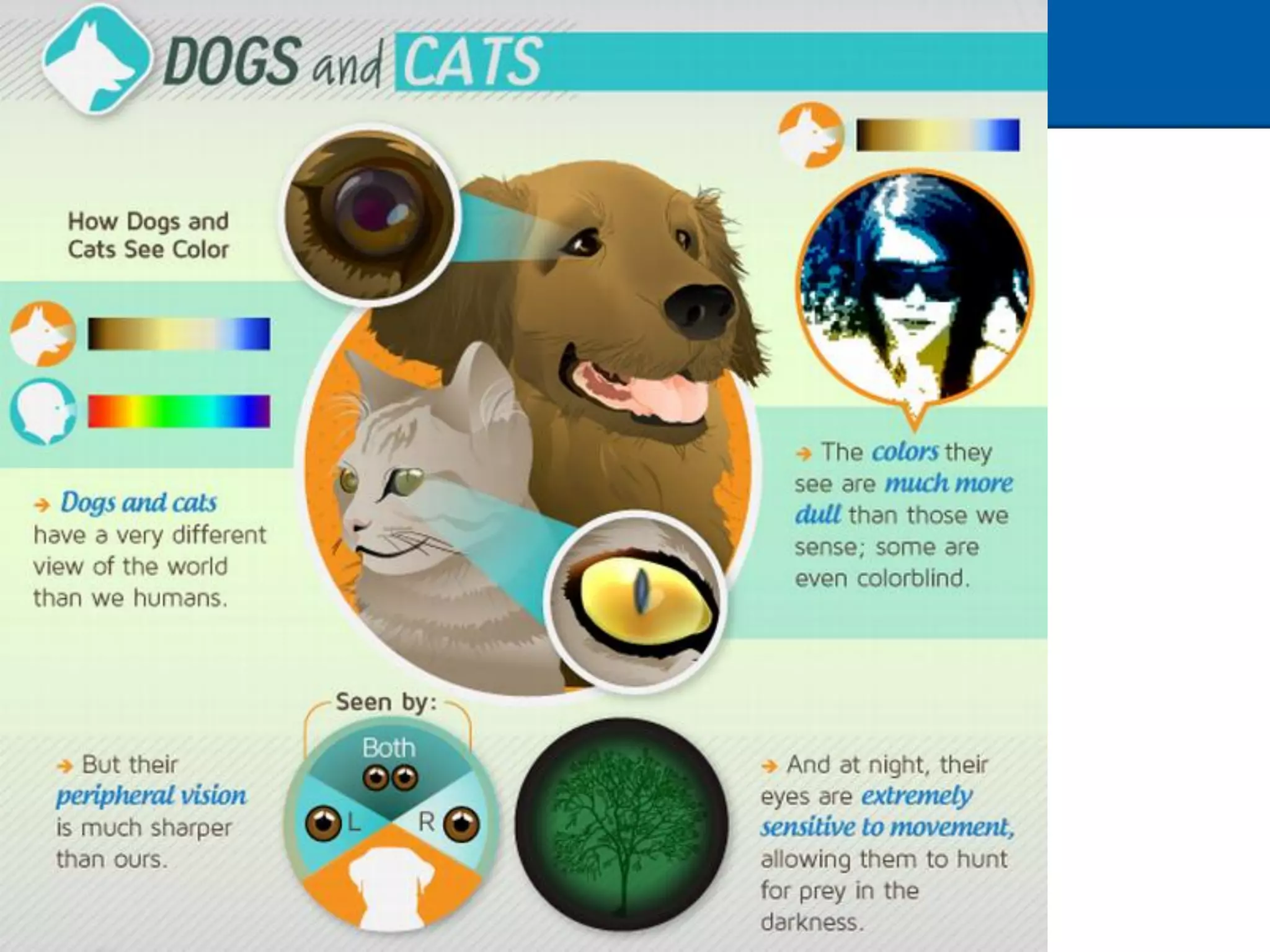
• Visual perception is the ability to interpret the surrounding
environment using light in the visible spectrum reflected by the
objects in the environment.
• Examples of the possibilities of visual perception:
• Seeing the visible light in the wavelength range from 400 to 700 nm
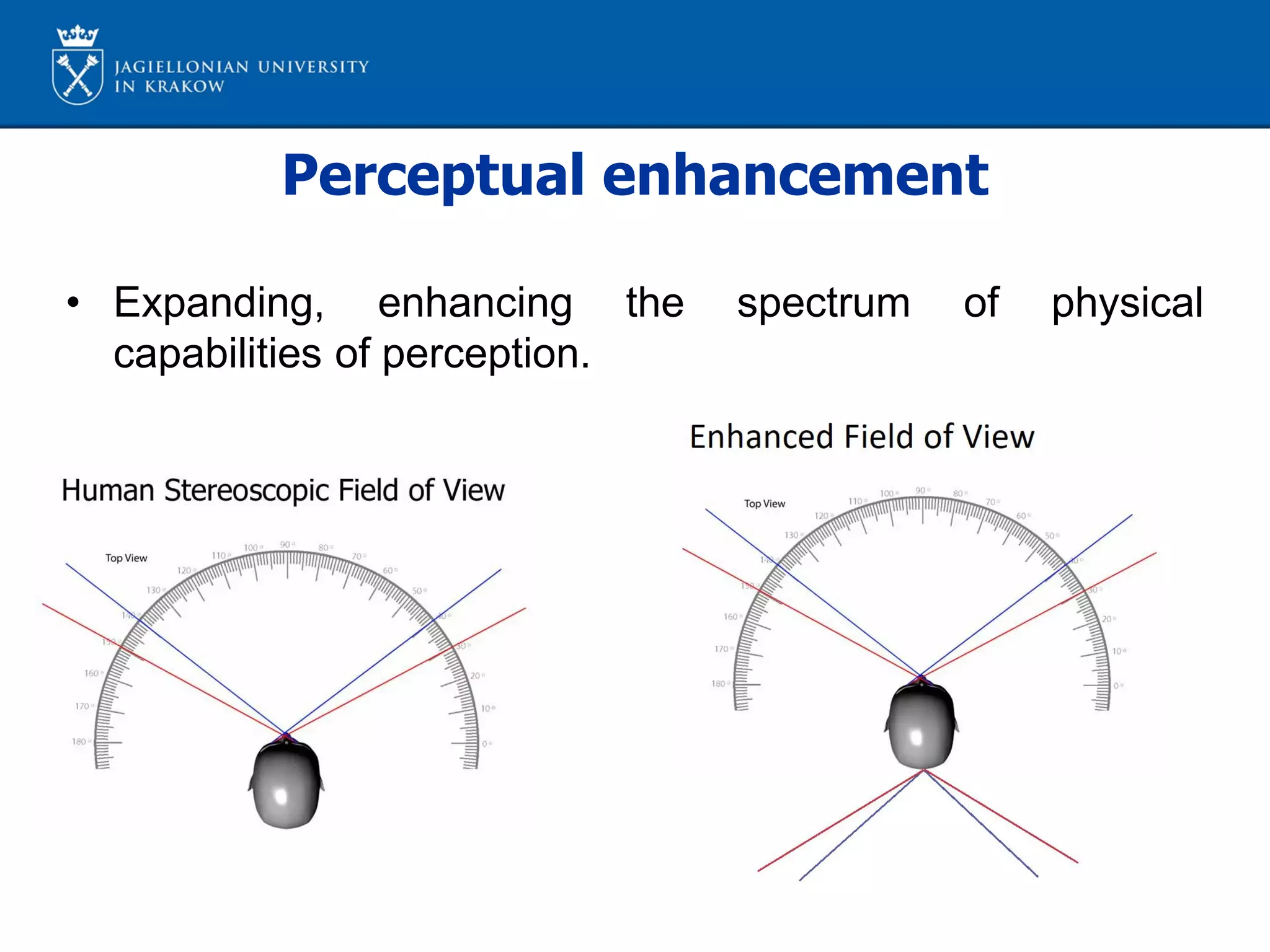
• Fields of view, the area that is seen by the unmoved eye or unmoved head, vertically from 10
to 15 degrees (without eyeballs), 30 degrees (moving the eyeballs, but not the head).
Horizontally with fixed head to 114 degrees.
• Flicker fusion frequency number of images that we can see in one second: 50-70 Hz in daily
vision, 3-5 Hz in night vision.
Perceptual enhancement
• Expanding, enhancing the spectrum of physical
capabilities of perception.
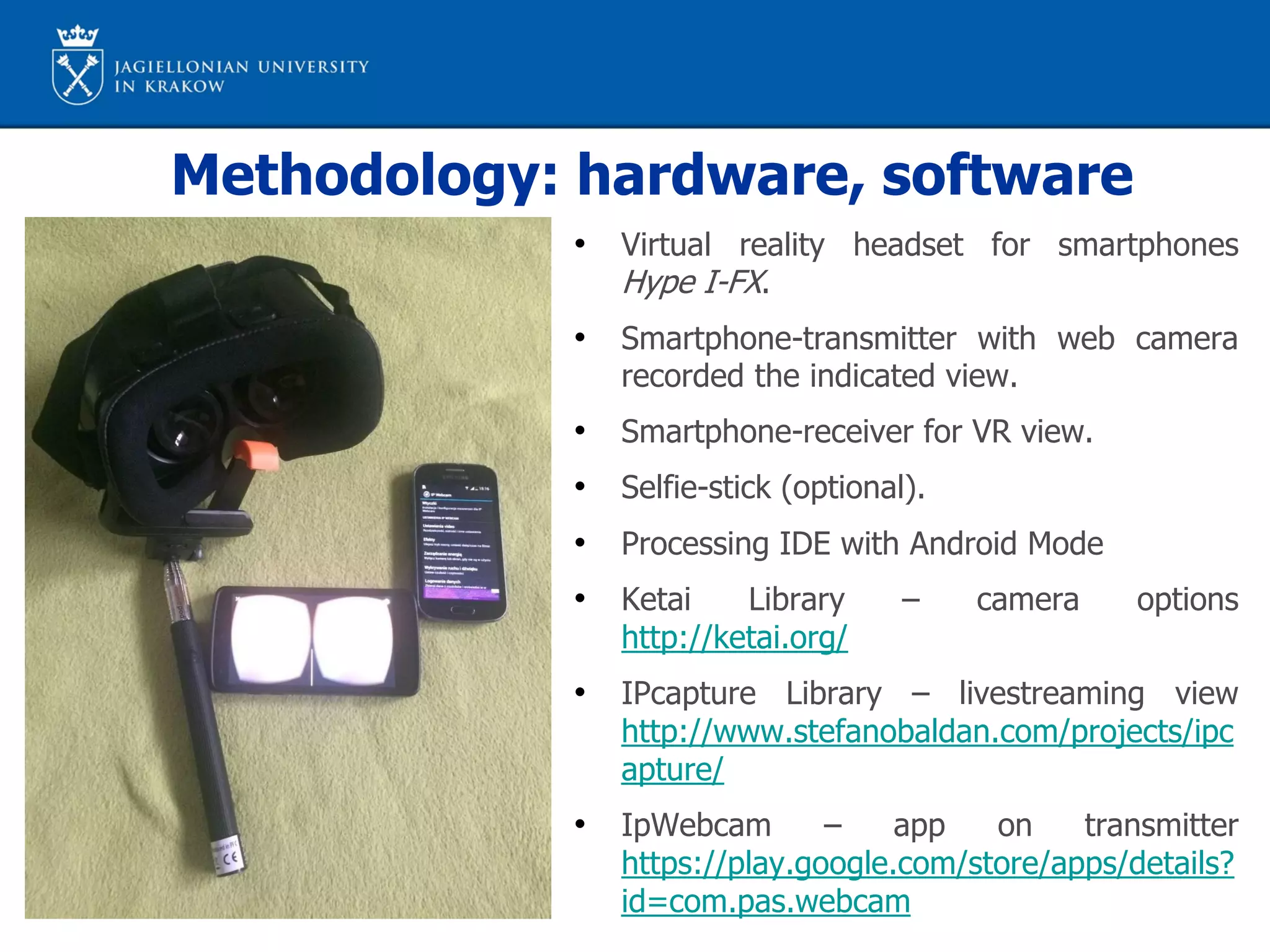
Methodology: hardware, software
• Virtual reality headset for smartphones
Hype I-FX.
• Smartphone-transmitter with web camera
recorded the indicated view.
• Smartphone-receiver for VR view.
• Selfie-stick (optional).
• Processing IDE with Android Mode
• Ketai Library – camera options
http://ketai.org/
• IPcapture Library – livestreaming view
http://www.stefanobaldan.com/projects/ipc
apture/
• IpWebcam – app on transmitter
https://play.google.com/store/apps/details?
id=com.pas.webcam
Sense of own body procedure
https://www.youtube.com/watch?v=Z1w-cV9Otb8
Or look below, slide 40
Double view procedure
https://www.youtube.com/watch?v=C4zms0gOJ_I
Or look below, slide 41
Quantitative and qualitative
enhancement
• Quantitative enhancement refers to the situation where the user gets
more information with the use of technology. For example, an AR system
for recognizing faces can directly and automatically read and analyze
information from the human faces and give a relevant output to the user.
In this case virtual markers augment the natural human view; the
cognition is enhanced by giving new information.
• Qualitative enhancement refers to the situation where the user gets a
new modality beyond the natural cognitive limits. Enhancement is giving
a new stimulus, by creating a new environment, and new perspectives
that are not possible with the natural senses. This type of enhancement
changes our normal perception, changes (enhance) our body sense, or
changes the motoric behaviors, by giving new quality to many of our
experiences.
Gunia, A., & Indurkhya, B. (2017). A Prototype to Study Cognitive and Aesthetic
Aspects of Mixed Reality Technologies. In Cybernetics (CYBCONF), 2017 3rd IEEE
International Conference on (pp. 1-6). IEEE.
Conclusion
• Designing of new technologies requires an
interdisciplinary approach, along with an insightful
analysis from the perspectives of social science and
humanities.
• The affective and motoric impact of mixed realities is
strong, which can be deployed for therapy, especially
disorders of body perception (anorexia, obesity, phantom
limbs, Cotard syndrome, etc.).
• If the mixed realities impact on human body or on sense
of aesthetics the applications in some situation should
show a relevant message or drop its functionality.
Bibliography
• Gunia, A. „Wzmocnienie poznawcze w kontekście transhumanistycznym. Teoria, praktyka oraz
konsekwencje wpływu technologii kognitywnych na człowieka” (thesis).
• Gunia, A., & Indurkhya, B. (2017, June). A Prototype to Study Cognitive and Aesthetic Aspects of Mixed
Reality Technologies. In Cybernetics (CYBCONF), 2017 3rd IEEE International Conference on (pp. 1-6).
IEEE.
• Kutt, K., Gunia, A., & Nalepa, G. J. (2015, June). Cognitive enhancement: How to increase chance of
survival in the jungle?. In Cybernetics (CYBCONF), 2015 IEEE 2nd International Conference on (pp.
293-298). IEEE.
• Gunia, A. (2017). Wzmocnienie zmysłu estetycznego przy wykorzystaniu technologii kognitywnych.
Medialica. Studia Multimedialne z Humanistyki, (1). https://www.youtube.com/watch?v=zXTUYXU1dKY
• Sandberg, A., & Bostrom, N. (2006). Converging cognitive enhancements. Annals of the New York
Academy of Sciences, 1093(1), 201-227.
• Shannon, C. E. (1949). A mathematical theory of communication. Bell system technical journal, 27(3),
379-423.
• Gallagher, S. (2000). Phenomenological and experimental research on embodied experience. Atelier
phénoménologie et cognition, Phenomenology and Cognition Research Group, CREA, Paris.
• Shapira, S. “The Aftermath,” YOLOCAUST. [Online]. Available: https://yolocaust.de/
• Kreibig, S. D. (2010). Autonomic nervous system activity in emotion: A review. Biological psychology,
84(3), 394-421.
• Picard, R. W. (1995). Affective computing.
Thank you for your attention ☺
Artur Gunia, Bipin Indurkhya
Institute of Philosophy, Jagiellonian University
Ul. Grodzka 52, 31-044 Kraków, Poland
Email: artur.gunia@uj.edu.pl
18.04.2018 Lecture at the Department of Computer Science, AGH, Kraków

Cognitive technologies

  • 1.
    Cognitive Technologies Artur Gunia,Bipin Indurkhya Institute of Philosophy, Jagiellonian University Ul. Grodzka 52, 31-044 Kraków, Poland Email: artur.gunia@uj.edu.pl 18.04.2018 Lecture at the Department of Computer Science, AGH, Kraków
  • 2.
  • 3.
    Motivation • IT wasdeveloped for delegating human mental abilities to machines. But technology can also improve our own mental powers.
  • 4.
    Research objectives: Toshow that • Mixed reality technologies are tools for cognitive enhancement. • Even simple mixed reality solution can enhance such subtle mental states as the sense of one’s own body and the sense of aesthetics. • The enhancement features of technologies strongly impact on lifestyle and everyday events.
  • 5.
    Background: transhumanism More, M.(1990). Transhumanism: towards a futurist philosophy. Extropy, 6, 6-12. https://humanityplus.org/philosophy/transhumanist-faq/ Transhumanism is a class of philosophies of life that seek the continuation and acceleration of the evolution of intelligent life beyond its currently human form and human limitations by means of science and technology, guided by life-promoting principles and values. http://filozofuj.eu/filozofuj-2017-nr-6-18/
  • 6.
    Background: cognitive enhancement Cognitiveenhancement is the amplification or extension of the core mental capacities through improvement or augmentation of internal or external information processing systems. Methods: • Neuropharmacology • Genetics • Natural optimization of the basic physiological processes • Prevention from pathological factors • Informatics A. Sandberg and N. Bostrom, “Converging Cognitive Enhancements,” Annals of the New York Academy of Sciences, vol. 1093, no. 1, pp. 201–227, Jan. 2006. K. Kutt, A. Gunia, and G. J. Nalepa, “Cognitive enhancement: How to increase chance of survival in the jungle?,” 2015 IEEE 2nd International Conference on Cybernetics (CYBCONF), 2015.
  • 7.
    Informatics ● Support perceptionby condensation of large sets of data ○ Data mining systems with visualization functions for abstracting large data sets. ● Support reasoning, imagination and decision making. ● Expand the scope of perception ○ Augmented reality systems connecting the real world with virtual beings in three dimensions and in real time. ○ Simulate haptic and other sensory modalities. ○ Allow alternative modes of perception. ● Use of brain-computer interface in communication Examples: Decision support systems, multiagent systems, context-aware systems, multi-modal interfaces, augmented reality glasses, head-mounted display, brain-computer interfaces, neuroprosthetics.
  • 8.
    Cognitive powers Cognitive powersare holistic mental and biological processes through which we get to know/ cognize / recognize the outside world and internal conscious states. A. Gunia. „Wzmocnienie poznawcze w kontekście transhumanistycznym. Teoria, praktyka oraz konsekwencje wpływu technologii kognitywnych na człowieka” (thesis).
  • 9.
    Cognitive powers A. Gunia.„Wzmocnienie poznawcze w kontekście transhumanistycznym. Teoria, praktyka oraz konsekwencje wpływu technologii kognitywnych na człowieka” (thesis).
  • 10.
    Methodology: Cognitive technologies ●Technologies that actively affect human cognitive processes and daily activities. ● Can change the body schema and body image. ● Are emotionally effective. ● Relate with immersion and cyborgization. Features: • Modulating and optimizing human behavior (self-tracking). • Creating immersive and augmented environments to affect or change human perception (virtual, mixed, augmented realities). • Creating intelligent and automated environments (ambient intelligence systems). • Technology implantation inside human body (cyborgization).
  • 11.
    Cognitive enhancement viacognitive technologies • Motivational enhancement • Informational enhancement • Aesthetic enhancement • Affective enhancement • Perceptual enhancement • Quantitative and qualitative enhancement A. Gunia. „Wzmocnienie poznawcze w kontekście transhumanistycznym. Teoria, praktyka oraz konsekwencje wpływu technologii kognitywnych na człowieka” (thesis).
  • 12.
    Motivational enhancement • Motivationis the reason for people's actions, desires, and needs. • Motivation is the reason for engaging in a behavior, or what causes a person to repeat a behavior. • An individual is not motivated by another individual. Motivation comes from within the individual. • It is a system of perceptions, emotional attitudes, and beliefs pertaining to one's own body.
  • 13.
    Motivational enhancement • Tosupport self-motivation ○ Focusing on the goal of motivating oneself to realize the goals set for oneself. • To allow better recognition of needs. • To optimize and control capabilities to meet the needs. • To stimulate and supplement cognitive processes and emotional feelings for better performance of motivated tasks.
  • 14.
    Technologies of motivational enhancement Self-tracking:sport tracker (Endomondo), diet tracker (MyFitnessPal ). Badges system in TripAdvisor.
  • 15.
    Informational enhancement • Informationprocessing is the change (processing) of information in any manner detectable by an observer. • Information enhancement is providing signals where content relevant to current events relating to the user is included in real time. • Provides information that is beneficial, but which cannot be obtained from natural, biological cognitive apparatus. • Supports in the processing of multimodal information, and reducing information noise.
  • 16.
    Informational process model External signal Internal signal (self) Signal recognition Signal clustering information inworking memory processing information supplementing information coding information information storage information transfer use of information
  • 17.
    Enhanced information processingmodel External signal Internal signal (self) Signal recognition Signal clustering information in working memory processing information supplementing information coding information information storage information transfer use of information providing new signals providing adequate messages Aesthetic, affective enhancement decoding of signals amplification of signals reduction of irrelevant signals External storage media automatic information processing warehouses past experience decision support system Semantic web
  • 18.
  • 19.
    Processing IDE Tools Processingis an open-source computer programming language and integrated development environment (IDE) built for the electronic art, new media art, and visual design communities for teaching non- programmers the fundamentals of computer programming in a visual context. The processing language builds on the Java language, but uses a simplified syntax and a graphics user interface. https://processing.org/ exhibition/
  • 20.
  • 21.
  • 22.
  • 23.
    Extended information withaugmented reality https://www.youtube.com/watch?v=9PMMPTMtiOc Or look below, slide 23
  • 24.
    Extended information withaugmented reality TOOLS • Processing https://processing.org/downlo ad/ • Video for Processing library https://processing.org/referen ce/libraries/video/index.html • Minim library – playing sounds http://code.compartmental.net /minim/ • ARToolkit library – recognize AR patterns https://nyatla.jp/nyartoolkit/wp/ ?page_id=357 • Web Cam
  • 25.
    Extended information withaugmented reality - syntax
  • 26.
    Automatic information processing: objectrecognition OpenCV for Processing library - OpenCV (Open Source Computer Vision) is a library of programming functions aimed at real-time computer vision. The library is cross-platform and free for use under the open-source BSD license. https://github.com/atduskgreg/opencv-processing
  • 27.
    Automatic information processing:Face recognition TOOLS: • OpenCV library • Microsoft Azure Face API https://azure.microsoft.com/pl -pl/services/cognitive- services/face/
  • 28.
    Timeline in Snapchat, Google Maps, Facebook Repositoryof past experience Possible solutions: • AR glasses • Camera • Microphone • Cloud • Network • Eye-tracking or voice communication system
  • 29.
    Aesthetic enhancement • Aestheticsis a field of philosophy that explores the nature of art, beauty, and taste. • Sense of aesthetics is a function of perception, which distinguishes beauty from ugliness, or good taste form bad taste. • Aesthetic enhancement is the ability to influence technology on the mood, sense of aesthetic, and positive emotions.
  • 30.
    Aesthetic enhancement Perception ofan object without aesthetic value Perception of an object with aesthetic value Aesthetic enhanced perception. Now the object without aesthetic value has a new look
  • 31.
  • 32.
  • 33.
    Aesthetic enhancement: Problems YOLOCAUSTProject https://yolocaust.de/
  • 34.
    Emotion • Emotion isany conscious experience characterized by intense mental activity and a certain degree of pleasure or displeasure. • Autonomic nervous system (ANS) activity is viewed as a major component of the emotion response in many recent theories of emotion. Positions on the degree of specificity of ANS activation in emotion, however, greatly diverge, ranging from undifferentiated arousal, over acknowledgment of strong response idiosyncrasies, to highly specific predictions of autonomic response patterns for certain emotions. • Kreibig, S. D. (2010). Autonomic nervous system activity in emotion: A review. Biological psychology, 84(3), 394-421.
  • 35.
    Affective enhancement andaffective computing • Affective enhancement is stimulating positive emotions and reduction of negative emotion. • Affective computing is computing that relates to, arises from, or deliberately influences emotion or other affective phenomena 1. Designing new ways for people to communicate affective-cognitive states, especially through creation of novel wearable sensors and new machine learning algorithms that jointly analyze multimodal channels of information; 2. Creating new techniques to assess frustration, stress, and mood indirectly, through natural interaction and conversation; 3. Showing how computers can be more emotionally intelligent, especially responding to a person's frustration in a way that reduces negative feelings; 4. Inventing personal technologies for improving self-awareness of affective state and its selective communication to others; 5. Increasing understanding of how affect influences personal health Picard, R. W. (1995). Affective computing.
  • 36.
    Perception • Perception isthe organization, identification, and interpretation of sensory information in order to represent and understand the presented information, or the environment. • Visual perception is the ability to interpret the surrounding environment using light in the visible spectrum reflected by the objects in the environment. • Examples of the possibilities of visual perception: • Seeing the visible light in the wavelength range from 400 to 700 nm • Fields of view, the area that is seen by the unmoved eye or unmoved head, vertically from 10 to 15 degrees (without eyeballs), 30 degrees (moving the eyeballs, but not the head). Horizontally with fixed head to 114 degrees. • Flicker fusion frequency number of images that we can see in one second: 50-70 Hz in daily vision, 3-5 Hz in night vision.
  • 37.
    Perceptual enhancement • Expanding,enhancing the spectrum of physical capabilities of perception.
  • 39.
    Methodology: hardware, software •Virtual reality headset for smartphones Hype I-FX. • Smartphone-transmitter with web camera recorded the indicated view. • Smartphone-receiver for VR view. • Selfie-stick (optional). • Processing IDE with Android Mode • Ketai Library – camera options http://ketai.org/ • IPcapture Library – livestreaming view http://www.stefanobaldan.com/projects/ipc apture/ • IpWebcam – app on transmitter https://play.google.com/store/apps/details? id=com.pas.webcam
  • 40.
    Sense of ownbody procedure https://www.youtube.com/watch?v=Z1w-cV9Otb8 Or look below, slide 40
  • 41.
  • 42.
    Quantitative and qualitative enhancement •Quantitative enhancement refers to the situation where the user gets more information with the use of technology. For example, an AR system for recognizing faces can directly and automatically read and analyze information from the human faces and give a relevant output to the user. In this case virtual markers augment the natural human view; the cognition is enhanced by giving new information. • Qualitative enhancement refers to the situation where the user gets a new modality beyond the natural cognitive limits. Enhancement is giving a new stimulus, by creating a new environment, and new perspectives that are not possible with the natural senses. This type of enhancement changes our normal perception, changes (enhance) our body sense, or changes the motoric behaviors, by giving new quality to many of our experiences. Gunia, A., & Indurkhya, B. (2017). A Prototype to Study Cognitive and Aesthetic Aspects of Mixed Reality Technologies. In Cybernetics (CYBCONF), 2017 3rd IEEE International Conference on (pp. 1-6). IEEE.
  • 43.
    Conclusion • Designing ofnew technologies requires an interdisciplinary approach, along with an insightful analysis from the perspectives of social science and humanities. • The affective and motoric impact of mixed realities is strong, which can be deployed for therapy, especially disorders of body perception (anorexia, obesity, phantom limbs, Cotard syndrome, etc.). • If the mixed realities impact on human body or on sense of aesthetics the applications in some situation should show a relevant message or drop its functionality.
  • 44.
    Bibliography • Gunia, A.„Wzmocnienie poznawcze w kontekście transhumanistycznym. Teoria, praktyka oraz konsekwencje wpływu technologii kognitywnych na człowieka” (thesis). • Gunia, A., & Indurkhya, B. (2017, June). A Prototype to Study Cognitive and Aesthetic Aspects of Mixed Reality Technologies. In Cybernetics (CYBCONF), 2017 3rd IEEE International Conference on (pp. 1-6). IEEE. • Kutt, K., Gunia, A., & Nalepa, G. J. (2015, June). Cognitive enhancement: How to increase chance of survival in the jungle?. In Cybernetics (CYBCONF), 2015 IEEE 2nd International Conference on (pp. 293-298). IEEE. • Gunia, A. (2017). Wzmocnienie zmysłu estetycznego przy wykorzystaniu technologii kognitywnych. Medialica. Studia Multimedialne z Humanistyki, (1). https://www.youtube.com/watch?v=zXTUYXU1dKY • Sandberg, A., & Bostrom, N. (2006). Converging cognitive enhancements. Annals of the New York Academy of Sciences, 1093(1), 201-227. • Shannon, C. E. (1949). A mathematical theory of communication. Bell system technical journal, 27(3), 379-423. • Gallagher, S. (2000). Phenomenological and experimental research on embodied experience. Atelier phénoménologie et cognition, Phenomenology and Cognition Research Group, CREA, Paris. • Shapira, S. “The Aftermath,” YOLOCAUST. [Online]. Available: https://yolocaust.de/ • Kreibig, S. D. (2010). Autonomic nervous system activity in emotion: A review. Biological psychology, 84(3), 394-421. • Picard, R. W. (1995). Affective computing.
  • 45.
    Thank you foryour attention ☺ Artur Gunia, Bipin Indurkhya Institute of Philosophy, Jagiellonian University Ul. Grodzka 52, 31-044 Kraków, Poland Email: artur.gunia@uj.edu.pl 18.04.2018 Lecture at the Department of Computer Science, AGH, Kraków