COGNITIVE
COMPUTING
Rupshanker Mishra
Roll No. 214212
B.Tech CSE 6th sem.
WHAT IS COGNITION..?
COGNITION
Cognition is "the mental action or process of acquiring
knowledge and understanding through thought,experience,and
the senses”.
Cognitive processes use existing knowledge and generate new
knowledge.
Technologies – natural language processing, machine learning
In order to achieve this new level of
computing, cognitive systems must be
1. Adaptive
2. Interactive
3. Iterative and stateful
4. Contextual
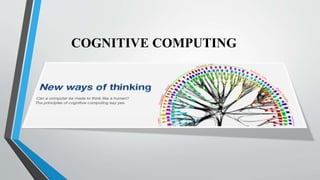
COGNITIVE COMPUTING
COGNITIVE COMPUTING
 Mimicking the function of a human brain and handling
human kind of problems.
 Combination of technologies to understand human
interaction and provide answers.
 Cognitive computing systems use machine learning
algorithms.
 Such systems continually acquire knowledge from the
data.
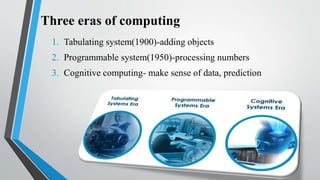
Three eras of computing
1. Tabulating system(1900)-adding objects
2. Programmable system(1950)-processing numbers
3. Cognitive computing- make sense of data, prediction
WHEN COMPUTER BECOMES BRAINS
 The human brain integrates memory and processing together
 It reacts to things in its environment
 But a computer has separate memory and processing.
 It does its work by a clock.
WATSON
 Super computer developed by IBM Research
 Named for IBM’s founder –Thomas J Watson
 Research team led by Principal Investigator
Dr. David Ferrucci.
 Programmed by 25 IBM scientists
 Not connected to Internet
• Watson is an artificial intelligent computer system
• Capable of answering questions posed in natural languages
• Able to build knowledge and learn ,understand natural
language and interact more naturally with human beings
• More than hundred techniques are used to analyse natural
language
WATSON
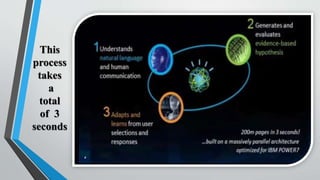
This
process
takes
a
total
of 3
seconds
GOAL OF WATSON
According to IBM, "The goal is to have computers start to
interact in natural human terms across a range of applications and
processes, understanding the questions that humans ask and
providing answers that humans can understand and justify.“
The goal of cognitive computing is to create automated IT
systems that are capable of solving problems without requiring
human assistance.
APPLICATIONS
•HEALTHCARE
The Data Explosion-Medical data are expected to double every 73
days by 2020.
The Great Unknown-80% of health data are invisible to current
systems because they are unstructured. Watson Health can see them.
A Quick Study-Watson can read 40 million documents in 15
seconds.
• Cognitive Computing is making agriculture more productive.
• Cognitive Computing is making cars smarter.
• Cognitive Computing is making our homes and offices more
secure, as well as our borders.
FUTURE ASPECTS
Augmented Virtual Reality
Sentient Systems
Specialized Deep Learning on Big Data sets
Generalized Artificial Intelligence systems
CONCLUSION
 Cognitive computing has been characterized as a set of
autonomous and perceptive knowledge processing theories and
technologies mimicking the mechanisms of the brain beyond
conventional imperative data processing
Cognitive Technology

Cognitive Technology

  • 1.
  • 2.
  • 3.
    COGNITION Cognition is "themental action or process of acquiring knowledge and understanding through thought,experience,and the senses”. Cognitive processes use existing knowledge and generate new knowledge. Technologies – natural language processing, machine learning
  • 4.
    In order toachieve this new level of computing, cognitive systems must be 1. Adaptive 2. Interactive 3. Iterative and stateful 4. Contextual
  • 5.
  • 6.
    COGNITIVE COMPUTING  Mimickingthe function of a human brain and handling human kind of problems.  Combination of technologies to understand human interaction and provide answers.  Cognitive computing systems use machine learning algorithms.  Such systems continually acquire knowledge from the data.
  • 7.
    Three eras ofcomputing 1. Tabulating system(1900)-adding objects 2. Programmable system(1950)-processing numbers 3. Cognitive computing- make sense of data, prediction
  • 8.
    WHEN COMPUTER BECOMESBRAINS  The human brain integrates memory and processing together  It reacts to things in its environment  But a computer has separate memory and processing.  It does its work by a clock.
  • 9.
    WATSON  Super computerdeveloped by IBM Research  Named for IBM’s founder –Thomas J Watson  Research team led by Principal Investigator Dr. David Ferrucci.  Programmed by 25 IBM scientists  Not connected to Internet
  • 10.
    • Watson isan artificial intelligent computer system • Capable of answering questions posed in natural languages • Able to build knowledge and learn ,understand natural language and interact more naturally with human beings • More than hundred techniques are used to analyse natural language WATSON
  • 11.
  • 12.
    GOAL OF WATSON Accordingto IBM, "The goal is to have computers start to interact in natural human terms across a range of applications and processes, understanding the questions that humans ask and providing answers that humans can understand and justify.“ The goal of cognitive computing is to create automated IT systems that are capable of solving problems without requiring human assistance.
  • 13.
    APPLICATIONS •HEALTHCARE The Data Explosion-Medicaldata are expected to double every 73 days by 2020. The Great Unknown-80% of health data are invisible to current systems because they are unstructured. Watson Health can see them. A Quick Study-Watson can read 40 million documents in 15 seconds.
  • 14.
    • Cognitive Computingis making agriculture more productive. • Cognitive Computing is making cars smarter. • Cognitive Computing is making our homes and offices more secure, as well as our borders.
  • 15.
    FUTURE ASPECTS Augmented VirtualReality Sentient Systems Specialized Deep Learning on Big Data sets Generalized Artificial Intelligence systems
  • 16.
    CONCLUSION  Cognitive computinghas been characterized as a set of autonomous and perceptive knowledge processing theories and technologies mimicking the mechanisms of the brain beyond conventional imperative data processing