Mind upgrade Information technologies, methods and practices  for mind enhancement Danila Medvedev, General Director, KrioRus Russian Transhumanist Movement www.kriorus.ru, www.transhumanism-russia.ru

Structure of the talk Problem Solution Tools Vision
Defining the problem A: limitations of today B: limitless future How do we get from A to B? Thinking as software What is “IA”?
Solution strategy Approaches to IA Methods of IA Proposed general strategy
Tools Thinking like a genius Being an efficient  informavore Mapping your mind Getting things done Upgrading others forcefully Gadgets This is your brain on drugs
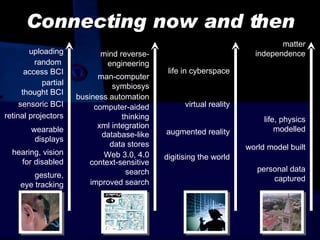
Vision The shape of things to come Estimated Time of Arrival Connecting now and then
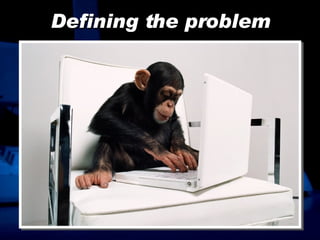
Defining the problem
A: limitations of today Brain is a system evolved for certain environment and tasks It is not a universal Turing machine, it has weaknesses, limitations, biases and bugs All “human errors” are caused by our limitations But we don’t even understand the limitations
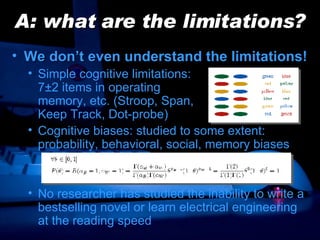
A: what are the limitations? We don’t even understand the limitations! Simple cognitive limitations:  7 ±2  items in operating  memory, etc. (Stroop, Span,  Keep Track, Dot-probe) Cognitive biases: studied to some extent: probability, behavioral, social, memory biases No researcher has studied the inability to write a bestselling novel or learn electrical engineering at the reading speed
B: limitless future Likely (almost certain) prospects: Merging with the AI Superintelligence Recursive self-improvement Technological Singularity
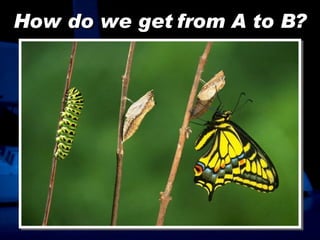
How do we get from A to B?
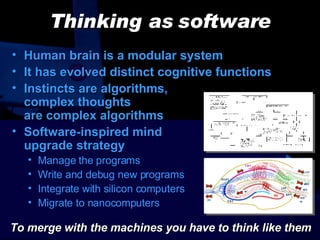
Thinking as software Human brain is a modular system It has evolved distinct cognitive functions Instincts are algorithms,  complex thoughts  are complex algorithms Software-inspired mind  upgrade strategy Manage the programs Write and debug new programs Integrate with silicon computers Migrate to nanocomputers To merge with the machines you have to think like them
What is “IA”? Intelligence amplification* (IA) refers to the effective use of information technology in augmenting human intelligence. The theory was developed in the 1950s and 1960s by cybernetics and early computer pioneers. *  AKA “cognitive augmentation” and “machine augmented intelligence”
IA history Speculation  on “amplifying intelligence“:  Introduction to Cybernetics , 1956 Idea   of  Man-Computer Symbiosis , 1960 Vision  of  Augmenting Human Intellect: A Conceptual Framework, 1962 Partial realisation  by all of us, 1960s-now
Strategy Personal approaches, existing methods, proposed strategy
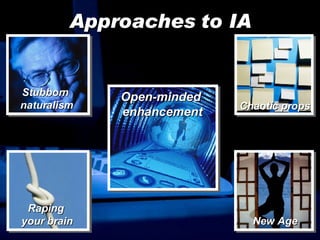
Approaches to IA Stubborn  naturalism Raping  your brain Chaotic props New Age Open-minded  enhancement
Methods of IA Wetware-based Mnemonic techniques – inefficient Nootropics – just emerging Software-based Patterns and strategies ICT tools (and paper tools), such as mindmaps Hardware-based Devices (neurofeedback, brainwaves, etc.) – too crude Implants – not here yet
Proposed general strategy Capture everything Use GTD methodology to track commitments Use Lion Kimbro’s method to track thoughts Manage life, projects, tasks Have a good  reference  system Use an effective process record ideas collect and develop information turn them into projects realise them Use creativity techniques Organisational system Keep track and stay in control
Tools Thinking well, processing information, mapping your mind, working with others, using gadgets and nootropics
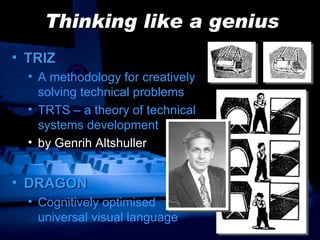
Thinking like a genius TRIZ A methodology for creatively  solving technical problems TRTS – a theory of technical  systems development by Genrih Altshuller DRAGON Cognitively optimised  universal visual language
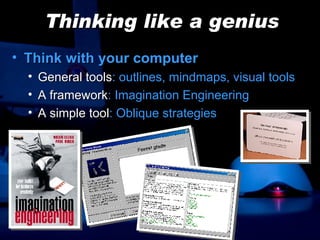
Thinking like a genius Think with your computer General tools : outlines, mindmaps, visual tools A framework : Imagination Engineering A simple tool : Oblique strategies
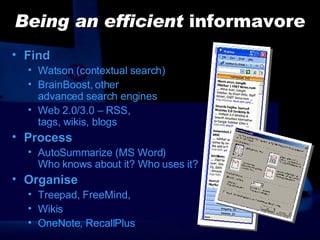
Being an efficient  informavore Find Watson (contextual search) BrainBoost, other  advanced search engines Web 2.0/3.0 – RSS,  tags, wikis, blogs Process AutoSummarize (MS Word)  Who knows about it? Who uses it? Organise Treepad, FreeMind,  Wikis OneNote, RecallPlus
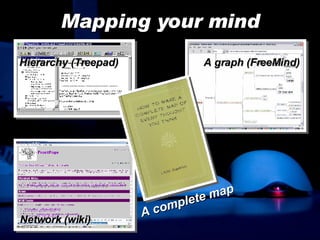
Mapping your mind Hierarchy (Treepad) A graph (FreeMind) Network (wiki) A complete map
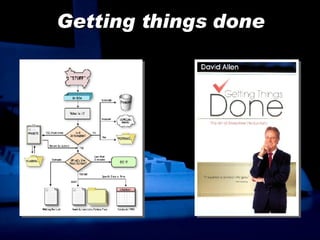
Getting things done
Upgrading others forcefully Collaboration wiki real-time editing calendar tools Web Semantic web and info agents: Once machines can understand and use information in a standard way, the world will never be the same. New tools Not just to a tide of information  but also of new tools for managing information
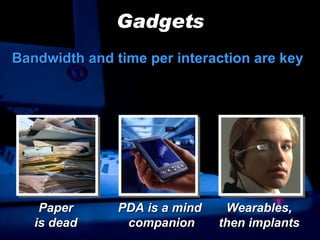
Gadgets Bandwidth and time per interaction are key PDA is a mind  companion Wearables, then implants Paper is dead
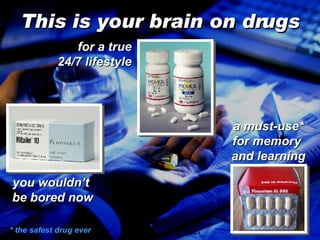
This is your brain on drugs * the safest drug ever you wouldn’t  be bored now a must-use* for memory  and learning for a true 24/7 lifestyle
Vision Today, the shape of things to come, ETA, connecting now and then
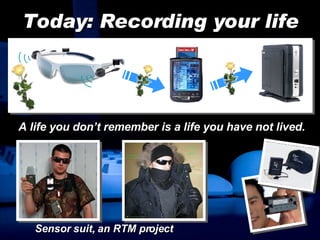
Today: Recording your life A life you don’t remember is a life you have not lived. Sensor suit, an RTM project
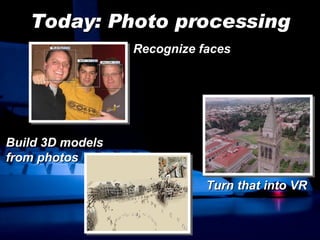
Today: Photo processing Recognize faces Turn that into VR Build 3D models from photos
Today: Virtual Reality
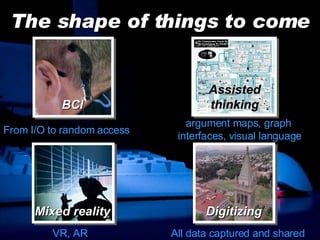
The shape of things to come Mixed reality BCI Assisted thinking Digitizing From I/O to random access argument maps, graph  interfaces, visual language All data captured and shared VR, AR
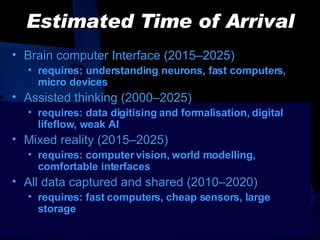
Estimated Time of Arrival Brain computer Interface (2015–2025) requires: understanding neurons, fast computers, micro devices Assisted thinking (2000–2025) requires: data digitising and formalisation, digital lifeflow, weak AI Mixed reality (2015–2025) requires: computer vision, world modelling, comfortable interfaces All data captured and shared (2010–2020) requires: fast computers, cheap sensors, large storage
Connecting now and then gesture, eye tracking hearing, vision for disabled wearable displays retinal projectors sensoric BCI partial thought BCI random  access BCI uploading improved search context-sensitive search database-like data stores xml integration computer-aided thinking business automation man-computer symbiosys mind reverse- engineering augmented reality virtual reality digitising the world life in cyberspace world model built personal data captured life, physics modelled matter independence Web 3.0, 4.0
Let’s review What do you remember from this presentation?
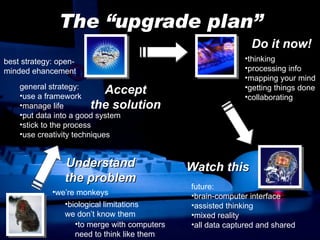
The “upgrade plan” we’re monkeys biological limitations we don’t know them to merge with computers need to think like them best strategy: open- minded ehancement general strategy: use a framework manage life put data into a good system stick to the process use creativity techniques thinking processing info mapping your mind getting things done collaborating future: brain-computer interface assisted thinking mixed reality all data captured and shared Do it now! Watch this Accept the solution Understand the problem
Review this presentation* http://danila.spb.ru This very presentation (ppt + wikified) Detailed notes Links to additional information * when I get home
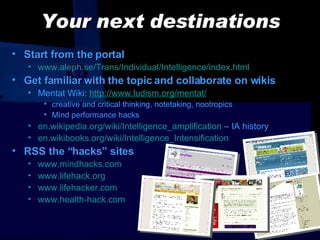
Your next destinations Start from the portal www.aleph.se/Trans/Individual/Intelligence/index.html Get familiar with the topic and collaborate on wikis Mentat Wiki :  http://www.ludism.org/mentat/ creative and critical thinking, notetaking, nootropics Mind performance hacks en.wikipedia.org/wiki/Intelligence_amplification  – IA history en.wikibooks.org/wiki/Intelligence_Intensification RSS the “ hacks ”   sites www.mindhacks.com www.lifehack.org www.lifehacker.com www. health-hack.com


Information Technologies, Methods and Practices for Mind Enhancement

  • 1.
    Mind upgrade Informationtechnologies, methods and practices for mind enhancement Danila Medvedev, General Director, KrioRus Russian Transhumanist Movement www.kriorus.ru, www.transhumanism-russia.ru
  • 2.
    Structure of thetalk Problem Solution Tools Vision
  • 3.
    Defining the problemA: limitations of today B: limitless future How do we get from A to B? Thinking as software What is “IA”?
  • 4.
    Solution strategy Approachesto IA Methods of IA Proposed general strategy
  • 5.
    Tools Thinking likea genius Being an efficient informavore Mapping your mind Getting things done Upgrading others forcefully Gadgets This is your brain on drugs
  • 6.
    Vision The shapeof things to come Estimated Time of Arrival Connecting now and then
  • 7.
  • 8.
    A: limitations oftoday Brain is a system evolved for certain environment and tasks It is not a universal Turing machine, it has weaknesses, limitations, biases and bugs All “human errors” are caused by our limitations But we don’t even understand the limitations
  • 9.
    A: what arethe limitations? We don’t even understand the limitations! Simple cognitive limitations: 7 ±2 items in operating memory, etc. (Stroop, Span, Keep Track, Dot-probe) Cognitive biases: studied to some extent: probability, behavioral, social, memory biases No researcher has studied the inability to write a bestselling novel or learn electrical engineering at the reading speed
  • 10.
    B: limitless futureLikely (almost certain) prospects: Merging with the AI Superintelligence Recursive self-improvement Technological Singularity
  • 11.
    How do weget from A to B?
  • 12.
    Thinking as softwareHuman brain is a modular system It has evolved distinct cognitive functions Instincts are algorithms, complex thoughts are complex algorithms Software-inspired mind upgrade strategy Manage the programs Write and debug new programs Integrate with silicon computers Migrate to nanocomputers To merge with the machines you have to think like them
  • 13.
    What is “IA”?Intelligence amplification* (IA) refers to the effective use of information technology in augmenting human intelligence. The theory was developed in the 1950s and 1960s by cybernetics and early computer pioneers. * AKA “cognitive augmentation” and “machine augmented intelligence”
  • 14.
    IA history Speculation on “amplifying intelligence“: Introduction to Cybernetics , 1956 Idea of Man-Computer Symbiosis , 1960 Vision of Augmenting Human Intellect: A Conceptual Framework, 1962 Partial realisation by all of us, 1960s-now
  • 15.
    Strategy Personal approaches,existing methods, proposed strategy
  • 16.
    Approaches to IAStubborn naturalism Raping your brain Chaotic props New Age Open-minded enhancement
  • 17.
    Methods of IAWetware-based Mnemonic techniques – inefficient Nootropics – just emerging Software-based Patterns and strategies ICT tools (and paper tools), such as mindmaps Hardware-based Devices (neurofeedback, brainwaves, etc.) – too crude Implants – not here yet
  • 18.
    Proposed general strategyCapture everything Use GTD methodology to track commitments Use Lion Kimbro’s method to track thoughts Manage life, projects, tasks Have a good reference system Use an effective process record ideas collect and develop information turn them into projects realise them Use creativity techniques Organisational system Keep track and stay in control
  • 19.
    Tools Thinking well,processing information, mapping your mind, working with others, using gadgets and nootropics
  • 20.
    Thinking like agenius TRIZ A methodology for creatively solving technical problems TRTS – a theory of technical systems development by Genrih Altshuller DRAGON Cognitively optimised universal visual language
  • 21.
    Thinking like agenius Think with your computer General tools : outlines, mindmaps, visual tools A framework : Imagination Engineering A simple tool : Oblique strategies
  • 22.
    Being an efficient informavore Find Watson (contextual search) BrainBoost, other advanced search engines Web 2.0/3.0 – RSS, tags, wikis, blogs Process AutoSummarize (MS Word) Who knows about it? Who uses it? Organise Treepad, FreeMind, Wikis OneNote, RecallPlus
  • 23.
    Mapping your mindHierarchy (Treepad) A graph (FreeMind) Network (wiki) A complete map
  • 24.
  • 25.
    Upgrading others forcefullyCollaboration wiki real-time editing calendar tools Web Semantic web and info agents: Once machines can understand and use information in a standard way, the world will never be the same. New tools Not just to a tide of information but also of new tools for managing information
  • 26.
    Gadgets Bandwidth andtime per interaction are key PDA is a mind companion Wearables, then implants Paper is dead
  • 27.
    This is yourbrain on drugs * the safest drug ever you wouldn’t be bored now a must-use* for memory and learning for a true 24/7 lifestyle
  • 28.
    Vision Today, theshape of things to come, ETA, connecting now and then
  • 29.
    Today: Recording yourlife A life you don’t remember is a life you have not lived. Sensor suit, an RTM project
  • 30.
    Today: Photo processingRecognize faces Turn that into VR Build 3D models from photos
  • 31.
  • 32.
    The shape ofthings to come Mixed reality BCI Assisted thinking Digitizing From I/O to random access argument maps, graph interfaces, visual language All data captured and shared VR, AR
  • 33.
    Estimated Time ofArrival Brain computer Interface (2015–2025) requires: understanding neurons, fast computers, micro devices Assisted thinking (2000–2025) requires: data digitising and formalisation, digital lifeflow, weak AI Mixed reality (2015–2025) requires: computer vision, world modelling, comfortable interfaces All data captured and shared (2010–2020) requires: fast computers, cheap sensors, large storage
  • 34.
    Connecting now andthen gesture, eye tracking hearing, vision for disabled wearable displays retinal projectors sensoric BCI partial thought BCI random access BCI uploading improved search context-sensitive search database-like data stores xml integration computer-aided thinking business automation man-computer symbiosys mind reverse- engineering augmented reality virtual reality digitising the world life in cyberspace world model built personal data captured life, physics modelled matter independence Web 3.0, 4.0
  • 35.
    Let’s review Whatdo you remember from this presentation?
  • 36.
    The “upgrade plan”we’re monkeys biological limitations we don’t know them to merge with computers need to think like them best strategy: open- minded ehancement general strategy: use a framework manage life put data into a good system stick to the process use creativity techniques thinking processing info mapping your mind getting things done collaborating future: brain-computer interface assisted thinking mixed reality all data captured and shared Do it now! Watch this Accept the solution Understand the problem
  • 37.
    Review this presentation*http://danila.spb.ru This very presentation (ppt + wikified) Detailed notes Links to additional information * when I get home
  • 38.
    Your next destinationsStart from the portal www.aleph.se/Trans/Individual/Intelligence/index.html Get familiar with the topic and collaborate on wikis Mentat Wiki : http://www.ludism.org/mentat/ creative and critical thinking, notetaking, nootropics Mind performance hacks en.wikipedia.org/wiki/Intelligence_amplification – IA history en.wikibooks.org/wiki/Intelligence_Intensification RSS the “ hacks ” sites www.mindhacks.com www.lifehack.org www.lifehacker.com www. health-hack.com
  • 39.
  • 40.

Editor's Notes

  • #2 Objective(s) of the presentation: to describe existing possibilities for mind enhancement using ICT, to outline the expected development path for them, to encourage people to explore and use currently available technologies for mind enhancement. The historic role of the computer in mind enhancement (including intelligence amplification), Doug Engelbart's pre-PC vision, hopes for the computer use in education. Overview of the present situation (described using possible usage scenarios, not just listed) - best available tools to aid memory, use and share knowledge, improve decision making, etc. Some of the cutting-edge technologies currently in development. Outline of expected developments and the path to 2025-2030 (transhuman technologies - exocortex, uploading, etc.). Abstract (25-50 words) for inclusion in the conference program: In the future transhumansts foresee a merger between the human mind and AIs. This will be a gradual development, starting with existing information technologies. Possible paths from the present to expected transhuman future are outlined in the presentation.