APPROACHES IN IDENTIFYING
CHILDREN WITH DISABILITIES-
COGNITIVE APPROACH
D.KALAIVANI
UNESCO reports that 75% of children with disabilities
don't attend schools in India. To provide education to this
uncovered population, appropriate strategies need to be
adopted for locating them for early intervention services.
Early intervention would solve many of the problems of
the child later in life. While early identification is of
paramount importance in the life of every child, it is more
vital in the case of children with disabilities.
 INTRODUCTION
 As evident from the definitions of various disability
conditions, some persons experience difficulties in
cognitive functions, some in senses and some others
in their physical and bodily conditions. The common
approaches in identifying persons with disabilities are
as follows:
 (a) Cognitive approach
 (b) Sensory approach
 (c) Ability-based approach
 (d) Society-based approach
 Cognitive approach advocates that children with
disabilities could be easily identified by observing the
limitations in individual’s cognitive abilities like
receiving information from his environment,
processing, interpreting and reacting to it. These
cognitive abilities are related with once intelligence.
So it is possible to identify the disabled by measuring
intelligence level of the children and spotting those
who have significantly low level of intelligence.
 By adopting the cognitive approach, identification of
children may be made as those who are mentally
retarded, slow learners, normal learners, academically
advanced learners and gifted learners. This
identification is purely based on the cognitive
functions of the child.
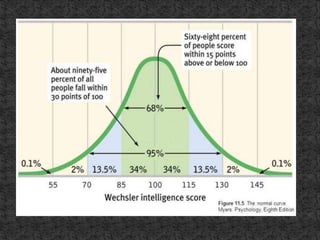
 Children with average intelligence have their IQ
ranging from 90-110.
 The child who has an IQ between 50 and 75 will come
under the category of educable mentally retarded
child.
 The trainable mentally retarded children have an IQ of 25
to 50 and they may find it difficult even to perform
manual kind of work.
 Those who have an IQ of less than 25 are called totally
dependent category.
 In developed countries, not only children with mental
retardation, but also children having slow learning skills
are also given special attention.
 The child who has an IQ between 70 and 90
will come under the category of slow learners
or backward children.
 These backward children by getting
appropriate training and education could lead
almost a normal life.
 Those who have IQ less than 50 are considered as
Mentally retarded . Their sensory abilities, social
adjustments , critical thinking etc., will be also at a
low level.
 For these children learning in normal class room will
not be of much use; providing special education for
them is essential.
 The supporters of cognitive approach argue that
as IQ remains more are less constant throughout
the life, it is appropriate to take it as a good
measure for identifying the disabled
 Two main forms of intelligence are involved in most
intelligence assessments:
 Verbal Intelligence is the ability to comprehend and
solve language-based problems.
 Nonverbal Intelligence is the ability to understand and
solve visual and spatial problems.
 They are also classified as individual tests and group
tests.
 There are two major types of intelligence test, those
administered to individuals and those administered to
groups.
 The two main individual intelligence tests are the
Stanford-Binet Intelligence Test and the Wechsler
tests, i.e. Wechsler Intelligence Test for Children
(WISC) and the Wechsler Adult Intelligence Scale
(WAIS) for adults. The individual intelligence tests
require one-on-one consultation
 Stanford-Binet test(1916) is a new version of Binet-
Simon test
 In the year 1905, two French Psychologist Binet
and Simon discover the Intelligence test.
 After that in 1916 it was modified by American
Psychologist Lewis Terman with Binet At Stanford
University for current use of Intelligent
assessment.
 Afterwards, it is known as Stanford-Binet
Intelligence Test
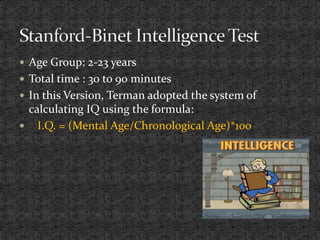
 Age Group: 2-23 years
 Total time : 30 to 90 minutes
 In this Version, Terman adopted the system of
calculating IQ using the formula:
 I.Q. = (Mental Age/Chronological Age)*100
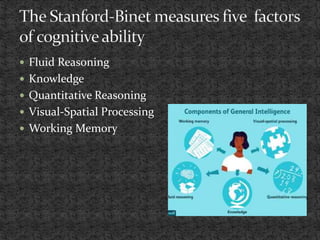
 Fluid Reasoning
 Knowledge
 Quantitative Reasoning
 Visual-Spatial Processing
 Working Memory
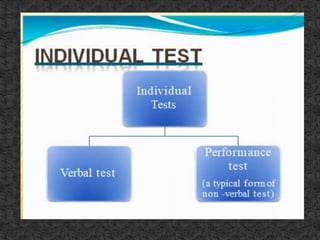
 These tests make use of language. Here
the instructions are given in words
(either in written or oral form or both).
Individuals are required to use
language as well as paper or pencil for
giving the responses. The test content
is loaded with verbal material
 These tests involve such activities in
which the use of language is not
necessary. The use of language is
eliminated from the test content and
response expect in giving directions.
 The first popular individual test is the Wechsler
Bellevue scale (1938).
 Developed by Dr. David Wechsler, a clinical
psychologist
 The test measures one’s ability to adapt and
constructively solve problems in the environment
 Consists of three scales :
 WAIS -Wechsler Adult Intelligence Test
 WISC –Wechsler Intelligence Scale for Children
 WPPSI –Wechsler Preschool and Primary Scale of
Intelligence
 WAIS : to measure intelligence and Cognitive ability in
adults and older Adolescents (16-74 years)
 WISC : intelligence test for children between the ages
of 6 to 16 years
 WPPSI : intelligence test for children between the ages
 4-6 years
 Generally to judge whether person is disabled,
individual tests of intelligence are used.
 For young children who have not yet developed
language ability, illiterate tribal, visually impaired and
those who have lack of language ability etc.
performance test of intelligence will be highly useful.
 The chances of are very high, for IQ being normal, in
the case of orthopedically handicapped, visually
impaired, hearing and speech impaired.
 Only the mentally retarded could be identified using
this approach.
 This approach gives priority to provide special
education to the disabled by isolating them from the
mainstream.
 This approach is not contributing much in improving
the degree of disability.
Cognitive approach

Cognitive approach

  • 1.
    APPROACHES IN IDENTIFYING CHILDRENWITH DISABILITIES- COGNITIVE APPROACH D.KALAIVANI
  • 2.
    UNESCO reports that75% of children with disabilities don't attend schools in India. To provide education to this uncovered population, appropriate strategies need to be adopted for locating them for early intervention services. Early intervention would solve many of the problems of the child later in life. While early identification is of paramount importance in the life of every child, it is more vital in the case of children with disabilities.
  • 3.
     INTRODUCTION  Asevident from the definitions of various disability conditions, some persons experience difficulties in cognitive functions, some in senses and some others in their physical and bodily conditions. The common approaches in identifying persons with disabilities are as follows:  (a) Cognitive approach  (b) Sensory approach  (c) Ability-based approach  (d) Society-based approach
  • 4.
     Cognitive approachadvocates that children with disabilities could be easily identified by observing the limitations in individual’s cognitive abilities like receiving information from his environment, processing, interpreting and reacting to it. These cognitive abilities are related with once intelligence. So it is possible to identify the disabled by measuring intelligence level of the children and spotting those who have significantly low level of intelligence.
  • 5.
     By adoptingthe cognitive approach, identification of children may be made as those who are mentally retarded, slow learners, normal learners, academically advanced learners and gifted learners. This identification is purely based on the cognitive functions of the child.  Children with average intelligence have their IQ ranging from 90-110.  The child who has an IQ between 50 and 75 will come under the category of educable mentally retarded child.
  • 6.
     The trainablementally retarded children have an IQ of 25 to 50 and they may find it difficult even to perform manual kind of work.  Those who have an IQ of less than 25 are called totally dependent category.  In developed countries, not only children with mental retardation, but also children having slow learning skills are also given special attention.
  • 7.
     The childwho has an IQ between 70 and 90 will come under the category of slow learners or backward children.  These backward children by getting appropriate training and education could lead almost a normal life.
  • 8.
     Those whohave IQ less than 50 are considered as Mentally retarded . Their sensory abilities, social adjustments , critical thinking etc., will be also at a low level.  For these children learning in normal class room will not be of much use; providing special education for them is essential.  The supporters of cognitive approach argue that as IQ remains more are less constant throughout the life, it is appropriate to take it as a good measure for identifying the disabled
  • 9.
     Two mainforms of intelligence are involved in most intelligence assessments:  Verbal Intelligence is the ability to comprehend and solve language-based problems.  Nonverbal Intelligence is the ability to understand and solve visual and spatial problems.  They are also classified as individual tests and group tests.
  • 10.
     There aretwo major types of intelligence test, those administered to individuals and those administered to groups.  The two main individual intelligence tests are the Stanford-Binet Intelligence Test and the Wechsler tests, i.e. Wechsler Intelligence Test for Children (WISC) and the Wechsler Adult Intelligence Scale (WAIS) for adults. The individual intelligence tests require one-on-one consultation
  • 12.
     Stanford-Binet test(1916)is a new version of Binet- Simon test  In the year 1905, two French Psychologist Binet and Simon discover the Intelligence test.  After that in 1916 it was modified by American Psychologist Lewis Terman with Binet At Stanford University for current use of Intelligent assessment.  Afterwards, it is known as Stanford-Binet Intelligence Test
  • 13.
     Age Group:2-23 years  Total time : 30 to 90 minutes  In this Version, Terman adopted the system of calculating IQ using the formula:  I.Q. = (Mental Age/Chronological Age)*100
  • 14.
     Fluid Reasoning Knowledge  Quantitative Reasoning  Visual-Spatial Processing  Working Memory
  • 15.
     These testsmake use of language. Here the instructions are given in words (either in written or oral form or both). Individuals are required to use language as well as paper or pencil for giving the responses. The test content is loaded with verbal material
  • 16.
     These testsinvolve such activities in which the use of language is not necessary. The use of language is eliminated from the test content and response expect in giving directions.
  • 17.
     The firstpopular individual test is the Wechsler Bellevue scale (1938).  Developed by Dr. David Wechsler, a clinical psychologist  The test measures one’s ability to adapt and constructively solve problems in the environment  Consists of three scales :  WAIS -Wechsler Adult Intelligence Test  WISC –Wechsler Intelligence Scale for Children  WPPSI –Wechsler Preschool and Primary Scale of Intelligence
  • 18.
     WAIS :to measure intelligence and Cognitive ability in adults and older Adolescents (16-74 years)  WISC : intelligence test for children between the ages of 6 to 16 years  WPPSI : intelligence test for children between the ages  4-6 years
  • 20.
     Generally tojudge whether person is disabled, individual tests of intelligence are used.  For young children who have not yet developed language ability, illiterate tribal, visually impaired and those who have lack of language ability etc. performance test of intelligence will be highly useful.
  • 21.
     The chancesof are very high, for IQ being normal, in the case of orthopedically handicapped, visually impaired, hearing and speech impaired.  Only the mentally retarded could be identified using this approach.  This approach gives priority to provide special education to the disabled by isolating them from the mainstream.  This approach is not contributing much in improving the degree of disability.