OVERVIEW
Psychological tests areused to assess intelligence, achievement,
personality, and psychopathology.
Psychological assessment is typically driven by a particular problem or
referral question.
The purpose of assessment is to answer particular questions related to
an individual’s intellectual, psychological, emotional-behavioral, or
psychosocial functioning, or some combination of these domains.
Referrals generated in the medical setting may include1
:
Evaluate child’s defiant behavior and poor academic performance.
Patient’s depression screen is positive. Patient has a complicated psychiatric history.
Evaluate.
Determine psychological readiness to undergo surgical procedure (e.g., organ
transplants, bariatric, amputation)
ALTMAIER & TALLMAN, 2013
3.
TESTING IN CONTEXT
Psychologicaltesting is one component of psychological assessment
• Gather information from the patient (clinical interview/behavioral
observations)
• Obtain collateral information (parent, school)
• Administer psychological test instruments
• Test battery will look at functioning in a number of different
functional areas.
• Use tests that have been standardized for a specific population
within a specific context so scores are reliable and valid in
describing abilities.
• Interpret the results
• Report will test combine data with the collateral and interview data
• This conceptualization is summarized, a diagnosis or a diagnostic
rule-out is offered
• Recommendations are made
4.
LIMITATIONS
Bias
Psychologist mayselectively attend to behaviors that are consistent with their expectations or
theoretical orientation (confirmatory bias)
Preference and availability of certain instruments
Patient factors
Motivation
Effort on a continuum (positive impression management, optimal effort, passively
cooperative, suboptimal effort, negative impression management, malingering)
Comfort with the testing situation
Assessment of diverse populations
Culture, ethnicity, race, primary language, SES, level of education are variables that that
influence test results.
Validity of test results may be attenuated when instruments are used inappropriately cross-
culturally.
Stereotype threat2
STEELE & ARONSON, 1995
INTELLIGENCE
Intelligence is definedas the ability to understand abstract concepts;
reason; assimilate, recall, analyze, and organize information; and meet
the special needs of new situations.
Is intelligence a single general ability or are there several distinct kinds
of intelligence?
Spearman: General cognitive ability (g factor)
Cattell
Fluid Intelligence: capacity to acquire new knowledge and solve new problems,
and is partially determined by biological and genetic factors.
Crystallized intelligence: knowledge and learning gained over one’s lifetime
through an interaction between fluid intelligence and environment (i.e., culture,
education)
7.
INTELLIGENCE
IQ is determinedto a large extent by genetics.
Substantial heritability of g has been documented in dozens of family, twin, and adoption studies,
with estimates varying from 40 to 80%.
In 34 twin studies with a total of 4672 pairs of MZ twins, the average MZ correlation is 0.86,
indicating that the identical twins are nearly as similar as the same person tested twice (test-
retest correlation for g is about 0.90). In contrast, the average DZ correlation is 0.60 in 41
studies, with a total of 5546 pairs of DZ twins.3
Heritability of g seems to increase with age. Genetic factors account for approximately 50% of
population–level variation in intelligence by the end of the first decade of life. This proportion
increases to 70% by late adolescence.4
However, poor nutrition and illness during development can negatively affect
IQ.
IQ is relatively stable throughout life.
G is one of the most reliable, valid, and stable behavioral traits.
In the absence of brain pathology, an individual’s IQ is essentially the same in old age as in
childhood.
BOUCHARD & MCGUE, 1981; HAWORTH, 2010
8.
INTELLIGENCE AND MENTALAGE
Seminal work by Binet and colleagues (Simon) in the early 1900s.
Binet’s fundamental assumption was that intellectual capacities in children increased with age
on average, so that older children were expected to perform better than younger children on
the same items.
Chronological Age (CA) is the person’s actual age in years.
Mental Age (MA), as defined by Alfred Binet, reflects a person’s level of
intellectual functioning.
A student with a mental age of 10 performed as well as the average 10-year old in the
normative sample.
IQ is the ratio of MA to CA multiplied by 100 (i.e., IQ = MA/CA x 100)
An IQ of 100 means that the person’s mental and chronological ages are
equivalent.
The highest CA used to determine IQ is 15 years.
9.
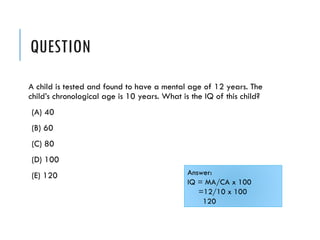
QUESTION
A child istested and found to have a mental age of 12 years. The
child’s chronological age is 10 years. What is the IQ of this child?
(A) 40
(B) 60
(C) 80
(D) 100
(E) 120 Answer:
IQ = MA/CA x 100
=12/10 x 100
120
10.
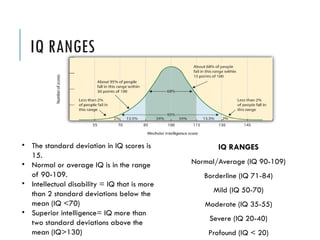
IQ RANGES
IQ RANGES
Normal/Average(IQ 90-109)
Borderline (IQ 71-84)
Mild (IQ 50-70)
Moderate (IQ 35-55)
Severe (IQ 20-40)
Profound (IQ < 20)
• The standard deviation in IQ scores is
15.
• Normal or average IQ is in the range
of 90-109.
• Intellectual disability = IQ that is more
than 2 standard deviations below the
mean (IQ <70)
• Superior intelligence= IQ more than
two standard deviations above the
mean (IQ>130)
11.
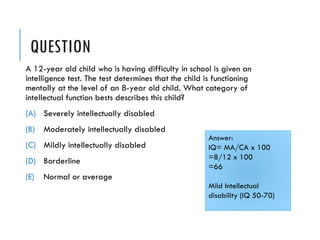
QUESTION
A 12-year oldchild who is having difficulty in school is given an
intelligence test. The test determines that the child is functioning
mentally at the level of an 8-year old child. What category of
intellectual function bests describes this child?
(A) Severely intellectually disabled
(B) Moderately intellectually disabled
(C) Mildly intellectually disabled
(D) Borderline
(E) Normal or average
Answer:
IQ= MA/CA x 100
=8/12 x 100
=66
Mild Intellectual
disability (IQ 50-70)
12.
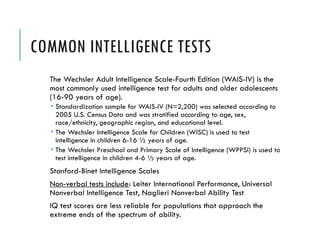
COMMON INTELLIGENCE TESTS
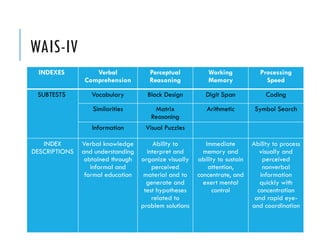
TheWechsler Adult Intelligence Scale-Fourth Edition (WAIS-IV) is the
most commonly used intelligence test for adults and older adolescents
(16-90 years of age).
Standardization sample for WAIS-IV (N=2,200) was selected according to
2005 U.S. Census Data and was stratified according to age, sex,
race/ethnicity, geographic region, and educational level.
The Wechsler Intelligence Scale for Children (WISC) is used to test
intelligence in children 6-16 ½ years of age.
The Wechsler Preschool and Primary Scale of Intelligence (WPPSI) is used to
test intelligence in children 4-6 ½ years of age.
Stanford-Binet Intelligence Scales
Non-verbal tests include: Leiter International Performance, Universal
Nonverbal Intelligence Test, Naglieri Nonverbal Ability Test
IQ test scores are less reliable for populations that approach the
extreme ends of the spectrum of ability.
13.
WAIS-IV
INDEXES Verbal
Comprehension
Perceptual
Reasoning
Working
Memory
Processing
Speed
SUBTESTS VocabularyBlock Design Digit Span Coding
Similarities Matrix
Reasoning
Arithmetic Symbol Search
Information Visual Puzzles
INDEX
DESCRIPTIONS
Verbal knowledge
and understanding
obtained through
informal and
formal education
Ability to
interpret and
organize visually
perceived
material and to
generate and
test hypotheses
related to
problem solutions
Immediate
memory and
ability to sustain
attention,
concentrate, and
exert mental
control
Ability to process
visually and
perceived
nonverbal
information
quickly with
concentration
and rapid eye-
and coordination
14.
INTELLECTUAL DISABILITY
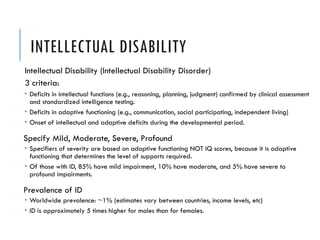
Intellectual Disability(Intellectual Disability Disorder)
3 criteria:
Deficits in intellectual functions (e.g., reasoning, planning, judgment) confirmed by clinical assessment
and standardized intelligence testing.
Deficits in adaptive functioning (e.g., communication, social participating, independent living)
Onset of intellectual and adaptive deficits during the developmental period.
Specify Mild, Moderate, Severe, Profound
Specifiers of severity are based on adaptive functioning NOT IQ scores, because it is adaptive
functioning that determines the level of supports required.
Of those with ID, 85% have mild impairment, 10% have moderate, and 5% have severe to
profound impairments.
Prevalence of ID
Worldwide prevalence: ~1% (estimates vary between countries, income levels, etc)
ID is approximately 5 times higher for males than for females.
15.
ADAPTIVE BEHAVIOR ASSESSMENT
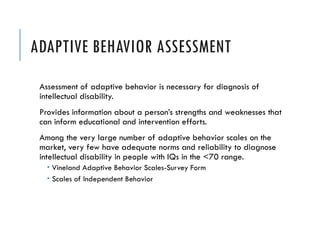
Assessmentof adaptive behavior is necessary for diagnosis of
intellectual disability.
Provides information about a person’s strengths and weaknesses that
can inform educational and intervention efforts.
Among the very large number of adaptive behavior scales on the
market, very few have adequate norms and reliability to diagnose
intellectual disability in people with IQs in the <70 range.
Vineland Adaptive Behavior Scales-Survey Form
Scales of Independent Behavior
16.
VINELAND ADAPTIVE BEHAVIORSCALES
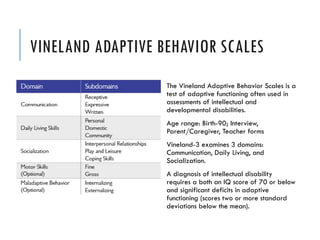
The Vineland Adaptive Behavior Scales is a
test of adaptive functioning often used in
assessments of intellectual and
developmental disabilities.
Age range: Birth-90; Interview,
Parent/Caregiver, Teacher forms
Vineland-3 examines 3 domains:
Communication, Daily Living, and
Socialization.
A diagnosis of intellectual disability
requires a both an IQ score of 70 or below
and significant deficits in adaptive
functioning (scores two or more standard
deviations below the mean).
ACHIEVEMENT TESTS
Achievement testsare used to assess academic achievement (e.g.,
evaluate how well an individual has mastered specific subject areas, such
as reading and mathematics).
Achievement tests include the Scholastic Aptitude Test (SAT), Medical
College Admission Test (MCAT), and the United States Licensing
Examination (USMLE).
The Wide Range Achievement Test (WRAT), which is often used clinically,
evaluates arithmetic, reading, and spelling skills.
Achievement tests often used by school systems include the California,
Iowa, Stanford, and Peabody Achievement Tests.
19.
LEARNING DISORDERS
Ability-achievement Discrepancy
Traditionally, learning disability was defined as significantly lower academic
achievement relative to one’s measured intellectual ability.6
But, this assumes that factors that negatively affect academic achievement
scores do not influence scores on IQ tests.
Specific learning disorders
Difficulties of learning and using specific academic skills in certain learning
domains (i.e., word reading, reading comprehension, spelling, written
expression, number sense, mathematical reasoning) that are substantially
below individual's chronological age, and cause significant interference with
academic or occupational performance.
Although intellectual assessment has been the core of psychological
assessment for LD for decades, it is no longer required for a DSM-
5 diagnosis
of SLD, except when Intellectual Disabilities are suspected.
APA, 2000
20.
PSYCHOPATHOLOGY
In medicalsettings the most common psychopathology you will encounter
will relate to symptoms of depression, anxiety, and substance abuse.
Evaluation of patients with emotional symptoms involves:
Psychiatric history
Includes mental illness, drug and alcohol use, sexual activity, current
living situation, and sources of stress.
Mental Status Exam
Data from personality testing and symptom inventories
21.
DEPRESSION SCALES
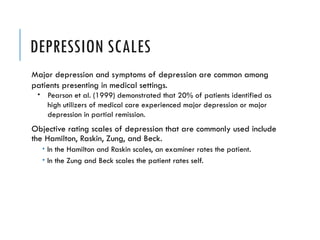
Major depressionand symptoms of depression are common among
patients presenting in medical settings.
Pearson et al. (1999) demonstrated that 20% of patients identified as
high utilizers of medical care experienced major depression or major
depression in partial remission.
Objective rating scales of depression that are commonly used include
the Hamilton, Raskin, Zung, and Beck.
In the Hamilton and Raskin scales, an examiner rates the patient.
In the Zung and Beck scales the patient rates self.
22.
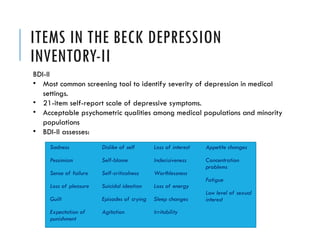
ITEMS IN THEBECK DEPRESSION
INVENTORY-II
Sadness
Pessimism
Sense of failure
Loss of pleasure
Guilt
Expectation of
punishment
Dislike of self
Self-blame
Self-criticalness
Suicidal ideation
Episodes of crying
Agitation
Loss of interest
Indecisiveness
Worthlessness
Loss of energy
Sleep changes
Irritability
Appetite changes
Concentration
problems
Fatigue
Low level of sexual
interest
BDI-II
• Most common screening tool to identify severity of depression in medical
settings.
• 21-item self-report scale of depressive symptoms.
• Acceptable psychometric qualities among medical populations and minority
populations
• BDI-II assesses:
23.
ANXIETY SCALES
Anxiety disordersare also highly prevalent in medial settings.
Several assessment methods detect symptoms of anxiety.
Generalized Anxiety Disorder Scale (GAD-7)
Patient Health Questionnaire (PHQ-9)
24.
REFERENCES
Altmaier, E.M., &Tallman, B.A. (2013). Psychological assessment in medical settings. In APA
Handbook of Testing and Assessment in Psychology: Volume 2. Testing and Assessment in Clinical
and Counseling Psychology, 285-302).
Bouchard, T.J. and McGue, M.J. (1981) Familial studies of intelligence: A review. Science, 1055-
1059.
Froehlich, L., Martiny, S.E., Keaux, K., Goetz, T., Mok, S.Y. (2016). Being smart of getting
smarter. Implicit theory of intelligence moderates stereotype threat and stereotype lift effects.
British Journal of Social Psychology, 55, 564-587.
Haworth, C. M. A., Wright, M. J., Luciano, M., Martin, N. G., de Geus, E. J. C., van Beijsterveldt,
C. E. M., . . . Plomin, R. (2010). The heritability of general cognitive ability increases linearly
from childhood to young adulthood. Molecular Psychiatry, 15, 1112–1120.
Maltzman, S. (2013). The assessment process. In APA Handbook of Testing and Assessment in
Psychology: Volume 2. Testing and Assessment in Clinical and Counseling Psychology, 19-34).
Steele, C.M., & Aronson, J. (1995). Stereotype threat and the intellectual test performance of
African Americans. Journal of Personality and Social Psychology, 69, 797-811.
Editor's Notes
#6 Intelligence is a set of cognitive characteristics and abilities that cannot be directly observed. Gardner’s multiple intelligences: linguistic, logical-mathematical, spatial, musical, body-kinesthetic, interpersonal, intrapersonal, naturalistic.
Spearman: g factor is a variable that summarizes positive correlations among different cognitive tasks, reflecting the face that an individual’s performance on one type of cognitive task tends to be comparable to that person’s performance on other kinds of cognitive tasks.
Cattell: ; g factor with two subtypes
#15 Both these tests have adequate standardization samples.
#22 Most common screening tool to identify severity of depression in medical settings.