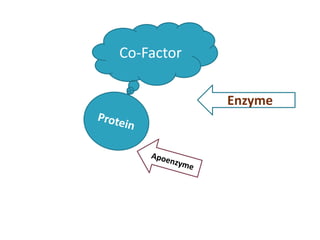
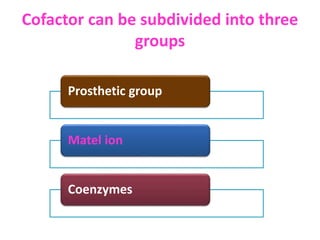
Cofactors are non-protein molecules that assist enzymes during catalysis. There are three main types of cofactors: prosthetic groups, metal ions, and coenzymes. Prosthetic groups are tightly bound organic or inorganic molecules that are integrated into the enzyme structure. Metal ions are commonly bound prosthetic groups that facilitate substrate binding and reactions. Coenzymes serve as recyclable carriers that transport substrates between where they are generated and utilized in reactions.
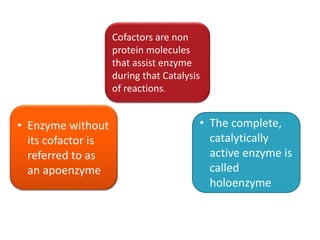
Cofactors are non
proteinmolecules
that assist enzyme
during that Catalysis
of reactions.
• Enzyme without
its cofactor is
referred to as
an apoenzyme
• The complete,
catalytically
active enzyme is
called
holoenzyme
Prosthetic group
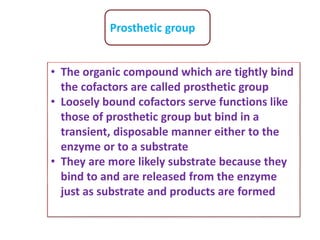
• Theorganic compound which are tightly bind
the cofactors are called prosthetic group
• Loosely bound cofactors serve functions like
those of prosthetic group but bind in a
transient, disposable manner either to the
enzyme or to a substrate
• They are more likely substrate because they
bind to and are released from the enzyme
just as substrate and products are formed
6.
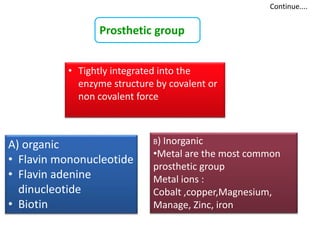
Prosthetic group
• Tightlyintegrated into the
enzyme structure by covalent or
non covalent force
B) Inorganic
•Metal are the most common
prosthetic group
Metal ions :
Cobalt ,copper,Magnesium,
Manage, Zinc, iron
A) organic
• Flavin mononucleotide
• Flavin adenine
dinucleotide
• Biotin
Continue....
7.
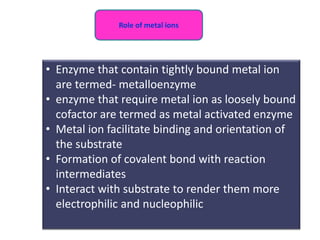
• Enzyme thatcontain tightly bound metal ion
are termed- metalloenzyme
• enzyme that require metal ion as loosely bound
cofactor are termed as metal activated enzyme
• Metal ion facilitate binding and orientation of
the substrate
• Formation of covalent bond with reaction
intermediates
• Interact with substrate to render them more
electrophilic and nucleophilic
Role of metal ions
8.
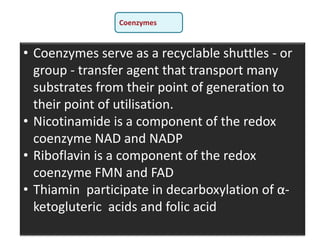
• Coenzymes serveas a recyclable shuttles - or
group - transfer agent that transport many
substrates from their point of generation to
their point of utilisation.
• Nicotinamide is a component of the redox
coenzyme NAD and NADP
• Riboflavin is a component of the redox
coenzyme FMN and FAD
• Thiamin participate in decarboxylation of α-
ketogluteric acids and folic acid
Coenzymes
9.
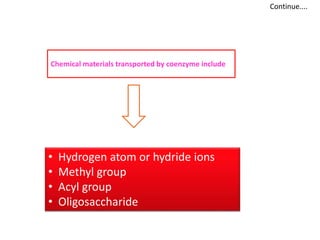
• Hydrogen atomor hydride ions
• Methyl group
• Acyl group
• Oligosaccharide
Continue....
Chemical materials transported by coenzyme include