“Beginning to think is
beginning to be undermined.”
Albert Camus - The myth of Sisyphus
“Beginning to think is
beginning to be underm ined.”
Albert Cam us - The m yth of Sisyphus
Gunther Verheyen, Ullizee-Inc
independent Scrum Caretaker
Team Engagement is the key
(to unlocking your biggest unused competitive advantage)
Gunther Verheyen
Agile Open Space Tricity
Gdansk, 23 November 2019
“Employees who are engaged
actually care a lot more.”
(about customer outcomes and profitability)
Gunther Verheyen
4© 2003-2019 Gunther Verheyen – Ullizee-Inc, - @Ullizee
“Businesses that orient
performance management
systems around basic human
needs for psychological
engagement get the most out
of their employees.”
Team engagement, the untapped potential
Poland: 14% - 73% - 13%
(Belgium: 10% - 73% - 17%)
[Source: Gallup - State of the global workplace, 2017]
5© 2003-2019 Gunther Verheyen – Ullizee-Inc, - @Ullizee
The first prerequisite
What is needed first and foremost to
establish an environment of engagement
and creativity?
2”
6© 2003-2019 Gunther Verheyen – Ullizee-Inc, - @Ullizee
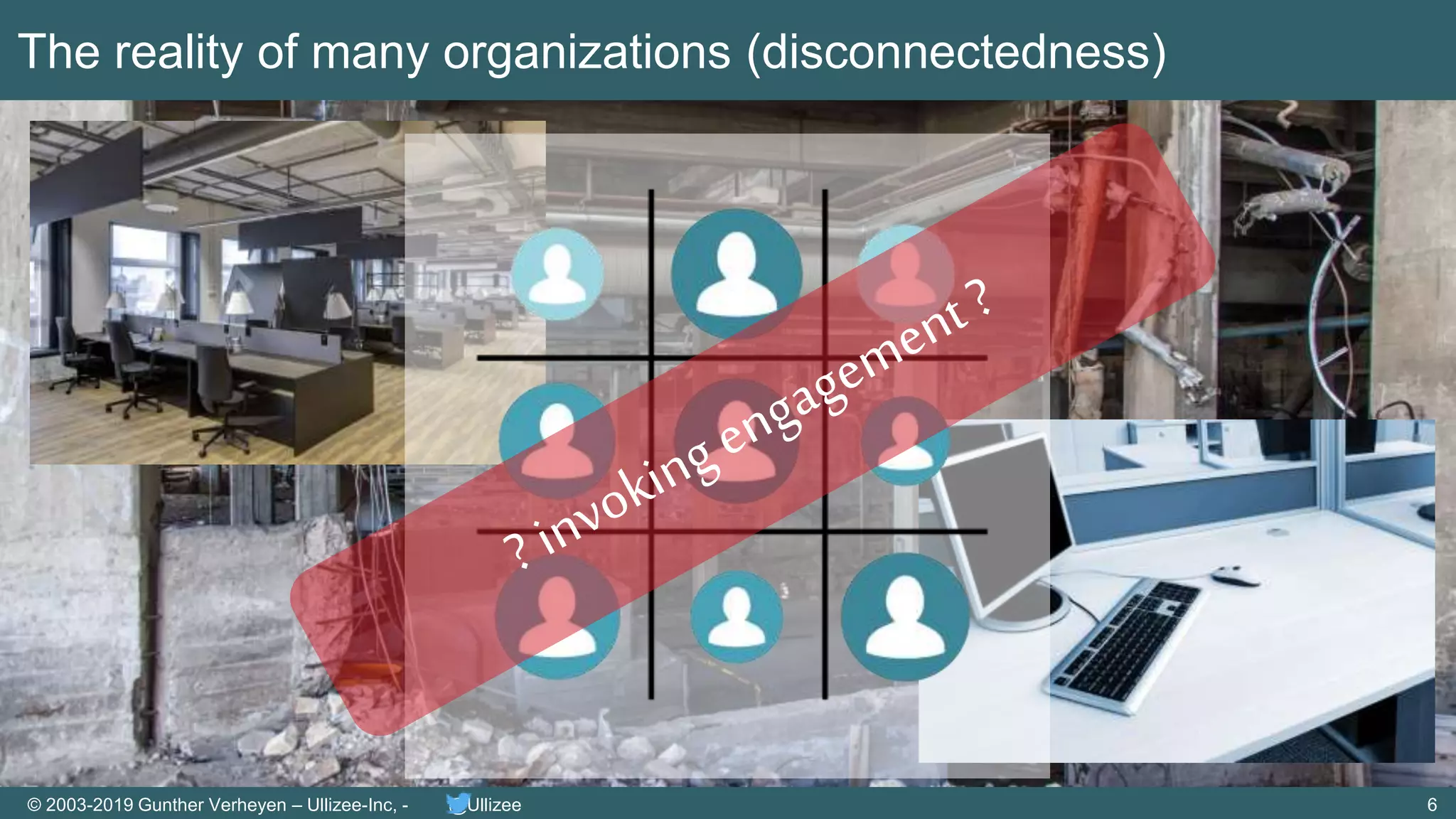
The reality of many organizations (disconnectedness)
7© 2003-2019 Gunther Verheyen – Ullizee-Inc, - @Ullizee
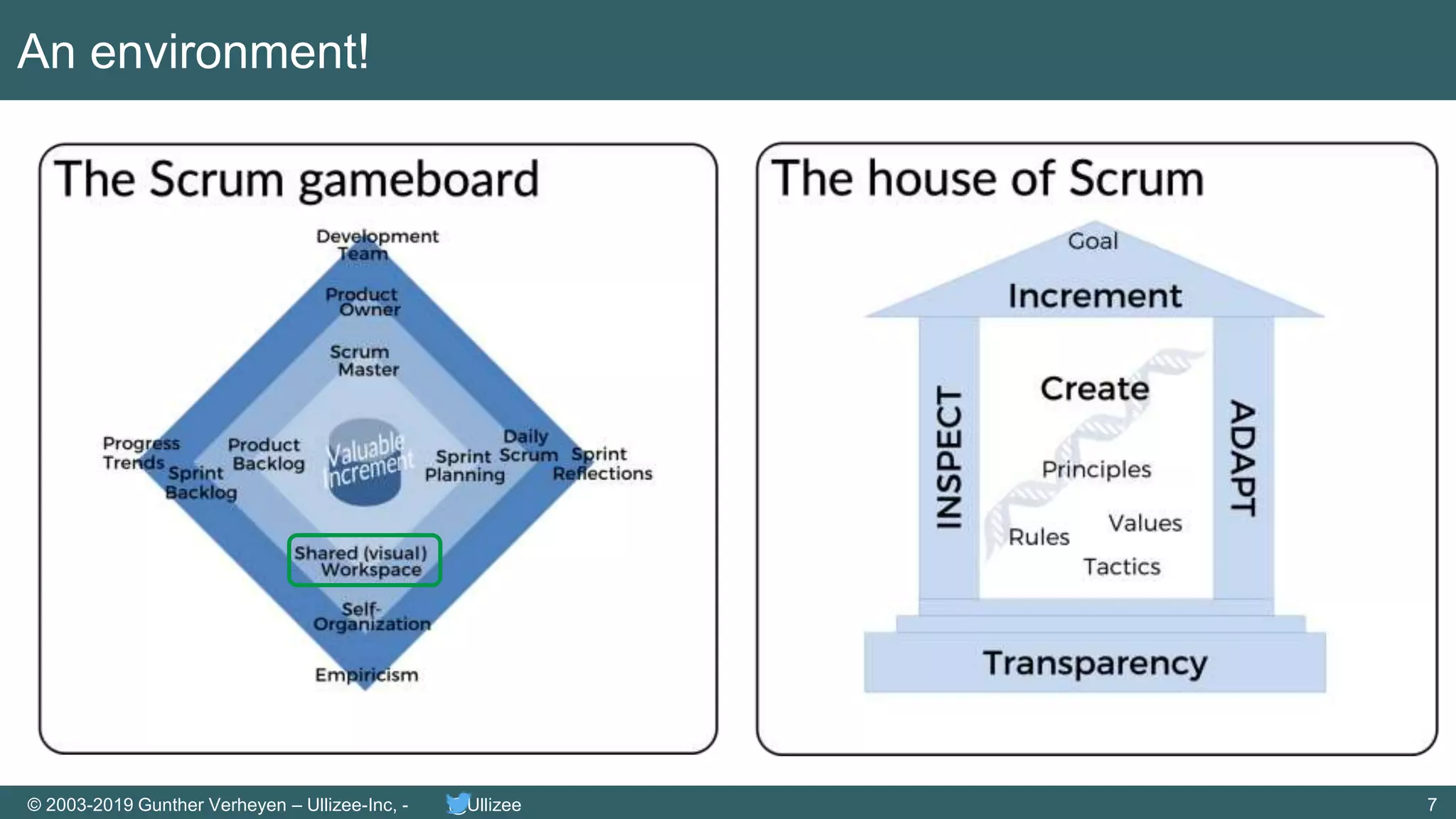
An environment!
8© 2003-2019 Gunther Verheyen – Ullizee-Inc, - @Ullizee
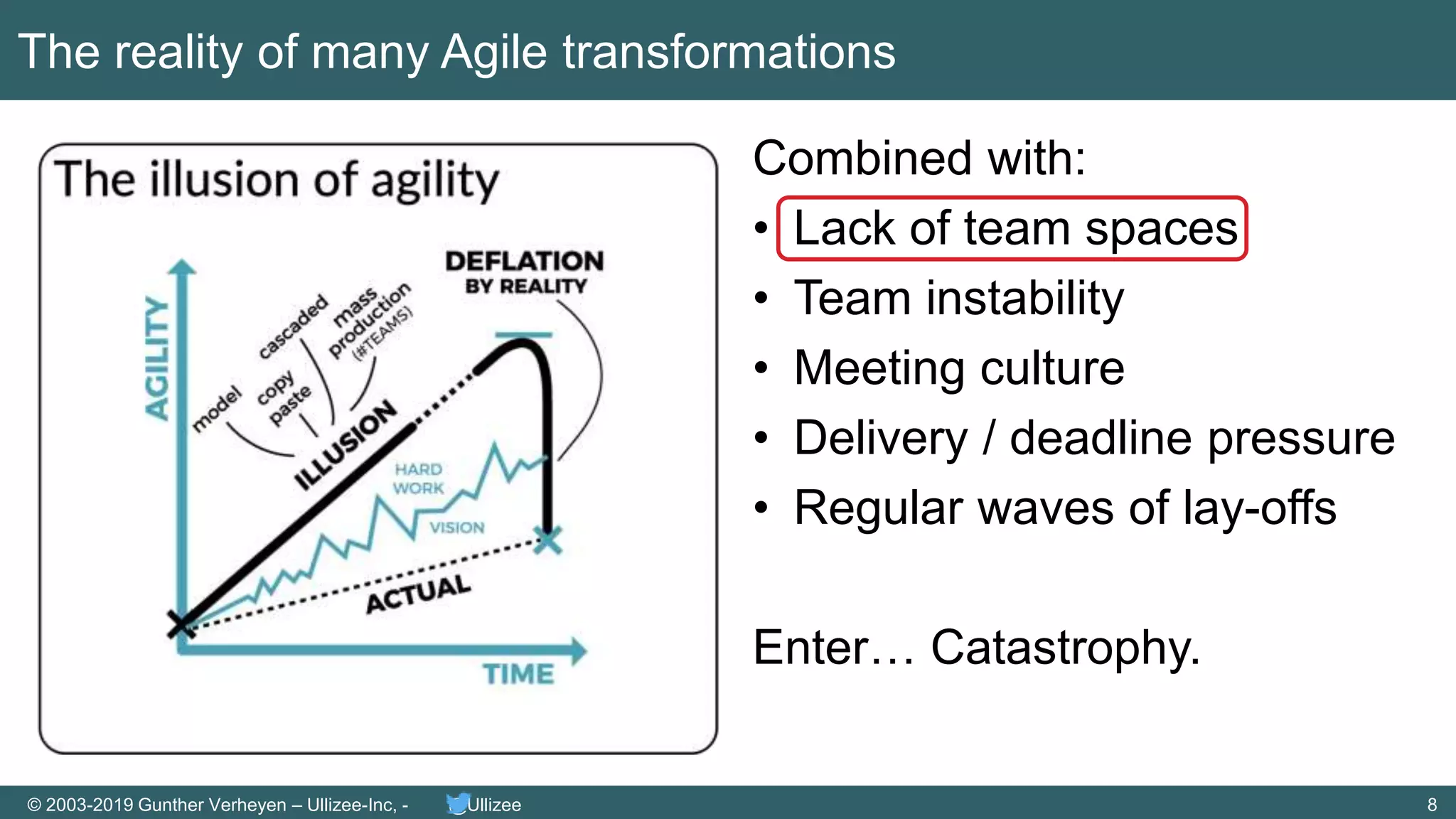
Combined with:
• Lack of team spaces
• Team instability
• Meeting culture
• Delivery / deadline pressure
• Regular waves of lay-offs
Enter… Catastrophy.
The reality of many Agile transformations
9© 2003-2019 Gunther Verheyen – Ullizee-Inc, - @Ullizee
It is not a transformation if it doesn’t change how you work.
It is not an Agile transformation if it doesn’t simplify how you
work.
It is not an Agile transformation with Scrum if people don’t
engage.
Three indicators to detect the illusion of agility
10© 2003-2019 Gunther Verheyen – Ullizee-Inc, - @Ullizee
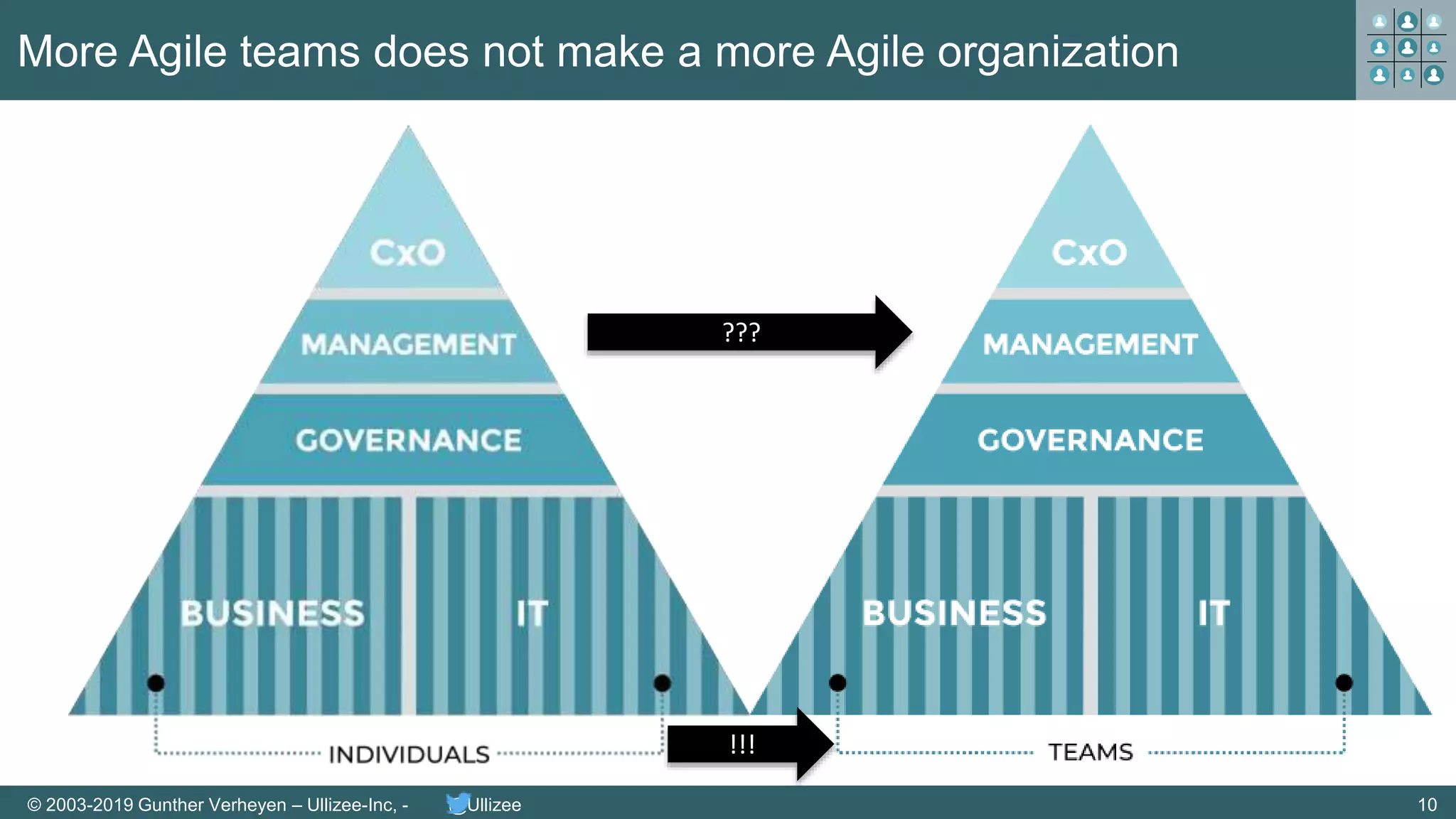
More Agile teams does not make a more Agile organization
???
!!!
11© 2003-2019 Gunther Verheyen – Ullizee-Inc, - @Ullizee
“The New New Product Development Game” (1986)
Hirotaka Takeuchi and Ikujiro Nonaka defined 6 characteristics of “Scrum”, the product
development process that emerges from the constant interaction of a multi-disciplinary team
whose members work together from start to finish.
.
The new approach is a vehicle for introducing creative processes into an old, rigid
organization. Organizations need to adopt a management style that promotes this process.
1. Built-ininstability
The tension of carrying out strategically important work against
challenging goals with a wide measure of freedom.
3. Overlappingdevelopmentphases
The team, with its different disciplines and personalities, works as a
unit in a shared workspace to combine all phases.
2. Self-organizingteams
The organization funds the teams like start-ups thriving on autonomy,
self-transcendence, and cross-fertilization.
4. “Multi-learning”
A team becomes more versatile as team members develop skills and
accumulate experience in different areas.
5. Subtlecontrol
Check-points and self-control help find mistakes early and keep
instability, ambiguity and tension from turning into chaos.
6. Organizationaltransferof learning
Beyond accumulating knowledge across levels and functions,
learnings are transferred to other product groups and divisions.
12© 2003-2019 Gunther Verheyen – Ullizee-Inc, - @Ullizee
Exploratory Management (of value)
People are not ‘resources’
(robots, cogs or replaceable
pieces of machinery).
People are… people.
[Source: Gunther Verheyen, “Scrum – A Pocket Guide (A Smart Travel Companion)”, 2nd edition, 2013-2019]
14© 2003-2019 Gunther Verheyen – Ullizee-Inc, - @Ullizee
What truly motivates people
[Source: Daniel Pink - Drive (the surprising truth about what motivates us), 2011]
External rewards like money (carrot-and-
stick) work; for simple, mechanical work.
• It has opposite effects in cognitive,
complex or creative work.
Money counts, but the secret to
engagement lies beyond it, in:
• Autonomy – organizing my own work
(4 Ts)
• Mastery – becoming better at my work
• Purpose – making a contribution
“The biggest impediment to Agile
is our ingrained obsession with
controlling individuals.”
Gunther Verheyen
16© 2003-2019 Gunther Verheyen – Ullizee-Inc, - @Ullizee
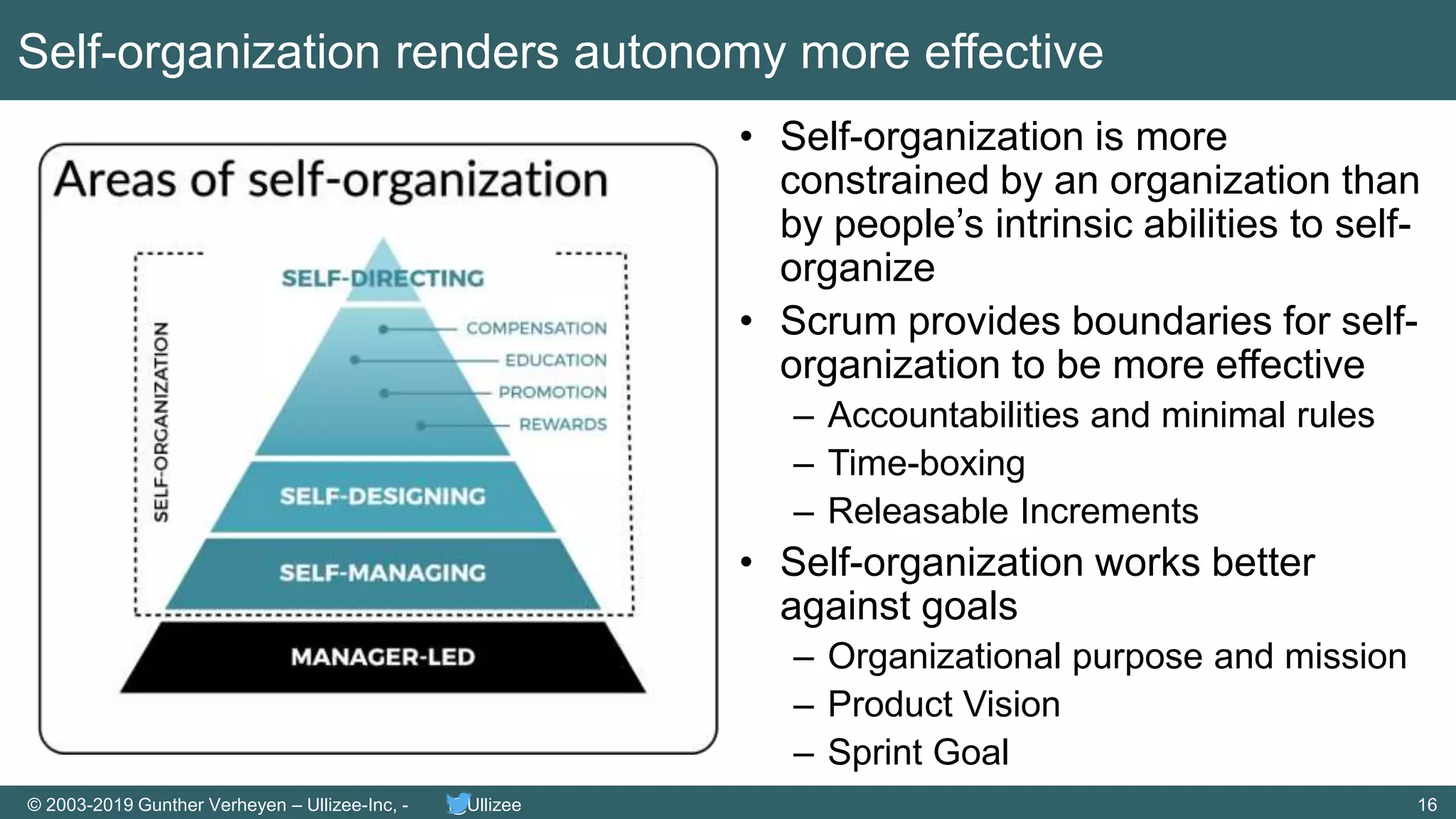
• Self-organization is more
constrained by an organization than
by people’s intrinsic abilities to self-
organize
• Scrum provides boundaries for self-
organization to be more effective
– Accountabilities and minimal rules
– Time-boxing
– Releasable Increments
• Self-organization works better
against goals
– Organizational purpose and mission
– Product Vision
– Sprint Goal
Self-organization renders autonomy more effective
17© 2003-2019 Gunther Verheyen – Ullizee-Inc, - @Ullizee
Conflict is interaction
• Complex and cognitive
challenges require the
intelligence, insights and
viewpoints of all involved to be
gathered and discussed.
• Self-organizing teams
constructively sort out
disagreements over ideas,
options and relationships.
• Both absence of conflict and
conflicts with a destructive
orientation are detrimental to
progress and performance.
18© 2003-2019 Gunther Verheyen – Ullizee-Inc, - @Ullizee
An organizational frame to engagement
Following the findings of "The new
new product development game”:
• Hubs operate like start-ups,
setting their own agenda and
taking their own initiatives.
• Management acts as a venture
capitalist, not intervening on a
daily base but rather providing
guidance, money, and moral
support at the outset.
19© 2003-2019 Gunther Verheyen – Ullizee-Inc, - @Ullizee
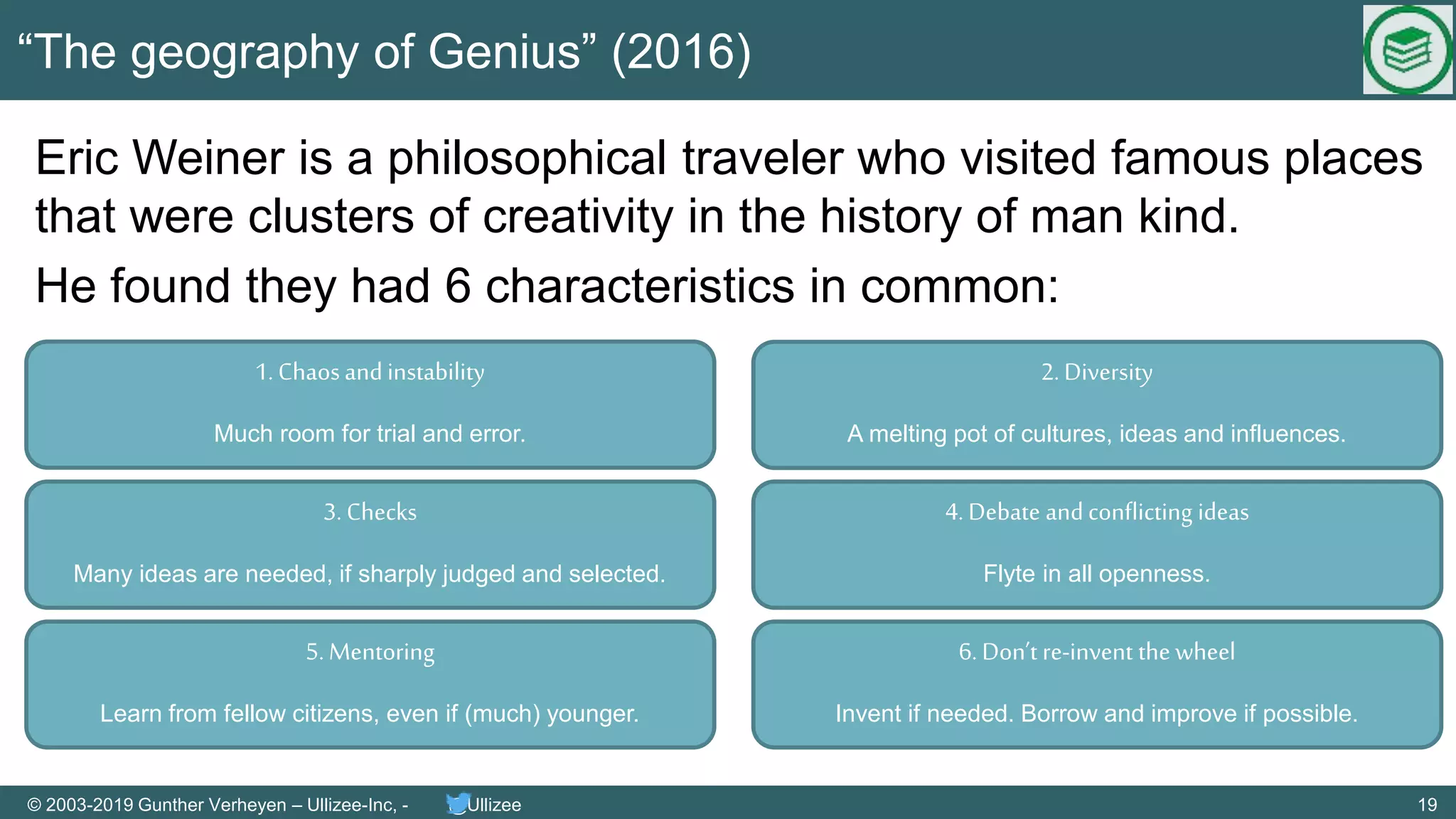
“The geography of Genius” (2016)
Eric Weiner is a philosophical traveler who visited famous places
that were clusters of creativity in the history of man kind.
He found they had 6 characteristics in common:
1. Chaosandinstability
Much room for trial and error.
3. Checks
Many ideas are needed, if sharply judged and selected.
2. Diversity
A melting pot of cultures, ideas and influences.
4. Debate andconflicting ideas
Flyte in all openness.
5. Mentoring
Learn from fellow citizens, even if (much) younger.
6. Don’t re-invent the wheel
Invent if needed. Borrow and improve if possible.
The future state ofScrum willno longer be called‘Scrum’.
What we now callScrum willhave become the norm, and
organizationshave re-emerged aroundit.
[Source: Gunther Verheyen, “Scrum – A Pocket Guide (A Smart Travel Companion)”, 2nd edition, 2013-2019]
21© 2003-2019 Gunther Verheyen – Ullizee-Inc, - @Ullizee
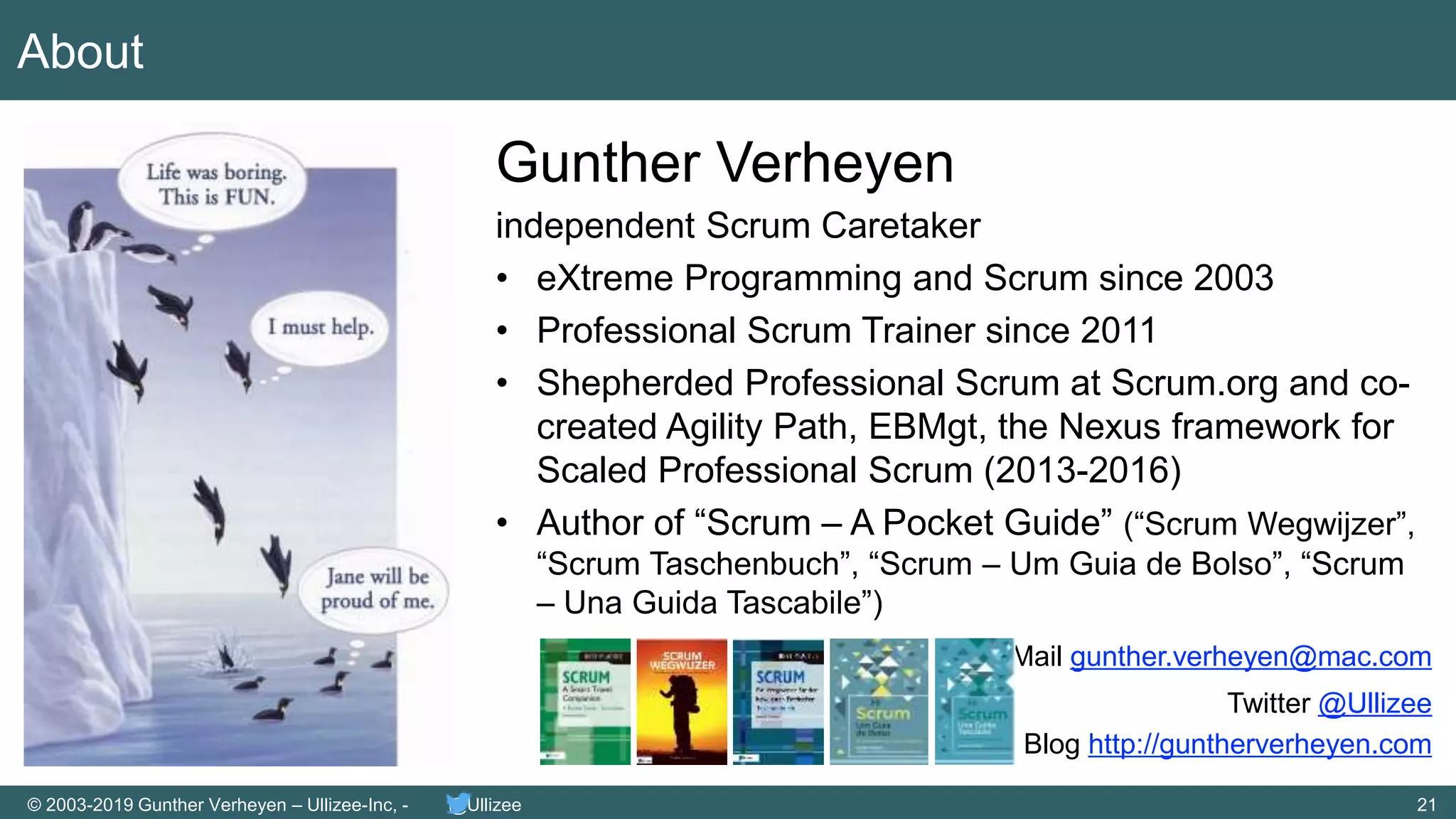
About
Gunther Verheyen
independent Scrum Caretaker
• eXtreme Programming and Scrum since 2003
• Professional Scrum Trainer since 2011
• Shepherded Professional Scrum at Scrum.org and co-
created Agility Path, EBMgt, the Nexus framework for
Scaled Professional Scrum (2013-2016)
• Author of “Scrum – A Pocket Guide” (“Scrum Wegwijzer”,
“Scrum Taschenbuch”, “Scrum – Um Guia de Bolso”, “Scrum
– Una Guida Tascabile”)
Mail gunther.verheyen@mac.com
Twitter @Ullizee
Blog http://guntherverheyen.com
22© 2003-2019 Gunther Verheyen – Ullizee-Inc, - @Ullizee
My Scrum Caretaker compass
Throughout the years I have discovered I
prefer ideas and ideals over
positions and titles.
It helped me realize I value independence and
freedom of thought over corporate and
commercial structures.
Rather than regretting or mourning the consequences, I
aspire embracing them. I don’t expect this to change in the
foreseeable future.

Agile Open Space Tricity (Lufthansa Systems) - Engagement is key

  • 1.
    “Beginning to thinkis beginning to be undermined.” Albert Camus - The myth of Sisyphus “Beginning to think is beginning to be underm ined.” Albert Cam us - The m yth of Sisyphus
  • 2.
    Gunther Verheyen, Ullizee-Inc independentScrum Caretaker Team Engagement is the key (to unlocking your biggest unused competitive advantage) Gunther Verheyen Agile Open Space Tricity Gdansk, 23 November 2019
  • 3.
    “Employees who areengaged actually care a lot more.” (about customer outcomes and profitability) Gunther Verheyen
  • 4.
    4© 2003-2019 GuntherVerheyen – Ullizee-Inc, - @Ullizee “Businesses that orient performance management systems around basic human needs for psychological engagement get the most out of their employees.” Team engagement, the untapped potential Poland: 14% - 73% - 13% (Belgium: 10% - 73% - 17%) [Source: Gallup - State of the global workplace, 2017]
  • 5.
    5© 2003-2019 GuntherVerheyen – Ullizee-Inc, - @Ullizee The first prerequisite What is needed first and foremost to establish an environment of engagement and creativity? 2”
  • 6.
    6© 2003-2019 GuntherVerheyen – Ullizee-Inc, - @Ullizee The reality of many organizations (disconnectedness)
  • 7.
    7© 2003-2019 GuntherVerheyen – Ullizee-Inc, - @Ullizee An environment!
  • 8.
    8© 2003-2019 GuntherVerheyen – Ullizee-Inc, - @Ullizee Combined with: • Lack of team spaces • Team instability • Meeting culture • Delivery / deadline pressure • Regular waves of lay-offs Enter… Catastrophy. The reality of many Agile transformations
  • 9.
    9© 2003-2019 GuntherVerheyen – Ullizee-Inc, - @Ullizee It is not a transformation if it doesn’t change how you work. It is not an Agile transformation if it doesn’t simplify how you work. It is not an Agile transformation with Scrum if people don’t engage. Three indicators to detect the illusion of agility
  • 10.
    10© 2003-2019 GuntherVerheyen – Ullizee-Inc, - @Ullizee More Agile teams does not make a more Agile organization ??? !!!
  • 11.
    11© 2003-2019 GuntherVerheyen – Ullizee-Inc, - @Ullizee “The New New Product Development Game” (1986) Hirotaka Takeuchi and Ikujiro Nonaka defined 6 characteristics of “Scrum”, the product development process that emerges from the constant interaction of a multi-disciplinary team whose members work together from start to finish. . The new approach is a vehicle for introducing creative processes into an old, rigid organization. Organizations need to adopt a management style that promotes this process. 1. Built-ininstability The tension of carrying out strategically important work against challenging goals with a wide measure of freedom. 3. Overlappingdevelopmentphases The team, with its different disciplines and personalities, works as a unit in a shared workspace to combine all phases. 2. Self-organizingteams The organization funds the teams like start-ups thriving on autonomy, self-transcendence, and cross-fertilization. 4. “Multi-learning” A team becomes more versatile as team members develop skills and accumulate experience in different areas. 5. Subtlecontrol Check-points and self-control help find mistakes early and keep instability, ambiguity and tension from turning into chaos. 6. Organizationaltransferof learning Beyond accumulating knowledge across levels and functions, learnings are transferred to other product groups and divisions.
  • 12.
    12© 2003-2019 GuntherVerheyen – Ullizee-Inc, - @Ullizee Exploratory Management (of value)
  • 13.
    People are not‘resources’ (robots, cogs or replaceable pieces of machinery). People are… people. [Source: Gunther Verheyen, “Scrum – A Pocket Guide (A Smart Travel Companion)”, 2nd edition, 2013-2019]
  • 14.
    14© 2003-2019 GuntherVerheyen – Ullizee-Inc, - @Ullizee What truly motivates people [Source: Daniel Pink - Drive (the surprising truth about what motivates us), 2011] External rewards like money (carrot-and- stick) work; for simple, mechanical work. • It has opposite effects in cognitive, complex or creative work. Money counts, but the secret to engagement lies beyond it, in: • Autonomy – organizing my own work (4 Ts) • Mastery – becoming better at my work • Purpose – making a contribution
  • 15.
    “The biggest impedimentto Agile is our ingrained obsession with controlling individuals.” Gunther Verheyen
  • 16.
    16© 2003-2019 GuntherVerheyen – Ullizee-Inc, - @Ullizee • Self-organization is more constrained by an organization than by people’s intrinsic abilities to self- organize • Scrum provides boundaries for self- organization to be more effective – Accountabilities and minimal rules – Time-boxing – Releasable Increments • Self-organization works better against goals – Organizational purpose and mission – Product Vision – Sprint Goal Self-organization renders autonomy more effective
  • 17.
    17© 2003-2019 GuntherVerheyen – Ullizee-Inc, - @Ullizee Conflict is interaction • Complex and cognitive challenges require the intelligence, insights and viewpoints of all involved to be gathered and discussed. • Self-organizing teams constructively sort out disagreements over ideas, options and relationships. • Both absence of conflict and conflicts with a destructive orientation are detrimental to progress and performance.
  • 18.
    18© 2003-2019 GuntherVerheyen – Ullizee-Inc, - @Ullizee An organizational frame to engagement Following the findings of "The new new product development game”: • Hubs operate like start-ups, setting their own agenda and taking their own initiatives. • Management acts as a venture capitalist, not intervening on a daily base but rather providing guidance, money, and moral support at the outset.
  • 19.
    19© 2003-2019 GuntherVerheyen – Ullizee-Inc, - @Ullizee “The geography of Genius” (2016) Eric Weiner is a philosophical traveler who visited famous places that were clusters of creativity in the history of man kind. He found they had 6 characteristics in common: 1. Chaosandinstability Much room for trial and error. 3. Checks Many ideas are needed, if sharply judged and selected. 2. Diversity A melting pot of cultures, ideas and influences. 4. Debate andconflicting ideas Flyte in all openness. 5. Mentoring Learn from fellow citizens, even if (much) younger. 6. Don’t re-invent the wheel Invent if needed. Borrow and improve if possible.
  • 20.
    The future stateofScrum willno longer be called‘Scrum’. What we now callScrum willhave become the norm, and organizationshave re-emerged aroundit. [Source: Gunther Verheyen, “Scrum – A Pocket Guide (A Smart Travel Companion)”, 2nd edition, 2013-2019]
  • 21.
    21© 2003-2019 GuntherVerheyen – Ullizee-Inc, - @Ullizee About Gunther Verheyen independent Scrum Caretaker • eXtreme Programming and Scrum since 2003 • Professional Scrum Trainer since 2011 • Shepherded Professional Scrum at Scrum.org and co- created Agility Path, EBMgt, the Nexus framework for Scaled Professional Scrum (2013-2016) • Author of “Scrum – A Pocket Guide” (“Scrum Wegwijzer”, “Scrum Taschenbuch”, “Scrum – Um Guia de Bolso”, “Scrum – Una Guida Tascabile”) Mail gunther.verheyen@mac.com Twitter @Ullizee Blog http://guntherverheyen.com
  • 22.
    22© 2003-2019 GuntherVerheyen – Ullizee-Inc, - @Ullizee My Scrum Caretaker compass Throughout the years I have discovered I prefer ideas and ideals over positions and titles. It helped me realize I value independence and freedom of thought over corporate and commercial structures. Rather than regretting or mourning the consequences, I aspire embracing them. I don’t expect this to change in the foreseeable future.

Editor's Notes

  • #3 At the Agile Tricity Open Space event in Gdansk on 23 November 2019, hosted by Lufthansa Systems Poland, Gunther Verheyen reflected on ‘performance’ in a world of Scrum. Scrum drives us toward enacting the first principle of the Agile Manifesto, “Our highest priority is to satisfy the customer through early and continuous delivery of valuable software”. Scrum thereby invites us to look for ways to actually deliver ‘value’. Although ‘value’ in itself is hard to quantify, we can absolutely measure in order to improve how we effectively deliver value. “Team Engagement” is the most ignored aspect of ‘value’, yet one where huge gains can be made to increase the ability to deliver value. As an independent Scrum Caretaker, Gunther helps organizations re-imagine their Scrum to re-emerge their organizational structures, and thus increase their agility. Gunther consolidated over a decade of experience, ideas, beliefs and observations of Scrum in re.vers.ify. Re.vers.ify is an act of simplicity, rhythm and focus. It is a narrative showing a path, rather than predicting an outcome.
  • #9 https://guntherverheyen.com/2019/01/07/the-illusion-of-agility-what-most-agile-transformations-end-up-delivering/
  • #15 Reference the book Drive by Dan Pink. There is also a short (10 minute) video. https://www.youtube.com/watch?v=u6XAPnuFjJc
  • #19 https://guntherverheyen.com/2017/08/22/the-future-of-agile-is-in-the-small/
  • #21 My belief. My dream. My goal. Because I care for Scrum. I care for people. I care for how Scrum is used by people.
  • #22 Gunther Verheyen (gunther.verheyen@mac.com) is a longtime Scrum practitioner (2003). After a standing career as a consultant, he became partner to Ken Schwaber, co-creator of Scrum, and Director of the Professional Scrum series at Scrum.org (2013-2016). Gunther nowadays engages with people and organizations as an independent Scrum Caretaker. Gunther ventured into IT and software development after graduating in 1992. His Agile journey started with eXtreme Programming and Scrum in 2003. Years of dedication followed, years of employing Scrum in diverse circumstances. As from 2010 Gunther became the inspiring force behind some large-scale enterprise transformations. In 2011 he became a Professional Scrum Trainer. Gunther left consulting in 2013 to found Ullizee-Inc and partner exclusively with Ken Schwaber, Scrum co-creator. He represented Ken and his organization Scrum.org in Europe, shepherded the ‘Professional Scrum’ series and guided Scrum.org’s global network of Professional Scrum Trainers. Gunther is co-creator to Agility Path, EBMgtTM (Evidence-Based Managing of Software) and the Nexus framework for Scaled Professional Scrum. Since 2016 Gunther continues his journey as an independent Scrum Caretaker; a connector, writer, speaker, humanizer. His services build on 15+ years of experience, ideas, beliefs and observations of Scrum, expressed in re.vers.ify, an act of people re-imagining their Scrum to re-emerge their organization. Gunther created the acclaimed book “Scrum – A Pocket Guide” in 2013, with a second edition published in 2019. Ken Schwaber recommends his book as ‘the best description of Scrum currently available’ and ‘extraordinarily competent’. In 2016 the Dutch translation was published as “Scrum Wegwijzer“. In 2017 the German translation was released as “Scrum Taschenbuch”. Other translations are planned for 2019. When not travelling for Scrum and professionalism, Gunther lives and works in Antwerp (Belgium). More? About: https://guntherverheyen.com/about/
  • #23 https://guntherverheyen.com/2017/11/14/creating-opportunities-to-deliver-value-as-an-independent-scrum-caretaker/