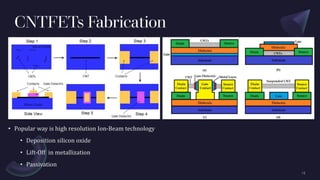
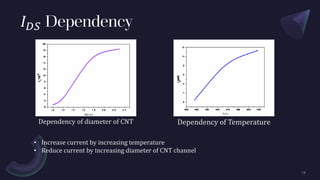
Carbon nanotube field-effect transistors (CNTFETs) are a promising candidate to replace conventional silicon transistors. CNTFETs use a carbon nanotube as the channel between the source and drain, controlled by a gate. They offer advantages like higher carrier mobility, lower power consumption, and the potential for terahertz switching speeds. However, CNTFET technology is still developing, with challenges including process variation and degradation over time when exposed to oxygen. Improving electrostatic control of the carbon nanotube channel through techniques like inner gate designs could help address these issues and bring CNTFETs closer to commercialization.