neurology
Motor system Examination
Dr mohamed rizk khodair
lecturer of neurology
October 6 university
Mohamedrizk.med@edu.edu.eg
‫والجراحة‬ ‫الطب‬ ‫كلية‬
The motor system evaluation is divided into the following
Inspection :
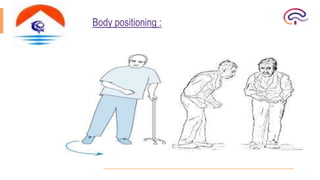
Body positioning
Muscle waste ( wasting or hypertrophy )
Involuntary movements, fasciculation .
Skeletal deformities
Trophic changes
Body positioning :
Muscle wasting
Distribution :
Focal or generalized (proximal or distal)
Unilateral or bilateral
Symmetrical or not
Muscle wasting
pseudo hypertrophy
Skeletal deformities
Look for skeletal deformities : pes cavus , scoliosis
Muscle inspections
Fasciculation : examine the bulky muscle
Trophic changes
Muscle inspections
abnormal movements
• Distribution
• Rest , postural or action
• Frequency
• Amplitude
• Rhythmic or not
• What increase or decrease them
Assessment of muscle tone
A: upper limbs :
Shoulder : Gower’s method
Elbow : passive flexion and extension
Wrist : shaking , passive flexion and extension
B: lower limbs :
Hip : rolling
Knee : hooking , passive flexion and extension
Ankle : shaking , passive flexion and extension
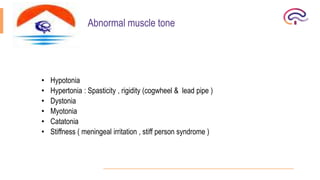
Abnormal muscle tone
• Hypotonia
• Hypertonia : Spasticity , rigidity (cogwheel & lead pipe )
• Dystonia
• Myotonia
• Catatonia
• Stiffness ( meningeal irritation , stiff person syndrome )
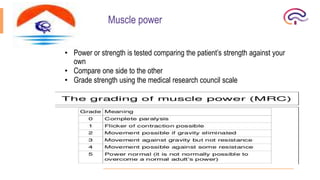
Muscle power
• Power or strength is tested comparing the patient’s strength against your
own
• Compare one side to the other
• Grade strength using the medical research council scale
Upper limb
1. Shoulder ( adduction , abduction , flexion, extension, lateral rotators, medial rotators, serratus
anterior )
2. Elbow ( flexion and extension )
3. Wrist ( flexion and extension )
4. Hand ( thumb, interossesi, lumbricals )
Lower limb
1. Hip : flexion , extension, abduction, adduction
2. Knee : flexion , extension
3. Ankle : dorsiflexion , plantarflexion ,inversion , eversion
Don’t forget the trunk muscle ( abdominal and back muscle )
Gait abnormality
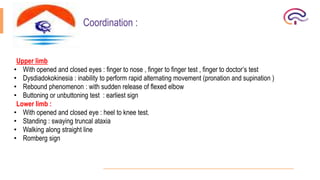
Coordination :
Upper limb
• With opened and closed eyes : finger to nose , finger to finger test , finger to doctor’s test
• Dysdiadokokinesia : inability to perform rapid alternating movement (pronation and supination )
• Rebound phenomenon : with sudden release of flexed elbow
• Buttoning or unbuttoning test : earliest sign
Lower limb :
• With opened and closed eye : heel to knee test.
• Standing : swaying truncal ataxia
• Walking along straight line
• Romberg sign
You must continue searching for all signs of
cerebellum
• Eye : nystagmus
• Speech staccato
• Neck : nodding
• Buttoning and non buttoning
• Rebound phenomenon
• Heel toes walking
Reflexes
Deep reflexes :
Upper limb ( Biceps reflex c5,6 , Brachioradialis reflex c5,6, Triceps reflex c6,7,
Supraspinatus reflex ,Finger reflex )
Lower limb ( knee reflex, ankle reflex, patellar reflex, adductor reflex )
Superficial reflexes
Planter reflexes ( babiniski method ,chaddok ,baradah openhinme , Gordon , Schaefer)
Abdominal reflexes, cremastric reflex , gluteal reflex , anal reflexes
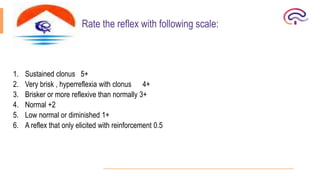
Rate the reflex with following scale:
1. Sustained clonus 5+
2. Very brisk , hyperreflexia with clonus 4+
3. Brisker or more reflexive than normally 3+
4. Normal +2
5. Low normal or diminished 1+
6. A reflex that only elicited with reinforcement 0.5
Reflexes
Superficial reflexes
Abdominal reflex
Trömner reflex Mayer reflex
Reflexes: Pathological
Hoffman's sign (reflex): hold the patients partially extended middle finger by
your index finger and thumb, then flick it sharply by other hand followed by
sudden release~ flexion of the thumb (&adduction) and other fingers .
Tromner sign: hold the patients partially extended middle finger, letting the
hand dangle, then with the other hand flick the finger pad (similar response to
Hoffmann sign).
Wartenberg's thumb adduction sign : examiner links his flexed fingers with
patients' flexed fingers, then both flex their fingers further against each other's
resistance -> normally, thumb extends, while in pyramidal tract lesions ->
thumb adducts & flexes.
Frontal release signs (FRS):
• They are normally present in the developing nervous system, but disappear with maturation, and include palmomental
reflex (PMR), grasp, snout, sucking, head retraction and others.
• They occur with severe diffuse frontal lobes lesions e.g., dementias, diffuse encephalopathy, or head injury.
Guide to Neurological Examination
1. Grasp (forced grasping) reflex: gentle touching patients palm or trying to extend patients fingers - > patients' finger
flexion.
3.Palmomental reflex (PMR), or palm-chin reflex: scratching the palm of the ipsilateral hand especially thenar eminence ~
contraction of the mentalis and orbicularis oris ~ wrinkling of the chin with slight retraction of mouth.
It is exaggerated with frontal lobe lesions.
4. The orbicularis oris (snout): pressing firmly backward on the philtrum of the upper lip ~ puckering and protrusion of the
lips.
5. The sucking reflex).
Lower-Limb Pathologic Reflexes:
1. Babinski sign : the most important of pathological reflexes.
2. Flexion plantar responses:
- Plantar grasp reflex: similar to grasp reflex.
- Plantar muscle reflex: comparable to finger flexor reflex
- Rossolimo's sign: tapping the ball of foot or plantar surface of toes ~
plantar flexion.
3. Crossed extensor reflex: stimulation of the foot or leg on one side ~
flexion of that leg with extension of the other leg (with severe myelopathy).
4. Extensor thrust response: pressure applied to the foot of the passively flexed leg causes reflex extension.
5. The mass reflex (of Riddoch) : with severe myelopathy, stimulation below the spinal level -> massive
response, including leg flexion, abdominal wall contractions, evacuation of the bladder and bowel, sweating,
reflex erythema, pilomotor responses, and hypertension ± priapism and ejaculation.
The typical reflex pattern with UMNL is exaggerated DTRs, lost superficial
reflexes, and emergence of pathologic reflexes.
Reflexes: Pathological Postural Reflex
• Flexion withdrawal reflex:
• Decorticated:
• Decerebrated:
Thank you
Mohamedrizk.med@edu.edu.eg

motor system examination.pptx

  • 1.
    neurology Motor system Examination Drmohamed rizk khodair lecturer of neurology October 6 university Mohamedrizk.med@edu.edu.eg ‫والجراحة‬ ‫الطب‬ ‫كلية‬
  • 2.
    The motor systemevaluation is divided into the following Inspection : Body positioning Muscle waste ( wasting or hypertrophy ) Involuntary movements, fasciculation . Skeletal deformities Trophic changes
  • 3.
  • 4.
    Muscle wasting Distribution : Focalor generalized (proximal or distal) Unilateral or bilateral Symmetrical or not
  • 5.
  • 6.
    Skeletal deformities Look forskeletal deformities : pes cavus , scoliosis
  • 7.
    Muscle inspections Fasciculation :examine the bulky muscle Trophic changes
  • 8.
    Muscle inspections abnormal movements •Distribution • Rest , postural or action • Frequency • Amplitude • Rhythmic or not • What increase or decrease them
  • 9.
    Assessment of muscletone A: upper limbs : Shoulder : Gower’s method Elbow : passive flexion and extension Wrist : shaking , passive flexion and extension B: lower limbs : Hip : rolling Knee : hooking , passive flexion and extension Ankle : shaking , passive flexion and extension
  • 10.
    Abnormal muscle tone •Hypotonia • Hypertonia : Spasticity , rigidity (cogwheel & lead pipe ) • Dystonia • Myotonia • Catatonia • Stiffness ( meningeal irritation , stiff person syndrome )
  • 11.
    Muscle power • Poweror strength is tested comparing the patient’s strength against your own • Compare one side to the other • Grade strength using the medical research council scale
  • 12.
    Upper limb 1. Shoulder( adduction , abduction , flexion, extension, lateral rotators, medial rotators, serratus anterior ) 2. Elbow ( flexion and extension ) 3. Wrist ( flexion and extension ) 4. Hand ( thumb, interossesi, lumbricals )
  • 13.
    Lower limb 1. Hip: flexion , extension, abduction, adduction 2. Knee : flexion , extension 3. Ankle : dorsiflexion , plantarflexion ,inversion , eversion Don’t forget the trunk muscle ( abdominal and back muscle )
  • 14.
  • 15.
    Coordination : Upper limb •With opened and closed eyes : finger to nose , finger to finger test , finger to doctor’s test • Dysdiadokokinesia : inability to perform rapid alternating movement (pronation and supination ) • Rebound phenomenon : with sudden release of flexed elbow • Buttoning or unbuttoning test : earliest sign Lower limb : • With opened and closed eye : heel to knee test. • Standing : swaying truncal ataxia • Walking along straight line • Romberg sign
  • 16.
    You must continuesearching for all signs of cerebellum • Eye : nystagmus • Speech staccato • Neck : nodding • Buttoning and non buttoning • Rebound phenomenon • Heel toes walking
  • 17.
    Reflexes Deep reflexes : Upperlimb ( Biceps reflex c5,6 , Brachioradialis reflex c5,6, Triceps reflex c6,7, Supraspinatus reflex ,Finger reflex ) Lower limb ( knee reflex, ankle reflex, patellar reflex, adductor reflex ) Superficial reflexes Planter reflexes ( babiniski method ,chaddok ,baradah openhinme , Gordon , Schaefer) Abdominal reflexes, cremastric reflex , gluteal reflex , anal reflexes
  • 18.
    Rate the reflexwith following scale: 1. Sustained clonus 5+ 2. Very brisk , hyperreflexia with clonus 4+ 3. Brisker or more reflexive than normally 3+ 4. Normal +2 5. Low normal or diminished 1+ 6. A reflex that only elicited with reinforcement 0.5
  • 19.
  • 20.
  • 21.
  • 22.
    Trömner reflex Mayerreflex Reflexes: Pathological Hoffman's sign (reflex): hold the patients partially extended middle finger by your index finger and thumb, then flick it sharply by other hand followed by sudden release~ flexion of the thumb (&adduction) and other fingers . Tromner sign: hold the patients partially extended middle finger, letting the hand dangle, then with the other hand flick the finger pad (similar response to Hoffmann sign). Wartenberg's thumb adduction sign : examiner links his flexed fingers with patients' flexed fingers, then both flex their fingers further against each other's resistance -> normally, thumb extends, while in pyramidal tract lesions -> thumb adducts & flexes.
  • 23.
    Frontal release signs(FRS): • They are normally present in the developing nervous system, but disappear with maturation, and include palmomental reflex (PMR), grasp, snout, sucking, head retraction and others. • They occur with severe diffuse frontal lobes lesions e.g., dementias, diffuse encephalopathy, or head injury. Guide to Neurological Examination 1. Grasp (forced grasping) reflex: gentle touching patients palm or trying to extend patients fingers - > patients' finger flexion. 3.Palmomental reflex (PMR), or palm-chin reflex: scratching the palm of the ipsilateral hand especially thenar eminence ~ contraction of the mentalis and orbicularis oris ~ wrinkling of the chin with slight retraction of mouth. It is exaggerated with frontal lobe lesions. 4. The orbicularis oris (snout): pressing firmly backward on the philtrum of the upper lip ~ puckering and protrusion of the lips. 5. The sucking reflex).
  • 24.
    Lower-Limb Pathologic Reflexes: 1.Babinski sign : the most important of pathological reflexes. 2. Flexion plantar responses: - Plantar grasp reflex: similar to grasp reflex. - Plantar muscle reflex: comparable to finger flexor reflex - Rossolimo's sign: tapping the ball of foot or plantar surface of toes ~ plantar flexion. 3. Crossed extensor reflex: stimulation of the foot or leg on one side ~ flexion of that leg with extension of the other leg (with severe myelopathy). 4. Extensor thrust response: pressure applied to the foot of the passively flexed leg causes reflex extension. 5. The mass reflex (of Riddoch) : with severe myelopathy, stimulation below the spinal level -> massive response, including leg flexion, abdominal wall contractions, evacuation of the bladder and bowel, sweating, reflex erythema, pilomotor responses, and hypertension ± priapism and ejaculation.
  • 25.
    The typical reflexpattern with UMNL is exaggerated DTRs, lost superficial reflexes, and emergence of pathologic reflexes.
  • 26.
    Reflexes: Pathological PosturalReflex • Flexion withdrawal reflex: • Decorticated: • Decerebrated:
  • 27.