CNC
TECHNOLOGY

         1
INTRODUCTION TO
      CNC


                  2
DEFINITION


   C          N         C

Computer   Numerical Control


                               3
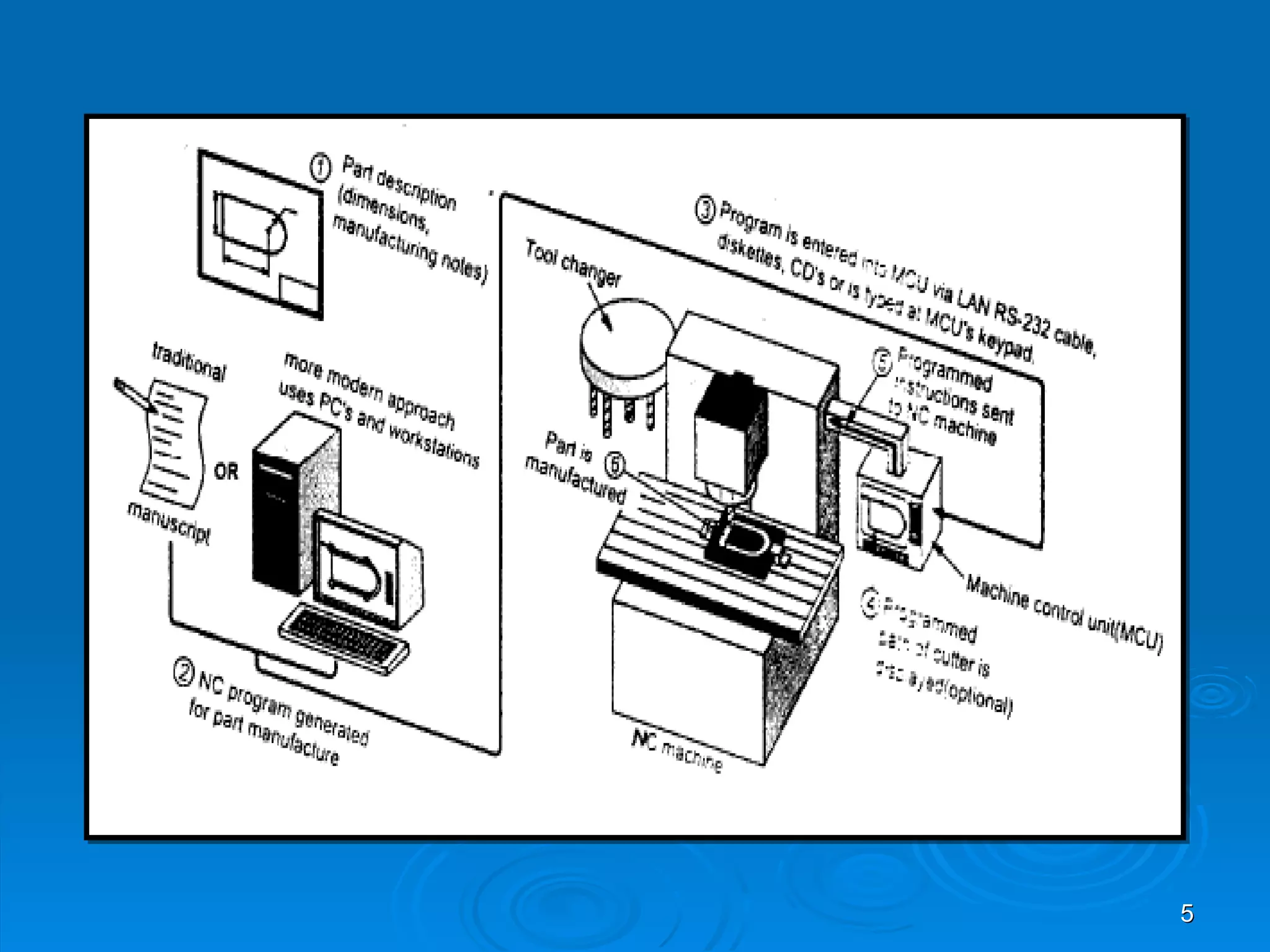
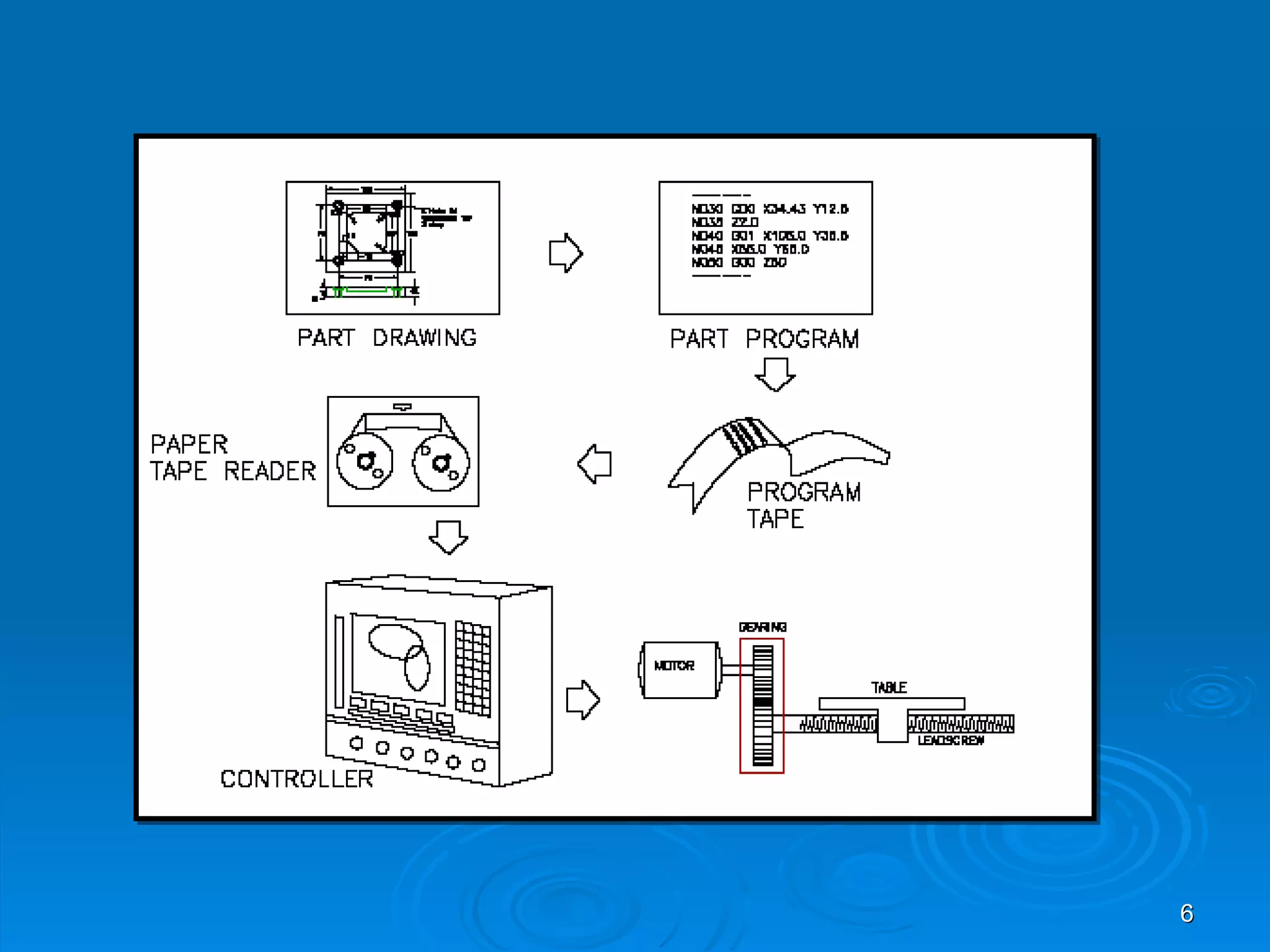
CNC TECHNOLOGY
•   The CNC stands for Computer Numerical Control
•   Instructions are stored as a program in micro-computer
    attached to the machine.
•   Refers to a computer controller that controls the
    movement of every axis of the machine
•   Using G and M codes instructions
•   Drives the spindle or machine tool into a raw material to
    fabricate or to remove the unwanted material from work
    piece more accurately without human intervention.
•   The computer will also handle much of the controllogic of
    the machine, making it more adaptable than earlier hard-
    wired controllers.


                                                            4
5
6
HISTORY
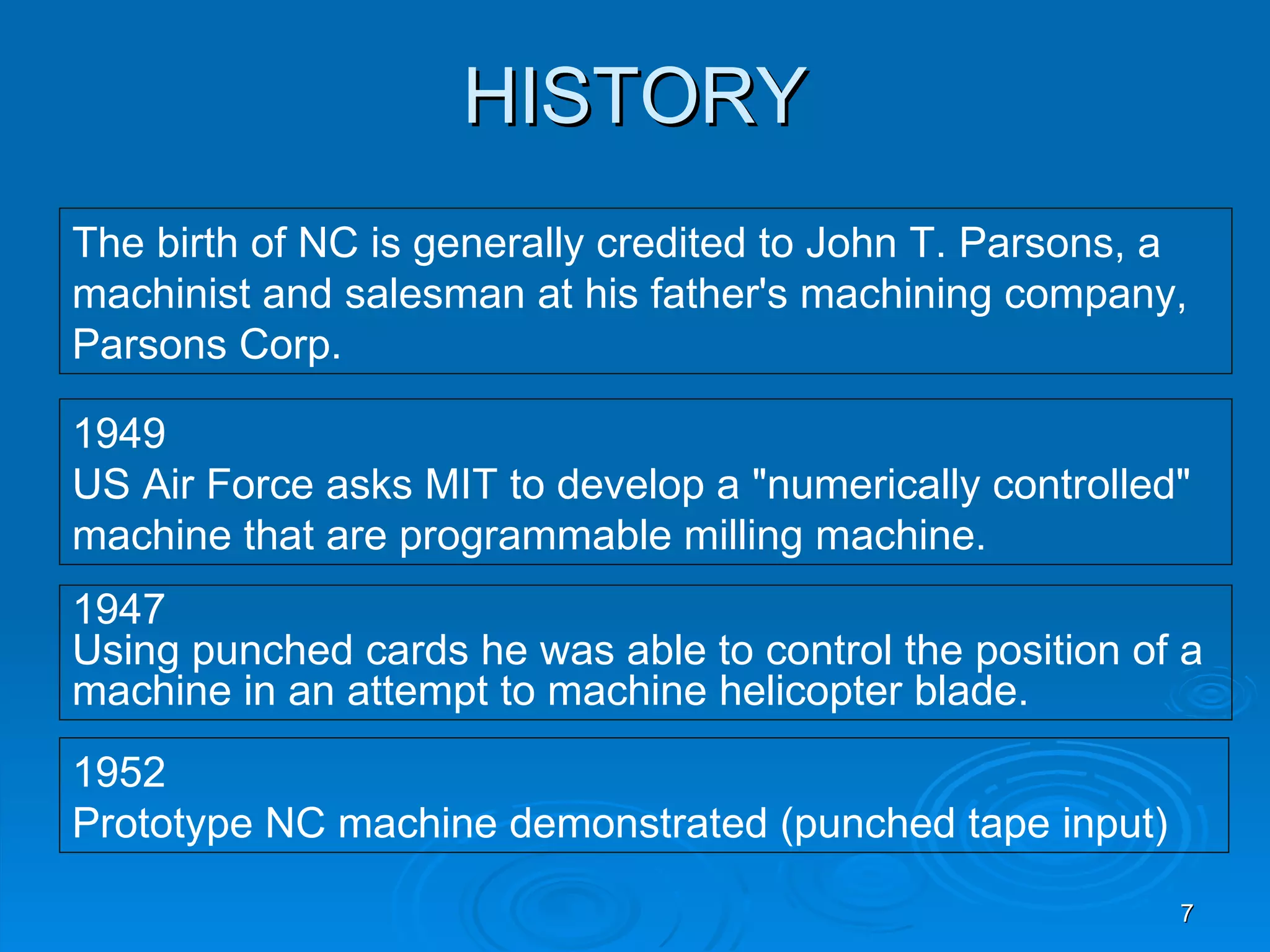
The birth of NC is generally credited to John T. Parsons, a
machinist and salesman at his father's machining company,
Parsons Corp.

1949
US Air Force asks MIT to develop a "numerically controlled"
machine that are programmable milling machine.
1947
Using punched cards he was able to control the position of a
machine in an attempt to machine helicopter blade.
1952
Prototype NC machine demonstrated (punched tape input)
                                                          7
HISTORY
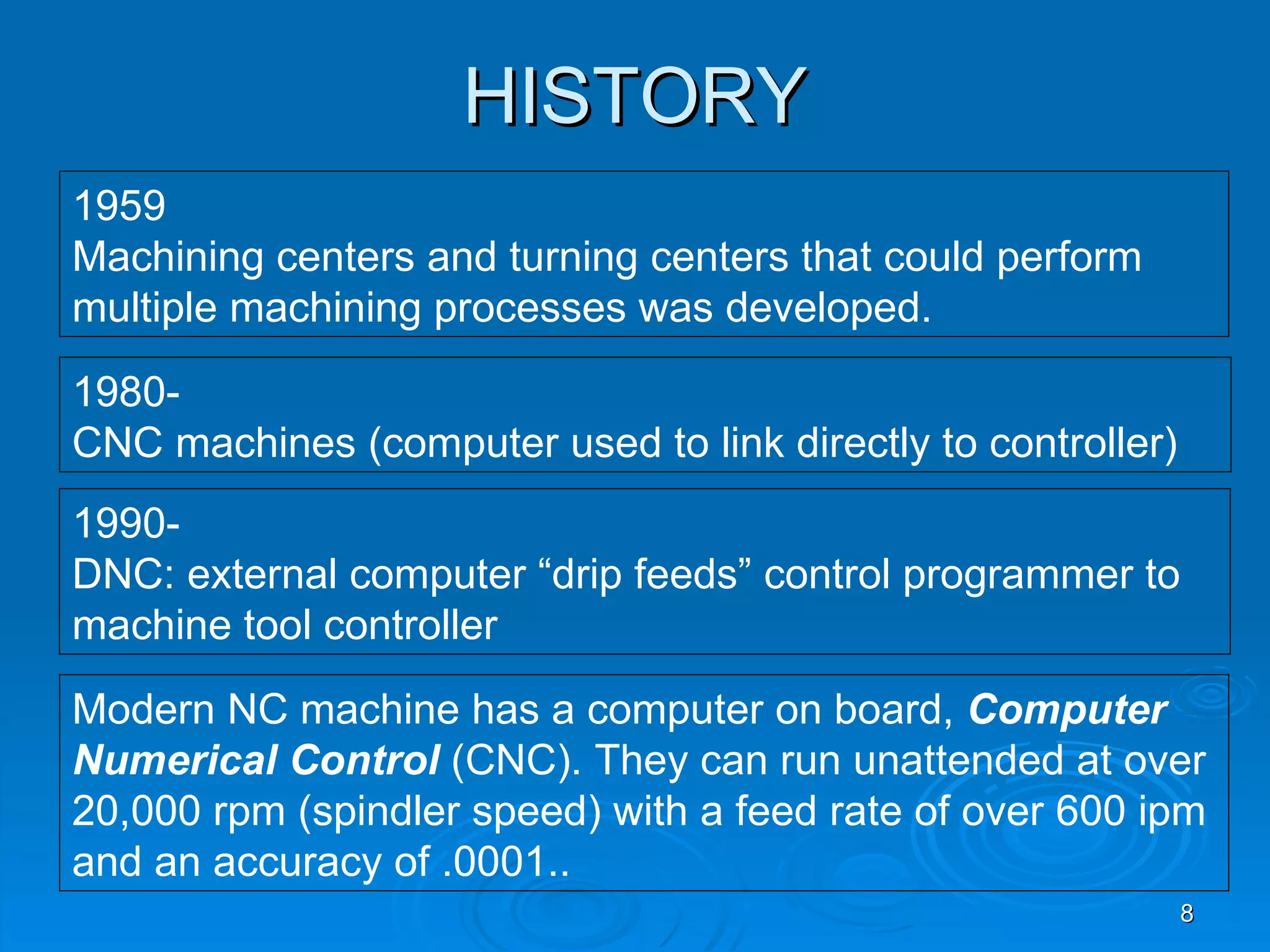
1959
Machining centers and turning centers that could perform
multiple machining processes was developed.

1980-
CNC machines (computer used to link directly to controller)
1990-
DNC: external computer “drip feeds” control programmer to
machine tool controller
Modern NC machine has a computer on board, Computer
Numerical Control (CNC). They can run unattended at over
20,000 rpm (spindler speed) with a feed rate of over 600 ipm
and an accuracy of .0001..
                                                              8
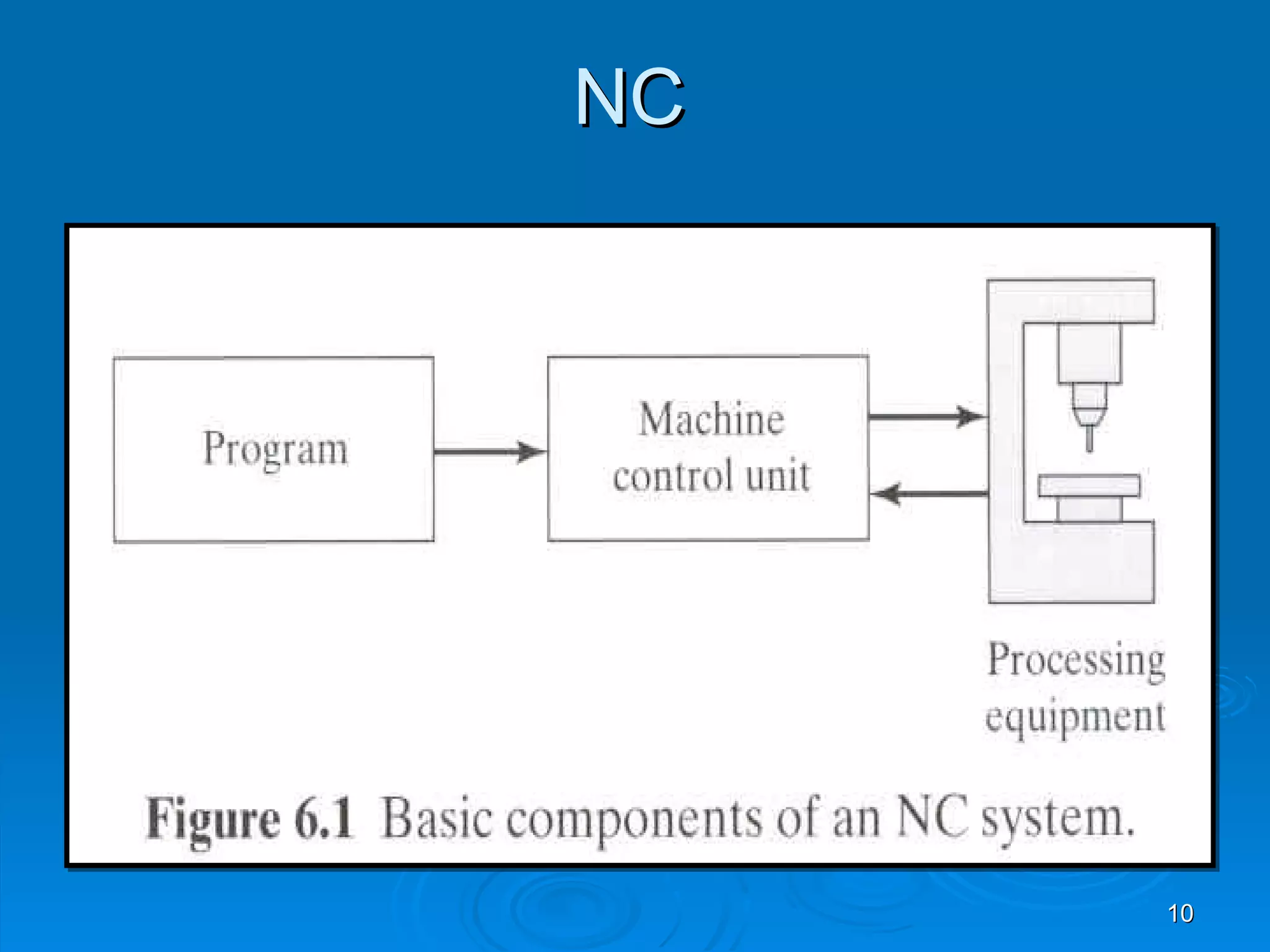
NC
• A control system which primarily processes numeric
  input.

• Limited programming capability at the machine tool.

• Limited logic beyond direct input.

• These types of systems are referred to as “hardwire
  controls” and were popular from the 1950’s to
  1970’s.
                                                   9
NC


     10
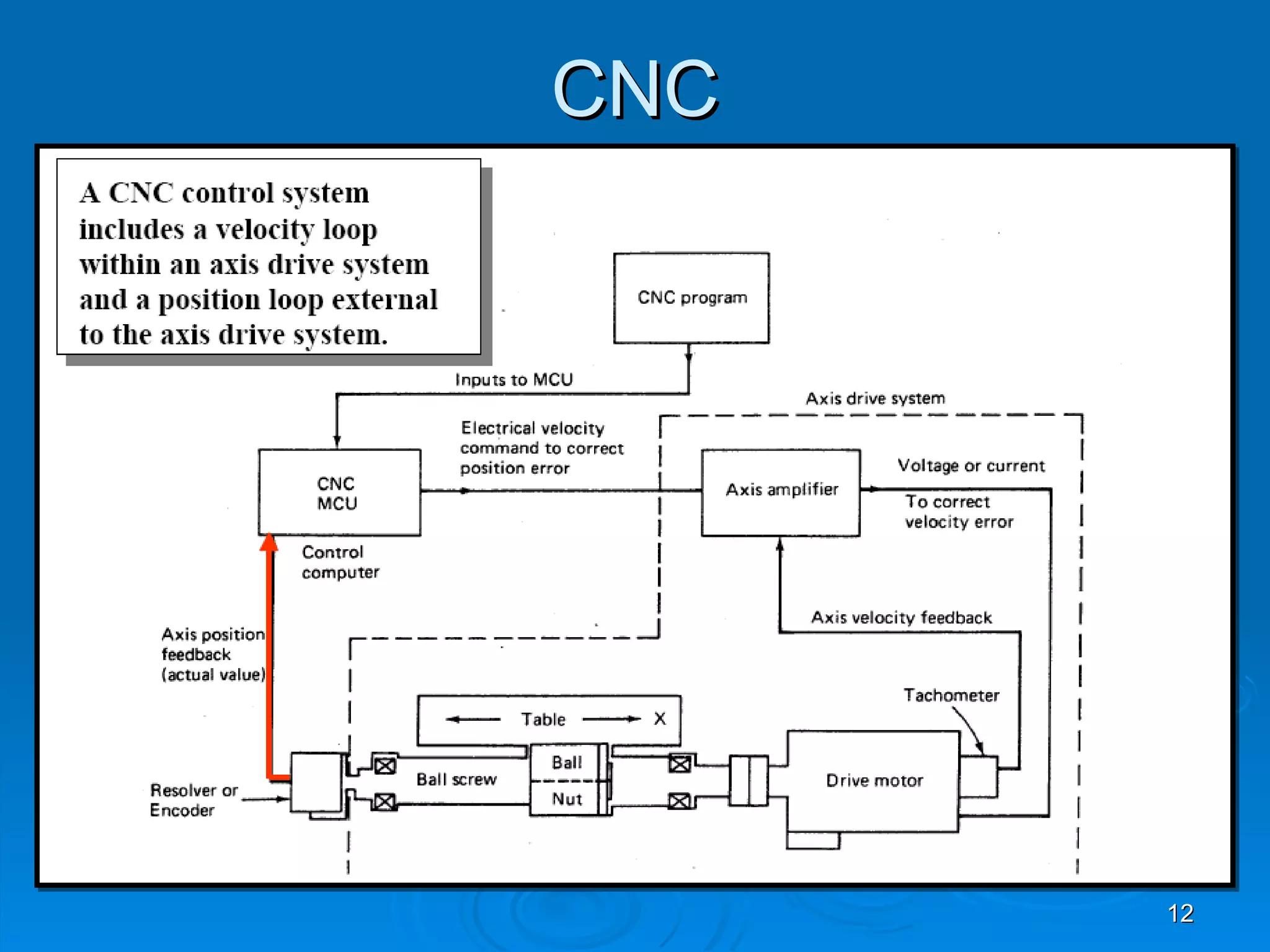
CNC

• A numerical control system in which the data
  handling, control sequences, and response to
  input is determined by an on-board computer
  system at the machine tool.


                                                 11
CNC


      12
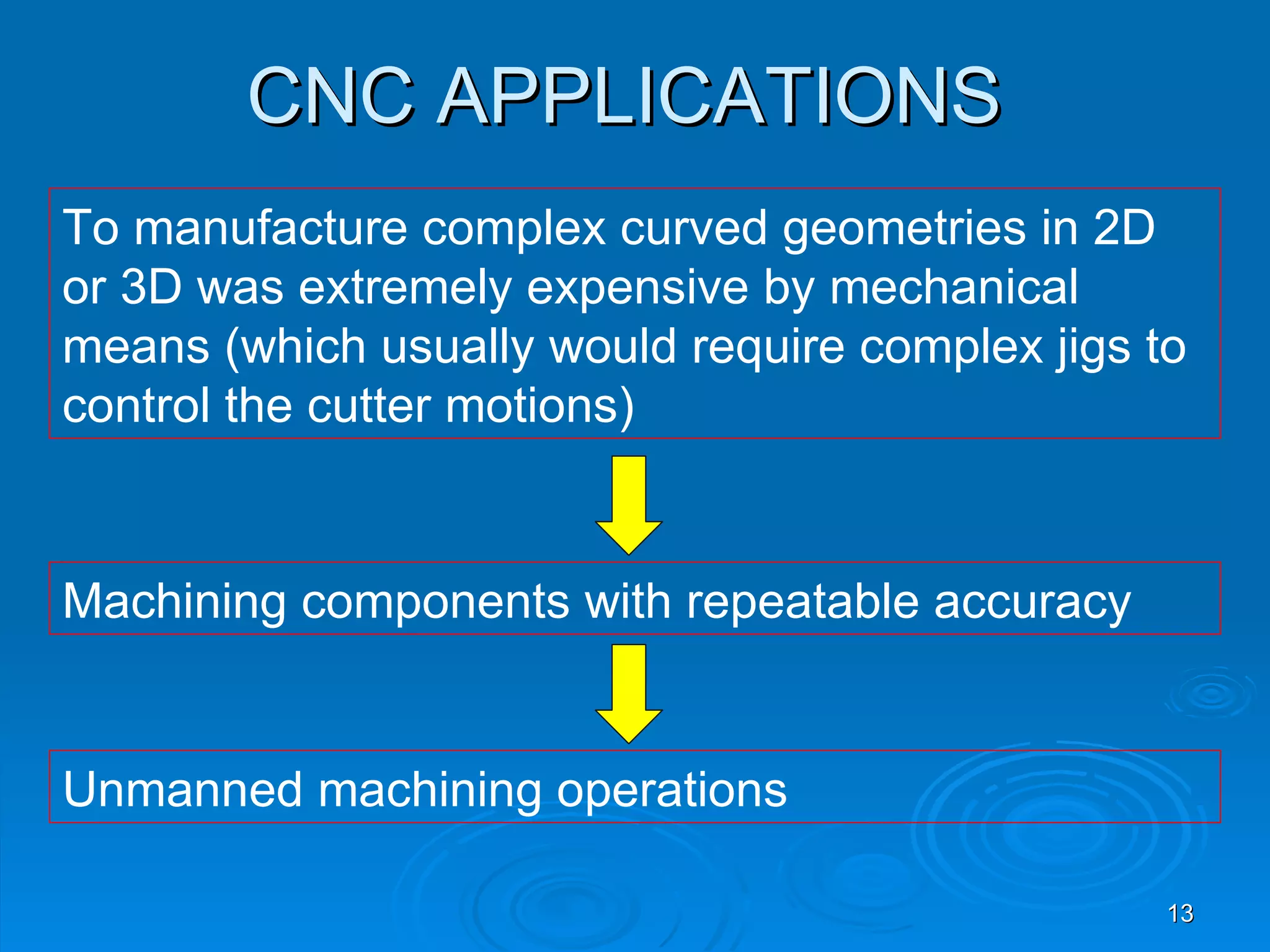
CNC APPLICATIONS
To manufacture complex curved geometries in 2D
or 3D was extremely expensive by mechanical
means (which usually would require complex jigs to
control the cutter motions)


Machining components with repeatable accuracy


Unmanned machining operations

                                                 13
CNC APPLICATIONS
Machining

• 2.5D / 3D

• Turning : Lathes, Turning Centre

• Milling : Machining Centres


                                     14
CNC APPLICATIONS
Forming
• 2D

• 3D

• Plasma & Laser Cutting

• Blanking, Nibbling & Punching

• Rapid Prototyping
                                  15
TYPES OF
CNC MACHINES


               16
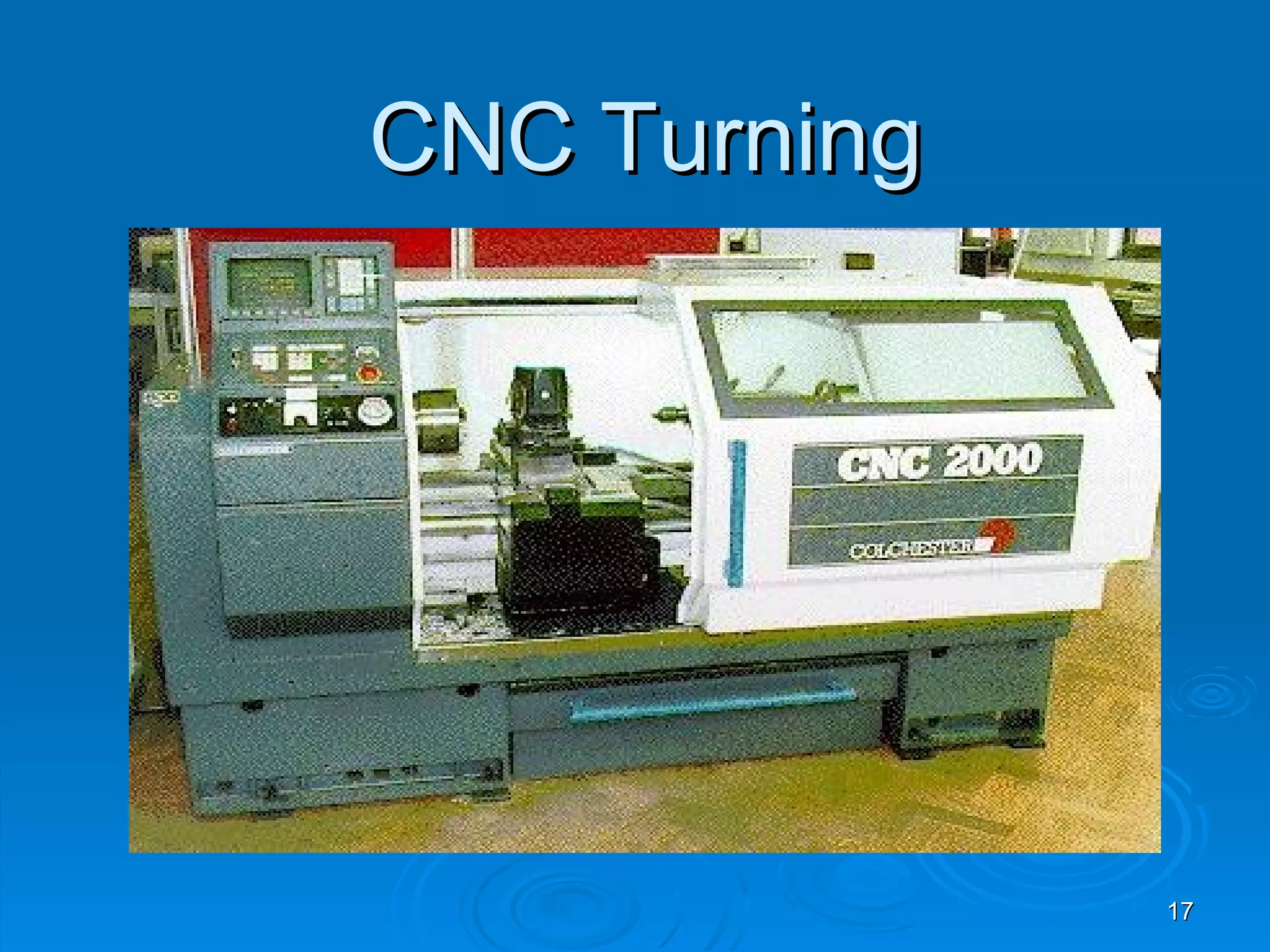
CNC Turning


              17
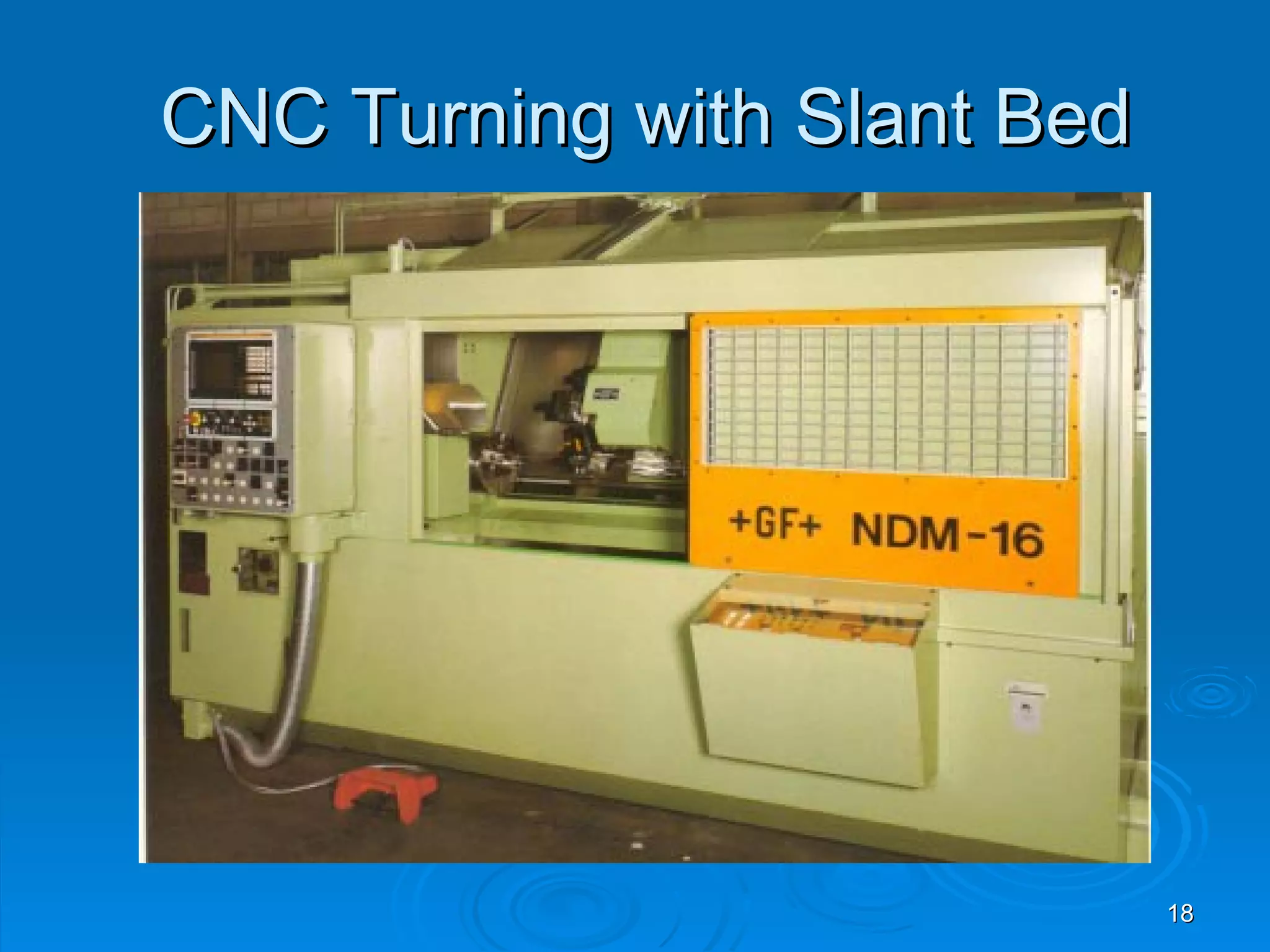
CNC Turning with Slant Bed


                             18
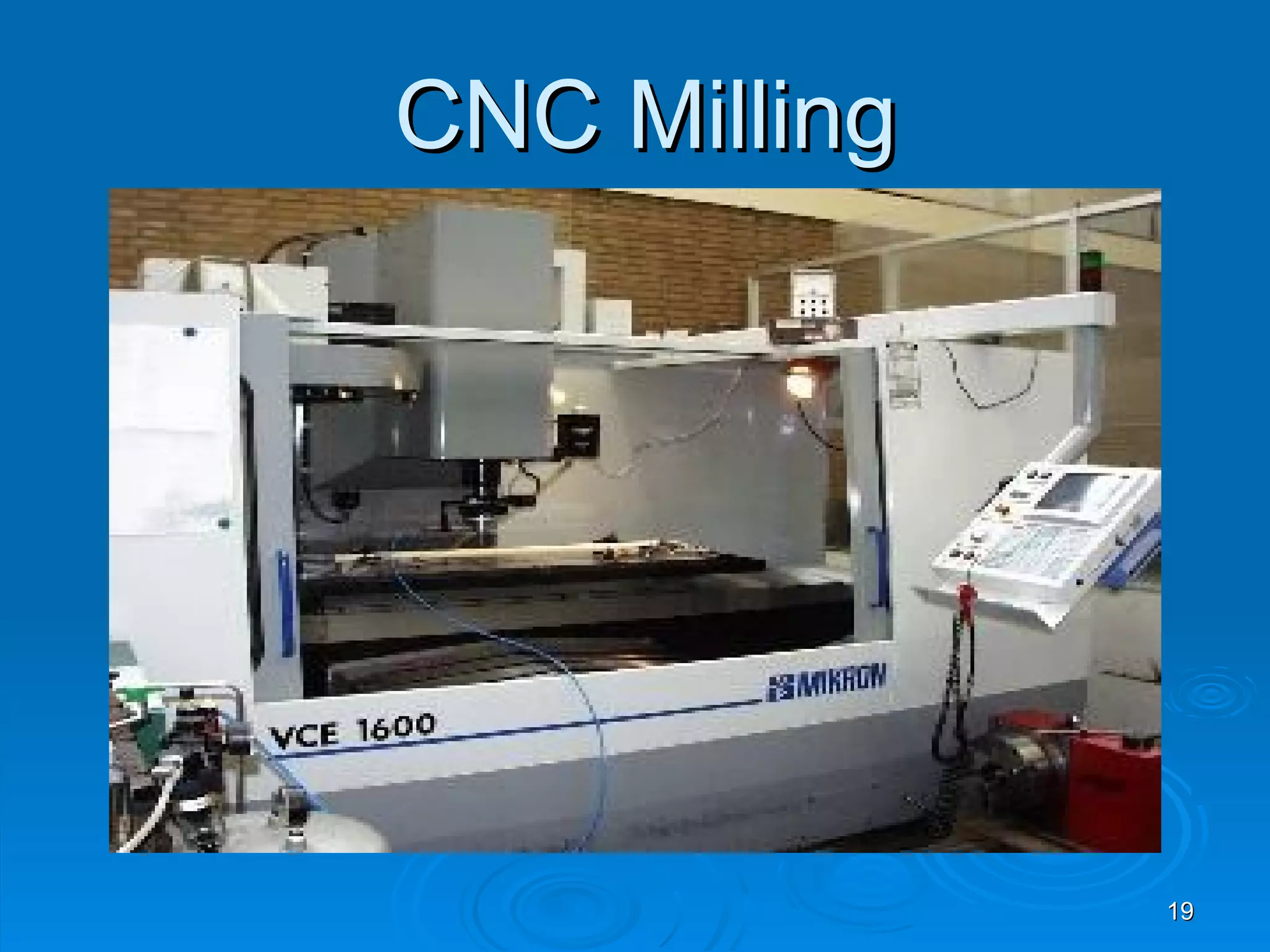
CNC Milling


              19
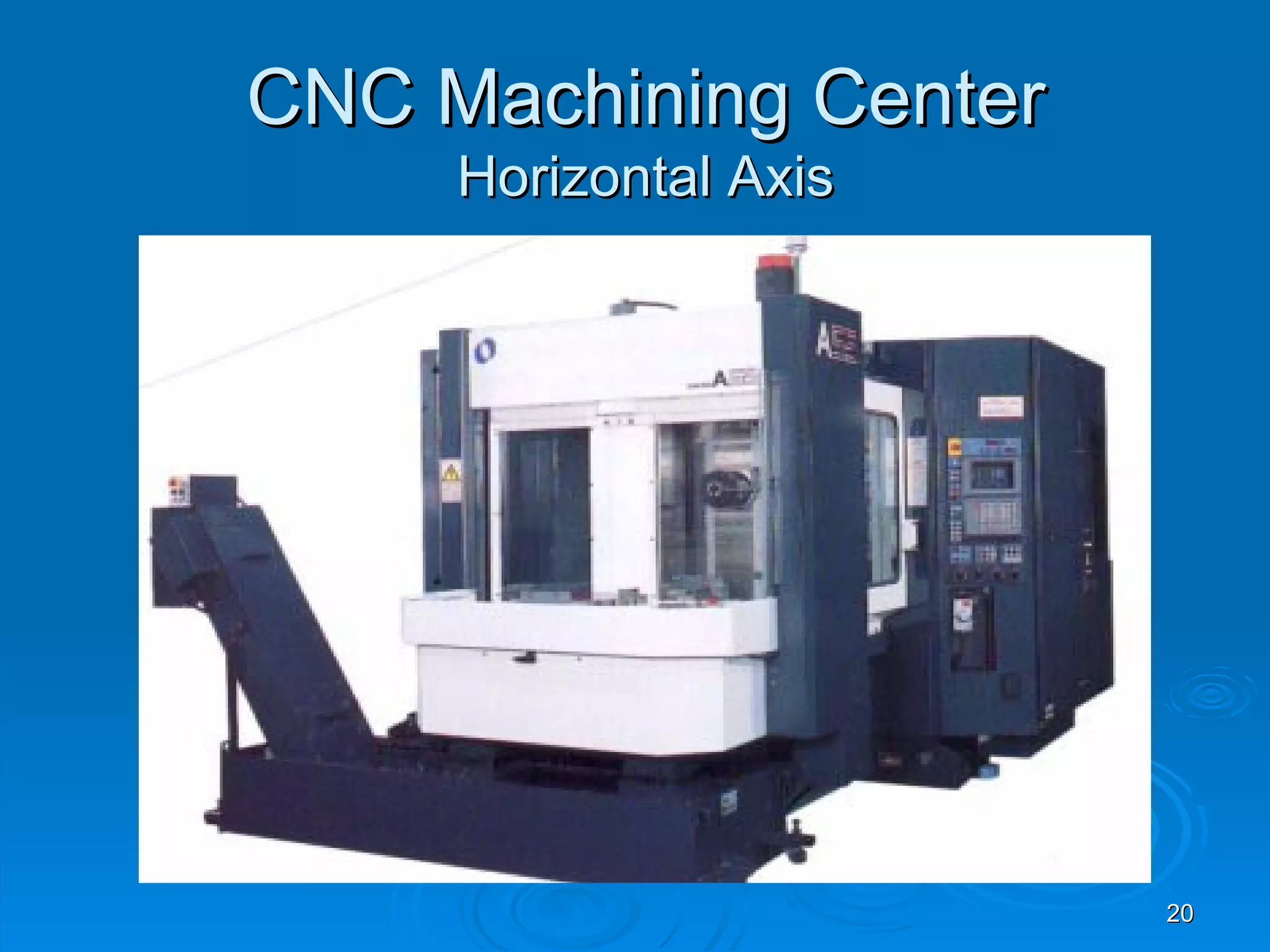
CNC Machining Center
     Horizontal Axis


                       20
CNC Coordinate Measuring


                           21
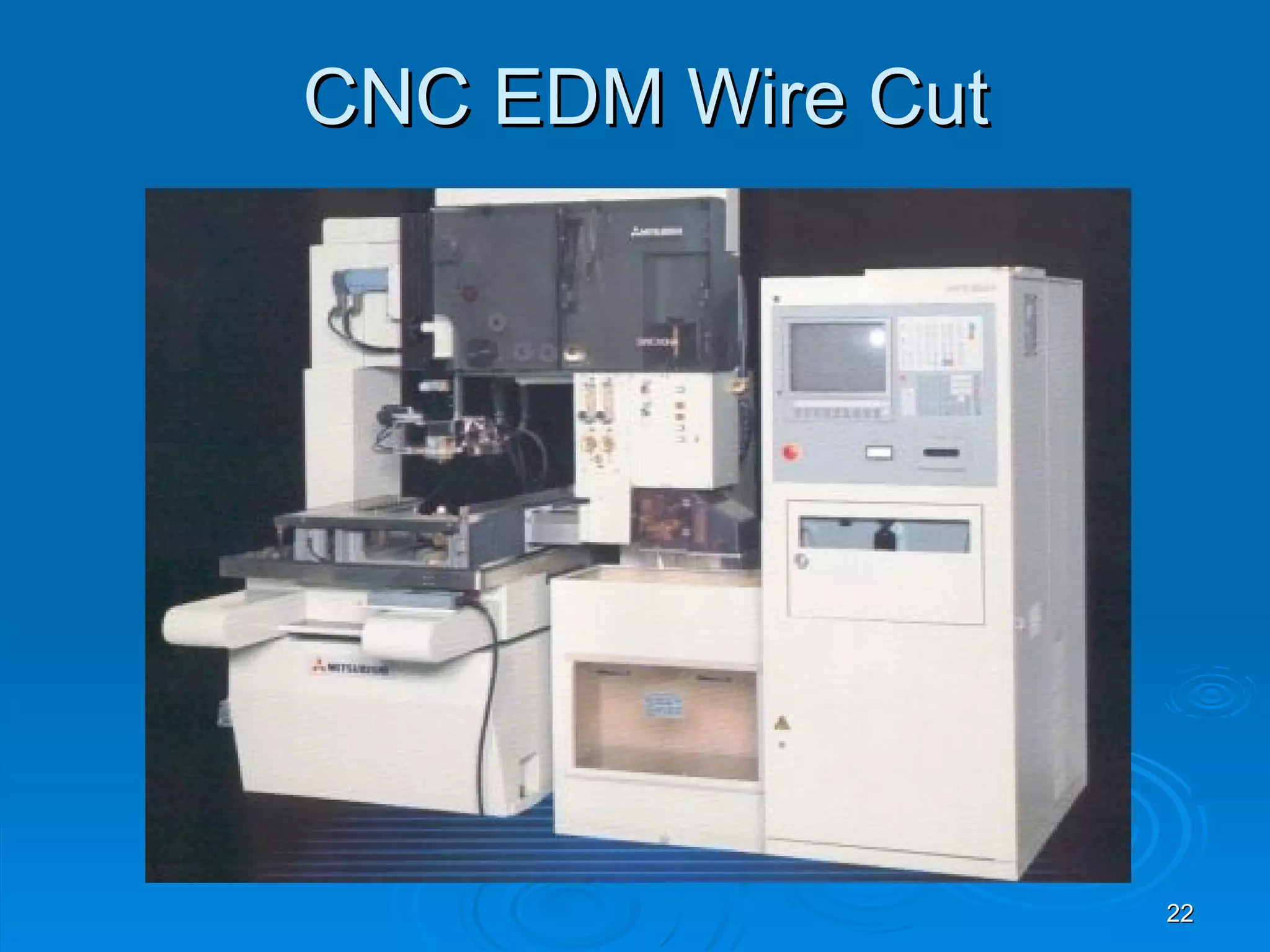
CNC EDM Wire Cut


                   22
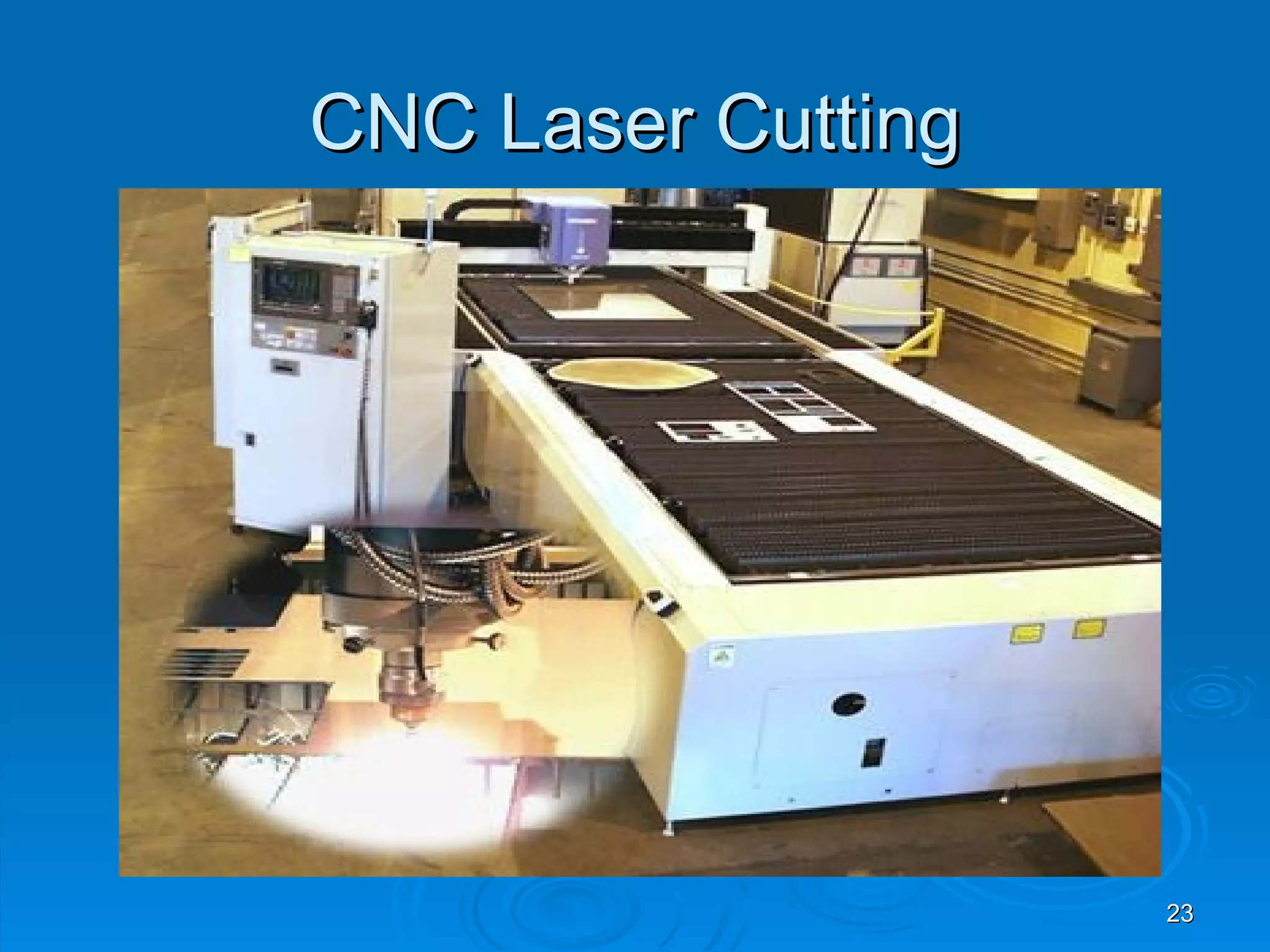
CNC Laser Cutting


                    23
CNC Plasma Cutting


                     24
CNC Press


            25
CNC Rapid Prototyping


                        26
INDUSTRIES MOST AFFECTED
            &
    SAMPLE PRODUCTS
            OF
   CNC MANUFACTURING


                       27
AUTOMOTIVE INDUSTRY
    Engine Block


                      28
AUTOMOTIVE INDUSTRY
   Different Products


                        29
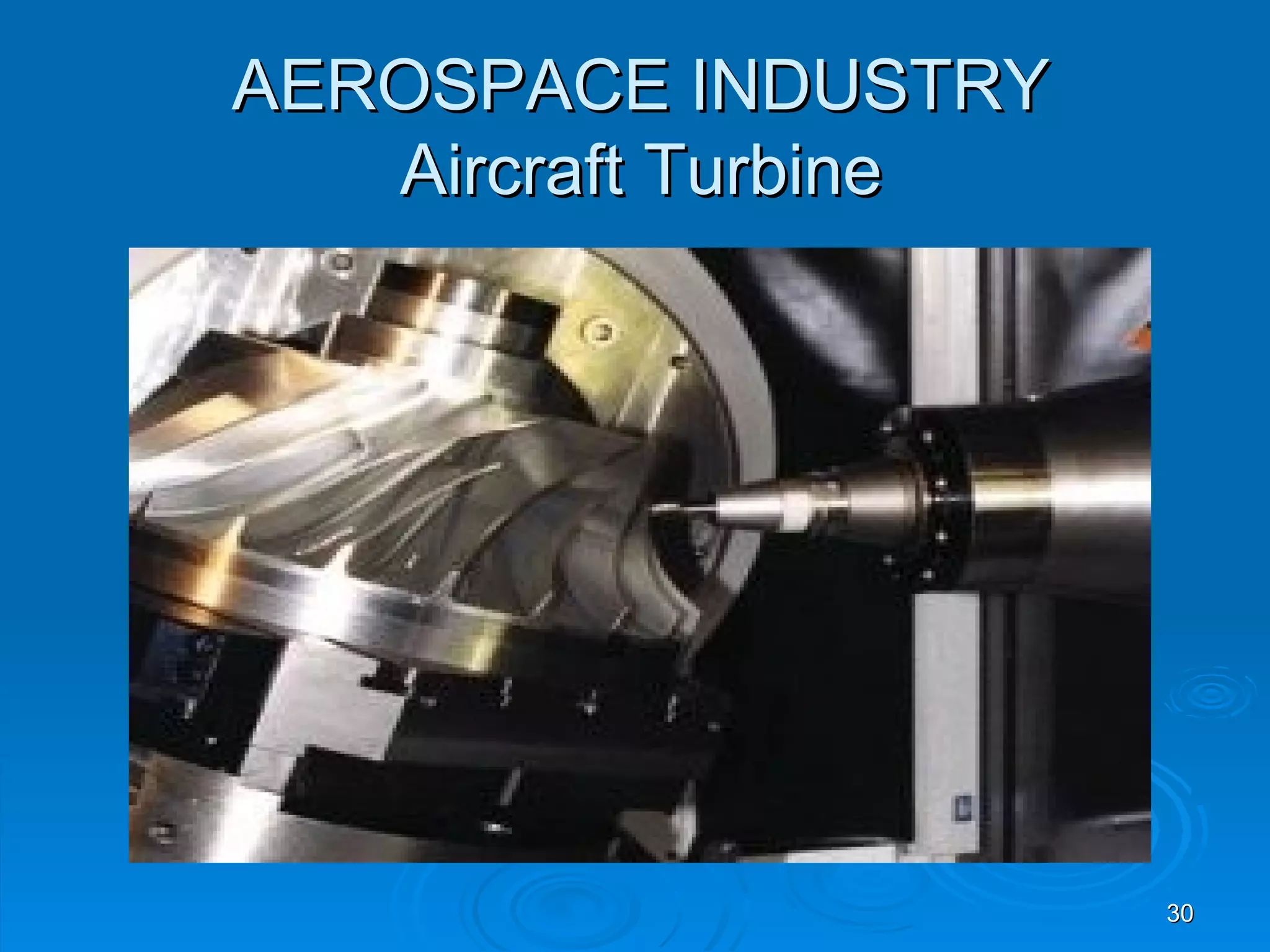
AEROSPACE INDUSTRY
   Aircraft Turbine


                      30
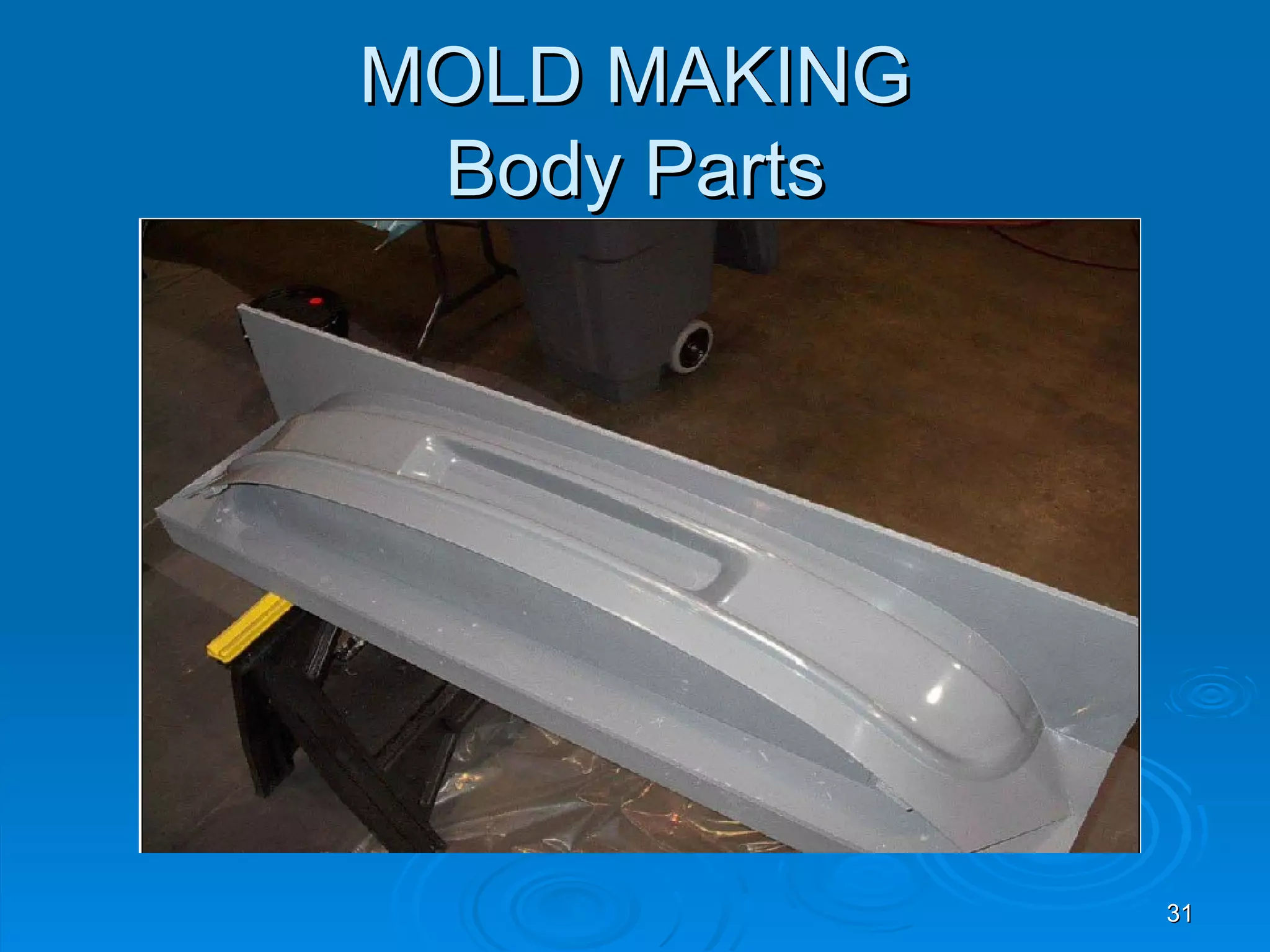
MOLD MAKING
 Body Parts


              31
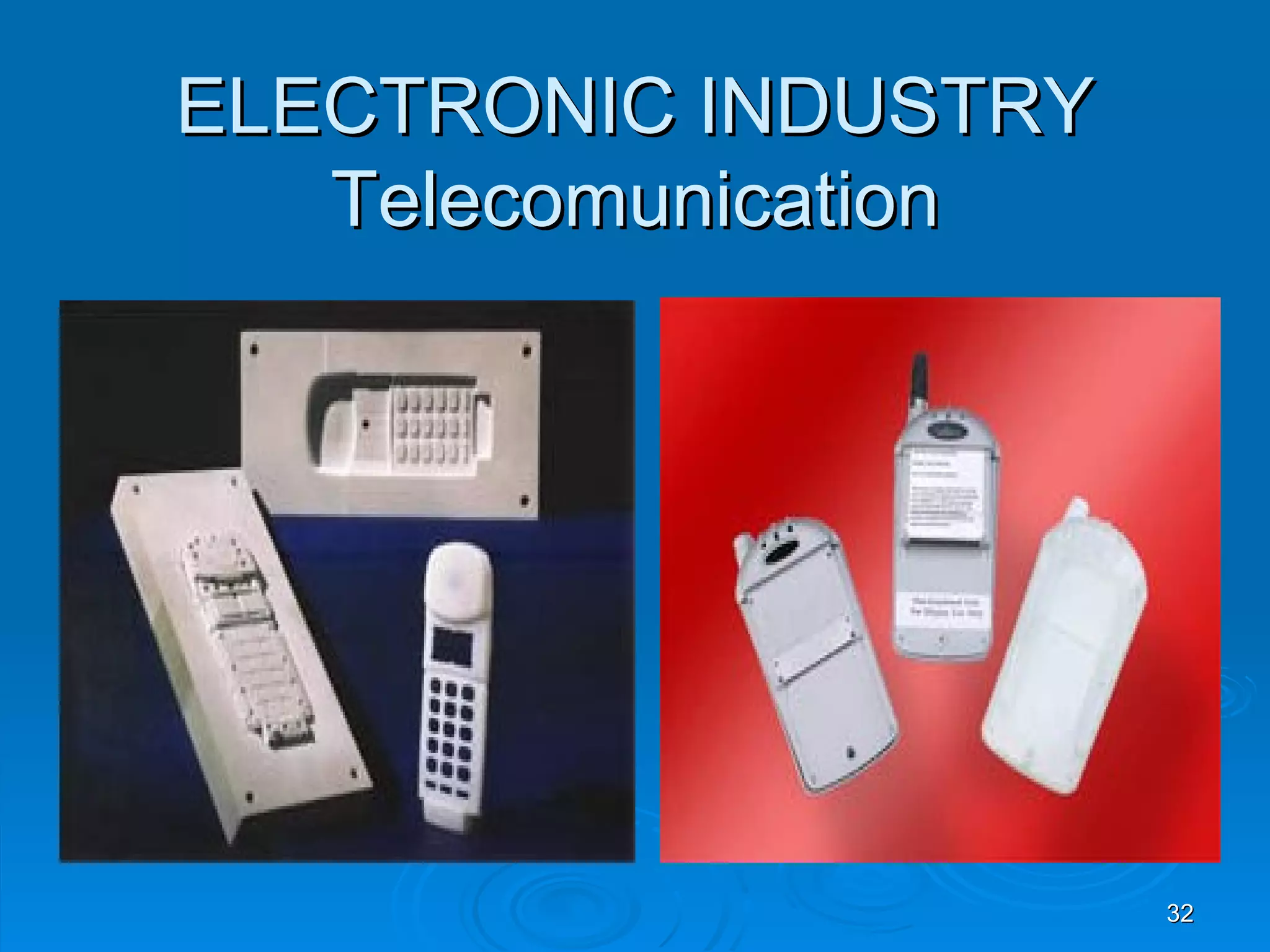
ELECTRONIC INDUSTRY
   Telecomunication


                      32
RAPID PROTOTYPING
    PRODUCTS


                    33

Cnc technology yani punye

  • 1.
  • 2.
  • 3.
    DEFINITION C N C Computer Numerical Control 3
  • 4.
    CNC TECHNOLOGY • The CNC stands for Computer Numerical Control • Instructions are stored as a program in micro-computer attached to the machine. • Refers to a computer controller that controls the movement of every axis of the machine • Using G and M codes instructions • Drives the spindle or machine tool into a raw material to fabricate or to remove the unwanted material from work piece more accurately without human intervention. • The computer will also handle much of the controllogic of the machine, making it more adaptable than earlier hard- wired controllers. 4
  • 5.
  • 6.
  • 7.
    HISTORY The birth ofNC is generally credited to John T. Parsons, a machinist and salesman at his father's machining company, Parsons Corp. 1949 US Air Force asks MIT to develop a "numerically controlled" machine that are programmable milling machine. 1947 Using punched cards he was able to control the position of a machine in an attempt to machine helicopter blade. 1952 Prototype NC machine demonstrated (punched tape input) 7
  • 8.
    HISTORY 1959 Machining centers andturning centers that could perform multiple machining processes was developed. 1980- CNC machines (computer used to link directly to controller) 1990- DNC: external computer “drip feeds” control programmer to machine tool controller Modern NC machine has a computer on board, Computer Numerical Control (CNC). They can run unattended at over 20,000 rpm (spindler speed) with a feed rate of over 600 ipm and an accuracy of .0001.. 8
  • 9.
    NC • A controlsystem which primarily processes numeric input. • Limited programming capability at the machine tool. • Limited logic beyond direct input. • These types of systems are referred to as “hardwire controls” and were popular from the 1950’s to 1970’s. 9
  • 10.
    NC 10
  • 11.
    CNC • A numericalcontrol system in which the data handling, control sequences, and response to input is determined by an on-board computer system at the machine tool. 11
  • 12.
    CNC 12
  • 13.
    CNC APPLICATIONS To manufacturecomplex curved geometries in 2D or 3D was extremely expensive by mechanical means (which usually would require complex jigs to control the cutter motions) Machining components with repeatable accuracy Unmanned machining operations 13
  • 14.
    CNC APPLICATIONS Machining • 2.5D/ 3D • Turning : Lathes, Turning Centre • Milling : Machining Centres 14
  • 15.
    CNC APPLICATIONS Forming • 2D •3D • Plasma & Laser Cutting • Blanking, Nibbling & Punching • Rapid Prototyping 15
  • 16.
  • 17.
  • 18.
    CNC Turning withSlant Bed 18
  • 19.
  • 20.
    CNC Machining Center Horizontal Axis 20
  • 21.
  • 22.
  • 23.
  • 24.
  • 25.
  • 26.
  • 27.
    INDUSTRIES MOST AFFECTED & SAMPLE PRODUCTS OF CNC MANUFACTURING 27
  • 28.
    AUTOMOTIVE INDUSTRY Engine Block 28
  • 29.
    AUTOMOTIVE INDUSTRY Different Products 29
  • 30.
    AEROSPACE INDUSTRY Aircraft Turbine 30
  • 31.
  • 32.
    ELECTRONIC INDUSTRY Telecomunication 32
  • 33.
    RAPID PROTOTYPING PRODUCTS 33