ABES Engineering College
Ghaziabad
Summer training program
CNC Milling Machine
Presented by
Gitanshu kumar
Roll No.- 1503240904
Submitted to:-
Mr. Sanjay kumar
Asst. prof. ABESEC GZB
Content CNC Machines
 The Evolution of NC
 Types of CNC Machine
 Types of CNC Machine control units
 Different ways of data input
 Operational Features of CNC Machine
 CNC Milling Machine
 Features of CNC Milling
 Tools
 Cut Viewer Mill
 Programming Key Letters
 G Code
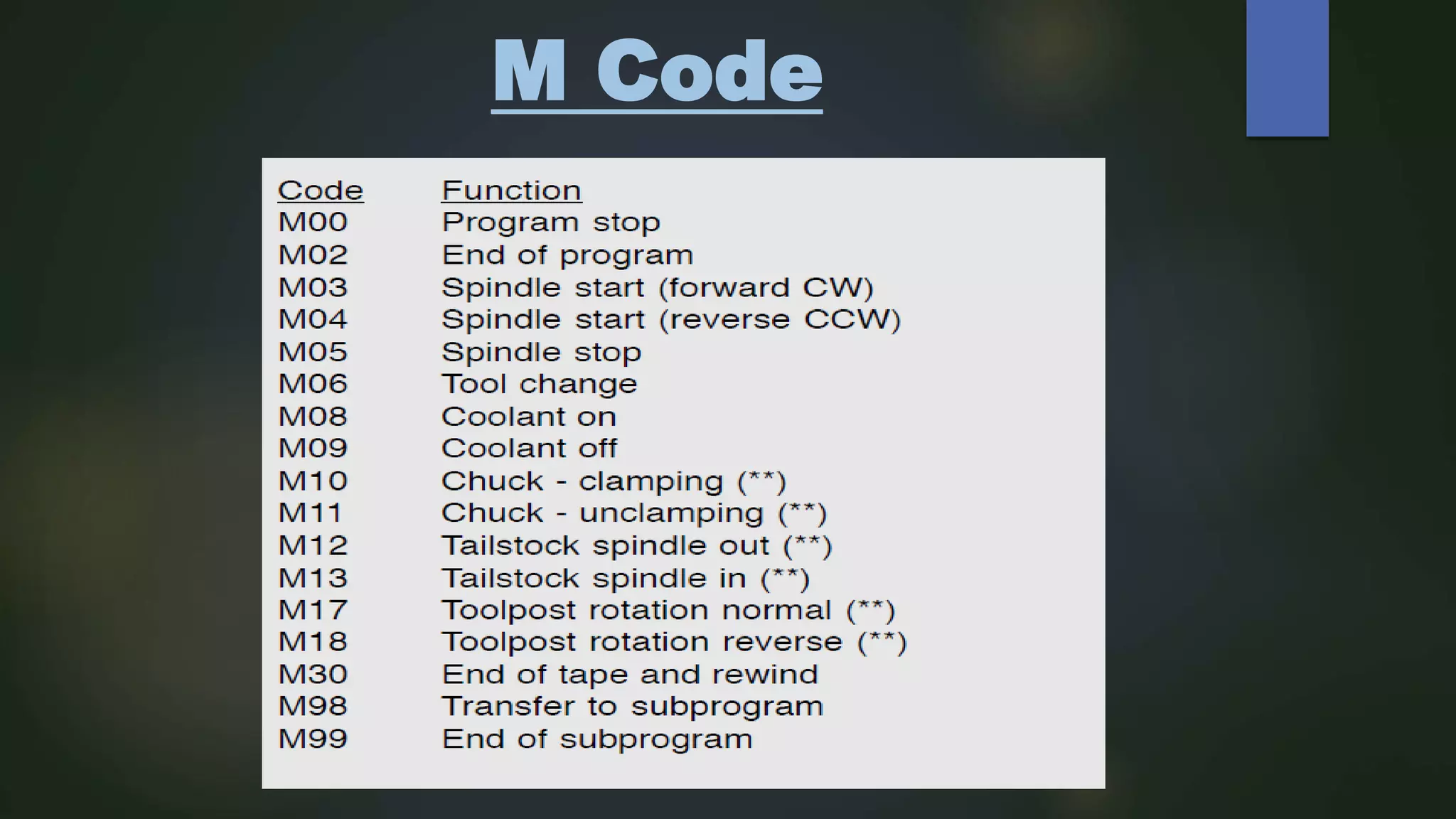
 M Code
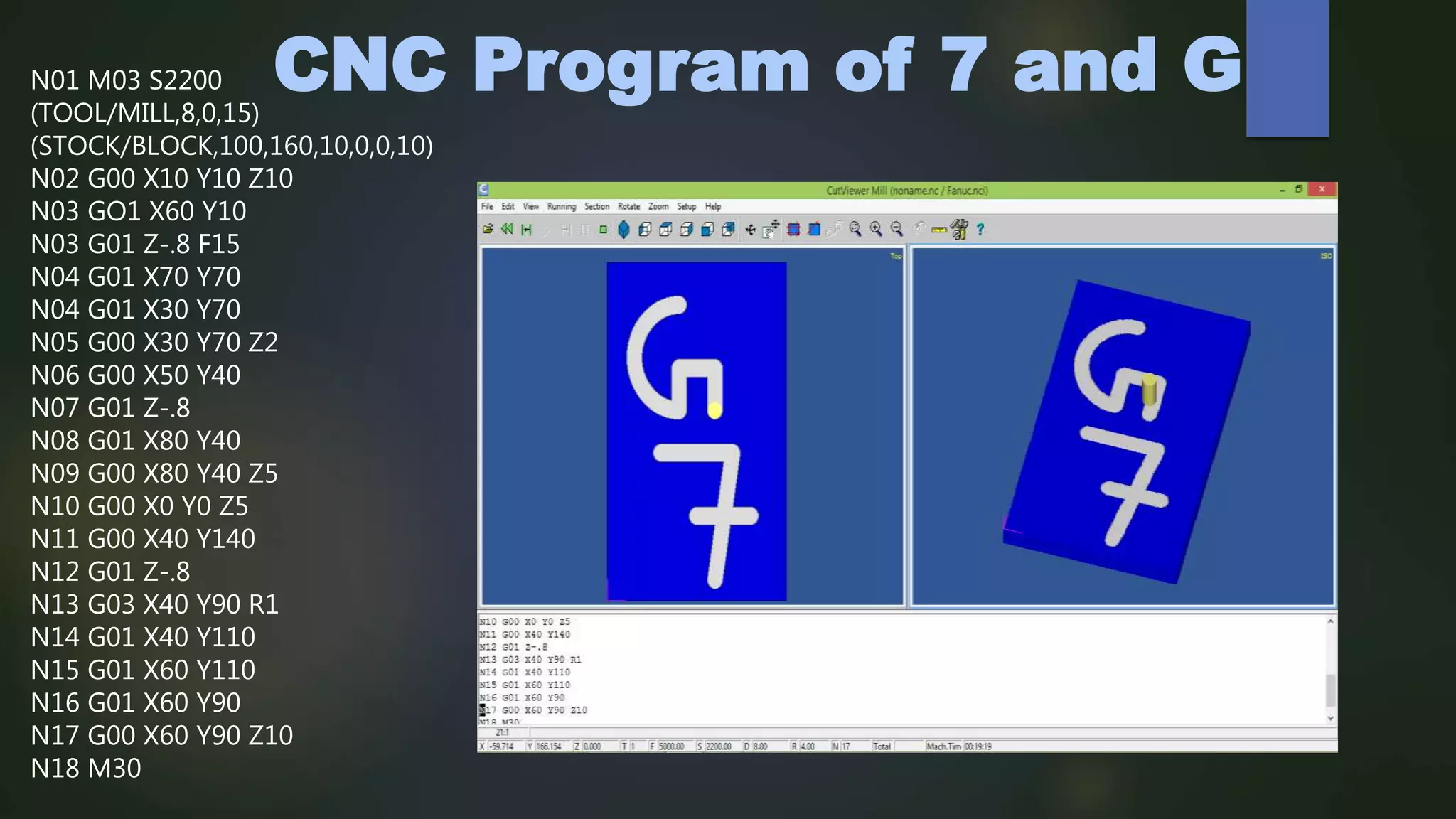
 CNC Program of 7 and G
 Advantages of CNC machine
 Disadvantages of CNC machines
CNC Machines
What is a CNC Machine?
CNC : Computer Numerical Control
Conventionally, an operator decides and adjusts various
machines parameters like feed , depth of cut etc. depending on
type of job , and controls the slide movements by hand. In a
CNC Machine functions and slide movements are controlled by
motors using computer programs.
The Evolution of NC
It was in 1947 when numerical control was born. It began when
John C. Parsons of the Parsons Corporation, Traverse City,
Michigan, a manufacturer of helicopter rotor blades, could not
make his templates fast enough. So, he invented a way of
coupling computer equipment with a jig borer. Mr. Parsons used
punched cards to operate his digit Ron system.
1949 was the year of another “Urgent need”. The U.S. Air Material
command realized that parts for its planes and missiles were
becoming more complex. Also, as the designs were constantly
being improved, changes in the drawing were frequently made.
Thus, in their search for methods of faster production, an Air Force
study contract was awarded to the Parsons Corporation. The servo
mechanisms laboratory of the Massachusetts Institute of
Technology (MIT) was the subcontractor.
In 1951, MIT took over the complete job, and in 1952, the
prototype of today’s NC machine, a modified Cincinnati Hydro
Milling Machine, was successfully demonstrated. The term
numerical control was originated at MIT.
Types of CNC Machine
There are many different types of CNC Machines used in
industry, Such as:
 Mills and Machining Centers
 Lathes and Turning Centers
 Drilling Machines
 EDM Sinker and wire Cut Machines
 Flame and Laser-Cutting Machines
 Water Jet Profilers
Types of CNC Machine
Control Unites
 FANUC CONTROLL
 SIEMENS
 GSK
 MECH 3
Different ways of data
input are
MDI : Manual Data Input
PROGRAM PREPARATION WITH CAD CAM
PROGRAM DATA TRANSFER FROM PC TO CNC M/C
PROGRAM DATA TRANSFER FROM PC TO DNC
OPERATIONS
PROGRAM INPUT
How CNC Works
 Controlled by G and M codes.
 These are number values and co-ordinates.
 Each number or code is assigned to a particular
operation.
 Typed in manually to CAD by machine operators.
 G&M codes are automatically generated by the
computer software.
Operational Features of
CNC Machines
CNC Milling Machine
The CNC Milling Simulator
simulates a 3-axis milling
machine with vertical spindle
position. In the CNC simulation
all positioning and feed
movements appear to be made
by the tool carrier, so the
machine table and the work
part have a fixed position and
the tool moves in all three
coordinates
Features of CNC Milling
 The tool or material moves.
 Tools can operate in 1-3 axes.
 Larger machines have a machine control unit (MCU) which
manages operations.
 Movement is controlled by a motors .
 Feedback is provided by sensors.
 Tool magazines are used to change tools automatically
Tools
 Most are made from high speed steel (HSS),
 Tungsten carbide or ceramics.
 Tools are designed to direct waste away from the
material.
 Some tools need coolant such as oil to protect the
tool and work.
Cut Viewer Mill
Special functions of the software
The CNC Simulator incorporates some special
functions which effectively support processing and
NC programming:
 3D representation
 Programming aids for ISO commands
 Setting-up automatics, set-up sheet
 Status management
Programming Key Letters
 O -Program number (Used for program identification)
 N -Sequence number (Used for line identification)
 G -Preparatory function
 X -X axis designation
 Y -Y axis designation
 Z -Z axis designation
 R -Radius designation
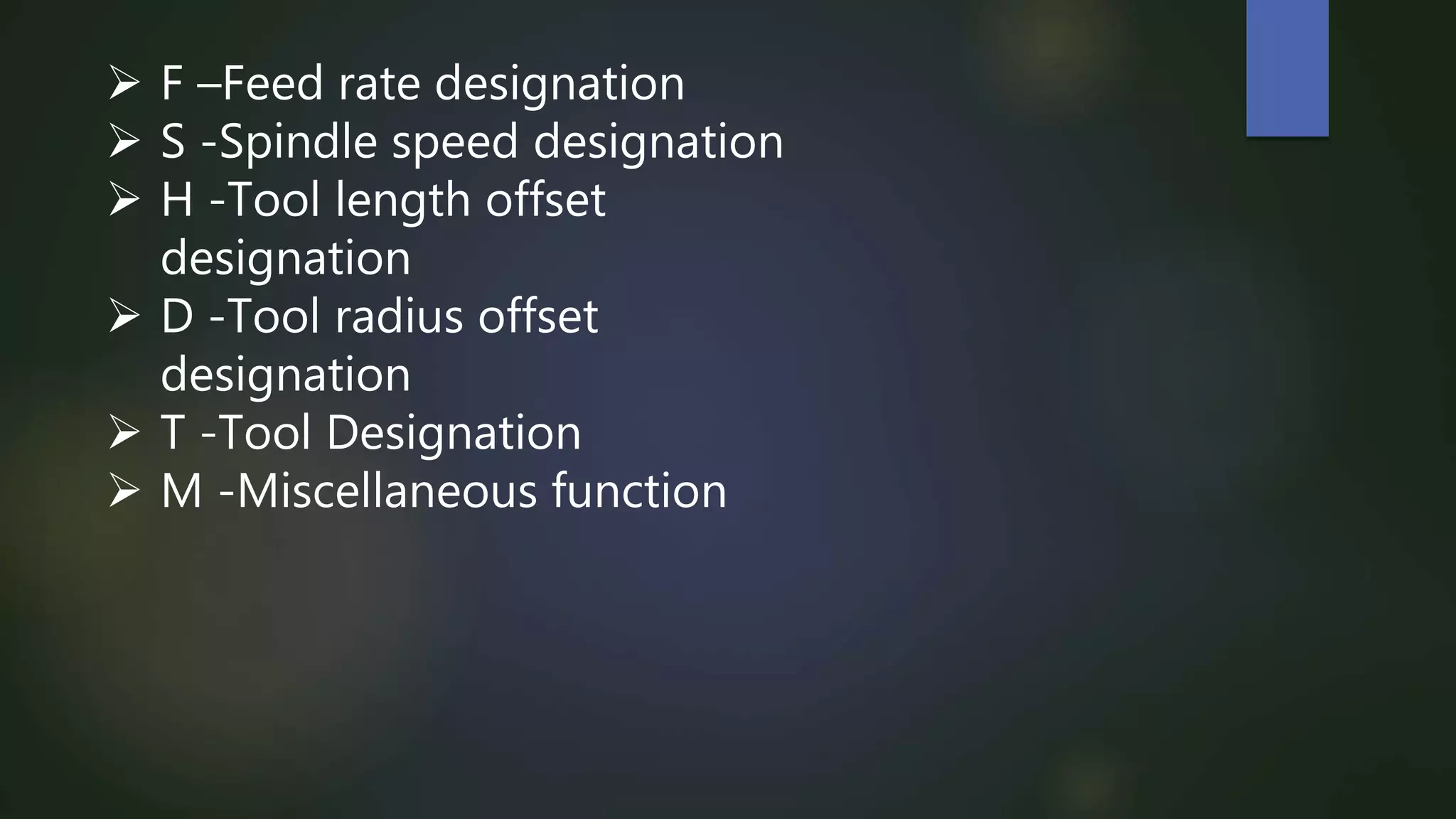
 F –Feed rate designation
 S -Spindle speed designation
 H -Tool length offset
designation
 D -Tool radius offset
designation
 T -Tool Designation
 M -Miscellaneous function
G Code
M Code
N01 M03 S2200
(TOOL/MILL,8,0,15)
(STOCK/BLOCK,100,160,10,0,0,10)
N02 G00 X10 Y10 Z10
N03 GO1 X60 Y10
N03 G01 Z-.8 F15
N04 G01 X70 Y70
N04 G01 X30 Y70
N05 G00 X30 Y70 Z2
N06 G00 X50 Y40
N07 G01 Z-.8
N08 G01 X80 Y40
N09 G00 X80 Y40 Z5
N10 G00 X0 Y0 Z5
N11 G00 X40 Y140
N12 G01 Z-.8
N13 G03 X40 Y90 R1
N14 G01 X40 Y110
N15 G01 X60 Y110
N16 G01 X60 Y90
N17 G00 X60 Y90 Z10
N18 M30
CNC Program of 7 and G
Advantages of CNC
machine
 High Repeatability and Precision e.g. Aircraft parts
 Volume of production is very high
 Complex contours/surfaces need to be machined etc.
 Flexibility in job change, automatic tool settings, less
crap
 More safe, higher productivity, better quality
 Less paperwork, faster prototype production, reduction
in lead times
Disadvantages of CNC
machines
 Costly setup, skilled operators
 Computers , programming knowledge required
 Maintenance is difficult
Thank You
Any Questions 

Cnc

  • 1.
    ABES Engineering College Ghaziabad Summertraining program CNC Milling Machine Presented by Gitanshu kumar Roll No.- 1503240904 Submitted to:- Mr. Sanjay kumar Asst. prof. ABESEC GZB
  • 2.
    Content CNC Machines The Evolution of NC  Types of CNC Machine  Types of CNC Machine control units  Different ways of data input  Operational Features of CNC Machine  CNC Milling Machine  Features of CNC Milling  Tools  Cut Viewer Mill  Programming Key Letters  G Code  M Code  CNC Program of 7 and G  Advantages of CNC machine  Disadvantages of CNC machines
  • 3.
    CNC Machines What isa CNC Machine? CNC : Computer Numerical Control Conventionally, an operator decides and adjusts various machines parameters like feed , depth of cut etc. depending on type of job , and controls the slide movements by hand. In a CNC Machine functions and slide movements are controlled by motors using computer programs.
  • 4.
    The Evolution ofNC It was in 1947 when numerical control was born. It began when John C. Parsons of the Parsons Corporation, Traverse City, Michigan, a manufacturer of helicopter rotor blades, could not make his templates fast enough. So, he invented a way of coupling computer equipment with a jig borer. Mr. Parsons used punched cards to operate his digit Ron system.
  • 5.
    1949 was theyear of another “Urgent need”. The U.S. Air Material command realized that parts for its planes and missiles were becoming more complex. Also, as the designs were constantly being improved, changes in the drawing were frequently made. Thus, in their search for methods of faster production, an Air Force study contract was awarded to the Parsons Corporation. The servo mechanisms laboratory of the Massachusetts Institute of Technology (MIT) was the subcontractor. In 1951, MIT took over the complete job, and in 1952, the prototype of today’s NC machine, a modified Cincinnati Hydro Milling Machine, was successfully demonstrated. The term numerical control was originated at MIT.
  • 6.
    Types of CNCMachine There are many different types of CNC Machines used in industry, Such as:  Mills and Machining Centers  Lathes and Turning Centers  Drilling Machines  EDM Sinker and wire Cut Machines  Flame and Laser-Cutting Machines  Water Jet Profilers
  • 7.
    Types of CNCMachine Control Unites  FANUC CONTROLL  SIEMENS  GSK  MECH 3
  • 8.
    Different ways ofdata input are MDI : Manual Data Input PROGRAM PREPARATION WITH CAD CAM PROGRAM DATA TRANSFER FROM PC TO CNC M/C PROGRAM DATA TRANSFER FROM PC TO DNC OPERATIONS PROGRAM INPUT
  • 9.
    How CNC Works Controlled by G and M codes.  These are number values and co-ordinates.  Each number or code is assigned to a particular operation.  Typed in manually to CAD by machine operators.  G&M codes are automatically generated by the computer software.
  • 10.
  • 11.
    CNC Milling Machine TheCNC Milling Simulator simulates a 3-axis milling machine with vertical spindle position. In the CNC simulation all positioning and feed movements appear to be made by the tool carrier, so the machine table and the work part have a fixed position and the tool moves in all three coordinates
  • 12.
    Features of CNCMilling  The tool or material moves.  Tools can operate in 1-3 axes.  Larger machines have a machine control unit (MCU) which manages operations.  Movement is controlled by a motors .  Feedback is provided by sensors.  Tool magazines are used to change tools automatically
  • 13.
    Tools  Most aremade from high speed steel (HSS),  Tungsten carbide or ceramics.  Tools are designed to direct waste away from the material.  Some tools need coolant such as oil to protect the tool and work.
  • 14.
    Cut Viewer Mill Specialfunctions of the software The CNC Simulator incorporates some special functions which effectively support processing and NC programming:  3D representation  Programming aids for ISO commands  Setting-up automatics, set-up sheet  Status management
  • 16.
    Programming Key Letters O -Program number (Used for program identification)  N -Sequence number (Used for line identification)  G -Preparatory function  X -X axis designation  Y -Y axis designation  Z -Z axis designation  R -Radius designation
  • 17.
     F –Feedrate designation  S -Spindle speed designation  H -Tool length offset designation  D -Tool radius offset designation  T -Tool Designation  M -Miscellaneous function
  • 18.
  • 19.
  • 20.
    N01 M03 S2200 (TOOL/MILL,8,0,15) (STOCK/BLOCK,100,160,10,0,0,10) N02G00 X10 Y10 Z10 N03 GO1 X60 Y10 N03 G01 Z-.8 F15 N04 G01 X70 Y70 N04 G01 X30 Y70 N05 G00 X30 Y70 Z2 N06 G00 X50 Y40 N07 G01 Z-.8 N08 G01 X80 Y40 N09 G00 X80 Y40 Z5 N10 G00 X0 Y0 Z5 N11 G00 X40 Y140 N12 G01 Z-.8 N13 G03 X40 Y90 R1 N14 G01 X40 Y110 N15 G01 X60 Y110 N16 G01 X60 Y90 N17 G00 X60 Y90 Z10 N18 M30 CNC Program of 7 and G
  • 21.
    Advantages of CNC machine High Repeatability and Precision e.g. Aircraft parts  Volume of production is very high  Complex contours/surfaces need to be machined etc.  Flexibility in job change, automatic tool settings, less crap  More safe, higher productivity, better quality  Less paperwork, faster prototype production, reduction in lead times
  • 22.
    Disadvantages of CNC machines Costly setup, skilled operators  Computers , programming knowledge required  Maintenance is difficult
  • 23.