MD.Farhadul Alam Himel,City University.
ATM:
ATM stands for Asynchronous Transfer Mode. It is a switching technique that uses time division
multiplexing (TDM) for data communications.
ATM networks are connection oriented networks for cell relay that supports voice, video and data
communications. It encodes data into small fixed - size cells so that they are suitable for TDM and
transmits them over a physical medium.
The size of an ATM cell is 53 bytes: 5 byte header and 48 byte payload. There are two different
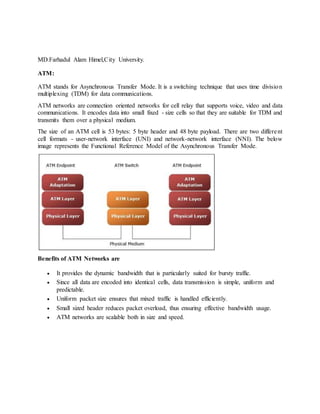
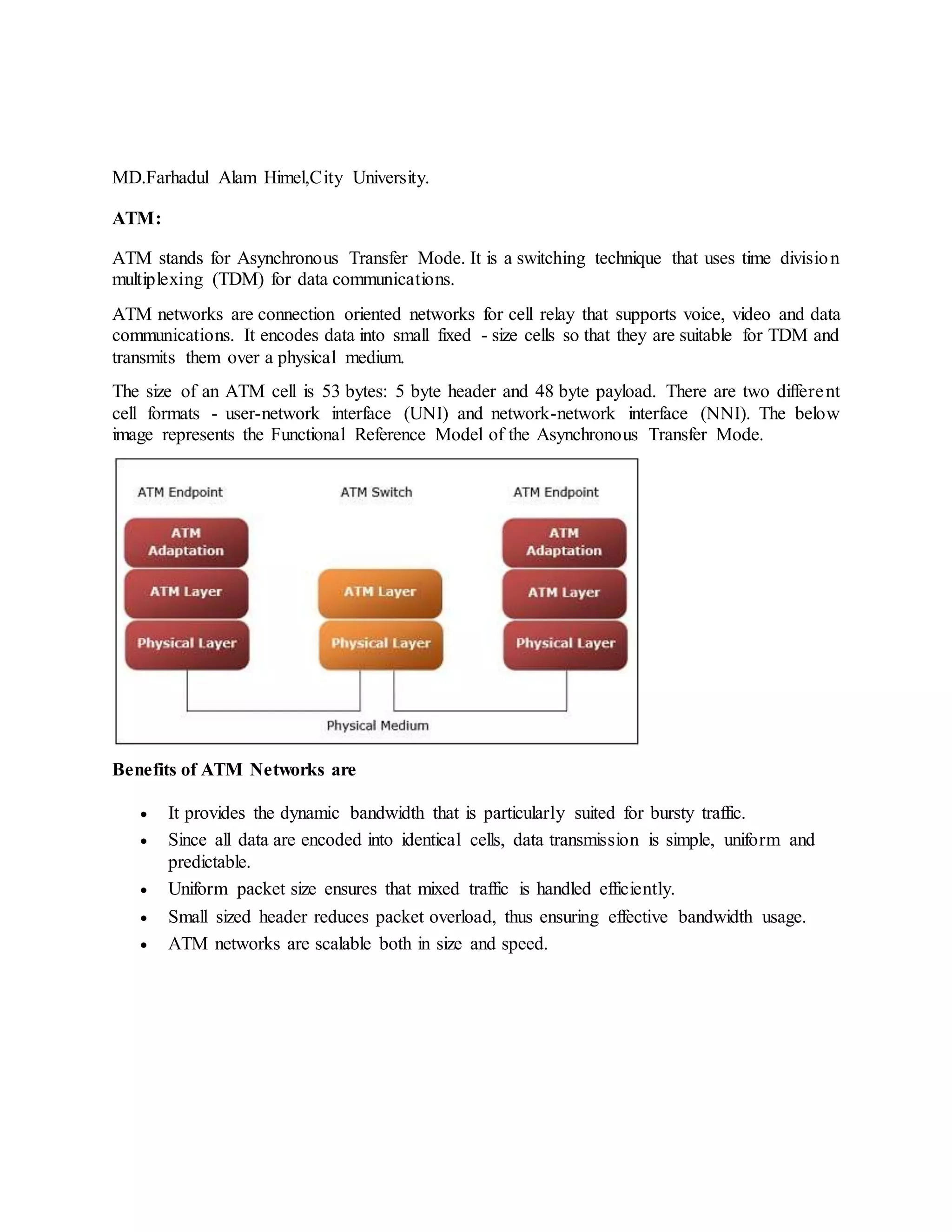
cell formats - user-network interface (UNI) and network-network interface (NNI). The below
image represents the Functional Reference Model of the Asynchronous Transfer Mode.
Benefits of ATM Networks are
 It provides the dynamic bandwidth that is particularly suited for bursty traffic.
 Since all data are encoded into identical cells, data transmission is simple, uniform and
predictable.
 Uniform packet size ensures that mixed traffic is handled efficiently.
 Small sized header reduces packet overload, thus ensuring effective bandwidth usage.
 ATM networks are scalable both in size and speed.
ATM reference model comprises of three layers
Physical Layer − This layer corresponds to physical layer of OSI model. At this layer, the cells
are converted into bit streams and transmitted over the physical medium. This layer has two sub
layers: PMD sub layer (Physical Medium Dependent) and TC (Transmission Convergence) sub
layer.
ATM Layer −This layer is comparable to data link layer of OSI model. It accepts the 48 byte
segments from the upper layer, adds a 5 byte header to each segment and converts into 53 byte
cells. This layer is responsible for routing of each cell, traffic management, multiplexing and
switching.
ATM Adaptation Layer (AAL) −This layer corresponds to network layer of OSI model. It
provides facilities to the existing packet switched networks to connect to ATM network and use
its services. It accepts the data and converts them into fixed sized segments. The transmissions
can be of fixed or variable data rate. This layer has two sub layers − Convergence sub layer and
Segmentation and Reassembly sub layer.
ATM endpoints − It contains ATM network interface adaptor. Examples of endpoints are
workstations, routers, CODECs, LAN switches, etc.
ATM switch −It transmits cells through the ATM networks. It accepts the incoming cells from
ATM endpoints (UNI) or another switch (NNI), updates cell header and retransmits cell towards
destination.
Reference:
1. tutorials point

Atm work

  • 1.
    MD.Farhadul Alam Himel,CityUniversity. ATM: ATM stands for Asynchronous Transfer Mode. It is a switching technique that uses time division multiplexing (TDM) for data communications. ATM networks are connection oriented networks for cell relay that supports voice, video and data communications. It encodes data into small fixed - size cells so that they are suitable for TDM and transmits them over a physical medium. The size of an ATM cell is 53 bytes: 5 byte header and 48 byte payload. There are two different cell formats - user-network interface (UNI) and network-network interface (NNI). The below image represents the Functional Reference Model of the Asynchronous Transfer Mode. Benefits of ATM Networks are  It provides the dynamic bandwidth that is particularly suited for bursty traffic.  Since all data are encoded into identical cells, data transmission is simple, uniform and predictable.  Uniform packet size ensures that mixed traffic is handled efficiently.  Small sized header reduces packet overload, thus ensuring effective bandwidth usage.  ATM networks are scalable both in size and speed.
  • 2.
    ATM reference modelcomprises of three layers Physical Layer − This layer corresponds to physical layer of OSI model. At this layer, the cells are converted into bit streams and transmitted over the physical medium. This layer has two sub layers: PMD sub layer (Physical Medium Dependent) and TC (Transmission Convergence) sub layer. ATM Layer −This layer is comparable to data link layer of OSI model. It accepts the 48 byte segments from the upper layer, adds a 5 byte header to each segment and converts into 53 byte cells. This layer is responsible for routing of each cell, traffic management, multiplexing and switching. ATM Adaptation Layer (AAL) −This layer corresponds to network layer of OSI model. It provides facilities to the existing packet switched networks to connect to ATM network and use its services. It accepts the data and converts them into fixed sized segments. The transmissions can be of fixed or variable data rate. This layer has two sub layers − Convergence sub layer and Segmentation and Reassembly sub layer. ATM endpoints − It contains ATM network interface adaptor. Examples of endpoints are workstations, routers, CODECs, LAN switches, etc. ATM switch −It transmits cells through the ATM networks. It accepts the incoming cells from ATM endpoints (UNI) or another switch (NNI), updates cell header and retransmits cell towards destination. Reference: 1. tutorials point