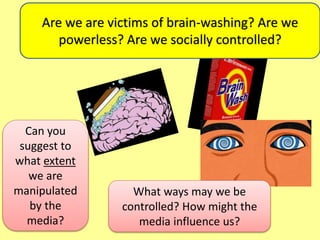
Are we are victims of brain-washing? Are we
powerless? Are we socially controlled?
Can you
suggest to
what extent
we are
manipulated
by the
media?
What ways may we be
controlled? How might the
media influence us?
Today’s Learning Objectives
• To get an initial idea of what is meant by
Audience Theory
• To consider some issues with regulatory
bodies in the UK.
• To start considering WHY we need to
regulate the media.
MEDIA AUDIENCE THEORIES
• Media Audience theories are different ways of viewing how
the media may affect or influence audiences.
• Today, we’ll briefly run through the main theories. Take
notes. We’ll go over them all again – but spend some time
doing some research about these topics in your own time
too.
• It is important to know about all of these when discussing
media regulation. One of the main reasons people argue in
favour of media regulation is the belief that the media can
influence people: you need to show that you understand
how this can be done.
The Hypodermic Needle/Syringe
Theory of Mass Media
http://www.youtube.com/watch?v=Yd88H_5k-rY -
what is this?
• One of the media effects theories is the
hypodermic syringe model, which viewed
audiences as passive recipients of ‘injected’
messages
• This theory is largely rejected today but can help
us to think about how the media affects us in
various ways.
Cultivation theory
• “The primary proposition of cultivation theory
states that the more time people spend ‘living’ in
a televised world, the more likely they are to
believe social reality aligns with reality portrayed
on television.” (K. Riddle, 2009)
• To what extent do you agree with this theory?
Can you think of any particular aspects of the TV
which we may ‘believe’, and which may therefore
influence our idea of reality?
Desensitisation theory
• This theory is often raised by those who wish to
increase media regulation.
• If we are exposed to violence frequently within the
media, we become desensitised in real life.
Copycat theory
• This theory is also often raised by those who wish to
increase media regulation.
• There have been claims that individuals have ‘modelled’
their crimes on those that they have seen on screen (for
example, the Hungerford massacre or the killing of James
Bulger).
• This can quickly become a major debate in the media, with
vote-hungry politicians quickly blaming violent films etc.
Reception theory
• A single media text may have many different
polysemic meanings – we may therefore as
audience members view the same text in a variety
of different ways.
Media Studies 2.0 theory (developed by
David Gauntlett, 2007)
• The recent idea that with the development of the web and
increase of social media, the line between producer and
audience has diminished: it therefore makes little sense to
analyse media audiences in the same way anymore.
Debates about the Media
Social: How we use
the media (or are
used by it)
Political: Whether a
government should,
or can regulate the
media
Economic: the
media generates
huge profit for the
UK
Why regulate the media?
• The media are big business and if they are unregulated,
companies and corporations can gain a great deal of power
and influence through acquisition of media companies.
Examples? www.youtube.com/watch?v=fCtPnx5wbso
(Regulation of media ownership and commercial practices)
• Media content, as well as people’s access to it, especially
children, who are more vulnerable to media effects, is the
topic of heated public debate. Examples? (Let’s have a look
at the BBC Newsbeat example too. – ON THE NEXT TWO
SLIDES ARE A NEWSBEAT REPORT, GIVING AN EXAMPLE…
READ!)
• Regulation of media content and regulation of media
access and distribution)
BBC Newsbeat: Mother urges internet awareness after daughter's
suicide
Page last updated at 17:17 GMT, Wednesday, 22 January 2014
The mother of a London teenager who died after being hit by a train has
urged every parent to be aware of the dangers of the internet.
St Pancras Coroner's Court was told Tallulah Wilson, 15, from West
Hampstead, created a fantasy cocaine-taking character to escape
reality.
In a statement, her mother Sarah said her daughter had been "in the
clutches of a toxic digital world".
She added that in her final few weeks her family "could no longer reach
her".
Sarah Wilson said that like any parent she had tried to protect her
daughter, looking for help from professionals at her school and in the
health sector.
"Our lives will never be the same without Tallulah," her statement said.
"We have lost someone more precious than words could ever say - a
beautiful, loving and talented shining star has been stolen from our
skies.
"Her sisters and I did everything we could to keep her safe, but she had
fallen into a world of nightmares.
"She was in the clutches of a toxic digital world where in the final few
weeks we could no longer reach her."
Worst nightmare
Tallulah Wilson died after being hit by a First Capital Connect train at St Pancras Station on 14 October, 2012.
The inquest heard how she posted self-harming pictures online.
In its narrative determination, the jury said that healthcare professionals and educators had a responsibility to
"gain better understanding" of the importance of online life for young people after deciding that the teenager
had taken her own life.
A statement said: "This case has highlighted the importance of online life for young people.
"We all have a responsibility to gain better understanding of this.
"This is a particular challenge for healthcare professionals and educators."
Sarah Wilson said she was "shocked by the ease with which Tallulah and other children could access online self-
harm and suicide blogs".
She told the inquest that she had shut down her daughter's Tumblr account shortly before her death because it
contained photos of her harming herself.
"Tallulah entered a world where the lines between fantasy and reality became blurred," she said. "It is every
parent's worst nightmare.
"I appeal to big brands to withdraw their advertising from those sites who continue to host inappropriate self-
harming and suicide-promoting blogs to stop this poison spreading.
"My family has suffered an irretrievable loss and would now appreciate some time to reflect and come to terms
with a world eclipsed without Tallulah, but every parent needs to be aware of the dangers of the internet and
what their children may be viewing online."
Extremely challenging
Anna Thwaites, the family's solicitor, from Hodge Jones & Allen LLP, said: "This is a tragic case. More needs to
be done regarding the perils of the internet and the impact this has on our children."
A statement from Tumblr said: "Tallulah Wilson and her family are in the thoughts of Tumblr and its employees.
"Issues of depression and self-harm are extremely challenging, particularly in online environments that
encourage self-expression.
"Tumblr has policies to address the most harmful of this content, and we have systems in place to direct users
to appropriate resources for getting whatever help they may need.
"We are committed to continually improving our ability to act on self-harm content, and also to keeping Tumblr
a positive, supportive environment for those individuals dealing with issues of depression and self-harm."
DO NOW: What’s the difference?
Classification?
Censorship?
Media Regulation
Regulation is achieved through either:
Classification – Preventing people from accessing
material that is deemed to be unsuitable for their age.
Or...
Censorship – Removing material from public access
altogether
OCR: These are very different approaches and it is
extremely important that you do not confuse them
or lump them together as one and the same
Censor Definition
Noun: An official who examines books, films, news
etc that are to be published and suppresses any
parts that are considered obscene, politically
unacceptable, or a threat to security.
Verb: [with object] examine (a book, film etc)
officially and suppress unacceptable parts of it:
the report has been censored ‘in the national
interest’
Who Regulates What?
“On the one hand, professional independence is
actually bolstered by self-regulation. Like
doctors and lawyers, media professionals
operate within codes of practice designed to
prevent unacceptable standards of
production or irresponsible behaviour. If
members adhere to such codes, then there
are less likely to be attempts made to impose
conditions from outside the industry (e.g.
The government)...”
- http://www.levesoninquiry.org.uk/about/the-
report/
“However, not surprisingly, there is limited state
or public faith in any organisation’s or
industry’s attempt to police itself, and all the
media are subject to a variety of external
controls either enshrined in the law and/or
administered by external independent
bodies...”
Do you think regulating
through independent
bodies is a good idea or
should the government
always be involved?
How is film classified or censored in
the UK?
• The British Board of Film Classification (BBFC) issues
certificates for all cinema and DVD releases, applying the
categories:
• U – Universal
• PG – Parental Guidance
• 12a
• 12
• 15
• 18
• R-18
• UC (for home release) – meaning it is particularly unsuitable
for children. Controls are stricter because of the possibility of
young children viewing films rented by adults or older
children.
http://www.bbfc.co.uk/ - BBFC Website
BBFC Research time!
Complete your worksheets
carefully. You should aim to
build yourself up a good set
of notes.
Find an example of films with the following
ratings:
• U – Universal
• PG – Parental Guidance
• 12a
• 12
• 15
• 18
• What happens within the films which makes them
appropriate for that particular classification?

CMR L2 - why do we regulate films?

  • 1.
    Are we arevictims of brain-washing? Are we powerless? Are we socially controlled? Can you suggest to what extent we are manipulated by the media? What ways may we be controlled? How might the media influence us?
  • 2.
    Today’s Learning Objectives •To get an initial idea of what is meant by Audience Theory • To consider some issues with regulatory bodies in the UK. • To start considering WHY we need to regulate the media.
  • 3.
    MEDIA AUDIENCE THEORIES •Media Audience theories are different ways of viewing how the media may affect or influence audiences. • Today, we’ll briefly run through the main theories. Take notes. We’ll go over them all again – but spend some time doing some research about these topics in your own time too. • It is important to know about all of these when discussing media regulation. One of the main reasons people argue in favour of media regulation is the belief that the media can influence people: you need to show that you understand how this can be done.
  • 4.
    The Hypodermic Needle/Syringe Theoryof Mass Media http://www.youtube.com/watch?v=Yd88H_5k-rY - what is this? • One of the media effects theories is the hypodermic syringe model, which viewed audiences as passive recipients of ‘injected’ messages • This theory is largely rejected today but can help us to think about how the media affects us in various ways.
  • 5.
    Cultivation theory • “Theprimary proposition of cultivation theory states that the more time people spend ‘living’ in a televised world, the more likely they are to believe social reality aligns with reality portrayed on television.” (K. Riddle, 2009) • To what extent do you agree with this theory? Can you think of any particular aspects of the TV which we may ‘believe’, and which may therefore influence our idea of reality?
  • 6.
    Desensitisation theory • Thistheory is often raised by those who wish to increase media regulation. • If we are exposed to violence frequently within the media, we become desensitised in real life. Copycat theory • This theory is also often raised by those who wish to increase media regulation. • There have been claims that individuals have ‘modelled’ their crimes on those that they have seen on screen (for example, the Hungerford massacre or the killing of James Bulger). • This can quickly become a major debate in the media, with vote-hungry politicians quickly blaming violent films etc.
  • 7.
    Reception theory • Asingle media text may have many different polysemic meanings – we may therefore as audience members view the same text in a variety of different ways. Media Studies 2.0 theory (developed by David Gauntlett, 2007) • The recent idea that with the development of the web and increase of social media, the line between producer and audience has diminished: it therefore makes little sense to analyse media audiences in the same way anymore.
  • 8.
    Debates about theMedia Social: How we use the media (or are used by it) Political: Whether a government should, or can regulate the media Economic: the media generates huge profit for the UK
  • 9.
    Why regulate themedia? • The media are big business and if they are unregulated, companies and corporations can gain a great deal of power and influence through acquisition of media companies. Examples? www.youtube.com/watch?v=fCtPnx5wbso (Regulation of media ownership and commercial practices) • Media content, as well as people’s access to it, especially children, who are more vulnerable to media effects, is the topic of heated public debate. Examples? (Let’s have a look at the BBC Newsbeat example too. – ON THE NEXT TWO SLIDES ARE A NEWSBEAT REPORT, GIVING AN EXAMPLE… READ!) • Regulation of media content and regulation of media access and distribution)
  • 10.
    BBC Newsbeat: Motherurges internet awareness after daughter's suicide Page last updated at 17:17 GMT, Wednesday, 22 January 2014 The mother of a London teenager who died after being hit by a train has urged every parent to be aware of the dangers of the internet. St Pancras Coroner's Court was told Tallulah Wilson, 15, from West Hampstead, created a fantasy cocaine-taking character to escape reality. In a statement, her mother Sarah said her daughter had been "in the clutches of a toxic digital world". She added that in her final few weeks her family "could no longer reach her". Sarah Wilson said that like any parent she had tried to protect her daughter, looking for help from professionals at her school and in the health sector. "Our lives will never be the same without Tallulah," her statement said. "We have lost someone more precious than words could ever say - a beautiful, loving and talented shining star has been stolen from our skies. "Her sisters and I did everything we could to keep her safe, but she had fallen into a world of nightmares. "She was in the clutches of a toxic digital world where in the final few weeks we could no longer reach her."
  • 11.
    Worst nightmare Tallulah Wilsondied after being hit by a First Capital Connect train at St Pancras Station on 14 October, 2012. The inquest heard how she posted self-harming pictures online. In its narrative determination, the jury said that healthcare professionals and educators had a responsibility to "gain better understanding" of the importance of online life for young people after deciding that the teenager had taken her own life. A statement said: "This case has highlighted the importance of online life for young people. "We all have a responsibility to gain better understanding of this. "This is a particular challenge for healthcare professionals and educators." Sarah Wilson said she was "shocked by the ease with which Tallulah and other children could access online self- harm and suicide blogs". She told the inquest that she had shut down her daughter's Tumblr account shortly before her death because it contained photos of her harming herself. "Tallulah entered a world where the lines between fantasy and reality became blurred," she said. "It is every parent's worst nightmare. "I appeal to big brands to withdraw their advertising from those sites who continue to host inappropriate self- harming and suicide-promoting blogs to stop this poison spreading. "My family has suffered an irretrievable loss and would now appreciate some time to reflect and come to terms with a world eclipsed without Tallulah, but every parent needs to be aware of the dangers of the internet and what their children may be viewing online." Extremely challenging Anna Thwaites, the family's solicitor, from Hodge Jones & Allen LLP, said: "This is a tragic case. More needs to be done regarding the perils of the internet and the impact this has on our children." A statement from Tumblr said: "Tallulah Wilson and her family are in the thoughts of Tumblr and its employees. "Issues of depression and self-harm are extremely challenging, particularly in online environments that encourage self-expression. "Tumblr has policies to address the most harmful of this content, and we have systems in place to direct users to appropriate resources for getting whatever help they may need. "We are committed to continually improving our ability to act on self-harm content, and also to keeping Tumblr a positive, supportive environment for those individuals dealing with issues of depression and self-harm."
  • 12.
    DO NOW: What’sthe difference? Classification? Censorship?
  • 13.
    Media Regulation Regulation isachieved through either: Classification – Preventing people from accessing material that is deemed to be unsuitable for their age. Or... Censorship – Removing material from public access altogether OCR: These are very different approaches and it is extremely important that you do not confuse them or lump them together as one and the same
  • 14.
    Censor Definition Noun: Anofficial who examines books, films, news etc that are to be published and suppresses any parts that are considered obscene, politically unacceptable, or a threat to security. Verb: [with object] examine (a book, film etc) officially and suppress unacceptable parts of it: the report has been censored ‘in the national interest’
  • 15.
    Who Regulates What? “Onthe one hand, professional independence is actually bolstered by self-regulation. Like doctors and lawyers, media professionals operate within codes of practice designed to prevent unacceptable standards of production or irresponsible behaviour. If members adhere to such codes, then there are less likely to be attempts made to impose conditions from outside the industry (e.g. The government)...” - http://www.levesoninquiry.org.uk/about/the- report/
  • 16.
    “However, not surprisingly,there is limited state or public faith in any organisation’s or industry’s attempt to police itself, and all the media are subject to a variety of external controls either enshrined in the law and/or administered by external independent bodies...” Do you think regulating through independent bodies is a good idea or should the government always be involved?
  • 17.
    How is filmclassified or censored in the UK? • The British Board of Film Classification (BBFC) issues certificates for all cinema and DVD releases, applying the categories: • U – Universal • PG – Parental Guidance • 12a • 12 • 15 • 18 • R-18 • UC (for home release) – meaning it is particularly unsuitable for children. Controls are stricter because of the possibility of young children viewing films rented by adults or older children. http://www.bbfc.co.uk/ - BBFC Website BBFC Research time! Complete your worksheets carefully. You should aim to build yourself up a good set of notes.
  • 19.
    Find an exampleof films with the following ratings: • U – Universal • PG – Parental Guidance • 12a • 12 • 15 • 18 • What happens within the films which makes them appropriate for that particular classification?

Editor's Notes

  • #2 Surely most of our international knowledge is from media? And national? So how do we know we’re not controlled? Who is Harvey Weinstein… what’s he GUILTY of?
  • #6 The news More time we spend watching TV, more we believe it
  • #8 Polyseme – word with several possible related (subtly different) meanings e.g. BANK: Financial institution put your money in the bank The synonym for ‘rely upon’, since it suggests the reliability of a bank HOWEVER… BANK AS IN RIVER BANK IS NOT A POLYSEME AS IT IS UNRELATED, IT IS A HOMONYM