Operation Lifesaver – A Real Time
Crisis Approach
Protecting Communities
by Spreading Awareness
Presentation To:
AMCTO Law Enforcement
Forum
May 2014
GO Transit – long history of moving
people
GO TransitGO Transit began as a three-year experiment on May 23, 1967 runningbegan as a three-year experiment on May 23, 1967 running
single-deck, seven coach trains on a single rail line along Lake Ontario'ssingle-deck, seven coach trains on a single rail line along Lake Ontario's
shoreline averaging 15,000 passengersshoreline averaging 15,000 passengers per dayper day
Growth, growth and more growth
GO Transit, a Division of MetrolinxGO Transit, a Division of Metrolinx now operates Bombardier bi-level, 12now operates Bombardier bi-level, 12
coach trains on seven lines connecting Barrie, Niagara Falls, Hamiltoncoach trains on seven lines connecting Barrie, Niagara Falls, Hamilton
and Oshawa averaging in excess of 250,000 boardings per day.and Oshawa averaging in excess of 250,000 boardings per day.
• 30-minute each-way service all day along the Lakeshore Rail Line(s)30-minute each-way service all day along the Lakeshore Rail Line(s)
• At least 96% of the train ridership is to and from Union Station in downtownAt least 96% of the train ridership is to and from Union Station in downtown
TorontoToronto
• In 2015, Air Rail link will consist of 140 daily trips running every 15 minutes, sevenIn 2015, Air Rail link will consist of 140 daily trips running every 15 minutes, seven
days a week, carrying an estimated 2 million passengers annuallydays a week, carrying an estimated 2 million passengers annually
• Expanded peak train service on most corridors and will have introduced new off-Expanded peak train service on most corridors and will have introduced new off-
peak train servicepeak train service
Expansion – Improvements
• Transit Safety Officers are responsible for ensuring passenger
safety, customer service, asset protection, crime prevention and
ensuring the integrity of the proof of payment (POP) fare system.
• This is accomplished through the
strategic deployment of staff
based on historical trends, data
analysis and customer input.
Transit Safety Officers – The part you
probably knew
• TSOs are responsible for:
– Enforcing the Metrolinx Act bylaws
– Enforcing, processing, and arresting persons in contravention of:
– Criminal Code of Canada
– Controlled Drugs & Substances Act
– Youth Criminal Justice Act
– TPA, LLA, MHA, SSA
– Providing assistance and protection to GO Transit customers and their property, employees and
corporate assets and ensuring the appropriate action is taken. Promoting and maintaining good
customer relations.
– Conducting prevention & deterrence patrols of infrastructure, stations, rolling stock.
– Maintaining the public peace within the GO Transit system.
Transit Safety Officers – The part you may
not have known
Vast Area of Coverage
80+ Special
Constables
15+ Provincial
Offences
Officers
9 Dispatchers
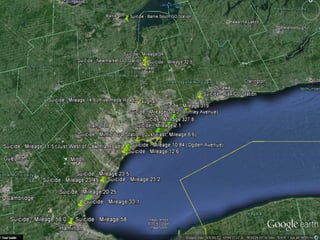
Well over 100 Suicides in 10 yearsWell over 100 Suicides in 10 years
• Average 10/yr.Average 10/yr.
• Train delays can be between 3 – 5 hrs.Train delays can be between 3 – 5 hrs.
• Impacts on 50,000+ rush hour passengersImpacts on 50,000+ rush hour passengers
– 50,000 passengers, single point of departure, 90 trains (GO Transit)50,000 passengers, single point of departure, 90 trains (GO Transit)
Railway Fatalities – Suicides is a real and
present concern
These are more than just statistics
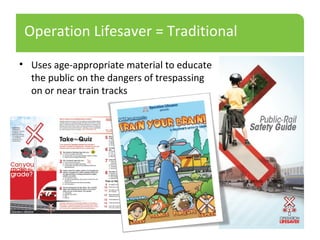
Operation Lifesaver = Traditional
• Uses age-appropriate material to educate
the public on the dangers of trespassing
on or near train tracks
Officer School Presentations
Plan to present to all schools in service region over 4 years
124 schools - 3 presentations per school = 372 presentations
completed so far
Commitment to Public Safety
• We recognize the potential safety hazards presented by public
transportation services
• We take our customer’s safety and the safety of the public seriously
• We are committed to proactively sharing safety information in the
community embrace opportunities to demonstrate that we are
good corporate citizens within our community
• Ongoing participation of GO Transit Safety at public events shows
our commitment
• We are always on the look-out
for community events that we
can participate in to share our
safety message
Our Traditional Approach was not enough
Operation Lifesaver – Real Time Crisis
• Service Recovery Improved
• Educational Awareness Improved
• Suicides rates did not improve
• Staff initiative to become active on twitter led
to partnership with Real Time Crisis
• Almost immediately – suicide rates improved
(even one is a dramatic invaluable
improvement)
• Leading cause of death by injury is suicide. (2012 study
published in the American Journal of Public Health.)
• Suicide has increased by 15% over the past 10 years.
• Social Media is the most prevalent form of communication
currently being used.
• Twitter users send over 400 million tweets a day
• There are 288 million active monthly users and over 500
million registered accounts on Twitter.
• 25% of smart phone owners between the ages of 18-44 say
they cant recall the last time their smart phone wasn’t next to
them.
STATISTICS:
What are the options for a youth
who comes across a tweet like
WHAT IS REAL TIME
CRISIS?
Board
Members
Contribut
ors@Zengarden1
7
@GORivett94
@Andrewstwt
@ClaireSMB
B
@Paisleyrae
@USACrimeSt
op
@AnneMarieB
atten
@Lawscomm
@MediatedRe
ality
@Precontempl
ator
STRUCTURE
• Charitable organization incorporating under
the laws of Canada (Thank you to
@BLGLaw)
• Professionally trained staff in area of mental
health emergencies
• Began operations in Toronto, Canada, with
the goal of expanding throughout Canada
and the United States
VISION
The recognized leader in real-time
intervention while becoming the leading
authority regarding positive and
negative effects of social media
communications during traumatic
events.MISSION
Connecting Real Time Professionals in
Real Time Interventions
PURPOSE
• Trained professionals saving and improving
lives through the utilization of social media
tools and resources.
• Empowering and promoting safety and
successful outcomes through the
engagement and development of trusted
relationships.
• Excel by bridging the gap between
community, social services and law
enforcement through virtual crisis
WHAT WOULD YOU
DO?
*Simulated Tweets Based on Actual
WHAT WOULD YOU
DO?
*Simulated Tweets Based on Actual
Occurrences
WHAT WOULD YOU
DO?
*Simulated Tweets Based on Actual
REAL TIME CRISIS
CAN….
Locate the person via a geo tag.
Contact Go Transit or TTC safety officers to
hold the next train.
Intervene with the person in hopes of
prolonging the conversation.
*Actual occurrence
*Actual occurrence
*Actual occurrence
*Actual occurrence
TWITTER’S RESPONSE TO A
REQUEST TO HAVE THE
PICTURES REMOVED.
*Actual occurrence
7 DAYS LATER
*Actual occurrence
ENGAGE-ASSESS-
RESPOND-SAFETY
• ENGAGE- Crisis Nurse engages directly with
person at risk, reaches out in a
nonjudgmental way.
• ASSESS- Mental health risk assessment.
• RESPOND- Response is determined by level
of risk.
• SAFETY- For person at risk, all service
providers involved.
REAL TIME CRISIS GOALS
• Manage call for mental-health related calls with a social
media component for the Toronto Police Service or any other
police, education or social service.
• Looking to reduce 911 calls for service, policing hours and
visits to the emergency department
• Looking to save and improve lives by building trusted
relationships using technology.
• Collaborate with community partners such as Victim
Services, Go Transit officers, probation officers, leaders in
the education sector and community mental health
supporters
• Provide social media support for interested community
partners already helping others but not currently using
WHY REAL TIME CRISIS?
Potential for assistance in:
•Mental health intervention
•Youth cyber bullying related matters
•Domestic violence
•Sexual assault
•Human trafficking
Some persons at risk are unable to call for
help but can use a smart phone and obtain a
connection and help silently.
WHY REAL TIME CRISIS?
Individuals who have received support from the
nurse and officer from Real Time Crisis continue to
reach out for help on social media post intervention
but direct their concerns to RTC in lieu of police
intervention.
•One female has reached out over 100 times,
police and ER were only needed 3 of those times.
A successful online intervention can prevent an
escalation that may potentially lead to an
emergency response that could result in injury for
the person at risk and the service provider.
TORONTO
POLICE
SERVICE
POSTED A
PICTURE OF
MISSING
GIRL.
*Actual occurrence
HER
FRIENDS
BEGAN
TO TAG
HER
INSTAGR
AM
ACCOUNT
. *Actual occurrence
HER
INSTAGR
AM WAS
SET TO
PRIVATE
*Actual occurrence
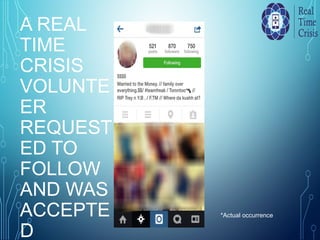
A REAL
TIME
CRISIS
VOLUNTE
ER
REQUEST
ED TO
FOLLOW
AND WAS
ACCEPTE
D
*Actual occurrence
HER INSTAGRAM HAD
INFORMATION SUCH AS A PHONE
NUMBER AND A BLACK BERRY PIN.
*Actual occurrence
NEXT STEP:
A goal of #RealTimeCrisis would be to keep
her engaged positively and to keep her out of
street life using social media tools. 
She ended up calling her Mom and
going home the following day.
Social media appeal assisted with this. 
THANK YOU FOR YOUR
ATTENTION
Contact Real Time Crisis
Twitter: @RealTimeCrisis
Facebook: Facebook.com/RealTimeCrisis
Instagram: RealTimeCrisis
Email: Realtimecrisis@gmail.com
Search for Real Time Crisis on Slide Share
for this presentation
Visit Realtimecrisis.org for more information

Stopping Suicides Using Social Media @GoTransit & @RealTimeCrisis

  • 1.
    Operation Lifesaver –A Real Time Crisis Approach Protecting Communities by Spreading Awareness Presentation To: AMCTO Law Enforcement Forum May 2014
  • 2.
    GO Transit –long history of moving people GO TransitGO Transit began as a three-year experiment on May 23, 1967 runningbegan as a three-year experiment on May 23, 1967 running single-deck, seven coach trains on a single rail line along Lake Ontario'ssingle-deck, seven coach trains on a single rail line along Lake Ontario's shoreline averaging 15,000 passengersshoreline averaging 15,000 passengers per dayper day
  • 3.
    Growth, growth andmore growth GO Transit, a Division of MetrolinxGO Transit, a Division of Metrolinx now operates Bombardier bi-level, 12now operates Bombardier bi-level, 12 coach trains on seven lines connecting Barrie, Niagara Falls, Hamiltoncoach trains on seven lines connecting Barrie, Niagara Falls, Hamilton and Oshawa averaging in excess of 250,000 boardings per day.and Oshawa averaging in excess of 250,000 boardings per day.
  • 4.
    • 30-minute each-wayservice all day along the Lakeshore Rail Line(s)30-minute each-way service all day along the Lakeshore Rail Line(s) • At least 96% of the train ridership is to and from Union Station in downtownAt least 96% of the train ridership is to and from Union Station in downtown TorontoToronto • In 2015, Air Rail link will consist of 140 daily trips running every 15 minutes, sevenIn 2015, Air Rail link will consist of 140 daily trips running every 15 minutes, seven days a week, carrying an estimated 2 million passengers annuallydays a week, carrying an estimated 2 million passengers annually • Expanded peak train service on most corridors and will have introduced new off-Expanded peak train service on most corridors and will have introduced new off- peak train servicepeak train service Expansion – Improvements
  • 5.
    • Transit SafetyOfficers are responsible for ensuring passenger safety, customer service, asset protection, crime prevention and ensuring the integrity of the proof of payment (POP) fare system. • This is accomplished through the strategic deployment of staff based on historical trends, data analysis and customer input. Transit Safety Officers – The part you probably knew
  • 6.
    • TSOs areresponsible for: – Enforcing the Metrolinx Act bylaws – Enforcing, processing, and arresting persons in contravention of: – Criminal Code of Canada – Controlled Drugs & Substances Act – Youth Criminal Justice Act – TPA, LLA, MHA, SSA – Providing assistance and protection to GO Transit customers and their property, employees and corporate assets and ensuring the appropriate action is taken. Promoting and maintaining good customer relations. – Conducting prevention & deterrence patrols of infrastructure, stations, rolling stock. – Maintaining the public peace within the GO Transit system. Transit Safety Officers – The part you may not have known
  • 7.
    Vast Area ofCoverage 80+ Special Constables 15+ Provincial Offences Officers 9 Dispatchers
  • 10.
    Well over 100Suicides in 10 yearsWell over 100 Suicides in 10 years • Average 10/yr.Average 10/yr. • Train delays can be between 3 – 5 hrs.Train delays can be between 3 – 5 hrs. • Impacts on 50,000+ rush hour passengersImpacts on 50,000+ rush hour passengers – 50,000 passengers, single point of departure, 90 trains (GO Transit)50,000 passengers, single point of departure, 90 trains (GO Transit) Railway Fatalities – Suicides is a real and present concern
  • 11.
    These are morethan just statistics
  • 12.
    Operation Lifesaver =Traditional • Uses age-appropriate material to educate the public on the dangers of trespassing on or near train tracks
  • 13.
    Officer School Presentations Planto present to all schools in service region over 4 years 124 schools - 3 presentations per school = 372 presentations completed so far
  • 14.
    Commitment to PublicSafety • We recognize the potential safety hazards presented by public transportation services • We take our customer’s safety and the safety of the public seriously • We are committed to proactively sharing safety information in the community embrace opportunities to demonstrate that we are good corporate citizens within our community • Ongoing participation of GO Transit Safety at public events shows our commitment • We are always on the look-out for community events that we can participate in to share our safety message
  • 15.
    Our Traditional Approachwas not enough Operation Lifesaver – Real Time Crisis • Service Recovery Improved • Educational Awareness Improved • Suicides rates did not improve • Staff initiative to become active on twitter led to partnership with Real Time Crisis • Almost immediately – suicide rates improved (even one is a dramatic invaluable improvement)
  • 17.
    • Leading causeof death by injury is suicide. (2012 study published in the American Journal of Public Health.) • Suicide has increased by 15% over the past 10 years. • Social Media is the most prevalent form of communication currently being used. • Twitter users send over 400 million tweets a day • There are 288 million active monthly users and over 500 million registered accounts on Twitter. • 25% of smart phone owners between the ages of 18-44 say they cant recall the last time their smart phone wasn’t next to them. STATISTICS:
  • 18.
    What are theoptions for a youth who comes across a tweet like
  • 19.
    WHAT IS REALTIME CRISIS? Board Members Contribut ors@Zengarden1 7 @GORivett94 @Andrewstwt @ClaireSMB B @Paisleyrae @USACrimeSt op @AnneMarieB atten @Lawscomm @MediatedRe ality @Precontempl ator
  • 20.
    STRUCTURE • Charitable organizationincorporating under the laws of Canada (Thank you to @BLGLaw) • Professionally trained staff in area of mental health emergencies • Began operations in Toronto, Canada, with the goal of expanding throughout Canada and the United States
  • 21.
    VISION The recognized leaderin real-time intervention while becoming the leading authority regarding positive and negative effects of social media communications during traumatic events.MISSION Connecting Real Time Professionals in Real Time Interventions
  • 22.
    PURPOSE • Trained professionalssaving and improving lives through the utilization of social media tools and resources. • Empowering and promoting safety and successful outcomes through the engagement and development of trusted relationships. • Excel by bridging the gap between community, social services and law enforcement through virtual crisis
  • 23.
    WHAT WOULD YOU DO? *SimulatedTweets Based on Actual
  • 24.
    WHAT WOULD YOU DO? *SimulatedTweets Based on Actual Occurrences
  • 25.
    WHAT WOULD YOU DO? *SimulatedTweets Based on Actual
  • 26.
    REAL TIME CRISIS CAN…. Locatethe person via a geo tag. Contact Go Transit or TTC safety officers to hold the next train. Intervene with the person in hopes of prolonging the conversation.
  • 27.
  • 28.
  • 29.
  • 30.
  • 31.
    TWITTER’S RESPONSE TOA REQUEST TO HAVE THE PICTURES REMOVED. *Actual occurrence
  • 32.
  • 33.
    ENGAGE-ASSESS- RESPOND-SAFETY • ENGAGE- CrisisNurse engages directly with person at risk, reaches out in a nonjudgmental way. • ASSESS- Mental health risk assessment. • RESPOND- Response is determined by level of risk. • SAFETY- For person at risk, all service providers involved.
  • 34.
    REAL TIME CRISISGOALS • Manage call for mental-health related calls with a social media component for the Toronto Police Service or any other police, education or social service. • Looking to reduce 911 calls for service, policing hours and visits to the emergency department • Looking to save and improve lives by building trusted relationships using technology. • Collaborate with community partners such as Victim Services, Go Transit officers, probation officers, leaders in the education sector and community mental health supporters • Provide social media support for interested community partners already helping others but not currently using
  • 35.
    WHY REAL TIMECRISIS? Potential for assistance in: •Mental health intervention •Youth cyber bullying related matters •Domestic violence •Sexual assault •Human trafficking Some persons at risk are unable to call for help but can use a smart phone and obtain a connection and help silently.
  • 36.
    WHY REAL TIMECRISIS? Individuals who have received support from the nurse and officer from Real Time Crisis continue to reach out for help on social media post intervention but direct their concerns to RTC in lieu of police intervention. •One female has reached out over 100 times, police and ER were only needed 3 of those times. A successful online intervention can prevent an escalation that may potentially lead to an emergency response that could result in injury for the person at risk and the service provider.
  • 37.
  • 38.
  • 39.
  • 40.
  • 41.
    HER INSTAGRAM HAD INFORMATIONSUCH AS A PHONE NUMBER AND A BLACK BERRY PIN. *Actual occurrence
  • 42.
    NEXT STEP: A goalof #RealTimeCrisis would be to keep her engaged positively and to keep her out of street life using social media tools.  She ended up calling her Mom and going home the following day. Social media appeal assisted with this. 
  • 43.
    THANK YOU FORYOUR ATTENTION Contact Real Time Crisis Twitter: @RealTimeCrisis Facebook: Facebook.com/RealTimeCrisis Instagram: RealTimeCrisis Email: Realtimecrisis@gmail.com Search for Real Time Crisis on Slide Share for this presentation Visit Realtimecrisis.org for more information