Media Regulation: Debates and
Perspectives.
Dr. Richard Berger.
The Centre for Excellence in Media Practice.
Bournemouth University.
• Historically, from the 1909 Cinematograph Act onwards,
censorship in the UK has been medium specific.
• The internet and new media has changed that.
• Harder to regulate the internet – global nature etc.
– Differences in US and UK law regarding ‘impartiality’.
– In Sweden it’s not an offence to possess what in the UK would be
deemed unlawful child pornography.
• Move towards self-censorship/regulation.
• BBC guidelines for its online writers:
• “Swearing is not big and it’s not clever, so avoid it as
much as possible. If it’s in a quote, always star the
following: c**t, f**k, w**k, F**ing and w**ker. If you
really have to be foul mouthed, these words can be
written in full: shit, bastard, bollocks, arsehole, twat,
piss, sodding etc (eg, “He’s a c**t, that bastard.”).
Obviously all slurs on race and minorities are a
complete no-no.”
•  From BBCi’s Style Guide for writers and journalists (Sept 2005).
• The Broadcasting Standards Commission (later
replaced by Ofcom) even rated swear words in 2002;
• 1.    C**t    11. Shag. 21. Bugger.
• 2.    Motherf****r   12. Whore. 22. Balls.
• 3.    F**k    13. Twat. 23. Jew.
• 4.    W****r  14. Piss Off. 24. Sodding.
• 5.    N****r  15. Spastic. 25. Jesus Christ.
• 6.    Bastard 16. Slag. 26. Crap.
• 7.    Prick   17. S**t. 27. Bloody.
• 8.    Bollocks        18. Dickhead. 28. God.
• 9.    A***hole             19. P****d Off.
• 10.  P**i           20. Arse.
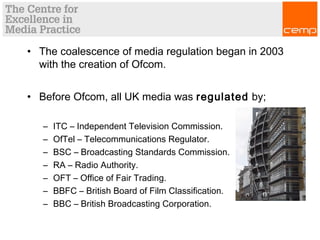
• The coalescence of media regulation began in 2003
with the creation of Ofcom.
• Before Ofcom, all UK media was regulated by;
– ITC – Independent Television Commission.
– OfTel – Telecommunications Regulator.
– BSC – Broadcasting Standards Commission.
– RA – Radio Authority.
– OFT – Office of Fair Trading.
– BBFC – British Board of Film Classification.
– BBC – British Broadcasting Corporation.
• So, Main problem is that the internet circumnavigates
other media, and the laws that surround and
regulate them.
– The internet can result in pre-trial prejudice, and
contempt of court.
– Some national/local events do have widespread
international appeal.
– http://
www.thesmokinggun.com/doc_o_day/doc_o_day.html
– Now with global 24 hour rolling news, it’s even
harder – many people can get the BBC, and Al-
jazerra.
• Another problem with medium specific media
regulation are the ‘media effects’ debate which
trawl in their wake.
• Media effects debate is as old as
cinema/television.
• Many studies to prove links between violence on
screen, and violence in society.
• Most media effects models based on media’s
perceived influence over children.
Problems with Media Effects.
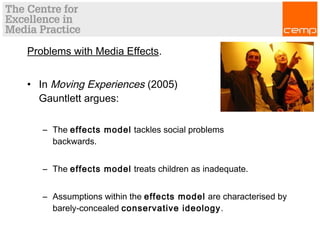
• In Moving Experiences (2005) David
Gauntlett argues:
– The effects model tackles social problems
backwards.
– The effects model treats children as inadequate.
– Assumptions within the effects model are characterised by
barely-concealed conservative ideology.
Problems with Media Effects.
– The effects model inadequately defines its own objects of
study.
– The effects model is often based on artificial elements and
assumptions within studies.
– The effects model is often based on studies with misapplied
methodology.
– The effects model is selective in its criticisms of media
depictions of violence.
Problems with Media Effects.
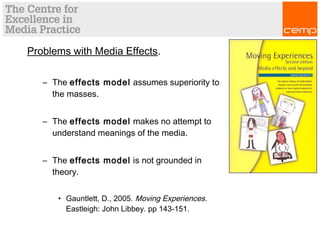
– The effects model assumes superiority to
the masses.
– The effects model makes no attempt to
understand meanings of the media.
– The effects model is not grounded in
theory.
• Gauntlett, D., 2005. Moving Experiences.
Eastleigh: John Libbey. pp 143-151.
Does media effect?
• Censors often act in self-serving ways – political.
• Effects model easy to demolish.
– i.e easy to see conservative ideology, highlighted by David
Gauntlett.
• The popular media can start a news spiral that
creates a ‘folk devil.’
– i.e Child’s Play 3, Crash, etc.
But…
• Films, and increasingly videogames, are still being
blamed for violence in society:
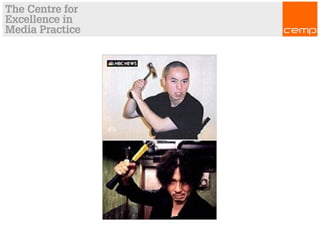
– Virginia Tech shootings – April 16th
2007.
– Student Seung-Hui Cho, killed 32 fellow students, and
himself.
– He sent a video and photographs of himself threatening the
massacre to NBC news, the previous day.
– Some newspapers blamed the film OldBoy (Park Chan-Wook,
2003).
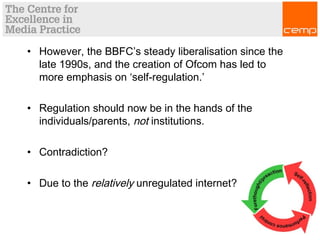
• However, the BBFC’s steady liberalisation since the
late 1990s, and the creation of Ofcom has led to
more emphasis on ‘self-regulation.’
• Regulation should now be in the hands of the
individuals/parents, not institutions.
• Contradiction?
• Due to the relatively unregulated internet?
Online Regulation.
• In 1998 the Culture, Media & Sport select committee
set up an enquiry into online regulation. They
reported:
– Existing broadcasting legislation wouldn’t work, but, new
regulation wasn’t viable because:

– Problems of access.
– Internet/Cyberspace is seen to be integral to economic
growth.
– International medium requires International law.
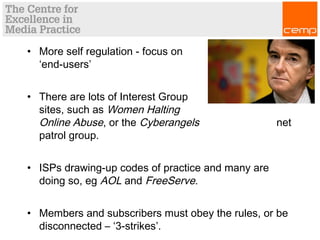
• More self regulation - focus on
‘end-users’
• There are lots of Interest Group
sites, such as Women Halting
Online Abuse, or the Cyberangels net
patrol group.
• ISPs drawing-up codes of practice and many are
doing so, eg AOL and FreeServe.
• Members and subscribers must obey the rules, or be
disconnected – ‘3-strikes’.
But…
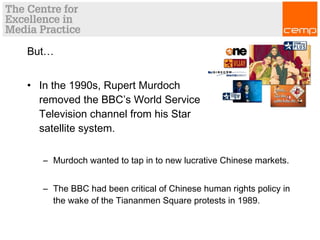
• In the 1990s, Rupert Murdoch
removed the BBC’s World Service
Television channel from his Star
satellite system.
– Murdoch wanted to tap in to new lucrative Chinese markets.
– The BBC had been critical of Chinese human rights policy in
the wake of the Tiananmen Square protests in 1989.
Google & China.
• On the 25th
January 2006 the search
engine Google introduced a system of
self-censorship for its Chinese version.
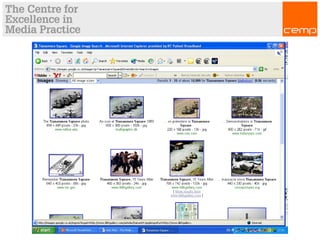
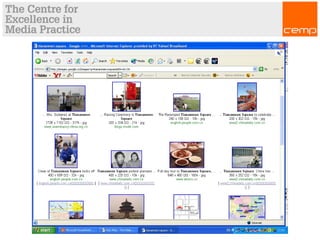
• For example, if you use www.google.co.uk for an
image search of ‘Tiananmen Square,’ you get…
• In February 2010, Google accused China of hacking
its service and announced it was pulling out.
• Further sourced relationships between China and the
new administration in the US.
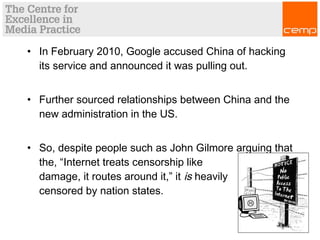
• So, despite people such as John Gilmore arguing that
the, “Internet treats censorship like
damage, it routes around it,” it is heavily
censored by nation states.
• So, despite the UK being the most heavily regulated
nation state in Europe, current content regulation is
being increasingly subverted.
• This is largely due to the internet, which transcends
national boundaries, political institutions and content
legislation.
• A great deal of controversial content can be found
online.
• Hate sites:
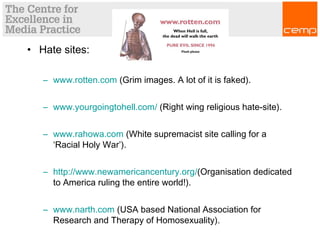
– www.rotten.com (Grim images. A lot of it is faked).
– www.yourgoingtohell.com/ (Right wing religious hate-site).
– www.rahowa.com (White supremacist site calling for a
‘Racial Holy War’).
– http://www.newamericancentury.org/(Organisation dedicated
to America ruling the entire world!).
– www.narth.com (USA based National Association for
Research and Therapy of Homosexuality).
– www.moralityinmedia.org (Right-wing
media watch site).
– http://www.afa.net/(American Family Association).
– http://www.newnation.org/(Racist site, mostly focusing on
immigration). 
– www.godhatesfags.com (Reverend Fred Phelps’ site)
– www.wakeupordie.com (Californian Elena
Haskins’ racist website).
– http://www.skrewdriver.net/(Combat 18’s website).
– www.av1611.org/crock.html (Christian site denouncing
The future of film and television.
• BBFC’s research has found that audiences are
concerned about violence and drug-taking, rather
than sex.
• Now, more films being passed at ’18’ certificate
featuring explicit sexual scenes.
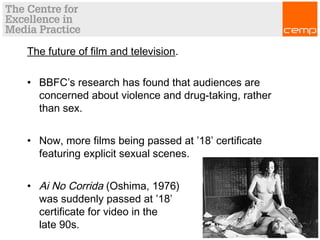
• Ai No Corrida (Oshima, 1976)
was suddenly passed at ’18’
certificate for video in the
late 90s.
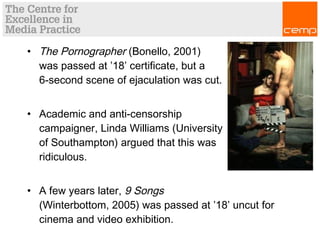
• The Pornographer (Bonello, 2001)
was passed at ’18’ certificate, but a
6-second scene of ejaculation was cut.
• Academic and anti-censorship
campaigner, Linda Williams (University
of Southampton) argued that this was
ridiculous.
• A few years later, 9 Songs
(Winterbottom, 2005) was passed at ’18’ uncut for
cinema and video exhibition.
• So, what happens online, impacts what other content
providers do – it’s all connected.
– Channel 4 plan to ‘test’ Ofcom’s power by showing the film-
probably on its More4 digital channel.
– This will hugely impact upon television censorship.
– Adult digital channels will probably feel that they can show
more ‘hardcore’ material – only currently available at ‘R18’
certificates from licensed premises.
Shortbus.
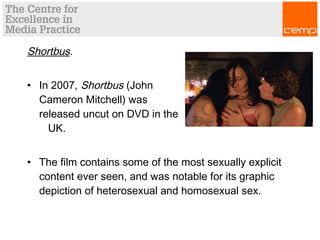
• In 2007, Shortbus (John
Cameron Mitchell) was
released uncut on DVD in the
UK.
• The film contains some of the most sexually explicit
content ever seen, and was notable for its graphic
depiction of heterosexual and homosexual sex.
• So, can the BBFC survive, if content it deems
unacceptable is available online?
• Will Ofcom replace it eventually?
• Or, will regulation shift subtly towards information and
education?
Political Impact.
• On the 30th
December 2006, at 6am
in North Baghdad, Saddam Hussein
was hanged.
• Silent images showing the moments leading up to the
execution were released from official sources within
minutes.
• The footage showed a composed Saddam, seemingly
accepting his fate.
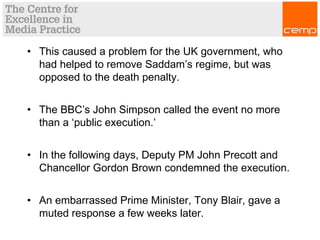
• However, within hours, footage showing the actual
execution, filmed on a mobile phone, was released
on the internet.
• Also shown on the Middle East news channel Al
Jazeera.
• It was later broadcast (almost) in its entirety on
television news.
• Showed Saddam being taunted.
• This caused a problem for the UK government, who
had helped to remove Saddam’s regime, but was
opposed to the death penalty.
• The BBC’s John Simpson called the event no more
than a ‘public execution.’
• In the following days, Deputy PM John Precott and
Chancellor Gordon Brown condemned the execution.
• An embarrassed Prime Minister, Tony Blair, gave a
muted response a few weeks later.
• The same debates regarding
censorship have been in circulation
throughout history.
• Successive UK Governments have
attempted to control and regulate
media.
• However, it is new forms of interactive media which
will cause concern for the censors of the future.
– In the ‘domestic space’ – like TV/VCR/DVD.
– Popular with children/young people.
– Level of ‘interactivity’ makes these texts potentially more
harmful/influential?
– Voluntary code of classification – at the moment.
– Not subject to the 1984 VRA.
– Videogames have been linked, by right-wing press, to
violence e.g Doom and the Columbine massacre.
– Videogames become more ‘real.’
• The current videogame debate is the same as the
‘video nasty’ debate in the 1980s.
• So…
• censorship and regulation will not decline.
• Despite recent changes, the UK is still the most
heavily regulated nation in Europe.
• Future content regulation will focus more on
videogames and interactive media.
• Legislation will probably be needed to combat the
increasing fluidity between different – and differently
regulated – media platforms.
richard@cemp.ac.uk.
March 2010.
Censorship and Regulation - OCR

Censorship and Regulation - OCR

  • 2.
    Media Regulation: Debatesand Perspectives. Dr. Richard Berger. The Centre for Excellence in Media Practice. Bournemouth University.
  • 3.
    • Historically, fromthe 1909 Cinematograph Act onwards, censorship in the UK has been medium specific. • The internet and new media has changed that. • Harder to regulate the internet – global nature etc. – Differences in US and UK law regarding ‘impartiality’. – In Sweden it’s not an offence to possess what in the UK would be deemed unlawful child pornography.
  • 4.
    • Move towardsself-censorship/regulation. • BBC guidelines for its online writers: • “Swearing is not big and it’s not clever, so avoid it as much as possible. If it’s in a quote, always star the following: c**t, f**k, w**k, F**ing and w**ker. If you really have to be foul mouthed, these words can be written in full: shit, bastard, bollocks, arsehole, twat, piss, sodding etc (eg, “He’s a c**t, that bastard.”). Obviously all slurs on race and minorities are a complete no-no.” •  From BBCi’s Style Guide for writers and journalists (Sept 2005).
  • 5.
    • The BroadcastingStandards Commission (later replaced by Ofcom) even rated swear words in 2002; • 1.    C**t    11. Shag. 21. Bugger. • 2.    Motherf****r   12. Whore. 22. Balls. • 3.    F**k    13. Twat. 23. Jew. • 4.    W****r  14. Piss Off. 24. Sodding. • 5.    N****r  15. Spastic. 25. Jesus Christ. • 6.    Bastard 16. Slag. 26. Crap. • 7.    Prick   17. S**t. 27. Bloody. • 8.    Bollocks        18. Dickhead. 28. God. • 9.    A***hole             19. P****d Off. • 10.  P**i           20. Arse.
  • 6.
    • The coalescenceof media regulation began in 2003 with the creation of Ofcom. • Before Ofcom, all UK media was regulated by; – ITC – Independent Television Commission. – OfTel – Telecommunications Regulator. – BSC – Broadcasting Standards Commission. – RA – Radio Authority. – OFT – Office of Fair Trading. – BBFC – British Board of Film Classification. – BBC – British Broadcasting Corporation.
  • 7.
    • So, Mainproblem is that the internet circumnavigates other media, and the laws that surround and regulate them. – The internet can result in pre-trial prejudice, and contempt of court. – Some national/local events do have widespread international appeal. – http:// www.thesmokinggun.com/doc_o_day/doc_o_day.html – Now with global 24 hour rolling news, it’s even harder – many people can get the BBC, and Al- jazerra.
  • 8.
    • Another problemwith medium specific media regulation are the ‘media effects’ debate which trawl in their wake. • Media effects debate is as old as cinema/television. • Many studies to prove links between violence on screen, and violence in society. • Most media effects models based on media’s perceived influence over children.
  • 9.
    Problems with MediaEffects. • In Moving Experiences (2005) David Gauntlett argues: – The effects model tackles social problems backwards. – The effects model treats children as inadequate. – Assumptions within the effects model are characterised by barely-concealed conservative ideology.
  • 10.
    Problems with MediaEffects. – The effects model inadequately defines its own objects of study. – The effects model is often based on artificial elements and assumptions within studies. – The effects model is often based on studies with misapplied methodology. – The effects model is selective in its criticisms of media depictions of violence.
  • 11.
    Problems with MediaEffects. – The effects model assumes superiority to the masses. – The effects model makes no attempt to understand meanings of the media. – The effects model is not grounded in theory. • Gauntlett, D., 2005. Moving Experiences. Eastleigh: John Libbey. pp 143-151.
  • 12.
    Does media effect? •Censors often act in self-serving ways – political. • Effects model easy to demolish. – i.e easy to see conservative ideology, highlighted by David Gauntlett. • The popular media can start a news spiral that creates a ‘folk devil.’ – i.e Child’s Play 3, Crash, etc.
  • 13.
    But… • Films, andincreasingly videogames, are still being blamed for violence in society: – Virginia Tech shootings – April 16th 2007. – Student Seung-Hui Cho, killed 32 fellow students, and himself. – He sent a video and photographs of himself threatening the massacre to NBC news, the previous day. – Some newspapers blamed the film OldBoy (Park Chan-Wook, 2003).
  • 15.
    • However, theBBFC’s steady liberalisation since the late 1990s, and the creation of Ofcom has led to more emphasis on ‘self-regulation.’ • Regulation should now be in the hands of the individuals/parents, not institutions. • Contradiction? • Due to the relatively unregulated internet?
  • 16.
    Online Regulation. • In1998 the Culture, Media & Sport select committee set up an enquiry into online regulation. They reported: – Existing broadcasting legislation wouldn’t work, but, new regulation wasn’t viable because: – Problems of access. – Internet/Cyberspace is seen to be integral to economic growth. – International medium requires International law.
  • 17.
    • More selfregulation - focus on ‘end-users’ • There are lots of Interest Group sites, such as Women Halting Online Abuse, or the Cyberangels net patrol group. • ISPs drawing-up codes of practice and many are doing so, eg AOL and FreeServe. • Members and subscribers must obey the rules, or be disconnected – ‘3-strikes’.
  • 18.
    But… • In the1990s, Rupert Murdoch removed the BBC’s World Service Television channel from his Star satellite system. – Murdoch wanted to tap in to new lucrative Chinese markets. – The BBC had been critical of Chinese human rights policy in the wake of the Tiananmen Square protests in 1989.
  • 19.
    Google & China. •On the 25th January 2006 the search engine Google introduced a system of self-censorship for its Chinese version. • For example, if you use www.google.co.uk for an image search of ‘Tiananmen Square,’ you get…
  • 22.
    • In February2010, Google accused China of hacking its service and announced it was pulling out. • Further sourced relationships between China and the new administration in the US. • So, despite people such as John Gilmore arguing that the, “Internet treats censorship like damage, it routes around it,” it is heavily censored by nation states.
  • 23.
    • So, despitethe UK being the most heavily regulated nation state in Europe, current content regulation is being increasingly subverted. • This is largely due to the internet, which transcends national boundaries, political institutions and content legislation. • A great deal of controversial content can be found online.
  • 24.
    • Hate sites: –www.rotten.com (Grim images. A lot of it is faked). – www.yourgoingtohell.com/ (Right wing religious hate-site). – www.rahowa.com (White supremacist site calling for a ‘Racial Holy War’). – http://www.newamericancentury.org/(Organisation dedicated to America ruling the entire world!). – www.narth.com (USA based National Association for Research and Therapy of Homosexuality).
  • 25.
    – www.moralityinmedia.org (Right-wing mediawatch site). – http://www.afa.net/(American Family Association). – http://www.newnation.org/(Racist site, mostly focusing on immigration).  – www.godhatesfags.com (Reverend Fred Phelps’ site) – www.wakeupordie.com (Californian Elena Haskins’ racist website). – http://www.skrewdriver.net/(Combat 18’s website). – www.av1611.org/crock.html (Christian site denouncing
  • 26.
    The future offilm and television. • BBFC’s research has found that audiences are concerned about violence and drug-taking, rather than sex. • Now, more films being passed at ’18’ certificate featuring explicit sexual scenes. • Ai No Corrida (Oshima, 1976) was suddenly passed at ’18’ certificate for video in the late 90s.
  • 27.
    • The Pornographer(Bonello, 2001) was passed at ’18’ certificate, but a 6-second scene of ejaculation was cut. • Academic and anti-censorship campaigner, Linda Williams (University of Southampton) argued that this was ridiculous. • A few years later, 9 Songs (Winterbottom, 2005) was passed at ’18’ uncut for cinema and video exhibition.
  • 28.
    • So, whathappens online, impacts what other content providers do – it’s all connected. – Channel 4 plan to ‘test’ Ofcom’s power by showing the film- probably on its More4 digital channel. – This will hugely impact upon television censorship. – Adult digital channels will probably feel that they can show more ‘hardcore’ material – only currently available at ‘R18’ certificates from licensed premises.
  • 29.
    Shortbus. • In 2007,Shortbus (John Cameron Mitchell) was released uncut on DVD in the UK. • The film contains some of the most sexually explicit content ever seen, and was notable for its graphic depiction of heterosexual and homosexual sex.
  • 30.
    • So, canthe BBFC survive, if content it deems unacceptable is available online? • Will Ofcom replace it eventually? • Or, will regulation shift subtly towards information and education?
  • 31.
    Political Impact. • Onthe 30th December 2006, at 6am in North Baghdad, Saddam Hussein was hanged. • Silent images showing the moments leading up to the execution were released from official sources within minutes. • The footage showed a composed Saddam, seemingly accepting his fate.
  • 32.
    • However, withinhours, footage showing the actual execution, filmed on a mobile phone, was released on the internet. • Also shown on the Middle East news channel Al Jazeera. • It was later broadcast (almost) in its entirety on television news. • Showed Saddam being taunted.
  • 33.
    • This causeda problem for the UK government, who had helped to remove Saddam’s regime, but was opposed to the death penalty. • The BBC’s John Simpson called the event no more than a ‘public execution.’ • In the following days, Deputy PM John Precott and Chancellor Gordon Brown condemned the execution. • An embarrassed Prime Minister, Tony Blair, gave a muted response a few weeks later.
  • 34.
    • The samedebates regarding censorship have been in circulation throughout history. • Successive UK Governments have attempted to control and regulate media.
  • 35.
    • However, itis new forms of interactive media which will cause concern for the censors of the future. – In the ‘domestic space’ – like TV/VCR/DVD. – Popular with children/young people. – Level of ‘interactivity’ makes these texts potentially more harmful/influential? – Voluntary code of classification – at the moment. – Not subject to the 1984 VRA. – Videogames have been linked, by right-wing press, to violence e.g Doom and the Columbine massacre. – Videogames become more ‘real.’
  • 36.
    • The currentvideogame debate is the same as the ‘video nasty’ debate in the 1980s. • So… • censorship and regulation will not decline. • Despite recent changes, the UK is still the most heavily regulated nation in Europe.
  • 37.
    • Future contentregulation will focus more on videogames and interactive media. • Legislation will probably be needed to combat the increasing fluidity between different – and differently regulated – media platforms. richard@cemp.ac.uk. March 2010.