Media Audiences
 
Definition The audience for any media product is the group that consumed it.  Some texts will aim to encourage a wide or mass audience and others a specific or niche group.  Each person will consume the product in a different way.
Research In order to target the most appropriate audience producers research: Age Gender Socio-economic group Sexual orientation Consumption history or preferences.
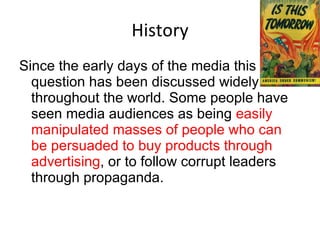
History Since the early days of the media this question has been discussed widely throughout the world. Some people have seen media audiences as being  easily manipulated masses of people who can be persuaded to buy products through advertising , or to follow corrupt leaders through propaganda.
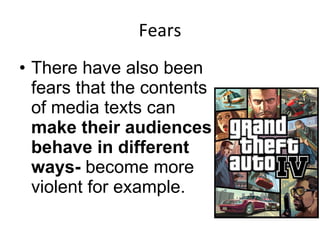
Fears There have also been fears that the contents of media texts can  make their audiences behave in different ways-  become more violent for example.
Life without media…. All of the different media that we think of as "The Media" are actually  quite recent inventions . The cliché about pre- media times is that  people made their own entertainment  and there is obviously some truth in this. The kinds of things that people did in their leisure time were either likely to be  fairly independent things such as reading , or they would involve  mixing with many other people such as going to a play or musical .
Did You Know????? Within less than a hundred years photography, Film, radio and television were all invented.
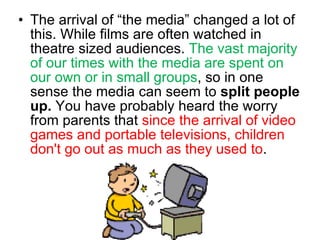
The arrival of “the media” changed a lot of this. While films are often watched in theatre sized audiences.  The vast majority of our times with the media are spent on our own or in small groups , so in one sense the media can seem to  split people up.  You have probably heard the worry from parents that  since the arrival of video games and portable televisions, children don't go out as much as they used to .
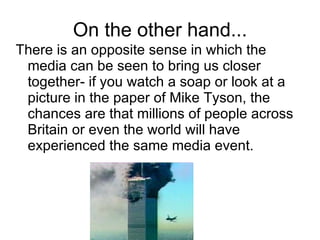
On the other hand... There is an opposite sense in which the media can be seen to bring us closer together- if you watch a soap or look at a picture in the paper of Mike Tyson, the chances are that millions of people across Britain or even the world will have experienced the same media event.
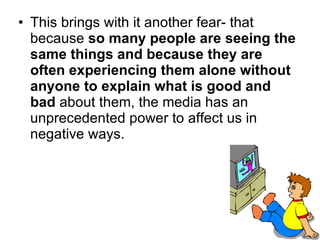
This brings with it another fear- that because  so many people are seeing the same things and because they are often experiencing them alone without anyone to explain what is good and bad  about them, the media has an unprecedented power to affect us in negative ways.
Good and bad What are the possible good and bad points about these conflicting ideas?  Which do you think is right (or just slightly more right)? Good Bad
Key points Summary The media are often experienced by people  alone . (Some critics have talked about media audiences as atomised- cut off from other people like separate atoms)  Wherever they are in the world, the audience for a media text are all receiving exactly the  same thing .
According to many theorists, particularly in the early history of the subject, when we listen to our CDs or sit in the cinema, we  become part of a mass audience  in many ways like a crowd at a football match or a rock concert but at the same time very different because  separated from all the other members of this mass  by space and sometimes time.
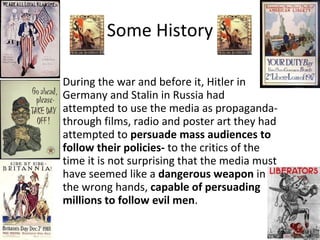
Some History During the war and before it, Hitler in Germany and Stalin in Russia had attempted to use the media as propaganda- through films, radio and poster art they had attempted to  persuade mass audiences to follow their policies-  to the critics of the time it is not surprising that the media must have seemed like a  dangerous weapon  in the wrong hands,  capable of persuading millions to follow evil men .
Audience Theory Audience theory is the starting point for many Media Studies tasks. Whether you are constructing a text or analysing one, you will need to  consider the destination  of that text, ie its target audience and how that audience (or any other) will respond to that text.
Why bother? It is virtually impossible these days to go through a day without encountering the media in some form. You may  wake up to the sound of the radio ,  play an Ipod  on your way into school, pass  billboards  in the street and  watch television  or  go to a film  in the evening.  We are all therefore part of the audience for these different kinds of media products. What does this statement actually mean?
Theory Problems some audience theories are seen as a call for  more censorship , others for  less control . Whatever your personal stance on the subject, you must  understand the following theories and how they may be used to deconstruct the relationship between audience and text .
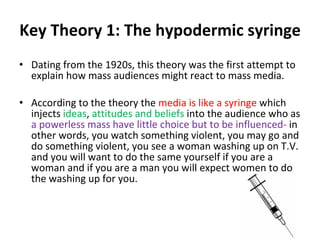
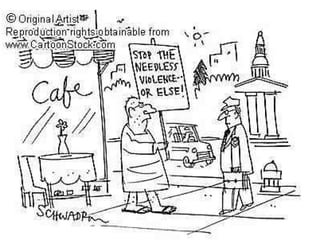
Key Theory 1: The hypodermic syringe Dating from the 1920s, this theory was the first attempt to explain how mass audiences might react to mass media. According to the theory the  media is like a syringe  which injects  ideas ,  attitudes and beliefs  into the audience who as  a powerless mass have little choice but to be influenced-  in other words, you watch something violent, you may go and do something violent, you see a woman washing up on T.V. and you will want to do the same yourself if you are a woman and if you are a man you will expect women to do the washing up for you.
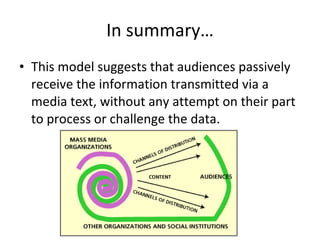
In summary… This model suggests that audiences passively receive the information transmitted via a media text, without any attempt on their part to process or challenge the data.
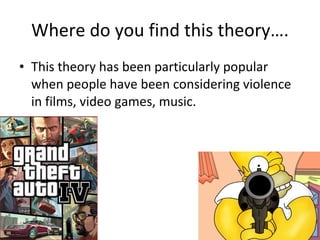
Where do you find this theory…. This theory has been particularly popular when people have been considering violence in films, video games, music.
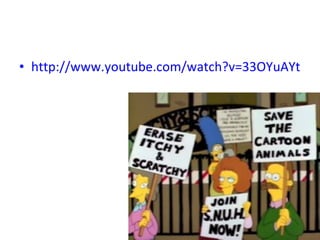
http://www.youtube.com/watch?v=33OYuAYta6g
What’s wrong with this theory? __________________________________________________________________________________________________________________________________________________________________________________________________________________________________________________________________________________________________________.
Many people have seen this theory as simplistic  because it doesn't take any account of  people's individuality  and yet it is still very  popular in society particularly for politicians  looking for reasons why society has become more violent.
 
Worth thinking about…. It is obviously easy to find reasons why the hypodermic syringe theory could never apply to everyone equally.  But do you think it could work sometimes?  What about you- can you think of any media texts which you feel have had a big effect on you and made you behave in any way differently?
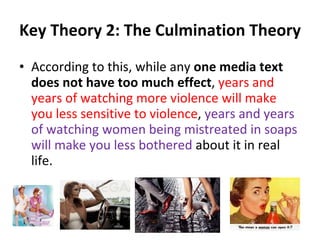
Key Theory 2: The Culmination Theory According to this, while any  one media text does not have too much effect ,  years and years of watching more violence will make you less sensitive to violence ,  years and years of watching women being mistreated in soaps will make you less bothered  about it in real life.
What do you think? What do you think about this as an idea- can you think of anything that upset you the first time you saw it on television which you now take for granted? ____________________________________________________________________________________________________________________________________________________________________________________
Difficulties One difficulty with both of these ways of looking at the media is that they are very  difficult to prove either way . Many people have a general sense that the  media do affect our behaviour  and advertisers certainly justify their fees by working on this assumption, but  it can be extraordinarily difficult to actually prove how much effect if any a text might have on an audience .  http://www.youtube.com/watch?v=Y7Y9w0JjRX4
Criticisms Critics of the idea often claim that it is elitist-  in other words that it suggests a value judgement about these masses-  that they are  easily led  and not so perceptive and self- aware as the theorists who are analysing them.
Questions Think about this for yourself: Are there any forms of media that you think society gives  greater status  to. For example which do people see as "better":  films or television, soaps or detective dramas, opera or garage? Do you have any  feelings about the kinds of audience these different forms of media attract - are some likely to be more thoughtful and more intelligent than others?
So in simple terms… The first idea seems to be suggesting that because we often watch the media independently, it has more chance of affecting us.  Certainly many parents think this is true and will make a point of sitting with their young children while they watch potentially disturbing programmes  so that they can have some influence on the way the children take in the messages and explain confusing issues.
More thinking… Do you feel adults need to be protected in the same ways?  Some of the critics of the idea of the mass audience have pointed out the many ways that individuals who watch programmes alone will then share their experience with others in conversations about what they have seen. One argument is that these kind of conversations have much more influence on potential behaviour than the programme from which they may have sprung
Key Theory 3: The two step flow A theory that springs from this idea is called the two step flow. The idea of this is that  whatever our experience  of the media we will be  likely to discuss it with others  and if we respect their opinion, the chances are that we will be  more likely to be affected by it . (The theory calls these people opinion leaders .)
Now really… Think about this honestly- are your opinions about television, films or groups ever  influenced  by other people?   http://www.youtube.com/watch?v=aOEPOvR1YAM
Now it gets confusing We believe that each of you has an  individual way of seeing any media text  and that  your ideas are equally valid  to ours. In other words  we might interpret a film as being sexist  but  you have a perfect right to argue an opposite case-  we could experience the same text in very different ways -  so different, in fact that the film I saw  could almost be another text to the one that you saw.
Key Theory 4: Uses and Gratifications   This is probably the most important theory for you to know. According to uses and gratification theory,  we all have different uses for the media  and we  make choices  over what we want to watch. In other words, when we encounter a media text,  it is not just some kind of mindless entertainment-  we are  expecting to get something from it :  some kind of gratification.
Huh What kinds of gratification can we be getting? ________________________________________________________________________________________________________________________________________________________________________________________________________________________________________.
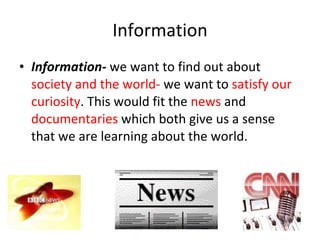
Information Information -  we want to find out about  society and the world-  we want to  satisfy our curiosity . This would fit the  news  and  documentaries  which both give us a sense that we are learning about the world.
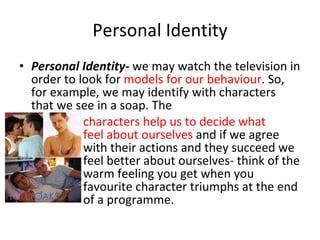
Personal Identity Personal Identity -  we may watch the television in order to look for  models for our behaviour . So, for example, we may identify with characters that we see in a soap. The  characters help us to decide what  feel about ourselves  and if we agree  with their actions and they succeed we  feel better about ourselves- think of the  warm feeling you get when you  favourite character triumphs at the end  of a programme.
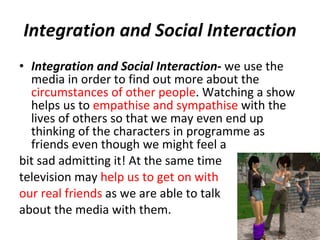
Integration and Social Interaction Integration and Social Interaction -  we use the media in order to find out more about the  circumstances of other people . Watching a show helps us to  empathise and sympathise  with the lives of others so that we may even end up thinking of the characters in programme as friends even though we might feel a  bit sad admitting it! At the same time  television may  help us to get on with  our real friends  as we are able to talk  about the media with them.
Entertainment Entertainment-  sometimes we simply use the media for  enjoyment ,  relaxation  or just to  fill time.
So what’s wrong with this  theory? First of all, it ignores the fact that  we do not always have complete choice as to what we receive from the media . Think, for example, about your family who may end up having to listen to the same music as you sometimes. Similarly, you  don't have that much choice about the posters that you see  on your way to school however objectionable you may find some of them.
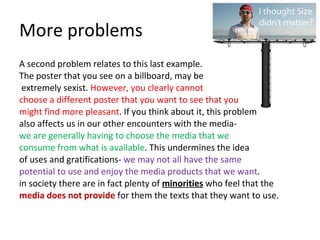
More problems A second problem relates to this last example.  The poster that you see on a billboard, may be extremely sexist.  However, you clearly cannot  choose a different poster that you want to see that you  might find more pleasant . If you think about it, this problem  also affects us in our other encounters with the media-  we are generally having to choose the media that we  consume from what is available . This undermines the idea  of uses and gratifications-  we may not all have the same  potential to use and enjoy the media products that we want .  in society there are in fact plenty of  minorities  who feel that the  media does not provide  for them the texts that they want to use.
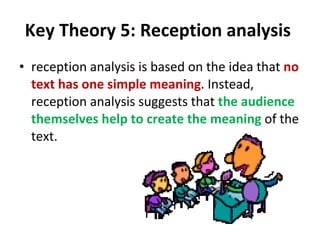
Key Theory 5: Reception analysis  reception analysis is based on the idea that  no text has one simple meaning . Instead, reception analysis suggests that  the audience themselves help to create the meaning  of the text.
How do we do this? We all decode the texts that we encounter in individual ways  which may be a result of our  upbringing , the  mood that we are in , the  place where we are  at the time or in fact any combination of these and all kinds of other factors.  So viewer 1 may watch a television programme and enjoy every minute of it and viewer 2 may hate the same show . But of course, it goes way beyond just how much we enjoy the text.  We will actually create a different meaning for it as well.
Influences Reception analysis is all about trying to look at these kinds of differences and to understand them. What reception analysts have found is that factors such as a  gender , our  place inside society , and the  context of the time  we are living in can be enormously important when we make the meaning or a text.
How do they learn this information? While quantitative researchers simply count the number of people watching a programme ,  reception analysts have to make use of interviews in order to get some kind of idea of the meanings that people attach to texts .  This can be very time consuming - a simple questionnaire is rarely enough and often the researchers will have to ask quite detailed and spontaneous questions.
The end?? What you have been reading about up to now are very much the classic ideas about audiences. You need to be familiar with these theories if you are to answer questions in the media studies exam successfully

Media audiences

  • 1.
  • 2.
  • 3.
    Definition The audiencefor any media product is the group that consumed it. Some texts will aim to encourage a wide or mass audience and others a specific or niche group. Each person will consume the product in a different way.
  • 4.
    Research In orderto target the most appropriate audience producers research: Age Gender Socio-economic group Sexual orientation Consumption history or preferences.
  • 5.
    History Since theearly days of the media this question has been discussed widely throughout the world. Some people have seen media audiences as being easily manipulated masses of people who can be persuaded to buy products through advertising , or to follow corrupt leaders through propaganda.
  • 6.
    Fears There havealso been fears that the contents of media texts can make their audiences behave in different ways- become more violent for example.
  • 7.
    Life without media….All of the different media that we think of as "The Media" are actually quite recent inventions . The cliché about pre- media times is that people made their own entertainment and there is obviously some truth in this. The kinds of things that people did in their leisure time were either likely to be fairly independent things such as reading , or they would involve mixing with many other people such as going to a play or musical .
  • 8.
    Did You Know?????Within less than a hundred years photography, Film, radio and television were all invented.
  • 9.
    The arrival of“the media” changed a lot of this. While films are often watched in theatre sized audiences. The vast majority of our times with the media are spent on our own or in small groups , so in one sense the media can seem to split people up. You have probably heard the worry from parents that since the arrival of video games and portable televisions, children don't go out as much as they used to .
  • 10.
    On the otherhand... There is an opposite sense in which the media can be seen to bring us closer together- if you watch a soap or look at a picture in the paper of Mike Tyson, the chances are that millions of people across Britain or even the world will have experienced the same media event.
  • 11.
    This brings withit another fear- that because so many people are seeing the same things and because they are often experiencing them alone without anyone to explain what is good and bad about them, the media has an unprecedented power to affect us in negative ways.
  • 12.
    Good and badWhat are the possible good and bad points about these conflicting ideas? Which do you think is right (or just slightly more right)? Good Bad
  • 13.
    Key points SummaryThe media are often experienced by people alone . (Some critics have talked about media audiences as atomised- cut off from other people like separate atoms) Wherever they are in the world, the audience for a media text are all receiving exactly the same thing .
  • 14.
    According to manytheorists, particularly in the early history of the subject, when we listen to our CDs or sit in the cinema, we become part of a mass audience in many ways like a crowd at a football match or a rock concert but at the same time very different because separated from all the other members of this mass by space and sometimes time.
  • 15.
    Some History Duringthe war and before it, Hitler in Germany and Stalin in Russia had attempted to use the media as propaganda- through films, radio and poster art they had attempted to persuade mass audiences to follow their policies- to the critics of the time it is not surprising that the media must have seemed like a dangerous weapon in the wrong hands, capable of persuading millions to follow evil men .
  • 16.
    Audience Theory Audiencetheory is the starting point for many Media Studies tasks. Whether you are constructing a text or analysing one, you will need to consider the destination of that text, ie its target audience and how that audience (or any other) will respond to that text.
  • 17.
    Why bother? Itis virtually impossible these days to go through a day without encountering the media in some form. You may wake up to the sound of the radio , play an Ipod on your way into school, pass billboards in the street and watch television or go to a film in the evening. We are all therefore part of the audience for these different kinds of media products. What does this statement actually mean?
  • 18.
    Theory Problems someaudience theories are seen as a call for more censorship , others for less control . Whatever your personal stance on the subject, you must understand the following theories and how they may be used to deconstruct the relationship between audience and text .
  • 19.
    Key Theory 1:The hypodermic syringe Dating from the 1920s, this theory was the first attempt to explain how mass audiences might react to mass media. According to the theory the media is like a syringe which injects ideas , attitudes and beliefs into the audience who as a powerless mass have little choice but to be influenced- in other words, you watch something violent, you may go and do something violent, you see a woman washing up on T.V. and you will want to do the same yourself if you are a woman and if you are a man you will expect women to do the washing up for you.
  • 20.
    In summary… Thismodel suggests that audiences passively receive the information transmitted via a media text, without any attempt on their part to process or challenge the data.
  • 21.
    Where do youfind this theory…. This theory has been particularly popular when people have been considering violence in films, video games, music.
  • 22.
  • 23.
    What’s wrong withthis theory? __________________________________________________________________________________________________________________________________________________________________________________________________________________________________________________________________________________________________________.
  • 24.
    Many people haveseen this theory as simplistic because it doesn't take any account of people's individuality and yet it is still very popular in society particularly for politicians looking for reasons why society has become more violent.
  • 25.
  • 26.
    Worth thinking about….It is obviously easy to find reasons why the hypodermic syringe theory could never apply to everyone equally. But do you think it could work sometimes? What about you- can you think of any media texts which you feel have had a big effect on you and made you behave in any way differently?
  • 27.
    Key Theory 2:The Culmination Theory According to this, while any one media text does not have too much effect , years and years of watching more violence will make you less sensitive to violence , years and years of watching women being mistreated in soaps will make you less bothered about it in real life.
  • 28.
    What do youthink? What do you think about this as an idea- can you think of anything that upset you the first time you saw it on television which you now take for granted? ____________________________________________________________________________________________________________________________________________________________________________________
  • 29.
    Difficulties One difficultywith both of these ways of looking at the media is that they are very difficult to prove either way . Many people have a general sense that the media do affect our behaviour and advertisers certainly justify their fees by working on this assumption, but it can be extraordinarily difficult to actually prove how much effect if any a text might have on an audience . http://www.youtube.com/watch?v=Y7Y9w0JjRX4
  • 30.
    Criticisms Critics ofthe idea often claim that it is elitist- in other words that it suggests a value judgement about these masses- that they are easily led and not so perceptive and self- aware as the theorists who are analysing them.
  • 31.
    Questions Think aboutthis for yourself: Are there any forms of media that you think society gives greater status to. For example which do people see as "better": films or television, soaps or detective dramas, opera or garage? Do you have any feelings about the kinds of audience these different forms of media attract - are some likely to be more thoughtful and more intelligent than others?
  • 32.
    So in simpleterms… The first idea seems to be suggesting that because we often watch the media independently, it has more chance of affecting us. Certainly many parents think this is true and will make a point of sitting with their young children while they watch potentially disturbing programmes so that they can have some influence on the way the children take in the messages and explain confusing issues.
  • 33.
    More thinking… Doyou feel adults need to be protected in the same ways? Some of the critics of the idea of the mass audience have pointed out the many ways that individuals who watch programmes alone will then share their experience with others in conversations about what they have seen. One argument is that these kind of conversations have much more influence on potential behaviour than the programme from which they may have sprung
  • 34.
    Key Theory 3:The two step flow A theory that springs from this idea is called the two step flow. The idea of this is that whatever our experience of the media we will be likely to discuss it with others and if we respect their opinion, the chances are that we will be more likely to be affected by it . (The theory calls these people opinion leaders .)
  • 35.
    Now really… Thinkabout this honestly- are your opinions about television, films or groups ever influenced by other people? http://www.youtube.com/watch?v=aOEPOvR1YAM
  • 36.
    Now it getsconfusing We believe that each of you has an individual way of seeing any media text and that your ideas are equally valid to ours. In other words we might interpret a film as being sexist but you have a perfect right to argue an opposite case- we could experience the same text in very different ways - so different, in fact that the film I saw could almost be another text to the one that you saw.
  • 37.
    Key Theory 4:Uses and Gratifications This is probably the most important theory for you to know. According to uses and gratification theory, we all have different uses for the media and we make choices over what we want to watch. In other words, when we encounter a media text, it is not just some kind of mindless entertainment- we are expecting to get something from it : some kind of gratification.
  • 38.
    Huh What kindsof gratification can we be getting? ________________________________________________________________________________________________________________________________________________________________________________________________________________________________________.
  • 39.
    Information Information - we want to find out about society and the world- we want to satisfy our curiosity . This would fit the news and documentaries which both give us a sense that we are learning about the world.
  • 40.
    Personal Identity PersonalIdentity - we may watch the television in order to look for models for our behaviour . So, for example, we may identify with characters that we see in a soap. The characters help us to decide what feel about ourselves and if we agree with their actions and they succeed we feel better about ourselves- think of the warm feeling you get when you favourite character triumphs at the end of a programme.
  • 41.
    Integration and SocialInteraction Integration and Social Interaction - we use the media in order to find out more about the circumstances of other people . Watching a show helps us to empathise and sympathise with the lives of others so that we may even end up thinking of the characters in programme as friends even though we might feel a bit sad admitting it! At the same time television may help us to get on with our real friends as we are able to talk about the media with them.
  • 42.
    Entertainment Entertainment- sometimes we simply use the media for enjoyment , relaxation or just to fill time.
  • 43.
    So what’s wrongwith this theory? First of all, it ignores the fact that we do not always have complete choice as to what we receive from the media . Think, for example, about your family who may end up having to listen to the same music as you sometimes. Similarly, you don't have that much choice about the posters that you see on your way to school however objectionable you may find some of them.
  • 44.
    More problems Asecond problem relates to this last example. The poster that you see on a billboard, may be extremely sexist. However, you clearly cannot choose a different poster that you want to see that you might find more pleasant . If you think about it, this problem also affects us in our other encounters with the media- we are generally having to choose the media that we consume from what is available . This undermines the idea of uses and gratifications- we may not all have the same potential to use and enjoy the media products that we want . in society there are in fact plenty of minorities who feel that the media does not provide for them the texts that they want to use.
  • 45.
    Key Theory 5:Reception analysis reception analysis is based on the idea that no text has one simple meaning . Instead, reception analysis suggests that the audience themselves help to create the meaning of the text.
  • 46.
    How do wedo this? We all decode the texts that we encounter in individual ways which may be a result of our upbringing , the mood that we are in , the place where we are at the time or in fact any combination of these and all kinds of other factors. So viewer 1 may watch a television programme and enjoy every minute of it and viewer 2 may hate the same show . But of course, it goes way beyond just how much we enjoy the text. We will actually create a different meaning for it as well.
  • 47.
    Influences Reception analysisis all about trying to look at these kinds of differences and to understand them. What reception analysts have found is that factors such as a gender , our place inside society , and the context of the time we are living in can be enormously important when we make the meaning or a text.
  • 48.
    How do theylearn this information? While quantitative researchers simply count the number of people watching a programme , reception analysts have to make use of interviews in order to get some kind of idea of the meanings that people attach to texts . This can be very time consuming - a simple questionnaire is rarely enough and often the researchers will have to ask quite detailed and spontaneous questions.
  • 49.
    The end?? Whatyou have been reading about up to now are very much the classic ideas about audiences. You need to be familiar with these theories if you are to answer questions in the media studies exam successfully