CMMI
CMMI Implementation
https://www.arshadqa.com
CMMI FOR DEVELOPMENT (VERSION 1.3)
Module 1: Introduction to CMMI for Development
Module 2: Process Areas in CMMI for Development
Module 3: Implementing CMMI for Development
Module 4: Appraisals and CMMI Assessments
Module 5: Process Improvement and Maturity Level
Advancement
Module 6: Tools and Resources for CMMI Implementation
MODULE 1:
INTRODUCTION TO
CMMI FOR
DEVELOPMENT
https://www.arshadqa.com
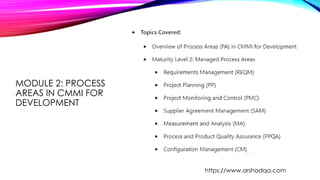
MODULE 2: PROCESS
AREAS IN CMMI FOR
DEVELOPMENT
https://www.arshadqa.com
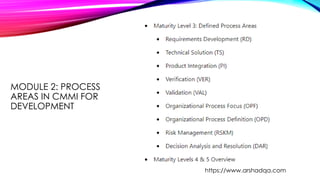
MODULE 2: PROCESS
AREAS IN CMMI FOR
DEVELOPMENT
https://www.arshadqa.com
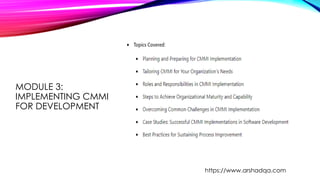
MODULE 3:
IMPLEMENTING CMMI
FOR DEVELOPMENT
https://www.arshadqa.com
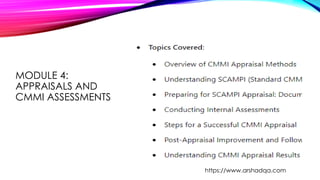
MODULE 4:
APPRAISALS AND
CMMI ASSESSMENTS
https://www.arshadqa.com
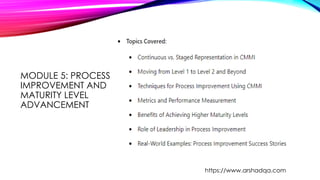
MODULE 5: PROCESS
IMPROVEMENT AND
MATURITY LEVEL
ADVANCEMENT
https://www.arshadqa.com
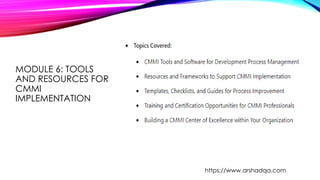
MODULE 6: TOOLS
AND RESOURCES FOR
CMMI
IMPLEMENTATION
https://www.arshadqa.com
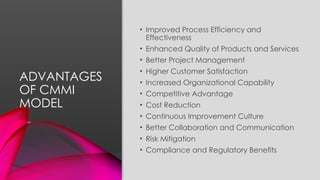
ADVANTAGES
OF CMMI
MODEL
• Improved Process Efficiency and
Effectiveness
• Enhanced Quality of Products and Services
• Better Project Management
• Higher Customer Satisfaction
• Increased Organizational Capability
• Competitive Advantage
• Cost Reduction
• Continuous Improvement Culture
• Better Collaboration and Communication
• Risk Mitigation
• Compliance and Regulatory Benefits
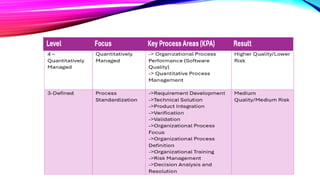
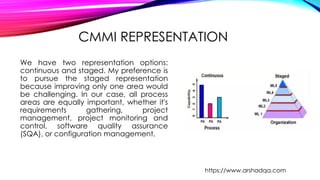
CMMI REPRESENTATION
We have two representation options:
continuous and staged. My preference is
to pursue the staged representation
because improving only one area would
be challenging. In our case, all process
areas are equally important, whether it's
requirements gathering, project
management, project monitoring and
control, software quality assurance
(SQA), or configuration management.
https://www.arshadqa.com
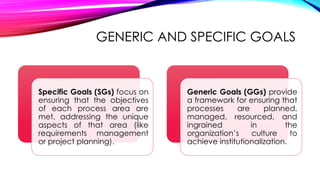
GENERIC AND SPECIFIC GOALS
Specific Goals (SGs) focus on
ensuring that the objectives
of each process area are
met, addressing the unique
aspects of that area (like
requirements management
or project planning).
Generic Goals (GGs) provide
a framework for ensuring that
processes are planned,
managed, resourced, and
ingrained in the
organization’s culture to
achieve institutionalization.
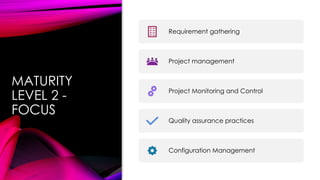
MATURITY
LEVEL 2 -
FOCUS
Requirement gathering
Project management
Project Monitoring and Control
Quality assurance practices
Configuration Management
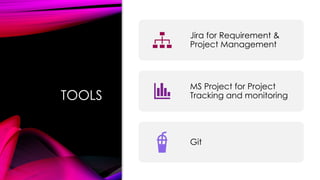
TOOLS
Jira for Requirement &
Project Management
MS Project for Project
Tracking and monitoring
Git
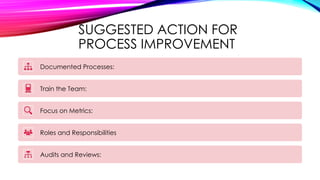
SUGGESTED ACTION FOR
PROCESS IMPROVEMENT
Documented Processes:
Train the Team:
Focus on Metrics:
Roles and Responsibilities
Audits and Reviews:
SUGGESTED ACTION
FOR PROCESS
IMPROVEMENT
These steps will help transition from a
people-dependent approach to one
where processes are repeatable,
measurable, and scalable across the
organization
WORK PRODUCTS FOR CMMI LEVEL 2
KEY PROCESS AREAS (KPAS)
Each work product serves as evidence
that specific processes are being
followed and are essential for auditing
purposes during the CMMI Level 2
assessment.
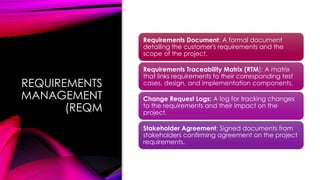
REQUIREMENTS
MANAGEMENT
(REQM
Requirements Document: A formal document
detailing the customer's requirements and the
scope of the project.
Requirements Traceability Matrix (RTM): A matrix
that links requirements to their corresponding test
cases, design, and implementation components.
Change Request Logs: A log for tracking changes
to the requirements and their impact on the
project.
Stakeholder Agreement: Signed documents from
stakeholders confirming agreement on the project
requirements.
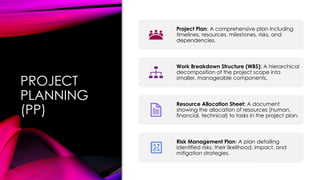
PROJECT
PLANNING
(PP)
Project Plan: A comprehensive plan including
timelines, resources, milestones, risks, and
dependencies.
Work Breakdown Structure (WBS): A hierarchical
decomposition of the project scope into
smaller, manageable components.
Resource Allocation Sheet: A document
showing the allocation of resources (human,
financial, technical) to tasks in the project plan.
Risk Management Plan: A plan detailing
identified risks, their likelihood, impact, and
mitigation strategies.
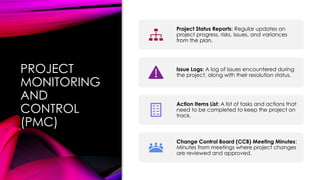
PROJECT
MONITORING
AND
CONTROL
(PMC)
Project Status Reports: Regular updates on
project progress, risks, issues, and variances
from the plan.
Issue Logs: A log of issues encountered during
the project, along with their resolution status.
Action Items List: A list of tasks and actions that
need to be completed to keep the project on
track.
Change Control Board (CCB) Meeting Minutes:
Minutes from meetings where project changes
are reviewed and approved.
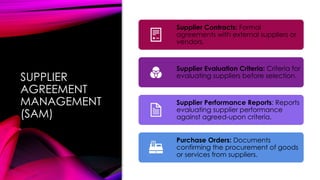
SUPPLIER
AGREEMENT
MANAGEMENT
(SAM)
Supplier Contracts: Formal
agreements with external suppliers or
vendors.
Supplier Evaluation Criteria: Criteria for
evaluating suppliers before selection.
Supplier Performance Reports: Reports
evaluating supplier performance
against agreed-upon criteria.
Purchase Orders: Documents
confirming the procurement of goods
or services from suppliers.
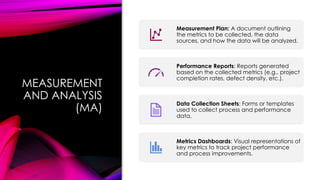
MEASUREMENT
AND ANALYSIS
(MA)
Measurement Plan: A document outlining
the metrics to be collected, the data
sources, and how the data will be analyzed.
Performance Reports: Reports generated
based on the collected metrics (e.g., project
completion rates, defect density, etc.).
Data Collection Sheets: Forms or templates
used to collect process and performance
data.
Metrics Dashboards: Visual representations of
key metrics to track project performance
and process improvements.
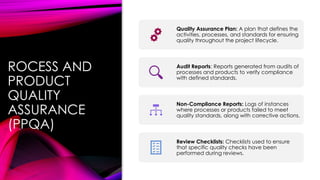
ROCESS AND
PRODUCT
QUALITY
ASSURANCE
(PPQA)
Quality Assurance Plan: A plan that defines the
activities, processes, and standards for ensuring
quality throughout the project lifecycle.
Audit Reports: Reports generated from audits of
processes and products to verify compliance
with defined standards.
Non-Compliance Reports: Logs of instances
where processes or products failed to meet
quality standards, along with corrective actions.
Review Checklists: Checklists used to ensure
that specific quality checks have been
performed during reviews.
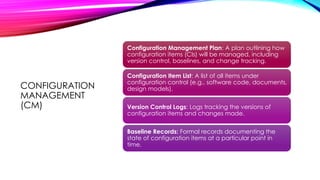
CONFIGURATION
MANAGEMENT
(CM)
Configuration Management Plan: A plan outlining how
configuration items (CIs) will be managed, including
version control, baselines, and change tracking.
Configuration Item List: A list of all items under
configuration control (e.g., software code, documents,
design models).
Version Control Logs: Logs tracking the versions of
configuration items and changes made.
Baseline Records: Formal records documenting the
state of configuration items at a particular point in
time.
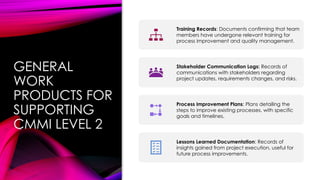
GENERAL
WORK
PRODUCTS FOR
SUPPORTING
CMMI LEVEL 2
Training Records: Documents confirming that team
members have undergone relevant training for
process improvement and quality management.
Stakeholder Communication Logs: Records of
communications with stakeholders regarding
project updates, requirements changes, and risks.
Process Improvement Plans: Plans detailing the
steps to improve existing processes, with specific
goals and timelines.
Lessons Learned Documentation: Records of
insights gained from project execution, useful for
future process improvements.
THANKS
https://www.arshadqa.com

Capability Maturity Model Integration Implementation

  • 1.
  • 2.
    CMMI FOR DEVELOPMENT(VERSION 1.3) Module 1: Introduction to CMMI for Development Module 2: Process Areas in CMMI for Development Module 3: Implementing CMMI for Development Module 4: Appraisals and CMMI Assessments Module 5: Process Improvement and Maturity Level Advancement Module 6: Tools and Resources for CMMI Implementation
  • 3.
    MODULE 1: INTRODUCTION TO CMMIFOR DEVELOPMENT https://www.arshadqa.com
  • 4.
    MODULE 2: PROCESS AREASIN CMMI FOR DEVELOPMENT https://www.arshadqa.com
  • 5.
    MODULE 2: PROCESS AREASIN CMMI FOR DEVELOPMENT https://www.arshadqa.com
  • 6.
    MODULE 3: IMPLEMENTING CMMI FORDEVELOPMENT https://www.arshadqa.com
  • 7.
    MODULE 4: APPRAISALS AND CMMIASSESSMENTS https://www.arshadqa.com
  • 8.
    MODULE 5: PROCESS IMPROVEMENTAND MATURITY LEVEL ADVANCEMENT https://www.arshadqa.com
  • 9.
    MODULE 6: TOOLS ANDRESOURCES FOR CMMI IMPLEMENTATION https://www.arshadqa.com
  • 10.
    ADVANTAGES OF CMMI MODEL • ImprovedProcess Efficiency and Effectiveness • Enhanced Quality of Products and Services • Better Project Management • Higher Customer Satisfaction • Increased Organizational Capability • Competitive Advantage • Cost Reduction • Continuous Improvement Culture • Better Collaboration and Communication • Risk Mitigation • Compliance and Regulatory Benefits
  • 14.
    CMMI REPRESENTATION We havetwo representation options: continuous and staged. My preference is to pursue the staged representation because improving only one area would be challenging. In our case, all process areas are equally important, whether it's requirements gathering, project management, project monitoring and control, software quality assurance (SQA), or configuration management. https://www.arshadqa.com
  • 15.
    GENERIC AND SPECIFICGOALS Specific Goals (SGs) focus on ensuring that the objectives of each process area are met, addressing the unique aspects of that area (like requirements management or project planning). Generic Goals (GGs) provide a framework for ensuring that processes are planned, managed, resourced, and ingrained in the organization’s culture to achieve institutionalization.
  • 16.
    MATURITY LEVEL 2 - FOCUS Requirementgathering Project management Project Monitoring and Control Quality assurance practices Configuration Management
  • 17.
    TOOLS Jira for Requirement& Project Management MS Project for Project Tracking and monitoring Git
  • 18.
    SUGGESTED ACTION FOR PROCESSIMPROVEMENT Documented Processes: Train the Team: Focus on Metrics: Roles and Responsibilities Audits and Reviews:
  • 19.
    SUGGESTED ACTION FOR PROCESS IMPROVEMENT Thesesteps will help transition from a people-dependent approach to one where processes are repeatable, measurable, and scalable across the organization
  • 20.
    WORK PRODUCTS FORCMMI LEVEL 2 KEY PROCESS AREAS (KPAS) Each work product serves as evidence that specific processes are being followed and are essential for auditing purposes during the CMMI Level 2 assessment.
  • 21.
    REQUIREMENTS MANAGEMENT (REQM Requirements Document: Aformal document detailing the customer's requirements and the scope of the project. Requirements Traceability Matrix (RTM): A matrix that links requirements to their corresponding test cases, design, and implementation components. Change Request Logs: A log for tracking changes to the requirements and their impact on the project. Stakeholder Agreement: Signed documents from stakeholders confirming agreement on the project requirements.
  • 22.
    PROJECT PLANNING (PP) Project Plan: Acomprehensive plan including timelines, resources, milestones, risks, and dependencies. Work Breakdown Structure (WBS): A hierarchical decomposition of the project scope into smaller, manageable components. Resource Allocation Sheet: A document showing the allocation of resources (human, financial, technical) to tasks in the project plan. Risk Management Plan: A plan detailing identified risks, their likelihood, impact, and mitigation strategies.
  • 23.
    PROJECT MONITORING AND CONTROL (PMC) Project Status Reports:Regular updates on project progress, risks, issues, and variances from the plan. Issue Logs: A log of issues encountered during the project, along with their resolution status. Action Items List: A list of tasks and actions that need to be completed to keep the project on track. Change Control Board (CCB) Meeting Minutes: Minutes from meetings where project changes are reviewed and approved.
  • 24.
    SUPPLIER AGREEMENT MANAGEMENT (SAM) Supplier Contracts: Formal agreementswith external suppliers or vendors. Supplier Evaluation Criteria: Criteria for evaluating suppliers before selection. Supplier Performance Reports: Reports evaluating supplier performance against agreed-upon criteria. Purchase Orders: Documents confirming the procurement of goods or services from suppliers.
  • 25.
    MEASUREMENT AND ANALYSIS (MA) Measurement Plan:A document outlining the metrics to be collected, the data sources, and how the data will be analyzed. Performance Reports: Reports generated based on the collected metrics (e.g., project completion rates, defect density, etc.). Data Collection Sheets: Forms or templates used to collect process and performance data. Metrics Dashboards: Visual representations of key metrics to track project performance and process improvements.
  • 26.
    ROCESS AND PRODUCT QUALITY ASSURANCE (PPQA) Quality AssurancePlan: A plan that defines the activities, processes, and standards for ensuring quality throughout the project lifecycle. Audit Reports: Reports generated from audits of processes and products to verify compliance with defined standards. Non-Compliance Reports: Logs of instances where processes or products failed to meet quality standards, along with corrective actions. Review Checklists: Checklists used to ensure that specific quality checks have been performed during reviews.
  • 27.
    CONFIGURATION MANAGEMENT (CM) Configuration Management Plan:A plan outlining how configuration items (CIs) will be managed, including version control, baselines, and change tracking. Configuration Item List: A list of all items under configuration control (e.g., software code, documents, design models). Version Control Logs: Logs tracking the versions of configuration items and changes made. Baseline Records: Formal records documenting the state of configuration items at a particular point in time.
  • 28.
    GENERAL WORK PRODUCTS FOR SUPPORTING CMMI LEVEL2 Training Records: Documents confirming that team members have undergone relevant training for process improvement and quality management. Stakeholder Communication Logs: Records of communications with stakeholders regarding project updates, requirements changes, and risks. Process Improvement Plans: Plans detailing the steps to improve existing processes, with specific goals and timelines. Lessons Learned Documentation: Records of insights gained from project execution, useful for future process improvements.
  • 29.