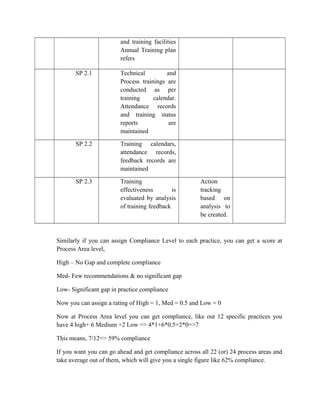
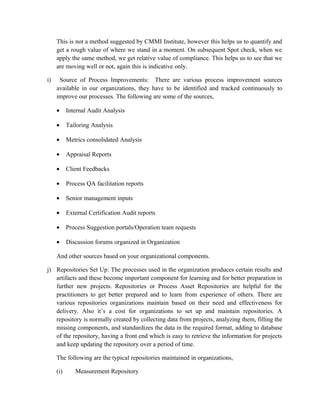
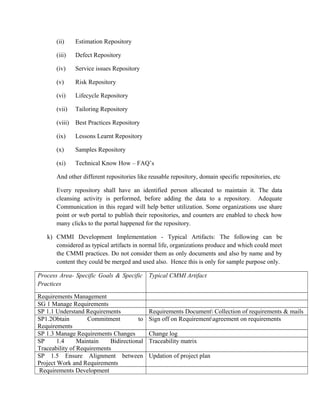
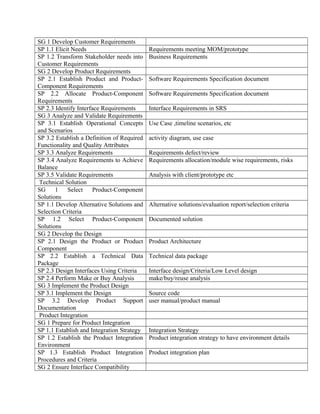
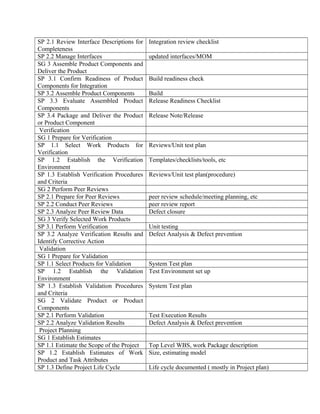
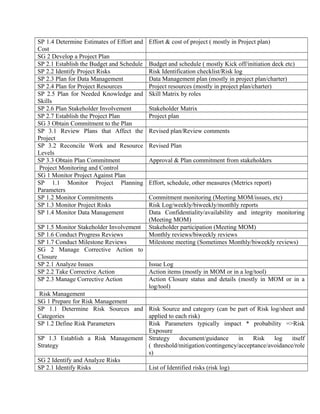
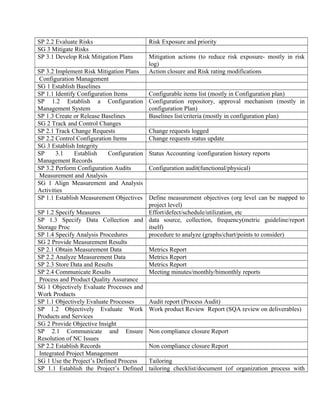
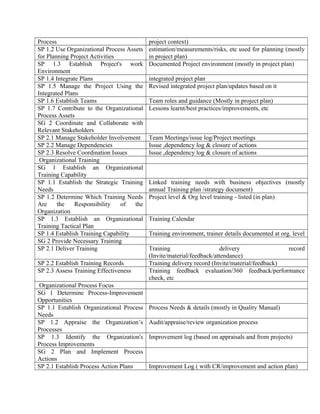
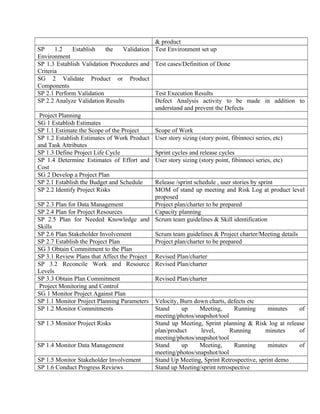
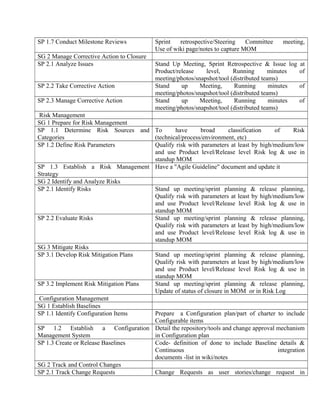
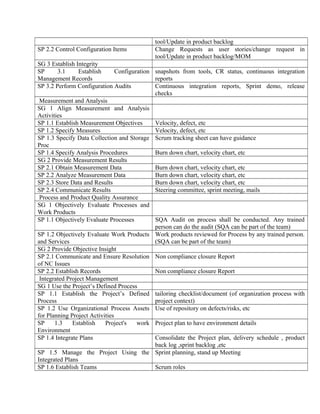
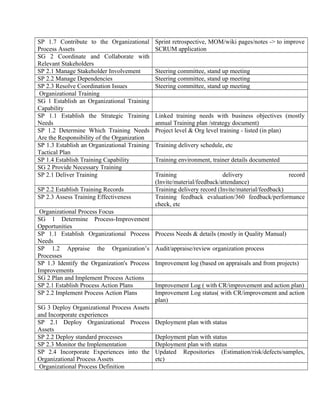
Authored by Vishnuvarthanan Moorthy
CMMI Implementation Guide
A Practitioner’s Perspective
Copyright2013 Vishnuvarthanan Moorthy
This CMMI Implementation Guide is a reference book for anyone interested in implementing
CMMI in their organization. The purpose of this book is, to provide insight in to CMMI
Implementation phases and best practices to be followed in this journey. Most of us agree, that
CMMI is more a De facto model that IT Industry follows and other industries also has shown lot
of interest in adopting this model. The day to day popularity and its adoption rate is on the surge
for CMMI. In this scenario, this book will help the new organizations and implementers, on how
to approach CMMI Implementation practically in their organization. This book is not a
replacement to the Model or to the resources which CMMI Institute Publishes. This is only an
additional resource which user can benefit from.
CMMI Institute holds the complete authority and rights to CMMI model and all the components
within the framework. This book is prepared based on the experience of a practitioner on
implementing the model in various organizations. The Author has worked in multiple roles in
CMMI Implementation and has global exposure in implementing the model. We reiterate that for
all the model related details and updates, please visit CMMI Institute website and contact CMMI
Institute team for any clarifications.
This book is intent to give you guidance on how to approach CMMI Implementation in your
organization from initiation, planning, execution, appraisal and sustenance. This book gives
various practical approaches followed by organizations as typical examples. Implementation of
CMMI is not an activity for marketing and bidding, it’s more than that, its strengthening of your
product development & Service delivery models to achieve your business results. Considering
this you would want CMMI Implementation to bring in the real cultural change and value to your
business. This book provides you information which is useful for deciding, planning and
implementing CMMI in Successful way.
Be clear, there are many ways to implement CMMI and its practices. Having a better consultant
or Engaging a CMMI Institute Partner in your Journey is always helpful in removing the barriers
at right time, however in this book we are giving the details, which one should be aware of in
this journey to better utilize the resources and control the program.
This book is suggested for senior management people, process quality assurance people, delivery
people and anyone interested to know about CMMI Implementation. Understanding on the topics
given in this book will help them to strategize for successful CMMI Implementation.
Contents
Introduction to CMMI
Initiating CMMI Implementation
Planning CMMI Implementation
Executing CMMI Implementation
Appraising CMMI Implementation
Sustaining CMMI Implementation
CMMI High Maturity Implementation
Miscellaneous
References
Introduction to CMMI
CMMI (Capability Maturity Model Integration) is a Process Improvement Model, which has
collection of Industry best practices to implement in Organizations to achieve process capability
and maturity. CMMI is a proven approach to achieve better performance results. CMMI is more
of a framework which contains the model, trainings and appraisal components which helps an
organization to implement the model in successful way to get benefit out of it. CMMI over the
years has shown lot of success considering organizations are getting dramatic improvements in
effectiveness, efficiency and quality.
Software Engineering Institute in Carnegie Melon University has developed this model initially.
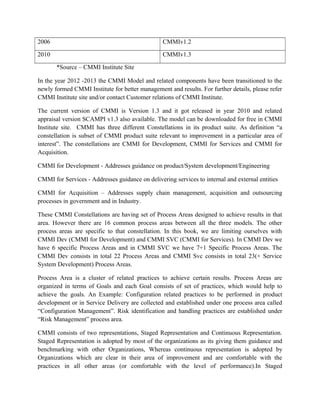
The CMMI Model Evolution is given below,
Year Model Development
1987 Initial Framework
1990 CMMv1.0
1993 CMMv1.1
1998 CMMv2.0
2000 CMMIv1.0
2002 CMMIv1.1
2006 CMMIv1.2
2010 CMMIv1.3
*Source – CMMI Institute Site
In the year 2012 -2013 the CMMI Model and related components have been transitioned to the
newly formed CMMI Institute for better management and results. For further details, please refer
CMMI Institute site and/or contact Customer relations of CMMI Institute.
The current version of CMMI is Version 1.3 and it got released in year 2010 and related
appraisal version SCAMPI v1.3 also available. The model can be downloaded for free in CMMI
Institute site. CMMI has three different Constellations in its product suite. As definition “a
constellation is subset of CMMI product suite relevant to improvement in a particular area of
interest”. The constellations are CMMI for Development, CMMI for Services and CMMI for
Acquisition.
CMMI for Development - Addresses guidance on product/System development/Engineering
CMMI for Services - Addresses guidance on delivering services to internal and external entities
CMMI for Acquisition – Addresses supply chain management, acquisition and outsourcing
processes in government and in Industry.
These CMMI Constellations are having set of Process Areas designed to achieve results in that
area. However there are 16 common process areas between all the three models. The other
process areas are specific to that constellation. In this book, we are limiting ourselves with
CMMI Dev (CMMI for Development) and CMMI SVC (CMMI for Services). In CMMI Dev we
have 6 specific Process Areas and in CMMI SVC we have 7+1 Specific Process Areas. The
CMMI Dev consists in total 22 Process Areas and CMMI Svc consists in total 23(+ Service
System Development) Process Areas.
Process Area is a cluster of related practices to achieve certain results. Process Areas are
organized in terms of Goals and each Goal consists of set of practices, which would help to
achieve the goals. An Example: Configuration related practices to be performed in product
development or in Service Delivery are collected and established under one process area called
“Configuration Management”. Risk identification and handling practices are established under
“Risk Management” process area.
CMMI consists of two representations, Staged Representation and Continuous Representation.
Staged Representation is adopted by most of the organizations as its giving them guidance and
benchmarking with other Organizations, Whereas continuous representation is adopted by
Organizations which are clear in their area of improvement and are comfortable with the
practices in all other areas (or comfortable with the level of performance).In Staged
Representation, Organization’s Maturity level is provided with 5 different process maturities. In
Continuous Representation, Each process Areas’ capability levels are presented with 6 levels. A
representation in CMMI is analogous to a view into a dataset provided by a database. Both
representations provide ways of implementing process improvement to achieve business goals.
Both representations provide the same technical content, but organized into different ways.
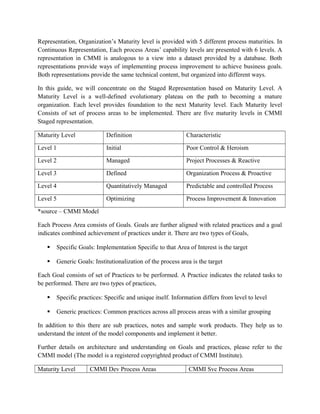
In this guide, we will concentrate on the Staged Representation based on Maturity Level. A
Maturity Level is a well-defined evolutionary plateau on the path to becoming a mature
organization. Each level provides foundation to the next Maturity level. Each Maturity level
Consists of set of process areas to be implemented. There are five maturity levels in CMMI
Staged representation.
Maturity Level Definition Characteristic
Level 1 Initial Poor Control & Heroism
Level 2 Managed Project Processes & Reactive
Level 3 Defined Organization Process & Proactive
Level 4 Quantitatively Managed Predictable and controlled Process
Level 5 Optimizing Process Improvement & Innovation
*source – CMMI Model
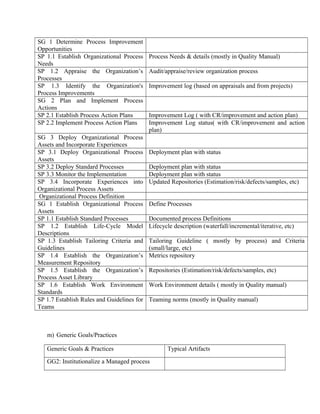
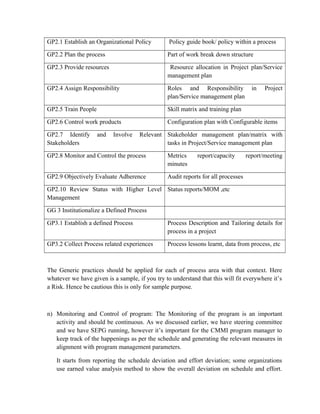
Each Process Area consists of Goals. Goals are further aligned with related practices and a goal
indicates combined achievement of practices under it. There are two types of Goals,
 Specific Goals: Implementation Specific to that Area of Interest is the target
 Generic Goals: Institutionalization of the process area is the target
Each Goal consists of set of Practices to be performed. A Practice indicates the related tasks to
be performed. There are two types of practices,
 Specific practices: Specific and unique itself. Information differs from level to level
 Generic practices: Common practices across all process areas with a similar grouping
In addition to this there are sub practices, notes and sample work products. They help us to
understand the intent of the model components and implement it better.
Further details on architecture and understanding on Goals and practices, please refer to the
CMMI model (The model is a registered copyrighted product of CMMI Institute).
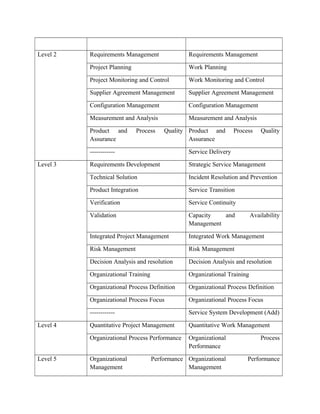
Maturity Level CMMI Dev Process Areas CMMI Svc Process Areas
Level 2 Requirements Management Requirements Management
Project Planning Work Planning
Project Monitoring and Control Work Monitoring and Control
Supplier Agreement Management Supplier Agreement Management
Configuration Management Configuration Management
Measurement and Analysis Measurement and Analysis
Product and Process Quality
Assurance
Product and Process Quality
Assurance
------------ Service Delivery
Level 3 Requirements Development Strategic Service Management
Technical Solution Incident Resolution and Prevention
Product Integration Service Transition
Verification Service Continuity
Validation Capacity and Availability
Management
Integrated Project Management Integrated Work Management
Risk Management Risk Management
Decision Analysis and resolution Decision Analysis and resolution
Organizational Training Organizational Training
Organizational Process Definition Organizational Process Definition
Organizational Process Focus Organizational Process Focus
------------ Service System Development (Add)
Level 4 Quantitative Project Management Quantitative Work Management
Organizational Process Performance Organizational Process
Performance
Level 5 Organizational Performance
Management
Organizational Performance
Management
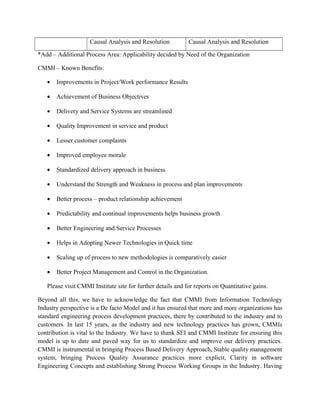
Causal Analysis and Resolution Causal Analysis and Resolution
*Add – Additional Process Area: Applicability decided by Need of the Organization
CMMI – Known Benefits:
• Improvements in Project/Work performance Results
• Achievement of Business Objectives
• Delivery and Service Systems are streamlined
• Quality Improvement in service and product
• Lesser customer complaints
• Improved employee morale
• Standardized delivery approach in business
• Understand the Strength and Weakness in process and plan improvements
• Better process – product relationship achievement
• Predictability and continual improvements helps business growth
• Better Engineering and Service Processes
• Helps in Adopting Newer Technologies in Quick time
• Scaling up of process to new methodologies is comparatively easier
• Better Project Management and Control in the Organization.
Please visit CMMI Institute site for further details and for reports on Quantitative gains.
Beyond all this, we have to acknowledge the fact that CMMI from Information Technology
Industry perspective is a De facto Model and it has ensured that more and more organizations has
standard engineering process development practices, there by contributed to the industry and to
customers. In last 15 years, as the industry and new technology practices has grown, CMMIs
contribution is vital to the Industry. We have to thank SEI and CMMI Institute for ensuring this
model is up to date and paved way for us to standardize and improve our delivery practices.
CMMI is instrumental in bringing Process Based Delivery Approach, Stable quality management
system, bringing Process Quality Assurance practices more explicit, Clarity in software
Engineering Concepts and establishing Strong Process Working Groups in the Industry. Having
said that, CMMI is beyond software and Systems, however in this guide we limit only to the IT
Industry.
Few Key Success Factors for its worldwide adoption:
• The users can contribute and raise change requests to customer relations
• Users of the model can ask clarifications and they are supported well by CMMI Institute
• The New changes are discussed and piloted in many cases
• New improvements are always welcome with CMMI Institute
• The Model and related sources are free and users can download
• Apart from Appraisal and official Training there is no mandated cost involved
• The Proven results made it as a model widely adopted across the globe
• CMMI Partners are available worldwide and getting services are easier
• User groups in Yahoo, LinkedIn and other social sites help in people to understand and
clarify doubts
• Systematic working and bringing in changes to help users by the CMMI Institute and all
its certified personnel is strength.
• The Quality of the results are monitored and relevant policy updates are given by CMMI
Institute to ensure that Users get good experience in Implementing the model and
performing appraisals
• The case studies, presentations, webinars on different topics performed by CMMI
Institute to ensure that all kind of industries get relevant update.
• SEIR repository provides enormous amount of user contributed materials, which helps
every organization and its employees to get better understanding and implementation of
the model.
• CMMI Institute and associated members/partners work on different areas of interest and
share updates on them to the community. Most of them are free articles. Example: Agile
and CMMI, in this area lot of effort spent by community members and today we can say,
we are no longer with many ambiguities in adopting CMMI and Agile together.
• Combined Constellation implementations and combined appraisals has also become
reality and many of the organizations are interested considering their business model.
• CMMI Institute SEPG meetings which happens once in every 6 month, brings in lot new
ideas and process approaches, which is critical for the evolving trends in the Industry. In
short they work on maintaining the Model up to date.
Initiating CMMI Implementation
Do I need CMMI?
The first step in CMMI Implementation is to understand what you want to achieve in your
product development or service delivery. For that you have to be clear with your current business
model and the role of processes in your business. There can be no business without any process
in this world. However the balance between process, technology and people could vary from one
to another. Hence it’s important to understand what is the role of process in your business and by
improving its maturity, what is the kind of result you expect with your business to be understood.
This we can say, “Do I need CMMI?” CMMI may not be a solution for all the problems you
have and just because someone has told, you may not start your implementation.
You are expected to have the clear understanding of current Business and related processes, in
addition to that, now you are expected to set your objectives for CMMI Implementation. We can
look at any similar organizations which has implemented the model and how the results have
paid for them. With little more research on your own and with CMMI Institute site and relevant
reports, you can have an idea about how CMMI Implementation can help in your business and in
delivery.
When we say understand your business, it means
• What are the different products or services your organization offer
• How many divisions and units are there
• Do all of them produce same or similar products/services
• Are all of them produce same business benefit or which of them are key for me to
succeed in business
• Are you already in the optimum level or there is scope for improvement
• Which part of the business to improve or Business process to improve
• What is the cycle time of my services or products
• Do you produce part of product/service or complete product/service
• Are you interacting with client directly or with your own resources (onsite teams)
• What is the current resource competency I have
• What is the level of Infrastructure you have
• Whether you are clients are expecting you to perform with certain maturity in some
processes
The Understanding on these questions will help you to think more on what you are going to gain
by implementing CMMI. Also it will tell, do you really inclined to implement CMMI or its just
for Attracting clients or for bidding purpose, you want to get some maturity level. Because when
we are not aware of our business model and where exactly we feel CMMI Implementation will
benefit us in our business, then we have more chances of not getting the real benefits of CMMI.
Establish Internal Commitment:
Discuss within management about what CMMI is, and what kind of benefits you are expecting
from implementing the model in your organization. Be specific on the results and be clear that
questions may come on the following, Why CMMI model and why not others, what benefit it
will give, how can we apply in our business, etc. The reality is almost 90% of the organizations
might have the same questions; however they have implemented the model and getting benefits
today. It’s pretty normal that everyone thinks that their business is unique, their project is unique
and they are unique. However most of them can be categorized in countable number of groups
and many of them has similar characteristics, so CMMI is no difference to it. Set clear
expectations with people on what level of involvement you expect and where the changes are
likely to come. Many times, fear of change and modification of system will make people resist
the Implementation. Hence clarity on what is expected, what might change, what benefit it will
bring, motivating them to be part of change and making them own the changes will help to great
extent. Involve the Heads of all the functions in your discussion, so that everyone feels part of
the initiative.
Give time to people to think and come back on the CMMI Initiative. Let the questions come on
the initiative and anything on the model, it’s better to answer it through an Executive Session on
CMMI. The Session could be typically for a day, so that better clarity and understanding all the
senior management people achieve. This could help you in removing the anxiety from the
stakeholders.
Initial discussion with Subject Matter Expert:
Once all the stakeholders are in alignment you can go ahead and have discussion with the CMMI
Subject Matter Expert (SME). You may find one internally in your organization or you may
contact any CMMI Partners in your region, who are providing the Consulting and Appraisal
services. You can check the list of CMMI Partners and their services through CMMI Institute
site. A discussion with Subject Matter Expert should be on the following,
• Current Version and Status of CMMI Model
• What are the different steps involved in Implementation
• What phases and approach they generally suggest to the organization
• Data/Experience related to Similar Cases of Implementation
• Check the ROI that Other Organizations have achieved
• What the different Objectives that Organization like yours can aim to achieve
• What are the different requirements on Human, Infrastructure, training requirements
• What is the right Constellation according to the SME for your business
• Have them describe the overall expectation from the Organization
• Collect the Contact points and relevant references for them (for external Service
Providers)
• It may be too early, however you can check with them the timeline typically it takes to
implement CMMI Model on an Organization like yours and the maturity level you should
target.
CMMI Institute always keeps their database up to date on their Partners; hence selecting a
Service Provider from there is not a difficult choice. At the same time, there are many other
renowned organizations also providing CMMI Consulting services. You have the option of
selecting among many, but for Appraisal and formal training services from CMMI Institute, it
shall be done through CMMI Partners only with the CMMI Certified Individuals. However for
consulting or SME services there is no such restriction.
Choosing the right Constellation for you:
As we already discussed that you have worked on the basics of your business and what you
expect from CMMI Implementation. However when it comes to selection of CMMI
Constellations for your business, you may end up with question, which one to choose. It can be
decided on few factors,
• Business Model in the Organization
• Typical Cycle Time to deliver your Product or Services
• Volume of work in Service Delivery and Product Delivery
• Business Income ratio between Service Delivery and Product Delivery
• Complexity involved in Product Development
• Areas where you need Improvement
• Type of Activities Performed
There could be other factors which also can influence. However when you find they are smaller
cycle times in which you have to deliver your product or services and less intensive engineering
needs, then its recommended to go for CMMI Services. However if you are involved equally on
development of product and in Services (Maintenance/migration/testing/etc) then you can go for
combined CMMI Dev and CMMI Svc Constellations to have the best from both. In case if you
have lot of medium (3 to 9 month) and Longer Projects (> 9 months) and need good Engineering
Practices to strengthen your product, you can select CMMI Dev model.
Be clear CMMI Svc doesn’t mean there are no engineering practices; it has Service System
Development process area to support your needs. However you have to decide based on what
level of complexity, your products have.
Fix your Goal on the Program:
The following aspects you have to be clear before engaging in to the planning part of CMMI
Implementation in your organization.
• Clear description on your business needs on CMMI Implementation
• Performance Goals target for your business
• Tools and Technology Improvements or positioning
• Prioritization of process based delivery and Services
• Competency level of Employees and target improvements
• Possible Effort and Availability requirements of Management Team
• Possible effort needs from SME and Process Quality Assurance people
• Return on Investment expected from the program (direct and in-direct)
Once you have made up your mind on the above given points then it’s time for you to engage
Service Provider.
Engaging CMMI Institute Partner or Service Provider:
As explained earlier, you would definitely need a CMMI Institute Partner for performing a)
CMMI Official Trainings b) Appraisal Services. For CMMI Consulting Activities, you can
engage any Subject Matter Expert from your own organization or from other service provider or
through a CMMI Institute Partner. If Appraisal is in your plan and you want to achieve a
Maturity Level rating, then it’s important that you understand that you need a CMMI Institute
certified Lead Appraiser for performing your appraisal. A Lead Appraiser services can be availed
through the CMMI Institute Partner. Engaging Lead Appraiser early in your implementation
helps you to be in alignment with his expectations and to ensure his availability for your
program.
The following points you need to consider before engaging any of them:
a) Consider the overall experience of the Lead Appraiser and relevant experience in the area
of working
b) Interact with them to see how they are able to pick up your business model and services
c) Check their credibility in the market
d) Cost of the Appraisal services (include Logistics cost)
e) Past experiences and similar organization appraisals performed by them
f) Collect References for their work
g) Get their view on your CMMI Implementation program
h) Understand their schedule and how busy they are. ( There is a cap of 12 appraisal per
year/ per LA, hence check whether they are available for you)
i) Sponsor of CMMI Program has to interact with the Lead Appraiser, before engaging
them
j) Check your comfort level with Lead Appraiser. Sometimes few are comfortable with
aggressive type of Individual and some are comfortable with soft spoken, friendly Lead
Appraiser.
k) Check what are all the different product modules (Trainings, Appraisals) he is certified
for, that can reduce your interaction with multiple Certified Individuals.
l) Check on the best possible review schedule and Appraisal schedule they suggest to you.
Be clear a Lead Appraiser who is going to perform your appraisal, cant’ be a consultant for you.
Similarly if you have your own Lead Appraiser, then he/she can’t be from the same
Organizational Unit (the Organizational unit which is within the scope of Appraisal).
Most of the points given here holds true for selecting a Consultant, however for that you don’t
need a CMMI Institute Partner. CMMI Institute doesn’t mandate consulting activities under any
case and Implementation of the model, can be completely done by in house or with any known
service provider. The fact is CMMI Institute monitors the conflict of Interest that same registered
organization shall not consult and perform appraisals. Under any case, CMMI Institute collects
declarations from Partners and from Individuals in different times.
Common Reasons for Ineffective CMMI Implementation:
Before you start the complete planning of your CMMI Implementation program, be aware of the
Common reasons which could make your CMMI Implementation in-effective.
• Lack of business alignment
• Lack of management participation
• CMMI Implementation Program for “customer demand’
• Lack of project management competency
• Not considering as “Organizational Program”
• Resistance to change
• Lack of belief in process improvement
• Interpretation challenges
• Lack of clarity in ROI
• Lack of resources
• Separation of Finance metric from Process metric
• Failure to understand the significance of “Product and Process relationship‟
Planning CMMI Implementation
The first step recommended is to understand your current product and/or service delivery
practices and its gap with CMMI Constellations which you are targeting. This would help you to
plan your activities, timelines, estimation on resources, establishing/modifying working
functions and strategize for effective implementation of CMMI. Hence a Gap Analysis is the
recommended first step in Planning. Gap Analysis can be performed by internal Subject Matter
Expert (SME) or with external one. Basically you do this exercise to understand the gaps in your
defined processes (if you have one) and with Practices followed in Service/product delivery.
Also a good understanding on the Organizational dynamics and gaps identified there would be
values add for you.
Gap Analysis:
Planning a Gap Analysis, involves the service/delivery centers in different places, type of
delivery models, type of business, duration of projects/programs, etc Based on these factors
identify set of projects/program/applications which you want to take as sample for your Gap
Analysis. Performing Gap Analysis involves a) Artifact Study and b) Interview/Discussion with
practitioners. A detailed Gap Study will reduce lot of ambiguities and estimation errors in the
subsequent stages of the program. Fix time with your practitioners and perform gap analysis with
CMMI constellation that has been chosen. Check the relevant artifacts given by them to
understand the delivery model and the current maturity.
Prepare a draft report in terms of Process Definition gaps and Process Implementation gaps for
each of the Process Area. With certain number allocation for compliance with practices, you can
also give an indicative value for Compliance with the model. Though it’s inaccurate, it definitely
helps organizations to visualize the compliance and to understand how much gap they have. A
Gap Analysis report is the basis for planning and to work on removing the weaknesses, hence a
detailed report is required. The Draft report has to be discussed with the management and final
report to be prepared. Consensus with your management team ensures accuracy is established in
the report. A good Gap Analysis report will also have significant weaknesses identified and
provides key recommendations for next level planning. The Gap Analysis should also consider
the relevant tools available and used in your organization. Any existing standards compliance by
your organization to be considered in the gap analysis, as this would help in evaluating the
process understanding and Management system maturity.
Strategize and Plan your CMMI Program:
We call it as a program here, considering that your entire organization is involved in it and it
brings cultural change in the organization and beyond that you may need to run lot of smaller
projects within this CMMI Implementation program to make it effective and bring desired results
for you. Having said that, it also depends on how big is your organizational Unit, for which you
are targeting the CMMI Implementation. Now based on the Gap Analysis, Understand the
following,
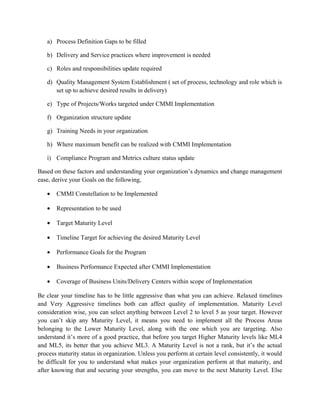
a) Process Definition Gaps to be filled
b) Delivery and Service practices where improvement is needed
c) Roles and responsibilities update required
d) Quality Management System Establishment ( set of process, technology and role which is
set up to achieve desired results in delivery)
e) Type of Projects/Works targeted under CMMI Implementation
f) Organization structure update
g) Training Needs in your organization
h) Where maximum benefit can be realized with CMMI Implementation
i) Compliance Program and Metrics culture status update
Based on these factors and understanding your organization’s dynamics and change management
ease, derive your Goals on the following,
• CMMI Constellation to be Implemented
• Representation to be used
• Target Maturity Level
• Timeline Target for achieving the desired Maturity Level
• Performance Goals for the Program
• Business Performance Expected after CMMI Implementation
• Coverage of Business Units/Delivery Centers within scope of Implementation
Be clear your timeline has to be little aggressive than what you can achieve. Relaxed timelines
and Very Aggressive timelines both can affect quality of implementation. Maturity Level
consideration wise, you can select anything between Level 2 to level 5 as your target. However
you can’t skip any Maturity Level, it means you need to implement all the Process Areas
belonging to the Lower Maturity Level, along with the one which you are targeting. Also
understand it’s more of a good practice, that before you target Higher Maturity levels like ML4
and ML5, its better that you achieve ML3. A Maturity Level is not a rank, but it’s the actual
process maturity status in organization. Unless you perform at certain level consistently, it would
be difficult for you to understand what makes your organization perform at that maturity, and
after knowing that and securing your strengths, you can move to the next Maturity Level. Else
you might be working with unstable system and trying to simulate Maturity only on certain
accounts, which could result in negative results and poor employee morale.
Discuss with your SME/CMMI Institute Partner:
Discuss the timelines, scope of implementation, Maturity Level targeting with your CMMI SME
(Subject Matter Expert)/ CMMI Institute Partner and ensure that all of you are in alignment and
see the possibilities of making the program success. Understand the additional points which you
need to take care in this implementation program. You can’t have very different plans from your
service provider that will not help to achieve your results. Be open and seek support as required.
Do not consider CMMI Implementation as Process definition and Audit, such thinking will
definitely cost your organization badly.
Planning the Elements in Implementation:
Organization Structure:
If you don’t have any existing process standard or model implementation in your organization,
than you may need few new functions in your organization. Typically for CMMI Implementation
you may need,
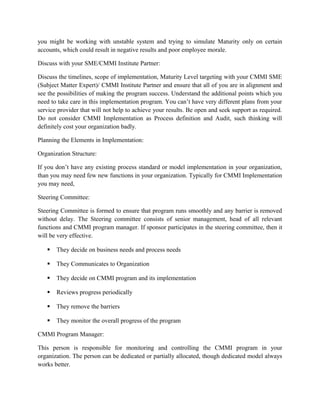
Steering Committee:
Steering Committee is formed to ensure that program runs smoothly and any barrier is removed
without delay. The Steering committee consists of senior management, head of all relevant
functions and CMMI program manager. If sponsor participates in the steering committee, then it
will be very effective.
 They decide on business needs and process needs
 They Communicates to Organization
 They decide on CMMI program and its implementation
 Reviews progress periodically
 They remove the barriers
 They monitor the overall progress of the program
CMMI Program Manager:
This person is responsible for monitoring and controlling the CMMI program in your
organization. The person can be dedicated or partially allocated, though dedicated model always
works better.
 Prepares the plan for CMMI Program
 Monitors and controls the program
 Manages the projects and stakeholders
 Reports to Steering Committee
 Participates in SEPG, Steering Committee and CMMI progress meetings
 Mobilizes the resources effectively to achieve target
 Risk management is handled and timely escalations are performed
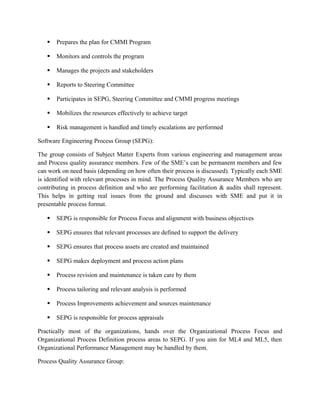
Software Engineering Process Group (SEPG):
The group consists of Subject Matter Experts from various engineering and management areas
and Process quality assurance members. Few of the SME’s can be permanent members and few
can work on need basis (depending on how often their process is discussed). Typically each SME
is identified with relevant processes in mind. The Process Quality Assurance Members who are
contributing in process definition and who are performing facilitation & audits shall represent.
This helps in getting real issues from the ground and discusses with SME and put it in
presentable process format.
 SEPG is responsible for Process Focus and alignment with business objectives
 SEPG ensures that relevant processes are defined to support the delivery
 SEPG ensures that process assets are created and maintained
 SEPG makes deployment and process action plans
 Process revision and maintenance is taken care by them
 Process tailoring and relevant analysis is performed
 Process Improvements achievement and sources maintenance
 SEPG is responsible for process appraisals
Practically most of the organizations, hands over the Organizational Process Focus and
Organizational Process Definition process areas to SEPG. If you aim for ML4 and ML5, then
Organizational Performance Management may be handled by them.
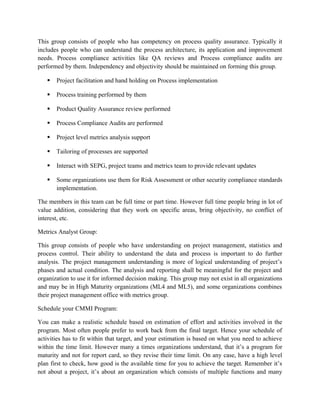
Process Quality Assurance Group:
This group consists of people who has competency on process quality assurance. Typically it
includes people who can understand the process architecture, its application and improvement
needs. Process compliance activities like QA reviews and Process compliance audits are
performed by them. Independency and objectivity should be maintained on forming this group.
 Project facilitation and hand holding on Process implementation
 Process training performed by them
 Product Quality Assurance review performed
 Process Compliance Audits are performed
 Project level metrics analysis support
 Tailoring of processes are supported
 Interact with SEPG, project teams and metrics team to provide relevant updates
 Some organizations use them for Risk Assessment or other security compliance standards
implementation.
The members in this team can be full time or part time. However full time people bring in lot of
value addition, considering that they work on specific areas, bring objectivity, no conflict of
interest, etc.
Metrics Analyst Group:
This group consists of people who have understanding on project management, statistics and
process control. Their ability to understand the data and process is important to do further
analysis. The project management understanding is more of logical understanding of project’s
phases and actual condition. The analysis and reporting shall be meaningful for the project and
organization to use it for informed decision making. This group may not exist in all organizations
and may be in High Maturity organizations (ML4 and ML5), and some organizations combines
their project management office with metrics group.
Schedule your CMMI Program:
You can make a realistic schedule based on estimation of effort and activities involved in the
program. Most often people prefer to work back from the final target. Hence your schedule of
activities has to fit within that target, and your estimation is based on what you need to achieve
within the time limit. However many a times organizations understand, that it’s a program for
maturity and not for report card, so they revise their time limit. On any case, have a high level
plan first to check, how good is the available time for you to achieve the target. Remember it’s
not about a project, it’s about an organization which consists of multiple functions and many
people, so it’s not that easy to fit any date and activity to get consensus, there is in fact lot more
to think.
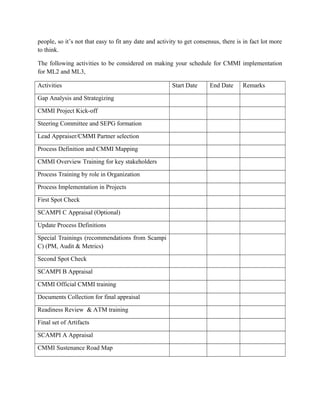
The following activities to be considered on making your schedule for CMMI implementation
for ML2 and ML3,
Activities Start Date End Date Remarks
Gap Analysis and Strategizing
CMMI Project Kick-off
Steering Committee and SEPG formation
Lead Appraiser/CMMI Partner selection
Process Definition and CMMI Mapping
CMMI Overview Training for key stakeholders
Process Training by role in Organization
Process Implementation in Projects
First Spot Check
SCAMPI C Appraisal (Optional)
Update Process Definitions
Special Trainings (recommendations from Scampi
C) (PM, Audit & Metrics)
Second Spot Check
SCAMPI B Appraisal
CMMI Official CMMI training
Documents Collection for final appraisal
Readiness Review & ATM training
Final set of Artifacts
SCAMPI A Appraisal
CMMI Sustenance Road Map
In case if you are working for High Maturity Levels then add the following to your schedule,
a) Process Capability Baselines Preparation
b) Process Performance Model Development
c) Business Objectives Fixing
d) Business Objectives vs. Performance Evaluation
e) Causal Analysis / Outcome Analysis Meetings
f) High Maturity Reviews
g) Quantitative Management Support activities
There are no timeline given here, because that’s based on the organizations current maturity and
gaps with respect to targeted maturity. However be clear if you don’t have any previous
experience with quality standards or don’t have detailed Engineering or Services processes, then
for Maturity Level 2, you may take 9 to 14 months and for Maturity Level 3, you may take 14 to
20 months, and for Maturity Level 4 or 5, you may take 24 to 38 months from the day you are
appraised at Maturity Level 3. These all are indicative numbers and we recommend you not to
take them as a hard and fast rule.
For your Process definition, plan a minimum of 3 to 6 months as duration. Plan your first spot
check after 1.5 to 3 months after process training. Perform Scampi C, as you believe it will help.
We will see in detail on SCAMPI C, B and A in the Appraisal Topic. Plan your second spot
check after 2 to 4 months, after first spot check. Your final phase of Document update, SCAMPI
planning, Readiness review and SCAMPI A will happen in last 3 months.
In High Maturity, Business Goal identification is the first activity. PCB development can be once
in 6 month or in a year, it’s based on lot of factors, we can see them in High Maturity section.
PPM development shall start as early as possible. As the process is getting stable, initiate your
Causal Analysis and Improvement Activities and ensure you have minimum 12 to 18 months to
do better improvement.
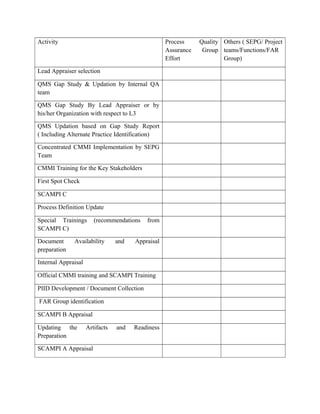
Estimating Effort/Cost for CMMI Program:
Estimation of Effort in CMMI Program is typically performed with work break down structure
method. Each task is allotted with effort based on the experience, its normal to check with your
consultant on typically how much effort it will take. Also the estimate can be on Process QA
group and Operational Members effort contribution, because most of the time your employees
will ask what will be their level of effort involvement in this program.
Activity Process Quality
Assurance Group
Effort
Others ( SEPG/ Project
teams/Functions/FAR
Group)
Lead Appraiser selection
QMS Gap Study & Updation by Internal QA
team
QMS Gap Study By Lead Appraiser or by
his/her Organization with respect to L3
QMS Updation based on Gap Study Report
( Including Alternate Practice Identification)
Concentrated CMMI Implementation by SEPG
Team
CMMI Training for the Key Stakeholders
First Spot Check
SCAMPI C
Process Definition Update
Special Trainings (recommendations from
SCAMPI C)
Document Availability and Appraisal
preparation
Internal Appraisal
Official CMMI training and SCAMPI Training
PIID Development / Document Collection
FAR Group identification
SCAMPI B Appraisal
Updating the Artifacts and Readiness
Preparation
SCAMPI A Appraisal
The final effort can be presented in terms of Full time resource equivalent, though it has not
much meaning for Operational teams, at least for management to calculate the cost it will be
useful.
In addition don’t forget to add the cost of your appraisal or consulting. Typically the cost goes
from 20000$ to 45000$ for appraisal related activities. It’s based on the services you avail and
the scope of your appraisal and many other factors. The following appraisal related services,
typically availed by organizations,
a) SCAMPI C Appraisal
b) SCAMPI B Appraisal
c) SCAMPI A Appraisal
d) CMMI Official Introduction Training
e) ATM Training
f) Readiness Review
g) Intermediate Review
In Addition you may have consulting activities planned with identified Consulting partner
(service providers). You have to include that cost also. Typical areas where you may need your
consultant is,
a) Training on Project Management, Reviews, Audits and Metrics
b) Spot checks on Process Implementation
c) Clarifications on Implementation
d) Process Capability Baseline Development & Review
e) Process Performance Models Development
f) Sub Process Control – Clarifications
g) Application of Causal Analysis
h) Preparation for Appraisal
i) Gap analysis on QMS
Having a consultant is not mandatory and it’s optional, however when you have internal
resources who can do this, you can go ahead with them. It’s also common, that organizations
bring external consultants, so that it helps in change management and reduces the internal
frictions.
When organizations don’t have process quality assurance teams, it’s pretty common they
outsource the work to external consultants. In that case, the competency required for performing
the work differs and typically the cost for such work is lower than consulting.
For High Maturity Projects, you have to ensure that you may need to spend on tools. It’s not
mandatory to buy tools, there are freeware available and/or you can make your simple tools,
which can support your needs. However as we know, freeware normally has its own limitations.
Hence plan your budget accordingly. Few more details, we will on see on the High Maturity
topic.
Stakeholder Management:
It’s very important to identify and involve the stakeholders in this program. Sometimes, if you
miss out anyone, this can hurt your team. So plan the stakeholders well, and establish clear
communication with them. Normally we prepare the activities in Y axis and all the stakeholders
in X axis. The participation level of them is entered in the relevant cells. It can be like a RACI
matrix, where Responsible, Accountable, Consulted and Informed can be their Involvement in
that activity.
Change Management:
To make any change at organizational level we need clear commitment from top management. If
you get that, then you need a plan to introduce and grow that change in the organization. You
need constant communication on the changes and bring more interest of people in that change.
Ideally use all the milestone points in your program for better change management. Have a
strong communication plan along with you, which reaches all levels of people in the
organization. Appreciate the adoption of changes in every place, even you can create competition
among internal units to ensure that change is accepted and implemented.
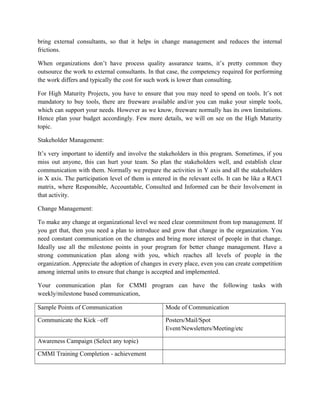
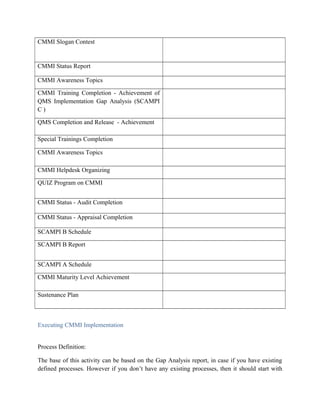
Your communication plan for CMMI program can have the following tasks with
weekly/milestone based communication,
Sample Points of Communication Mode of Communication
Communicate the Kick –off Posters/Mail/Spot
Event/Newsletters/Meeting/etc
Awareness Campaign (Select any topic)
CMMI Training Completion - achievement
CMMI Slogan Contest
CMMI Status Report
CMMI Awareness Topics
CMMI Training Completion - Achievement of
QMS Implementation Gap Analysis (SCAMPI
C )
QMS Completion and Release - Achievement
Special Trainings Completion
CMMI Awareness Topics
CMMI Helpdesk Organizing
QUIZ Program on CMMI
CMMI Status - Audit Completion
CMMI Status - Appraisal Completion
SCAMPI B Schedule
SCAMPI B Report
SCAMPI A Schedule
CMMI Maturity Level Achievement
Sustenance Plan
Executing CMMI Implementation
Process Definition:
The base of this activity can be based on the Gap Analysis report, in case if you have existing
defined processes. However if you don’t have any existing processes, then it should start with
discussion with your management team. Define the business goals of your organization, from
there percolate it to process needs. The simpler and useful technique to have good process
definition is, run it like development project, in the sense collect all the requirements with
respect to your process needs, then make architecture for each process, its components and
interface with other process, then develop the process along with relevant components and then
validate with relevant Subject Matter Experts and with users.
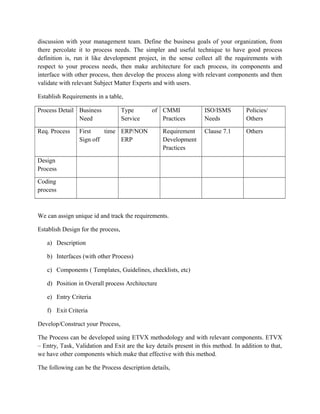
Establish Requirements in a table,
Process Detail Business
Need
Type of
Service
CMMI
Practices
ISO/ISMS
Needs
Policies/
Others
Req. Process First time
Sign off
ERP/NON
ERP
Requirement
Development
Practices
Clause 7.1 Others
Design
Process
Coding
process
We can assign unique id and track the requirements.
Establish Design for the process,
a) Description
b) Interfaces (with other Process)
c) Components ( Templates, Guidelines, checklists, etc)
d) Position in Overall process Architecture
e) Entry Criteria
f) Exit Criteria
Develop/Construct your Process,
The Process can be developed using ETVX methodology and with relevant components. ETVX
– Entry, Task, Validation and Exit are the key details present in this method. In addition to that,
we have other components which make that effective with this method.
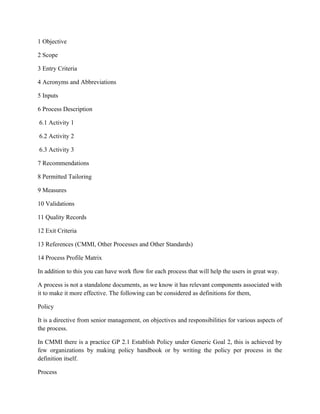
The following can be the Process description details,
1 Objective
2 Scope
3 Entry Criteria
4 Acronyms and Abbreviations
5 Inputs
6 Process Description
6.1 Activity 1
6.2 Activity 2
6.3 Activity 3
7 Recommendations
8 Permitted Tailoring
9 Measures
10 Validations
11 Quality Records
12 Exit Criteria
13 References (CMMI, Other Processes and Other Standards)
14 Process Profile Matrix
In addition to this you can have work flow for each process that will help the users in great way.
A process is not a standalone documents, as we know it has relevant components associated with
it to make it more effective. The following can be considered as definitions for them,
Policy
It is a directive from senior management, on objectives and responsibilities for various aspects of
the process.
In CMMI there is a practice GP 2.1 Establish Policy under Generic Goal 2, this is achieved by
few organizations by making policy handbook or by writing the policy per process in the
definition itself.
Process
It is a framework consisting of inputs, entry criteria, output, and exit criteria with list of
activities/tasks to be performed to convert inputs to outputs. Process will contain certain
templates and forms to be used while executing the activity/task. Process provides a mechanism
for implementing certain policies and requirements of international standards/models facilitating
Plan-Do-Check-Act approach to continual improvement
A process in your organization need not be the same as Process Area of CMMI. The Process
needs and architecture is determined by various requirements you have identified. Some
organizations just take the CMMI Specific practices in a Process Area and make them as
practices; this may not really benefit them, as they don’t understand the process architecture
needs of them.
A Process of your organization may address multiple process Areas of CMMI and vice versa.
Standard
Standards specify uniform use of specific technologies, parameters or procedures when such use
will benefit the organization. Ex: Coding Standards
Guidelines
Guidelines assist users in implementing policies/ procedures, which may warrant variations, or
which are under trials and imposition of standards is not always achievable. Ex: Estimation
Guideline
Procedures
Procedures assist in complying with applicable policies, standards and guidelines. They are
detailed steps to be followed by users to accomplish a particular task. Procedures may contain
certain templates to be followed while executing the task.
Templates
They are prescribed format for creating documents/deliverables expected by the processes. A
well defined template helps us in achieving consistency in capturing information and reduces the
redundancy.
Validation of process:
Validation of process happens through mostly reviews by relevant teams. The process is
reviewed by Subject Matter Expert and then it’s reviewed by SEPG team. A checklist based
review by the author or his peer will help in reducing the defects. Similarly a traceability matrix
from requirements through validation will help in reducing the defects.
Release of Process:
The following should be taken care on release of process,
a) Process and its components should have followed Naming Convention
b) Processes are reviewed and approved by SEPG
c) Relevant Training Records are updated
d) Processes are updated in QMS or in portal and ready for announcement
e) Process Transition plan is available
f) Process Request documents/requirements documents are updated
g) Master list of Processes are updated
h) Release Notes is prepared
i) Final Approval received from competent authority
j) Release communication is ready
Sometime people want to know, the different processes they should have, it’s something which
we can’t answer easily, and it needs lot of context. I would recommend you to follow the method
given above to come out with them.
Quality Management System Documents:
Every Quality management system contains quality manual as apex document, which provides
detail on how the quality policy, objectives are achieved in the organization. The scope of
processes, process architecture, and detail of every process is detailed in the manual. The Quality
manual helps anyone to understand how the system is defined and helps to navigate the
processes.
Quality Manual contains the following sections,
1.0 Introduction
1.1 Purpose
1.2 Scope
1.3 References
1.4 Definitions and Acronyms
2.0 Business Overview
2.1 Business Group
2.2 Vision/ Mission
2.3 About Organization
2.4 Nature of Business
2.5 Organization Structure
2.6 Business Objectives
3.0 Quality Management System
3.1 Approach
3.2 Documentation Structure
4.0 Quality Management Scope and Policy
4.1 Scope of Quality Management System
4.2 Quality Policy
5.0 Lifecycles
6.0 Tailoring of Processes
7.0 Quality Management Components
7.1 Management Review Committee/Steering Committee
7.2 SEPG
7.3 Policies
7.4 Procedures
7.5 Processes
7.6 Guidelines
7.7 Standards
Annexure: Process Architecture
Annexure: Process Details
Publishing Processes/QMS in Organization:
There are various methods by which the Processes/QMS is published within the organization.
The simplest of them is having a common shared folder in a drive and give read only access to
all members in the organization. Some uses wiki pages to publish interfaces and use databases
or back end server to access the documents. Some organizations use share point portal for
complete control on the QMS site. Some of them use intranet web portal as front end and use any
available document management system as back end. What is important is, the QMS should have
simple navigation and that requires good arrangement of documents. If you can create front end
GUI interfaces, then it’s good.
Some organizations use the Type of business (development, maintenance, testing) as the primary
level document and subsequently lifecycles are given, from there processes are linked. In some
organizations, even you can select all the relevant processes by the role. In some organizations
you can select the processes by function. You have to select the relevant method, so that time
spent on navigation can be reduced.
Roles and Responsibilities Documentation:
Well defined roles and responsibilities will help in reducing lot of ambiguities. The roles need
not be designation offered in your organization. If you have the mapping to some extent, it’s
good, however don’t allow people to get confused by designation. Roles have to be defined as
you have identified in the processes and all the responsibilities given for the role in the processes
shall be documented. Ensure that the roles required to perform some of the tasks as per the model
is available with you. Example: Configuration activities shall be handled by a competent person
in project, for that normally a configuration controller/manager role is identified. Check you
have some role which is available to perform that activity. Unless you defined something at
organizational level, it will never really get in to project level.
Maintenance of QMS:
The Quality Management System is maintained by the Process Quality Assurance group
members in practical. However the responsibility lies with SEPG team. SEPG has to ensure all
the processes are implemented and latest version is available for use by the users in the
organization. A QMS revision can happen on need basis, as we get enough
improvements/change requests coming in or based on following cases,
a) New Business Lines to be included
b) Change in Delivery model
c) Change in working methods
d) Changes in Tools/Technologies
e) Improvement Requests
f) Roles and Responsibility change
g) New Lifecycle
h) New Product line/service line
i) Audits/Compliance Standards triggered
j) Statutory or Regulatory compliances
k) Client Mandated changes
l) Others
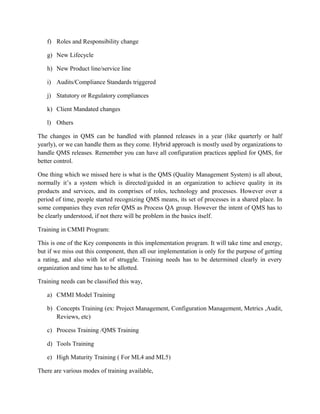
The changes in QMS can be handled with planned releases in a year (like quarterly or half
yearly), or we can handle them as they come. Hybrid approach is mostly used by organizations to
handle QMS releases. Remember you can have all configuration practices applied for QMS, for
better control.
One thing which we missed here is what is the QMS (Quality Management System) is all about,
normally it’s a system which is directed/guided in an organization to achieve quality in its
products and services, and its comprises of roles, technology and processes. However over a
period of time, people started recognizing QMS means, its set of processes in a shared place. In
some companies they even refer QMS as Process QA group. However the intent of QMS has to
be clearly understood, if not there will be problem in the basics itself.
Training in CMMI Program:
This is one of the Key components in this implementation program. It will take time and energy,
but if we miss out this component, then all our implementation is only for the purpose of getting
a rating, and also with lot of struggle. Training needs has to be determined clearly in every
organization and time has to be allotted.
Training needs can be classified this way,
a) CMMI Model Training
b) Concepts Training (ex: Project Management, Configuration Management, Metrics ,Audit,
Reviews, etc)
c) Process Training /QMS Training
d) Tools Training
e) High Maturity Training ( For ML4 and ML5)
There are various modes of training available,
a) Instructor driven
b) E learning
c) Self Study
d) On the job
e) Coaching and so on
The better way to determine the training needs are based on, which role needs what training,
using a simple table/matrix and get it checked with SEPG and SME’s/Operations team
Role Model
Training
Concepts Process/QMS Tools HM Training
Project
Manager
CMMI v1.3
Dev
CMMIv1.3
Svc
Project
Management
Estimation
Project
Management
MS Project Statistical
Process
Control
Developer NA Reviews Coding Review Tools NA
We are not talking about technical trainings required for a role that depends on the project and its
taken care by CMMI Process areas themselves, on how to determine and address them.
CMMI Institute offers many programs even for software development like Personal Software
Process (PSP) and Team Software Process (TSP); however they are based on the need of the
organizations to take.
Typically a well organized training program can go around 1 to 2 months, to ensure all relevant
roles got trained. Typical duration of your training program can be 1 to 3 hrs, and in the need of
long training hours, you can split them in to multiple days. Training programs can be organized
with adequate exercises, quizzes and so on, to break the monotony. The fact is everyone has their
normal work and taking large inputs in a day and applying it over a period of time, is difficult.
Hence understanding this, you can split training programs in to multiple levels in different time
periods.
Process Hand Holding Period:
Every team has a role to play in this, but the major role is played by the Operations team. They
are the one, who actually implement the processes and provide feedback to organization. In a
poor system, it will be always seen that Process QA group as the implementer of the process
and/or it’s for the Process QA group sake the Process related artifacts are produced. It’s the
operational team, who truly takes the responsibility, implement them, provide feedback and
improve the processes to fit into the practical delivery needs of service/product. In some cases,
we see operations teams are getting rewarded for following processes and achieving >80%
compliance, we have nothing to say for that. It’s expected that all the processes are complied by
all the applicable projects, and even the case where they are not able to follow they have clear
understanding of the situation and they are dealt in QMS in right way. Beyond everything, the
success of CMMI Implementation program remains with the key implementation people, the
operational team.
However it needs a good amount of facilitation from Process QA group, as most of the
templates, guidelines are new to the Operation teams. The Process QA group can have dedicated
period, like one to three months to help all the projects to implement the process and relevant
components. There can be walkthrough sessions, clarifications session and review sessions to
support the implementation. Similarly this is an important period for SEPG team to understand
how the process deployment goes on. Wherever required they can release supportive guidelines,
newsletters and communication to ensure successful Process implementation. The initial period
is crucial for the program.
Always implement processes in multiple projects and don’t go for pilot, once you have finalized
your QMS, because getting feedback from different conditions and projects which has different
characteristics is important. This helps in getting quick feedback and improving processes.
However a caution can be made to projects, when really you are not sure about the process or
you can go for piloting instead of a caution, but they should be based on adequate evaluation.
Key points in Execution of CMMI Implementation:
The following are some of the key points in execution, and since you already made a schedule
they should be easier for you to implement,
a) Selection of Projects and/or Units: We have already decided at the beginning of this
program that what kind of projects we want to cover in implementation, like application
development, application maintenance, testing, migration, etc. Also this is the time to
ensure that the scope of implementation remains same. Similarly check whether Package
projects are part of your implementation. Once you have selected the type of projects and
technology, then you can decide on the centers which are all following the same QMS,
and how many those of you want to include in implementation. The reason is there could
be very small centers and they don’t produce/develop many services and including them
in scope of implementation can have high impact in cost but not from benefit point of
view. Remember here we are talking only about implementation of CMMI, not on
appraisal. Implementation is for your business growth and for you delivery practices
maturity, but appraisal is a stage in which you like to see whether you are doing alright
when compared to external world and where your processes are good and where it can be
improved. Sometimes we see organizations starting the implementation itself from
appraisal point of view, which in larger picture is not the right thing and for your business
it’s not good. Similarly when selecting any center for implementation check on a) people
b) Type of business c) Contribution to business d) technology available e) Connectivity f)
Standardization need, etc. The reason is sometimes remote centers are there, and people
are specialized in some area in that center, for them actually such implementation which
you do at corporate level may not yield same level of benefit. Even they may feel it’s too
demanding, so you have to evaluate and then include them in Implementation. Basically
whenever we talk on CMMI Implementation, most of the time we talk on process/QMS
implementation, because apart from specific spot check/appraisals it’s the processes
which are defined in the organization is implemented by operational and support teams.
b) Broadcasting your program: Every stage in this program shall be broadcasted to the
relevant members in the organization that will ensure the success of implementation. The
more you keep the program within few members and few projects, in fact you are
obstructing the implementation in full fledge. Involvement and belongingness shall be
created by the level of communication you make. Involvement of senior management in
such event is very important. Bring in methods like open forum discussion on monthly
basis or stand up meeting on weekly/ bi weekly and involve all relevant stakeholders for
15 minutes or so. Discuss what you did in the last period and what the plan is for next
period and what support you need from them. Not only this, but also discuss and
attribute the success to operational teams. Neither the senior management nor the process
quality assurance group needs any credit for the implementation, because for them its
responsibility, however for operational team, it’s something like change in culture and
way of working and once they come in to process way of working, that’s the best you can
ask for. Be clear, we have to learn to appreciate others in this program than ourselves.
c) Implementation across Projects: The QMS should be implemented in all the applicable
projects as discussed earlier. The best way is to create competition among different
projects to implement processes quickly. A good support from QA facilitation team will
help quick compliance. However it’s also required the management people support
process oriented approach. Often we see people searching to understand their process,
only when client ask or when the quality compliant is received. The management people
should be strong enough to ensure that every member is following process. This is very
important when more than one member is working. Because you might be a hero to finish
your work, but you don’t know the other person is a hero to finish his/her works, at the
same time, if you have thousands of employees, how can one identify all the heroes and
allocate work. Instead believe in process, which will ensure expected level of consistency
in results. Also it’s important to ensure in appropriate phases the processes are
implemented and relevant artifacts are produced. Sometime people allocate separate time
for creating project artifacts for quality purpose; this is nothing but documentation work
and will not yield real benefit. Some organization uses Quality Gates/Project gate
mechanism based on milestones identified and relevant artifacts are checked and
approved on that phase/period and then they are allowed to move to the next
phase/milestone. This will ensure projects follow the applicable processes in the period.
As discussed earlier the important benefit of implementing the processes across projects
is to learn about the process on its ease of implementation, changes needed and
elimination of complexity.
d) Compliance Checks: There are two levels of checks are performed in the process of
implementation. (i) Audit activities to ensure the projects/work units (Work Unit
terminology given here, so that CMMI SVC users can relate) are following all the
relevant processes (ii) Appraisal/Spot Checks to ensure that CMMI Model practices are
met. It is expected that already your QMS is completely covering all the CMMI practices,
which means just by following your QMS; the CMMI practices expectations are met.
However if your QMS is not well aligned then Audits may not be really that effective.
Apart from that, we have to be clear that Audit as a technique is sample based and
sometime the checklist (if any) doesn’t address all the CMMI practices, which means by
doing audit you may not be sure whether all practices are met in the organization. Also
Audits may be designed in such a way that they only give non compliances, then again
it’s of less use to us. Appraisal is designed to evaluate the process in terms of strength
and weakness based on a model/standard/some reference. Hence it’s better to have both
the approaches sometime to eliminate any gap in evaluation methodology. You may not
do Audit and Appraisal together in same time for a project and you can plan it out with
different period.
When any Spot checks are planned with external consultant, it’s better to do an internal
spot checks on your own. This will help in reducing the gaps and also your understanding
and method of evaluation can be verified with external consultant. Otherwise your team
learning such evaluation method is of reduced probability.
Normally you can concentrate on Specific practices of process areas in the first few
checks in projects, apart from a QMS gap study on Generic practices. Which means, you
are aware that you have generic practices are mapped in your Processes and in Quality
management system, and also you are aware, when projects use your QMS the Generic
practices will get satisfied, and knowing this you are concentrating on Specific practices.
Some of the process areas can take some time to streamline, so it’s better to concentrate
on them (like measurement and analysis, decision analysis and resolution, etc)
e) Consulting Activities: If you have an external consultant, then it’s better to create a log of
questions to ask. You can keep it in central place, where different teams like SEPG,
Process QA group, Operational teams, metrics team and others can update the log with
their clarification needs. Prioritize them before you call your consultant and get it
clarified with them. Many a times organization spends lot of time in template/guideline
creation along with the consultant, this is not so effective way. You can ask your
consultant to share some samples, and based on that you derive a model/and log
questions where clarifications needed and just get it reviewed. CMMI is no longer an
unknown phenomenon; there are sources available now a day to take templates to
everything and the best sources is the web. A consultant need comes, when you need
someone to provide multiple solutions to a given area, because of their rich experience in
that area. In some cases, the consultant may be actually performing the dedicated
SQA/outsourced SQA in that case, you can use his/her time for various activities as you
plan. However when they are hired for providing guidance and solution, then we have to
be clear with our need and problem. Also when it comes from various teams, it’s more
effective than one or two people thinking and deciding what to ask.
f) Typical Challenges & Risk Management: The Implementation challenges can be broadly
classified in to (i) Model Interpretation (ii) Lifecycle Application (iii) Process Definition
(iv) Implementation Challenge and (v) Miscellaneous. First thing which we need to do is
classify our challenges in to the categories, and if you are able to do this level, then you
are solution is half done. Model and Process definition challenges can be mostly
addressed by your consultant or SME. The Implementation challenges shall be addressed
by senior management, SEPG and steering committee. The Lifecycle application
challenges can be addressed by the SEPG and Operational SME’s. In addition to this, it’s
a good practice to have Risk log created for the CMMI program. The common issues
given in the earlier topics can be taken as list of possible risk and evaluate it. Enter all the
risks which your team foresees and do not shy away in entering any risk, as this a
program for organization and it involves members from CEO to Developer. Track the
risks periodically and discuss the top risks in the steering committee. Many a times we
know a good risk management is equivalent of good program management.
g) Friction is good: The teams like SEPG, Process QA group, Metrics group and audit group
might be having process people more. Sometimes the people are reporting to same
functional head. This could trigger a case, where everyone is trying play down their role
and taking care of their own people. Sometimes it might look all these are sub functions
of one major process QA function and Operational teams will look completely as
different group. If you don’t see any friction between any of your internal groups
mentioned above, it means you are having the best of the best or you are facing a real
problem there. Each function when do their role effectively, there will be friction and
issues, this a good sign and to be appreciated. Too much of friction good mean, they are
just trying to safe guard themselves. Hence keep an eye on this Organizational dynamics.
Taking this opportunity lets discuss what SEPG is expected to perform typically,
• Establish and Maintain the Apex documents like Quality manual and policy up to
date
• Establish and maintain Process Needs
• Establish and maintain process repository and process assets
• Deploy Processes and Process assets
• Appraise the Processes in the Organization
• Monitor and analyze Tailoring
• Improve the Processes
• Monitor Process alignment to meet business objectives
• Monitor and analyze Process Compliance
• Establish process action plans and execute them
Typically SEPG,
• To have its own plan for the year with clear planned schedule
• To have Clear roles and responsibilities
• Have configuration of documents
• Regular Meetings with action items tracking
• Analysis and decisions taken on meetings
• SEPG head shall be there to moderate and conduct sessions
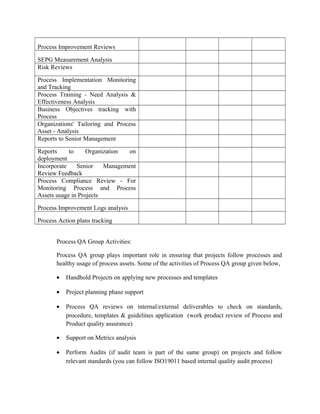
Sample Work Breakdown Structure for SEPG,
Activity Responsible Month1 Month 2 Month ‘n’
Process Appraisal
Name 1 Yes Yes
Internal Quality Audits (Refer Audit
Calendar)
Planned QMS Releases
Yes
Lessons Learnt meetings
Yes Yes Yes
Process Improvement Reviews
SEPG Measurement Analysis
Risk Reviews
Process Implementation Monitoring
and Tracking
Process Training - Need Analysis &
Effectiveness Analysis
Business Objectives tracking with
Process
Organizations' Tailoring and Process
Asset - Analysis
Reports to Senior Management
Reports to Organization on
deployment
Incorporate Senior Management
Review Feedback
Process Compliance Review - For
Monitoring Process and Process
Assets usage in Projects
Process Improvement Logs analysis
Process Action plans tracking
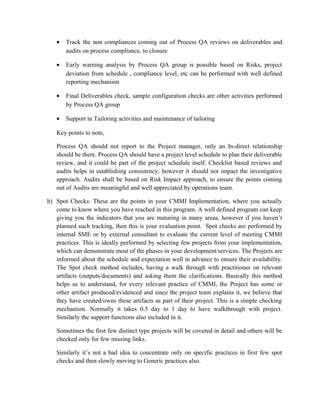
Process QA Group Activities:
Process QA group plays important role in ensuring that projects follow processes and
healthy usage of process assets. Some of the activities of Process QA group given below,
• Handhold Projects on applying new processes and templates
• Project planning phase support
• Process QA reviews on internal/external deliverables to check on standards,
procedure, templates & guidelines application (work product review of Process and
Product quality assurance)
• Support on Metrics analysis
• Perform Audits (if audit team is part of the same group) on projects and follow
relevant standards (you can follow ISO19011 based internal quality audit process)
• Track the non compliances coming out of Process QA reviews on deliverables and
audits on process compliance, to closure
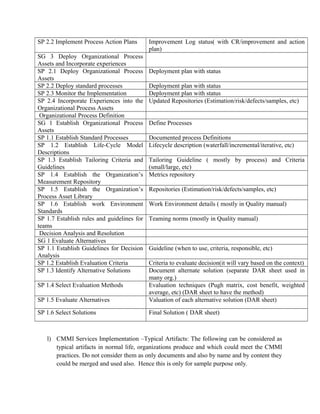
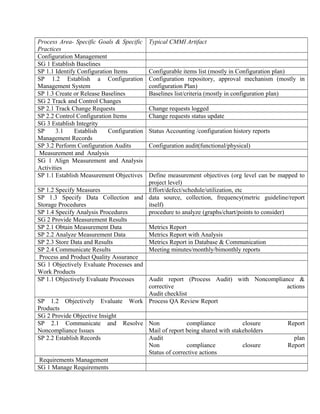
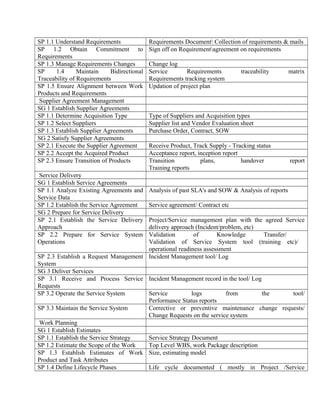
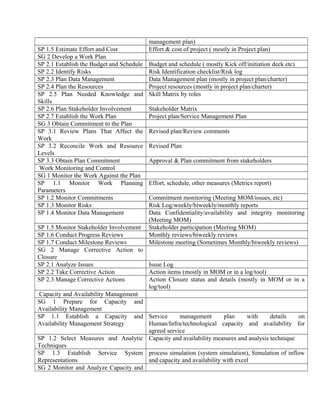
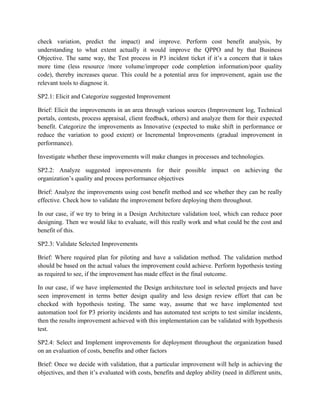
• Early warning analysis by Process QA group is possible based on Risks, project
deviation from schedule , compliance level, etc can be performed with well defined
reporting mechanism
• Final Deliverables check, sample configuration checks are other activities performed
by Process QA group
• Support in Tailoring activities and maintenance of tailoring
Key points to note,
Process QA should not report to the Project manager, only an In-direct relationship
should be there. Process QA should have a project level schedule to plan their deliverable
review, and it could be part of the project schedule itself. Checklist based reviews and
audits helps in establishing consistency; however it should not impact the investigative
approach. Audits shall be based on Risk Impact approach, to ensure the points coming
out of Audits are meaningful and well appreciated by operations team.
h) Spot Checks: These are the points in your CMMI Implementation, where you actually
come to know where you have reached in this program. A well defined program can keep
giving you the indicators that you are maturing in many areas, however if you haven’t
planned such tracking, then this is your evaluation point. Spot checks are performed by
internal SME or by external consultant to evaluate the current level of meeting CMMI
practices. This is ideally performed by selecting few projects from your implementation,
which can demonstrate most of the phases in your development/services. The Projects are
informed about the schedule and expectation well in advance to ensure their availability.
The Spot check method includes, having a walk through with practitioner on relevant
artifacts (outputs/documents) and asking them the clarifications. Basically this method
helps us to understand, for every relevant practice of CMMI, the Project has some or
other artifact produced/evidenced and since the project team explains it, we believe that
they have created/owns these artifacts as part of their project. This is a simple checking
mechanism. Normally it takes 0.5 day to 1 day to have walkthrough with project.
Similarly the support functions also included in it.
Sometimes the first few distinct type projects will be covered in detail and others will be
checked only for few missing links.
Similarly it’s not a bad idea to concentrate only on specific practices in first few spot
checks and then slowly moving to Generic practices also.
Remember we are talking on practice level, it’s only to say, that in practical life practices
mentioned in CMMI are similar to tasks to achieve something. If we don’t have some
practice as mentioned in CMMI, we might have alternate practice. Similarly the goals are
like activities in practical life, we can’t miss out the activities, which just leads to failure.
We address in this book at practice level, so that less clarifications are needed and more
details are provided.
Spot Check Reports shall be at Practice Level. If the report doesn’t give any remark on a
practice, it means we assume that practice is well met in the samples taken.
Sample Report in a Process Area,
P
A
Practice Compliance Gap Recomme
ndations
O
T
SP 1.1 Training needs are
identified from SEPG
(process related),
projects (technical)
and also from role
based training needs;
and feasible training
programs are rolled
out
SP 1.2 Project specific and
org level trainings are
planed and
responsibilities are
spelled out in Annual
Training Plan
SP 1.3 Annual Training Plan
is established and
maintained
SP 1.4 Training capability is
established through
identification of
trainers (internal and
external), repository
of training materials
and training facilities
Annual Training plan
refers
SP 2.1 Technical and
Process trainings are
conducted as per
training calendar.
Attendance records
and training status
reports are
maintained
SP 2.2 Training calendars,
attendance records,
feedback records are
maintained
SP 2.3 Training
effectiveness is
evaluated by analysis
of training feedback
Action
tracking
based on
analysis to
be created.
Similarly if you can assign Compliance Level to each practice, you can get a score at
Process Area level,
High – No Gap and complete compliance
Med- Few recommendations & no significant gap
Low- Significant gap in practice compliance
Now you can assign a rating of High = 1, Med = 0.5 and Low = 0
Now at Process Area level you can get compliance, like out 12 specific practices you
have 4 high+ 6 Medium +2 Low => 4*1+6*0.5+2*0=>7
This means, 7/12=> 59% compliance
If you want you can go ahead and get compliance across all 22 (or) 24 process areas and
take average out of them, which will give you a single figure like 62% compliance.
This is not a method suggested by CMMI Institute, however this helps us to quantify and
get a rough value of where we stand in a moment. On subsequent Spot check, when we
apply the same method, we get relative value of compliance. This helps us to see that we
are moving well or not, again this is indicative only.
i) Source of Process Improvements: There are various process improvement sources
available in our organizations, they have to be identified and tracked continuously to
improve our processes. The following are some of the sources,
• Internal Audit Analysis
• Tailoring Analysis
• Metrics consolidated Analysis
• Appraisal Reports
• Client Feedbacks
• Process QA facilitation reports
• Senior management inputs
• External Certification Audit reports
• Process Suggestion portals/Operation team requests
• Discussion forums organized in Organization
And other sources based on your organizational components.
j) Repositories Set Up: The processes used in the organization produces certain results and
artifacts and these become important component for learning and for better preparation in
further new projects. Repositories or Process Asset Repositories are helpful for the
practitioners to get better prepared and to learn from experience of others. There are
various repositories organizations maintain based on their need and effectiveness for
delivery. Also it’s a cost for organizations to set up and maintain repositories. A
repository is normally created by collecting data from projects, analyzing them, filling the
missing components, and standardizes the data in the required format, adding to database
of the repository, having a front end which is easy to retrieve the information for projects
and keep updating the repository over a period of time.
The following are the typical repositories maintained in organizations,
(i) Measurement Repository
(ii) Estimation Repository
(iii) Defect Repository
(iv) Service issues Repository
(v) Risk Repository
(vi) Lifecycle Repository
(vii) Tailoring Repository
(viii) Best Practices Repository
(ix) Lessons Learnt Repository
(x) Samples Repository
(xi) Technical Know How – FAQ’s
And other different repositories like reusable repository, domain specific repositories, etc
Every repository shall have an identified person allocated to maintain it. The data
cleansing activity is performed, before adding the data to a repository. Adequate
Communication in this regard will help better utilization. Some organizations use share
point or web portal to publish their repositories, and counters are enabled to check how
many clicks to the portal happened for the repository.
k) CMMI Development Implementation - Typical Artifacts: The following can be
considered as typical artifacts in normal life, organizations produce and which could meet
the CMMI practices. Do not consider them as only documents and also by name and by
content they could be merged and used also. Hence this is only for sample purpose only.
Process Area- Specific Goals & Specific
Practices
Typical CMMI Artifact
Requirements Management
SG 1 Manage Requirements
SP 1.1 Understand Requirements Requirements Document Collection of requirements & mails
SP1.2Obtain Commitment to
Requirements
Sign off on Requirementagreement on requirements
SP 1.3 Manage Requirements Changes Change log
SP 1.4 Maintain Bidirectional
Traceability of Requirements
Traceability matrix
SP 1.5 Ensure Alignment between
Project Work and Requirements
Updation of project plan
Requirements Development
SG 1 Develop Customer Requirements
SP 1.1 Elicit Needs Requirements meeting MOM/prototype
SP 1.2 Transform Stakeholder needs into
Customer Requirements
Business Requirements
SG 2 Develop Product Requirements
SP 2.1 Establish Product and Product-
Component Requirements
Software Requirements Specification document
SP 2.2 Allocate Product-Component
Requirements
Software Requirements Specification document
SP 2.3 Identify Interface Requirements Interface Requirements in SRS
SG 3 Analyze and Validate Requirements
SP 3.1 Establish Operational Concepts
and Scenarios
Use Case ,timeline scenarios, etc
SP 3.2 Establish a Definition of Required
Functionality and Quality Attributes
activity diagram, use case
SP 3.3 Analyze Requirements Requirements defect/review
SP 3.4 Analyze Requirements to Achieve
Balance
Requirements allocation/module wise requirements, risks
SP 3.5 Validate Requirements Analysis with client/prototype etc
Technical Solution
SG 1 Select Product-Component
Solutions
SP 1.1 Develop Alternative Solutions and
Selection Criteria
Alternative solutions/evaluation report/selection criteria
SP 1.2 Select Product-Component
Solutions
Documented solution
SG 2 Develop the Design
SP 2.1 Design the Product or Product
Component
Product Architecture
SP 2.2 Establish a Technical Data
Package
Technical data package
SP 2.3 Design Interfaces Using Criteria Interface design/Criteria/Low Level design
SP 2.4 Perform Make or Buy Analysis make/buy/reuse analysis
SG 3 Implement the Product Design
SP 3.1 Implement the Design Source code
SP 3.2 Develop Product Support
Documentation
user manual/product manual
Product Integration
SG 1 Prepare for Product Integration
SP 1.1 Establish and Integration Strategy Integration Strategy
SP 1.2 Establish the Product Integration
Environment
Product integration strategy to have environment details
SP 1.3 Establish Product Integration
Procedures and Criteria
Product integration plan
SG 2 Ensure Interface Compatibility
SP 2.1 Review Interface Descriptions for
Completeness
Integration review checklist
SP 2.2 Manage Interfaces updated interfaces/MOM
SG 3 Assemble Product Components and
Deliver the Product
SP 3.1 Confirm Readiness of Product
Components for Integration
Build readiness check
SP 3.2 Assemble Product Components Build
SP 3.3 Evaluate Assembled Product
Components
Release Readiness Checklist
SP 3.4 Package and Deliver the Product
or Product Component
Release Note/Release
Verification
SG 1 Prepare for Verification
SP 1.1 Select Work Products for
Verification
Reviews/Unit test plan
SP 1.2 Establish the Verification
Environment
Templates/checklists/tools, etc
SP 1.3 Establish Verification Procedures
and Criteria
Reviews/Unit test plan(procedure)
SG 2 Perform Peer Reviews
SP 2.1 Prepare for Peer Reviews peer review schedule/meeting planning, etc
SP 2.2 Conduct Peer Reviews peer review report
SP 2.3 Analyze Peer Review Data Defect closure
SG 3 Verify Selected Work Products
SP 3.1 Perform Verification Unit testing
SP 3.2 Analyze Verification Results and
Identify Corrective Action
Defect Analysis & Defect prevention
Validation
SG 1 Prepare for Validation
SP 1.1 Select Products for Validation System Test plan
SP 1.2 Establish the Validation
Environment
Test Environment set up
SP 1.3 Establish Validation Procedures
and Criteria
System Test plan
SG 2 Validate Product or Product
Components
SP 2.1 Perform Validation Test Execution Results
SP 2.2 Analyze Validation Results Defect Analysis & Defect prevention
Project Planning
SG 1 Establish Estimates
SP 1.1 Estimate the Scope of the Project Top Level WBS, work Package description
SP 1.2 Establish Estimates of Work
Product and Task Attributes
Size, estimating model
SP 1.3 Define Project Life Cycle Life cycle documented ( mostly in Project plan)
SP 1.4 Determine Estimates of Effort and
Cost
Effort & cost of project ( mostly in Project plan)
SG 2 Develop a Project Plan
SP 2.1 Establish the Budget and Schedule Budget and schedule ( mostly Kick off/initiation deck etc)
SP 2.2 Identify Project Risks Risk Identification checklist/Risk log
SP 2.3 Plan for Data Management Data Management plan (mostly in project plan/charter)
SP 2.4 Plan for Project Resources Project resources (mostly in project plan/charter)
SP 2.5 Plan for Needed Knowledge and
Skills
Skill Matrix by roles
SP 2.6 Plan Stakeholder Involvement Stakeholder Matrix
SP 2.7 Establish the Project Plan Project plan
SG 3 Obtain Commitment to the Plan
SP 3.1 Review Plans that Affect the
Project
Revised plan/Review comments
SP 3.2 Reconcile Work and Resource
Levels
Revised Plan
SP 3.3 Obtain Plan Commitment Approval & Plan commitment from stakeholders
Project Monitoring and Control
SG 1 Monitor Project Against Plan
SP 1.1 Monitor Project Planning
Parameters
Effort, schedule, other measures (Metrics report)
SP 1.2 Monitor Commitments Commitment monitoring (Meeting MOM/issues, etc)
SP 1.3 Monitor Project Risks Risk Log/weekly/biweekly/monthly reports
SP 1.4 Monitor Data Management Data Confidentiality/availability and integrity monitoring
(Meeting MOM)
SP 1.5 Monitor Stakeholder Involvement Stakeholder participation (Meeting MOM)
SP 1.6 Conduct Progress Reviews Monthly reviews/biweekly reviews
SP 1.7 Conduct Milestone Reviews Milestone meeting (Sometimes Monthly/biweekly reviews)
SG 2 Manage Corrective Action to
Closure
SP 2.1 Analyze Issues Issue Log
SP 2.2 Take Corrective Action Action items (mostly in MOM or in a log/tool)
SP 2.3 Manage Corrective Action Action Closure status and details (mostly in MOM or in a
log/tool)
Risk Management
SG 1 Prepare for Risk Management
SP 1.1 Determine Risk Sources and
Categories
Risk Source and category (can be part of Risk log/sheet and
applied to each risk)
SP 1.2 Define Risk Parameters Risk Parameters typically impact * probability =>Risk
Exposure
SP 1.3 Establish a Risk Management
Strategy
Strategy document/guidance in Risk log itself
( threshold/mitigation/contingency/acceptance/avoidance/role
s)
SG 2 Identify and Analyze Risks
SP 2.1 Identify Risks List of Identified risks (risk log)
SP 2.2 Evaluate Risks Risk Exposure and priority
SG 3 Mitigate Risks
SP 3.1 Develop Risk Mitigation Plans Mitigation actions (to reduce risk exposure- mostly in risk
log)
SP 3.2 Implement Risk Mitigation Plans Action closure and Risk rating modifications
Configuration Management
SG 1 Establish Baselines
SP 1.1 Identify Configuration Items Configurable items list (mostly in Configuration plan)
SP 1.2 Establish a Configuration
Management System
Configuration repository, approval mechanism (mostly in
configuration Plan)
SP 1.3 Create or Release Baselines Baselines list/criteria (mostly in configuration plan)
SG 2 Track and Control Changes
SP 2.1 Track Change Requests Change requests logged
SP 2.2 Control Configuration Items Change requests status update
SG 3 Establish Integrity
SP 3.1 Establish Configuration
Management Records
Status Accounting /configuration history reports
SP 3.2 Perform Configuration Audits Configuration audit(functional/physical)
Measurement and Analysis
SG 1 Align Measurement and Analysis
Activities
SP 1.1 Establish Measurement Objectives Define measurement objectives (org level can be mapped to
project level)
SP 1.2 Specify Measures Effort/defect/schedule/utilization, etc
SP 1.3 Specify Data Collection and
Storage Proc
data source, collection, frequency(metric guideline/report
itself)
SP 1.4 Specify Analysis Procedures procedure to analyze (graphs/chart/points to consider)
SG 2 Provide Measurement Results
SP 2.1 Obtain Measurement Data Metrics Report
SP 2.2 Analyze Measurement Data Metrics Report
SP 2.3 Store Data and Results Metrics Report
SP 2.4 Communicate Results Meeting minutes/monthly/bimonthly reports
Process and Product Quality Assurance
SG 1 Objectively Evaluate Processes and
Work Products
SP 1.1 Objectively Evaluate Processes Audit report (Process Audit)
SP 1.2 Objectively Evaluate Work
Products and Services
Work product Review Report (SQA review on deliverables)
SG 2 Provide Objective Insight
SP 2.1 Communicate and Ensure
Resolution of NC Issues
Non compliance closure Report
SP 2.2 Establish Records Non compliance closure Report
Integrated Project Management
SG 1 Use the Project’s Defined Process Tailoring
SP 1.1 Establish the Project’s Defined tailoring checklist/document (of organization process with
Process project context)
SP 1.2 Use Organizational Process Assets
for Planning Project Activities
estimation/measurements/risks, etc used for planning (mostly
in project plan)
SP 1.3 Establish Project's work
Environment
Documented Project environment (mostly in project plan)
SP 1.4 Integrate Plans integrated project plan
SP 1.5 Manage the Project Using the
Integrated Plans
Revised integrated project plan/updates based on it
SP 1.6 Establish Teams Team roles and guidance (Mostly in project plan)
SP 1.7 Contribute to the Organizational
Process Assets
Lessons learnt/best practices/improvements, etc
SG 2 Coordinate and Collaborate with
Relevant Stakeholders
SP 2.1 Manage Stakeholder Involvement Team Meetings/issue log/Project meetings
SP 2.2 Manage Dependencies Issue ,dependency log & closure of actions
SP 2.3 Resolve Coordination Issues Issue ,dependency log & closure of actions
Organizational Training
SG 1 Establish an Organizational
Training Capability
SP 1.1 Establish the Strategic Training
Needs
Linked training needs with business objectives (mostly
annual Training plan /strategy document)
SP 1.2 Determine Which Training Needs
Are the Responsibility of the
Organization
Project level & Org level training - listed (in plan)
SP 1.3 Establish an Organizational
Training Tactical Plan
Training Calendar
SP 1.4 Establish Training Capability Training environment, trainer details documented at org. level
SG 2 Provide Necessary Training
SP 2.1 Deliver Training Training delivery record
(Invite/material/feedback/attendance)
SP 2.2 Establish Training Records Training delivery record (Invite/material/feedback)
SP 2.3 Assess Training Effectiveness Training feedback evaluation/360 feedback/performance
check, etc
Organizational Process Focus
SG 1 Determine Process-Improvement
Opportunities
SP 1.1 Establish Organizational Process
Needs
Process Needs & details (mostly in Quality Manual)
SP 1.2 Appraise the Organization’s
Processes
Audit/appraise/review organization process
SP 1.3 Identify the Organization's
Process Improvements
Improvement log (based on appraisals and from projects)
SG 2 Plan and Implement Process
Actions
SP 2.1 Establish Process Action Plans Improvement Log ( with CR/improvement and action plan)
SP 2.2 Implement Process Action Plans Improvement Log status( with CR/improvement and action
plan)
SG 3 Deploy Organizational Process
Assets and Incorporate experiences
SP 2.1 Deploy Organizational Process
Assets
Deployment plan with status
SP 2.2 Deploy standard processes Deployment plan with status
SP 2.3 Monitor the Implementation Deployment plan with status
SP 2.4 Incorporate Experiences into the
Organizational Process Assets
Updated Repositories (Estimation/risk/defects/samples, etc)
Organizational Process Definition
SG 1 Establish Organizational Process
Assets
Define Processes
SP 1.1 Establish Standard Processes Documented process Definitions
SP 1.2 Establish Life-Cycle Model
Descriptions
Lifecycle description (waterfall/incremental/iterative, etc)
SP 1.3 Establish Tailoring Criteria and
Guidelines
Tailoring Guideline ( mostly by process) and Criteria
(small/large, etc)
SP 1.4 Establish the Organization’s
Measurement Repository
Metrics repository
SP 1.5 Establish the Organization’s
Process Asset Library
Repositories (Estimation/risk/defects/samples, etc)
SP 1.6 Establish work Environment
Standards
Work Environment details ( mostly in Quality manual)
SP 1.7 Establish rules and guidelines for
teams
Teaming norms (mostly in Quality manual)
Decision Analysis and Resolution
SG 1 Evaluate Alternatives
SP 1.1 Establish Guidelines for Decision
Analysis
Guideline (when to use, criteria, responsible, etc)
SP 1.2 Establish Evaluation Criteria Criteria to evaluate decision(it will vary based on the context)
SP 1.3 Identify Alternative Solutions Document alternate solution (separate DAR sheet used in
many org.)
SP 1.4 Select Evaluation Methods Evaluation techniques (Pugh matrix, cost benefit, weighted
average, etc) (DAR sheet to have the method)
SP 1.5 Evaluate Alternatives Valuation of each alternative solution (DAR sheet)
SP 1.6 Select Solutions Final Solution ( DAR sheet)
l) CMMI Services Implementation –Typical Artifacts: The following can be considered as
typical artifacts in normal life, organizations produce and which could meet the CMMI
practices. Do not consider them as only documents and also by name and by content they
could be merged and used also. Hence this is only for sample purpose only.
Process Area- Specific Goals & Specific
Practices
Typical CMMI Artifact
Configuration Management
SG 1 Establish Baselines
SP 1.1 Identify Configuration Items Configurable items list (mostly in Configuration plan)
SP 1.2 Establish a Configuration
Management System
Configuration repository, approval mechanism (mostly in
configuration Plan)
SP 1.3 Create or Release Baselines Baselines list/criteria (mostly in configuration plan)
SG 2 Track and Control Changes
SP 2.1 Track Change Requests Change requests logged
SP 2.2 Control Configuration Items Change requests status update
SG 3 Establish Integrity
SP 3.1 Establish Configuration
Management Records
Status Accounting /configuration history reports
SP 3.2 Perform Configuration Audits Configuration audit(functional/physical)
Measurement and Analysis
SG 1 Align Measurement and Analysis
Activities
SP 1.1 Establish Measurement Objectives Define measurement objectives (org level can be mapped to
project level)
SP 1.2 Specify Measures Effort/defect/schedule/utilization, etc
SP 1.3 Specify Data Collection and
Storage Procedures
data source, collection, frequency(metric guideline/report
itself)
SP 1.4 Specify Analysis Procedures procedure to analyze (graphs/chart/points to consider)
SG 2 Provide Measurement Results
SP 2.1 Obtain Measurement Data Metrics Report
SP 2.2 Analyze Measurement Data Metrics Report with Analysis
SP 2.3 Store Data and Results Metrics Report in Database & Communication
SP 2.4 Communicate Results Meeting minutes/monthly/bimonthly reports
Process and Product Quality Assurance
SG 1 Objectively Evaluate Processes and
Work Products
SP 1.1 Objectively Evaluate Processes Audit report (Process Audit) with Noncompliance &
corrective actions
Audit checklist
SP 1.2 Objectively Evaluate Work
Products
Process QA Review Report
SG 2 Provide Objective Insight
SP 2.1 Communicate and Resolve
Noncompliance Issues
Non compliance closure Report
Mail of report being shared with stakeholders
SP 2.2 Establish Records Audit plan
Non compliance closure Report
Status of corrective actions
Requirements Management
SG 1 Manage Requirements
SP 1.1 Understand Requirements Requirements Document Collection of requirements & mails
SP 1.2 Obtain Commitment to
Requirements
Sign off on Requirementagreement on requirements
SP 1.3 Manage Requirements Changes Change log
SP 1.4 Maintain Bidirectional
Traceability of Requirements
Service Requirements traceability matrix
Requirements tracking system
SP 1.5 Ensure Alignment between Work
Products and Requirements
Updation of project plan
Supplier Agreement Management
SG 1 Establish Supplier Agreements
SP 1.1 Determine Acquisition Type Type of Suppliers and Acquisition types
SP 1.2 Select Suppliers Supplier list and Vendor Evaluation sheet
SP 1.3 Establish Supplier Agreements Purchase Order, Contract, SOW
SG 2 Satisfy Supplier Agreements
SP 2.1 Execute the Supplier Agreement Receive Product, Track Supply - Tracking status
SP 2.2 Accept the Acquired Product Acceptance report, inception report
SP 2.3 Ensure Transition of Products Transition plans, handover report
Training reports
Service Delivery
SG 1 Establish Service Agreements
SP 1.1 Analyze Existing Agreements and
Service Data
Analysis of past SLA's and SOW & Analysis of reports
SP 1.2 Establish the Service Agreement Service agreement/ Contract etc
SG 2 Prepare for Service Delivery
SP 2.1 Establish the Service Delivery
Approach
Project/Service management plan with the agreed Service
delivery approach (Incident/problem, etc)
SP 2.2 Prepare for Service System
Operations
Validation of Knowledge Transfer/
Validation of Service System tool (training etc)/
operational readiness assessment
SP 2.3 Establish a Request Management
System
Incident Management tool/ Log
SG 3 Deliver Services
SP 3.1 Receive and Process Service
Requests
Incident Management record in the tool/ Log
SP 3.2 Operate the Service System Service logs from the tool/
Performance Status reports
SP 3.3 Maintain the Service System Corrective or preventive maintenance change requests/
Change Requests on the service system
Work Planning
SG 1 Establish Estimates
SP 1.1 Establish the Service Strategy Service Strategy Document
SP 1.2 Estimate the Scope of the Work Top Level WBS, work Package description
SP 1.3 Establish Estimates of Work
Product and Task Attributes
Size, estimating model
SP 1.4 Define Lifecycle Phases Life cycle documented ( mostly in Project /Service
management plan)
SP 1.5 Estimate Effort and Cost Effort & cost of project ( mostly in Project plan)
SG 2 Develop a Work Plan
SP 2.1 Establish the Budget and Schedule Budget and schedule ( mostly Kick off/initiation deck etc)
SP 2.2 Identify Risks Risk Identification checklist/Risk log
SP 2.3 Plan Data Management Data Management plan (mostly in project plan/charter)
SP 2.4 Plan the Resources Project resources (mostly in project plan/charter)
SP 2.5 Plan Needed Knowledge and
Skills
Skill Matrix by roles
SP 2.6 Plan Stakeholder Involvement Stakeholder Matrix
SP 2.7 Establish the Work Plan Project plan/Service Management Plan
SG 3 Obtain Commitment to the Plan
SP 3.1 Review Plans That Affect the
Work
Revised plan/Review comments
SP 3.2 Reconcile Work and Resource
Levels
Revised Plan
SP 3.3 Obtain Plan Commitment Approval & Plan commitment from stakeholders
Work Monitoring and Control
SG 1 Monitor the Work Against the Plan
SP 1.1 Monitor Work Planning
Parameters
Effort, schedule, other measures (Metrics report)
SP 1.2 Monitor Commitments Commitment monitoring (Meeting MOM/issues, etc)
SP 1.3 Monitor Risks Risk Log/weekly/biweekly/monthly reports
SP 1.4 Monitor Data Management Data Confidentiality/availability and integrity monitoring
(Meeting MOM)
SP 1.5 Monitor Stakeholder Involvement Stakeholder participation (Meeting MOM)
SP 1.6 Conduct Progress Reviews Monthly reviews/biweekly reviews
SP 1.7 Conduct Milestone Reviews Milestone meeting (Sometimes Monthly/biweekly reviews)
SG 2 Manage Corrective Action to
Closure
SP 2.1 Analyze Issues Issue Log
SP 2.2 Take Corrective Action Action items (mostly in MOM or in a log/tool)
SP 2.3 Manage Corrective Actions Action Closure status and details (mostly in MOM or in a
log/tool)
Capacity and Availability Management
SG 1 Prepare for Capacity and
Availability Management
SP 1.1 Establish a Capacity and
Availability Management Strategy
Service management plan with details on
Human/Infra/technological capacity and availability for
agreed service
SP 1.2 Select Measures and Analytic
Techniques
Capacity and availability measures and analysis technique
SP 1.3 Establish Service System
Representations
process simulation (system simulation), Simulation of inflow
and capacity and availability with excel
SG 2 Monitor and Analyze Capacity and
Availability
SP 2.1 Monitor and Analyze Capacity Trend charts on service resource usage data
SP 2.2 Monitor and Analyze Availability Trends on availability, analysis and action
SP 2.3 Report Capacity and Availability
Management Data
Service system performance reports
Service availability reports
Decision Analysis and Resolution
SG 1 Evaluate Alternatives
SP 1.1 Establish Guidelines for Decision
Analysis
Guideline (when to use, criteria, responsible, etc)
SP 1.2 Establish Evaluation Criteria Criteria to evaluate decision(it will vary based on the context)
SP 1.3 Identify Alternative Solutions Document alternate solution (separate DAR sheet used in
many org.)
SP 1.4 Select Evaluation Methods Evaluation techniques (Pugh matrix, cost benefit, weighted
average, etc) (DAR sheet to have the method)
SP 1.5 Evaluate Alternative Solutions Valuation of each alternative solution (DAR sheet)
SP 1.6 Select Solutions Final Solution ( DAR sheet)
Incident Resolution and Prevention
SG 1 Prepare for Incident Resolution and
Prevention
SP 1.1 Establish an Approach to Incident
Resolution and Prevention
SQP with details on Service Incident handling approach
SP 1.2 Establish an Incident Management
System
Service Incident logging Tool/ Log
SG 2 Identify, Control, and Address
Individual Incidents
SP 2.1 Identify and Record Incidents Service Incident ticket record
SP 2.2 Analyze Individual Incident Data Major incident, repeat incident analysis
SP 2.3 Resolve Incidents Updated resolution in the tool/ log
SP 2.4 Monitor the Status of Incidents to
Closure
Closure Service incident log/ Status update/ Escalation data
(mail/tool ref etc)
SP 2.5 Communicate the Status of
Incidents
Status reports/ Communication mail
SG 3 Analyze and Address Causes and
Impacts of Selected Incidents
SP 3.1 Analyze Selected Incidents Report of underlying causes of incidents/
Documented causal analysis activities
SP 3.2 Establish Solutions to Respond to
Future Incidents
Knowledge data base
SP 3.3 Establish and Apply Solutions to
Reduce Incident Occurrence
Change in Service Delivery system like a tool/ procedure /
policies etc.
Service System Transition
SG 1 Prepare for Service System
Transition
SP 1.1 Analyze Service System
Transition Needs
Compatibility analysis of current and post-transition service
systems
Baseline service system components
Mitigations for of identified transition Issues and risks
SP 1.2 Develop Service System
Transition Plans
Transition plans for service system transition (tools, process,
competency)
SP 1.3 Prepare Stakeholders for Changes Strategy of training and transition
Transition communication and notification artifacts (e.g.,
emails, system announcements, bulletin boards)
SG 2 Deploy the Service System
SP 2.1 Deploy Service System
Components
Installation records
Installation instructions
Operational scenarios and procedures
SP 2.2 Assess and Control the Impacts of
the Transition
Post deployment review
Back out / rollback results, if needed
Service impacts due to deployment issues
Service System Development
SG 1 Develop and Analyze Stakeholder
Requirements
SP 1.1 Develop Stakeholder
Requirements
Customer requirements
End-user requirements
SP 1.2 Develop Service System
Requirements
Service system Requirements & software requirement
specification
SP 1.3 Analyze and Validate
Requirements
Prototype, Validation of requirements
SG 2 Develop Service Systems
SP 2.1 Select Service System Solutions Architecture of solution, Service system design
SP 2.2 Develop the Design Code and develop service software, develop components of
service system
SP 2.3 Ensure Interface Compatibility Interface identification within components and external
components of service system
SP 2.4 Implement the Service System
Design
Implemented service system components
Training materials
User, operator, and maintenance manual
SP 2.5 Integrate Service System
Components
Service system integration plan, build the service system
SG 3 Verify and Validate Service
Systems
SP 3.1 Prepare for Verification and
Validation
Verification tools, environment, test strategy, simulation plan
SP 3.2 Perform Peer Reviews peer review checklist, peer review report
SP 3.3 Verify Selected Service System
Components
Review and unit test
SP 3.4 Validate the Service System Validation reports and results, Test Results
Integrated Work Management
SG 1 Use the Defined Process for the
Work
SP 1.1 Establish the Defined Process tailoring checklist/document (of organization process with
project context)
SP 1.2 Use Organizational Process Assets
for Planning Work Activities
estimation/measurements/risks, etc used for planning (mostly
in project plan)
SP 1.3 Establish the Work Environment Documented Project environment (mostly in project plan)
SP 1.4 Integrate Plans integrated project plan
SP 1.5 Manage the Work Using
Integrated Plans
Revised integrated project plan/updates based on it
SP 1.6 Establish Teams Team roles and guidance (Mostly in project plan)
SP 1.7 Contribute to Organizational
Process Assets
Lessons learnt/best practices/improvements, etc
SG 2 Coordinate and Collaborate with
Relevant Stakeholders
SP 2.1 Manage Stakeholder Involvement Team Meetings/issue log/Project meetings
SP 2.2 Manage Dependencies Issue ,dependency log & closure of actions
SP 2.3 Resolve Coordination Issues Issue ,dependency log & closure of actions
Strategic Service Management
SSG 1 Establish Strategic Needs and
Plans for Standard Services
SP 1.1 Gather and Analyze Data Analyzed data on the organization’s capabilities (past
performance report)
Analyzed data on strategic needs, Analysis report
SP 1.2 Establish Plans for Standard
Services
Strategic plan on standard service, catalogue, needs
SG 2 Establish Standard Services
SP 2.1 Establish Properties of Standard
Services and Service Levels
Critical attributes of standard services
Organization’s set of standard service levels
Common and variable parts of standard services
SP 2.2 Establish Descriptions of Standard
Services
Service Catalog with specific instructions
Service Continuity
SG 1 Identify Essential Service
Dependencies
SP 1.1 Identify and Prioritize Essential
Functions
Risk Assessment, Business continuity assessment report
SP 1.2 Identify and Prioritize Essential
Resources
prioritization based on Assessment (Business continuity
assessment report)
SG 2 Prepare for Service Continuity
SP 2.1 Establish Service Continuity Plans Business Continuity plan
SP 2.2 Establish Service Continuity
Training
Service continuity training material
Training records
SP 2.3 Provide and Evaluate Service
Continuity Training
Training Records on business continuity
SG 3 Verify and Validate the Service
Continuity Plan
SP 3.1 Prepare for the Verification and
Validation of the Service Continuity Plan
Plan for Business continuity check
SP 3.2 Verify and Validate the Service
Continuity Plan
Review report
SP 3.3 Analyze Results of Verification
and Validation of the Service Continuity
Plan
Results of Simulation Test report & improvement
recommendations
Risk Management
SG 1 Prepare for Risk Management
SP 1.1 Determine Risk Sources and
Categories
Risk Source and category (can be part of Risk log/sheet and
applied to each risk)
SP 1.2 Define Risk Parameters Risk Parameters typically impact * probability =>Risk
Exposure
SP 1.3 Establish a Risk Management
Strategy
Strategy document/guidance in Risk log itself
( threshold/mitigation/contingency/acceptance/avoidance/role
s)
SG 2 Identify and Analyze Risks
SP 2.1 Identify Risks List of Identified risks (risk log)
SP 2.2 Evaluate, Categorize, and
Prioritize Risks
Risk Exposure and priority
SG 3 Mitigate Risks
SP 3.1 Develop Risk Mitigation Plans Mitigation actions (to reduce risk exposure- mostly in risk
log)
SP 3.2 Implement Risk Mitigation Plans Action closure and Risk rating modifications
Organizational Training
SG 1 Establish an Organizational
Training Capability
SP 1.1 Establish Strategic Training Needs Linked training needs with business objectives (mostly
annual Training plan /strategy document)
SP 1.2 Determine Which Training Needs
Are the Responsibility of the
Organization
Project level & Org level training - listed (in plan)
SP 1.3 Establish an Organizational
Training Tactical Plan
Training Calendar
SP 1.4 Establish a Training Capability Training environment, trainer details documented at org. level
SG 2 Provide Training
SP 2.1 Deliver Training Training delivery record
(Invite/material/feedback/attendance)
SP 2.2 Establish Training Records Training delivery record (Invite/material/feedback)
SP 2.3 Assess Training Effectiveness Training feedback evaluation/360 feedback/performance
check, etc
Organizational Process Focus
SG 1 Determine Process Improvement
Opportunities
SP 1.1 Establish Organizational Process
Needs
Process Needs & details (mostly in Quality Manual)
SP 1.2 Appraise the Organization’s
Processes
Audit/appraise/review organization process
SP 1.3 Identify the Organization's
Process Improvements
Improvement log (based on appraisals and from projects)
SG 2 Plan and Implement Process
Actions
SP 2.1 Establish Process Action Plans Improvement Log ( with CR/improvement and action plan)
SP 2.2 Implement Process Action Plans Improvement Log status( with CR/improvement and action
plan)
SG 3 Deploy Organizational Process
Assets and Incorporate Experiences
SP 3.1 Deploy Organizational Process
Assets
Deployment plan with status
SP 3.2 Deploy Standard Processes Deployment plan with status
SP 3.3 Monitor the Implementation Deployment plan with status
SP 3.4 Incorporate Experiences into
Organizational Process Assets
Updated Repositories (Estimation/risk/defects/samples, etc)
Organizational Process Definition
SG 1 Establish Organizational Process
Assets
Define Processes
SP 1.1 Establish Standard Processes Documented process Definitions
SP 1.2 Establish Life-Cycle Model
Descriptions
Lifecycle description (waterfall/incremental/iterative, etc)
SP 1.3 Establish Tailoring Criteria and
Guidelines
Tailoring Guideline ( mostly by process) and Criteria
(small/large, etc)
SP 1.4 Establish the Organization’s
Measurement Repository
Metrics repository
SP 1.5 Establish the Organization’s
Process Asset Library
Repositories (Estimation/risk/defects/samples, etc)
SP 1.6 Establish Work Environment
Standards
Work Environment details ( mostly in Quality manual)
SP 1.7 Establish Rules and Guidelines for
Teams
Teaming norms (mostly in Quality manual)
m) Generic Goals/Practices
Generic Goals & Practices Typical Artifacts
GG2: Institutionalize a Managed process
GP2.1 Establish an Organizational Policy Policy guide book/ policy within a process
GP2.2 Plan the process Part of work break down structure
GP2.3 Provide resources Resource allocation in Project plan/Service
management plan
GP2.4 Assign Responsibility Roles and Responsibility in Project
plan/Service management plan
GP2.5 Train People Skill matrix and training plan
GP2.6 Control work products Configuration plan with Configurable items
GP2.7 Identify and Involve Relevant
Stakeholders
Stakeholder management plan/matrix with
tasks in Project/Service management plan
GP2.8 Monitor and Control the process Metrics report/capacity report/meeting
minutes
GP2.9 Objectively Evaluate Adherence Audit reports for all processes
GP2.10 Review Status with Higher Level
Management
Status reports/MOM ,etc
GG 3 Institutionalize a Defined Process
GP3.1 Establish a defined Process Process Description and Tailoring details for
process in a project
GP3.2 Collect Process related experiences Process lessons learnt, data from process, etc
The Generic practices should be applied for each of process area with that context. Here
whatever we have given is a sample, if you try to understand that this will fit everywhere it’s
a Risk. Hence be cautious this is only for sample purpose.
n) Monitoring and Control of program: The Monitoring of the program is an important
activity and should be continuous. As we discussed earlier, we have steering committee
and we have SEPG running, however it’s important for the CMMI program manager to
keep track of the happenings as per the schedule and generating the relevant measures in
alignment with program management parameters.
It starts from reporting the schedule deviation and effort deviation; some organizations
use earned value analysis method to show the overall deviation on schedule and effort.
Some people may claim that effort can be estimated in a program like CMMI, however in
normal life there are companies who have estimated effort, tracked and controlled it (not
FTE). Estimation can always be revised, but what it makes you is taking decision in
informed way. Considering the spot check compliance rating method we described
earlier, you can go ahead and have targets for your CMMI compliance level by each spot
check/appraisal, and see whether you are in that range.
Ex: Spot check 1, you wanted to achieve 55% compliance and spot check 2, you wanted
to achieve 65% compliance etc. similarly before the appraisal, and you may want to reach
more than 95% compliance with the model.
Other monitoring is on the deliverables by timeline. If you have targeted QMS release on
a particular period to support the implementation, any delay will have impact on the
successor task in your schedule.
Communication of the Metrics report and compliance chart publishing in various places
in the organization will give confidence and the information to employees and
encourages them to progress further.
o) Other Points to take care in Implementation:
• Monitor the scope of implementation throughout and not to deviate
• The barriers has to be logged in issue log, but keep progressing in other areas ,while
clearing them
• Check the coverage level in implementation
• Check the compliance level in implementation
• Don’t go for any short cut, that’s not what is intended by your organizations. Work
around is different from short cuts.
• Be ready to face the challenges and don’t shy away from them
• Be proactive and drive the implementation and don’t allow the program to drive you.
• The time limit set should be always challenging than comfort, however too aggressive
timeline can be devastating also. Always go for 20% more than your comfort zone.
• Strong Management support is very important, because not every question can be
answered with data or history, new things has to be experimented, and whenever you
face challenges that people are not ready for change, and then management support is
vital.
• You may progress slower than what you aimed for, but if the progress is convincing
and meaningful results are coming out, then don’t worry about them.
• Manage the Ego between people, this is important for success. This is anyway part of
change management, however ego and personal goal clashes sometime hinders the
progress of the program. You have to ready to convince and include them sometime,
or escalate as needed or change few things in organization to ensure that dynamics
settles well to produce a supportive environment.
• Never allocate a person to run a CMMI program, because they are free or you want
them to work hard. You need a person, who is strategic and who can ensure that every
arm is working towards the goal. Sometimes we see people, who are not very
successful in delivery is suddenly allocated to this program to manage. The reality is
this the important program in your organization and it’s going to change your culture,
then why to allocate a poorly performing person there. However if you believe this
only for achieving some rating and you are not going to change anything, it means
you are already decided the failure, so feel free to allocate anyone.
• Never call it as “Certification”. This is clarified many times by SEI and now by
CMMI Institute that there is nothing like Certification at organization level. But still
we see organizations calling it as certification. This is more than just wording, it
reflects the mentality and approach they have over the program. It’s only a “Rating”
based on Appraisal on Maturity or capability level on that instance of appraisal. Every
time correct your employees when they use the word certification, this is important
for them to understand and live up to the expectation of the program.
Execution of all the tasks mentioned in your plan as per the suggestions given here will
definitely lead you to a better position and to get ready for your appraisal.
Appraising CMMI Implementation
This is an important phase to evaluate your processes and understand the strength and
weaknesses and find the improvement opportunities to increase the efficiency and effectiveness
of your processes. Also it gives a way to bench mark and see your process maturity level across
industry through appraisal rating system.
Appraisal phase has lot of different activities and terminologies to understand for better clarity.
To Appraise the CMMI Model, there is a document called “ARC – Appraisal Requirements for
CMMI” is available, which basically explains the different criteria and characteristics the
appraisal method should posses. We are not much bothered about it, as CMMI Institute has an
Appraisal Method called SCAMPI which is already in compliance with this requirement.
SCAMPI stands for Standard CMMI based Appraisal Method for Process Improvement.
SCAMPI has 3 types of Appraisals in it.
SCAMPI C – The lightest method, the appraisals can be based on artifacts or Oral affirmation.
The purpose of this appraisal method is quickly to understand the high level approach issues and
interpretation issues. We need a Team Leader certified by CMMI Institute to do the SCAMPI C
appraisal. This is not mandatory activity, if you are looking for achieving a particular maturity
rating. However it’s preferred to have this kind of appraisal for early correction in approach.
SCAMPI B – The method helps to understand in detail the weakness and strength in process
areas. We can adopt this when we are in mid stage of implementation or in 75% progress in our
journey. The missing elements can be identified and it gives deeper understanding. Cost wise this
is lesser costlier than SCAMPI A. We need certified Team Leader for SCAMPI B appraisal to
conduct this appraisal. We need a team of members to participate along with team leader to
perform appraisal. If we have Appraisal Team Members (trained), it will be added advantage.
This is again not mandatory, but definitely recommended to avoid any surprise.
SCAMPI A – The only method which meets all the requirements of ARC and which can produce
results in terms of “Rating” at organizational level is this method. To perform this we need a
Certified Lead Appraiser (Up to ML3) or a Certified High Maturity Lead Appraiser (Up to ML5)
and team of trained members in CMMI Model and in Appraisal Methodology. The Results
provided this method is valid for 3 years and the sponsor of the program can select publishing it
in PARS site of CMMI Institute, where your results based on confidentiality chosen will be
available for external world to view. It’s a very detailed method and multiple analysis method is
available like a) Verification method b) Discovery method and c) Managed Discovery Method.
Most of them like to go with Managed Discovery method, where they collect minimum required
information before appraisal and take the discovery approach to better understand the
implementation. This greatly reduced the level of effort put in PIID (Process Implementation
Indicator Document) preparation.
For more understanding on SCAMPI Method, you can download MDD (Method Definition
Document) from CMMIInstitute.com
Appraisal Phase Activities:
a) Appraisal Scope Discussion: Before you enter this phase, it’s expected that the Lead
Appraiser is already identified and formal introduction about your organization and a
meeting with sponsor should have been done. In this activity it’s important to discuss
with him on the appraisal scope you are looking forward and define them clearly in a
word document. This could be the one in later point of time, submitted in CMMI Institute
Appraisal System (SAS) and may come in the Appraisal plan document. The
terminologies shall be at industry standard and which your client can understand.
Similarly discuss with lead appraiser on units to be included and projects which are
falling under the scope of appraisal. Organizational unit is the terminology which defines
the boundary of the organization which has implemented the model and to be included in
appraisal. It can happen that only one production/service line you have considered in
Implementation and then organizational unit is only inclusive of that line. Once you and
the lead appraiser has come in to understanding, by this time, you will also have collected
some idea from your lead appraiser that how he/she is planning to select the projects or
samples for the given condition.
The SCAMPI v1.3 method contains sample case for the Organizations to understand the
sampling. The key is finding the factors which introduce variation in implementation and
create distinct sample groups out of them. Then based out of overall work units in the
Organizational unit and the number of work unit in each distinctive sample group, the
ratio are derived and the final number of sample work unit to be looked in appraisal is
derived using the pre defined formula in the method. The simple clue you can take is , the
lesser the variation and more or less equal number within in the sample groups, then you
will end with less work units to look in to appraisal. This means less cost and typical
normal schedule.
Sampling of Sub groups – with three varying factors (site, Domain, Type)
Site Domain Type Basic
Units
Sample
Calc
Sample
Size
Sub
Group1
Paris Banking Implementation 20 1.5 2
Sub
Group2
Paris Healthcare Upgrade 4 0.3 1
Sub
Group3
Paris Manufacturing Implementation 2 0.1 1
Sub
Group4
Beijing Banking Implementation 40 3.0 3
Sub
Group5
Beijing Manufacturing Implementation 1 0.1 1
Total 5 Total67
The Formula application for sample size of Basic units from each sub group is (Total number
of sub groups/ Total Basic Units) * Basic units in that sub group. In this case sub group 1
sample size is (5/67)*20 = 1.5 => 2, similarly others are also calculated.
b) Appraisal Team Member Selection: The appraisal members are selected typically nearer
to the last quarter to ensure their stay in the organization for the period is confirmed. The
Appraisal team members should have certain qualifications in terms of experience in
technical and project management side, reporting clearance and competency. The
expectations are set clear in the new method, and the lead appraiser will discuss with
organization and will ensure the requirements are met. From organization’s point of view,
you may need your best people or the practitioner to sit as Functional Area
Representative (FAR) than as Appraisal Team Member (ATM). However you may need
to have few people from your Process QA Group to be there, so process related doubts
and working methods can be explained well. For smaller organizations who don’t have
many , they can take external ATM’s or can declare the conflicts about a person
representing the ATM team, that can be planned and managed by Lead Appraiser. It’s
always a good practice to bring few external ATM’s to get better objective results.
However it also has slight risk on not understanding the context on timely manner.
Appraisal Team Members shall undergo formal “CMMI Introduction” training for the
respective model which is planned to be appraised in your organization. If you go for
combined appraisal, then CMMI Dev + CMMI Svc addition training is required or you
can send them for training on both the method separately. This training can be provided
only by a Certified CMMI Instructor, your lead appraiser may have this certification, so
he can do this. The trained member names, dates of training and organizational name is
collected and send to CMMI Institute, normally within weeks it’s added to their records.
This is important for the members to be part of Appraisal, because the SAS will have to
show their record to the lead appraiser to add in to a newly created appraisal as Appraisal
Team Member. The “Official Introduction to CMMI- Dev/Svc” can be a separate
program planned for your organization or shared program with organizations or regular
planned public programs conducted by the CMMI Instructors. This is of 3 days duration
and at the end you will receive a certificate of training with CMMI Institute emblem.
Appraisal Team training is provided by the Lead Appraiser of the appraisal. If you have
already just participated in an appraisal for the same constellation as team member, the
lead appraiser may chose not to give you the training but to include you as team member.
CMMI Institute never gives any certificate for this role, if at all it’s given; it’s normally
by the CMMI Partner. However in the ATM pool database in SAS (appraisal system-
portal) the names of eligible people to participate in an appraisal for a constellation is
listed by their training record. The ATM training is of 2 days duration and normally lead
appraiser’s combined them with SCAMPI B or Readiness Review, which gives the
ATM’s better understanding on applying the SCAMPI practices and getting ready for
SCAMPI A. There is a simple open book pre qualifying test too.
c) Appraisal Plan: Appraisal plan is prepared by the lead appraiser based on the various
inputs collected in the organization to schedule the SCAMPI A appraisal. The scope,
sampling, resources to be involved, plan for data collection, details on appraisal onsite
schedule, Appraisal Team Member details, back ground on the organization and other
details are documented in this. The Appraisal Plan normally undergoes multiple iterations
to ensure accuracy and updated details. The Sponsor from your organization and Lead
Appraiser have to sign the document. The Appraisal Team Member sign is also taken on
this. Appraisal plan should be agreed before getting in to SCAMPI A onsite period.
Data collection activities have to be planned in every appraisal and these details are
submitted to CMMI Institute. With many of them moving to Managed Discovery
Approach, the huge exercise of PIID preparation is no longer a concern in the new
SCAMPI V1.3 Method. The Important Artifacts which covers most of the practices and
acts as evidence is collected and stored in relevant places. The Appraisal teams are given
with relevant hints and they are able to locate and tag them in readiness review and they
raise documents request to the internal teams. Based on the responses, the relevant
documents are added to their evaluation system. In a sense the appraisal teams have to be
a bit smarter, however this has reduced the workload a lot.
d) Readiness Review: The Readiness in terms of Infrastructure, access needs, artifact
availability and others are checked in this activity. Normally a target of 80 to 90% is set
by Lead Appraisers. There is a time limit of gap between Readiness Review and
SCAMPI A appraisal is there. Similarly the Overall SCAMPI A cycle is to be completed
within 90 days.
e) Preparation for SCAMPI A: It’s very normal that Organizations give some level
understanding to the FAR group members on how to approach an appraisal. This is in one
way helps the Appraisal activity, as totally out of context talks don’t happen and better
utilization of interview time. However giving training on what to talk or rehearsal on how
to deliver can be avoided, as that’s not the intent of interview. The FAR group member
should communicate the actual and appraisal team members, basically listen and notes
down the facts given by them.
f) SCAMPI A Onsite Activity: Ensure that Sponsor, FAR group members and support
teams are available, apart from your ATM’s availability. Ensure that relevant logistics,
infrastructure teams are available for the support. The onsite coordinator is responsible
for ensuring all the relevant logistics available and right communication happens with
organization. Participation in Opening meeting, Preliminary findings and final findings
could be the three meetings the FAR group members to attend apart from their scheduled
Interview.
The Appraisal Team collects the facts from oral affirmation (Interviews) and checks the
Artifacts supporting the practices. Then the findings are documented. With that
information the rating generation happens. Before they generate practices, goals, and PA
and Organizational Level ratings the team presents the findings to the FAR group
members and gets their views, where the FAR group members believe they have
additional information which the ATM’s to look, that’s been submitted. The entire
Appraisal Team activities are guided and managed by the Lead Appraiser, the lesser the
disturbance given to them, more the efficiency will result. Finally the final findings are
presented. It’s the sponsor who has to decide, whether he/she wants everyone to be
present or not as audience for this presentation, as only he/she is the entitled one.
All the artifacts created in the process have to be distinguished and the copies which have
to be retained are well managed by the Lead Appraisers and others are destroyed.
The Lead Appraiser submits the results in the CMMI Appraisal System. Normally the
CMMI Institute team looks at the appraisal plan and the relevant details provided to them
and verify it. In some cases, the appraisal might be taken for Audit by SCAMPI Quality
team and they ask for further information on the appraisal process to the Lead appraiser.
Once the data is validated by them the audit process is cleared then your results will be
published in the CMMI Institute PARS site, in case if it’s not selected for audit, the
results will be published as soon as in CMMI Institute PARS site. The sponsor is kept
informed in all the happenings by the CMMI Institute along with the Lead Appraiser.
Once you get your results in CMMI PARS it’s time to go for celebration and be proud of
the system you have created in your Organization!
Sustaining CMMI Implementation
Sustenance Phase in CMMI is assumed to be the normal life in organization. If you have
implemented CMMI well, by this time that’s your normal process and way of working and you
have nothing to do in addition. The only roles which may disappear soon after CMMI rating
achievement is CMMI program manager and steering committee specifically set up to reach the
target. The other things which you need to take care is,
• Do not dilute your Process QA group and not to reduce the strength
• Do not modify the SEPG
• Improvements should be your next course of action
• Improve the effectiveness of Audits
• Make an yearly appraisal plan with SEPG for your processes
• Keep conducting meetings with senior management from process point of view
• Do necessary evaluation based on CMMI on any new additional services added in your QMS
• Keep Evaluating your business needs
• Ensure your policies kept up to date
• Bring in an award and appreciation mechanism to project teams on better compliance
• Perform QMS Gap Analysis on regular basis
• Process QA group can concentrate on effectiveness of audits and facilitation
• Your communication channels can be used for appreciation of good performance
• Continue Monthly newsletters as informative and community networking tool
• Important to address all the recommendations given in SCAMPI A
CMMI High Maturity Implementation
CMMI High Maturity denotes the Maturity level 4 and 5, considering Organization needs to put
additional effort and improve their competency with people, process and technology to reach
these levels. Also the organizations achieve capability to find and eliminate in effective
tasks/components in processes and bring in effective and efficient replacement components to
achieve Business results, and all of these with well informed and applied quantitative techniques.
Considering High Maturity Practices needs detailed understanding and relevant application of
techniques, this book would deal the High maturity practices only at concept level. We would
recommend attending CMMI Institute courses or taking the help of good SME/Consultant to
have better understanding on this.
What is High Maturity?
• Setting business & project goals
• Understand the past performance of standard and defined processes
• Develop prediction models and estimate / predict future performance of standard and
defined processes
• Manage project (Project Defined Process) using past performance and future predictions
• Take appropriate corrections (either at the beginning / at different phases) towards
meeting goals
• Bring continuous improvements / innovations into processes, tools and technology to
meet business goals
• Develop highest potential from people, tools and technology
The following are considered to be Important in high maturity implementation,
a) Timeline: Organizations has to be already there in CMMI Maturity Level 3 to reach
High Maturity Levels. This is not a mandate, but practically when you operate with
standard set of processes; it would be easier for you to go the next maturity level.
Remember the Maturity level can’t be skipped, which means, even you go for rating
or not, you must have applied all the relevant applicable processes till the level you
are looking forward. Hence Maturity Level 3 is a good plateau from where you can
improve your processes to next maturity level. Typically you should plan minimum
of 2 year road map for your High Maturity. Its normal not only the community but
even CMMI Institute will look at your Maturity with surprise if you achieve your
high maturity within a year from your CMMI ML3. It’s practical to suspect, because
the time required implementing the quantitative practice, getting data from them,
improving based on them and meeting the business goals actually needs a logical time
period of minimum 2 years. Data points are not a concern here, let the organization
has as much as data point, but the stability cycle and improvement cycle needs time.
b) People Competency: Definitely you may need to ensure that the people also have
relevant competency to accept these high maturity processes and techniques.
Typically we would expect the project managers to have competency not only in
project management but also in relevant Quantitative and Statistical techniques. The
Project managers shall be able to understand their data/results and apply relevant
techniques and interpret them accordingly to take decisions. Similarly the Causal
analysis and QC tools understanding are required. Sometime in Lower maturity
levels, organizations can survive with project managers who really don’t understand
the measures or has less authority to take project decision, but in High Maturity levels
we believe the project managers is self sufficient in terms of interpreting and taking
decisions of quantitative results. Similarly the metrics group shall be trained in
statistical methods and Process QA Group should be aware of Process performance
models and their application. The Process QA group normally assists the project
managers, hence they should be aware of basic statistics to perform the job. Even the
management team should have understanding on basic statistics.
c) Tools: The High Maturity levels need better maturity in terms of tools also. Typically
the data need for analysis purpose of various process is priority. Hence if you have a
poor timesheet tool, scheduling tool, defect management tool, etc. you may face
problem. We have to understand the base measures most of the time revolves around
effort, time and defect. When we don’t have precise data on them but the system has
pre exist bias reporting, then those will not help in High Maturity. Improve the tools
to ensure that precise and accurate data can be collected. Improve the process where
required to increase the accuracy. In addition to these you may need statistical
analysis tool and modeling tools. There are so many different tools available in the
market, some of them free, some we can make with macros, and some are available
for cost. Statistical tools like Minitab, Sigma XL, JMP and others are widely used by
organizations. Floating/concurrent licenses are one way to reduce your cost in tools.
Similarly for simulation purpose some of them create Excel based macros and some
use tool like crystal ball. Most of the tools mentioned here can help you Process
Performance Modeling (Like regression model, simulation, and Design of
Experiments and Reliability models) and there are special tools available for process
modeling and discrete event simulation methods (Processmodel tool) and for dynamic
modeling. You have to spend time and energy to decide which one will be the best
one for your case.
d) Process: The Process in the organization will undergo changes for betterment, not
only new processes will be written, even the existing processes will be re evaluated
for better clarity and ensure distinctive and accurate measures can be established with
the process. If you already have project management process, you may be interested
in looking at your estimation process and planning process in detail. To some extent
we are talking on sub process here, but more than that clarity is required in the tasks
and most of them should be measurable. The new processes will be written to bring in
the new process area practices to implementation. The new practices at high maturity
level helps your engineering/services and support processes to stabilize and to
improve their capability. Organizations can write these processes on their own or
where required they can check with their consultant to write these processes. We
would recommend writing on their own with understanding clarity established with
their consultant.
e) Consulting and Review Needs: You may need a SME or Consultant to help in you in
few areas when it comes to High Maturity. A consultant is required for providing
clarification on High Maturity practices, Process Capability Baseline preparation,
process performance model preparation and Review on Causal Analysis activities. In
addition to this you may need them to check the implementation of high maturity
practices. Information required for high maturity is mostly available in CMMI
Institute release presentations, and information like Business objectives fixing,
QPM/QWM interpretations are mostly available. In addition CMMI Institute also
conducts High Maturity Training, which is more useful in implementation.
High Maturity Process Areas Quick Look:
Organizational process Performance (ML4):
Before we look in to the practices of this process area, it’s important for your organization to
have clear business objectives and as far as possible, keep them SMART (Specific, Measurable,
Attainable, Relevant and Time bound) objective.
Sample Business Objective:
By Jul 2014, Organization will improve Customer Satisfaction from today’s baseline of mean 7.2
and Standard Deviation 2.2 to a new baseline of mean 7.5 and Standard deviation 1.5 with 95%
confidence without sacrificing Profit Margin.
The usage of Mean is based should be after confirming the data is having Normal Distribution,
for non normal data follow Median.
SP1.1 Establish and maintain the organization’s quantitative objectives for quality and Process
performance, which are traceable to business objectives.
Brief: The factors which are affecting the business objectives are identified. Their relationship
with Business Objectives is verified with data. On Confirmation of the relationship, the Quality
and Process performance objectives are defined. Quality objectives are given to emphasize the
importance of quality parameters.
In this case for example Customer Satisfaction is there, which could be analyzed with multiple
factors in the development a) Effort b) schedule c) Resource competency d) Defects e) first time
right, etc on Services a) SLA compliance b) Resource Competency c) Back log index d) Change
Request clearance index ,etc
You can use simple technique like correlation study and regression analysis to understand the
relationship with Business objective. Based on the identified factor which influences the
Business objective, defined the Quality and Process Performance Objective (QPPO).
Sample QPPO:
By end of 2013, Organization will reduce effort variance from mean 14.5 and S.D 2.5 to a new
baseline of mean 11 and S.D 2.5 with 95% confidence without increasing Defect density
By end of 2013, Organization will improve SLA compliance from mean 92 and S.D 3 to a new
baseline of mean 95 and S.D 2 with 95% confidence without increasing Defect density
SP1.2: Select processes or sub processes in the organizations set of processes to be included in
the organizations process performance analysis and maintain traceability to business objectives
Brief: Identify the processes or sub process which are having direct relationship with QPPO and
B.O and where required having the data based analysis will help. On the other hand when you
have process performance models, which contains factors coming out of your processes and sub
processes they will become the one which you may want to include in analysis.
Example: Analysis, design, coding and testing processes directly contributes to Effort variance,
on the other hand competency management process may have influence on the same (established
in process performance model), and so you may include all of them in process capability
baseline.
Similarly the incident management process by priority and service request process influence the
SLA compliance. Also the sub process like analyze, develop, test and fix sub processes can also
be influencing the SLA compliance in certain priority. Hence they also may be selected for
analysis. Typically the process performance model or specific relationship models are
established to prove the traceability in quantitative manner.
SP1.3: Establish and Maintain definitions of Measures to be included in the Organizations
process performance analysis
Brief: The measures has to be clearly defined with units, collection period, clarity in source, role,
analysis details, usage of QC tools for analysis, guideline on how to interpret and for Metrics the
formula for calculation has to be defined. The scale usage for the measure help in determining
the relevant statistical analysis tests to be performed.
In this case on Effort, we have analysis, design, coding, testing all these processes will have
measure on Effort normalized with the unit size produced. The measure of effort and relevant
details can be given in a common definition document.
Similarly the time taken for analyze, develop, test and fix sub processes will have measures like
cycle time which might be the influencing factor in the process performance model for the QPPO
identified.
SP1.4: Analyze the performance of the selected processes, and establish and maintain the process
performance baselines.
Brief: Process Performance baselines are derived from project data. Process Performance
analyzes are derived by analyzing the collected measures to establish a distribution and range
results that characterize the expected performance for selected processes when used on any
individual project in the organization.
The PPB helps in,
• Establish and verify the reasonableness of organizational and Project objectives
• Compose the project defined processes
• Establish Trail limits
• Identify potential sources of problems for Outcome Analysis
• Identify opportunities for improvement
• Evaluate the effect of changes after pilot or improvement
PPB’s are based on data available on frequent enough rate and timely fashion, based on common
measures defined in the organization, it contains time ordered data and non time ordered data, it
addresses all Processes and sub processes measures selected, it can have stable process data and
Non stable process data ( indicate them appropriately ). The PPB’s also contains the analysis of
measures and corrective action details to be taken to improve the performance.
The following are typically the checks performed on Measures reported in PPB,
a) Check the data for accuracy and precision
b) Performing Gauge R&R will help in ensuring data quality
c) Box Plot and verify the data for variations
d) Check the data for Normality
e) Perform Stability check on data (western electric rule or 8 point check)
f) Perform data outlier analysis
g) Process capability can be determined Cp and Cpk
h) Establish Graphical Distribution analysis – Mean, S.D , Quartiles, median, Control limits,
others
i) Hypothesis testing (where required to prove, change in central tendency or variation) –
with parametric test (Normal distribution) and Non Parametric test (Non Normal
distribution) are performed
Typically, the PPB has all the relevant measures and compares it with previous PPB and
indicates if there is any change in Central tendency and variation and trend details apart from the
measures.
In addition to that establish trend analysis for the QPPO.
The following could be the contents in your PPB,
1) Process Performance baseline overview
a. Process Performance baseline objective
b. Process Performance baseline scope
2) Definition, Acronyms and Abbreviations
3) List of Project Buckets
4) Segmentation and Stratification
5) List of Process and sub process measures
6) Current Goals and Objectives
7) Process performance baseline summary
a. Change in projects
b. Changes in Project Baseline and Goals
8) Graphical Summary and Analysis for Each Measure
9) Causal Analysis
10) Recommendations
11) Assumptions
12) Annexure
Key steps in Process Performance baseline preparation are,
• Collect and analyze measurement data from projects
• Establish and maintain Organizational process performance baseline from the collected
measurement data, using the steps given above
• Review and get agreement with all relevant stakeholders about the process performance
baselines
• Publish your process performance baselines to the members in organization
• Compare the baselines and associated business objectives and plan for improvements
• Revise the Process Performance baselines as necessary ( new service lines, significant
changes, process changes, improvements, etc)
Typically a Central Metrics/Statistical Process control team involves in preparation of PPB and it
gets discussed in SEPG and final approval comes from SEPG Head for release.
Tools like Minitab, sigma XL, MS Excel with Macros, JMP and others can be used for making
the PPB. Some organizations use word format, some uses Excel and some uses web pages.
SP1.5: Establish and Maintain process performance models for the organization’s set of standard
processes.
Processes Performance Models (PPM) s is used to predict the value of a process performance
measure from the values of other process and product/service measurements. PPM’s typically
use process and product/service measurements collected throughout the lifecycle to estimate
progress towards achieving objectives, which can’t be measured until later in lifecycle.
These models typically let us know the critical processes which are influencing the business
objective significantly. The result of PPM is an interval (prediction interval) than a single point
prediction (that’s why earned value analysis is not a PPM).
These ranges typically help us to understand the probability of achieving results at project level,
when used in projects. Typically the PPMs are based on static data (past performance) and few
PPMs are based on dynamic data (the relationship of model established with live data). Static
models like multiple regression, dummy variable regression are popular in community and
similarly reliability growth model is an example of dynamic model.
How PPM’s are used,
• Establish and verify meeting of Business Objectives or Project Objectives , hence
reasonability is verified
• Determine the project progress to meet final objectives
• Analyze, impact and predict the benefit of
o Outcome analysis corrective actions
o Action proposal for improvements
o Innovations proposed
o Corrective actions aimed at improving critical process
• Evaluate the proposed change in terms of predictable results
Essential Ingredients of Process Performance Model are,
• Model should relate behavior of a process or sub process to an outcome (QPPO)
• The Model should be able to predict outcomes based on possible changes to the factors
(support what if analysis)
• The model uses factors of sub process or process to conduct the prediction. When more
of controllable factors are figuring in that, we have more chance of controlling the final
outcome; however it can have uncontrollable factors also to represent the reality.
• The models are statistical or probabilistic in nature, which accounts variation, rather than
deterministic
• It could be collection of models which predicts outcome of Interest
Few Types of Modeling:
• Statistical Models – Multiple Regression, Dummy variable Regression, logistic , Log
Normal regression and many
• Monte Carlo simulation models
• Process Simulation – Using computerized simulation
• Discrete Event Simulation
• Discrete Event Simulation with Queuing theory
• Reliability growth
• Neural network and many more
Process Performance Models can be generated first with a good overall system flow and by
clearly noting the processes which are contributing to it. Then identify the factors which
influence each of these processes. With this understanding the relevant data can be collected and
their relationship with the final outcome can be studied. If there is positive or negative
relationship they can be noted down. Select those factors of processes which have significant
relationship (many cases correlation co-efficient helps) and feed them in to the model which are
designing. Construct the model and see whether the results show relevant relationship of factors
with Outcome. Where required, change the factors combination and try again. The best possible
relationship model together and every individual factor distinctively contribute to the prediction
and not hindered by other factors, will create a good model. Where the model results are not
statistically verifiable, then use the actual data and see the prediction results and compare the
allowable prediction variation.
In our case, if we are looking forward to effort variance at project level then Analysis, design,
coding and testing process effort (normalized with size) might have relationship, similarly the
factors impacting the processes also might have relationship, example - Complexity of design,
stability in requirements, coverage in testing, customer type, competency of Business Analyst,
test case number and so on (there can be many). However you have to narrow down the factors,
first by analyzing with your team and finding the causes using fishbone, and then collect data on
them to verify. The factors we gave earlier some of them are controllable and some of them are
non controllable (ex: Customer Type), however your model can have both. Also based on type of
data (discrete or continuous) the modeling technique and tools can differ.
Assume that we use regression model and it’s based on continuous data, you may do correlation
analysis with each factor and Effort variance and then select the ones which has significance and
add it to Multiple Regression Analysis (you may be using Minitab, Sigma XL, R, JMP or any
tool) and might achieve a better relationship equation like
Effort Variance (Y) = 0.25 * Complexity of Design (X1) + 0.51*Req. Stability (X2) – 1.2 *
Coverage in Testing
Normally we will go with R2 adjusted value (more than 80%) and then study the individual
relationship with factors, then look at F statistic (or) P value which should be less than 0.05 (if
95% C.I) to prove that at least one of the factor influence the Outcome (Y). Not only this, you
need to see the standard residual and other parameters before concluding.
Similarly, in a dynamic model like process modeling the model is constructed with process flow
with each and every step (sub process) and decision loops. The data on these sub processes are
collected and factor influencing them (like complexity, competency level, etc) are configured
and the model is run with simulation. The running length is typically the period like a day/ week
or month which you are trying to check with outcome. Remember when you are feeding in the
data, you feed the range based on actual distribution model of data of these factors. The final
result is the predicted outcome. However in this model, the model can be validated only be
checking a particular period actual data and check the deviation of predicted outcome and actual
outcome. As long as the deviation is within the range (risk accepted by organization) the model
can be used in organization.
The PPM’s are revised when, there is change in any process, when improvement actions
performed, significant change in any of the process measure or factor.
Quantitative Project/Work Management:
SP1.1: Establish and Maintain projects’ quality and process performance objectives
Brief: Consider the Organizations’ QPPO and Client given objectives, based on that derive the
first level project objectives, Cross check the Process performance baseline in the organization
and use the process performance model with trail values and see whether the Project objectives
are achievable. Negotiate the project objectives if required.
Sample: Effort variance in the project should be lesser than 10% with 95% confidence level
SLA compliance should be greater than 95% with 95% confidence level
SP1.2: Using Statistical and other quantitative techniques, compose a defined process that
enables the work to achieve its quality and process performance objectives
Brief: Typically the process performance model which you use is having all the relevant process
in the lifecycle connected. Also we believe the project objectives are predictable by one or more
PPM you have developed (in combination). In such a case, the process performance model is run
with relevant simulation with identified process/sub process and what if analysis are performed
by varying the process values (by depth variation or adjustment in tasks), similarly the alternate
processes have been checked with their values in the final prediction. The composition of
process/sub process which gives lesser risk in the probability of achieving the expected project
objectives (using PPM) is selected for further analysis and monitoring and those processes are
formalized for execution in Project.
Tools like Crystal ball, JMP, Process Model and other simulation enabled tools can help in
performing this practice and learn the probability level/certainty level with relevant process
composition. Obviously we might want a probability of more than 95%, and otherwise we have
to consider the risk and make a plan to mitigate or accept it.
SP1.3: Select sub processes and attributes critical to evaluating performance and that help to
achieve the quality and process performance objectives for the work.
Brief: The Sub Processes which are critical to achieve the QPPO can be selected based on a) The
major contributors and predictors to the achievement of the projects objectives b) The subset of
the organizationally selected processes and sub-processes c) The processes and sub processes
reflected in the organizational baselines and models d) Also the sub process provides sufficient
data for monitoring and control.
The sub processes which are part of the PPM will be considered in addition to this, and basically
we try to stabilize these processes or alter the performance level so that the project objectives can
be achieved.
In our sample case, we will select the sub process like Analyze, design, design review, code
review and others. Please note that design review or code review can be sub process. We would
recommend following the terminology description given for “Sub process” in CMMI Model.
Similarly in services where you are trying to achieve SLA compliance as objectives, Priority 1
sub process, Priority 2 sub process, priority 3 analyze sub process, priority 3 develop sub
process, etc can be the sub process (Incident management is considered as process in this case).
These sub processes in our case, we assume has significance in final outcome/project objectives,
and the same can be proven with our performance models or statistical relationships (don’t’ miss
out logical relationship).
SP1.4: Select Measures and analytic techniques to be used in quantitative management
Each critical sub processes and its related measures of interest is selected for quantitative
management and similarly the analytic techniques are identified for those measures. The
techniques like Scatter plots, control charts, run chart, Box plot, Pareto chart, histogram,
Hypothesis test ( T test, ANOVA, Kruskal Wallis, Chi-square test, etc) are identified for the
purpose.
Example: Code Review sub process, we may measure productivity/effort per unit and IMR chart
could be the analysis technique we may use. Similarly Priority 3 develop sub process (Incident
Management) may have measure cycle time and IMR chart may be the analysis technique used.
SP2.1: Monitor the performance of selected sub processes using statistical and other quantitative
techniques
The selected sub process are monitored based on the pre identified frequency (it depends on the
execution of sub process), where the sub process is executed on daily basis a monitoring on
daily or weekly could be more meaningful. The importance is, to understand the behavior of sub
process and control the special causes, and when there is shift in process based on planned
changes be aware and monitor them for changes.
Mostly control charts are used to monitor the stability of process (selection of control charts
should be based on type of data) and any special cause is analyzed and corrective actions are
taken. In our case, when code review has taken more time in a particular case (out of range), then
analyzes performed and corrective action applied. At the beginning trail limits from PPB might
be taken, as more the data comes from the sub process the natural limits for the sub process is
established.
Example: Code review effort control limits are 0.75 to 1.5 hrs per unit code, in a special case, if
the outlier goes beyond 1.5 hrs or lesser than 0.75 its analyzed for special cause. Similarly if any
trend is seen in the data plots (perform 8 point stability check/western electric rule) then analysis
performed and sub process is notified as instable.
SP2.2: Manage the work using statistical and other quantitative techniques to determine whether
or not the quality and process performance objectives for the work/project will be satisfied
The process performance model is used at the beginning of each identified
phase/month/milestones or any identified frequency to understand the probability of achieving
the project objective. When the predicted values are deviated much or certainty level is low,
causal analysis can be triggered to address the factors. Similarly in the middle of lifecycle on all
the relevant milestones or in intermediate points the PPM can be used to predict the Project
objectives. Remember to manage all the project objectives and in case of prioritization of project
objectives, you can manage them using relevant PPM, however it’s important to verify no other
project objectives are compromised.
In the case where we have taken Effort variance, at the beginning of every phase the PPM can be
run with the actual data available till that phase and further phases with variation and simulation
can be done to predict the values. Similarly in case of SLA compliance, beginning of the month
and middle of the month the PPM can be run with the actual values of the attributes of the
process.
Where the project objectives are not going to meet, apply corrective actions and bring in causal
analysis as required.
SP2.3: Perform root cause analysis of selected issues to address deficiencies in achieving the
work group’s /projects quality process performance objectives
The causal analyses are triggered whenever there is potential issue that project objectives are not
met or reactively looking at the actual on QPPO. The root causes are identified normally using
fishbone diagram or other technique and the corrective actions are identified. The actions are
tracked to closure, where required cost benefit analysis can be performed.
The change in performance is monitored and where required PPM is used to predict the Project
objectives.
In the case of effort variance, where consistently the code reviews have taken higher effort
and/or the PPM is predicting high Effort variance, root cause analysis can be performed and
relevant root cause identified, eliminated with corrective action, then the PPM can be re run with
the new values of the factor. Similarly when we understand that SLA compliance is predicted to
be on lower range for that period, root cause analysis can be triggered and corrective actions can
be taken.
Causal Analysis and Resolution (ML5):
SP1.1 Select Outcome for Analysis:
Outcome here refers to any value of our interest in project level. Typically the project objectives
which we want to attain can be Outcomes for analysis, however it doesn’t limit only to them.
Considering this is supportive process area the intent is to apply to any outcome.
PPB and PPM’s can be useful in identifying the outcomes which can be considered for analysis.
Consider the impact of the outcome, frequency of happening, cost of the analysis, ROI and time
it will take, while selecting the outcome for analysis.
In our case, you can take effort variance which will not meet as per the prediction and SLA for a
month which will not meet can be taken for analysis.
SP1.2: Perform Causal Analysis of selected outcomes and propose actions to address them
Organizations sometime have special teams to coordinate the causal analysis activities at
organizational level and at project level. This is purely depends on the need of the context and
the kind of outcomes the organization has to address and how the organizational structure is,
people availability, etc. Typically a good analysis of data and simple techniques like Pareto chart
and fish bone diagram application can help in identifying the qualitative root causes. With
adequate data the causes can be identified and corrective actions can be taken.
SP2.1: Implement selected action proposals developed in causal analysis
The action proposal coming out of causal analysis can be evaluated with ROI, PPM usage to see
if the action items are useful to apply and bring improvement in the outcome. Application of
PPM and cost benefit analysis would help in getting the better action proposals.
SP2.2: Evaluate the effect of Implemented actions on Process Performance
As the corrective actions are identified, they are tracked to closure. Their effect on the process
performance shall be checked using quantitative and/or statistical techniques. Application of
hypothesis testing on the results of outcome before and after change helps to confirm the effect
of implemented action. The other techniques used are box plot and control charts; they help us
to understand the significant changes in the process or Project objectives.
In the case of effort variance, an action taken to implement automated code review tool, how
much it has changed the process performance of code review can be checked with box plot and
stability understanding with control chart. Also the Hypothesis testing of before and after data
will help in proving that they both are not same. Similarly reducing the time of analysis process
of incident management by having knowledge data base could be the solution and its effect can
be checked with relevant techniques.
SP2.3: Record Causal analysis and resolution data for use across work groups and the
organization
Ensuring the actions are applied and the records are stored for use for others and availability of
the solution across work groups (projects) helps in improving the system.
In this case the automated code review tool implementation across organization or implementing
a Knowledge data base across Organization, which are solutions identified from causal analysis
can be deployed with use of SEPG.
Organization Performance Management (ML5)
SP1.1: Maintain business objectives based on an understanding of business strategies and actual
performance results
Brief: The organizational business objectives are established in SMART format already. Here we
are trying to maintain the business objectives using any change in business strategies (new
business line, change in service, etc) and looking at how good we are progressing on actual
performance in terms of business objective. Trend Analysis of business objectives will provide
details on how good we are progressing towards meeting business objectives. Similarly look at
the QPPO’s and compare the actual and revise them as necessary.
A revision of Business and/ or QPPO with relevant data or comparison of targeted objectives
with actual values/ trend would help in this.
SP1.2: Analyze Process performance data to determine the Organization’s ability to meet
identified business objectives
Brief: Considering that we are developing process performance baselines on periodically, the
process performance data coming out these PPB’s can be used to determine, whether the
business objectives will be achieved. The QPPOs are compared with the current PPB to evaluate
whether the B.O can be achieved. Wherever there is risk of not meeting the objectives that can
be documented and improvements can be planned.
In our case, when we understand that we have code review effort operating at some level, which
leads to certain range of Effort variance (using PPM) and for that range the customer satisfaction
range can be predicted. Similarly the SLA compliance level is lower (in current PPB) than the
targeted one, this could be further analyzed for the risks.
SP1.3: Identify potential areas for improvement that could contribute to meeting business
objectives
Brief: The potential areas for improvement can be identified using, shortfalls in not meeting the
process objectives or process capability issues. These could be the indicators that a particular
area needs improvement. In addition Causal Analysis technique can help us to determine them.
These potential areas can be evaluated for cost benefit and can be taken for further evaluation
and prioritization.
In the case we have taken, If the design process is taking higher effort or injecting more defects,
then it could be a potential area to look at ( with data, do analysis including Pareto and fishbone,
check variation, predict the impact) and improve. Perform cost benefit analysis, by
understanding to what extent actually it would improve the QPPO and by that Business
Objective. The same way, the Test process in P3 incident ticket if it’s a concern that it takes
more time (less resource /more volume/improper code completion information/poor quality
code), thereby increases queue. This could be a potential area for improvement, again use the
relevant tools to diagnose it.
SP2.1: Elicit and Categorize suggested Improvement
Brief: Elicit the improvements in an area through various sources (Improvement log, Technical
portals, contests, process appraisal, client feedback, others) and analyze them for their expected
benefit. Categorize the improvements as Innovative (expected to make shift in performance or
reduce the variation to good extent) or Incremental Improvements (gradual improvement in
performance).
Investigate whether these improvements will make changes in processes and technologies.
SP2.2: Analyze suggested improvements for their possible impact on achieving the
organization’s quality and process performance objectives
Brief: Analyze the improvements using cost benefit method and see whether they can be really
effective. Check how to validate the improvement before deploying them throughout.
In our case, if we try to bring in a Design Architecture validation tool, which can reduce poor
designing. Then we would like to evaluate, will this really work and what could be the cost and
benefit of this.
SP2.3: Validate Selected Improvements
Brief: Where required plan for piloting and have a validation method. The validation method
should be based on the actual values the improvement could achieve. Perform hypothesis testing
as required to see, if the improvement has made effect in the final outcome.
In our case, if we have implemented the Design architecture tool in selected projects and have
seen improvement in terms better design quality and less design review effort that can be
checked with hypothesis testing. The same way, assume that we have implemented test
automation tool for P3 priority incidents and has automated test scripts to test similar incidents,
then the results improvement achieved with this implementation can be validated with hypothesis
test.
SP2.4: Select and Implement improvements for deployment throughout the organization based
on an evaluation of costs, benefits and other factors
Brief: Once we decide with validation, that a particular improvement will help in achieving the
objectives, and then it’s evaluated with costs, benefits and deploy ability (need in different units,
resources, method, technology, communication, etc). If the evaluation results are good, then the
improvement is selected for deployment in the organization. Remember we do the evaluation at
the beginning on improvement area and to consider a improvement for implementation and
validation. Not all the validated improvements may go for deployment, because the condition
could differ. Hence again we do cost benefit analysis here.
SP3.1: Establish and maintain plans for deploying selected improvements
Brief: We make deployment plan to ensure all the relevant projects/work units can deploy the
improvement. Deployment plan includes training plan, schedule, strategy of implementation,
effort required, QMS release/process updates, Resource required, effectiveness checking, etc.
The deployment plan made at the beginnings shall be kept up to date, based on the feedback or
status. The schedule might undergo changes based on the kind of issues/barriers faced in
deployment or support required. Hence maintain the deployment plan.
SP3.2: Manage deployment of selected improvements
Brief: The deployment is supported with resources and the plan is executed. During the course of
deployment the trainings are executed, processes released, projects are added to the umbrella and
many more. Hence effective tracking and corrective actions are required. At the end of
deployment its expected as per the original plan (/revised) you were able to deploy the
improvements and records are available
SP3.3: Evaluate the effects of deployed Improvements on Quality and Process Performance
using statistical and other quantitative techniques
Brief: As the deployment happens, the PPM can be used to predict the QPPO meeting target. As
the deployment is complete, we could use techniques like hypothesis testing to validate if there is
any change (ex: compare the previous and current PPB values) and also we can use PPM to see
the probability of meeting QPPOs.
Miscellaneous
Agile with CMMI mapping:
The following table contains mapping for CMMI when we execute agile projects. These are
again typical artifacts and would vary from organization to organization. We would request you
to evaluate accordingly.
Process Area- Specific Goals & Specific
Practices
Agile Scrum
Requirements Management
SG 1 Manage Requirements
SP 1.1 Understand Requirements Product backlog
SP 1.2 Obtain Commitment to
Requirements
Release planning meeting &MOM can be captured
SP 1.3 Manage Requirements Changes change in product back log & CR for scope change
SP 1.4 Maintain Bidirectional Traceability
of Requirements
product backlog ,a) Usage of Test& Review tool
b) Add additional Sheet/column with Mapping to other
Phases
SP 1.5 Ensure Alignment between Project
Work and Requirements
update in Release plan/Release backlog, etc
Requirements Development
SG 1 Develop Customer Requirements
SP 1.1 Elicit Needs User stories
SP 1.2 Transform Stakeholder needs into
Customer Requirements
Business Requirements Document/user stories
SG 2 Develop Product Requirements
SP 2.1 Establish Product and Product-
Component Requirements
Software Requirements Specification/user stories
categorized by module
SP 2.2 Allocate Product-Component
Requirements
Software Requirements Specification/user stories
categorized by module
SP 2.3 Identify Interface Requirements User Stories related to Interface Requirements
SG 3 Analyze and Validate Requirements
SP 3.1 Establish Operational Concepts and
Scenarios
Use cases
SP 3.2 Establish a Definition of Required
Functionality and Quality Attributes
Use cases
SP 3.3 Analyze Requirements Use case review/Use Case prioritization
SP 3.4 Analyze Requirements to Achieve
Balance
Use Case prioritization
SP 3.5 Validate Requirements product backlog
Technical Solution
SG 1 Select Product-Component Solutions
SP 1.1 Develop Alternative Solutions and
Selection Criteria
Minute of Architecture discussion/consolidated chits/
Alternative solutions/evaluation report/selection criteria
SP 1.2 Select Product-Component Solutions Minute of Architecture discussion/consolidated chits/
Alternative solutions/evaluation report/selection criteria
SG 2 Develop the Design
SP 2.1 Design the Product or Product
Component
Product Architecture/Architecture drawn in the board-
photo copies/ Consolidated chits /Minutes of Meeting on
architecture discussion
SP 2.2 Establish a Technical Data Package Use case, architecture documents, Unit tests
SP 2.3 Design Interfaces Using Criteria Use case on Interfaces/architecture
SP 2.4 Perform Make or Buy Analysis Minutes of design discussion/consolidated chits/
evaluation/solutions bought to integrate
SG 3 Implement the Product Design
SP 3.1 Implement the Design Source code
SP 3.2 Develop Product Support
Documentation
user manual/product manual
Product Integration
SG 1 Prepare for Product Integration
SP 1.1 Establish and Integration Strategy Plan for System /integration test to expand the strategy
SP 1.2 Establish the Product Integration
Environment
Build environment/Continuous integration details
SP 1.3 Establish Product Integration
Procedures and Criteria
Build steps in wiki/notes
SG 2 Ensure Interface Compatibility
SP 2.1 Review Interface Descriptions for
Completeness
Integration test/Continuous build
SP 2.2 Manage Interfaces Integration test/Continuous build/action items/standup
MOM
SG 3 Assemble Product Components and
Deliver the Product
SP 3.1 Confirm Readiness of Product
Components for Integration
Unit test/Continuous build
SP 3.2 Assemble Product Components Continuous build/Build
SP 3.3 Evaluate Assembled Product
Components
Sprint demo
SP 3.4 Package and Deliver the Product or
Product Component
Release Details
Verification
SG 1 Prepare for Verification
SP 1.1 Select Work Products for
Verification
Definition of Done details/User stories tasks
SP 1.2 Establish the Verification
Environment
Code standards/XP method/checkpoints/tools
SP 1.3 Establish Verification Procedures
and Criteria
Code standards/XP method/checkpoints & Definition of
Done
SG 2 Perform Peer Reviews
SP 2.1 Prepare for Peer Reviews User story tasks/pair programming/automate code review
SP 2.2 Conduct Peer Reviews Automated code review reports/Pair Programming
correction in code/Refactoring
SP 2.3 Analyze Peer Review Data Corrected code /automated code test re-run
report/Refactoring
SG 3 Verify Selected Work Products
SP 3.1 Perform Verification Unit testing
SP 3.2 Analyze Verification Results and
Identify Corrective Action
Defect Analysis activity to be made in addition to
understand and prevent the Defects
Validation
SG 1 Prepare for Validation
SP 1.1 Select Products for Validation System test plan/ Test approach for user stories & Release
& product
SP 1.2 Establish the Validation
Environment
Test Environment set up
SP 1.3 Establish Validation Procedures and
Criteria
Test cases/Definition of Done
SG 2 Validate Product or Product
Components
SP 2.1 Perform Validation Test Execution Results
SP 2.2 Analyze Validation Results Defect Analysis activity to be made in addition to
understand and prevent the Defects
Project Planning
SG 1 Establish Estimates
SP 1.1 Estimate the Scope of the Project Scope of Work
SP 1.2 Establish Estimates of Work Product
and Task Attributes
User story sizing (story point, fibinnoci series, etc)
SP 1.3 Define Project Life Cycle Sprint cycles and release cycles
SP 1.4 Determine Estimates of Effort and
Cost
User story sizing (story point, fibinnoci series, etc)
SG 2 Develop a Project Plan
SP 2.1 Establish the Budget and Schedule Release /sprint schedule , user stories by sprint
SP 2.2 Identify Project Risks MOM of stand up meeting and Risk Log at product level
proposed
SP 2.3 Plan for Data Management Project plan/charter to be prepared
SP 2.4 Plan for Project Resources Capacity planning
SP 2.5 Plan for Needed Knowledge and
Skills
Scrum team guidelines & Skill identification
SP 2.6 Plan Stakeholder Involvement Scrum team guidelines & Project charter/Meeting details
SP 2.7 Establish the Project Plan Project plan/charter to be prepared
SG 3 Obtain Commitment to the Plan
SP 3.1 Review Plans that Affect the Project Revised Plan/charter
SP 3.2 Reconcile Work and Resource
Levels
Revised Plan/charter
SP 3.3 Obtain Plan Commitment Revised Plan/charter
Project Monitoring and Control
SG 1 Monitor Project Against Plan
SP 1.1 Monitor Project Planning Parameters Velocity, Burn down charts, defects etc
SP 1.2 Monitor Commitments Stand up Meeting, Running minutes of
meeting/photos/snapshot/tool
SP 1.3 Monitor Project Risks Stand up Meeting, Sprint planning & Risk log at release
plan/product level, Running minutes of
meeting/photos/snapshot/tool
SP 1.4 Monitor Data Management Stand up Meeting, Running minutes of
meeting/photos/snapshot/tool
SP 1.5 Monitor Stakeholder Involvement Stand Up Meeting, Sprint Retrospective, sprint demo
SP 1.6 Conduct Progress Reviews Stand up Meeting/sprint retrospective
SP 1.7 Conduct Milestone Reviews Sprint retrospective/Steering Committee meeting,
Use of wiki page/notes to capture MOM
SG 2 Manage Corrective Action to Closure
SP 2.1 Analyze Issues Stand Up Meeting, Sprint Retrospective & Issue log at
Product/release level, Running minutes of
meeting/photos/snapshot/tool (distributed teams)
SP 2.2 Take Corrective Action Stand up Meeting, Running minutes of
meeting/photos/snapshot/tool (distributed teams)
SP 2.3 Manage Corrective Action Stand up Meeting, Running minutes of
meeting/photos/snapshot/tool (distributed teams)
Risk Management
SG 1 Prepare for Risk Management
SP 1.1 Determine Risk Sources and
Categories
To have broad classification of Risk
(technical/process/environment, etc)
SP 1.2 Define Risk Parameters Qualify risk with parameters at least by high/medium/low
and use Product level/Release level Risk log & use in
standup MOM
SP 1.3 Establish a Risk Management
Strategy
Have a "Agile Guideline" document and update it
SG 2 Identify and Analyze Risks
SP 2.1 Identify Risks Stand up meeting/sprint planning & release planning,
Qualify risk with parameters at least by high/medium/low
and use Product level/Release level Risk log & use in
standup MOM
SP 2.2 Evaluate Risks Stand up meeting/sprint planning & release planning,
Qualify risk with parameters at least by high/medium/low
and use Product level/Release level Risk log & use in
standup MOM
SG 3 Mitigate Risks
SP 3.1 Develop Risk Mitigation Plans Stand up meeting/sprint planning & release planning,
Qualify risk with parameters at least by high/medium/low
and use Product level/Release level Risk log & use in
standup MOM
SP 3.2 Implement Risk Mitigation Plans Stand up meeting/sprint planning & release planning,
Update of status of closure in MOM or in Risk Log
Configuration Management
SG 1 Establish Baselines
SP 1.1 Identify Configuration Items Prepare a Configuration plan/part of charter to include
Configurable items
SP 1.2 Establish a Configuration
Management System
Detail the repository/tools and change approval mechanism
in Configuration plan
SP 1.3 Create or Release Baselines Code- definition of done to include Baseline details &
Continuous integration
documents -list in wiki/notes
SG 2 Track and Control Changes
SP 2.1 Track Change Requests Change Requests as user stories/change request in
tool/Update in product backlog
SP 2.2 Control Configuration Items Change Requests as user stories/change request in
tool/Update in product backlog/MOM
SG 3 Establish Integrity
SP 3.1 Establish Configuration
Management Records
snapshots from tools, CR status, continuous integration
reports
SP 3.2 Perform Configuration Audits Continuous integration reports, Sprint demo, release
checks
Measurement and Analysis
SG 1 Align Measurement and Analysis
Activities
SP 1.1 Establish Measurement Objectives Velocity, defect, etc
SP 1.2 Specify Measures Velocity, defect, etc
SP 1.3 Specify Data Collection and Storage
Proc
Scrum tracking sheet can have guidance
SP 1.4 Specify Analysis Procedures Burn down chart, velocity chart, etc
SG 2 Provide Measurement Results
SP 2.1 Obtain Measurement Data Burn down chart, velocity chart, etc
SP 2.2 Analyze Measurement Data Burn down chart, velocity chart, etc
SP 2.3 Store Data and Results Burn down chart, velocity chart, etc
SP 2.4 Communicate Results Steering committee, sprint meeting, mails
Process and Product Quality Assurance
SG 1 Objectively Evaluate Processes and
Work Products
SP 1.1 Objectively Evaluate Processes SQA Audit on process shall be conducted. Any trained
person can do the audit (SQA can be part of the team)
SP 1.2 Objectively Evaluate Work Products
and Services
Work products reviewed for Process by any trained person.
(SQA can be part of the team)
SG 2 Provide Objective Insight
SP 2.1 Communicate and Ensure Resolution
of NC Issues
Non compliance closure Report
SP 2.2 Establish Records Non compliance closure Report
Integrated Project Management
SG 1 Use the Project’s Defined Process
SP 1.1 Establish the Project’s Defined
Process
tailoring checklist/document (of organization process with
project context)
SP 1.2 Use Organizational Process Assets
for Planning Project Activities
Use of repository on defects/risks, etc
SP 1.3 Establish Project's work
Environment
Project plan to have environment details
SP 1.4 Integrate Plans Consolidate the Project plan, delivery schedule , product
back log ,sprint backlog ,etc
SP 1.5 Manage the Project Using the
Integrated Plans
Sprint planning, stand up Meeting
SP 1.6 Establish Teams Scrum roles
SP 1.7 Contribute to the Organizational
Process Assets
Sprint retrospective, MOM/wiki pages/notes -> to improve
SCRUM application
SG 2 Coordinate and Collaborate with
Relevant Stakeholders
SP 2.1 Manage Stakeholder Involvement Steering committee, stand up meeting
SP 2.2 Manage Dependencies Steering committee, stand up meeting
SP 2.3 Resolve Coordination Issues Steering committee, stand up meeting
Organizational Training
SG 1 Establish an Organizational Training
Capability
SP 1.1 Establish the Strategic Training
Needs
Linked training needs with business objectives (mostly
annual Training plan /strategy document)
SP 1.2 Determine Which Training Needs
Are the Responsibility of the Organization
Project level & Org level training - listed (in plan)
SP 1.3 Establish an Organizational Training
Tactical Plan
Training delivery schedule, etc
SP 1.4 Establish Training Capability Training environment, trainer details documented
SG 2 Provide Necessary Training
SP 2.1 Deliver Training Training delivery record
(Invite/material/feedback/attendance)
SP 2.2 Establish Training Records Training delivery record (Invite/material/feedback)
SP 2.3 Assess Training Effectiveness Training feedback evaluation/360 feedback/performance
check, etc
Organizational Process Focus
SG 1 Determine Process-Improvement
Opportunities
SP 1.1 Establish Organizational Process
Needs
Process Needs & details (mostly in Quality Manual)
SP 1.2 Appraise the Organization’s
Processes
Audit/appraise/review organization process
SP 1.3 Identify the Organization's Process
Improvements
Improvement log (based on appraisals and from projects)
SG 2 Plan and Implement Process Actions
SP 2.1 Establish Process Action Plans Improvement Log ( with CR/improvement and action plan)
SP 2.2 Implement Process Action Plans Improvement Log status( with CR/improvement and action
plan)
SG 3 Deploy Organizational Process Assets
and Incorporate experiences
SP 2.1 Deploy Organizational Process
Assets
Deployment plan with status
SP 2.2 Deploy standard processes Deployment plan with status
SP 2.3 Monitor the Implementation Deployment plan with status
SP 2.4 Incorporate Experiences into the
Organizational Process Assets
Updated Repositories (Estimation/risk/defects/samples,
etc)
Organizational Process Definition
SG 1 Establish Organizational Process
Assets
Same as CMMI as they are Org. level practices
SP 1.1 Establish Standard Processes Documented process Definitions
SP 1.2 Establish Life-Cycle Model
Descriptions
SCRUM guideline
SP 1.3 Establish Tailoring Criteria and
Guidelines
Tailoring Guideline ( mostly by process) and Criteria ( Co-
located/distributed teams, etc)
SP 1.4 Establish the Organization’s
Measurement Repository
Metrics repository
SP 1.5 Establish the Organization’s Process
Asset Library
Repositories (Estimation/risk/defects/samples, etc)
SP 1.6 Establish work Environment
Standards
Work Environment details ( mostly in Quality manual)
SP 1.7 Establish rules and guidelines for
teams
Teaming norms (mostly in Quality manual)
Decision Analysis and Resolution
SG 1 Evaluate Alternatives
SP 1.1 Establish Guidelines for Decision
Analysis
Guideline (when to use, criteria, responsible, etc)
SP 1.2 Establish Evaluation Criteria Criteria to evaluate decision(it will vary based on the
context)
SP 1.3 Identify Alternative Solutions Document alternate solution (separate DAR sheet used in
many org.)
SP 1.4 Select Evaluation Methods Evaluation techniques (Pugh matrix, cost benefit, weighted
average, etc) (DAR sheet to have the method)
SP 1.5 Evaluate Alternatives Valuation of each alternative solution (DAR sheet)
SP 1.6 Select Solutions Final Solution ( DAR sheet)
Alternate Practices:
In CMMI Model the goals are required component and practices are only expected components.
However considering the practices are based on the Industry experience to great extent they are
applicable in most of the context. Also they are neither tasks nor redundant practices, they are
exclusive in nature. The practices can be interpreted for any context accordingly and in most of
the context they are applicable. However very rarely organizations may have a context in which
the Specific Goal is applicable however the practices are not really applicable. In that case, the
organizations can document the alternate practices which they follow. The same can be shared
with CMMI Institute.
A Sample case, when an organization’s project is working using a complete lifecycle
management tool with integrated resource planning software, in such case the Configuration
Management Specific Goal 3 Establish Integrity, is met actually with existing environment
which has all the configurable items in an well managed automated life cycle management tool
(which include project plan, schedule, code, etc) and the tool also manages the versioning and
without relevant information the tool doesn’t allow you to save your work (such rules are part of
the tool). In that case the Specific practice 3.1 and 3.2 may not be implemented but the Specific
Goal is satisfied with the integrated life cycle tool environment and working within the tool. You
can write the relevant practice and document as part of CMMI mapping with QMS and share
with Appraisal team for evaluation. Again the case which we have taken here is for sample
purpose and it can be interpreted and argued with more information.
References
Websites:
• www. cmmiinstitute.com
• seir.sei.cmu.edu
• sei.cmu.edu
Articles, Whitepaper and Documents
• CMMI Model v1.3 Dev (TR)
• CMMI Model v1.3 Svc
• A Jumpstart Method for Business Goals and Project Objectives Supporting CMMI High
Maturity - By Robert W. Stoddard
• High Maturity! How do we Know? – By Mike Konrad
• SCAMPI v1.3
• A Mini-Tutorial for Building CMMI Process Performance Models - Robert Stoddard,
Kevin Schaaff, Rusty Young, and Dave Zubrow
• CMMI or Agile: why not embrace both! – Jeff Dalton, Hillel Glazer, David Anderson
Michael D.Konrad and Sandra shrum

CMMI Implementation Guide

  • 1.
  • 2.
    CMMI Implementation Guide APractitioner’s Perspective Copyright2013 Vishnuvarthanan Moorthy This CMMI Implementation Guide is a reference book for anyone interested in implementing CMMI in their organization. The purpose of this book is, to provide insight in to CMMI Implementation phases and best practices to be followed in this journey. Most of us agree, that CMMI is more a De facto model that IT Industry follows and other industries also has shown lot of interest in adopting this model. The day to day popularity and its adoption rate is on the surge for CMMI. In this scenario, this book will help the new organizations and implementers, on how to approach CMMI Implementation practically in their organization. This book is not a replacement to the Model or to the resources which CMMI Institute Publishes. This is only an additional resource which user can benefit from. CMMI Institute holds the complete authority and rights to CMMI model and all the components within the framework. This book is prepared based on the experience of a practitioner on implementing the model in various organizations. The Author has worked in multiple roles in CMMI Implementation and has global exposure in implementing the model. We reiterate that for all the model related details and updates, please visit CMMI Institute website and contact CMMI Institute team for any clarifications. This book is intent to give you guidance on how to approach CMMI Implementation in your organization from initiation, planning, execution, appraisal and sustenance. This book gives various practical approaches followed by organizations as typical examples. Implementation of CMMI is not an activity for marketing and bidding, it’s more than that, its strengthening of your product development & Service delivery models to achieve your business results. Considering this you would want CMMI Implementation to bring in the real cultural change and value to your business. This book provides you information which is useful for deciding, planning and implementing CMMI in Successful way. Be clear, there are many ways to implement CMMI and its practices. Having a better consultant or Engaging a CMMI Institute Partner in your Journey is always helpful in removing the barriers at right time, however in this book we are giving the details, which one should be aware of in this journey to better utilize the resources and control the program. This book is suggested for senior management people, process quality assurance people, delivery people and anyone interested to know about CMMI Implementation. Understanding on the topics given in this book will help them to strategize for successful CMMI Implementation.
  • 3.
    Contents Introduction to CMMI InitiatingCMMI Implementation Planning CMMI Implementation Executing CMMI Implementation Appraising CMMI Implementation Sustaining CMMI Implementation CMMI High Maturity Implementation Miscellaneous References Introduction to CMMI CMMI (Capability Maturity Model Integration) is a Process Improvement Model, which has collection of Industry best practices to implement in Organizations to achieve process capability and maturity. CMMI is a proven approach to achieve better performance results. CMMI is more of a framework which contains the model, trainings and appraisal components which helps an organization to implement the model in successful way to get benefit out of it. CMMI over the years has shown lot of success considering organizations are getting dramatic improvements in effectiveness, efficiency and quality. Software Engineering Institute in Carnegie Melon University has developed this model initially. The CMMI Model Evolution is given below, Year Model Development 1987 Initial Framework 1990 CMMv1.0 1993 CMMv1.1 1998 CMMv2.0 2000 CMMIv1.0 2002 CMMIv1.1
  • 4.
    2006 CMMIv1.2 2010 CMMIv1.3 *Source– CMMI Institute Site In the year 2012 -2013 the CMMI Model and related components have been transitioned to the newly formed CMMI Institute for better management and results. For further details, please refer CMMI Institute site and/or contact Customer relations of CMMI Institute. The current version of CMMI is Version 1.3 and it got released in year 2010 and related appraisal version SCAMPI v1.3 also available. The model can be downloaded for free in CMMI Institute site. CMMI has three different Constellations in its product suite. As definition “a constellation is subset of CMMI product suite relevant to improvement in a particular area of interest”. The constellations are CMMI for Development, CMMI for Services and CMMI for Acquisition. CMMI for Development - Addresses guidance on product/System development/Engineering CMMI for Services - Addresses guidance on delivering services to internal and external entities CMMI for Acquisition – Addresses supply chain management, acquisition and outsourcing processes in government and in Industry. These CMMI Constellations are having set of Process Areas designed to achieve results in that area. However there are 16 common process areas between all the three models. The other process areas are specific to that constellation. In this book, we are limiting ourselves with CMMI Dev (CMMI for Development) and CMMI SVC (CMMI for Services). In CMMI Dev we have 6 specific Process Areas and in CMMI SVC we have 7+1 Specific Process Areas. The CMMI Dev consists in total 22 Process Areas and CMMI Svc consists in total 23(+ Service System Development) Process Areas. Process Area is a cluster of related practices to achieve certain results. Process Areas are organized in terms of Goals and each Goal consists of set of practices, which would help to achieve the goals. An Example: Configuration related practices to be performed in product development or in Service Delivery are collected and established under one process area called “Configuration Management”. Risk identification and handling practices are established under “Risk Management” process area. CMMI consists of two representations, Staged Representation and Continuous Representation. Staged Representation is adopted by most of the organizations as its giving them guidance and benchmarking with other Organizations, Whereas continuous representation is adopted by Organizations which are clear in their area of improvement and are comfortable with the practices in all other areas (or comfortable with the level of performance).In Staged
  • 5.
    Representation, Organization’s Maturitylevel is provided with 5 different process maturities. In Continuous Representation, Each process Areas’ capability levels are presented with 6 levels. A representation in CMMI is analogous to a view into a dataset provided by a database. Both representations provide ways of implementing process improvement to achieve business goals. Both representations provide the same technical content, but organized into different ways. In this guide, we will concentrate on the Staged Representation based on Maturity Level. A Maturity Level is a well-defined evolutionary plateau on the path to becoming a mature organization. Each level provides foundation to the next Maturity level. Each Maturity level Consists of set of process areas to be implemented. There are five maturity levels in CMMI Staged representation. Maturity Level Definition Characteristic Level 1 Initial Poor Control & Heroism Level 2 Managed Project Processes & Reactive Level 3 Defined Organization Process & Proactive Level 4 Quantitatively Managed Predictable and controlled Process Level 5 Optimizing Process Improvement & Innovation *source – CMMI Model Each Process Area consists of Goals. Goals are further aligned with related practices and a goal indicates combined achievement of practices under it. There are two types of Goals,  Specific Goals: Implementation Specific to that Area of Interest is the target  Generic Goals: Institutionalization of the process area is the target Each Goal consists of set of Practices to be performed. A Practice indicates the related tasks to be performed. There are two types of practices,  Specific practices: Specific and unique itself. Information differs from level to level  Generic practices: Common practices across all process areas with a similar grouping In addition to this there are sub practices, notes and sample work products. They help us to understand the intent of the model components and implement it better. Further details on architecture and understanding on Goals and practices, please refer to the CMMI model (The model is a registered copyrighted product of CMMI Institute). Maturity Level CMMI Dev Process Areas CMMI Svc Process Areas
  • 6.
    Level 2 RequirementsManagement Requirements Management Project Planning Work Planning Project Monitoring and Control Work Monitoring and Control Supplier Agreement Management Supplier Agreement Management Configuration Management Configuration Management Measurement and Analysis Measurement and Analysis Product and Process Quality Assurance Product and Process Quality Assurance ------------ Service Delivery Level 3 Requirements Development Strategic Service Management Technical Solution Incident Resolution and Prevention Product Integration Service Transition Verification Service Continuity Validation Capacity and Availability Management Integrated Project Management Integrated Work Management Risk Management Risk Management Decision Analysis and resolution Decision Analysis and resolution Organizational Training Organizational Training Organizational Process Definition Organizational Process Definition Organizational Process Focus Organizational Process Focus ------------ Service System Development (Add) Level 4 Quantitative Project Management Quantitative Work Management Organizational Process Performance Organizational Process Performance Level 5 Organizational Performance Management Organizational Performance Management
  • 7.
    Causal Analysis andResolution Causal Analysis and Resolution *Add – Additional Process Area: Applicability decided by Need of the Organization CMMI – Known Benefits: • Improvements in Project/Work performance Results • Achievement of Business Objectives • Delivery and Service Systems are streamlined • Quality Improvement in service and product • Lesser customer complaints • Improved employee morale • Standardized delivery approach in business • Understand the Strength and Weakness in process and plan improvements • Better process – product relationship achievement • Predictability and continual improvements helps business growth • Better Engineering and Service Processes • Helps in Adopting Newer Technologies in Quick time • Scaling up of process to new methodologies is comparatively easier • Better Project Management and Control in the Organization. Please visit CMMI Institute site for further details and for reports on Quantitative gains. Beyond all this, we have to acknowledge the fact that CMMI from Information Technology Industry perspective is a De facto Model and it has ensured that more and more organizations has standard engineering process development practices, there by contributed to the industry and to customers. In last 15 years, as the industry and new technology practices has grown, CMMIs contribution is vital to the Industry. We have to thank SEI and CMMI Institute for ensuring this model is up to date and paved way for us to standardize and improve our delivery practices. CMMI is instrumental in bringing Process Based Delivery Approach, Stable quality management system, bringing Process Quality Assurance practices more explicit, Clarity in software Engineering Concepts and establishing Strong Process Working Groups in the Industry. Having
  • 8.
    said that, CMMIis beyond software and Systems, however in this guide we limit only to the IT Industry. Few Key Success Factors for its worldwide adoption: • The users can contribute and raise change requests to customer relations • Users of the model can ask clarifications and they are supported well by CMMI Institute • The New changes are discussed and piloted in many cases • New improvements are always welcome with CMMI Institute • The Model and related sources are free and users can download • Apart from Appraisal and official Training there is no mandated cost involved • The Proven results made it as a model widely adopted across the globe • CMMI Partners are available worldwide and getting services are easier • User groups in Yahoo, LinkedIn and other social sites help in people to understand and clarify doubts • Systematic working and bringing in changes to help users by the CMMI Institute and all its certified personnel is strength. • The Quality of the results are monitored and relevant policy updates are given by CMMI Institute to ensure that Users get good experience in Implementing the model and performing appraisals • The case studies, presentations, webinars on different topics performed by CMMI Institute to ensure that all kind of industries get relevant update. • SEIR repository provides enormous amount of user contributed materials, which helps every organization and its employees to get better understanding and implementation of the model. • CMMI Institute and associated members/partners work on different areas of interest and share updates on them to the community. Most of them are free articles. Example: Agile and CMMI, in this area lot of effort spent by community members and today we can say, we are no longer with many ambiguities in adopting CMMI and Agile together. • Combined Constellation implementations and combined appraisals has also become reality and many of the organizations are interested considering their business model.
  • 9.
    • CMMI InstituteSEPG meetings which happens once in every 6 month, brings in lot new ideas and process approaches, which is critical for the evolving trends in the Industry. In short they work on maintaining the Model up to date. Initiating CMMI Implementation Do I need CMMI? The first step in CMMI Implementation is to understand what you want to achieve in your product development or service delivery. For that you have to be clear with your current business model and the role of processes in your business. There can be no business without any process in this world. However the balance between process, technology and people could vary from one to another. Hence it’s important to understand what is the role of process in your business and by improving its maturity, what is the kind of result you expect with your business to be understood. This we can say, “Do I need CMMI?” CMMI may not be a solution for all the problems you have and just because someone has told, you may not start your implementation. You are expected to have the clear understanding of current Business and related processes, in addition to that, now you are expected to set your objectives for CMMI Implementation. We can look at any similar organizations which has implemented the model and how the results have paid for them. With little more research on your own and with CMMI Institute site and relevant reports, you can have an idea about how CMMI Implementation can help in your business and in delivery. When we say understand your business, it means • What are the different products or services your organization offer • How many divisions and units are there • Do all of them produce same or similar products/services • Are all of them produce same business benefit or which of them are key for me to succeed in business • Are you already in the optimum level or there is scope for improvement • Which part of the business to improve or Business process to improve • What is the cycle time of my services or products • Do you produce part of product/service or complete product/service
  • 10.
    • Are youinteracting with client directly or with your own resources (onsite teams) • What is the current resource competency I have • What is the level of Infrastructure you have • Whether you are clients are expecting you to perform with certain maturity in some processes The Understanding on these questions will help you to think more on what you are going to gain by implementing CMMI. Also it will tell, do you really inclined to implement CMMI or its just for Attracting clients or for bidding purpose, you want to get some maturity level. Because when we are not aware of our business model and where exactly we feel CMMI Implementation will benefit us in our business, then we have more chances of not getting the real benefits of CMMI. Establish Internal Commitment: Discuss within management about what CMMI is, and what kind of benefits you are expecting from implementing the model in your organization. Be specific on the results and be clear that questions may come on the following, Why CMMI model and why not others, what benefit it will give, how can we apply in our business, etc. The reality is almost 90% of the organizations might have the same questions; however they have implemented the model and getting benefits today. It’s pretty normal that everyone thinks that their business is unique, their project is unique and they are unique. However most of them can be categorized in countable number of groups and many of them has similar characteristics, so CMMI is no difference to it. Set clear expectations with people on what level of involvement you expect and where the changes are likely to come. Many times, fear of change and modification of system will make people resist the Implementation. Hence clarity on what is expected, what might change, what benefit it will bring, motivating them to be part of change and making them own the changes will help to great extent. Involve the Heads of all the functions in your discussion, so that everyone feels part of the initiative. Give time to people to think and come back on the CMMI Initiative. Let the questions come on the initiative and anything on the model, it’s better to answer it through an Executive Session on CMMI. The Session could be typically for a day, so that better clarity and understanding all the senior management people achieve. This could help you in removing the anxiety from the stakeholders. Initial discussion with Subject Matter Expert: Once all the stakeholders are in alignment you can go ahead and have discussion with the CMMI Subject Matter Expert (SME). You may find one internally in your organization or you may contact any CMMI Partners in your region, who are providing the Consulting and Appraisal
  • 11.
    services. You cancheck the list of CMMI Partners and their services through CMMI Institute site. A discussion with Subject Matter Expert should be on the following, • Current Version and Status of CMMI Model • What are the different steps involved in Implementation • What phases and approach they generally suggest to the organization • Data/Experience related to Similar Cases of Implementation • Check the ROI that Other Organizations have achieved • What the different Objectives that Organization like yours can aim to achieve • What are the different requirements on Human, Infrastructure, training requirements • What is the right Constellation according to the SME for your business • Have them describe the overall expectation from the Organization • Collect the Contact points and relevant references for them (for external Service Providers) • It may be too early, however you can check with them the timeline typically it takes to implement CMMI Model on an Organization like yours and the maturity level you should target. CMMI Institute always keeps their database up to date on their Partners; hence selecting a Service Provider from there is not a difficult choice. At the same time, there are many other renowned organizations also providing CMMI Consulting services. You have the option of selecting among many, but for Appraisal and formal training services from CMMI Institute, it shall be done through CMMI Partners only with the CMMI Certified Individuals. However for consulting or SME services there is no such restriction. Choosing the right Constellation for you: As we already discussed that you have worked on the basics of your business and what you expect from CMMI Implementation. However when it comes to selection of CMMI Constellations for your business, you may end up with question, which one to choose. It can be decided on few factors, • Business Model in the Organization • Typical Cycle Time to deliver your Product or Services
  • 12.
    • Volume ofwork in Service Delivery and Product Delivery • Business Income ratio between Service Delivery and Product Delivery • Complexity involved in Product Development • Areas where you need Improvement • Type of Activities Performed There could be other factors which also can influence. However when you find they are smaller cycle times in which you have to deliver your product or services and less intensive engineering needs, then its recommended to go for CMMI Services. However if you are involved equally on development of product and in Services (Maintenance/migration/testing/etc) then you can go for combined CMMI Dev and CMMI Svc Constellations to have the best from both. In case if you have lot of medium (3 to 9 month) and Longer Projects (> 9 months) and need good Engineering Practices to strengthen your product, you can select CMMI Dev model. Be clear CMMI Svc doesn’t mean there are no engineering practices; it has Service System Development process area to support your needs. However you have to decide based on what level of complexity, your products have. Fix your Goal on the Program: The following aspects you have to be clear before engaging in to the planning part of CMMI Implementation in your organization. • Clear description on your business needs on CMMI Implementation • Performance Goals target for your business • Tools and Technology Improvements or positioning • Prioritization of process based delivery and Services • Competency level of Employees and target improvements • Possible Effort and Availability requirements of Management Team • Possible effort needs from SME and Process Quality Assurance people • Return on Investment expected from the program (direct and in-direct) Once you have made up your mind on the above given points then it’s time for you to engage Service Provider.
  • 13.
    Engaging CMMI InstitutePartner or Service Provider: As explained earlier, you would definitely need a CMMI Institute Partner for performing a) CMMI Official Trainings b) Appraisal Services. For CMMI Consulting Activities, you can engage any Subject Matter Expert from your own organization or from other service provider or through a CMMI Institute Partner. If Appraisal is in your plan and you want to achieve a Maturity Level rating, then it’s important that you understand that you need a CMMI Institute certified Lead Appraiser for performing your appraisal. A Lead Appraiser services can be availed through the CMMI Institute Partner. Engaging Lead Appraiser early in your implementation helps you to be in alignment with his expectations and to ensure his availability for your program. The following points you need to consider before engaging any of them: a) Consider the overall experience of the Lead Appraiser and relevant experience in the area of working b) Interact with them to see how they are able to pick up your business model and services c) Check their credibility in the market d) Cost of the Appraisal services (include Logistics cost) e) Past experiences and similar organization appraisals performed by them f) Collect References for their work g) Get their view on your CMMI Implementation program h) Understand their schedule and how busy they are. ( There is a cap of 12 appraisal per year/ per LA, hence check whether they are available for you) i) Sponsor of CMMI Program has to interact with the Lead Appraiser, before engaging them j) Check your comfort level with Lead Appraiser. Sometimes few are comfortable with aggressive type of Individual and some are comfortable with soft spoken, friendly Lead Appraiser. k) Check what are all the different product modules (Trainings, Appraisals) he is certified for, that can reduce your interaction with multiple Certified Individuals. l) Check on the best possible review schedule and Appraisal schedule they suggest to you.
  • 14.
    Be clear aLead Appraiser who is going to perform your appraisal, cant’ be a consultant for you. Similarly if you have your own Lead Appraiser, then he/she can’t be from the same Organizational Unit (the Organizational unit which is within the scope of Appraisal). Most of the points given here holds true for selecting a Consultant, however for that you don’t need a CMMI Institute Partner. CMMI Institute doesn’t mandate consulting activities under any case and Implementation of the model, can be completely done by in house or with any known service provider. The fact is CMMI Institute monitors the conflict of Interest that same registered organization shall not consult and perform appraisals. Under any case, CMMI Institute collects declarations from Partners and from Individuals in different times. Common Reasons for Ineffective CMMI Implementation: Before you start the complete planning of your CMMI Implementation program, be aware of the Common reasons which could make your CMMI Implementation in-effective. • Lack of business alignment • Lack of management participation • CMMI Implementation Program for “customer demand’ • Lack of project management competency • Not considering as “Organizational Program” • Resistance to change • Lack of belief in process improvement • Interpretation challenges • Lack of clarity in ROI • Lack of resources • Separation of Finance metric from Process metric • Failure to understand the significance of “Product and Process relationship‟ Planning CMMI Implementation
  • 15.
    The first steprecommended is to understand your current product and/or service delivery practices and its gap with CMMI Constellations which you are targeting. This would help you to plan your activities, timelines, estimation on resources, establishing/modifying working functions and strategize for effective implementation of CMMI. Hence a Gap Analysis is the recommended first step in Planning. Gap Analysis can be performed by internal Subject Matter Expert (SME) or with external one. Basically you do this exercise to understand the gaps in your defined processes (if you have one) and with Practices followed in Service/product delivery. Also a good understanding on the Organizational dynamics and gaps identified there would be values add for you. Gap Analysis: Planning a Gap Analysis, involves the service/delivery centers in different places, type of delivery models, type of business, duration of projects/programs, etc Based on these factors identify set of projects/program/applications which you want to take as sample for your Gap Analysis. Performing Gap Analysis involves a) Artifact Study and b) Interview/Discussion with practitioners. A detailed Gap Study will reduce lot of ambiguities and estimation errors in the subsequent stages of the program. Fix time with your practitioners and perform gap analysis with CMMI constellation that has been chosen. Check the relevant artifacts given by them to understand the delivery model and the current maturity. Prepare a draft report in terms of Process Definition gaps and Process Implementation gaps for each of the Process Area. With certain number allocation for compliance with practices, you can also give an indicative value for Compliance with the model. Though it’s inaccurate, it definitely helps organizations to visualize the compliance and to understand how much gap they have. A Gap Analysis report is the basis for planning and to work on removing the weaknesses, hence a detailed report is required. The Draft report has to be discussed with the management and final report to be prepared. Consensus with your management team ensures accuracy is established in the report. A good Gap Analysis report will also have significant weaknesses identified and provides key recommendations for next level planning. The Gap Analysis should also consider the relevant tools available and used in your organization. Any existing standards compliance by your organization to be considered in the gap analysis, as this would help in evaluating the process understanding and Management system maturity. Strategize and Plan your CMMI Program: We call it as a program here, considering that your entire organization is involved in it and it brings cultural change in the organization and beyond that you may need to run lot of smaller projects within this CMMI Implementation program to make it effective and bring desired results for you. Having said that, it also depends on how big is your organizational Unit, for which you are targeting the CMMI Implementation. Now based on the Gap Analysis, Understand the following,
  • 16.
    a) Process DefinitionGaps to be filled b) Delivery and Service practices where improvement is needed c) Roles and responsibilities update required d) Quality Management System Establishment ( set of process, technology and role which is set up to achieve desired results in delivery) e) Type of Projects/Works targeted under CMMI Implementation f) Organization structure update g) Training Needs in your organization h) Where maximum benefit can be realized with CMMI Implementation i) Compliance Program and Metrics culture status update Based on these factors and understanding your organization’s dynamics and change management ease, derive your Goals on the following, • CMMI Constellation to be Implemented • Representation to be used • Target Maturity Level • Timeline Target for achieving the desired Maturity Level • Performance Goals for the Program • Business Performance Expected after CMMI Implementation • Coverage of Business Units/Delivery Centers within scope of Implementation Be clear your timeline has to be little aggressive than what you can achieve. Relaxed timelines and Very Aggressive timelines both can affect quality of implementation. Maturity Level consideration wise, you can select anything between Level 2 to level 5 as your target. However you can’t skip any Maturity Level, it means you need to implement all the Process Areas belonging to the Lower Maturity Level, along with the one which you are targeting. Also understand it’s more of a good practice, that before you target Higher Maturity levels like ML4 and ML5, its better that you achieve ML3. A Maturity Level is not a rank, but it’s the actual process maturity status in organization. Unless you perform at certain level consistently, it would be difficult for you to understand what makes your organization perform at that maturity, and after knowing that and securing your strengths, you can move to the next Maturity Level. Else
  • 17.
    you might beworking with unstable system and trying to simulate Maturity only on certain accounts, which could result in negative results and poor employee morale. Discuss with your SME/CMMI Institute Partner: Discuss the timelines, scope of implementation, Maturity Level targeting with your CMMI SME (Subject Matter Expert)/ CMMI Institute Partner and ensure that all of you are in alignment and see the possibilities of making the program success. Understand the additional points which you need to take care in this implementation program. You can’t have very different plans from your service provider that will not help to achieve your results. Be open and seek support as required. Do not consider CMMI Implementation as Process definition and Audit, such thinking will definitely cost your organization badly. Planning the Elements in Implementation: Organization Structure: If you don’t have any existing process standard or model implementation in your organization, than you may need few new functions in your organization. Typically for CMMI Implementation you may need, Steering Committee: Steering Committee is formed to ensure that program runs smoothly and any barrier is removed without delay. The Steering committee consists of senior management, head of all relevant functions and CMMI program manager. If sponsor participates in the steering committee, then it will be very effective.  They decide on business needs and process needs  They Communicates to Organization  They decide on CMMI program and its implementation  Reviews progress periodically  They remove the barriers  They monitor the overall progress of the program CMMI Program Manager: This person is responsible for monitoring and controlling the CMMI program in your organization. The person can be dedicated or partially allocated, though dedicated model always works better.
  • 18.
     Prepares theplan for CMMI Program  Monitors and controls the program  Manages the projects and stakeholders  Reports to Steering Committee  Participates in SEPG, Steering Committee and CMMI progress meetings  Mobilizes the resources effectively to achieve target  Risk management is handled and timely escalations are performed Software Engineering Process Group (SEPG): The group consists of Subject Matter Experts from various engineering and management areas and Process quality assurance members. Few of the SME’s can be permanent members and few can work on need basis (depending on how often their process is discussed). Typically each SME is identified with relevant processes in mind. The Process Quality Assurance Members who are contributing in process definition and who are performing facilitation & audits shall represent. This helps in getting real issues from the ground and discusses with SME and put it in presentable process format.  SEPG is responsible for Process Focus and alignment with business objectives  SEPG ensures that relevant processes are defined to support the delivery  SEPG ensures that process assets are created and maintained  SEPG makes deployment and process action plans  Process revision and maintenance is taken care by them  Process tailoring and relevant analysis is performed  Process Improvements achievement and sources maintenance  SEPG is responsible for process appraisals Practically most of the organizations, hands over the Organizational Process Focus and Organizational Process Definition process areas to SEPG. If you aim for ML4 and ML5, then Organizational Performance Management may be handled by them. Process Quality Assurance Group:
  • 19.
    This group consistsof people who has competency on process quality assurance. Typically it includes people who can understand the process architecture, its application and improvement needs. Process compliance activities like QA reviews and Process compliance audits are performed by them. Independency and objectivity should be maintained on forming this group.  Project facilitation and hand holding on Process implementation  Process training performed by them  Product Quality Assurance review performed  Process Compliance Audits are performed  Project level metrics analysis support  Tailoring of processes are supported  Interact with SEPG, project teams and metrics team to provide relevant updates  Some organizations use them for Risk Assessment or other security compliance standards implementation. The members in this team can be full time or part time. However full time people bring in lot of value addition, considering that they work on specific areas, bring objectivity, no conflict of interest, etc. Metrics Analyst Group: This group consists of people who have understanding on project management, statistics and process control. Their ability to understand the data and process is important to do further analysis. The project management understanding is more of logical understanding of project’s phases and actual condition. The analysis and reporting shall be meaningful for the project and organization to use it for informed decision making. This group may not exist in all organizations and may be in High Maturity organizations (ML4 and ML5), and some organizations combines their project management office with metrics group. Schedule your CMMI Program: You can make a realistic schedule based on estimation of effort and activities involved in the program. Most often people prefer to work back from the final target. Hence your schedule of activities has to fit within that target, and your estimation is based on what you need to achieve within the time limit. However many a times organizations understand, that it’s a program for maturity and not for report card, so they revise their time limit. On any case, have a high level plan first to check, how good is the available time for you to achieve the target. Remember it’s not about a project, it’s about an organization which consists of multiple functions and many
  • 20.
    people, so it’snot that easy to fit any date and activity to get consensus, there is in fact lot more to think. The following activities to be considered on making your schedule for CMMI implementation for ML2 and ML3, Activities Start Date End Date Remarks Gap Analysis and Strategizing CMMI Project Kick-off Steering Committee and SEPG formation Lead Appraiser/CMMI Partner selection Process Definition and CMMI Mapping CMMI Overview Training for key stakeholders Process Training by role in Organization Process Implementation in Projects First Spot Check SCAMPI C Appraisal (Optional) Update Process Definitions Special Trainings (recommendations from Scampi C) (PM, Audit & Metrics) Second Spot Check SCAMPI B Appraisal CMMI Official CMMI training Documents Collection for final appraisal Readiness Review & ATM training Final set of Artifacts SCAMPI A Appraisal CMMI Sustenance Road Map
  • 21.
    In case ifyou are working for High Maturity Levels then add the following to your schedule, a) Process Capability Baselines Preparation b) Process Performance Model Development c) Business Objectives Fixing d) Business Objectives vs. Performance Evaluation e) Causal Analysis / Outcome Analysis Meetings f) High Maturity Reviews g) Quantitative Management Support activities There are no timeline given here, because that’s based on the organizations current maturity and gaps with respect to targeted maturity. However be clear if you don’t have any previous experience with quality standards or don’t have detailed Engineering or Services processes, then for Maturity Level 2, you may take 9 to 14 months and for Maturity Level 3, you may take 14 to 20 months, and for Maturity Level 4 or 5, you may take 24 to 38 months from the day you are appraised at Maturity Level 3. These all are indicative numbers and we recommend you not to take them as a hard and fast rule. For your Process definition, plan a minimum of 3 to 6 months as duration. Plan your first spot check after 1.5 to 3 months after process training. Perform Scampi C, as you believe it will help. We will see in detail on SCAMPI C, B and A in the Appraisal Topic. Plan your second spot check after 2 to 4 months, after first spot check. Your final phase of Document update, SCAMPI planning, Readiness review and SCAMPI A will happen in last 3 months. In High Maturity, Business Goal identification is the first activity. PCB development can be once in 6 month or in a year, it’s based on lot of factors, we can see them in High Maturity section. PPM development shall start as early as possible. As the process is getting stable, initiate your Causal Analysis and Improvement Activities and ensure you have minimum 12 to 18 months to do better improvement. Estimating Effort/Cost for CMMI Program: Estimation of Effort in CMMI Program is typically performed with work break down structure method. Each task is allotted with effort based on the experience, its normal to check with your consultant on typically how much effort it will take. Also the estimate can be on Process QA group and Operational Members effort contribution, because most of the time your employees will ask what will be their level of effort involvement in this program.
  • 22.
    Activity Process Quality AssuranceGroup Effort Others ( SEPG/ Project teams/Functions/FAR Group) Lead Appraiser selection QMS Gap Study & Updation by Internal QA team QMS Gap Study By Lead Appraiser or by his/her Organization with respect to L3 QMS Updation based on Gap Study Report ( Including Alternate Practice Identification) Concentrated CMMI Implementation by SEPG Team CMMI Training for the Key Stakeholders First Spot Check SCAMPI C Process Definition Update Special Trainings (recommendations from SCAMPI C) Document Availability and Appraisal preparation Internal Appraisal Official CMMI training and SCAMPI Training PIID Development / Document Collection FAR Group identification SCAMPI B Appraisal Updating the Artifacts and Readiness Preparation SCAMPI A Appraisal
  • 23.
    The final effortcan be presented in terms of Full time resource equivalent, though it has not much meaning for Operational teams, at least for management to calculate the cost it will be useful. In addition don’t forget to add the cost of your appraisal or consulting. Typically the cost goes from 20000$ to 45000$ for appraisal related activities. It’s based on the services you avail and the scope of your appraisal and many other factors. The following appraisal related services, typically availed by organizations, a) SCAMPI C Appraisal b) SCAMPI B Appraisal c) SCAMPI A Appraisal d) CMMI Official Introduction Training e) ATM Training f) Readiness Review g) Intermediate Review In Addition you may have consulting activities planned with identified Consulting partner (service providers). You have to include that cost also. Typical areas where you may need your consultant is, a) Training on Project Management, Reviews, Audits and Metrics b) Spot checks on Process Implementation c) Clarifications on Implementation d) Process Capability Baseline Development & Review e) Process Performance Models Development f) Sub Process Control – Clarifications g) Application of Causal Analysis h) Preparation for Appraisal i) Gap analysis on QMS Having a consultant is not mandatory and it’s optional, however when you have internal resources who can do this, you can go ahead with them. It’s also common, that organizations
  • 24.
    bring external consultants,so that it helps in change management and reduces the internal frictions. When organizations don’t have process quality assurance teams, it’s pretty common they outsource the work to external consultants. In that case, the competency required for performing the work differs and typically the cost for such work is lower than consulting. For High Maturity Projects, you have to ensure that you may need to spend on tools. It’s not mandatory to buy tools, there are freeware available and/or you can make your simple tools, which can support your needs. However as we know, freeware normally has its own limitations. Hence plan your budget accordingly. Few more details, we will on see on the High Maturity topic. Stakeholder Management: It’s very important to identify and involve the stakeholders in this program. Sometimes, if you miss out anyone, this can hurt your team. So plan the stakeholders well, and establish clear communication with them. Normally we prepare the activities in Y axis and all the stakeholders in X axis. The participation level of them is entered in the relevant cells. It can be like a RACI matrix, where Responsible, Accountable, Consulted and Informed can be their Involvement in that activity. Change Management: To make any change at organizational level we need clear commitment from top management. If you get that, then you need a plan to introduce and grow that change in the organization. You need constant communication on the changes and bring more interest of people in that change. Ideally use all the milestone points in your program for better change management. Have a strong communication plan along with you, which reaches all levels of people in the organization. Appreciate the adoption of changes in every place, even you can create competition among internal units to ensure that change is accepted and implemented. Your communication plan for CMMI program can have the following tasks with weekly/milestone based communication, Sample Points of Communication Mode of Communication Communicate the Kick –off Posters/Mail/Spot Event/Newsletters/Meeting/etc Awareness Campaign (Select any topic) CMMI Training Completion - achievement
  • 25.
    CMMI Slogan Contest CMMIStatus Report CMMI Awareness Topics CMMI Training Completion - Achievement of QMS Implementation Gap Analysis (SCAMPI C ) QMS Completion and Release - Achievement Special Trainings Completion CMMI Awareness Topics CMMI Helpdesk Organizing QUIZ Program on CMMI CMMI Status - Audit Completion CMMI Status - Appraisal Completion SCAMPI B Schedule SCAMPI B Report SCAMPI A Schedule CMMI Maturity Level Achievement Sustenance Plan Executing CMMI Implementation Process Definition: The base of this activity can be based on the Gap Analysis report, in case if you have existing defined processes. However if you don’t have any existing processes, then it should start with
  • 26.
    discussion with yourmanagement team. Define the business goals of your organization, from there percolate it to process needs. The simpler and useful technique to have good process definition is, run it like development project, in the sense collect all the requirements with respect to your process needs, then make architecture for each process, its components and interface with other process, then develop the process along with relevant components and then validate with relevant Subject Matter Experts and with users. Establish Requirements in a table, Process Detail Business Need Type of Service CMMI Practices ISO/ISMS Needs Policies/ Others Req. Process First time Sign off ERP/NON ERP Requirement Development Practices Clause 7.1 Others Design Process Coding process We can assign unique id and track the requirements. Establish Design for the process, a) Description b) Interfaces (with other Process) c) Components ( Templates, Guidelines, checklists, etc) d) Position in Overall process Architecture e) Entry Criteria f) Exit Criteria Develop/Construct your Process, The Process can be developed using ETVX methodology and with relevant components. ETVX – Entry, Task, Validation and Exit are the key details present in this method. In addition to that, we have other components which make that effective with this method. The following can be the Process description details,
  • 27.
    1 Objective 2 Scope 3Entry Criteria 4 Acronyms and Abbreviations 5 Inputs 6 Process Description 6.1 Activity 1 6.2 Activity 2 6.3 Activity 3 7 Recommendations 8 Permitted Tailoring 9 Measures 10 Validations 11 Quality Records 12 Exit Criteria 13 References (CMMI, Other Processes and Other Standards) 14 Process Profile Matrix In addition to this you can have work flow for each process that will help the users in great way. A process is not a standalone documents, as we know it has relevant components associated with it to make it more effective. The following can be considered as definitions for them, Policy It is a directive from senior management, on objectives and responsibilities for various aspects of the process. In CMMI there is a practice GP 2.1 Establish Policy under Generic Goal 2, this is achieved by few organizations by making policy handbook or by writing the policy per process in the definition itself. Process
  • 28.
    It is aframework consisting of inputs, entry criteria, output, and exit criteria with list of activities/tasks to be performed to convert inputs to outputs. Process will contain certain templates and forms to be used while executing the activity/task. Process provides a mechanism for implementing certain policies and requirements of international standards/models facilitating Plan-Do-Check-Act approach to continual improvement A process in your organization need not be the same as Process Area of CMMI. The Process needs and architecture is determined by various requirements you have identified. Some organizations just take the CMMI Specific practices in a Process Area and make them as practices; this may not really benefit them, as they don’t understand the process architecture needs of them. A Process of your organization may address multiple process Areas of CMMI and vice versa. Standard Standards specify uniform use of specific technologies, parameters or procedures when such use will benefit the organization. Ex: Coding Standards Guidelines Guidelines assist users in implementing policies/ procedures, which may warrant variations, or which are under trials and imposition of standards is not always achievable. Ex: Estimation Guideline Procedures Procedures assist in complying with applicable policies, standards and guidelines. They are detailed steps to be followed by users to accomplish a particular task. Procedures may contain certain templates to be followed while executing the task. Templates They are prescribed format for creating documents/deliverables expected by the processes. A well defined template helps us in achieving consistency in capturing information and reduces the redundancy. Validation of process: Validation of process happens through mostly reviews by relevant teams. The process is reviewed by Subject Matter Expert and then it’s reviewed by SEPG team. A checklist based review by the author or his peer will help in reducing the defects. Similarly a traceability matrix from requirements through validation will help in reducing the defects. Release of Process:
  • 29.
    The following shouldbe taken care on release of process, a) Process and its components should have followed Naming Convention b) Processes are reviewed and approved by SEPG c) Relevant Training Records are updated d) Processes are updated in QMS or in portal and ready for announcement e) Process Transition plan is available f) Process Request documents/requirements documents are updated g) Master list of Processes are updated h) Release Notes is prepared i) Final Approval received from competent authority j) Release communication is ready Sometime people want to know, the different processes they should have, it’s something which we can’t answer easily, and it needs lot of context. I would recommend you to follow the method given above to come out with them. Quality Management System Documents: Every Quality management system contains quality manual as apex document, which provides detail on how the quality policy, objectives are achieved in the organization. The scope of processes, process architecture, and detail of every process is detailed in the manual. The Quality manual helps anyone to understand how the system is defined and helps to navigate the processes. Quality Manual contains the following sections, 1.0 Introduction 1.1 Purpose 1.2 Scope 1.3 References 1.4 Definitions and Acronyms 2.0 Business Overview
  • 30.
    2.1 Business Group 2.2Vision/ Mission 2.3 About Organization 2.4 Nature of Business 2.5 Organization Structure 2.6 Business Objectives 3.0 Quality Management System 3.1 Approach 3.2 Documentation Structure 4.0 Quality Management Scope and Policy 4.1 Scope of Quality Management System 4.2 Quality Policy 5.0 Lifecycles 6.0 Tailoring of Processes 7.0 Quality Management Components 7.1 Management Review Committee/Steering Committee 7.2 SEPG 7.3 Policies 7.4 Procedures 7.5 Processes 7.6 Guidelines 7.7 Standards Annexure: Process Architecture Annexure: Process Details Publishing Processes/QMS in Organization:
  • 31.
    There are variousmethods by which the Processes/QMS is published within the organization. The simplest of them is having a common shared folder in a drive and give read only access to all members in the organization. Some uses wiki pages to publish interfaces and use databases or back end server to access the documents. Some organizations use share point portal for complete control on the QMS site. Some of them use intranet web portal as front end and use any available document management system as back end. What is important is, the QMS should have simple navigation and that requires good arrangement of documents. If you can create front end GUI interfaces, then it’s good. Some organizations use the Type of business (development, maintenance, testing) as the primary level document and subsequently lifecycles are given, from there processes are linked. In some organizations, even you can select all the relevant processes by the role. In some organizations you can select the processes by function. You have to select the relevant method, so that time spent on navigation can be reduced. Roles and Responsibilities Documentation: Well defined roles and responsibilities will help in reducing lot of ambiguities. The roles need not be designation offered in your organization. If you have the mapping to some extent, it’s good, however don’t allow people to get confused by designation. Roles have to be defined as you have identified in the processes and all the responsibilities given for the role in the processes shall be documented. Ensure that the roles required to perform some of the tasks as per the model is available with you. Example: Configuration activities shall be handled by a competent person in project, for that normally a configuration controller/manager role is identified. Check you have some role which is available to perform that activity. Unless you defined something at organizational level, it will never really get in to project level. Maintenance of QMS: The Quality Management System is maintained by the Process Quality Assurance group members in practical. However the responsibility lies with SEPG team. SEPG has to ensure all the processes are implemented and latest version is available for use by the users in the organization. A QMS revision can happen on need basis, as we get enough improvements/change requests coming in or based on following cases, a) New Business Lines to be included b) Change in Delivery model c) Change in working methods d) Changes in Tools/Technologies e) Improvement Requests
  • 32.
    f) Roles andResponsibility change g) New Lifecycle h) New Product line/service line i) Audits/Compliance Standards triggered j) Statutory or Regulatory compliances k) Client Mandated changes l) Others The changes in QMS can be handled with planned releases in a year (like quarterly or half yearly), or we can handle them as they come. Hybrid approach is mostly used by organizations to handle QMS releases. Remember you can have all configuration practices applied for QMS, for better control. One thing which we missed here is what is the QMS (Quality Management System) is all about, normally it’s a system which is directed/guided in an organization to achieve quality in its products and services, and its comprises of roles, technology and processes. However over a period of time, people started recognizing QMS means, its set of processes in a shared place. In some companies they even refer QMS as Process QA group. However the intent of QMS has to be clearly understood, if not there will be problem in the basics itself. Training in CMMI Program: This is one of the Key components in this implementation program. It will take time and energy, but if we miss out this component, then all our implementation is only for the purpose of getting a rating, and also with lot of struggle. Training needs has to be determined clearly in every organization and time has to be allotted. Training needs can be classified this way, a) CMMI Model Training b) Concepts Training (ex: Project Management, Configuration Management, Metrics ,Audit, Reviews, etc) c) Process Training /QMS Training d) Tools Training e) High Maturity Training ( For ML4 and ML5) There are various modes of training available,
  • 33.
    a) Instructor driven b)E learning c) Self Study d) On the job e) Coaching and so on The better way to determine the training needs are based on, which role needs what training, using a simple table/matrix and get it checked with SEPG and SME’s/Operations team Role Model Training Concepts Process/QMS Tools HM Training Project Manager CMMI v1.3 Dev CMMIv1.3 Svc Project Management Estimation Project Management MS Project Statistical Process Control Developer NA Reviews Coding Review Tools NA We are not talking about technical trainings required for a role that depends on the project and its taken care by CMMI Process areas themselves, on how to determine and address them. CMMI Institute offers many programs even for software development like Personal Software Process (PSP) and Team Software Process (TSP); however they are based on the need of the organizations to take. Typically a well organized training program can go around 1 to 2 months, to ensure all relevant roles got trained. Typical duration of your training program can be 1 to 3 hrs, and in the need of long training hours, you can split them in to multiple days. Training programs can be organized with adequate exercises, quizzes and so on, to break the monotony. The fact is everyone has their normal work and taking large inputs in a day and applying it over a period of time, is difficult. Hence understanding this, you can split training programs in to multiple levels in different time periods. Process Hand Holding Period: Every team has a role to play in this, but the major role is played by the Operations team. They are the one, who actually implement the processes and provide feedback to organization. In a poor system, it will be always seen that Process QA group as the implementer of the process
  • 34.
    and/or it’s forthe Process QA group sake the Process related artifacts are produced. It’s the operational team, who truly takes the responsibility, implement them, provide feedback and improve the processes to fit into the practical delivery needs of service/product. In some cases, we see operations teams are getting rewarded for following processes and achieving >80% compliance, we have nothing to say for that. It’s expected that all the processes are complied by all the applicable projects, and even the case where they are not able to follow they have clear understanding of the situation and they are dealt in QMS in right way. Beyond everything, the success of CMMI Implementation program remains with the key implementation people, the operational team. However it needs a good amount of facilitation from Process QA group, as most of the templates, guidelines are new to the Operation teams. The Process QA group can have dedicated period, like one to three months to help all the projects to implement the process and relevant components. There can be walkthrough sessions, clarifications session and review sessions to support the implementation. Similarly this is an important period for SEPG team to understand how the process deployment goes on. Wherever required they can release supportive guidelines, newsletters and communication to ensure successful Process implementation. The initial period is crucial for the program. Always implement processes in multiple projects and don’t go for pilot, once you have finalized your QMS, because getting feedback from different conditions and projects which has different characteristics is important. This helps in getting quick feedback and improving processes. However a caution can be made to projects, when really you are not sure about the process or you can go for piloting instead of a caution, but they should be based on adequate evaluation. Key points in Execution of CMMI Implementation: The following are some of the key points in execution, and since you already made a schedule they should be easier for you to implement, a) Selection of Projects and/or Units: We have already decided at the beginning of this program that what kind of projects we want to cover in implementation, like application development, application maintenance, testing, migration, etc. Also this is the time to ensure that the scope of implementation remains same. Similarly check whether Package projects are part of your implementation. Once you have selected the type of projects and technology, then you can decide on the centers which are all following the same QMS, and how many those of you want to include in implementation. The reason is there could be very small centers and they don’t produce/develop many services and including them in scope of implementation can have high impact in cost but not from benefit point of view. Remember here we are talking only about implementation of CMMI, not on appraisal. Implementation is for your business growth and for you delivery practices maturity, but appraisal is a stage in which you like to see whether you are doing alright
  • 35.
    when compared toexternal world and where your processes are good and where it can be improved. Sometimes we see organizations starting the implementation itself from appraisal point of view, which in larger picture is not the right thing and for your business it’s not good. Similarly when selecting any center for implementation check on a) people b) Type of business c) Contribution to business d) technology available e) Connectivity f) Standardization need, etc. The reason is sometimes remote centers are there, and people are specialized in some area in that center, for them actually such implementation which you do at corporate level may not yield same level of benefit. Even they may feel it’s too demanding, so you have to evaluate and then include them in Implementation. Basically whenever we talk on CMMI Implementation, most of the time we talk on process/QMS implementation, because apart from specific spot check/appraisals it’s the processes which are defined in the organization is implemented by operational and support teams. b) Broadcasting your program: Every stage in this program shall be broadcasted to the relevant members in the organization that will ensure the success of implementation. The more you keep the program within few members and few projects, in fact you are obstructing the implementation in full fledge. Involvement and belongingness shall be created by the level of communication you make. Involvement of senior management in such event is very important. Bring in methods like open forum discussion on monthly basis or stand up meeting on weekly/ bi weekly and involve all relevant stakeholders for 15 minutes or so. Discuss what you did in the last period and what the plan is for next period and what support you need from them. Not only this, but also discuss and attribute the success to operational teams. Neither the senior management nor the process quality assurance group needs any credit for the implementation, because for them its responsibility, however for operational team, it’s something like change in culture and way of working and once they come in to process way of working, that’s the best you can ask for. Be clear, we have to learn to appreciate others in this program than ourselves. c) Implementation across Projects: The QMS should be implemented in all the applicable projects as discussed earlier. The best way is to create competition among different projects to implement processes quickly. A good support from QA facilitation team will help quick compliance. However it’s also required the management people support process oriented approach. Often we see people searching to understand their process, only when client ask or when the quality compliant is received. The management people should be strong enough to ensure that every member is following process. This is very important when more than one member is working. Because you might be a hero to finish your work, but you don’t know the other person is a hero to finish his/her works, at the same time, if you have thousands of employees, how can one identify all the heroes and allocate work. Instead believe in process, which will ensure expected level of consistency in results. Also it’s important to ensure in appropriate phases the processes are implemented and relevant artifacts are produced. Sometime people allocate separate time
  • 36.
    for creating projectartifacts for quality purpose; this is nothing but documentation work and will not yield real benefit. Some organization uses Quality Gates/Project gate mechanism based on milestones identified and relevant artifacts are checked and approved on that phase/period and then they are allowed to move to the next phase/milestone. This will ensure projects follow the applicable processes in the period. As discussed earlier the important benefit of implementing the processes across projects is to learn about the process on its ease of implementation, changes needed and elimination of complexity. d) Compliance Checks: There are two levels of checks are performed in the process of implementation. (i) Audit activities to ensure the projects/work units (Work Unit terminology given here, so that CMMI SVC users can relate) are following all the relevant processes (ii) Appraisal/Spot Checks to ensure that CMMI Model practices are met. It is expected that already your QMS is completely covering all the CMMI practices, which means just by following your QMS; the CMMI practices expectations are met. However if your QMS is not well aligned then Audits may not be really that effective. Apart from that, we have to be clear that Audit as a technique is sample based and sometime the checklist (if any) doesn’t address all the CMMI practices, which means by doing audit you may not be sure whether all practices are met in the organization. Also Audits may be designed in such a way that they only give non compliances, then again it’s of less use to us. Appraisal is designed to evaluate the process in terms of strength and weakness based on a model/standard/some reference. Hence it’s better to have both the approaches sometime to eliminate any gap in evaluation methodology. You may not do Audit and Appraisal together in same time for a project and you can plan it out with different period. When any Spot checks are planned with external consultant, it’s better to do an internal spot checks on your own. This will help in reducing the gaps and also your understanding and method of evaluation can be verified with external consultant. Otherwise your team learning such evaluation method is of reduced probability. Normally you can concentrate on Specific practices of process areas in the first few checks in projects, apart from a QMS gap study on Generic practices. Which means, you are aware that you have generic practices are mapped in your Processes and in Quality management system, and also you are aware, when projects use your QMS the Generic practices will get satisfied, and knowing this you are concentrating on Specific practices. Some of the process areas can take some time to streamline, so it’s better to concentrate on them (like measurement and analysis, decision analysis and resolution, etc) e) Consulting Activities: If you have an external consultant, then it’s better to create a log of questions to ask. You can keep it in central place, where different teams like SEPG, Process QA group, Operational teams, metrics team and others can update the log with
  • 37.
    their clarification needs.Prioritize them before you call your consultant and get it clarified with them. Many a times organization spends lot of time in template/guideline creation along with the consultant, this is not so effective way. You can ask your consultant to share some samples, and based on that you derive a model/and log questions where clarifications needed and just get it reviewed. CMMI is no longer an unknown phenomenon; there are sources available now a day to take templates to everything and the best sources is the web. A consultant need comes, when you need someone to provide multiple solutions to a given area, because of their rich experience in that area. In some cases, the consultant may be actually performing the dedicated SQA/outsourced SQA in that case, you can use his/her time for various activities as you plan. However when they are hired for providing guidance and solution, then we have to be clear with our need and problem. Also when it comes from various teams, it’s more effective than one or two people thinking and deciding what to ask. f) Typical Challenges & Risk Management: The Implementation challenges can be broadly classified in to (i) Model Interpretation (ii) Lifecycle Application (iii) Process Definition (iv) Implementation Challenge and (v) Miscellaneous. First thing which we need to do is classify our challenges in to the categories, and if you are able to do this level, then you are solution is half done. Model and Process definition challenges can be mostly addressed by your consultant or SME. The Implementation challenges shall be addressed by senior management, SEPG and steering committee. The Lifecycle application challenges can be addressed by the SEPG and Operational SME’s. In addition to this, it’s a good practice to have Risk log created for the CMMI program. The common issues given in the earlier topics can be taken as list of possible risk and evaluate it. Enter all the risks which your team foresees and do not shy away in entering any risk, as this a program for organization and it involves members from CEO to Developer. Track the risks periodically and discuss the top risks in the steering committee. Many a times we know a good risk management is equivalent of good program management. g) Friction is good: The teams like SEPG, Process QA group, Metrics group and audit group might be having process people more. Sometimes the people are reporting to same functional head. This could trigger a case, where everyone is trying play down their role and taking care of their own people. Sometimes it might look all these are sub functions of one major process QA function and Operational teams will look completely as different group. If you don’t see any friction between any of your internal groups mentioned above, it means you are having the best of the best or you are facing a real problem there. Each function when do their role effectively, there will be friction and issues, this a good sign and to be appreciated. Too much of friction good mean, they are just trying to safe guard themselves. Hence keep an eye on this Organizational dynamics. Taking this opportunity lets discuss what SEPG is expected to perform typically,
  • 38.
    • Establish andMaintain the Apex documents like Quality manual and policy up to date • Establish and maintain Process Needs • Establish and maintain process repository and process assets • Deploy Processes and Process assets • Appraise the Processes in the Organization • Monitor and analyze Tailoring • Improve the Processes • Monitor Process alignment to meet business objectives • Monitor and analyze Process Compliance • Establish process action plans and execute them Typically SEPG, • To have its own plan for the year with clear planned schedule • To have Clear roles and responsibilities • Have configuration of documents • Regular Meetings with action items tracking • Analysis and decisions taken on meetings • SEPG head shall be there to moderate and conduct sessions Sample Work Breakdown Structure for SEPG, Activity Responsible Month1 Month 2 Month ‘n’ Process Appraisal Name 1 Yes Yes Internal Quality Audits (Refer Audit Calendar) Planned QMS Releases Yes Lessons Learnt meetings Yes Yes Yes
  • 39.
    Process Improvement Reviews SEPGMeasurement Analysis Risk Reviews Process Implementation Monitoring and Tracking Process Training - Need Analysis & Effectiveness Analysis Business Objectives tracking with Process Organizations' Tailoring and Process Asset - Analysis Reports to Senior Management Reports to Organization on deployment Incorporate Senior Management Review Feedback Process Compliance Review - For Monitoring Process and Process Assets usage in Projects Process Improvement Logs analysis Process Action plans tracking Process QA Group Activities: Process QA group plays important role in ensuring that projects follow processes and healthy usage of process assets. Some of the activities of Process QA group given below, • Handhold Projects on applying new processes and templates • Project planning phase support • Process QA reviews on internal/external deliverables to check on standards, procedure, templates & guidelines application (work product review of Process and Product quality assurance) • Support on Metrics analysis • Perform Audits (if audit team is part of the same group) on projects and follow relevant standards (you can follow ISO19011 based internal quality audit process)
  • 40.
    • Track thenon compliances coming out of Process QA reviews on deliverables and audits on process compliance, to closure • Early warning analysis by Process QA group is possible based on Risks, project deviation from schedule , compliance level, etc can be performed with well defined reporting mechanism • Final Deliverables check, sample configuration checks are other activities performed by Process QA group • Support in Tailoring activities and maintenance of tailoring Key points to note, Process QA should not report to the Project manager, only an In-direct relationship should be there. Process QA should have a project level schedule to plan their deliverable review, and it could be part of the project schedule itself. Checklist based reviews and audits helps in establishing consistency; however it should not impact the investigative approach. Audits shall be based on Risk Impact approach, to ensure the points coming out of Audits are meaningful and well appreciated by operations team. h) Spot Checks: These are the points in your CMMI Implementation, where you actually come to know where you have reached in this program. A well defined program can keep giving you the indicators that you are maturing in many areas, however if you haven’t planned such tracking, then this is your evaluation point. Spot checks are performed by internal SME or by external consultant to evaluate the current level of meeting CMMI practices. This is ideally performed by selecting few projects from your implementation, which can demonstrate most of the phases in your development/services. The Projects are informed about the schedule and expectation well in advance to ensure their availability. The Spot check method includes, having a walk through with practitioner on relevant artifacts (outputs/documents) and asking them the clarifications. Basically this method helps us to understand, for every relevant practice of CMMI, the Project has some or other artifact produced/evidenced and since the project team explains it, we believe that they have created/owns these artifacts as part of their project. This is a simple checking mechanism. Normally it takes 0.5 day to 1 day to have walkthrough with project. Similarly the support functions also included in it. Sometimes the first few distinct type projects will be covered in detail and others will be checked only for few missing links. Similarly it’s not a bad idea to concentrate only on specific practices in first few spot checks and then slowly moving to Generic practices also.
  • 41.
    Remember we aretalking on practice level, it’s only to say, that in practical life practices mentioned in CMMI are similar to tasks to achieve something. If we don’t have some practice as mentioned in CMMI, we might have alternate practice. Similarly the goals are like activities in practical life, we can’t miss out the activities, which just leads to failure. We address in this book at practice level, so that less clarifications are needed and more details are provided. Spot Check Reports shall be at Practice Level. If the report doesn’t give any remark on a practice, it means we assume that practice is well met in the samples taken. Sample Report in a Process Area, P A Practice Compliance Gap Recomme ndations O T SP 1.1 Training needs are identified from SEPG (process related), projects (technical) and also from role based training needs; and feasible training programs are rolled out SP 1.2 Project specific and org level trainings are planed and responsibilities are spelled out in Annual Training Plan SP 1.3 Annual Training Plan is established and maintained SP 1.4 Training capability is established through identification of trainers (internal and external), repository of training materials
  • 42.
    and training facilities AnnualTraining plan refers SP 2.1 Technical and Process trainings are conducted as per training calendar. Attendance records and training status reports are maintained SP 2.2 Training calendars, attendance records, feedback records are maintained SP 2.3 Training effectiveness is evaluated by analysis of training feedback Action tracking based on analysis to be created. Similarly if you can assign Compliance Level to each practice, you can get a score at Process Area level, High – No Gap and complete compliance Med- Few recommendations & no significant gap Low- Significant gap in practice compliance Now you can assign a rating of High = 1, Med = 0.5 and Low = 0 Now at Process Area level you can get compliance, like out 12 specific practices you have 4 high+ 6 Medium +2 Low => 4*1+6*0.5+2*0=>7 This means, 7/12=> 59% compliance If you want you can go ahead and get compliance across all 22 (or) 24 process areas and take average out of them, which will give you a single figure like 62% compliance.
  • 43.
    This is nota method suggested by CMMI Institute, however this helps us to quantify and get a rough value of where we stand in a moment. On subsequent Spot check, when we apply the same method, we get relative value of compliance. This helps us to see that we are moving well or not, again this is indicative only. i) Source of Process Improvements: There are various process improvement sources available in our organizations, they have to be identified and tracked continuously to improve our processes. The following are some of the sources, • Internal Audit Analysis • Tailoring Analysis • Metrics consolidated Analysis • Appraisal Reports • Client Feedbacks • Process QA facilitation reports • Senior management inputs • External Certification Audit reports • Process Suggestion portals/Operation team requests • Discussion forums organized in Organization And other sources based on your organizational components. j) Repositories Set Up: The processes used in the organization produces certain results and artifacts and these become important component for learning and for better preparation in further new projects. Repositories or Process Asset Repositories are helpful for the practitioners to get better prepared and to learn from experience of others. There are various repositories organizations maintain based on their need and effectiveness for delivery. Also it’s a cost for organizations to set up and maintain repositories. A repository is normally created by collecting data from projects, analyzing them, filling the missing components, and standardizes the data in the required format, adding to database of the repository, having a front end which is easy to retrieve the information for projects and keep updating the repository over a period of time. The following are the typical repositories maintained in organizations, (i) Measurement Repository
  • 44.
    (ii) Estimation Repository (iii)Defect Repository (iv) Service issues Repository (v) Risk Repository (vi) Lifecycle Repository (vii) Tailoring Repository (viii) Best Practices Repository (ix) Lessons Learnt Repository (x) Samples Repository (xi) Technical Know How – FAQ’s And other different repositories like reusable repository, domain specific repositories, etc Every repository shall have an identified person allocated to maintain it. The data cleansing activity is performed, before adding the data to a repository. Adequate Communication in this regard will help better utilization. Some organizations use share point or web portal to publish their repositories, and counters are enabled to check how many clicks to the portal happened for the repository. k) CMMI Development Implementation - Typical Artifacts: The following can be considered as typical artifacts in normal life, organizations produce and which could meet the CMMI practices. Do not consider them as only documents and also by name and by content they could be merged and used also. Hence this is only for sample purpose only. Process Area- Specific Goals & Specific Practices Typical CMMI Artifact Requirements Management SG 1 Manage Requirements SP 1.1 Understand Requirements Requirements Document Collection of requirements & mails SP1.2Obtain Commitment to Requirements Sign off on Requirementagreement on requirements SP 1.3 Manage Requirements Changes Change log SP 1.4 Maintain Bidirectional Traceability of Requirements Traceability matrix SP 1.5 Ensure Alignment between Project Work and Requirements Updation of project plan Requirements Development
  • 45.
    SG 1 DevelopCustomer Requirements SP 1.1 Elicit Needs Requirements meeting MOM/prototype SP 1.2 Transform Stakeholder needs into Customer Requirements Business Requirements SG 2 Develop Product Requirements SP 2.1 Establish Product and Product- Component Requirements Software Requirements Specification document SP 2.2 Allocate Product-Component Requirements Software Requirements Specification document SP 2.3 Identify Interface Requirements Interface Requirements in SRS SG 3 Analyze and Validate Requirements SP 3.1 Establish Operational Concepts and Scenarios Use Case ,timeline scenarios, etc SP 3.2 Establish a Definition of Required Functionality and Quality Attributes activity diagram, use case SP 3.3 Analyze Requirements Requirements defect/review SP 3.4 Analyze Requirements to Achieve Balance Requirements allocation/module wise requirements, risks SP 3.5 Validate Requirements Analysis with client/prototype etc Technical Solution SG 1 Select Product-Component Solutions SP 1.1 Develop Alternative Solutions and Selection Criteria Alternative solutions/evaluation report/selection criteria SP 1.2 Select Product-Component Solutions Documented solution SG 2 Develop the Design SP 2.1 Design the Product or Product Component Product Architecture SP 2.2 Establish a Technical Data Package Technical data package SP 2.3 Design Interfaces Using Criteria Interface design/Criteria/Low Level design SP 2.4 Perform Make or Buy Analysis make/buy/reuse analysis SG 3 Implement the Product Design SP 3.1 Implement the Design Source code SP 3.2 Develop Product Support Documentation user manual/product manual Product Integration SG 1 Prepare for Product Integration SP 1.1 Establish and Integration Strategy Integration Strategy SP 1.2 Establish the Product Integration Environment Product integration strategy to have environment details SP 1.3 Establish Product Integration Procedures and Criteria Product integration plan SG 2 Ensure Interface Compatibility
  • 46.
    SP 2.1 ReviewInterface Descriptions for Completeness Integration review checklist SP 2.2 Manage Interfaces updated interfaces/MOM SG 3 Assemble Product Components and Deliver the Product SP 3.1 Confirm Readiness of Product Components for Integration Build readiness check SP 3.2 Assemble Product Components Build SP 3.3 Evaluate Assembled Product Components Release Readiness Checklist SP 3.4 Package and Deliver the Product or Product Component Release Note/Release Verification SG 1 Prepare for Verification SP 1.1 Select Work Products for Verification Reviews/Unit test plan SP 1.2 Establish the Verification Environment Templates/checklists/tools, etc SP 1.3 Establish Verification Procedures and Criteria Reviews/Unit test plan(procedure) SG 2 Perform Peer Reviews SP 2.1 Prepare for Peer Reviews peer review schedule/meeting planning, etc SP 2.2 Conduct Peer Reviews peer review report SP 2.3 Analyze Peer Review Data Defect closure SG 3 Verify Selected Work Products SP 3.1 Perform Verification Unit testing SP 3.2 Analyze Verification Results and Identify Corrective Action Defect Analysis & Defect prevention Validation SG 1 Prepare for Validation SP 1.1 Select Products for Validation System Test plan SP 1.2 Establish the Validation Environment Test Environment set up SP 1.3 Establish Validation Procedures and Criteria System Test plan SG 2 Validate Product or Product Components SP 2.1 Perform Validation Test Execution Results SP 2.2 Analyze Validation Results Defect Analysis & Defect prevention Project Planning SG 1 Establish Estimates SP 1.1 Estimate the Scope of the Project Top Level WBS, work Package description SP 1.2 Establish Estimates of Work Product and Task Attributes Size, estimating model SP 1.3 Define Project Life Cycle Life cycle documented ( mostly in Project plan)
  • 47.
    SP 1.4 DetermineEstimates of Effort and Cost Effort & cost of project ( mostly in Project plan) SG 2 Develop a Project Plan SP 2.1 Establish the Budget and Schedule Budget and schedule ( mostly Kick off/initiation deck etc) SP 2.2 Identify Project Risks Risk Identification checklist/Risk log SP 2.3 Plan for Data Management Data Management plan (mostly in project plan/charter) SP 2.4 Plan for Project Resources Project resources (mostly in project plan/charter) SP 2.5 Plan for Needed Knowledge and Skills Skill Matrix by roles SP 2.6 Plan Stakeholder Involvement Stakeholder Matrix SP 2.7 Establish the Project Plan Project plan SG 3 Obtain Commitment to the Plan SP 3.1 Review Plans that Affect the Project Revised plan/Review comments SP 3.2 Reconcile Work and Resource Levels Revised Plan SP 3.3 Obtain Plan Commitment Approval & Plan commitment from stakeholders Project Monitoring and Control SG 1 Monitor Project Against Plan SP 1.1 Monitor Project Planning Parameters Effort, schedule, other measures (Metrics report) SP 1.2 Monitor Commitments Commitment monitoring (Meeting MOM/issues, etc) SP 1.3 Monitor Project Risks Risk Log/weekly/biweekly/monthly reports SP 1.4 Monitor Data Management Data Confidentiality/availability and integrity monitoring (Meeting MOM) SP 1.5 Monitor Stakeholder Involvement Stakeholder participation (Meeting MOM) SP 1.6 Conduct Progress Reviews Monthly reviews/biweekly reviews SP 1.7 Conduct Milestone Reviews Milestone meeting (Sometimes Monthly/biweekly reviews) SG 2 Manage Corrective Action to Closure SP 2.1 Analyze Issues Issue Log SP 2.2 Take Corrective Action Action items (mostly in MOM or in a log/tool) SP 2.3 Manage Corrective Action Action Closure status and details (mostly in MOM or in a log/tool) Risk Management SG 1 Prepare for Risk Management SP 1.1 Determine Risk Sources and Categories Risk Source and category (can be part of Risk log/sheet and applied to each risk) SP 1.2 Define Risk Parameters Risk Parameters typically impact * probability =>Risk Exposure SP 1.3 Establish a Risk Management Strategy Strategy document/guidance in Risk log itself ( threshold/mitigation/contingency/acceptance/avoidance/role s) SG 2 Identify and Analyze Risks SP 2.1 Identify Risks List of Identified risks (risk log)
  • 48.
    SP 2.2 EvaluateRisks Risk Exposure and priority SG 3 Mitigate Risks SP 3.1 Develop Risk Mitigation Plans Mitigation actions (to reduce risk exposure- mostly in risk log) SP 3.2 Implement Risk Mitigation Plans Action closure and Risk rating modifications Configuration Management SG 1 Establish Baselines SP 1.1 Identify Configuration Items Configurable items list (mostly in Configuration plan) SP 1.2 Establish a Configuration Management System Configuration repository, approval mechanism (mostly in configuration Plan) SP 1.3 Create or Release Baselines Baselines list/criteria (mostly in configuration plan) SG 2 Track and Control Changes SP 2.1 Track Change Requests Change requests logged SP 2.2 Control Configuration Items Change requests status update SG 3 Establish Integrity SP 3.1 Establish Configuration Management Records Status Accounting /configuration history reports SP 3.2 Perform Configuration Audits Configuration audit(functional/physical) Measurement and Analysis SG 1 Align Measurement and Analysis Activities SP 1.1 Establish Measurement Objectives Define measurement objectives (org level can be mapped to project level) SP 1.2 Specify Measures Effort/defect/schedule/utilization, etc SP 1.3 Specify Data Collection and Storage Proc data source, collection, frequency(metric guideline/report itself) SP 1.4 Specify Analysis Procedures procedure to analyze (graphs/chart/points to consider) SG 2 Provide Measurement Results SP 2.1 Obtain Measurement Data Metrics Report SP 2.2 Analyze Measurement Data Metrics Report SP 2.3 Store Data and Results Metrics Report SP 2.4 Communicate Results Meeting minutes/monthly/bimonthly reports Process and Product Quality Assurance SG 1 Objectively Evaluate Processes and Work Products SP 1.1 Objectively Evaluate Processes Audit report (Process Audit) SP 1.2 Objectively Evaluate Work Products and Services Work product Review Report (SQA review on deliverables) SG 2 Provide Objective Insight SP 2.1 Communicate and Ensure Resolution of NC Issues Non compliance closure Report SP 2.2 Establish Records Non compliance closure Report Integrated Project Management SG 1 Use the Project’s Defined Process Tailoring SP 1.1 Establish the Project’s Defined tailoring checklist/document (of organization process with
  • 49.
    Process project context) SP1.2 Use Organizational Process Assets for Planning Project Activities estimation/measurements/risks, etc used for planning (mostly in project plan) SP 1.3 Establish Project's work Environment Documented Project environment (mostly in project plan) SP 1.4 Integrate Plans integrated project plan SP 1.5 Manage the Project Using the Integrated Plans Revised integrated project plan/updates based on it SP 1.6 Establish Teams Team roles and guidance (Mostly in project plan) SP 1.7 Contribute to the Organizational Process Assets Lessons learnt/best practices/improvements, etc SG 2 Coordinate and Collaborate with Relevant Stakeholders SP 2.1 Manage Stakeholder Involvement Team Meetings/issue log/Project meetings SP 2.2 Manage Dependencies Issue ,dependency log & closure of actions SP 2.3 Resolve Coordination Issues Issue ,dependency log & closure of actions Organizational Training SG 1 Establish an Organizational Training Capability SP 1.1 Establish the Strategic Training Needs Linked training needs with business objectives (mostly annual Training plan /strategy document) SP 1.2 Determine Which Training Needs Are the Responsibility of the Organization Project level & Org level training - listed (in plan) SP 1.3 Establish an Organizational Training Tactical Plan Training Calendar SP 1.4 Establish Training Capability Training environment, trainer details documented at org. level SG 2 Provide Necessary Training SP 2.1 Deliver Training Training delivery record (Invite/material/feedback/attendance) SP 2.2 Establish Training Records Training delivery record (Invite/material/feedback) SP 2.3 Assess Training Effectiveness Training feedback evaluation/360 feedback/performance check, etc Organizational Process Focus SG 1 Determine Process-Improvement Opportunities SP 1.1 Establish Organizational Process Needs Process Needs & details (mostly in Quality Manual) SP 1.2 Appraise the Organization’s Processes Audit/appraise/review organization process SP 1.3 Identify the Organization's Process Improvements Improvement log (based on appraisals and from projects) SG 2 Plan and Implement Process Actions SP 2.1 Establish Process Action Plans Improvement Log ( with CR/improvement and action plan)
  • 50.
    SP 2.2 ImplementProcess Action Plans Improvement Log status( with CR/improvement and action plan) SG 3 Deploy Organizational Process Assets and Incorporate experiences SP 2.1 Deploy Organizational Process Assets Deployment plan with status SP 2.2 Deploy standard processes Deployment plan with status SP 2.3 Monitor the Implementation Deployment plan with status SP 2.4 Incorporate Experiences into the Organizational Process Assets Updated Repositories (Estimation/risk/defects/samples, etc) Organizational Process Definition SG 1 Establish Organizational Process Assets Define Processes SP 1.1 Establish Standard Processes Documented process Definitions SP 1.2 Establish Life-Cycle Model Descriptions Lifecycle description (waterfall/incremental/iterative, etc) SP 1.3 Establish Tailoring Criteria and Guidelines Tailoring Guideline ( mostly by process) and Criteria (small/large, etc) SP 1.4 Establish the Organization’s Measurement Repository Metrics repository SP 1.5 Establish the Organization’s Process Asset Library Repositories (Estimation/risk/defects/samples, etc) SP 1.6 Establish work Environment Standards Work Environment details ( mostly in Quality manual) SP 1.7 Establish rules and guidelines for teams Teaming norms (mostly in Quality manual) Decision Analysis and Resolution SG 1 Evaluate Alternatives SP 1.1 Establish Guidelines for Decision Analysis Guideline (when to use, criteria, responsible, etc) SP 1.2 Establish Evaluation Criteria Criteria to evaluate decision(it will vary based on the context) SP 1.3 Identify Alternative Solutions Document alternate solution (separate DAR sheet used in many org.) SP 1.4 Select Evaluation Methods Evaluation techniques (Pugh matrix, cost benefit, weighted average, etc) (DAR sheet to have the method) SP 1.5 Evaluate Alternatives Valuation of each alternative solution (DAR sheet) SP 1.6 Select Solutions Final Solution ( DAR sheet) l) CMMI Services Implementation –Typical Artifacts: The following can be considered as typical artifacts in normal life, organizations produce and which could meet the CMMI practices. Do not consider them as only documents and also by name and by content they could be merged and used also. Hence this is only for sample purpose only.
  • 51.
    Process Area- SpecificGoals & Specific Practices Typical CMMI Artifact Configuration Management SG 1 Establish Baselines SP 1.1 Identify Configuration Items Configurable items list (mostly in Configuration plan) SP 1.2 Establish a Configuration Management System Configuration repository, approval mechanism (mostly in configuration Plan) SP 1.3 Create or Release Baselines Baselines list/criteria (mostly in configuration plan) SG 2 Track and Control Changes SP 2.1 Track Change Requests Change requests logged SP 2.2 Control Configuration Items Change requests status update SG 3 Establish Integrity SP 3.1 Establish Configuration Management Records Status Accounting /configuration history reports SP 3.2 Perform Configuration Audits Configuration audit(functional/physical) Measurement and Analysis SG 1 Align Measurement and Analysis Activities SP 1.1 Establish Measurement Objectives Define measurement objectives (org level can be mapped to project level) SP 1.2 Specify Measures Effort/defect/schedule/utilization, etc SP 1.3 Specify Data Collection and Storage Procedures data source, collection, frequency(metric guideline/report itself) SP 1.4 Specify Analysis Procedures procedure to analyze (graphs/chart/points to consider) SG 2 Provide Measurement Results SP 2.1 Obtain Measurement Data Metrics Report SP 2.2 Analyze Measurement Data Metrics Report with Analysis SP 2.3 Store Data and Results Metrics Report in Database & Communication SP 2.4 Communicate Results Meeting minutes/monthly/bimonthly reports Process and Product Quality Assurance SG 1 Objectively Evaluate Processes and Work Products SP 1.1 Objectively Evaluate Processes Audit report (Process Audit) with Noncompliance & corrective actions Audit checklist SP 1.2 Objectively Evaluate Work Products Process QA Review Report SG 2 Provide Objective Insight SP 2.1 Communicate and Resolve Noncompliance Issues Non compliance closure Report Mail of report being shared with stakeholders SP 2.2 Establish Records Audit plan Non compliance closure Report Status of corrective actions Requirements Management SG 1 Manage Requirements
  • 52.
    SP 1.1 UnderstandRequirements Requirements Document Collection of requirements & mails SP 1.2 Obtain Commitment to Requirements Sign off on Requirementagreement on requirements SP 1.3 Manage Requirements Changes Change log SP 1.4 Maintain Bidirectional Traceability of Requirements Service Requirements traceability matrix Requirements tracking system SP 1.5 Ensure Alignment between Work Products and Requirements Updation of project plan Supplier Agreement Management SG 1 Establish Supplier Agreements SP 1.1 Determine Acquisition Type Type of Suppliers and Acquisition types SP 1.2 Select Suppliers Supplier list and Vendor Evaluation sheet SP 1.3 Establish Supplier Agreements Purchase Order, Contract, SOW SG 2 Satisfy Supplier Agreements SP 2.1 Execute the Supplier Agreement Receive Product, Track Supply - Tracking status SP 2.2 Accept the Acquired Product Acceptance report, inception report SP 2.3 Ensure Transition of Products Transition plans, handover report Training reports Service Delivery SG 1 Establish Service Agreements SP 1.1 Analyze Existing Agreements and Service Data Analysis of past SLA's and SOW & Analysis of reports SP 1.2 Establish the Service Agreement Service agreement/ Contract etc SG 2 Prepare for Service Delivery SP 2.1 Establish the Service Delivery Approach Project/Service management plan with the agreed Service delivery approach (Incident/problem, etc) SP 2.2 Prepare for Service System Operations Validation of Knowledge Transfer/ Validation of Service System tool (training etc)/ operational readiness assessment SP 2.3 Establish a Request Management System Incident Management tool/ Log SG 3 Deliver Services SP 3.1 Receive and Process Service Requests Incident Management record in the tool/ Log SP 3.2 Operate the Service System Service logs from the tool/ Performance Status reports SP 3.3 Maintain the Service System Corrective or preventive maintenance change requests/ Change Requests on the service system Work Planning SG 1 Establish Estimates SP 1.1 Establish the Service Strategy Service Strategy Document SP 1.2 Estimate the Scope of the Work Top Level WBS, work Package description SP 1.3 Establish Estimates of Work Product and Task Attributes Size, estimating model SP 1.4 Define Lifecycle Phases Life cycle documented ( mostly in Project /Service
  • 53.
    management plan) SP 1.5Estimate Effort and Cost Effort & cost of project ( mostly in Project plan) SG 2 Develop a Work Plan SP 2.1 Establish the Budget and Schedule Budget and schedule ( mostly Kick off/initiation deck etc) SP 2.2 Identify Risks Risk Identification checklist/Risk log SP 2.3 Plan Data Management Data Management plan (mostly in project plan/charter) SP 2.4 Plan the Resources Project resources (mostly in project plan/charter) SP 2.5 Plan Needed Knowledge and Skills Skill Matrix by roles SP 2.6 Plan Stakeholder Involvement Stakeholder Matrix SP 2.7 Establish the Work Plan Project plan/Service Management Plan SG 3 Obtain Commitment to the Plan SP 3.1 Review Plans That Affect the Work Revised plan/Review comments SP 3.2 Reconcile Work and Resource Levels Revised Plan SP 3.3 Obtain Plan Commitment Approval & Plan commitment from stakeholders Work Monitoring and Control SG 1 Monitor the Work Against the Plan SP 1.1 Monitor Work Planning Parameters Effort, schedule, other measures (Metrics report) SP 1.2 Monitor Commitments Commitment monitoring (Meeting MOM/issues, etc) SP 1.3 Monitor Risks Risk Log/weekly/biweekly/monthly reports SP 1.4 Monitor Data Management Data Confidentiality/availability and integrity monitoring (Meeting MOM) SP 1.5 Monitor Stakeholder Involvement Stakeholder participation (Meeting MOM) SP 1.6 Conduct Progress Reviews Monthly reviews/biweekly reviews SP 1.7 Conduct Milestone Reviews Milestone meeting (Sometimes Monthly/biweekly reviews) SG 2 Manage Corrective Action to Closure SP 2.1 Analyze Issues Issue Log SP 2.2 Take Corrective Action Action items (mostly in MOM or in a log/tool) SP 2.3 Manage Corrective Actions Action Closure status and details (mostly in MOM or in a log/tool) Capacity and Availability Management SG 1 Prepare for Capacity and Availability Management SP 1.1 Establish a Capacity and Availability Management Strategy Service management plan with details on Human/Infra/technological capacity and availability for agreed service SP 1.2 Select Measures and Analytic Techniques Capacity and availability measures and analysis technique SP 1.3 Establish Service System Representations process simulation (system simulation), Simulation of inflow and capacity and availability with excel SG 2 Monitor and Analyze Capacity and
  • 54.
    Availability SP 2.1 Monitorand Analyze Capacity Trend charts on service resource usage data SP 2.2 Monitor and Analyze Availability Trends on availability, analysis and action SP 2.3 Report Capacity and Availability Management Data Service system performance reports Service availability reports Decision Analysis and Resolution SG 1 Evaluate Alternatives SP 1.1 Establish Guidelines for Decision Analysis Guideline (when to use, criteria, responsible, etc) SP 1.2 Establish Evaluation Criteria Criteria to evaluate decision(it will vary based on the context) SP 1.3 Identify Alternative Solutions Document alternate solution (separate DAR sheet used in many org.) SP 1.4 Select Evaluation Methods Evaluation techniques (Pugh matrix, cost benefit, weighted average, etc) (DAR sheet to have the method) SP 1.5 Evaluate Alternative Solutions Valuation of each alternative solution (DAR sheet) SP 1.6 Select Solutions Final Solution ( DAR sheet) Incident Resolution and Prevention SG 1 Prepare for Incident Resolution and Prevention SP 1.1 Establish an Approach to Incident Resolution and Prevention SQP with details on Service Incident handling approach SP 1.2 Establish an Incident Management System Service Incident logging Tool/ Log SG 2 Identify, Control, and Address Individual Incidents SP 2.1 Identify and Record Incidents Service Incident ticket record SP 2.2 Analyze Individual Incident Data Major incident, repeat incident analysis SP 2.3 Resolve Incidents Updated resolution in the tool/ log SP 2.4 Monitor the Status of Incidents to Closure Closure Service incident log/ Status update/ Escalation data (mail/tool ref etc) SP 2.5 Communicate the Status of Incidents Status reports/ Communication mail SG 3 Analyze and Address Causes and Impacts of Selected Incidents SP 3.1 Analyze Selected Incidents Report of underlying causes of incidents/ Documented causal analysis activities SP 3.2 Establish Solutions to Respond to Future Incidents Knowledge data base SP 3.3 Establish and Apply Solutions to Reduce Incident Occurrence Change in Service Delivery system like a tool/ procedure / policies etc. Service System Transition SG 1 Prepare for Service System Transition SP 1.1 Analyze Service System Transition Needs Compatibility analysis of current and post-transition service systems
  • 55.
    Baseline service systemcomponents Mitigations for of identified transition Issues and risks SP 1.2 Develop Service System Transition Plans Transition plans for service system transition (tools, process, competency) SP 1.3 Prepare Stakeholders for Changes Strategy of training and transition Transition communication and notification artifacts (e.g., emails, system announcements, bulletin boards) SG 2 Deploy the Service System SP 2.1 Deploy Service System Components Installation records Installation instructions Operational scenarios and procedures SP 2.2 Assess and Control the Impacts of the Transition Post deployment review Back out / rollback results, if needed Service impacts due to deployment issues Service System Development SG 1 Develop and Analyze Stakeholder Requirements SP 1.1 Develop Stakeholder Requirements Customer requirements End-user requirements SP 1.2 Develop Service System Requirements Service system Requirements & software requirement specification SP 1.3 Analyze and Validate Requirements Prototype, Validation of requirements SG 2 Develop Service Systems SP 2.1 Select Service System Solutions Architecture of solution, Service system design SP 2.2 Develop the Design Code and develop service software, develop components of service system SP 2.3 Ensure Interface Compatibility Interface identification within components and external components of service system SP 2.4 Implement the Service System Design Implemented service system components Training materials User, operator, and maintenance manual SP 2.5 Integrate Service System Components Service system integration plan, build the service system SG 3 Verify and Validate Service Systems SP 3.1 Prepare for Verification and Validation Verification tools, environment, test strategy, simulation plan SP 3.2 Perform Peer Reviews peer review checklist, peer review report SP 3.3 Verify Selected Service System Components Review and unit test SP 3.4 Validate the Service System Validation reports and results, Test Results Integrated Work Management SG 1 Use the Defined Process for the Work
  • 56.
    SP 1.1 Establishthe Defined Process tailoring checklist/document (of organization process with project context) SP 1.2 Use Organizational Process Assets for Planning Work Activities estimation/measurements/risks, etc used for planning (mostly in project plan) SP 1.3 Establish the Work Environment Documented Project environment (mostly in project plan) SP 1.4 Integrate Plans integrated project plan SP 1.5 Manage the Work Using Integrated Plans Revised integrated project plan/updates based on it SP 1.6 Establish Teams Team roles and guidance (Mostly in project plan) SP 1.7 Contribute to Organizational Process Assets Lessons learnt/best practices/improvements, etc SG 2 Coordinate and Collaborate with Relevant Stakeholders SP 2.1 Manage Stakeholder Involvement Team Meetings/issue log/Project meetings SP 2.2 Manage Dependencies Issue ,dependency log & closure of actions SP 2.3 Resolve Coordination Issues Issue ,dependency log & closure of actions Strategic Service Management SSG 1 Establish Strategic Needs and Plans for Standard Services SP 1.1 Gather and Analyze Data Analyzed data on the organization’s capabilities (past performance report) Analyzed data on strategic needs, Analysis report SP 1.2 Establish Plans for Standard Services Strategic plan on standard service, catalogue, needs SG 2 Establish Standard Services SP 2.1 Establish Properties of Standard Services and Service Levels Critical attributes of standard services Organization’s set of standard service levels Common and variable parts of standard services SP 2.2 Establish Descriptions of Standard Services Service Catalog with specific instructions Service Continuity SG 1 Identify Essential Service Dependencies SP 1.1 Identify and Prioritize Essential Functions Risk Assessment, Business continuity assessment report SP 1.2 Identify and Prioritize Essential Resources prioritization based on Assessment (Business continuity assessment report) SG 2 Prepare for Service Continuity SP 2.1 Establish Service Continuity Plans Business Continuity plan SP 2.2 Establish Service Continuity Training Service continuity training material Training records SP 2.3 Provide and Evaluate Service Continuity Training Training Records on business continuity
  • 57.
    SG 3 Verifyand Validate the Service Continuity Plan SP 3.1 Prepare for the Verification and Validation of the Service Continuity Plan Plan for Business continuity check SP 3.2 Verify and Validate the Service Continuity Plan Review report SP 3.3 Analyze Results of Verification and Validation of the Service Continuity Plan Results of Simulation Test report & improvement recommendations Risk Management SG 1 Prepare for Risk Management SP 1.1 Determine Risk Sources and Categories Risk Source and category (can be part of Risk log/sheet and applied to each risk) SP 1.2 Define Risk Parameters Risk Parameters typically impact * probability =>Risk Exposure SP 1.3 Establish a Risk Management Strategy Strategy document/guidance in Risk log itself ( threshold/mitigation/contingency/acceptance/avoidance/role s) SG 2 Identify and Analyze Risks SP 2.1 Identify Risks List of Identified risks (risk log) SP 2.2 Evaluate, Categorize, and Prioritize Risks Risk Exposure and priority SG 3 Mitigate Risks SP 3.1 Develop Risk Mitigation Plans Mitigation actions (to reduce risk exposure- mostly in risk log) SP 3.2 Implement Risk Mitigation Plans Action closure and Risk rating modifications Organizational Training SG 1 Establish an Organizational Training Capability SP 1.1 Establish Strategic Training Needs Linked training needs with business objectives (mostly annual Training plan /strategy document) SP 1.2 Determine Which Training Needs Are the Responsibility of the Organization Project level & Org level training - listed (in plan) SP 1.3 Establish an Organizational Training Tactical Plan Training Calendar SP 1.4 Establish a Training Capability Training environment, trainer details documented at org. level SG 2 Provide Training SP 2.1 Deliver Training Training delivery record (Invite/material/feedback/attendance) SP 2.2 Establish Training Records Training delivery record (Invite/material/feedback) SP 2.3 Assess Training Effectiveness Training feedback evaluation/360 feedback/performance check, etc Organizational Process Focus
  • 58.
    SG 1 DetermineProcess Improvement Opportunities SP 1.1 Establish Organizational Process Needs Process Needs & details (mostly in Quality Manual) SP 1.2 Appraise the Organization’s Processes Audit/appraise/review organization process SP 1.3 Identify the Organization's Process Improvements Improvement log (based on appraisals and from projects) SG 2 Plan and Implement Process Actions SP 2.1 Establish Process Action Plans Improvement Log ( with CR/improvement and action plan) SP 2.2 Implement Process Action Plans Improvement Log status( with CR/improvement and action plan) SG 3 Deploy Organizational Process Assets and Incorporate Experiences SP 3.1 Deploy Organizational Process Assets Deployment plan with status SP 3.2 Deploy Standard Processes Deployment plan with status SP 3.3 Monitor the Implementation Deployment plan with status SP 3.4 Incorporate Experiences into Organizational Process Assets Updated Repositories (Estimation/risk/defects/samples, etc) Organizational Process Definition SG 1 Establish Organizational Process Assets Define Processes SP 1.1 Establish Standard Processes Documented process Definitions SP 1.2 Establish Life-Cycle Model Descriptions Lifecycle description (waterfall/incremental/iterative, etc) SP 1.3 Establish Tailoring Criteria and Guidelines Tailoring Guideline ( mostly by process) and Criteria (small/large, etc) SP 1.4 Establish the Organization’s Measurement Repository Metrics repository SP 1.5 Establish the Organization’s Process Asset Library Repositories (Estimation/risk/defects/samples, etc) SP 1.6 Establish Work Environment Standards Work Environment details ( mostly in Quality manual) SP 1.7 Establish Rules and Guidelines for Teams Teaming norms (mostly in Quality manual) m) Generic Goals/Practices Generic Goals & Practices Typical Artifacts GG2: Institutionalize a Managed process
  • 59.
    GP2.1 Establish anOrganizational Policy Policy guide book/ policy within a process GP2.2 Plan the process Part of work break down structure GP2.3 Provide resources Resource allocation in Project plan/Service management plan GP2.4 Assign Responsibility Roles and Responsibility in Project plan/Service management plan GP2.5 Train People Skill matrix and training plan GP2.6 Control work products Configuration plan with Configurable items GP2.7 Identify and Involve Relevant Stakeholders Stakeholder management plan/matrix with tasks in Project/Service management plan GP2.8 Monitor and Control the process Metrics report/capacity report/meeting minutes GP2.9 Objectively Evaluate Adherence Audit reports for all processes GP2.10 Review Status with Higher Level Management Status reports/MOM ,etc GG 3 Institutionalize a Defined Process GP3.1 Establish a defined Process Process Description and Tailoring details for process in a project GP3.2 Collect Process related experiences Process lessons learnt, data from process, etc The Generic practices should be applied for each of process area with that context. Here whatever we have given is a sample, if you try to understand that this will fit everywhere it’s a Risk. Hence be cautious this is only for sample purpose. n) Monitoring and Control of program: The Monitoring of the program is an important activity and should be continuous. As we discussed earlier, we have steering committee and we have SEPG running, however it’s important for the CMMI program manager to keep track of the happenings as per the schedule and generating the relevant measures in alignment with program management parameters. It starts from reporting the schedule deviation and effort deviation; some organizations use earned value analysis method to show the overall deviation on schedule and effort.
  • 60.
    Some people mayclaim that effort can be estimated in a program like CMMI, however in normal life there are companies who have estimated effort, tracked and controlled it (not FTE). Estimation can always be revised, but what it makes you is taking decision in informed way. Considering the spot check compliance rating method we described earlier, you can go ahead and have targets for your CMMI compliance level by each spot check/appraisal, and see whether you are in that range. Ex: Spot check 1, you wanted to achieve 55% compliance and spot check 2, you wanted to achieve 65% compliance etc. similarly before the appraisal, and you may want to reach more than 95% compliance with the model. Other monitoring is on the deliverables by timeline. If you have targeted QMS release on a particular period to support the implementation, any delay will have impact on the successor task in your schedule. Communication of the Metrics report and compliance chart publishing in various places in the organization will give confidence and the information to employees and encourages them to progress further. o) Other Points to take care in Implementation: • Monitor the scope of implementation throughout and not to deviate • The barriers has to be logged in issue log, but keep progressing in other areas ,while clearing them • Check the coverage level in implementation • Check the compliance level in implementation • Don’t go for any short cut, that’s not what is intended by your organizations. Work around is different from short cuts. • Be ready to face the challenges and don’t shy away from them • Be proactive and drive the implementation and don’t allow the program to drive you. • The time limit set should be always challenging than comfort, however too aggressive timeline can be devastating also. Always go for 20% more than your comfort zone. • Strong Management support is very important, because not every question can be answered with data or history, new things has to be experimented, and whenever you face challenges that people are not ready for change, and then management support is vital.
  • 61.
    • You mayprogress slower than what you aimed for, but if the progress is convincing and meaningful results are coming out, then don’t worry about them. • Manage the Ego between people, this is important for success. This is anyway part of change management, however ego and personal goal clashes sometime hinders the progress of the program. You have to ready to convince and include them sometime, or escalate as needed or change few things in organization to ensure that dynamics settles well to produce a supportive environment. • Never allocate a person to run a CMMI program, because they are free or you want them to work hard. You need a person, who is strategic and who can ensure that every arm is working towards the goal. Sometimes we see people, who are not very successful in delivery is suddenly allocated to this program to manage. The reality is this the important program in your organization and it’s going to change your culture, then why to allocate a poorly performing person there. However if you believe this only for achieving some rating and you are not going to change anything, it means you are already decided the failure, so feel free to allocate anyone. • Never call it as “Certification”. This is clarified many times by SEI and now by CMMI Institute that there is nothing like Certification at organization level. But still we see organizations calling it as certification. This is more than just wording, it reflects the mentality and approach they have over the program. It’s only a “Rating” based on Appraisal on Maturity or capability level on that instance of appraisal. Every time correct your employees when they use the word certification, this is important for them to understand and live up to the expectation of the program. Execution of all the tasks mentioned in your plan as per the suggestions given here will definitely lead you to a better position and to get ready for your appraisal. Appraising CMMI Implementation This is an important phase to evaluate your processes and understand the strength and weaknesses and find the improvement opportunities to increase the efficiency and effectiveness of your processes. Also it gives a way to bench mark and see your process maturity level across industry through appraisal rating system. Appraisal phase has lot of different activities and terminologies to understand for better clarity. To Appraise the CMMI Model, there is a document called “ARC – Appraisal Requirements for CMMI” is available, which basically explains the different criteria and characteristics the appraisal method should posses. We are not much bothered about it, as CMMI Institute has an Appraisal Method called SCAMPI which is already in compliance with this requirement.
  • 62.
    SCAMPI stands forStandard CMMI based Appraisal Method for Process Improvement. SCAMPI has 3 types of Appraisals in it. SCAMPI C – The lightest method, the appraisals can be based on artifacts or Oral affirmation. The purpose of this appraisal method is quickly to understand the high level approach issues and interpretation issues. We need a Team Leader certified by CMMI Institute to do the SCAMPI C appraisal. This is not mandatory activity, if you are looking for achieving a particular maturity rating. However it’s preferred to have this kind of appraisal for early correction in approach. SCAMPI B – The method helps to understand in detail the weakness and strength in process areas. We can adopt this when we are in mid stage of implementation or in 75% progress in our journey. The missing elements can be identified and it gives deeper understanding. Cost wise this is lesser costlier than SCAMPI A. We need certified Team Leader for SCAMPI B appraisal to conduct this appraisal. We need a team of members to participate along with team leader to perform appraisal. If we have Appraisal Team Members (trained), it will be added advantage. This is again not mandatory, but definitely recommended to avoid any surprise. SCAMPI A – The only method which meets all the requirements of ARC and which can produce results in terms of “Rating” at organizational level is this method. To perform this we need a Certified Lead Appraiser (Up to ML3) or a Certified High Maturity Lead Appraiser (Up to ML5) and team of trained members in CMMI Model and in Appraisal Methodology. The Results provided this method is valid for 3 years and the sponsor of the program can select publishing it in PARS site of CMMI Institute, where your results based on confidentiality chosen will be available for external world to view. It’s a very detailed method and multiple analysis method is available like a) Verification method b) Discovery method and c) Managed Discovery Method. Most of them like to go with Managed Discovery method, where they collect minimum required information before appraisal and take the discovery approach to better understand the implementation. This greatly reduced the level of effort put in PIID (Process Implementation Indicator Document) preparation. For more understanding on SCAMPI Method, you can download MDD (Method Definition Document) from CMMIInstitute.com Appraisal Phase Activities: a) Appraisal Scope Discussion: Before you enter this phase, it’s expected that the Lead Appraiser is already identified and formal introduction about your organization and a meeting with sponsor should have been done. In this activity it’s important to discuss with him on the appraisal scope you are looking forward and define them clearly in a word document. This could be the one in later point of time, submitted in CMMI Institute Appraisal System (SAS) and may come in the Appraisal plan document. The terminologies shall be at industry standard and which your client can understand. Similarly discuss with lead appraiser on units to be included and projects which are
  • 63.
    falling under thescope of appraisal. Organizational unit is the terminology which defines the boundary of the organization which has implemented the model and to be included in appraisal. It can happen that only one production/service line you have considered in Implementation and then organizational unit is only inclusive of that line. Once you and the lead appraiser has come in to understanding, by this time, you will also have collected some idea from your lead appraiser that how he/she is planning to select the projects or samples for the given condition. The SCAMPI v1.3 method contains sample case for the Organizations to understand the sampling. The key is finding the factors which introduce variation in implementation and create distinct sample groups out of them. Then based out of overall work units in the Organizational unit and the number of work unit in each distinctive sample group, the ratio are derived and the final number of sample work unit to be looked in appraisal is derived using the pre defined formula in the method. The simple clue you can take is , the lesser the variation and more or less equal number within in the sample groups, then you will end with less work units to look in to appraisal. This means less cost and typical normal schedule. Sampling of Sub groups – with three varying factors (site, Domain, Type) Site Domain Type Basic Units Sample Calc Sample Size Sub Group1 Paris Banking Implementation 20 1.5 2 Sub Group2 Paris Healthcare Upgrade 4 0.3 1 Sub Group3 Paris Manufacturing Implementation 2 0.1 1 Sub Group4 Beijing Banking Implementation 40 3.0 3 Sub Group5 Beijing Manufacturing Implementation 1 0.1 1 Total 5 Total67 The Formula application for sample size of Basic units from each sub group is (Total number of sub groups/ Total Basic Units) * Basic units in that sub group. In this case sub group 1 sample size is (5/67)*20 = 1.5 => 2, similarly others are also calculated.
  • 64.
    b) Appraisal TeamMember Selection: The appraisal members are selected typically nearer to the last quarter to ensure their stay in the organization for the period is confirmed. The Appraisal team members should have certain qualifications in terms of experience in technical and project management side, reporting clearance and competency. The expectations are set clear in the new method, and the lead appraiser will discuss with organization and will ensure the requirements are met. From organization’s point of view, you may need your best people or the practitioner to sit as Functional Area Representative (FAR) than as Appraisal Team Member (ATM). However you may need to have few people from your Process QA Group to be there, so process related doubts and working methods can be explained well. For smaller organizations who don’t have many , they can take external ATM’s or can declare the conflicts about a person representing the ATM team, that can be planned and managed by Lead Appraiser. It’s always a good practice to bring few external ATM’s to get better objective results. However it also has slight risk on not understanding the context on timely manner. Appraisal Team Members shall undergo formal “CMMI Introduction” training for the respective model which is planned to be appraised in your organization. If you go for combined appraisal, then CMMI Dev + CMMI Svc addition training is required or you can send them for training on both the method separately. This training can be provided only by a Certified CMMI Instructor, your lead appraiser may have this certification, so he can do this. The trained member names, dates of training and organizational name is collected and send to CMMI Institute, normally within weeks it’s added to their records. This is important for the members to be part of Appraisal, because the SAS will have to show their record to the lead appraiser to add in to a newly created appraisal as Appraisal Team Member. The “Official Introduction to CMMI- Dev/Svc” can be a separate program planned for your organization or shared program with organizations or regular planned public programs conducted by the CMMI Instructors. This is of 3 days duration and at the end you will receive a certificate of training with CMMI Institute emblem. Appraisal Team training is provided by the Lead Appraiser of the appraisal. If you have already just participated in an appraisal for the same constellation as team member, the lead appraiser may chose not to give you the training but to include you as team member. CMMI Institute never gives any certificate for this role, if at all it’s given; it’s normally by the CMMI Partner. However in the ATM pool database in SAS (appraisal system- portal) the names of eligible people to participate in an appraisal for a constellation is listed by their training record. The ATM training is of 2 days duration and normally lead appraiser’s combined them with SCAMPI B or Readiness Review, which gives the ATM’s better understanding on applying the SCAMPI practices and getting ready for SCAMPI A. There is a simple open book pre qualifying test too. c) Appraisal Plan: Appraisal plan is prepared by the lead appraiser based on the various inputs collected in the organization to schedule the SCAMPI A appraisal. The scope,
  • 65.
    sampling, resources tobe involved, plan for data collection, details on appraisal onsite schedule, Appraisal Team Member details, back ground on the organization and other details are documented in this. The Appraisal Plan normally undergoes multiple iterations to ensure accuracy and updated details. The Sponsor from your organization and Lead Appraiser have to sign the document. The Appraisal Team Member sign is also taken on this. Appraisal plan should be agreed before getting in to SCAMPI A onsite period. Data collection activities have to be planned in every appraisal and these details are submitted to CMMI Institute. With many of them moving to Managed Discovery Approach, the huge exercise of PIID preparation is no longer a concern in the new SCAMPI V1.3 Method. The Important Artifacts which covers most of the practices and acts as evidence is collected and stored in relevant places. The Appraisal teams are given with relevant hints and they are able to locate and tag them in readiness review and they raise documents request to the internal teams. Based on the responses, the relevant documents are added to their evaluation system. In a sense the appraisal teams have to be a bit smarter, however this has reduced the workload a lot. d) Readiness Review: The Readiness in terms of Infrastructure, access needs, artifact availability and others are checked in this activity. Normally a target of 80 to 90% is set by Lead Appraisers. There is a time limit of gap between Readiness Review and SCAMPI A appraisal is there. Similarly the Overall SCAMPI A cycle is to be completed within 90 days. e) Preparation for SCAMPI A: It’s very normal that Organizations give some level understanding to the FAR group members on how to approach an appraisal. This is in one way helps the Appraisal activity, as totally out of context talks don’t happen and better utilization of interview time. However giving training on what to talk or rehearsal on how to deliver can be avoided, as that’s not the intent of interview. The FAR group member should communicate the actual and appraisal team members, basically listen and notes down the facts given by them. f) SCAMPI A Onsite Activity: Ensure that Sponsor, FAR group members and support teams are available, apart from your ATM’s availability. Ensure that relevant logistics, infrastructure teams are available for the support. The onsite coordinator is responsible for ensuring all the relevant logistics available and right communication happens with organization. Participation in Opening meeting, Preliminary findings and final findings could be the three meetings the FAR group members to attend apart from their scheduled Interview. The Appraisal Team collects the facts from oral affirmation (Interviews) and checks the Artifacts supporting the practices. Then the findings are documented. With that information the rating generation happens. Before they generate practices, goals, and PA
  • 66.
    and Organizational Levelratings the team presents the findings to the FAR group members and gets their views, where the FAR group members believe they have additional information which the ATM’s to look, that’s been submitted. The entire Appraisal Team activities are guided and managed by the Lead Appraiser, the lesser the disturbance given to them, more the efficiency will result. Finally the final findings are presented. It’s the sponsor who has to decide, whether he/she wants everyone to be present or not as audience for this presentation, as only he/she is the entitled one. All the artifacts created in the process have to be distinguished and the copies which have to be retained are well managed by the Lead Appraisers and others are destroyed. The Lead Appraiser submits the results in the CMMI Appraisal System. Normally the CMMI Institute team looks at the appraisal plan and the relevant details provided to them and verify it. In some cases, the appraisal might be taken for Audit by SCAMPI Quality team and they ask for further information on the appraisal process to the Lead appraiser. Once the data is validated by them the audit process is cleared then your results will be published in the CMMI Institute PARS site, in case if it’s not selected for audit, the results will be published as soon as in CMMI Institute PARS site. The sponsor is kept informed in all the happenings by the CMMI Institute along with the Lead Appraiser. Once you get your results in CMMI PARS it’s time to go for celebration and be proud of the system you have created in your Organization! Sustaining CMMI Implementation Sustenance Phase in CMMI is assumed to be the normal life in organization. If you have implemented CMMI well, by this time that’s your normal process and way of working and you have nothing to do in addition. The only roles which may disappear soon after CMMI rating achievement is CMMI program manager and steering committee specifically set up to reach the target. The other things which you need to take care is, • Do not dilute your Process QA group and not to reduce the strength • Do not modify the SEPG • Improvements should be your next course of action • Improve the effectiveness of Audits • Make an yearly appraisal plan with SEPG for your processes • Keep conducting meetings with senior management from process point of view
  • 67.
    • Do necessaryevaluation based on CMMI on any new additional services added in your QMS • Keep Evaluating your business needs • Ensure your policies kept up to date • Bring in an award and appreciation mechanism to project teams on better compliance • Perform QMS Gap Analysis on regular basis • Process QA group can concentrate on effectiveness of audits and facilitation • Your communication channels can be used for appreciation of good performance • Continue Monthly newsletters as informative and community networking tool • Important to address all the recommendations given in SCAMPI A CMMI High Maturity Implementation CMMI High Maturity denotes the Maturity level 4 and 5, considering Organization needs to put additional effort and improve their competency with people, process and technology to reach these levels. Also the organizations achieve capability to find and eliminate in effective tasks/components in processes and bring in effective and efficient replacement components to achieve Business results, and all of these with well informed and applied quantitative techniques. Considering High Maturity Practices needs detailed understanding and relevant application of techniques, this book would deal the High maturity practices only at concept level. We would recommend attending CMMI Institute courses or taking the help of good SME/Consultant to have better understanding on this. What is High Maturity? • Setting business & project goals • Understand the past performance of standard and defined processes • Develop prediction models and estimate / predict future performance of standard and defined processes • Manage project (Project Defined Process) using past performance and future predictions
  • 68.
    • Take appropriatecorrections (either at the beginning / at different phases) towards meeting goals • Bring continuous improvements / innovations into processes, tools and technology to meet business goals • Develop highest potential from people, tools and technology The following are considered to be Important in high maturity implementation, a) Timeline: Organizations has to be already there in CMMI Maturity Level 3 to reach High Maturity Levels. This is not a mandate, but practically when you operate with standard set of processes; it would be easier for you to go the next maturity level. Remember the Maturity level can’t be skipped, which means, even you go for rating or not, you must have applied all the relevant applicable processes till the level you are looking forward. Hence Maturity Level 3 is a good plateau from where you can improve your processes to next maturity level. Typically you should plan minimum of 2 year road map for your High Maturity. Its normal not only the community but even CMMI Institute will look at your Maturity with surprise if you achieve your high maturity within a year from your CMMI ML3. It’s practical to suspect, because the time required implementing the quantitative practice, getting data from them, improving based on them and meeting the business goals actually needs a logical time period of minimum 2 years. Data points are not a concern here, let the organization has as much as data point, but the stability cycle and improvement cycle needs time. b) People Competency: Definitely you may need to ensure that the people also have relevant competency to accept these high maturity processes and techniques. Typically we would expect the project managers to have competency not only in project management but also in relevant Quantitative and Statistical techniques. The Project managers shall be able to understand their data/results and apply relevant techniques and interpret them accordingly to take decisions. Similarly the Causal analysis and QC tools understanding are required. Sometime in Lower maturity levels, organizations can survive with project managers who really don’t understand the measures or has less authority to take project decision, but in High Maturity levels we believe the project managers is self sufficient in terms of interpreting and taking decisions of quantitative results. Similarly the metrics group shall be trained in statistical methods and Process QA Group should be aware of Process performance models and their application. The Process QA group normally assists the project managers, hence they should be aware of basic statistics to perform the job. Even the management team should have understanding on basic statistics.
  • 69.
    c) Tools: TheHigh Maturity levels need better maturity in terms of tools also. Typically the data need for analysis purpose of various process is priority. Hence if you have a poor timesheet tool, scheduling tool, defect management tool, etc. you may face problem. We have to understand the base measures most of the time revolves around effort, time and defect. When we don’t have precise data on them but the system has pre exist bias reporting, then those will not help in High Maturity. Improve the tools to ensure that precise and accurate data can be collected. Improve the process where required to increase the accuracy. In addition to these you may need statistical analysis tool and modeling tools. There are so many different tools available in the market, some of them free, some we can make with macros, and some are available for cost. Statistical tools like Minitab, Sigma XL, JMP and others are widely used by organizations. Floating/concurrent licenses are one way to reduce your cost in tools. Similarly for simulation purpose some of them create Excel based macros and some use tool like crystal ball. Most of the tools mentioned here can help you Process Performance Modeling (Like regression model, simulation, and Design of Experiments and Reliability models) and there are special tools available for process modeling and discrete event simulation methods (Processmodel tool) and for dynamic modeling. You have to spend time and energy to decide which one will be the best one for your case. d) Process: The Process in the organization will undergo changes for betterment, not only new processes will be written, even the existing processes will be re evaluated for better clarity and ensure distinctive and accurate measures can be established with the process. If you already have project management process, you may be interested in looking at your estimation process and planning process in detail. To some extent we are talking on sub process here, but more than that clarity is required in the tasks and most of them should be measurable. The new processes will be written to bring in the new process area practices to implementation. The new practices at high maturity level helps your engineering/services and support processes to stabilize and to improve their capability. Organizations can write these processes on their own or where required they can check with their consultant to write these processes. We would recommend writing on their own with understanding clarity established with their consultant. e) Consulting and Review Needs: You may need a SME or Consultant to help in you in few areas when it comes to High Maturity. A consultant is required for providing clarification on High Maturity practices, Process Capability Baseline preparation, process performance model preparation and Review on Causal Analysis activities. In addition to this you may need them to check the implementation of high maturity practices. Information required for high maturity is mostly available in CMMI Institute release presentations, and information like Business objectives fixing,
  • 70.
    QPM/QWM interpretations aremostly available. In addition CMMI Institute also conducts High Maturity Training, which is more useful in implementation. High Maturity Process Areas Quick Look: Organizational process Performance (ML4): Before we look in to the practices of this process area, it’s important for your organization to have clear business objectives and as far as possible, keep them SMART (Specific, Measurable, Attainable, Relevant and Time bound) objective. Sample Business Objective: By Jul 2014, Organization will improve Customer Satisfaction from today’s baseline of mean 7.2 and Standard Deviation 2.2 to a new baseline of mean 7.5 and Standard deviation 1.5 with 95% confidence without sacrificing Profit Margin. The usage of Mean is based should be after confirming the data is having Normal Distribution, for non normal data follow Median. SP1.1 Establish and maintain the organization’s quantitative objectives for quality and Process performance, which are traceable to business objectives. Brief: The factors which are affecting the business objectives are identified. Their relationship with Business Objectives is verified with data. On Confirmation of the relationship, the Quality and Process performance objectives are defined. Quality objectives are given to emphasize the importance of quality parameters. In this case for example Customer Satisfaction is there, which could be analyzed with multiple factors in the development a) Effort b) schedule c) Resource competency d) Defects e) first time right, etc on Services a) SLA compliance b) Resource Competency c) Back log index d) Change Request clearance index ,etc You can use simple technique like correlation study and regression analysis to understand the relationship with Business objective. Based on the identified factor which influences the Business objective, defined the Quality and Process Performance Objective (QPPO). Sample QPPO: By end of 2013, Organization will reduce effort variance from mean 14.5 and S.D 2.5 to a new baseline of mean 11 and S.D 2.5 with 95% confidence without increasing Defect density By end of 2013, Organization will improve SLA compliance from mean 92 and S.D 3 to a new baseline of mean 95 and S.D 2 with 95% confidence without increasing Defect density
  • 71.
    SP1.2: Select processesor sub processes in the organizations set of processes to be included in the organizations process performance analysis and maintain traceability to business objectives Brief: Identify the processes or sub process which are having direct relationship with QPPO and B.O and where required having the data based analysis will help. On the other hand when you have process performance models, which contains factors coming out of your processes and sub processes they will become the one which you may want to include in analysis. Example: Analysis, design, coding and testing processes directly contributes to Effort variance, on the other hand competency management process may have influence on the same (established in process performance model), and so you may include all of them in process capability baseline. Similarly the incident management process by priority and service request process influence the SLA compliance. Also the sub process like analyze, develop, test and fix sub processes can also be influencing the SLA compliance in certain priority. Hence they also may be selected for analysis. Typically the process performance model or specific relationship models are established to prove the traceability in quantitative manner. SP1.3: Establish and Maintain definitions of Measures to be included in the Organizations process performance analysis Brief: The measures has to be clearly defined with units, collection period, clarity in source, role, analysis details, usage of QC tools for analysis, guideline on how to interpret and for Metrics the formula for calculation has to be defined. The scale usage for the measure help in determining the relevant statistical analysis tests to be performed. In this case on Effort, we have analysis, design, coding, testing all these processes will have measure on Effort normalized with the unit size produced. The measure of effort and relevant details can be given in a common definition document. Similarly the time taken for analyze, develop, test and fix sub processes will have measures like cycle time which might be the influencing factor in the process performance model for the QPPO identified. SP1.4: Analyze the performance of the selected processes, and establish and maintain the process performance baselines. Brief: Process Performance baselines are derived from project data. Process Performance analyzes are derived by analyzing the collected measures to establish a distribution and range results that characterize the expected performance for selected processes when used on any individual project in the organization. The PPB helps in,
  • 72.
    • Establish andverify the reasonableness of organizational and Project objectives • Compose the project defined processes • Establish Trail limits • Identify potential sources of problems for Outcome Analysis • Identify opportunities for improvement • Evaluate the effect of changes after pilot or improvement PPB’s are based on data available on frequent enough rate and timely fashion, based on common measures defined in the organization, it contains time ordered data and non time ordered data, it addresses all Processes and sub processes measures selected, it can have stable process data and Non stable process data ( indicate them appropriately ). The PPB’s also contains the analysis of measures and corrective action details to be taken to improve the performance. The following are typically the checks performed on Measures reported in PPB, a) Check the data for accuracy and precision b) Performing Gauge R&R will help in ensuring data quality c) Box Plot and verify the data for variations d) Check the data for Normality e) Perform Stability check on data (western electric rule or 8 point check) f) Perform data outlier analysis g) Process capability can be determined Cp and Cpk h) Establish Graphical Distribution analysis – Mean, S.D , Quartiles, median, Control limits, others i) Hypothesis testing (where required to prove, change in central tendency or variation) – with parametric test (Normal distribution) and Non Parametric test (Non Normal distribution) are performed Typically, the PPB has all the relevant measures and compares it with previous PPB and indicates if there is any change in Central tendency and variation and trend details apart from the measures. In addition to that establish trend analysis for the QPPO.
  • 73.
    The following couldbe the contents in your PPB, 1) Process Performance baseline overview a. Process Performance baseline objective b. Process Performance baseline scope 2) Definition, Acronyms and Abbreviations 3) List of Project Buckets 4) Segmentation and Stratification 5) List of Process and sub process measures 6) Current Goals and Objectives 7) Process performance baseline summary a. Change in projects b. Changes in Project Baseline and Goals 8) Graphical Summary and Analysis for Each Measure 9) Causal Analysis 10) Recommendations 11) Assumptions 12) Annexure Key steps in Process Performance baseline preparation are, • Collect and analyze measurement data from projects • Establish and maintain Organizational process performance baseline from the collected measurement data, using the steps given above • Review and get agreement with all relevant stakeholders about the process performance baselines • Publish your process performance baselines to the members in organization • Compare the baselines and associated business objectives and plan for improvements
  • 74.
    • Revise theProcess Performance baselines as necessary ( new service lines, significant changes, process changes, improvements, etc) Typically a Central Metrics/Statistical Process control team involves in preparation of PPB and it gets discussed in SEPG and final approval comes from SEPG Head for release. Tools like Minitab, sigma XL, MS Excel with Macros, JMP and others can be used for making the PPB. Some organizations use word format, some uses Excel and some uses web pages. SP1.5: Establish and Maintain process performance models for the organization’s set of standard processes. Processes Performance Models (PPM) s is used to predict the value of a process performance measure from the values of other process and product/service measurements. PPM’s typically use process and product/service measurements collected throughout the lifecycle to estimate progress towards achieving objectives, which can’t be measured until later in lifecycle. These models typically let us know the critical processes which are influencing the business objective significantly. The result of PPM is an interval (prediction interval) than a single point prediction (that’s why earned value analysis is not a PPM). These ranges typically help us to understand the probability of achieving results at project level, when used in projects. Typically the PPMs are based on static data (past performance) and few PPMs are based on dynamic data (the relationship of model established with live data). Static models like multiple regression, dummy variable regression are popular in community and similarly reliability growth model is an example of dynamic model. How PPM’s are used, • Establish and verify meeting of Business Objectives or Project Objectives , hence reasonability is verified • Determine the project progress to meet final objectives • Analyze, impact and predict the benefit of o Outcome analysis corrective actions o Action proposal for improvements o Innovations proposed o Corrective actions aimed at improving critical process • Evaluate the proposed change in terms of predictable results
  • 75.
    Essential Ingredients ofProcess Performance Model are, • Model should relate behavior of a process or sub process to an outcome (QPPO) • The Model should be able to predict outcomes based on possible changes to the factors (support what if analysis) • The model uses factors of sub process or process to conduct the prediction. When more of controllable factors are figuring in that, we have more chance of controlling the final outcome; however it can have uncontrollable factors also to represent the reality. • The models are statistical or probabilistic in nature, which accounts variation, rather than deterministic • It could be collection of models which predicts outcome of Interest Few Types of Modeling: • Statistical Models – Multiple Regression, Dummy variable Regression, logistic , Log Normal regression and many • Monte Carlo simulation models • Process Simulation – Using computerized simulation • Discrete Event Simulation • Discrete Event Simulation with Queuing theory • Reliability growth • Neural network and many more Process Performance Models can be generated first with a good overall system flow and by clearly noting the processes which are contributing to it. Then identify the factors which influence each of these processes. With this understanding the relevant data can be collected and their relationship with the final outcome can be studied. If there is positive or negative relationship they can be noted down. Select those factors of processes which have significant relationship (many cases correlation co-efficient helps) and feed them in to the model which are designing. Construct the model and see whether the results show relevant relationship of factors with Outcome. Where required, change the factors combination and try again. The best possible relationship model together and every individual factor distinctively contribute to the prediction and not hindered by other factors, will create a good model. Where the model results are not
  • 76.
    statistically verifiable, thenuse the actual data and see the prediction results and compare the allowable prediction variation. In our case, if we are looking forward to effort variance at project level then Analysis, design, coding and testing process effort (normalized with size) might have relationship, similarly the factors impacting the processes also might have relationship, example - Complexity of design, stability in requirements, coverage in testing, customer type, competency of Business Analyst, test case number and so on (there can be many). However you have to narrow down the factors, first by analyzing with your team and finding the causes using fishbone, and then collect data on them to verify. The factors we gave earlier some of them are controllable and some of them are non controllable (ex: Customer Type), however your model can have both. Also based on type of data (discrete or continuous) the modeling technique and tools can differ. Assume that we use regression model and it’s based on continuous data, you may do correlation analysis with each factor and Effort variance and then select the ones which has significance and add it to Multiple Regression Analysis (you may be using Minitab, Sigma XL, R, JMP or any tool) and might achieve a better relationship equation like Effort Variance (Y) = 0.25 * Complexity of Design (X1) + 0.51*Req. Stability (X2) – 1.2 * Coverage in Testing Normally we will go with R2 adjusted value (more than 80%) and then study the individual relationship with factors, then look at F statistic (or) P value which should be less than 0.05 (if 95% C.I) to prove that at least one of the factor influence the Outcome (Y). Not only this, you need to see the standard residual and other parameters before concluding. Similarly, in a dynamic model like process modeling the model is constructed with process flow with each and every step (sub process) and decision loops. The data on these sub processes are collected and factor influencing them (like complexity, competency level, etc) are configured and the model is run with simulation. The running length is typically the period like a day/ week or month which you are trying to check with outcome. Remember when you are feeding in the data, you feed the range based on actual distribution model of data of these factors. The final result is the predicted outcome. However in this model, the model can be validated only be checking a particular period actual data and check the deviation of predicted outcome and actual outcome. As long as the deviation is within the range (risk accepted by organization) the model can be used in organization. The PPM’s are revised when, there is change in any process, when improvement actions performed, significant change in any of the process measure or factor. Quantitative Project/Work Management: SP1.1: Establish and Maintain projects’ quality and process performance objectives
  • 77.
    Brief: Consider theOrganizations’ QPPO and Client given objectives, based on that derive the first level project objectives, Cross check the Process performance baseline in the organization and use the process performance model with trail values and see whether the Project objectives are achievable. Negotiate the project objectives if required. Sample: Effort variance in the project should be lesser than 10% with 95% confidence level SLA compliance should be greater than 95% with 95% confidence level SP1.2: Using Statistical and other quantitative techniques, compose a defined process that enables the work to achieve its quality and process performance objectives Brief: Typically the process performance model which you use is having all the relevant process in the lifecycle connected. Also we believe the project objectives are predictable by one or more PPM you have developed (in combination). In such a case, the process performance model is run with relevant simulation with identified process/sub process and what if analysis are performed by varying the process values (by depth variation or adjustment in tasks), similarly the alternate processes have been checked with their values in the final prediction. The composition of process/sub process which gives lesser risk in the probability of achieving the expected project objectives (using PPM) is selected for further analysis and monitoring and those processes are formalized for execution in Project. Tools like Crystal ball, JMP, Process Model and other simulation enabled tools can help in performing this practice and learn the probability level/certainty level with relevant process composition. Obviously we might want a probability of more than 95%, and otherwise we have to consider the risk and make a plan to mitigate or accept it. SP1.3: Select sub processes and attributes critical to evaluating performance and that help to achieve the quality and process performance objectives for the work. Brief: The Sub Processes which are critical to achieve the QPPO can be selected based on a) The major contributors and predictors to the achievement of the projects objectives b) The subset of the organizationally selected processes and sub-processes c) The processes and sub processes reflected in the organizational baselines and models d) Also the sub process provides sufficient data for monitoring and control. The sub processes which are part of the PPM will be considered in addition to this, and basically we try to stabilize these processes or alter the performance level so that the project objectives can be achieved. In our sample case, we will select the sub process like Analyze, design, design review, code review and others. Please note that design review or code review can be sub process. We would recommend following the terminology description given for “Sub process” in CMMI Model. Similarly in services where you are trying to achieve SLA compliance as objectives, Priority 1
  • 78.
    sub process, Priority2 sub process, priority 3 analyze sub process, priority 3 develop sub process, etc can be the sub process (Incident management is considered as process in this case). These sub processes in our case, we assume has significance in final outcome/project objectives, and the same can be proven with our performance models or statistical relationships (don’t’ miss out logical relationship). SP1.4: Select Measures and analytic techniques to be used in quantitative management Each critical sub processes and its related measures of interest is selected for quantitative management and similarly the analytic techniques are identified for those measures. The techniques like Scatter plots, control charts, run chart, Box plot, Pareto chart, histogram, Hypothesis test ( T test, ANOVA, Kruskal Wallis, Chi-square test, etc) are identified for the purpose. Example: Code Review sub process, we may measure productivity/effort per unit and IMR chart could be the analysis technique we may use. Similarly Priority 3 develop sub process (Incident Management) may have measure cycle time and IMR chart may be the analysis technique used. SP2.1: Monitor the performance of selected sub processes using statistical and other quantitative techniques The selected sub process are monitored based on the pre identified frequency (it depends on the execution of sub process), where the sub process is executed on daily basis a monitoring on daily or weekly could be more meaningful. The importance is, to understand the behavior of sub process and control the special causes, and when there is shift in process based on planned changes be aware and monitor them for changes. Mostly control charts are used to monitor the stability of process (selection of control charts should be based on type of data) and any special cause is analyzed and corrective actions are taken. In our case, when code review has taken more time in a particular case (out of range), then analyzes performed and corrective action applied. At the beginning trail limits from PPB might be taken, as more the data comes from the sub process the natural limits for the sub process is established. Example: Code review effort control limits are 0.75 to 1.5 hrs per unit code, in a special case, if the outlier goes beyond 1.5 hrs or lesser than 0.75 its analyzed for special cause. Similarly if any trend is seen in the data plots (perform 8 point stability check/western electric rule) then analysis performed and sub process is notified as instable. SP2.2: Manage the work using statistical and other quantitative techniques to determine whether or not the quality and process performance objectives for the work/project will be satisfied The process performance model is used at the beginning of each identified phase/month/milestones or any identified frequency to understand the probability of achieving
  • 79.
    the project objective.When the predicted values are deviated much or certainty level is low, causal analysis can be triggered to address the factors. Similarly in the middle of lifecycle on all the relevant milestones or in intermediate points the PPM can be used to predict the Project objectives. Remember to manage all the project objectives and in case of prioritization of project objectives, you can manage them using relevant PPM, however it’s important to verify no other project objectives are compromised. In the case where we have taken Effort variance, at the beginning of every phase the PPM can be run with the actual data available till that phase and further phases with variation and simulation can be done to predict the values. Similarly in case of SLA compliance, beginning of the month and middle of the month the PPM can be run with the actual values of the attributes of the process. Where the project objectives are not going to meet, apply corrective actions and bring in causal analysis as required. SP2.3: Perform root cause analysis of selected issues to address deficiencies in achieving the work group’s /projects quality process performance objectives The causal analyses are triggered whenever there is potential issue that project objectives are not met or reactively looking at the actual on QPPO. The root causes are identified normally using fishbone diagram or other technique and the corrective actions are identified. The actions are tracked to closure, where required cost benefit analysis can be performed. The change in performance is monitored and where required PPM is used to predict the Project objectives. In the case of effort variance, where consistently the code reviews have taken higher effort and/or the PPM is predicting high Effort variance, root cause analysis can be performed and relevant root cause identified, eliminated with corrective action, then the PPM can be re run with the new values of the factor. Similarly when we understand that SLA compliance is predicted to be on lower range for that period, root cause analysis can be triggered and corrective actions can be taken. Causal Analysis and Resolution (ML5): SP1.1 Select Outcome for Analysis: Outcome here refers to any value of our interest in project level. Typically the project objectives which we want to attain can be Outcomes for analysis, however it doesn’t limit only to them. Considering this is supportive process area the intent is to apply to any outcome.
  • 80.
    PPB and PPM’scan be useful in identifying the outcomes which can be considered for analysis. Consider the impact of the outcome, frequency of happening, cost of the analysis, ROI and time it will take, while selecting the outcome for analysis. In our case, you can take effort variance which will not meet as per the prediction and SLA for a month which will not meet can be taken for analysis. SP1.2: Perform Causal Analysis of selected outcomes and propose actions to address them Organizations sometime have special teams to coordinate the causal analysis activities at organizational level and at project level. This is purely depends on the need of the context and the kind of outcomes the organization has to address and how the organizational structure is, people availability, etc. Typically a good analysis of data and simple techniques like Pareto chart and fish bone diagram application can help in identifying the qualitative root causes. With adequate data the causes can be identified and corrective actions can be taken. SP2.1: Implement selected action proposals developed in causal analysis The action proposal coming out of causal analysis can be evaluated with ROI, PPM usage to see if the action items are useful to apply and bring improvement in the outcome. Application of PPM and cost benefit analysis would help in getting the better action proposals. SP2.2: Evaluate the effect of Implemented actions on Process Performance As the corrective actions are identified, they are tracked to closure. Their effect on the process performance shall be checked using quantitative and/or statistical techniques. Application of hypothesis testing on the results of outcome before and after change helps to confirm the effect of implemented action. The other techniques used are box plot and control charts; they help us to understand the significant changes in the process or Project objectives. In the case of effort variance, an action taken to implement automated code review tool, how much it has changed the process performance of code review can be checked with box plot and stability understanding with control chart. Also the Hypothesis testing of before and after data will help in proving that they both are not same. Similarly reducing the time of analysis process of incident management by having knowledge data base could be the solution and its effect can be checked with relevant techniques. SP2.3: Record Causal analysis and resolution data for use across work groups and the organization Ensuring the actions are applied and the records are stored for use for others and availability of the solution across work groups (projects) helps in improving the system.
  • 81.
    In this casethe automated code review tool implementation across organization or implementing a Knowledge data base across Organization, which are solutions identified from causal analysis can be deployed with use of SEPG. Organization Performance Management (ML5) SP1.1: Maintain business objectives based on an understanding of business strategies and actual performance results Brief: The organizational business objectives are established in SMART format already. Here we are trying to maintain the business objectives using any change in business strategies (new business line, change in service, etc) and looking at how good we are progressing on actual performance in terms of business objective. Trend Analysis of business objectives will provide details on how good we are progressing towards meeting business objectives. Similarly look at the QPPO’s and compare the actual and revise them as necessary. A revision of Business and/ or QPPO with relevant data or comparison of targeted objectives with actual values/ trend would help in this. SP1.2: Analyze Process performance data to determine the Organization’s ability to meet identified business objectives Brief: Considering that we are developing process performance baselines on periodically, the process performance data coming out these PPB’s can be used to determine, whether the business objectives will be achieved. The QPPOs are compared with the current PPB to evaluate whether the B.O can be achieved. Wherever there is risk of not meeting the objectives that can be documented and improvements can be planned. In our case, when we understand that we have code review effort operating at some level, which leads to certain range of Effort variance (using PPM) and for that range the customer satisfaction range can be predicted. Similarly the SLA compliance level is lower (in current PPB) than the targeted one, this could be further analyzed for the risks. SP1.3: Identify potential areas for improvement that could contribute to meeting business objectives Brief: The potential areas for improvement can be identified using, shortfalls in not meeting the process objectives or process capability issues. These could be the indicators that a particular area needs improvement. In addition Causal Analysis technique can help us to determine them. These potential areas can be evaluated for cost benefit and can be taken for further evaluation and prioritization. In the case we have taken, If the design process is taking higher effort or injecting more defects, then it could be a potential area to look at ( with data, do analysis including Pareto and fishbone,
  • 82.
    check variation, predictthe impact) and improve. Perform cost benefit analysis, by understanding to what extent actually it would improve the QPPO and by that Business Objective. The same way, the Test process in P3 incident ticket if it’s a concern that it takes more time (less resource /more volume/improper code completion information/poor quality code), thereby increases queue. This could be a potential area for improvement, again use the relevant tools to diagnose it. SP2.1: Elicit and Categorize suggested Improvement Brief: Elicit the improvements in an area through various sources (Improvement log, Technical portals, contests, process appraisal, client feedback, others) and analyze them for their expected benefit. Categorize the improvements as Innovative (expected to make shift in performance or reduce the variation to good extent) or Incremental Improvements (gradual improvement in performance). Investigate whether these improvements will make changes in processes and technologies. SP2.2: Analyze suggested improvements for their possible impact on achieving the organization’s quality and process performance objectives Brief: Analyze the improvements using cost benefit method and see whether they can be really effective. Check how to validate the improvement before deploying them throughout. In our case, if we try to bring in a Design Architecture validation tool, which can reduce poor designing. Then we would like to evaluate, will this really work and what could be the cost and benefit of this. SP2.3: Validate Selected Improvements Brief: Where required plan for piloting and have a validation method. The validation method should be based on the actual values the improvement could achieve. Perform hypothesis testing as required to see, if the improvement has made effect in the final outcome. In our case, if we have implemented the Design architecture tool in selected projects and have seen improvement in terms better design quality and less design review effort that can be checked with hypothesis testing. The same way, assume that we have implemented test automation tool for P3 priority incidents and has automated test scripts to test similar incidents, then the results improvement achieved with this implementation can be validated with hypothesis test. SP2.4: Select and Implement improvements for deployment throughout the organization based on an evaluation of costs, benefits and other factors Brief: Once we decide with validation, that a particular improvement will help in achieving the objectives, and then it’s evaluated with costs, benefits and deploy ability (need in different units,
  • 83.
    resources, method, technology,communication, etc). If the evaluation results are good, then the improvement is selected for deployment in the organization. Remember we do the evaluation at the beginning on improvement area and to consider a improvement for implementation and validation. Not all the validated improvements may go for deployment, because the condition could differ. Hence again we do cost benefit analysis here. SP3.1: Establish and maintain plans for deploying selected improvements Brief: We make deployment plan to ensure all the relevant projects/work units can deploy the improvement. Deployment plan includes training plan, schedule, strategy of implementation, effort required, QMS release/process updates, Resource required, effectiveness checking, etc. The deployment plan made at the beginnings shall be kept up to date, based on the feedback or status. The schedule might undergo changes based on the kind of issues/barriers faced in deployment or support required. Hence maintain the deployment plan. SP3.2: Manage deployment of selected improvements Brief: The deployment is supported with resources and the plan is executed. During the course of deployment the trainings are executed, processes released, projects are added to the umbrella and many more. Hence effective tracking and corrective actions are required. At the end of deployment its expected as per the original plan (/revised) you were able to deploy the improvements and records are available SP3.3: Evaluate the effects of deployed Improvements on Quality and Process Performance using statistical and other quantitative techniques Brief: As the deployment happens, the PPM can be used to predict the QPPO meeting target. As the deployment is complete, we could use techniques like hypothesis testing to validate if there is any change (ex: compare the previous and current PPB values) and also we can use PPM to see the probability of meeting QPPOs. Miscellaneous Agile with CMMI mapping: The following table contains mapping for CMMI when we execute agile projects. These are again typical artifacts and would vary from organization to organization. We would request you to evaluate accordingly. Process Area- Specific Goals & Specific Practices Agile Scrum Requirements Management
  • 84.
    SG 1 ManageRequirements SP 1.1 Understand Requirements Product backlog SP 1.2 Obtain Commitment to Requirements Release planning meeting &MOM can be captured SP 1.3 Manage Requirements Changes change in product back log & CR for scope change SP 1.4 Maintain Bidirectional Traceability of Requirements product backlog ,a) Usage of Test& Review tool b) Add additional Sheet/column with Mapping to other Phases SP 1.5 Ensure Alignment between Project Work and Requirements update in Release plan/Release backlog, etc Requirements Development SG 1 Develop Customer Requirements SP 1.1 Elicit Needs User stories SP 1.2 Transform Stakeholder needs into Customer Requirements Business Requirements Document/user stories SG 2 Develop Product Requirements SP 2.1 Establish Product and Product- Component Requirements Software Requirements Specification/user stories categorized by module SP 2.2 Allocate Product-Component Requirements Software Requirements Specification/user stories categorized by module SP 2.3 Identify Interface Requirements User Stories related to Interface Requirements SG 3 Analyze and Validate Requirements SP 3.1 Establish Operational Concepts and Scenarios Use cases SP 3.2 Establish a Definition of Required Functionality and Quality Attributes Use cases SP 3.3 Analyze Requirements Use case review/Use Case prioritization SP 3.4 Analyze Requirements to Achieve Balance Use Case prioritization SP 3.5 Validate Requirements product backlog Technical Solution SG 1 Select Product-Component Solutions SP 1.1 Develop Alternative Solutions and Selection Criteria Minute of Architecture discussion/consolidated chits/ Alternative solutions/evaluation report/selection criteria SP 1.2 Select Product-Component Solutions Minute of Architecture discussion/consolidated chits/ Alternative solutions/evaluation report/selection criteria SG 2 Develop the Design SP 2.1 Design the Product or Product Component Product Architecture/Architecture drawn in the board- photo copies/ Consolidated chits /Minutes of Meeting on architecture discussion SP 2.2 Establish a Technical Data Package Use case, architecture documents, Unit tests SP 2.3 Design Interfaces Using Criteria Use case on Interfaces/architecture SP 2.4 Perform Make or Buy Analysis Minutes of design discussion/consolidated chits/ evaluation/solutions bought to integrate SG 3 Implement the Product Design
  • 85.
    SP 3.1 Implementthe Design Source code SP 3.2 Develop Product Support Documentation user manual/product manual Product Integration SG 1 Prepare for Product Integration SP 1.1 Establish and Integration Strategy Plan for System /integration test to expand the strategy SP 1.2 Establish the Product Integration Environment Build environment/Continuous integration details SP 1.3 Establish Product Integration Procedures and Criteria Build steps in wiki/notes SG 2 Ensure Interface Compatibility SP 2.1 Review Interface Descriptions for Completeness Integration test/Continuous build SP 2.2 Manage Interfaces Integration test/Continuous build/action items/standup MOM SG 3 Assemble Product Components and Deliver the Product SP 3.1 Confirm Readiness of Product Components for Integration Unit test/Continuous build SP 3.2 Assemble Product Components Continuous build/Build SP 3.3 Evaluate Assembled Product Components Sprint demo SP 3.4 Package and Deliver the Product or Product Component Release Details Verification SG 1 Prepare for Verification SP 1.1 Select Work Products for Verification Definition of Done details/User stories tasks SP 1.2 Establish the Verification Environment Code standards/XP method/checkpoints/tools SP 1.3 Establish Verification Procedures and Criteria Code standards/XP method/checkpoints & Definition of Done SG 2 Perform Peer Reviews SP 2.1 Prepare for Peer Reviews User story tasks/pair programming/automate code review SP 2.2 Conduct Peer Reviews Automated code review reports/Pair Programming correction in code/Refactoring SP 2.3 Analyze Peer Review Data Corrected code /automated code test re-run report/Refactoring SG 3 Verify Selected Work Products SP 3.1 Perform Verification Unit testing SP 3.2 Analyze Verification Results and Identify Corrective Action Defect Analysis activity to be made in addition to understand and prevent the Defects Validation SG 1 Prepare for Validation SP 1.1 Select Products for Validation System test plan/ Test approach for user stories & Release
  • 86.
    & product SP 1.2Establish the Validation Environment Test Environment set up SP 1.3 Establish Validation Procedures and Criteria Test cases/Definition of Done SG 2 Validate Product or Product Components SP 2.1 Perform Validation Test Execution Results SP 2.2 Analyze Validation Results Defect Analysis activity to be made in addition to understand and prevent the Defects Project Planning SG 1 Establish Estimates SP 1.1 Estimate the Scope of the Project Scope of Work SP 1.2 Establish Estimates of Work Product and Task Attributes User story sizing (story point, fibinnoci series, etc) SP 1.3 Define Project Life Cycle Sprint cycles and release cycles SP 1.4 Determine Estimates of Effort and Cost User story sizing (story point, fibinnoci series, etc) SG 2 Develop a Project Plan SP 2.1 Establish the Budget and Schedule Release /sprint schedule , user stories by sprint SP 2.2 Identify Project Risks MOM of stand up meeting and Risk Log at product level proposed SP 2.3 Plan for Data Management Project plan/charter to be prepared SP 2.4 Plan for Project Resources Capacity planning SP 2.5 Plan for Needed Knowledge and Skills Scrum team guidelines & Skill identification SP 2.6 Plan Stakeholder Involvement Scrum team guidelines & Project charter/Meeting details SP 2.7 Establish the Project Plan Project plan/charter to be prepared SG 3 Obtain Commitment to the Plan SP 3.1 Review Plans that Affect the Project Revised Plan/charter SP 3.2 Reconcile Work and Resource Levels Revised Plan/charter SP 3.3 Obtain Plan Commitment Revised Plan/charter Project Monitoring and Control SG 1 Monitor Project Against Plan SP 1.1 Monitor Project Planning Parameters Velocity, Burn down charts, defects etc SP 1.2 Monitor Commitments Stand up Meeting, Running minutes of meeting/photos/snapshot/tool SP 1.3 Monitor Project Risks Stand up Meeting, Sprint planning & Risk log at release plan/product level, Running minutes of meeting/photos/snapshot/tool SP 1.4 Monitor Data Management Stand up Meeting, Running minutes of meeting/photos/snapshot/tool SP 1.5 Monitor Stakeholder Involvement Stand Up Meeting, Sprint Retrospective, sprint demo SP 1.6 Conduct Progress Reviews Stand up Meeting/sprint retrospective
  • 87.
    SP 1.7 ConductMilestone Reviews Sprint retrospective/Steering Committee meeting, Use of wiki page/notes to capture MOM SG 2 Manage Corrective Action to Closure SP 2.1 Analyze Issues Stand Up Meeting, Sprint Retrospective & Issue log at Product/release level, Running minutes of meeting/photos/snapshot/tool (distributed teams) SP 2.2 Take Corrective Action Stand up Meeting, Running minutes of meeting/photos/snapshot/tool (distributed teams) SP 2.3 Manage Corrective Action Stand up Meeting, Running minutes of meeting/photos/snapshot/tool (distributed teams) Risk Management SG 1 Prepare for Risk Management SP 1.1 Determine Risk Sources and Categories To have broad classification of Risk (technical/process/environment, etc) SP 1.2 Define Risk Parameters Qualify risk with parameters at least by high/medium/low and use Product level/Release level Risk log & use in standup MOM SP 1.3 Establish a Risk Management Strategy Have a "Agile Guideline" document and update it SG 2 Identify and Analyze Risks SP 2.1 Identify Risks Stand up meeting/sprint planning & release planning, Qualify risk with parameters at least by high/medium/low and use Product level/Release level Risk log & use in standup MOM SP 2.2 Evaluate Risks Stand up meeting/sprint planning & release planning, Qualify risk with parameters at least by high/medium/low and use Product level/Release level Risk log & use in standup MOM SG 3 Mitigate Risks SP 3.1 Develop Risk Mitigation Plans Stand up meeting/sprint planning & release planning, Qualify risk with parameters at least by high/medium/low and use Product level/Release level Risk log & use in standup MOM SP 3.2 Implement Risk Mitigation Plans Stand up meeting/sprint planning & release planning, Update of status of closure in MOM or in Risk Log Configuration Management SG 1 Establish Baselines SP 1.1 Identify Configuration Items Prepare a Configuration plan/part of charter to include Configurable items SP 1.2 Establish a Configuration Management System Detail the repository/tools and change approval mechanism in Configuration plan SP 1.3 Create or Release Baselines Code- definition of done to include Baseline details & Continuous integration documents -list in wiki/notes SG 2 Track and Control Changes SP 2.1 Track Change Requests Change Requests as user stories/change request in
  • 88.
    tool/Update in productbacklog SP 2.2 Control Configuration Items Change Requests as user stories/change request in tool/Update in product backlog/MOM SG 3 Establish Integrity SP 3.1 Establish Configuration Management Records snapshots from tools, CR status, continuous integration reports SP 3.2 Perform Configuration Audits Continuous integration reports, Sprint demo, release checks Measurement and Analysis SG 1 Align Measurement and Analysis Activities SP 1.1 Establish Measurement Objectives Velocity, defect, etc SP 1.2 Specify Measures Velocity, defect, etc SP 1.3 Specify Data Collection and Storage Proc Scrum tracking sheet can have guidance SP 1.4 Specify Analysis Procedures Burn down chart, velocity chart, etc SG 2 Provide Measurement Results SP 2.1 Obtain Measurement Data Burn down chart, velocity chart, etc SP 2.2 Analyze Measurement Data Burn down chart, velocity chart, etc SP 2.3 Store Data and Results Burn down chart, velocity chart, etc SP 2.4 Communicate Results Steering committee, sprint meeting, mails Process and Product Quality Assurance SG 1 Objectively Evaluate Processes and Work Products SP 1.1 Objectively Evaluate Processes SQA Audit on process shall be conducted. Any trained person can do the audit (SQA can be part of the team) SP 1.2 Objectively Evaluate Work Products and Services Work products reviewed for Process by any trained person. (SQA can be part of the team) SG 2 Provide Objective Insight SP 2.1 Communicate and Ensure Resolution of NC Issues Non compliance closure Report SP 2.2 Establish Records Non compliance closure Report Integrated Project Management SG 1 Use the Project’s Defined Process SP 1.1 Establish the Project’s Defined Process tailoring checklist/document (of organization process with project context) SP 1.2 Use Organizational Process Assets for Planning Project Activities Use of repository on defects/risks, etc SP 1.3 Establish Project's work Environment Project plan to have environment details SP 1.4 Integrate Plans Consolidate the Project plan, delivery schedule , product back log ,sprint backlog ,etc SP 1.5 Manage the Project Using the Integrated Plans Sprint planning, stand up Meeting SP 1.6 Establish Teams Scrum roles
  • 89.
    SP 1.7 Contributeto the Organizational Process Assets Sprint retrospective, MOM/wiki pages/notes -> to improve SCRUM application SG 2 Coordinate and Collaborate with Relevant Stakeholders SP 2.1 Manage Stakeholder Involvement Steering committee, stand up meeting SP 2.2 Manage Dependencies Steering committee, stand up meeting SP 2.3 Resolve Coordination Issues Steering committee, stand up meeting Organizational Training SG 1 Establish an Organizational Training Capability SP 1.1 Establish the Strategic Training Needs Linked training needs with business objectives (mostly annual Training plan /strategy document) SP 1.2 Determine Which Training Needs Are the Responsibility of the Organization Project level & Org level training - listed (in plan) SP 1.3 Establish an Organizational Training Tactical Plan Training delivery schedule, etc SP 1.4 Establish Training Capability Training environment, trainer details documented SG 2 Provide Necessary Training SP 2.1 Deliver Training Training delivery record (Invite/material/feedback/attendance) SP 2.2 Establish Training Records Training delivery record (Invite/material/feedback) SP 2.3 Assess Training Effectiveness Training feedback evaluation/360 feedback/performance check, etc Organizational Process Focus SG 1 Determine Process-Improvement Opportunities SP 1.1 Establish Organizational Process Needs Process Needs & details (mostly in Quality Manual) SP 1.2 Appraise the Organization’s Processes Audit/appraise/review organization process SP 1.3 Identify the Organization's Process Improvements Improvement log (based on appraisals and from projects) SG 2 Plan and Implement Process Actions SP 2.1 Establish Process Action Plans Improvement Log ( with CR/improvement and action plan) SP 2.2 Implement Process Action Plans Improvement Log status( with CR/improvement and action plan) SG 3 Deploy Organizational Process Assets and Incorporate experiences SP 2.1 Deploy Organizational Process Assets Deployment plan with status SP 2.2 Deploy standard processes Deployment plan with status SP 2.3 Monitor the Implementation Deployment plan with status SP 2.4 Incorporate Experiences into the Organizational Process Assets Updated Repositories (Estimation/risk/defects/samples, etc) Organizational Process Definition
  • 90.
    SG 1 EstablishOrganizational Process Assets Same as CMMI as they are Org. level practices SP 1.1 Establish Standard Processes Documented process Definitions SP 1.2 Establish Life-Cycle Model Descriptions SCRUM guideline SP 1.3 Establish Tailoring Criteria and Guidelines Tailoring Guideline ( mostly by process) and Criteria ( Co- located/distributed teams, etc) SP 1.4 Establish the Organization’s Measurement Repository Metrics repository SP 1.5 Establish the Organization’s Process Asset Library Repositories (Estimation/risk/defects/samples, etc) SP 1.6 Establish work Environment Standards Work Environment details ( mostly in Quality manual) SP 1.7 Establish rules and guidelines for teams Teaming norms (mostly in Quality manual) Decision Analysis and Resolution SG 1 Evaluate Alternatives SP 1.1 Establish Guidelines for Decision Analysis Guideline (when to use, criteria, responsible, etc) SP 1.2 Establish Evaluation Criteria Criteria to evaluate decision(it will vary based on the context) SP 1.3 Identify Alternative Solutions Document alternate solution (separate DAR sheet used in many org.) SP 1.4 Select Evaluation Methods Evaluation techniques (Pugh matrix, cost benefit, weighted average, etc) (DAR sheet to have the method) SP 1.5 Evaluate Alternatives Valuation of each alternative solution (DAR sheet) SP 1.6 Select Solutions Final Solution ( DAR sheet) Alternate Practices: In CMMI Model the goals are required component and practices are only expected components. However considering the practices are based on the Industry experience to great extent they are applicable in most of the context. Also they are neither tasks nor redundant practices, they are exclusive in nature. The practices can be interpreted for any context accordingly and in most of the context they are applicable. However very rarely organizations may have a context in which the Specific Goal is applicable however the practices are not really applicable. In that case, the organizations can document the alternate practices which they follow. The same can be shared with CMMI Institute. A Sample case, when an organization’s project is working using a complete lifecycle management tool with integrated resource planning software, in such case the Configuration Management Specific Goal 3 Establish Integrity, is met actually with existing environment which has all the configurable items in an well managed automated life cycle management tool (which include project plan, schedule, code, etc) and the tool also manages the versioning and
  • 91.
    without relevant informationthe tool doesn’t allow you to save your work (such rules are part of the tool). In that case the Specific practice 3.1 and 3.2 may not be implemented but the Specific Goal is satisfied with the integrated life cycle tool environment and working within the tool. You can write the relevant practice and document as part of CMMI mapping with QMS and share with Appraisal team for evaluation. Again the case which we have taken here is for sample purpose and it can be interpreted and argued with more information. References Websites: • www. cmmiinstitute.com • seir.sei.cmu.edu • sei.cmu.edu Articles, Whitepaper and Documents • CMMI Model v1.3 Dev (TR) • CMMI Model v1.3 Svc • A Jumpstart Method for Business Goals and Project Objectives Supporting CMMI High Maturity - By Robert W. Stoddard • High Maturity! How do we Know? – By Mike Konrad • SCAMPI v1.3 • A Mini-Tutorial for Building CMMI Process Performance Models - Robert Stoddard, Kevin Schaaff, Rusty Young, and Dave Zubrow • CMMI or Agile: why not embrace both! – Jeff Dalton, Hillel Glazer, David Anderson Michael D.Konrad and Sandra shrum