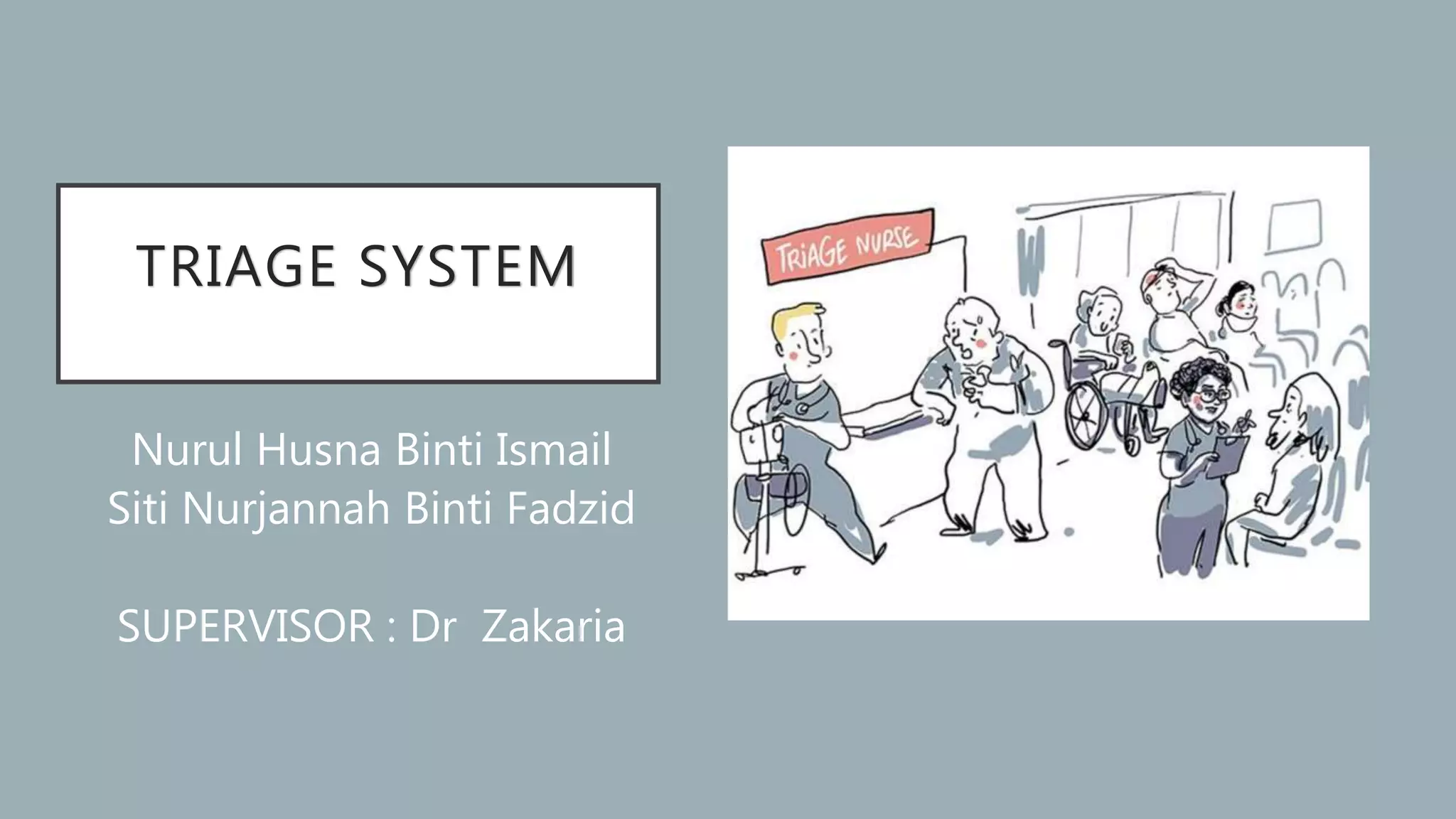
TRIAGE SYSTEM
Nurul Husna Binti Ismail
Siti Nurjannah Binti Fadzid
SUPERVISOR : Dr Zakaria
OUTLINE
Introduction
Primary and Secondary triage
Field triage
TRIAGE SERVICE SYSTEM
•Triage is derived from the French word “trier” which refers to the
categorization, classification, and prioritization of patients and
injured people, based on their urgent need for treatment
•The triaging services counter is the first point of contact for all
patients accessing the Emergency and Trauma Department (ETD)
•All patients presenting to the ETD shall be triaged on arrival by a
trained and experienced triageur(s)
TRIAGE OBJECTIVES
•Identify patient who need immediate care and
treatment
•Perform a brief assessment of all incoming patients
•Assign an appropriate acuity level
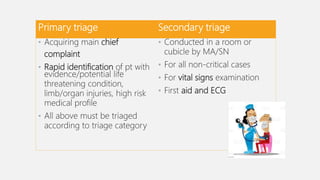
Primary triage Secondary triage
• Acquiring main chief
complaint
• Rapid identification of pt with
evidence/potential life
threatening condition,
limb/organ injuries, high risk
medical profile
• All above must be triaged
according to triage category
• Conducted in a room or
cubicle by MA/SN
• For all non-critical cases
• For vital signs examination
• First aid and ECG
FIELD TRIAGE
TRIAGE
HOSPITAL TRIAGE
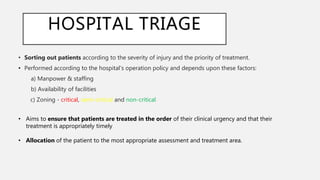
HOSPITAL TRIAGE
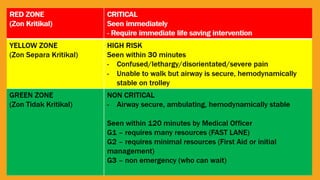
• Sorting out patients according to the severity of injury and the priority of treatment.
• Performed according to the hospital’s operation policy and depends upon these factors:
a) Manpower & staffing
b) Availability of facilities
c) Zoning - critical, semi-critical and non-critical
• Aims to ensure that patients are treated in the order of their clinical urgency and that their
treatment is appropriately timely
• Allocation of the patient to the most appropriate assessment and treatment area.
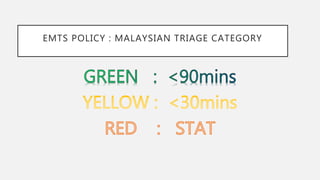
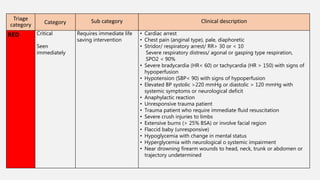
EMTS POLICY : MALAYSIAN TRIAGE CATEGORY
Triage
category Category Sub category Clinical description
RED Critical
Seen
immediately
Requires immediate life
saving intervention
• Cardiac arrest
• Chest pain (anginal type), pale, diaphoretic
• Stridor/ respiratory arrest/ RR> 30 or < 10
Severe respiratory distress/ agonal or gasping type respiration,
SPO2 < 90%
• Severe bradycardia (HR< 60) or tachycardia (HR > 150) with signs of
hypoperfusion
• Hypotension (SBP< 90) with signs of hypoperfusion
• Elevated BP systolic >220 mmHg or diastolic > 120 mmHg with
systemic symptoms or neurological deficit
• Anaphylactic reaction
• Unresponsive trauma patient
• Trauma patient who require immediate fluid resuscitation
• Severe crush injuries to limbs
• Extensive burns (> 25% BSA) or involve facial region
• Flaccid baby (unresponsive)
• Hypoglycemia with change in mental status
• Hyperglycemia with neurological o systemic impairment
• Near drowning firearm wounds to head, neck, trunk or abdomen or
trajectory undetermined
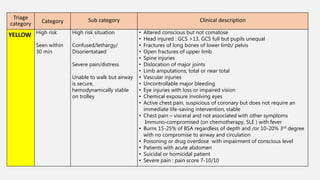
Triage
category Category Sub category Clinical description
YELLOW High risk
Seen within
30 min
High risk situation
Confused/lethargy/
Disorientataed
Severe pain/distress
Unable to walk but airway
is secure,
hemodynamically stable
on trolley
• Altered conscious but not comatose
• Head injured : GCS >13, GCS full but pupils unequal
• Fractures of long bones of lower limb/ pelvis
• Open fractures of upper limb
• Spine injuries
• Dislocation of major joints
• Limb amputations; total or near total
• Vascular injuries
• Uncontrollable major bleeding
• Eye injuries with loss or impaired vision
• Chemical exposure involving eyes
• Active chest pain, suspicious of coronary but does not require an
immediate life-saving intervention, stable
• Chest pain – visceral and not associated with other symptoms
Immuno-compromised (on chemotherapy, SLE ) with fever
• Burns 15-25% of BSA regardless of depth and /or 10-20% 3rd degree
with no compromise to airway and circulation
• Poisoning or drug overdose with impairment of conscious level
• Patients with acute abdomen
• Suicidal or homicidal patient
• Severe pain : pain score 7-10/10
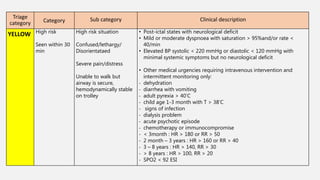
Triage
category Category Sub category Clinical description
YELLOW High risk
Seen within 30
min
High risk situation
Confused/lethargy/
Disorientataed
Severe pain/distress
Unable to walk but
airway is secure,
hemodynamically stable
on trolley
• Post-ictal states with neurological deficit
• Mild or moderate dyspnoea with saturation > 95%and/or rate <
40/min
• Elevated BP systolic < 220 mmHg or diastolic < 120 mmHg with
minimal systemic symptoms but no neurological deficit
• Other medical urgencies requiring intravenous intervention and
intermittent monitoring only:
- dehydration
- diarrhea with vomiting
- adult pyrexia > 40’C
- child age 1-3 month with T > 38’C
- signs of infection
- dialysis problem
- acute psychotic episode
- chemotherapy or immunocompromise
- < 3month : HR > 180 or RR > 50
- 2 month – 3 years : HR > 160 or RR > 40
- 3 – 8 years : HR > 140, RR > 30
- > 8 years : HR > 100, RR > 20
- SPO2 < 92 ESI
Triage
category
Response Description of category Clinical description
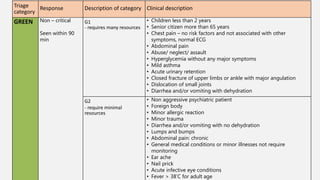
GREEN Non – critical
Seen within 90
min
G1
- requires many resources
• Children less than 2 years
• Senior citizen more than 65 years
• Chest pain – no risk factors and not associated with other
symptoms, normal ECG
• Abdominal pain
• Abuse/ neglect/ assault
• Hyperglycemia without any major symptoms
• Mild asthma
• Acute urinary retention
• Closed fracture of upper limbs or ankle with major angulation
• Dislocation of small joints
• Diarrhea and/or vomiting with dehydration
G2
- require minimal
resources
• Non aggressive psychiatric patient
• Foreign body
• Minor allergic reaction
• Minor trauma
• Diarrhea and/or vomiting with no dehydration
• Lumps and bumps
• Abdominal pain: chronic
• General medical conditions or minor illnesses not require
monitoring
• Ear ache
• Nail prick
• Acute infective eye conditions
• Fever > 38’C for adult age
Triage
category
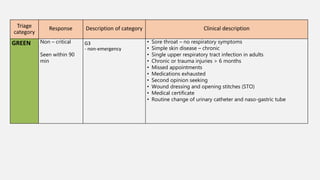
Response Description of category Clinical description
GREEN Non – critical
Seen within 90
min
G3
- non-emergency
• Sore throat – no respiratory symptoms
• Simple skin disease – chronic
• Single upper respiratory tract infection in adults
• Chronic or trauma injuries > 6 months
• Missed appointments
• Medications exhausted
• Second opinion seeking
• Wound dressing and opening stitches (STO)
• Medical certificate
• Routine change of urinary catheter and naso-gastric tube
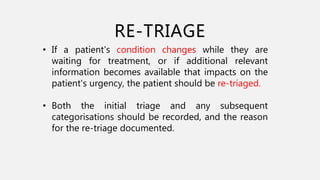
• If a patient's condition changes while they are
waiting for treatment, or if additional relevant
information becomes available that impacts on the
patient's urgency, the patient should be re-triaged.
• Both the initial triage and any subsequent
categorisations should be recorded, and the reason
for the re-triage documented.
RE-TRIAGE
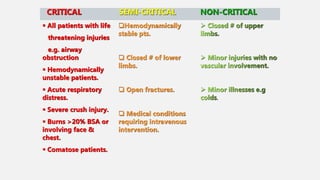
CRITICAL SEMI-CRITICAL NON-CRITICAL
 All patients with life
threatening injuries
e.g. airway
obstruction
 Hemodynamically
unstable patients.
 Acute respiratory
distress.
 Severe crush injury.
 Burns >20% BSA or
involving face &
chest.
 Comatose patients.
Hemodynamically
stable pts.
 Closed # of lower
limbs.
 Open fractures.
 Medical conditions
requiring intravenous
intervention.
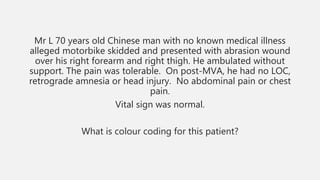
Mr L 70 years old Chinese man with no known medical illness
alleged motorbike skidded and presented with abrasion wound
over his right forearm and right thigh. He ambulated without
support. The pain was tolerable. On post-MVA, he had no LOC,
retrograde amnesia or head injury. No abdominal pain or chest
pain.
Vital sign was normal.
What is colour coding for this patient?
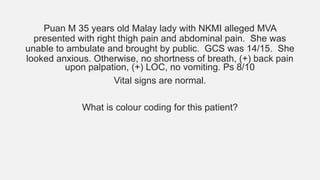
Puan M 35 years old Malay lady with NKMI alleged MVA
presented with right thigh pain and abdominal pain. She was
unable to ambulate and brought by public. GCS was 14/15. She
looked anxious. Otherwise, no shortness of breath, (+) back pain
upon palpation, (+) LOC, no vomiting. Ps 8/10
Vital signs are normal.
What is colour coding for this patient?
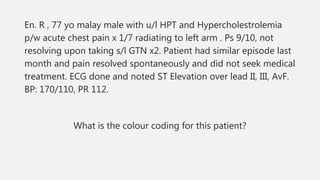
En. R , 77 yo malay male with u/l HPT and Hypercholestrolemia
p/w acute chest pain x 1/7 radiating to left arm . Ps 9/10, not
resolving upon taking s/l GTN x2. Patient had similar episode last
month and pain resolved spontaneously and did not seek medical
treatment. ECG done and noted ST Elevation over lead II, III, AvF.
BP: 170/110, PR 112.
What is the colour coding for this patient?
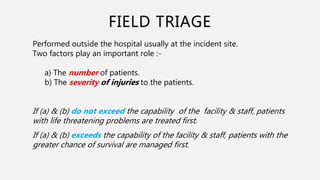
Performed outside the hospital usually at the incident site.
Two factors play an important role :-
a) The number of patients.
b) The severity of injuries to the patients.
If (a) & (b) do not exceed the capability of the facility & staff, patients
with life threatening problems are treated first.
If (a) & (b) exceeds the capability of the facility & staff, patients with the
greater chance of survival are managed first.
FIELD TRIAGE
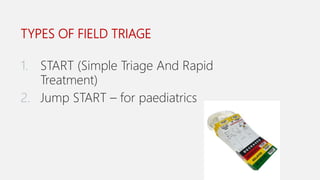
TYPES OF FIELD TRIAGE
1. START (Simple Triage And Rapid
Treatment)
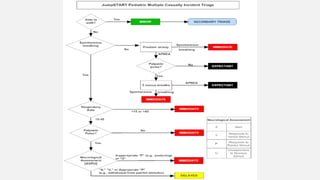
2. Jump START – for paediatrics
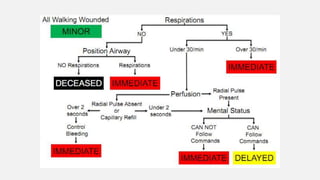
START
Done in <15 seconds
Triage categories:
Green (ambulatory)
Yellow (delayed)
Red (immediate)
Black (deceased / non salvageable)
Components of assessment : ARPM
Ambulation
Respiration
Perfusion
Mental status
JUMPSTART
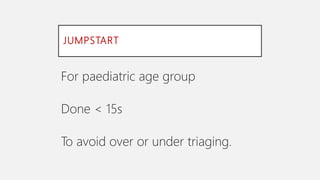
For paediatric age group
Done < 15s
To avoid over or under triaging.
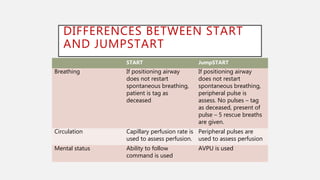
DIFFERENCES BETWEEN START
AND JUMPSTART
START JumpSTART
Breathing If positioning airway
does not restart
spontaneous breathing,
patient is tag as
deceased
If positioning airway
does not restart
spontaneous breathing,
peripheral pulse is
assess. No pulses – tag
as deceased, present of
pulse – 5 rescue breaths
are given.
Circulation Capillary perfusion rate is
used to assess perfusion.
Peripheral pulses are
used to assess perfusion
Mental status Ability to follow
command is used
AVPU is used
REFERENCES
• Emergency Medicine & Trauma Services Policy (EMTS)
• Hospital Triage
THANK YOU!

cme triage ED.pptx

  • 1.
    TRIAGE SYSTEM Nurul HusnaBinti Ismail Siti Nurjannah Binti Fadzid SUPERVISOR : Dr Zakaria
  • 2.
  • 3.
    TRIAGE SERVICE SYSTEM •Triageis derived from the French word “trier” which refers to the categorization, classification, and prioritization of patients and injured people, based on their urgent need for treatment •The triaging services counter is the first point of contact for all patients accessing the Emergency and Trauma Department (ETD) •All patients presenting to the ETD shall be triaged on arrival by a trained and experienced triageur(s)
  • 4.
    TRIAGE OBJECTIVES •Identify patientwho need immediate care and treatment •Perform a brief assessment of all incoming patients •Assign an appropriate acuity level
  • 5.
    Primary triage Secondarytriage • Acquiring main chief complaint • Rapid identification of pt with evidence/potential life threatening condition, limb/organ injuries, high risk medical profile • All above must be triaged according to triage category • Conducted in a room or cubicle by MA/SN • For all non-critical cases • For vital signs examination • First aid and ECG
  • 6.
  • 7.
    HOSPITAL TRIAGE • Sortingout patients according to the severity of injury and the priority of treatment. • Performed according to the hospital’s operation policy and depends upon these factors: a) Manpower & staffing b) Availability of facilities c) Zoning - critical, semi-critical and non-critical • Aims to ensure that patients are treated in the order of their clinical urgency and that their treatment is appropriately timely • Allocation of the patient to the most appropriate assessment and treatment area.
  • 8.
    EMTS POLICY :MALAYSIAN TRIAGE CATEGORY
  • 10.
    Triage category Category Subcategory Clinical description RED Critical Seen immediately Requires immediate life saving intervention • Cardiac arrest • Chest pain (anginal type), pale, diaphoretic • Stridor/ respiratory arrest/ RR> 30 or < 10 Severe respiratory distress/ agonal or gasping type respiration, SPO2 < 90% • Severe bradycardia (HR< 60) or tachycardia (HR > 150) with signs of hypoperfusion • Hypotension (SBP< 90) with signs of hypoperfusion • Elevated BP systolic >220 mmHg or diastolic > 120 mmHg with systemic symptoms or neurological deficit • Anaphylactic reaction • Unresponsive trauma patient • Trauma patient who require immediate fluid resuscitation • Severe crush injuries to limbs • Extensive burns (> 25% BSA) or involve facial region • Flaccid baby (unresponsive) • Hypoglycemia with change in mental status • Hyperglycemia with neurological o systemic impairment • Near drowning firearm wounds to head, neck, trunk or abdomen or trajectory undetermined
  • 11.
    Triage category Category Subcategory Clinical description YELLOW High risk Seen within 30 min High risk situation Confused/lethargy/ Disorientataed Severe pain/distress Unable to walk but airway is secure, hemodynamically stable on trolley • Altered conscious but not comatose • Head injured : GCS >13, GCS full but pupils unequal • Fractures of long bones of lower limb/ pelvis • Open fractures of upper limb • Spine injuries • Dislocation of major joints • Limb amputations; total or near total • Vascular injuries • Uncontrollable major bleeding • Eye injuries with loss or impaired vision • Chemical exposure involving eyes • Active chest pain, suspicious of coronary but does not require an immediate life-saving intervention, stable • Chest pain – visceral and not associated with other symptoms Immuno-compromised (on chemotherapy, SLE ) with fever • Burns 15-25% of BSA regardless of depth and /or 10-20% 3rd degree with no compromise to airway and circulation • Poisoning or drug overdose with impairment of conscious level • Patients with acute abdomen • Suicidal or homicidal patient • Severe pain : pain score 7-10/10
  • 12.
    Triage category Category Subcategory Clinical description YELLOW High risk Seen within 30 min High risk situation Confused/lethargy/ Disorientataed Severe pain/distress Unable to walk but airway is secure, hemodynamically stable on trolley • Post-ictal states with neurological deficit • Mild or moderate dyspnoea with saturation > 95%and/or rate < 40/min • Elevated BP systolic < 220 mmHg or diastolic < 120 mmHg with minimal systemic symptoms but no neurological deficit • Other medical urgencies requiring intravenous intervention and intermittent monitoring only: - dehydration - diarrhea with vomiting - adult pyrexia > 40’C - child age 1-3 month with T > 38’C - signs of infection - dialysis problem - acute psychotic episode - chemotherapy or immunocompromise - < 3month : HR > 180 or RR > 50 - 2 month – 3 years : HR > 160 or RR > 40 - 3 – 8 years : HR > 140, RR > 30 - > 8 years : HR > 100, RR > 20 - SPO2 < 92 ESI
  • 13.
    Triage category Response Description ofcategory Clinical description GREEN Non – critical Seen within 90 min G1 - requires many resources • Children less than 2 years • Senior citizen more than 65 years • Chest pain – no risk factors and not associated with other symptoms, normal ECG • Abdominal pain • Abuse/ neglect/ assault • Hyperglycemia without any major symptoms • Mild asthma • Acute urinary retention • Closed fracture of upper limbs or ankle with major angulation • Dislocation of small joints • Diarrhea and/or vomiting with dehydration G2 - require minimal resources • Non aggressive psychiatric patient • Foreign body • Minor allergic reaction • Minor trauma • Diarrhea and/or vomiting with no dehydration • Lumps and bumps • Abdominal pain: chronic • General medical conditions or minor illnesses not require monitoring • Ear ache • Nail prick • Acute infective eye conditions • Fever > 38’C for adult age
  • 14.
    Triage category Response Description ofcategory Clinical description GREEN Non – critical Seen within 90 min G3 - non-emergency • Sore throat – no respiratory symptoms • Simple skin disease – chronic • Single upper respiratory tract infection in adults • Chronic or trauma injuries > 6 months • Missed appointments • Medications exhausted • Second opinion seeking • Wound dressing and opening stitches (STO) • Medical certificate • Routine change of urinary catheter and naso-gastric tube
  • 15.
    • If apatient's condition changes while they are waiting for treatment, or if additional relevant information becomes available that impacts on the patient's urgency, the patient should be re-triaged. • Both the initial triage and any subsequent categorisations should be recorded, and the reason for the re-triage documented. RE-TRIAGE
  • 16.
    CRITICAL SEMI-CRITICAL NON-CRITICAL All patients with life threatening injuries e.g. airway obstruction  Hemodynamically unstable patients.  Acute respiratory distress.  Severe crush injury.  Burns >20% BSA or involving face & chest.  Comatose patients. Hemodynamically stable pts.  Closed # of lower limbs.  Open fractures.  Medical conditions requiring intravenous intervention.
  • 17.
    Mr L 70years old Chinese man with no known medical illness alleged motorbike skidded and presented with abrasion wound over his right forearm and right thigh. He ambulated without support. The pain was tolerable. On post-MVA, he had no LOC, retrograde amnesia or head injury. No abdominal pain or chest pain. Vital sign was normal. What is colour coding for this patient?
  • 18.
    Puan M 35years old Malay lady with NKMI alleged MVA presented with right thigh pain and abdominal pain. She was unable to ambulate and brought by public. GCS was 14/15. She looked anxious. Otherwise, no shortness of breath, (+) back pain upon palpation, (+) LOC, no vomiting. Ps 8/10 Vital signs are normal. What is colour coding for this patient?
  • 19.
    En. R ,77 yo malay male with u/l HPT and Hypercholestrolemia p/w acute chest pain x 1/7 radiating to left arm . Ps 9/10, not resolving upon taking s/l GTN x2. Patient had similar episode last month and pain resolved spontaneously and did not seek medical treatment. ECG done and noted ST Elevation over lead II, III, AvF. BP: 170/110, PR 112. What is the colour coding for this patient?
  • 20.
    Performed outside thehospital usually at the incident site. Two factors play an important role :- a) The number of patients. b) The severity of injuries to the patients. If (a) & (b) do not exceed the capability of the facility & staff, patients with life threatening problems are treated first. If (a) & (b) exceeds the capability of the facility & staff, patients with the greater chance of survival are managed first. FIELD TRIAGE
  • 21.
    TYPES OF FIELDTRIAGE 1. START (Simple Triage And Rapid Treatment) 2. Jump START – for paediatrics
  • 22.
    START Done in <15seconds Triage categories: Green (ambulatory) Yellow (delayed) Red (immediate) Black (deceased / non salvageable)
  • 23.
    Components of assessment: ARPM Ambulation Respiration Perfusion Mental status
  • 25.
    JUMPSTART For paediatric agegroup Done < 15s To avoid over or under triaging.
  • 27.
    DIFFERENCES BETWEEN START ANDJUMPSTART START JumpSTART Breathing If positioning airway does not restart spontaneous breathing, patient is tag as deceased If positioning airway does not restart spontaneous breathing, peripheral pulse is assess. No pulses – tag as deceased, present of pulse – 5 rescue breaths are given. Circulation Capillary perfusion rate is used to assess perfusion. Peripheral pulses are used to assess perfusion Mental status Ability to follow command is used AVPU is used
  • 28.
    REFERENCES • Emergency Medicine& Trauma Services Policy (EMTS) • Hospital Triage
  • 29.