MASS CASUALTY,
START TRIAGE AND
THE SMART TAG
SYSTEM
Objectives
• Define triage and mass casualty
• Review the dynamics of START triage
• Review use of the SMART tagging system
• Demonstrate competency in the START triage method in a
variety of scenarios
• Demonstrate competency in the SMART triage tag and
JumpStart.
What is a Mass Casualty Incident?
ANY event that overwhelms the available resources.
By available resources, this could mean that we don’t have enough
ambulances, enough personnel or enough hospital beds.
It could be:
Natural
Accidental or
Intentional event.
• Types of Common MCI’s
• Highway Accidents
• Air Crashes
• Major Fires
• Train Derailments
• Building Collapses
• Explosions
• Terrorist Attacks
• Hazardous Materials Releases
• Earthquakes Tornadoes Hurricanes Floods
WWYD - What Would You Do? If an explosion,
bombing or any event which created a large
number of injured and dying people happen
while you were on duty:
• What would you do to care for the injured?
• How would you sort the priority of treatment?
• How would you prioritize transport?
ANSWER:
You would use the
SMART Tag Triage
System
First, what is
Triage?
Triage is the process of
prioritizing or sorting of sick or
injured people for treatment
according to the seriousness of the
condition or injury.
Triage: Sorting of Patients
You can’t commit to “one-on-one” care
You have to be fast – 30 sec or less per patient
Very limited treatment is provide
Manually open airways
Clear airway with finger sweep
Control major bleeding
Primary and Secondary Triage
Primary triage
1st contact
Assign triage category
Secondary triage
ongoing process that takes place after the patient has been
moved to a treatment/holding area awaiting transport.
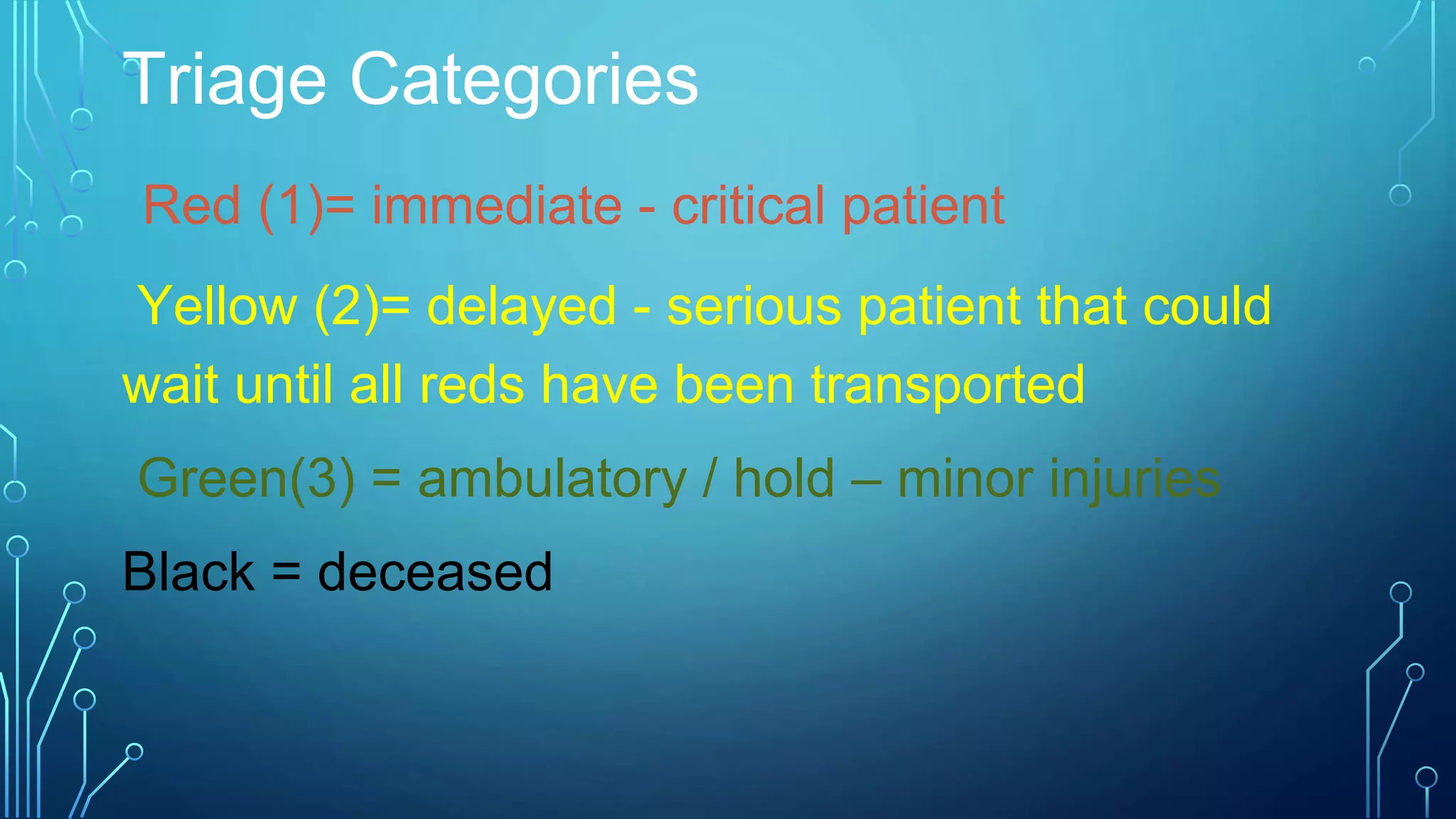
Triage Categories
Red (1)= immediate - critical patient
Yellow (2)= delayed - serious patient that could
wait until all reds have been transported
Green(3) = ambulatory / hold – minor injuries
Black = deceased
The “START” System of Triage
Simple triage and rapid treatment (START ) is a
triage method used by first responders to quickly
classify victims during a mass casualty incident
(MCI) based on the severity of their injury.
Simple Triage and Rapid Treatment
(START )
The method was developed in 1983 by the staff
members of the Newport Beach Fire Department
located at Hoag Memorial Hospital in Newport Beach,
CA
Easy to use
Focus is on signs/symptoms
Fast
In Applying “START” check for the following:
Ability to follow directions and walk
Respiratory effort
Pulses/perfusion
Mental status
The “START” System of Triage
Using START Triage, evaluate victims and assign
them to one of the following four categories:
Walking wounded/minor (green)
Delayed (yellow)
Immediate (red)
Deceased/expectant (black)
“START” Focus on tagging the patients
BEGIN… Clear out all ambulatory patients – tag Green
Rest of the patients require MORE triage – 3 steps:
They will be either red, yellow or black.
Respiratory effort
Pulses/perfusion
Mental status
The “Greens”
Once they walk toward you –
designate a place for them to go
Someone needs to tag them green
Someone needs to stay with them &
keep them informed
Something To Think About….
Keep in mind that in a larger scale event,
patients may be spread out over a large area or
even on several floors or rooms in a building.
In this type of situation, you may encounter
further ambulatory patients as you progress.
They are still tagged green – direct them to the
area that you selected for the “greens” to stage.
START – Step 1 Respiratory Effort
Not breathing – manually open their airway
If they start breathing - tag RED
If they don’t start breathing – tag BLACK
Breathing >30 or <10 = Tag RED
Breathing normal 10-30 = go to next step
START – Step 2 Pulses/Perfusion
Check for Radial pulse.
Radial pulse absent = tag RED
Radial pulse present = go to next
step
START – Step 3 Mental Status
You are assessing whether or not the person
can follow a simple command.
“Squeeze my hand”
Can follow a simple command = tag YELLOW
Cannot follow a simple command = tag RED
START – Step 3 Mental Status
You are assessing whether or not the person
can follow a simple command.
“Squeeze my hand”
Can follow a simple command = tag YELLOW
Cannot follow a simple command = tag RED
Pediatric Modifications for START =
JUMPSTART
Kids Are A Little Different
Expect children to be part of a
disaster
JumpStart – modified START for
kids
Pediatric Modifications - RPMs
Respiratory effort – not breathing
Open the airway
If the patient starts breathing tag RED
If apneic and no pulse tag BLACK
If apneic with pulse try 5 rescue breaths
If still apneic tag BLACK
If starts breathing tag RED
Respirations < 15 or > 45 tag RED
Respirations 15-45 go to next step (Pulse)
Pediatric START - RPMs
Pulse
No distal pulse – tag RED
Pulse present go to next step (Mental)
Mental status – use AVPU
Alert, responds to verbal or responds to pain = tag
YELLOW
Inappropriate response, posturing or unresponsive
tag RED
All Babies Under 1 Year Get
Secondary Triage (Meaning
No Greens!). Follow
JumpStart to Determine
Yellow or Red.
SMART TRIAGE TAG
A kit versus a group of tags
Larger, easier to see colors
Patient condition changes, tag changes
Larger area for documentation
Better Patient tracking system
Size Matters!
Smart tag has a larger colored area
Can be seen at night
Numbers and colors
-for the colorblind
Less chance of error
-no tear of section
Documentation area
Secondary triage/assessment/treatment
Now, let’s practice
what we have
learned…
Scenario#1
You are assigned the duty of triage
officer at a local factory where an
explosion has taken place due to a gas
leak. Utility workers have turned off
power and gas at this time and the
scene is safe. There are 435 workers at
the site and many were in the area of
the explosion.
Scenario#1
The following patients (#1 thru
#5) are involved in a worksite
explosion. Looking around, you
visualize 40 – 50 workers involved.
You begin the triage process…
Patient #1
You are assigned to triage at a factory where
an explosion has taken place. According to
the START Triage, when you assess pulses,
you would check:
A) Radial Pulses
B) Pedal Pulses
C) Femoral Pulses
D) Carotid Pulses
Patient #1
You are assigned to triage at a factory where
an explosion has taken place. According to
the START Triage, when you assess pulses,
you would check:
A) Radial Pulses
B) Pedal Pulses
C) Femoral Pulses
D) Carotid Pulses
Radial pulse: No palpable radial pulse was present in patients with a
systolic blood pressure of < 51 mmHg.
Femoral pulse: No palpable femoral pulse was present in patients with a
systolic blood pressure of < 47 mmHg.
Carotid pulse: No palpable carotid pulse was present in any patient with
a systolic blood pressure of < 37 mmHg.
Patient #2
You notice this patient is not breathing, you would
A) Tag Black and rapidly go to next patient
B) Tag Red, hopefully that he will begin to breath
shortly,
C) Don’t waste time with tagging process and proceed
to next patient.
D) Open the Airway, tag Red if he starts to breath.
Patient #3
The next patient is a 50 y/o welder with
partial amputation of RLE at the ankle. No
radial pulses are noted. RR 28/min.
A) Tag Black
B) Tag Red
C) Tag Yellow
D) Tag Green
B) Tag Red
NOTE: Breathing is good, but
absent of radial pulse confirms RED
Patient #4
The next patient is a 36 year old pipe fitter with
fracture of humerus. He is in pain, but no other
obvious distress or injury noted. He rates pain
of 8/10 when prompted. You would anticipate:
A) Tag Black
B) B) Tag Red
C) C) Tag Yellow
D) D) Tag Green
Patient #4
The next patient is a 36 year old pipe fitter with
fracture of humerus. He walks to you in pain,
but no other obvious distress or injury noted.
He rates pain of 8/10 when prompted. You
would anticipate:
A) Tag Black
B) B) Tag Red
C) C) Tag Yellow
D) D) Tag Green
D) Tag Green
NOTE: as long as he can walk, he
would be rated a green. If unable for
any reason, he would become a
YELLOW.
Patient #5
The next patient is a 42 y/o fabricator with
fracture of tib/fib with deformity. He is in severe
pain 10/10. RR 34, Radial pulse 120. You
would tag:
A) Tag Black
B) B) Tag Red
C) C) Tag Yellow
D) D) Tag Green
Tag Red
NOTE: RPM, Pulses are present,
able to answer questions, but RESP
are ok, but unable to walk.
Scenario #2
The next scenario also involves
multiple victims and you will triage 5
patients. A tornado hits a small
town and a day care with
approximately 25 children is
involved. You serve as the triage
officer and use the JUMPSTART
Patient #1
You first patient is 2 year old who was thrown
from the building. He is unresponsive with a
hematoma to the forhead. RR 34, Radial pulse
120. You would tag:
A)Tag Black
B) Tag Red
C) Tag Yellow
D) Tag Green
As you begin to assess a 9 month old,
you remember patients less that one
year old are not tagged:
A) Black
B) Red
C) Yellow
D) Green
Green
NOTE: due to low body mass,
injuries are frequent and/or serious.
Therefore, we do not use the green
tag on infants
(<1 y/o)
Patient #3
You third patient is 2 year old who was trapped
under building debris. He is unresponsive, no
pulse and not breathing. You would:
A) Tag Black
B) B) Preform CPR at 15:2 rate
C) C) Provide 10 rescue breaths
D) D) Provide 5 rescue breaths
Provide 5 rescue breaths
NOTE: Unlike adults, you may
provide rescue breaths to pediatrics
in hopes that they begin to breath.
Patient #4
After 5 rescue breaths, a 4 year old who was
trapped under the building debris takes 2
breaths, but quickly becomes apneic and
pulseless. You would:
A) TAG Black
B) B) Tag Red
C) C) Tag Yellow
D) D) Again, give 5 rescue breaths
Patient #5
A 6 y/o was found in a back bedroom. He
is semiconscious. RR are 10/min. Pulses
are present. According to JumpStart, you
would:
A) TAG Black
B) Tag Red
C) Tag Yellow
D) Tag Green
Tag Red
Using RPMs, Respirations are too
slow. Also, level of consciousness
would be a concern.
A young school aged boy is found lying
on the roadway 10 ft from the bus.
Breathing 10/min
Good distal pulse
Groans to painful stimuli
Would you TAG GREEN, RED,
YELLOW or BLACK ?
An adult kneels at the side of the road,
shaking his head. He says he’s too
dizzy to walk.
RR 20
CR 2 sec
Obeys commands
Would you TAG GREEN, RED,
YELLOW or BLACK ?
A school aged girl crawls out of the
wreckage. She’s able to stand and walk
toward you crying.
Jacket and shirt torn
No obvious bleeding
Would you TAG GREEN, RED,
YELLOW or BLACK ?
A toddler lies with his lower body
trapped under a seat inside the bus.
Apneic
Remains apneic with modified jaw
thrust
No pulse
Would you TAG GREEN, RED,
YELLOW or BLACK ?
A toddler lies with his lower body
trapped under a seat inside the bus.
Apneic
Remains apneic with modified jaw
thrust
No pulse
Would you TAG GREEN, RED,
YELLOW or BLACK ?

Smart tagging.pptx

  • 1.
    MASS CASUALTY, START TRIAGEAND THE SMART TAG SYSTEM
  • 2.
    Objectives • Define triageand mass casualty • Review the dynamics of START triage • Review use of the SMART tagging system • Demonstrate competency in the START triage method in a variety of scenarios • Demonstrate competency in the SMART triage tag and JumpStart.
  • 3.
    What is aMass Casualty Incident? ANY event that overwhelms the available resources. By available resources, this could mean that we don’t have enough ambulances, enough personnel or enough hospital beds. It could be: Natural Accidental or Intentional event.
  • 4.
    • Types ofCommon MCI’s • Highway Accidents • Air Crashes • Major Fires • Train Derailments • Building Collapses • Explosions • Terrorist Attacks • Hazardous Materials Releases • Earthquakes Tornadoes Hurricanes Floods
  • 5.
    WWYD - WhatWould You Do? If an explosion, bombing or any event which created a large number of injured and dying people happen while you were on duty: • What would you do to care for the injured? • How would you sort the priority of treatment? • How would you prioritize transport?
  • 6.
    ANSWER: You would usethe SMART Tag Triage System
  • 7.
  • 8.
    Triage is theprocess of prioritizing or sorting of sick or injured people for treatment according to the seriousness of the condition or injury.
  • 9.
    Triage: Sorting ofPatients You can’t commit to “one-on-one” care You have to be fast – 30 sec or less per patient Very limited treatment is provide Manually open airways Clear airway with finger sweep Control major bleeding
  • 10.
    Primary and SecondaryTriage Primary triage 1st contact Assign triage category Secondary triage ongoing process that takes place after the patient has been moved to a treatment/holding area awaiting transport.
  • 11.
    Triage Categories Red (1)=immediate - critical patient Yellow (2)= delayed - serious patient that could wait until all reds have been transported Green(3) = ambulatory / hold – minor injuries Black = deceased
  • 12.
    The “START” Systemof Triage Simple triage and rapid treatment (START ) is a triage method used by first responders to quickly classify victims during a mass casualty incident (MCI) based on the severity of their injury.
  • 13.
    Simple Triage andRapid Treatment (START ) The method was developed in 1983 by the staff members of the Newport Beach Fire Department located at Hoag Memorial Hospital in Newport Beach, CA Easy to use Focus is on signs/symptoms Fast
  • 15.
    In Applying “START”check for the following: Ability to follow directions and walk Respiratory effort Pulses/perfusion Mental status
  • 16.
    The “START” Systemof Triage Using START Triage, evaluate victims and assign them to one of the following four categories: Walking wounded/minor (green) Delayed (yellow) Immediate (red) Deceased/expectant (black)
  • 17.
    “START” Focus ontagging the patients BEGIN… Clear out all ambulatory patients – tag Green Rest of the patients require MORE triage – 3 steps: They will be either red, yellow or black. Respiratory effort Pulses/perfusion Mental status
  • 18.
    The “Greens” Once theywalk toward you – designate a place for them to go Someone needs to tag them green Someone needs to stay with them & keep them informed
  • 19.
    Something To ThinkAbout…. Keep in mind that in a larger scale event, patients may be spread out over a large area or even on several floors or rooms in a building. In this type of situation, you may encounter further ambulatory patients as you progress. They are still tagged green – direct them to the area that you selected for the “greens” to stage.
  • 20.
    START – Step1 Respiratory Effort Not breathing – manually open their airway If they start breathing - tag RED If they don’t start breathing – tag BLACK Breathing >30 or <10 = Tag RED Breathing normal 10-30 = go to next step
  • 21.
    START – Step2 Pulses/Perfusion Check for Radial pulse. Radial pulse absent = tag RED Radial pulse present = go to next step
  • 22.
    START – Step3 Mental Status You are assessing whether or not the person can follow a simple command. “Squeeze my hand” Can follow a simple command = tag YELLOW Cannot follow a simple command = tag RED
  • 23.
    START – Step3 Mental Status You are assessing whether or not the person can follow a simple command. “Squeeze my hand” Can follow a simple command = tag YELLOW Cannot follow a simple command = tag RED
  • 24.
    Pediatric Modifications forSTART = JUMPSTART Kids Are A Little Different Expect children to be part of a disaster JumpStart – modified START for kids
  • 25.
    Pediatric Modifications -RPMs Respiratory effort – not breathing Open the airway If the patient starts breathing tag RED If apneic and no pulse tag BLACK If apneic with pulse try 5 rescue breaths If still apneic tag BLACK If starts breathing tag RED Respirations < 15 or > 45 tag RED Respirations 15-45 go to next step (Pulse)
  • 26.
    Pediatric START -RPMs Pulse No distal pulse – tag RED Pulse present go to next step (Mental) Mental status – use AVPU Alert, responds to verbal or responds to pain = tag YELLOW Inappropriate response, posturing or unresponsive tag RED
  • 27.
    All Babies Under1 Year Get Secondary Triage (Meaning No Greens!). Follow JumpStart to Determine Yellow or Red.
  • 28.
    SMART TRIAGE TAG Akit versus a group of tags Larger, easier to see colors Patient condition changes, tag changes Larger area for documentation Better Patient tracking system
  • 29.
  • 30.
    Smart tag hasa larger colored area Can be seen at night Numbers and colors -for the colorblind Less chance of error -no tear of section Documentation area Secondary triage/assessment/treatment
  • 31.
    Now, let’s practice whatwe have learned…
  • 32.
    Scenario#1 You are assignedthe duty of triage officer at a local factory where an explosion has taken place due to a gas leak. Utility workers have turned off power and gas at this time and the scene is safe. There are 435 workers at the site and many were in the area of the explosion.
  • 33.
    Scenario#1 The following patients(#1 thru #5) are involved in a worksite explosion. Looking around, you visualize 40 – 50 workers involved. You begin the triage process…
  • 34.
    Patient #1 You areassigned to triage at a factory where an explosion has taken place. According to the START Triage, when you assess pulses, you would check: A) Radial Pulses B) Pedal Pulses C) Femoral Pulses D) Carotid Pulses
  • 35.
    Patient #1 You areassigned to triage at a factory where an explosion has taken place. According to the START Triage, when you assess pulses, you would check: A) Radial Pulses B) Pedal Pulses C) Femoral Pulses D) Carotid Pulses
  • 36.
    Radial pulse: Nopalpable radial pulse was present in patients with a systolic blood pressure of < 51 mmHg. Femoral pulse: No palpable femoral pulse was present in patients with a systolic blood pressure of < 47 mmHg. Carotid pulse: No palpable carotid pulse was present in any patient with a systolic blood pressure of < 37 mmHg.
  • 37.
    Patient #2 You noticethis patient is not breathing, you would A) Tag Black and rapidly go to next patient B) Tag Red, hopefully that he will begin to breath shortly, C) Don’t waste time with tagging process and proceed to next patient. D) Open the Airway, tag Red if he starts to breath.
  • 38.
    Patient #3 The nextpatient is a 50 y/o welder with partial amputation of RLE at the ankle. No radial pulses are noted. RR 28/min. A) Tag Black B) Tag Red C) Tag Yellow D) Tag Green
  • 39.
    B) Tag Red NOTE:Breathing is good, but absent of radial pulse confirms RED
  • 40.
    Patient #4 The nextpatient is a 36 year old pipe fitter with fracture of humerus. He is in pain, but no other obvious distress or injury noted. He rates pain of 8/10 when prompted. You would anticipate: A) Tag Black B) B) Tag Red C) C) Tag Yellow D) D) Tag Green
  • 41.
    Patient #4 The nextpatient is a 36 year old pipe fitter with fracture of humerus. He walks to you in pain, but no other obvious distress or injury noted. He rates pain of 8/10 when prompted. You would anticipate: A) Tag Black B) B) Tag Red C) C) Tag Yellow D) D) Tag Green
  • 42.
    D) Tag Green NOTE:as long as he can walk, he would be rated a green. If unable for any reason, he would become a YELLOW.
  • 43.
    Patient #5 The nextpatient is a 42 y/o fabricator with fracture of tib/fib with deformity. He is in severe pain 10/10. RR 34, Radial pulse 120. You would tag: A) Tag Black B) B) Tag Red C) C) Tag Yellow D) D) Tag Green
  • 44.
    Tag Red NOTE: RPM,Pulses are present, able to answer questions, but RESP are ok, but unable to walk.
  • 45.
    Scenario #2 The nextscenario also involves multiple victims and you will triage 5 patients. A tornado hits a small town and a day care with approximately 25 children is involved. You serve as the triage officer and use the JUMPSTART
  • 46.
    Patient #1 You firstpatient is 2 year old who was thrown from the building. He is unresponsive with a hematoma to the forhead. RR 34, Radial pulse 120. You would tag: A)Tag Black B) Tag Red C) Tag Yellow D) Tag Green
  • 47.
    As you beginto assess a 9 month old, you remember patients less that one year old are not tagged: A) Black B) Red C) Yellow D) Green
  • 48.
    Green NOTE: due tolow body mass, injuries are frequent and/or serious. Therefore, we do not use the green tag on infants (<1 y/o)
  • 49.
    Patient #3 You thirdpatient is 2 year old who was trapped under building debris. He is unresponsive, no pulse and not breathing. You would: A) Tag Black B) B) Preform CPR at 15:2 rate C) C) Provide 10 rescue breaths D) D) Provide 5 rescue breaths
  • 50.
    Provide 5 rescuebreaths NOTE: Unlike adults, you may provide rescue breaths to pediatrics in hopes that they begin to breath.
  • 51.
    Patient #4 After 5rescue breaths, a 4 year old who was trapped under the building debris takes 2 breaths, but quickly becomes apneic and pulseless. You would: A) TAG Black B) B) Tag Red C) C) Tag Yellow D) D) Again, give 5 rescue breaths
  • 52.
    Patient #5 A 6y/o was found in a back bedroom. He is semiconscious. RR are 10/min. Pulses are present. According to JumpStart, you would: A) TAG Black B) Tag Red C) Tag Yellow D) Tag Green
  • 53.
    Tag Red Using RPMs,Respirations are too slow. Also, level of consciousness would be a concern.
  • 54.
    A young schoolaged boy is found lying on the roadway 10 ft from the bus. Breathing 10/min Good distal pulse Groans to painful stimuli Would you TAG GREEN, RED, YELLOW or BLACK ?
  • 55.
    An adult kneelsat the side of the road, shaking his head. He says he’s too dizzy to walk. RR 20 CR 2 sec Obeys commands Would you TAG GREEN, RED, YELLOW or BLACK ?
  • 56.
    A school agedgirl crawls out of the wreckage. She’s able to stand and walk toward you crying. Jacket and shirt torn No obvious bleeding Would you TAG GREEN, RED, YELLOW or BLACK ?
  • 57.
    A toddler lieswith his lower body trapped under a seat inside the bus. Apneic Remains apneic with modified jaw thrust No pulse Would you TAG GREEN, RED, YELLOW or BLACK ?
  • 58.
    A toddler lieswith his lower body trapped under a seat inside the bus. Apneic Remains apneic with modified jaw thrust No pulse Would you TAG GREEN, RED, YELLOW or BLACK ?