MALAYSIAN TRIAGE
CATEGORY(MTC)
MOHAMMAD FIRDAUS ISKANDAR BIN MOHAMMAD ILIAS
OBJEKTIF
• Am
-memahami peranan Penolong Pegawai Perubatan semasa melakukan
“triage”
• Khursus
-mengenalpasti jenis-jenis “triage”
-boleh menentukan zon yang bersesuaian dengan keadaan penyakit
pesakit
-dapat mengamalkan dan mempraktikkan “triage” mengikut jenis-jenis
yang dinyatakan
PENDAHULUAN
• Definasi
• “Triage” berasal dari bahasa Perancis iaitu “trier” yang membawa maksud
menapis atau menyusun
• Cara ini digunakan untuk menilai kecederaan dan kesakitan pesakit dalam
masa yang singkat untuk menetapkan priorities serta zon yang bersesuian
untuk mendapatkan rawatan
SITUASI DI JAB. KECEMASAN
• Jumlah kemasukan ke jabatan kecemasan tidak boleh diramalkan
dengan tepat
• Hanya sebahagian tertentu daripada pesakit yang mempunyai
masalah kesihatan membahayakan nyawa atau yang memerlukan
perubatan segera
• Pesakit life-threatening injuries perlu dikenalpasti serta merta
• Overcrowding
• Permintaan untuk rawatan perubatan melebihi limitasi jabatan
Triage in Emergency Department
• Designed to identify the most urgent (or potentially most serious) cases.
• To ensure that they receive priority treatment, followed by the less urgent
cases.
• First-come, first-served basis
• Triage officers routinely assess all patients who present for treatment
to sort and prioritize them.
KLASIFIKASI TRIAGE
• Proactive
• Static
• Secondary
• Surveillance
• Definitive
Art of Triage
• Complex and dynamic process
• Mendapatkan maklumat yang berkaitan dalam masa yang singkat
• Keputusan dibuat dalam keadaan informasi yang limited
• Keputusan dibuat berdasarkan garis panduan yang sedia ada serta
menilai keadaan pesakit
Roles of Triage Officer
• Menentukan zon pesakit berdasarkan assessment terhadap pesakit
• First aid, analgesia.
• Berhubung dengan paramedic dan profession kesihatan yang lain
• Escort patient
• Pass over relevant information
• Provide patient and public education where necessary
• Documentation
Process of Triage
• Main complaint and brief history
• Vital signs
• Physical findings seen, heard, felt or smelt
• Setting the priority status of the patient
• Decision whether treatment should be started at triage
SOAP System
Larry-Weed SOAP system
• S (Subjective) – main complaint and brief history
• O (Objective) – physical finding and vital signs
• A (Assessment) – setting of the priority status based on subjective
and objective finding
• P (Plan) – preliminary diagnostic and treatment
Malaysian Triage Category
• MTC diwujudkan untuk digunakan dalam perkhidmatan kecemasan di
seluruh hospital Malaysia.
• Merupakan skala untuk menilai urgency
• Merupakan tahap untuk menilai keberkesanan zon triage dengan
pesakit (inpatient length of stay, ICU admission, mortality rate) dan
resource consumption (staff time, cost).
• Memberikan analisis dan gambaran terhadap prestasi di dalam
jabatan kecemasan.
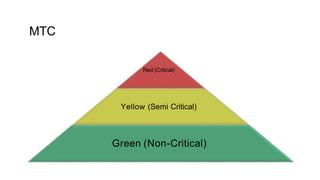
MTC
Red (Critical)
Yellow (Semi Critical)
Green (Non-Critical)
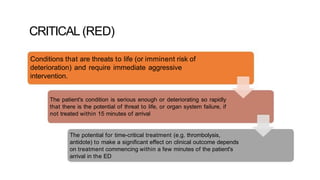
CRITICAL (RED)
Conditions that are threats to life (or imminent risk of
deterioration) and require immediate aggressive
intervention.
The patient's condition is serious enough or deteriorating so rapidly
that there is the potential of threat to life, or organ system failure, if
not treated within 15 minutes of arrival
The potential for time-critical treatment (e.g. thrombolysis,
antidote) to make a significant effect on clinical outcome depends
on treatment commencing within a few minutes of the patient's
arrival in the ED
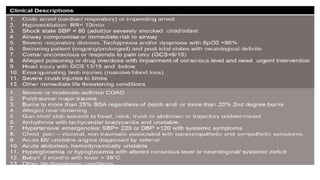
• Patients with life threatening injuries or illness which require
immediate attention.
• Assessment and treatment simultaneously within 5 minutes.
• Subcategories:
• R1 (immediate life-threatening)
• R2 (life-threatening)
Semi-Critical (YELLOW)
The patient's condition may progress to life or limb threatening,
or may lead to significant morbidity, if assessment and
treatment are not commenced within thirty minutes of arrival
There is potential for adverse outcome if time-critical treatment is
not commenced within thirty minutes
Human practice mandates the relief of severe discomfort or
distress
• Assessment and treatment starts within 30 minutes.
• Usual presentation:
• Unable to walk but airway is secure, hemodynamically stable and on
trolleys
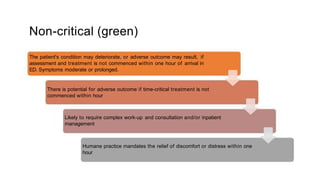
Non-critical (green)
The patient's condition may deteriorate, or adverse outcome may result, if
assessment and treatment is not commenced within one hour of arrival in
ED. Symptoms moderate or prolonged.
There is potential for adverse outcome if time-critical treatment is not
commenced within hour
Likely to require complex work-up and consultation and/or inpatient
management
Humane practice mandates the relief of discomfort or distress within one
hour
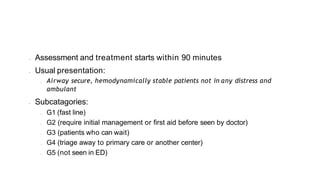
• Assessment and treatment starts within 90 minutes
• Usual presentation:
• Airway secure, hemodynamically stable patients not in any distress and
ambulant
• Subcatagories:
• G1 (fast line)
• G2 (require initial management or first aid before seen by doctor)
• G3 (patients who can wait)
• G4 (triage away to primary care or another center)
• G5 (not seen in ED)
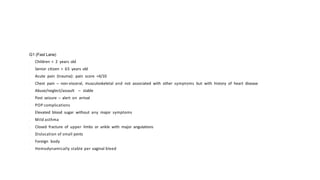
G1 (Fast Lane)
• Children < 2 years old
• Senior citizen > 65 years old
• Acute pain (trauma): pain score <4/10
• Chest pain – non-visceral, musculoskeletal and not associated with other symptoms but with history of heart disease
• Abuse/neglect/assault – stable
• Post seizure – alert on arrival
• POP complications
• Elevated blood sugar without any major symptoms
• Mild asthma
• Closed fracture of upper limbs or ankle with major angulations
• Dislocation of small joints
• Foreign body
• Hemodynamically stable per vaginal bleed
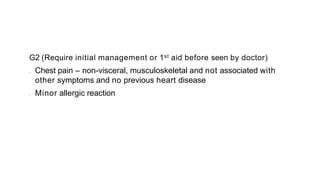
G2 (Require initial management or 1st aid before seen by doctor)
• Chest pain – non-visceral, musculoskeletal and not associated with
other symptoms and no previous heart disease
• Minor allergic reaction
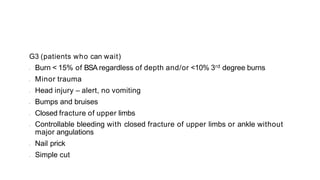
G3 (patients who can wait)
• Burn < 15% of BSA regardless of depth and/or <10% 3rd degree burns
• Minor trauma
• Head injury – alert, no vomiting
• Bumps and bruises
• Closed fracture of upper limbs
• Controllable bleeding with closed fracture of upper limbs or ankle without
major angulations
• Nail prick
• Simple cut
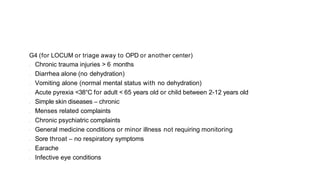
G4 (for LOCUM or triage away to OPD or another center)
•
•
• Chronic trauma injuries > 6 months
• Diarrhea alone (no dehydration)
• Vomiting alone (normal mental status with no dehydration)
Acute pyrexia <38°C for adult < 65 years old or child between 2-12 years old
• Simple skin diseases – chronic
• Menses related complaints
• Chronic psychiatric complaints
General medicine conditions or minor illness not requiring monitoring
• Sore throat – no respiratory symptoms
• Earache
• Infective eye conditions
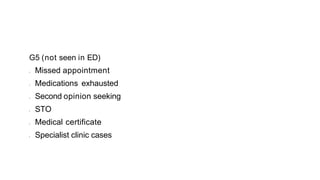
G5 (not seen in ED)
• Missed appointment
• Medications exhausted
• Second opinion seeking
• STO
• Medical certificate
• Specialist clinic cases

293753955-malaysian-triage-category-mtcpptx.pptx

  • 1.
  • 2.
    OBJEKTIF • Am -memahami perananPenolong Pegawai Perubatan semasa melakukan “triage” • Khursus -mengenalpasti jenis-jenis “triage” -boleh menentukan zon yang bersesuaian dengan keadaan penyakit pesakit -dapat mengamalkan dan mempraktikkan “triage” mengikut jenis-jenis yang dinyatakan
  • 3.
    PENDAHULUAN • Definasi • “Triage”berasal dari bahasa Perancis iaitu “trier” yang membawa maksud menapis atau menyusun • Cara ini digunakan untuk menilai kecederaan dan kesakitan pesakit dalam masa yang singkat untuk menetapkan priorities serta zon yang bersesuian untuk mendapatkan rawatan
  • 4.
    SITUASI DI JAB.KECEMASAN • Jumlah kemasukan ke jabatan kecemasan tidak boleh diramalkan dengan tepat • Hanya sebahagian tertentu daripada pesakit yang mempunyai masalah kesihatan membahayakan nyawa atau yang memerlukan perubatan segera • Pesakit life-threatening injuries perlu dikenalpasti serta merta • Overcrowding • Permintaan untuk rawatan perubatan melebihi limitasi jabatan
  • 5.
    Triage in EmergencyDepartment • Designed to identify the most urgent (or potentially most serious) cases. • To ensure that they receive priority treatment, followed by the less urgent cases. • First-come, first-served basis • Triage officers routinely assess all patients who present for treatment to sort and prioritize them.
  • 6.
    KLASIFIKASI TRIAGE • Proactive •Static • Secondary • Surveillance • Definitive
  • 7.
    Art of Triage •Complex and dynamic process • Mendapatkan maklumat yang berkaitan dalam masa yang singkat • Keputusan dibuat dalam keadaan informasi yang limited • Keputusan dibuat berdasarkan garis panduan yang sedia ada serta menilai keadaan pesakit
  • 8.
    Roles of TriageOfficer • Menentukan zon pesakit berdasarkan assessment terhadap pesakit • First aid, analgesia. • Berhubung dengan paramedic dan profession kesihatan yang lain • Escort patient • Pass over relevant information • Provide patient and public education where necessary • Documentation
  • 9.
    Process of Triage •Main complaint and brief history • Vital signs • Physical findings seen, heard, felt or smelt • Setting the priority status of the patient • Decision whether treatment should be started at triage
  • 10.
    SOAP System Larry-Weed SOAPsystem • S (Subjective) – main complaint and brief history • O (Objective) – physical finding and vital signs • A (Assessment) – setting of the priority status based on subjective and objective finding • P (Plan) – preliminary diagnostic and treatment
  • 11.
    Malaysian Triage Category •MTC diwujudkan untuk digunakan dalam perkhidmatan kecemasan di seluruh hospital Malaysia. • Merupakan skala untuk menilai urgency • Merupakan tahap untuk menilai keberkesanan zon triage dengan pesakit (inpatient length of stay, ICU admission, mortality rate) dan resource consumption (staff time, cost). • Memberikan analisis dan gambaran terhadap prestasi di dalam jabatan kecemasan.
  • 12.
    MTC Red (Critical) Yellow (SemiCritical) Green (Non-Critical)
  • 13.
    CRITICAL (RED) Conditions thatare threats to life (or imminent risk of deterioration) and require immediate aggressive intervention. The patient's condition is serious enough or deteriorating so rapidly that there is the potential of threat to life, or organ system failure, if not treated within 15 minutes of arrival The potential for time-critical treatment (e.g. thrombolysis, antidote) to make a significant effect on clinical outcome depends on treatment commencing within a few minutes of the patient's arrival in the ED
  • 14.
    • Patients withlife threatening injuries or illness which require immediate attention. • Assessment and treatment simultaneously within 5 minutes. • Subcategories: • R1 (immediate life-threatening) • R2 (life-threatening)
  • 16.
    Semi-Critical (YELLOW) The patient'scondition may progress to life or limb threatening, or may lead to significant morbidity, if assessment and treatment are not commenced within thirty minutes of arrival There is potential for adverse outcome if time-critical treatment is not commenced within thirty minutes Human practice mandates the relief of severe discomfort or distress
  • 17.
    • Assessment andtreatment starts within 30 minutes. • Usual presentation: • Unable to walk but airway is secure, hemodynamically stable and on trolleys
  • 19.
    Non-critical (green) The patient'scondition may deteriorate, or adverse outcome may result, if assessment and treatment is not commenced within one hour of arrival in ED. Symptoms moderate or prolonged. There is potential for adverse outcome if time-critical treatment is not commenced within hour Likely to require complex work-up and consultation and/or inpatient management Humane practice mandates the relief of discomfort or distress within one hour
  • 20.
    • Assessment andtreatment starts within 90 minutes • Usual presentation: • Airway secure, hemodynamically stable patients not in any distress and ambulant • Subcatagories: • G1 (fast line) • G2 (require initial management or first aid before seen by doctor) • G3 (patients who can wait) • G4 (triage away to primary care or another center) • G5 (not seen in ED)
  • 21.
    G1 (Fast Lane) •Children < 2 years old • Senior citizen > 65 years old • Acute pain (trauma): pain score <4/10 • Chest pain – non-visceral, musculoskeletal and not associated with other symptoms but with history of heart disease • Abuse/neglect/assault – stable • Post seizure – alert on arrival • POP complications • Elevated blood sugar without any major symptoms • Mild asthma • Closed fracture of upper limbs or ankle with major angulations • Dislocation of small joints • Foreign body • Hemodynamically stable per vaginal bleed
  • 22.
    G2 (Require initialmanagement or 1st aid before seen by doctor) • Chest pain – non-visceral, musculoskeletal and not associated with other symptoms and no previous heart disease • Minor allergic reaction
  • 23.
    G3 (patients whocan wait) • Burn < 15% of BSA regardless of depth and/or <10% 3rd degree burns • Minor trauma • Head injury – alert, no vomiting • Bumps and bruises • Closed fracture of upper limbs • Controllable bleeding with closed fracture of upper limbs or ankle without major angulations • Nail prick • Simple cut
  • 24.
    G4 (for LOCUMor triage away to OPD or another center) • • • Chronic trauma injuries > 6 months • Diarrhea alone (no dehydration) • Vomiting alone (normal mental status with no dehydration) Acute pyrexia <38°C for adult < 65 years old or child between 2-12 years old • Simple skin diseases – chronic • Menses related complaints • Chronic psychiatric complaints General medicine conditions or minor illness not requiring monitoring • Sore throat – no respiratory symptoms • Earache • Infective eye conditions
  • 25.
    G5 (not seenin ED) • Missed appointment • Medications exhausted • Second opinion seeking • STO • Medical certificate • Specialist clinic cases