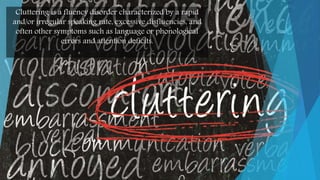
Cluttering is a fluency disorder characterized by a rapid
and/or irregular speaking rate, excessive disfluencies, and
often other symptoms such as language or phonological
errors and attention deficits.
Red Light Green Light Reading
https://freekidsbooks.org/wp-
content/uploads/2017/01/magic-sucks-FKB-YA-
Stories.pdf
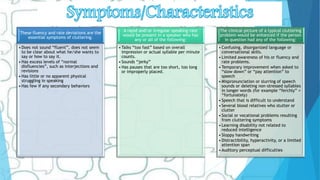
These fluency and rate deviations are the
essential symptoms of cluttering.
• Does not sound “fluent”, does not seem
to be clear about what he/she wants to
say or how to say it.
• Has excess levels of “normal
disfluencies”, such as interjections and
revisions
• Has little or no apparent physical
struggling in speaking
• Has few if any secondary behaviors
A rapid and/or irregular speaking rate
would be present in a speaker who has
any or all of the following:
• Talks “too fast” based on overall
impression or actual syllable per minute
counts.
• Sounds “jerky”
• Has pauses that are too short, too long
or improperly placed.
The clinical picture of a typical cluttering
problem would be enhanced if the person
in question had any of the following:
• Confusing, disorganized language or
conversational skills.
• Limited awareness of his or fluency and
rate problems.
• Temporary improvement when asked to
“slow down” or “pay attention” to
speech
• Mispronunciation or slurring of speech
sounds or deleting non-stressed syllables
in longer words (for example “ferchly” =
“fortunately)
• Speech that is difficult to understand
• Several blood relatives who stutter or
clutter
• Social or vocational problems resulting
from cluttering symptoms
• Learning disability not related to
reduced intelligence
• Sloppy handwriting
• Distractibility, hyperactivity, or a limited
attention span
• Auditory perceptual difficulties
Speech-language
pathologist
Multiple sessions
Reports by
•Teachers
•Special educators
•Psychologists
•Neuro-psychologists
Measures
•Fluency
•Co-existing oral-motor
•Language
•Pronunciation
•Learning or social problems
Co-existing disorders
•Difficulties with language
formulation
•Inadequate organization of
thought processes
•Sound-specific articulation
disorders
•Speech motor discoordination
•Attention deficit hyperactive
disorders (ADHD) or other
learning disorders
•Auditory processing disorders
•Asperger’s syndrome
•Apraxia
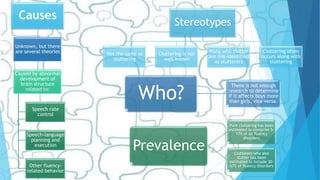
Causes
Unknown, but there
are several theories
Caused by abnormal
development of
brain structure
related to:
Speech rate
control
Speech-language
planning and
execution
Other fluency-
related behavior
Stereotypes
Not the same as
stuttering
Cluttering is not
well known
Many who clutter
are mis-identified
as stutterers
Cluttering often
occurs along with
stuttering
Who?
There is not enough
research to determine
if it affects boys more
than girls, vice versa.
Prevalence
Pure cluttering has been
estimated to comprise 5-
17% of all fluency
disorders
Clutterers who also
stutter has been
estimated to include 30-
67% of fluency disorders
Speech therapy includes various
combinations of the following
goals:
Reducing the speaking rate
Enhancing or improving the
ability to self monitor speech
Practicing speech characterized careful
enunciation of all of the words and
syllables
Constructing sentences that are
–
•Carefully organized
•Appropriately arranged
•Important to the communication
Learning to recognize and respond
appropriately to listener cues of
misunderstanding
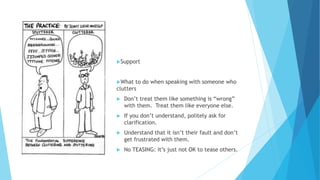
Support
What to do when speaking with someone who
clutters
 Don’t treat them like something is “wrong”
with them. Treat them like everyone else.
 If you don’t understand, politely ask for
clarification.
 Understand that it isn’t their fault and don’t
get frustrated with them.
 No TEASING: it’s just not OK to tease others.
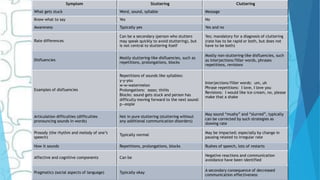
Symptom Stuttering Cluttering
What gets stuck Word, sound, syllable Message
Know what to say Yes No
Awareness Typically yes Yes and no
Rate differences
Can be a secondary (person who stutters
may speak quickly to avoid stuttering), but
is not central to stuttering itself
Yes; mandatory for a diagnosis of cluttering
(rate has to be rapid or both, but does not
have to be both)
Disfluencies
Mostly stuttering-like disfluencies, such as
repetitions, prolongations, blocks
Mostly non-stuttering-like disfluencies, such
as interjections/filler words, phrases
repetitions, revisions
Examples of disfluencies
Repetitions of sounds like syllables:
y-y-you
w-w-watermelon
Prolongations: sssso; thiiiis
Blocks: sound gets stuck and person has
difficulty moving forward to the next sound:
p—eople
Interjections/filler words: um, uh
Phrase repetitions: I love, I love you
Revisions: I would like ice cream, no, please
make that a shake
Articulation difficulties (difficulties
pronouncing sounds in words)
Not in pure stuttering (stuttering without
any additional communication disorders)
May sound “mushy” and “slurred”, typically
can be corrected by such strategies as
slowing rate
Prosody (the rhythm and melody of one’s
speech)
Typically normal
May be impacted; especially by change in
pausing related to irregular rate
How it sounds Repetitions, prolongations, blocks Rushes of speech, lots of restarts
Affective and cognitive components Can be
Negative reactions and communication
avoidance have been identified
Pragmatics (social aspects of language) Typically okay
A secondary consequence of decreased
communication effectiveness
Sources –
http://www.stutteringhelp.org/cluttering
http://associations.missouristate.edu/ica/
http://cirrie.buffalo.edu/encyclopedia/en/article/262/

Cluttering

  • 1.
    Cluttering is afluency disorder characterized by a rapid and/or irregular speaking rate, excessive disfluencies, and often other symptoms such as language or phonological errors and attention deficits.
  • 2.
    Red Light GreenLight Reading https://freekidsbooks.org/wp- content/uploads/2017/01/magic-sucks-FKB-YA- Stories.pdf
  • 4.
    These fluency andrate deviations are the essential symptoms of cluttering. • Does not sound “fluent”, does not seem to be clear about what he/she wants to say or how to say it. • Has excess levels of “normal disfluencies”, such as interjections and revisions • Has little or no apparent physical struggling in speaking • Has few if any secondary behaviors A rapid and/or irregular speaking rate would be present in a speaker who has any or all of the following: • Talks “too fast” based on overall impression or actual syllable per minute counts. • Sounds “jerky” • Has pauses that are too short, too long or improperly placed. The clinical picture of a typical cluttering problem would be enhanced if the person in question had any of the following: • Confusing, disorganized language or conversational skills. • Limited awareness of his or fluency and rate problems. • Temporary improvement when asked to “slow down” or “pay attention” to speech • Mispronunciation or slurring of speech sounds or deleting non-stressed syllables in longer words (for example “ferchly” = “fortunately) • Speech that is difficult to understand • Several blood relatives who stutter or clutter • Social or vocational problems resulting from cluttering symptoms • Learning disability not related to reduced intelligence • Sloppy handwriting • Distractibility, hyperactivity, or a limited attention span • Auditory perceptual difficulties
  • 5.
    Speech-language pathologist Multiple sessions Reports by •Teachers •Specialeducators •Psychologists •Neuro-psychologists Measures •Fluency •Co-existing oral-motor •Language •Pronunciation •Learning or social problems Co-existing disorders •Difficulties with language formulation •Inadequate organization of thought processes •Sound-specific articulation disorders •Speech motor discoordination •Attention deficit hyperactive disorders (ADHD) or other learning disorders •Auditory processing disorders •Asperger’s syndrome •Apraxia
  • 6.
    Causes Unknown, but there areseveral theories Caused by abnormal development of brain structure related to: Speech rate control Speech-language planning and execution Other fluency- related behavior Stereotypes Not the same as stuttering Cluttering is not well known Many who clutter are mis-identified as stutterers Cluttering often occurs along with stuttering Who? There is not enough research to determine if it affects boys more than girls, vice versa. Prevalence Pure cluttering has been estimated to comprise 5- 17% of all fluency disorders Clutterers who also stutter has been estimated to include 30- 67% of fluency disorders
  • 7.
    Speech therapy includesvarious combinations of the following goals: Reducing the speaking rate Enhancing or improving the ability to self monitor speech Practicing speech characterized careful enunciation of all of the words and syllables Constructing sentences that are – •Carefully organized •Appropriately arranged •Important to the communication Learning to recognize and respond appropriately to listener cues of misunderstanding
  • 8.
    Support What to dowhen speaking with someone who clutters  Don’t treat them like something is “wrong” with them. Treat them like everyone else.  If you don’t understand, politely ask for clarification.  Understand that it isn’t their fault and don’t get frustrated with them.  No TEASING: it’s just not OK to tease others.
  • 9.
    Symptom Stuttering Cluttering Whatgets stuck Word, sound, syllable Message Know what to say Yes No Awareness Typically yes Yes and no Rate differences Can be a secondary (person who stutters may speak quickly to avoid stuttering), but is not central to stuttering itself Yes; mandatory for a diagnosis of cluttering (rate has to be rapid or both, but does not have to be both) Disfluencies Mostly stuttering-like disfluencies, such as repetitions, prolongations, blocks Mostly non-stuttering-like disfluencies, such as interjections/filler words, phrases repetitions, revisions Examples of disfluencies Repetitions of sounds like syllables: y-y-you w-w-watermelon Prolongations: sssso; thiiiis Blocks: sound gets stuck and person has difficulty moving forward to the next sound: p—eople Interjections/filler words: um, uh Phrase repetitions: I love, I love you Revisions: I would like ice cream, no, please make that a shake Articulation difficulties (difficulties pronouncing sounds in words) Not in pure stuttering (stuttering without any additional communication disorders) May sound “mushy” and “slurred”, typically can be corrected by such strategies as slowing rate Prosody (the rhythm and melody of one’s speech) Typically normal May be impacted; especially by change in pausing related to irregular rate How it sounds Repetitions, prolongations, blocks Rushes of speech, lots of restarts Affective and cognitive components Can be Negative reactions and communication avoidance have been identified Pragmatics (social aspects of language) Typically okay A secondary consequence of decreased communication effectiveness
  • 10.