ST
AMMERINGASSESSMENT&
MANAGEMENT
Presented by
Ms. Fouzia Saleemi
SpeechLanguage P
athologist
/Pediatric Psychologist
B.S(BioMedicals)
M.Phil. (SpeechLanguage P
athology)
M.A (Special Ed), ABS(T
rainer), B
.ED
,
PGD (SL
T)
OBJEC
T
IV
E
1. Introduction of Stammering
2
. T
ypesof Stammering
3. Phase of Stammering
4. Informal and formal Assessment
5. Portfolio/Griding
6. Management
IN
T
R
ODU
C
T
IONOFST
AMMER
IN
G
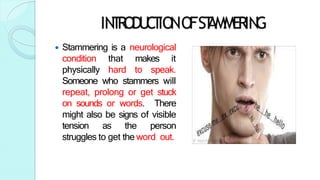
 Stammering is a neurological
condition that makes it
physically hard to speak.
Someone who stammers will
repeat, prolong or get stuck
on sounds or words. There
might also be signs of visible
tension as the person
struggles to get the word out.
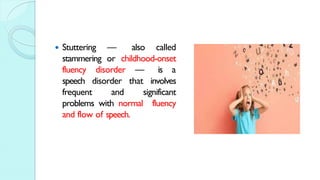
 Stuttering — also called
stammering or childhood-onset
fluency disorder — is a
speech disorder that involves
frequent and significant
problems with normal fluency
and flow of speech.
DIFFERENCEB
E
T
W
E
E
NSTUTTERINGAND
ST
AMMERING
The Difference between Stuttering and
Stammering is like a funny English in
which two different words represent the
same meaning like football also known
as soccer.
SYMPT
OMS
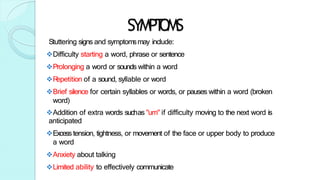
Stuttering signs and symptomsmay include:
Difficulty starting a word, phrase or sentence
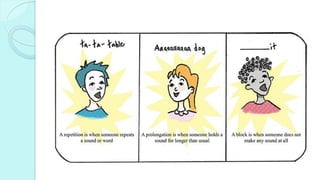
Prolonging a word or sounds within a word
R
epetition of a sound, syllable or word
Brief silence for certain syllables or words, or pauses within a word (broken
word)
Addition of extra words suchas "um" if difficulty moving to the next word is
anticipated
Excess tension, tightness, or movement of the face or upper body to produce
a word
Anxiety about talking
Limited ability to effectively communicate
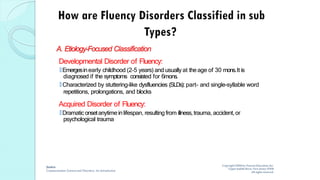
A. Etiology-Focused Classification
Developmental Disorder of Fluency:
🢝
Emergesinearly childhood (2-5 years) and usually at theage of 30 mons.It is
diagnosed if the symptoms consisted for 6mons.
🢝
Characterized by stuttering-like dysfluencies (SLDs): part- and single-syllable word
repetitions, prolongations, and blocks
Acquired Disorder of Fluency:
🢝
Dramaticonsetanytimeinlifespan, resulting from illness,trauma, accident,or
psychological trauma
Justice
Communication Sciences and Disorders: An Introduction
Copyright ©2006 by Pearson Education, Inc.
Upper Saddle River, New Jersey 07458
All rights reserved.
T
YPESOFST
AMMER
IN
G
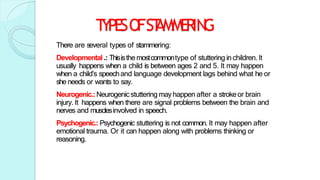
There are several types of stammering:
Developmental.: Thisisthemostcommontype of stuttering inchildren. It
usually happens when a child is between ages 2 and 5. It may happen
when a child’s speechand language development lags behind what he or
she needs or wants to say.
Neurogenic.:Neurogenicstuttering mayhappen after a strokeor brain
injury. It happens when there are signal problems between the brain and
nerves and musclesinvolved in speech.
Psychogenic.: Psychogenic stuttering is not common. It may happen after
emotional trauma. Or it can happen along with problems thinking or
reasoning.
PH
ASEOFST
AMMERIN
G
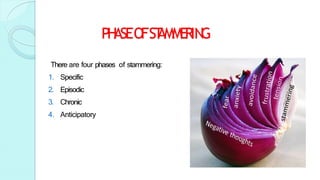
There are four phases of stammering:
1. Specific
2. Episodic
3. Chronic
4. Anticipatory
DEV
EL
OPMEN
T
ALLEV
ELSOFDISFL
U
EN
C
Y
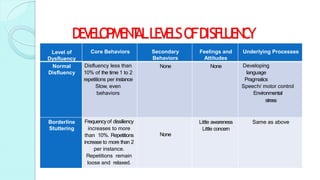
Level of
Dysfluency
Core Behaviors Secondary
Behaviors
Feelings and
Attitudes
Underlying Processes
Normal
Disfluency
Disfluency less than
10% of the time 1 to 2
repetitions per instance
Slow, even
behaviors
None None Developing
language
Pragmatics
Speech/ motor control
Environmental
stress
Borderline
Stuttering
Frequencyof dissiliency
increases to more
than 10%. Repetitions
increase to more than 2
per instance.
Repetitions remain
loose and relaxed.
None
Little awareness
Little concern
Same as above
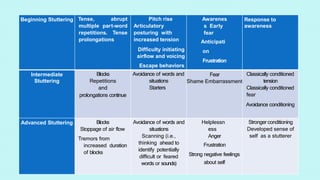
Beginning Stuttering Tense, abrupt
multiple part-word
repetitions. Tense
prolongations
Pitch rise
Articulatory
posturing with
increased tension
Difficulty initiating
airflow and voicing
Escape behaviors
Awarenes
s Early
fear
Anticipati
on
Frustration
Response to
awareness
Intermediate
Stuttering
Blocks
Repetitions
and
prolongations continue
Avoidance of words and
situations
Starters
Fear
Shame Embarrassment
Classically conditioned
tension
Classically conditioned
fear
Avoidance conditioning
Advanced Stuttering Blocks
Stoppage of air flow
Tremors from
increased duration
of blocks
Avoidance of words and
situations
Scanning (i.e.,
thinking ahead to
identify potentially
difficult or feared
words or sounds)
Helplessn
ess
Anger
Frustration
Strong negative feelings
about self
Stronger conditioning
Developed sense of
self as a stutterer
ASSESSMENT/FORMAL/INFORMAL
Stammering Assessment can be divided into two types
Screening
Diagnostic
1. Screening identifies if there is a problem
2. Diagnostic identifies what the problem is.
Core features:primary characteristics of a fluency disorder
🢝
R
epetitions
🢝
Prolongations
🢝
Blocks
Secondary features: emerge in response to the core behaviors
🢝
Avoid and escape momentsof disfluency, suchas
🢝
eye blinks, head jerks, pauses, fillers
🢝
Negative feelings and attitudes, such as worrying about speaking, viewing speaking
as difficult
Justice
Communication Sciences and Disorders: An Introduction
Copyright ©2006 by PearsonE
ducation, Inc.
Upper Saddle R
iver, New Jersey 07458
All rights reserved.
Informal Observations
They start the minute the client enters and include
observations of
▣ Posture
▣ Social skills
▣ The way in which a person speaks
▣ The way in which a person stutters
▣ etc.
▣Case History
▣ developmental milestones
▣ history of speech complaint
▣ current management of speech problems
▣ other speech /language problems
▣ familial history of stuttering
▣ relationships within the family
▣ emotional development
▣ school details
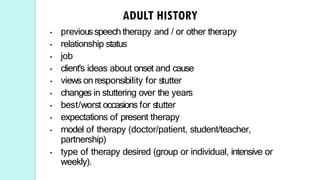
• previousspeech therapy and / or other therapy
• relationship status
• job
• client's ideas about onset and cause
• views on responsibility for stutter
• changes in stuttering over the years
• best/worst occasions for stutter
• expectations of present therapy
• model of therapy (doctor/patient, student/teacher,
partnership)
• type of therapy desired (group or individual, intensive or
weekly).
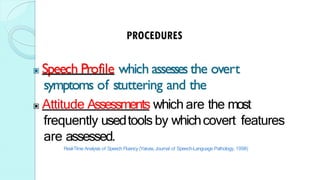
▣ Speech Profile which assesses the overt
symptoms of stuttering and the
▣ Attitude Assessments which are the most
frequently usedtoolsby whichcovert features
are assessed.
Real-Time Analysis of Speech Fluency (Yaruss,Journal of Speech-Language Pathology, 1998)
ASSESSMEN
TDESC
RIPT
ION
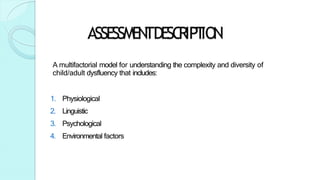
A multifactorial model for understanding the complexity and diversity of
child/adult dysfluency that includes:
1. Physiological
2. Linguistic
3. Psychological
4. Environmental factors
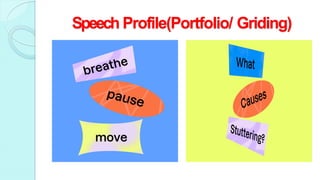
Speech Profile(Portfolio/ Griding)
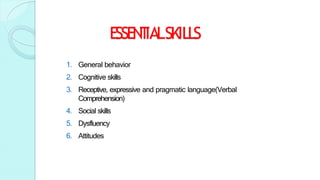
ESSEN
T
IALSKILLS
1. General behavior
2. Cognitive skills
3. Receptive, expressive and pragmatic language(Verbal
Comprehension)
4. Social skills
5. Dysfluency
6. Attitudes
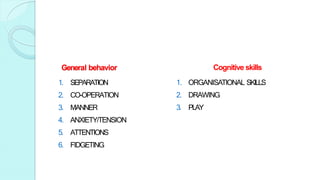
General behavior
1. SEPARATION
2. CO-OPERATION
3. MANNER
4. ANXIETY/TENSION
5. ATTENTIONS
6. FIDGETING
Cognitive skills
1. ORGANISATIONAL SKILLS
2. DRAWING
3. PLAY
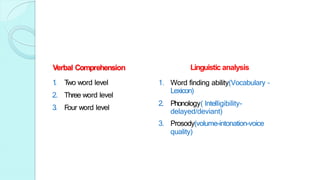
Verbal Comprehension
1
. T
wo word level
2. Three word level
3. Four word level
Linguistic analysis
1. Word finding ability(Vocabulary –
Lexicon)
2. Phonology( Intelligibility-
delayed/deviant)
3. Prosody(volume-intonation-voice
quality)
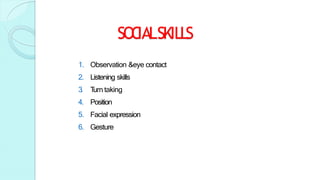
SOC
IALSKILLS
1. Observation &eye contact
2. Listening skills
3
. T
urn taking
4. Position
5. Facial expression
6. Gesture
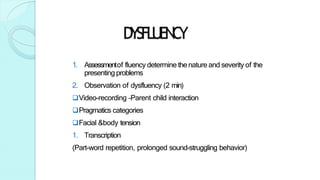
DYSFLUENCY
1. Assessmentof fluency determine thenature and severity of the
presenting problems
2. Observation of dysfluency (2 min)
Video-recording –Parent child interaction
Pragmatics categories
Facial &body tension
1. Transcription
(Part-word repetition, prolonged sound-struggling behavior)
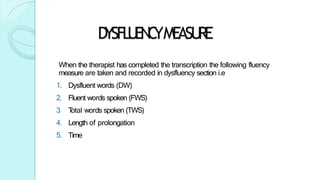
D
YSFL
U
EN
C
YMEASU
RE
When the therapist has completed the transcription the following fluency
measure are taken and recorded in dysfluency section i.e
1. Dysfluent words (DW)
2. Fluent words spoken (FWS)
3
. T
otal words spoken (TWS)
4. Length of prolongation
5. Time
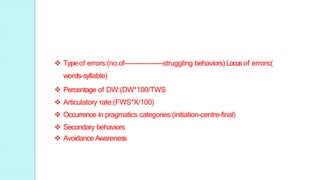
 Typeof errors:(no.of-----------------struggling behaviors)Locusof errors:(
words-syllable)
 Percentage of DW:(DW*100/TWS
 Articulatory rate:(FWS*X/100)
 Occurrence in pragmatics categories:(initiation-centre-final)
 Secondary behaviors
 AvoidanceAwareness
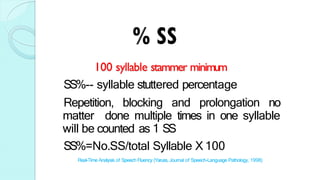
100 syllable stammer minimum
SS%-- syllable stuttered percentage
Repetition, blocking and prolongation no
matter done multiple times in one syllable
will be counted as 1 SS
SS%=No.SS/total Syllable X 100
Real-Time Analysis of Speech Fluency (Yaruss, Journal of Speech-Language Pathology, 1998)
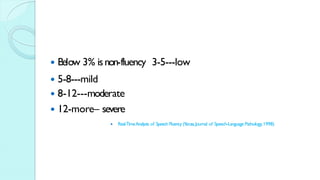
 Below 3% isnon-fluency 3-5---low
 5-8---mild
 8-12---moderate
 12-more– severe
 Real-TimeAnalysis of Speech Fluency (Y
aruss,Journal of Speech-Language Pathology,1998)
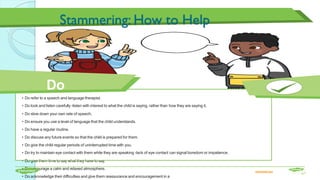
• Do refer to a speech and language therapist.
• Do look and listen carefully -listen with interest to what the child is saying, rather than how they are saying it.
• Do slow down your own rate of speech.
• Do ensure you use a level of language that the child understands.
• Do have a regular routine.
• Do discuss any future events so that the child is prepared for them.
• Do give the child regular periods of uninterrupted time with you.
• Do try to maintain eye contact with them while they are speaking -lack of eye contact can signal boredom or impatience.
• Do give them time to say what they have to say.
• Do encourage a calm and relaxed atmosphere.
• Do acknowledge their difficulties and give them reassurance and encouragement in a
Stammering: How to Help
Do
visit twinkl.com
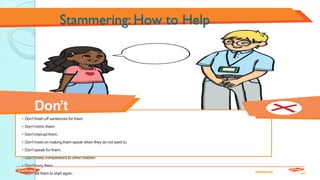
• Don’t finish off sentences for them.
• Don’t mimic them.
• Don’t interupt them.
• Don’t insist on making them speak when they do not want to.
• Don’t speak for them.
• Don’t make comparisons to other children.
• Don’t hurry them.
• Don’t tell them to start again.
Stammering: How to Help
Don’t
visit twinkl.com
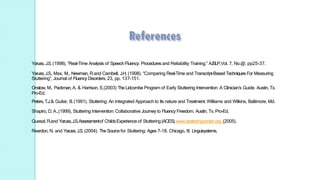
Yaruss,J.S.(1998), “Real-Time Analysis of SpeechFluency: Proceduresand Reliability Training.” AJSLP,Vol. 7, No.@, pp25-37.
Yaruss,J.S., Max, M., Newman, R.and Cambell, J.H. (1998). “Comparing Real-Time and Transcript-Based Techniques For Measuring
Stuttering”, Journal of Fluency Disorders, 23, pp. 137-151.
Onslow, M., Packman, A. & Harrison, E.(2003) The Lidcombe Program of Early Stuttering Intervention: A Clinician’s Guide. Austin, Tx.
Pro-Ed.
Peters,T.J.& Guitar, B.(1991). Stuttering: An Integrated Approach to Its nature and Treatment. Williams and Wilkins, Baltimore, Md.
Shapiro, D. A.,(1999), Stuttering Intervention: Collaborative Journey to Fluency Freedom. Austin, Tx. Pro-Ed.
Quesal,R.and Yaruss,J.S.Assessmentof ChildsExperienceof Stuttering(ACES).www.stutteringcenter.org.(2005).
Reardon, N. and Yaruss,J.S.(2004). The Sourcefor Stuttering: Ages 7-18. Chicago, Ill. Linguisystems.

Stammering Assessment .pdf

  • 1.
    ST AMMERINGASSESSMENT& MANAGEMENT Presented by Ms. FouziaSaleemi SpeechLanguage P athologist /Pediatric Psychologist B.S(BioMedicals) M.Phil. (SpeechLanguage P athology) M.A (Special Ed), ABS(T rainer), B .ED , PGD (SL T)
  • 2.
    OBJEC T IV E 1. Introduction ofStammering 2 . T ypesof Stammering 3. Phase of Stammering 4. Informal and formal Assessment 5. Portfolio/Griding 6. Management
  • 3.
    IN T R ODU C T IONOFST AMMER IN G  Stammering isa neurological condition that makes it physically hard to speak. Someone who stammers will repeat, prolong or get stuck on sounds or words. There might also be signs of visible tension as the person struggles to get the word out.
  • 4.
     Stuttering —also called stammering or childhood-onset fluency disorder — is a speech disorder that involves frequent and significant problems with normal fluency and flow of speech.
  • 5.
    DIFFERENCEB E T W E E NSTUTTERINGAND ST AMMERING The Difference betweenStuttering and Stammering is like a funny English in which two different words represent the same meaning like football also known as soccer.
  • 6.
    SYMPT OMS Stuttering signs andsymptomsmay include: Difficulty starting a word, phrase or sentence Prolonging a word or sounds within a word R epetition of a sound, syllable or word Brief silence for certain syllables or words, or pauses within a word (broken word) Addition of extra words suchas "um" if difficulty moving to the next word is anticipated Excess tension, tightness, or movement of the face or upper body to produce a word Anxiety about talking Limited ability to effectively communicate
  • 8.
    A. Etiology-Focused Classification DevelopmentalDisorder of Fluency: 🢝 Emergesinearly childhood (2-5 years) and usually at theage of 30 mons.It is diagnosed if the symptoms consisted for 6mons. 🢝 Characterized by stuttering-like dysfluencies (SLDs): part- and single-syllable word repetitions, prolongations, and blocks Acquired Disorder of Fluency: 🢝 Dramaticonsetanytimeinlifespan, resulting from illness,trauma, accident,or psychological trauma Justice Communication Sciences and Disorders: An Introduction Copyright ©2006 by Pearson Education, Inc. Upper Saddle River, New Jersey 07458 All rights reserved.
  • 9.
    T YPESOFST AMMER IN G There are severaltypes of stammering: Developmental.: Thisisthemostcommontype of stuttering inchildren. It usually happens when a child is between ages 2 and 5. It may happen when a child’s speechand language development lags behind what he or she needs or wants to say. Neurogenic.:Neurogenicstuttering mayhappen after a strokeor brain injury. It happens when there are signal problems between the brain and nerves and musclesinvolved in speech. Psychogenic.: Psychogenic stuttering is not common. It may happen after emotional trauma. Or it can happen along with problems thinking or reasoning.
  • 10.
    PH ASEOFST AMMERIN G There are fourphases of stammering: 1. Specific 2. Episodic 3. Chronic 4. Anticipatory
  • 11.
    DEV EL OPMEN T ALLEV ELSOFDISFL U EN C Y Level of Dysfluency Core BehaviorsSecondary Behaviors Feelings and Attitudes Underlying Processes Normal Disfluency Disfluency less than 10% of the time 1 to 2 repetitions per instance Slow, even behaviors None None Developing language Pragmatics Speech/ motor control Environmental stress Borderline Stuttering Frequencyof dissiliency increases to more than 10%. Repetitions increase to more than 2 per instance. Repetitions remain loose and relaxed. None Little awareness Little concern Same as above
  • 12.
    Beginning Stuttering Tense,abrupt multiple part-word repetitions. Tense prolongations Pitch rise Articulatory posturing with increased tension Difficulty initiating airflow and voicing Escape behaviors Awarenes s Early fear Anticipati on Frustration Response to awareness Intermediate Stuttering Blocks Repetitions and prolongations continue Avoidance of words and situations Starters Fear Shame Embarrassment Classically conditioned tension Classically conditioned fear Avoidance conditioning Advanced Stuttering Blocks Stoppage of air flow Tremors from increased duration of blocks Avoidance of words and situations Scanning (i.e., thinking ahead to identify potentially difficult or feared words or sounds) Helplessn ess Anger Frustration Strong negative feelings about self Stronger conditioning Developed sense of self as a stutterer
  • 13.
    ASSESSMENT/FORMAL/INFORMAL Stammering Assessment canbe divided into two types Screening Diagnostic 1. Screening identifies if there is a problem 2. Diagnostic identifies what the problem is.
  • 14.
    Core features:primary characteristicsof a fluency disorder 🢝 R epetitions 🢝 Prolongations 🢝 Blocks Secondary features: emerge in response to the core behaviors 🢝 Avoid and escape momentsof disfluency, suchas 🢝 eye blinks, head jerks, pauses, fillers 🢝 Negative feelings and attitudes, such as worrying about speaking, viewing speaking as difficult Justice Communication Sciences and Disorders: An Introduction Copyright ©2006 by PearsonE ducation, Inc. Upper Saddle R iver, New Jersey 07458 All rights reserved.
  • 15.
    Informal Observations They startthe minute the client enters and include observations of ▣ Posture ▣ Social skills ▣ The way in which a person speaks ▣ The way in which a person stutters ▣ etc. ▣Case History
  • 16.
    ▣ developmental milestones ▣history of speech complaint ▣ current management of speech problems ▣ other speech /language problems ▣ familial history of stuttering ▣ relationships within the family ▣ emotional development ▣ school details
  • 17.
    • previousspeech therapyand / or other therapy • relationship status • job • client's ideas about onset and cause • views on responsibility for stutter • changes in stuttering over the years • best/worst occasions for stutter • expectations of present therapy • model of therapy (doctor/patient, student/teacher, partnership) • type of therapy desired (group or individual, intensive or weekly).
  • 18.
    ▣ Speech Profilewhich assesses the overt symptoms of stuttering and the ▣ Attitude Assessments which are the most frequently usedtoolsby whichcovert features are assessed. Real-Time Analysis of Speech Fluency (Yaruss,Journal of Speech-Language Pathology, 1998)
  • 19.
    ASSESSMEN TDESC RIPT ION A multifactorial modelfor understanding the complexity and diversity of child/adult dysfluency that includes: 1. Physiological 2. Linguistic 3. Psychological 4. Environmental factors
  • 20.
  • 21.
    ESSEN T IALSKILLS 1. General behavior 2.Cognitive skills 3. Receptive, expressive and pragmatic language(Verbal Comprehension) 4. Social skills 5. Dysfluency 6. Attitudes
  • 22.
    General behavior 1. SEPARATION 2.CO-OPERATION 3. MANNER 4. ANXIETY/TENSION 5. ATTENTIONS 6. FIDGETING Cognitive skills 1. ORGANISATIONAL SKILLS 2. DRAWING 3. PLAY
  • 23.
    Verbal Comprehension 1 . T woword level 2. Three word level 3. Four word level Linguistic analysis 1. Word finding ability(Vocabulary – Lexicon) 2. Phonology( Intelligibility- delayed/deviant) 3. Prosody(volume-intonation-voice quality)
  • 24.
    SOC IALSKILLS 1. Observation &eyecontact 2. Listening skills 3 . T urn taking 4. Position 5. Facial expression 6. Gesture
  • 25.
    DYSFLUENCY 1. Assessmentof fluencydetermine thenature and severity of the presenting problems 2. Observation of dysfluency (2 min) Video-recording –Parent child interaction Pragmatics categories Facial &body tension 1. Transcription (Part-word repetition, prolonged sound-struggling behavior)
  • 26.
    D YSFL U EN C YMEASU RE When the therapisthas completed the transcription the following fluency measure are taken and recorded in dysfluency section i.e 1. Dysfluent words (DW) 2. Fluent words spoken (FWS) 3 . T otal words spoken (TWS) 4. Length of prolongation 5. Time
  • 27.
     Typeof errors:(no.of-----------------strugglingbehaviors)Locusof errors:( words-syllable)  Percentage of DW:(DW*100/TWS  Articulatory rate:(FWS*X/100)  Occurrence in pragmatics categories:(initiation-centre-final)  Secondary behaviors  AvoidanceAwareness
  • 28.
    100 syllable stammerminimum SS%-- syllable stuttered percentage Repetition, blocking and prolongation no matter done multiple times in one syllable will be counted as 1 SS SS%=No.SS/total Syllable X 100 Real-Time Analysis of Speech Fluency (Yaruss, Journal of Speech-Language Pathology, 1998)
  • 29.
     Below 3%isnon-fluency 3-5---low  5-8---mild  8-12---moderate  12-more– severe  Real-TimeAnalysis of Speech Fluency (Y aruss,Journal of Speech-Language Pathology,1998)
  • 30.
    • Do referto a speech and language therapist. • Do look and listen carefully -listen with interest to what the child is saying, rather than how they are saying it. • Do slow down your own rate of speech. • Do ensure you use a level of language that the child understands. • Do have a regular routine. • Do discuss any future events so that the child is prepared for them. • Do give the child regular periods of uninterrupted time with you. • Do try to maintain eye contact with them while they are speaking -lack of eye contact can signal boredom or impatience. • Do give them time to say what they have to say. • Do encourage a calm and relaxed atmosphere. • Do acknowledge their difficulties and give them reassurance and encouragement in a Stammering: How to Help Do visit twinkl.com
  • 31.
    • Don’t finishoff sentences for them. • Don’t mimic them. • Don’t interupt them. • Don’t insist on making them speak when they do not want to. • Don’t speak for them. • Don’t make comparisons to other children. • Don’t hurry them. • Don’t tell them to start again. Stammering: How to Help Don’t visit twinkl.com
  • 32.
    Yaruss,J.S.(1998), “Real-Time Analysisof SpeechFluency: Proceduresand Reliability Training.” AJSLP,Vol. 7, No.@, pp25-37. Yaruss,J.S., Max, M., Newman, R.and Cambell, J.H. (1998). “Comparing Real-Time and Transcript-Based Techniques For Measuring Stuttering”, Journal of Fluency Disorders, 23, pp. 137-151. Onslow, M., Packman, A. & Harrison, E.(2003) The Lidcombe Program of Early Stuttering Intervention: A Clinician’s Guide. Austin, Tx. Pro-Ed. Peters,T.J.& Guitar, B.(1991). Stuttering: An Integrated Approach to Its nature and Treatment. Williams and Wilkins, Baltimore, Md. Shapiro, D. A.,(1999), Stuttering Intervention: Collaborative Journey to Fluency Freedom. Austin, Tx. Pro-Ed. Quesal,R.and Yaruss,J.S.Assessmentof ChildsExperienceof Stuttering(ACES).www.stutteringcenter.org.(2005). Reardon, N. and Yaruss,J.S.(2004). The Sourcefor Stuttering: Ages 7-18. Chicago, Ill. Linguisystems.