A
Seminar
On
Cluster Computing
Department of Computer Science & Engineering,
PRM Institute Of Technology & Research, Badnera.
2016-2017
Submitted by Guided by
ADARSH A. MOHARLE Prof.A.A.CHAUDHARI
Introduction
Definition
Cluster Architecture
Cluster Component
Parallel/Distributed Processing Clusters
Cluster Nodes
Cluster Network
Software and Tools for Clustering
Message Passing System
Cluster Applications
Benefits
Conclusions
References
CONTENTS
 Cluster computing can be described as a fusion of the
fields of parallel, high-performance, distributed, and
high-availability computing.
 The use of clusters as computing platform is not just
limited to scientific and engineering applications.
INTRODUCTION
 A cluster is defined as a collection of interconnected
workstations or PCs Cooperatively working together as a single,
integrated computing resource .
DEFINiTION
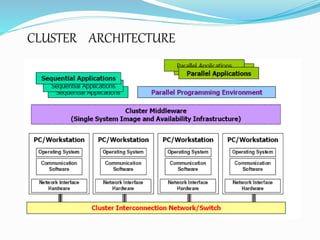
CLUSTER ARCHITECTURE
 Application
 Middleware
 Operating System
 Interconnect
CLUSTER COMPONENTS
Multiple processors in a specially designed parallel
computer .
Uses a number of nodes to simultaneously solve a specific
computational or data-mining task .
Parallel/Distributed Processing Clusters
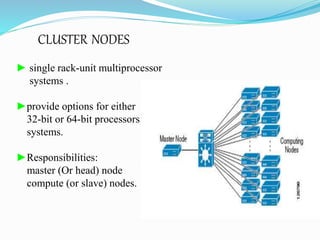
► single rack-unit multiprocessor
systems .
►provide options for either
32-bit or 64-bit processors
systems.
►Responsibilities:
master (Or head) node
compute (or slave) nodes.
CLUSTER NODES
 The high performance commodity servers and the
availability of high speed, low-latency network switch
technologies that provide the inter-nodal communications.
 Ethernet continues to be a leading interconnect technology
for many clusters.
CLUSTER NETWORK
Software and Tools for Clustering
 Linux is a freely available UNIX
 It provides features.
 Compilers
 FORTRAN
 GNU C
Message Passing System
It provide a high-level means of passing
data between process executing on distributed
memory systems .
Type of message passing system
MPI (Message Passing Interface)
PVM (Parallel Virtual Machine)
 Google Search Engine
 Petroleum Reservoir Simulation
CLUSTER APPLICATIONS
BENEFITS
 The main benefits of the Cluster are:
 Availability
 Performance
 Scalability
Clusters as well as the technologies available for
building clusters. The main importance is placed on using
commodity-based hardware and software components to
achieve high performance and scalability and at the same
time keeping the price/performance low.
REFERENCES
[1] R. Buyya (ed.), High Performance Cluster Computing: Architectures and Systems, vol.
1, Prentice Hall, 1999.
[2] T. E. Anderson, D. Culler, and D. A. Patterson, "A Case for NOW (Network of
Workstations)," IEEE Micro, vol. 15, pp. 54-64, Feb. 1995.
[3] A. Chien, S. Pakin, M. Lauria, M. Buchanan, K. Hane, L. Giannini, and J. Prusakova,
“High Performance Virtual Machines (HPVM): Clusters with Supercomputing APIs and
Performance,” Proc. 8th SIAM Conference on Parallel Processing for Scientific
Computing (PP97), Minneapolis, USA, Mar. 1997.
[4] G. F. Pfister, In Search of Clusters, 2nd Edition, Prentice Hall, 1998.
[5] T. Shanley, Infiniband Network Architecture, Addison-Wesley, Nov. 2002.
continued
[6] N. J. Boden, D. Cohen, R. E. Felderman, A.E. Kulawik, C.L. Seitz, J.N. Seizovic, and
Wen-King Su, “Myrinet: A Gigabit-per-second Local Area Network,” IEEE Micro, vol. 15,
Feb. 1995, pp. 29-36.
[7] K. Alnaes, E. H. Kristiansen, D. B. Gustavson, and D. V. James, “Scalable Coherent
Interface,” Proc. 1990 IEEE International Conference on Computer Systems and Software
Engineering (CompEuro ’90), Tel-Aviv, Israel, May 1990, pp. 446-453.
[8] D. Cameron, and G. Regnier, Virtual Interface Architecture, Intel Press, Apr. 2002.
[9] Message Passing Interface (MPI) Forum, http://www.mpi-forum.org
[10] M. Baker, A. Apon, R. Buyya, and H. Jin, “Cluster Computing and Applications,”
Encyclopedia of Computer Science and Technology, vol. 45, A. Kent, and J. Williams (eds.),
Marcel Dekker, Jan. 2002, pp. 87-125.
Cluster computing

Cluster computing

  • 1.
    A Seminar On Cluster Computing Department ofComputer Science & Engineering, PRM Institute Of Technology & Research, Badnera. 2016-2017 Submitted by Guided by ADARSH A. MOHARLE Prof.A.A.CHAUDHARI
  • 2.
    Introduction Definition Cluster Architecture Cluster Component Parallel/DistributedProcessing Clusters Cluster Nodes Cluster Network Software and Tools for Clustering Message Passing System Cluster Applications Benefits Conclusions References CONTENTS
  • 3.
     Cluster computingcan be described as a fusion of the fields of parallel, high-performance, distributed, and high-availability computing.  The use of clusters as computing platform is not just limited to scientific and engineering applications. INTRODUCTION
  • 4.
     A clusteris defined as a collection of interconnected workstations or PCs Cooperatively working together as a single, integrated computing resource . DEFINiTION
  • 5.
  • 6.
     Application  Middleware Operating System  Interconnect CLUSTER COMPONENTS
  • 7.
    Multiple processors ina specially designed parallel computer . Uses a number of nodes to simultaneously solve a specific computational or data-mining task . Parallel/Distributed Processing Clusters
  • 8.
    ► single rack-unitmultiprocessor systems . ►provide options for either 32-bit or 64-bit processors systems. ►Responsibilities: master (Or head) node compute (or slave) nodes. CLUSTER NODES
  • 9.
     The highperformance commodity servers and the availability of high speed, low-latency network switch technologies that provide the inter-nodal communications.  Ethernet continues to be a leading interconnect technology for many clusters. CLUSTER NETWORK
  • 10.
    Software and Toolsfor Clustering  Linux is a freely available UNIX  It provides features.  Compilers  FORTRAN  GNU C
  • 11.
    Message Passing System Itprovide a high-level means of passing data between process executing on distributed memory systems . Type of message passing system MPI (Message Passing Interface) PVM (Parallel Virtual Machine)
  • 12.
     Google SearchEngine  Petroleum Reservoir Simulation CLUSTER APPLICATIONS
  • 13.
    BENEFITS  The mainbenefits of the Cluster are:  Availability  Performance  Scalability
  • 14.
    Clusters as wellas the technologies available for building clusters. The main importance is placed on using commodity-based hardware and software components to achieve high performance and scalability and at the same time keeping the price/performance low.
  • 15.
    REFERENCES [1] R. Buyya(ed.), High Performance Cluster Computing: Architectures and Systems, vol. 1, Prentice Hall, 1999. [2] T. E. Anderson, D. Culler, and D. A. Patterson, "A Case for NOW (Network of Workstations)," IEEE Micro, vol. 15, pp. 54-64, Feb. 1995. [3] A. Chien, S. Pakin, M. Lauria, M. Buchanan, K. Hane, L. Giannini, and J. Prusakova, “High Performance Virtual Machines (HPVM): Clusters with Supercomputing APIs and Performance,” Proc. 8th SIAM Conference on Parallel Processing for Scientific Computing (PP97), Minneapolis, USA, Mar. 1997. [4] G. F. Pfister, In Search of Clusters, 2nd Edition, Prentice Hall, 1998. [5] T. Shanley, Infiniband Network Architecture, Addison-Wesley, Nov. 2002.
  • 16.
    continued [6] N. J.Boden, D. Cohen, R. E. Felderman, A.E. Kulawik, C.L. Seitz, J.N. Seizovic, and Wen-King Su, “Myrinet: A Gigabit-per-second Local Area Network,” IEEE Micro, vol. 15, Feb. 1995, pp. 29-36. [7] K. Alnaes, E. H. Kristiansen, D. B. Gustavson, and D. V. James, “Scalable Coherent Interface,” Proc. 1990 IEEE International Conference on Computer Systems and Software Engineering (CompEuro ’90), Tel-Aviv, Israel, May 1990, pp. 446-453. [8] D. Cameron, and G. Regnier, Virtual Interface Architecture, Intel Press, Apr. 2002. [9] Message Passing Interface (MPI) Forum, http://www.mpi-forum.org [10] M. Baker, A. Apon, R. Buyya, and H. Jin, “Cluster Computing and Applications,” Encyclopedia of Computer Science and Technology, vol. 45, A. Kent, and J. Williams (eds.), Marcel Dekker, Jan. 2002, pp. 87-125.