Pervasive Computing
What is pervasive computing?
Pervasive computing refers to embedding computers and
communication in our environment. The idea behind the
pervasive computing is to make the computing power disappear
in the environment, but will always be there whenever needed, it
means availability and invisibility. These invisible computers
won't have keyboards or screens, but will watch us, listen to us
and interact with us. Pervasive computing makes the computer
operate in the messy and unstructured world of real people and
real objects.
Pervasive Computing in short can be termed as
“Anything”, “Anytime", "Anywhere”
For example, a domestic pervasive computing
environment might interconnect lighting and
environmental controls with personal biometric
monitors woven into clothing so that illumination and
heating conditions in a room might be modulated
continuously.
HISTORY OF PERVASIVE COMPUTING
Pervasive computing is the third wave of computing
technologies to emerge since computers first appeared:
• First Wave - Mainframe computing era: one computer
shared by many people.
• Second Wave - Personal computing era: one computer
used by one person.
• Third Wave – Pervasive computing era: one person, many
computers. Millions of computers embedded in the
environment.
Four Principles of Pervasive Computing are:
– Decentralization
– Specialized services
– Connectivity
– Simplicity
Some Possible Applications:
Pervasive Computing involving Hybrid Internet works for:
Natural disaster-specific warning purposes like-
• Tsunami Warning
• Forest Fire Warning
• Volcanic Eruption Warning
• Flood Warning
Large-scale monitoring and tracking purposes like-
• Wildlife monitoring
• Baggage monitoring
• Intelligent Transportation Systems
• Wearable and Vehicular Computing
Advantages of Pervasive Computing:
 INVISIBLE: "Smart" environments will be embedded with computing
technologies that will be mostly out-of-sight.
 DECISION-MAKING: "Smart" environments will help occupants to make
choices about their everyday lives.
 INFORMATION PROCESSING: Architecture will go from crunching data to
making sense of data; therefore, eliminating our need to constantly input
adjustments.
 ENHANCING EXPERIENCE: As computers embed themselves in our
environments, sensors and actuators will create "smart" environments where
architectural space will be goal-oriented.
 CONVERGENCE: Much of our environment will be supplemented with
interconnected digital technologies. Such interconnectivity will allow for a new
type of "sharing" that will serve to eliminate many dull tasks.
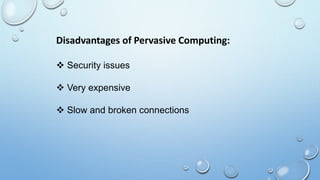
Disadvantages of Pervasive Computing:
 Security issues
 Very expensive
 Slow and broken connections
Pervasive computing

Pervasive computing

  • 1.
  • 2.
    What is pervasivecomputing? Pervasive computing refers to embedding computers and communication in our environment. The idea behind the pervasive computing is to make the computing power disappear in the environment, but will always be there whenever needed, it means availability and invisibility. These invisible computers won't have keyboards or screens, but will watch us, listen to us and interact with us. Pervasive computing makes the computer operate in the messy and unstructured world of real people and real objects.
  • 3.
    Pervasive Computing inshort can be termed as “Anything”, “Anytime", "Anywhere” For example, a domestic pervasive computing environment might interconnect lighting and environmental controls with personal biometric monitors woven into clothing so that illumination and heating conditions in a room might be modulated continuously.
  • 4.
    HISTORY OF PERVASIVECOMPUTING Pervasive computing is the third wave of computing technologies to emerge since computers first appeared: • First Wave - Mainframe computing era: one computer shared by many people. • Second Wave - Personal computing era: one computer used by one person. • Third Wave – Pervasive computing era: one person, many computers. Millions of computers embedded in the environment.
  • 5.
    Four Principles ofPervasive Computing are: – Decentralization – Specialized services – Connectivity – Simplicity
  • 6.
    Some Possible Applications: PervasiveComputing involving Hybrid Internet works for: Natural disaster-specific warning purposes like- • Tsunami Warning • Forest Fire Warning • Volcanic Eruption Warning • Flood Warning Large-scale monitoring and tracking purposes like- • Wildlife monitoring • Baggage monitoring • Intelligent Transportation Systems • Wearable and Vehicular Computing
  • 7.
    Advantages of PervasiveComputing:  INVISIBLE: "Smart" environments will be embedded with computing technologies that will be mostly out-of-sight.  DECISION-MAKING: "Smart" environments will help occupants to make choices about their everyday lives.  INFORMATION PROCESSING: Architecture will go from crunching data to making sense of data; therefore, eliminating our need to constantly input adjustments.  ENHANCING EXPERIENCE: As computers embed themselves in our environments, sensors and actuators will create "smart" environments where architectural space will be goal-oriented.  CONVERGENCE: Much of our environment will be supplemented with interconnected digital technologies. Such interconnectivity will allow for a new type of "sharing" that will serve to eliminate many dull tasks.
  • 8.
    Disadvantages of PervasiveComputing:  Security issues  Very expensive  Slow and broken connections