Clove Class
Cloves
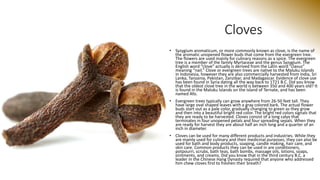
• Syzygium aromaticum, or more commonly known as clove, is the name of
the aromatic unopened flower buds that come from the evergreen tree.
The flowers are used mainly for culinary reasons as a spice. The evergreen
tree is a member of the family Myrtaceae and the genus Syzygium. The
English word “clove” actually is derived from the Latin word “clavus”
meaning “nail.” Clove or evergreen trees are native to the Maluku Islands
in Indonesia, however they are also commercially harvested from India, Sri
Lanka, Tanzania, Pakistan, Zanzibar, and Madagascar. Evidence of clove use
has been found in Syria dating all the way back to 1721 B.C. Did you know
that the oldest clove tree in the world is between 350 and 400 years old? It
is found in the Maluku Islands on the island of Ternate, and has been
named Afo.
• Evergreen trees typically can grow anywhere from 26-50 feet tall. They
have large oval shaped leaves with a gray colored bark. The actual flower
buds start out as a pale color, gradually changing to green as they grow
and then into a beautiful bright red color. The bright red colors signals that
they are ready to be harvested. Cloves consist of a long calyx that
terminates in four unopened petals and four spreading sepals. When they
are ready for harvest they are about half an inch long and a quarter of an
inch in diameter.
• Cloves can be used for many different products and industries. While they
are mainly used for culinary and their medicinal purposes, they can also be
used for bath and body products, soaping, candle making, hair care, and
skin care. Common products they can be used in are conditioners,
potpourri, scrubs, bath teas, bath bombs, massage oils, lotions, soaps,
ointments, and creams. Did you know that in the third century B.C. a
leader in the Chinese Hang Dynasty required that anyone who addressed
him chew cloves first to freshen their breath?
Growing Conditions
• Evergreen trees are perennial and like any plant, have their
own specific growth conditions. They prefer to be in wet
tropical areas with rich clay-like soils. However, they can also
grow and survive in areas with hard red soils but they need
good drainage no matter what areas they are in. They also
prefer to be in areas with rainfall that have partial shade. They
thrive best when planted in areas with climates like that of the
Maluku Islands.
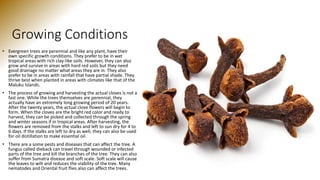
• The process of growing and harvesting the actual cloves is not a
fast one. While the trees themselves are perennial, they
actually have an extremely long growing period of 20 years.
After the twenty years, the actual clove flowers will begin to
form. When the cloves are the bright red color and ready to
harvest, they can be picked and collected through the spring
and winter seasons if in tropical areas. After harvesting, the
flowers are removed from the stalks and left to sun dry for 4 to
6 days. If the stalks are left to dry as well, they can also be used
for oil distillation to make essential oil.
• There are a some pests and diseases that can affect the tree. A
fungus called dieback can travel through wounded or infected
parts of the tree and kill the branches of the tree. They can also
suffer from Sumatra disease and soft scale. Soft scale will cause
the leaves to wilt and reduces the viability of the tree. Many
nematodes and Oriental fruit flies also can affect the trees.
Clove Uses in Industries
Food
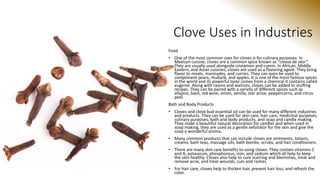
• One of the most common uses for cloves is for culinary purposes. In
Mexican cuisine, cloves are a common spice known as “clavos de olor”.
They are usually used alongside cinnamon and cumin. In African, Middle
Eastern, and Asian cuisines, cloves are used as a flavoring agent. They bring
flavor to meats, marinades, and curries. They can even be used to
compliment pears, rhubarb, and apples. It is one of the most famous spices
in the world and its powerful taste comes from a chemical it contains called
eugenol. Along with raisins and walnuts, cloves can be added to stuffing
recipes. They can be paired with a variety of different spices such as
allspice, basil, red wine, onion, vanilla, star anise, peppercorns, and citrus
peel.
Bath and Body Products
• Cloves and clove bud essential oil can be used for many different industries
and products. They can be used for skin care, hair care, medicinal purposes,
culinary purposes, bath and body products, and soap and candle making.
They make a beautiful natural decoration for candles and when used in
soap making, they are used as a gentle exfoliator for the skin and give the
soap a wonderful aroma.
• Many common products that can include cloves are ointments, lotions,
creams, bath teas, massage oils, bath bombs, scrubs, and hair conditioners.
• There are many skin care benefits to using cloves. They contain vitamins C
and A, potassium, phosphorous, iron, and sodium which all help to keep
the skin healthy. Cloves also help to cure scarring and blemishes, treat and
remove acne, and treat wounds, cuts and rashes.
• For hair care, cloves help to thicken hair, prevent hair loss, and refresh the
color.
Uses in Industries
Cont.
Medicinal
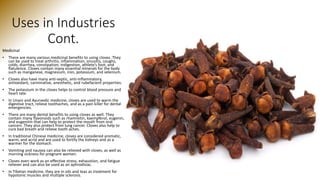
• There are many various medicinal benefits to using cloves. They
can be used to treat arthritis, inflammation, sinusitis, coughs,
colds, diarrhea, constipation, indigestion, athlete’s foot, and
flatulence. Cloves contain many essential minerals for the body
such as manganese, magnesium, iron, potassium, and selenium.
• Cloves also have many anti-septic, anti-inflammatory,
antioxidant, carminative, anesthetic, and rubefacient properties.
• The potassium in the cloves helps to control blood pressure and
heart rate.
• In Unani and Ayurvedic medicine, cloves are used to warm the
digestive tract, relieve toothaches, and as a pain killer for dental
emergencies.
• There are many dental benefits to using cloves as well. They
contain many flavonoids such as rhamnetin, kaempferol, eugenin,
and eugenitin that can help to protect the mouth from oral
cancers. They also protect from lung cancer. Cloves also help to
cure bad breath and relieve tooth aches.
• In traditional Chinese medicine, cloves are considered aromatic,
warm, and acrid and are used to fortify the kidneys and as a
warmer for the stomach.
• Vomiting and nausea can also be relieved with cloves, as well as
morning sickness for pregnant women.
• Cloves even work as an effective stress, exhaustion, and fatigue
reliever and can also be used as an aphrodisiac.
• In Tibetan medicine, they are in oils and teas as treatment for
hypotonic muscles and multiple sclerosis.
Other Uses
• Cloves can actually be used as a natural insect repellant.
• In Indonesia, cloves are used as a spice for cigarettes. These
cigarettes are called kretek.
• Nature’s Garden sells cloves and clove bud essential oil for
external use only. We do not sell it as a food item. The
information above talks about how great cloves are for
many industries, however we only sell them for external
use. We provide this data for educational purposes only.
Nothing in this article is to be construed as medical advice.
Please consult your doctor before using this product or any
of this information for treatment purposes.
• Are you looking for some new and exciting projects to try?
Check out all of our free classes and recipes!
www.naturesgardencandles.com

Clove class

  • 1.
  • 2.
    Cloves • Syzygium aromaticum,or more commonly known as clove, is the name of the aromatic unopened flower buds that come from the evergreen tree. The flowers are used mainly for culinary reasons as a spice. The evergreen tree is a member of the family Myrtaceae and the genus Syzygium. The English word “clove” actually is derived from the Latin word “clavus” meaning “nail.” Clove or evergreen trees are native to the Maluku Islands in Indonesia, however they are also commercially harvested from India, Sri Lanka, Tanzania, Pakistan, Zanzibar, and Madagascar. Evidence of clove use has been found in Syria dating all the way back to 1721 B.C. Did you know that the oldest clove tree in the world is between 350 and 400 years old? It is found in the Maluku Islands on the island of Ternate, and has been named Afo. • Evergreen trees typically can grow anywhere from 26-50 feet tall. They have large oval shaped leaves with a gray colored bark. The actual flower buds start out as a pale color, gradually changing to green as they grow and then into a beautiful bright red color. The bright red colors signals that they are ready to be harvested. Cloves consist of a long calyx that terminates in four unopened petals and four spreading sepals. When they are ready for harvest they are about half an inch long and a quarter of an inch in diameter. • Cloves can be used for many different products and industries. While they are mainly used for culinary and their medicinal purposes, they can also be used for bath and body products, soaping, candle making, hair care, and skin care. Common products they can be used in are conditioners, potpourri, scrubs, bath teas, bath bombs, massage oils, lotions, soaps, ointments, and creams. Did you know that in the third century B.C. a leader in the Chinese Hang Dynasty required that anyone who addressed him chew cloves first to freshen their breath?
  • 3.
    Growing Conditions • Evergreentrees are perennial and like any plant, have their own specific growth conditions. They prefer to be in wet tropical areas with rich clay-like soils. However, they can also grow and survive in areas with hard red soils but they need good drainage no matter what areas they are in. They also prefer to be in areas with rainfall that have partial shade. They thrive best when planted in areas with climates like that of the Maluku Islands. • The process of growing and harvesting the actual cloves is not a fast one. While the trees themselves are perennial, they actually have an extremely long growing period of 20 years. After the twenty years, the actual clove flowers will begin to form. When the cloves are the bright red color and ready to harvest, they can be picked and collected through the spring and winter seasons if in tropical areas. After harvesting, the flowers are removed from the stalks and left to sun dry for 4 to 6 days. If the stalks are left to dry as well, they can also be used for oil distillation to make essential oil. • There are a some pests and diseases that can affect the tree. A fungus called dieback can travel through wounded or infected parts of the tree and kill the branches of the tree. They can also suffer from Sumatra disease and soft scale. Soft scale will cause the leaves to wilt and reduces the viability of the tree. Many nematodes and Oriental fruit flies also can affect the trees.
  • 4.
    Clove Uses inIndustries Food • One of the most common uses for cloves is for culinary purposes. In Mexican cuisine, cloves are a common spice known as “clavos de olor”. They are usually used alongside cinnamon and cumin. In African, Middle Eastern, and Asian cuisines, cloves are used as a flavoring agent. They bring flavor to meats, marinades, and curries. They can even be used to compliment pears, rhubarb, and apples. It is one of the most famous spices in the world and its powerful taste comes from a chemical it contains called eugenol. Along with raisins and walnuts, cloves can be added to stuffing recipes. They can be paired with a variety of different spices such as allspice, basil, red wine, onion, vanilla, star anise, peppercorns, and citrus peel. Bath and Body Products • Cloves and clove bud essential oil can be used for many different industries and products. They can be used for skin care, hair care, medicinal purposes, culinary purposes, bath and body products, and soap and candle making. They make a beautiful natural decoration for candles and when used in soap making, they are used as a gentle exfoliator for the skin and give the soap a wonderful aroma. • Many common products that can include cloves are ointments, lotions, creams, bath teas, massage oils, bath bombs, scrubs, and hair conditioners. • There are many skin care benefits to using cloves. They contain vitamins C and A, potassium, phosphorous, iron, and sodium which all help to keep the skin healthy. Cloves also help to cure scarring and blemishes, treat and remove acne, and treat wounds, cuts and rashes. • For hair care, cloves help to thicken hair, prevent hair loss, and refresh the color.
  • 5.
    Uses in Industries Cont. Medicinal •There are many various medicinal benefits to using cloves. They can be used to treat arthritis, inflammation, sinusitis, coughs, colds, diarrhea, constipation, indigestion, athlete’s foot, and flatulence. Cloves contain many essential minerals for the body such as manganese, magnesium, iron, potassium, and selenium. • Cloves also have many anti-septic, anti-inflammatory, antioxidant, carminative, anesthetic, and rubefacient properties. • The potassium in the cloves helps to control blood pressure and heart rate. • In Unani and Ayurvedic medicine, cloves are used to warm the digestive tract, relieve toothaches, and as a pain killer for dental emergencies. • There are many dental benefits to using cloves as well. They contain many flavonoids such as rhamnetin, kaempferol, eugenin, and eugenitin that can help to protect the mouth from oral cancers. They also protect from lung cancer. Cloves also help to cure bad breath and relieve tooth aches. • In traditional Chinese medicine, cloves are considered aromatic, warm, and acrid and are used to fortify the kidneys and as a warmer for the stomach. • Vomiting and nausea can also be relieved with cloves, as well as morning sickness for pregnant women. • Cloves even work as an effective stress, exhaustion, and fatigue reliever and can also be used as an aphrodisiac. • In Tibetan medicine, they are in oils and teas as treatment for hypotonic muscles and multiple sclerosis.
  • 6.
    Other Uses • Clovescan actually be used as a natural insect repellant. • In Indonesia, cloves are used as a spice for cigarettes. These cigarettes are called kretek. • Nature’s Garden sells cloves and clove bud essential oil for external use only. We do not sell it as a food item. The information above talks about how great cloves are for many industries, however we only sell them for external use. We provide this data for educational purposes only. Nothing in this article is to be construed as medical advice. Please consult your doctor before using this product or any of this information for treatment purposes. • Are you looking for some new and exciting projects to try? Check out all of our free classes and recipes! www.naturesgardencandles.com