

FenugreekFenugreek
Description
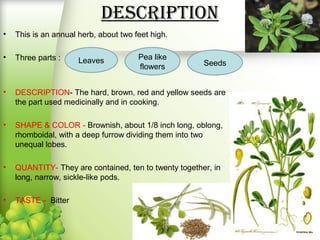
• This is an annual herb, about two feet high.
• Three parts :
• DESCRIPTION- The hard, brown, red and yellow seeds are
the part used medicinally and in cooking.
• SHAPE & COLOR - Brownish, about 1/8 inch long, oblong,
rhomboidal, with a deep furrow dividing them into two
unequal lobes.
• QUANTITY- They are contained, ten to twenty together, in
long, narrow, sickle-like pods.
• TASTE - Bitter
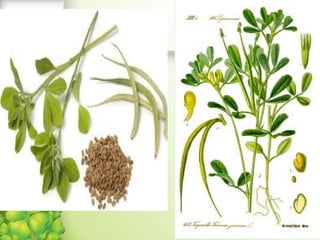
Leaves Pea like
flowers Seeds
HistorY
• Used since ancient times in Egypt, Greece and Rome,
fenugreek seeds were said to be almost a panacea (good for
everything)
• Fenugreek is one of the oldest medicinal plants in history; a
description of this plant was found on the Ebers Papyrus
1550 BC Egypt
• Fenugreek seeds have been recovered from Tell Halal, Iraq,
(carbon dated to 4000 BC) Bronze Age levels.
• Through the times, been used for a variety of health
conditions.
• Fenugreek has been around for thousands of years and used
as a medicine, spice, and food for both humans and
animals.
FenUGreeK
seeDs
FenUGreeK
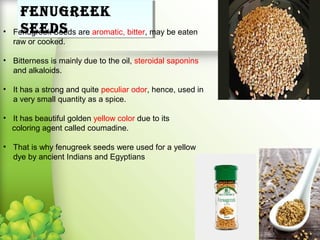
seeDs• Fenugreek Seeds are aromatic, bitter, may be eaten
raw or cooked.
• Bitterness is mainly due to the oil, steroidal saponins
and alkaloids.
• It has a strong and quite peculiar odor, hence, used in
a very small quantity as a spice.
• It has beautiful golden yellow color due to its
coloring agent called coumadine.
• That is why fenugreek seeds were used for a yellow
dye by ancient Indians and Egyptians
classiFication
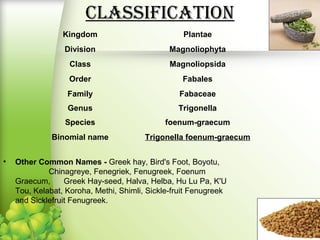
• Other Common Names - Greek hay, Bird's Foot, Boyotu,
Chinagreye, Fenegriek, Fenugreek, Foenum
Graecum, Greek Hay-seed, Halva, Helba, Hu Lu Pa, K'U
Tou, Kelabat, Koroha, Methi, Shimli, Sickle-fruit Fenugreek
and Sicklefruit Fenugreek.
Kingdom Plantae
Division Magnoliophyta
Class Magnoliopsida
Order Fabales
Family Fabaceae
Genus Trigonella
Species foenum-graecum
Binomial name Trigonella foenum-graecum
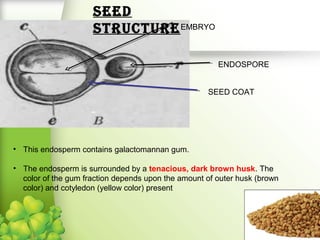
EMBRYO
ENDOSPORE
SEED COAT
SEED
STRUCTURE
• This endosperm contains galactomannan gum.
• The endosperm is surrounded by a tenacious, dark brown husk. The
color of the gum fraction depends upon the amount of outer husk (brown
color) and cotyledon (yellow color) present
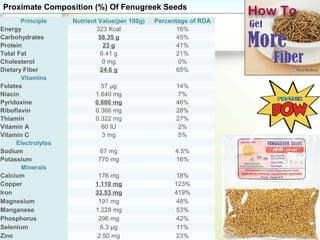
Proximate Composition (%) Of Fenugreek SeedsProximate Composition (%) Of Fenugreek Seeds
Principle Nutrient Value(per 100g) Percentage of RDA
Energy 323 Kcal 16%
Carbohydrates 58.35 g 45%
Protein 23 g 41%
Total Fat 6.41 g 21%
Cholesterol 0 mg 0%
Dietary Fiber 24.6 g 65%
Vitamins
Folates 57 µg 14%
Niacin 1.640 mg 7%
Pyridoxine 0.600 mg 46%
Riboflavin 0.366 mg 28%
Thiamin 0.322 mg 27%
Vitamin A 60 IU 2%
Vitamin C 3 mg 5%
Electrolytes
Sodium 67 mg 4.5%
Potassium 770 mg 16%
Minerals
Calcium 176 mg 18%
Copper 1.110 mg 123%
Iron 33.53 mg 419%
Magnesium 191 mg 48%
Manganese 1.228 mg 53%
Phosphorus 296 mg 42%
Selenium 6.3 µg 11%
Zinc 2.50 mg 23%
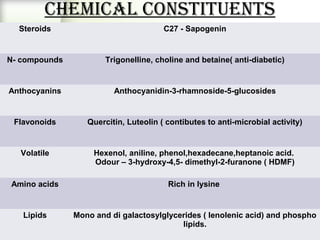
ChEmiCal ConSTiTUEnTS
Steroids C27 - Sapogenin
N- compounds Trigonelline, choline and betaine( anti-diabetic)
Anthocyanins Anthocyanidin-3-rhamnoside-5-glucosides
Flavonoids Quercitin, Luteolin ( contibutes to anti-microbial activity)
Volatile Hexenol, aniline, phenol,hexadecane,heptanoic acid.
Odour – 3-hydroxy-4,5- dimethyl-2-furanone ( HDMF)
Amino acids Rich in lysine
Lipids Mono and di galactosylglycerides ( lenolenic acid) and phospho
lipids.
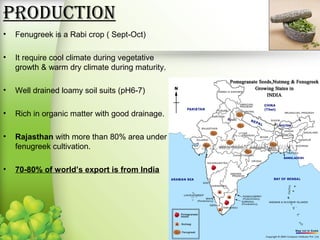
PRoDUCTion
• Fenugreek is a Rabi crop ( Sept-Oct)
• It require cool climate during vegetative
growth & warm dry climate during maturity.
• Well drained loamy soil suits (pH6-7)
• Rich in organic matter with good drainage.
• Rajasthan with more than 80% area under
fenugreek cultivation.
• 70-80% of world’s export is from India
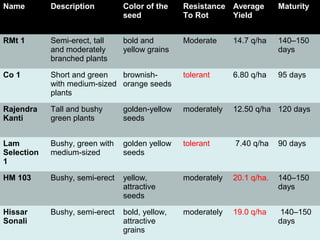
Name Description Color of the
seed
Resistance
To Rot
Average
Yield
Maturity
RMt 1 Semi-erect, tall
and moderately
branched plants
bold and
yellow grains
Moderate 14.7 q/ha 140–150
days
Co 1 Short and green
with medium-sized
plants
brownish-
orange seeds
tolerant 6.80 q/ha 95 days
Rajendra
Kanti
Tall and bushy
green plants
golden-yellow
seeds
moderately 12.50 q/ha 120 days
Lam
Selection
1
Bushy, green with
medium-sized
golden yellow
seeds
tolerant 7.40 q/ha 90 days
HM 103 Bushy, semi-erect yellow,
attractive
seeds
moderately 20.1 q/ha. 140–150
days
Hissar
Sonali
Bushy, semi-erect bold, yellow,
attractive
grains
moderately 19.0 q/ha 140–150
days
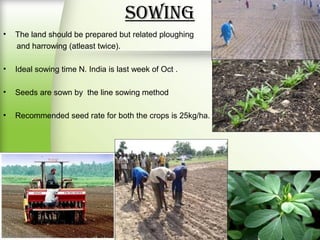
Sowing
• The land should be prepared but related ploughing
and harrowing (atleast twice).
• Ideal sowing time N. India is last week of Oct .
• Seeds are sown by the line sowing method
• Recommended seed rate for both the crops is 25kg/ha.
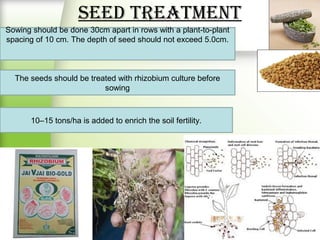
Seed treatment
The seeds should be treated with rhizobium culture before
sowing
Sowing should be done 30cm apart in rows with a plant-to-plant
spacing of 10 cm. The depth of seed should not exceed 5.0cm.
10–15 tons/ha is added to enrich the soil fertility.
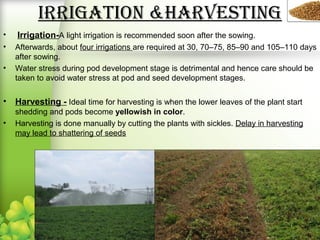
IrrIGatIOn &HarVeStInG
• Irrigation-A light irrigation is recommended soon after the sowing.
• Afterwards, about four irrigations are required at 30, 70–75, 85–90 and 105–110 days
after sowing.
• Water stress during pod development stage is detrimental and hence care should be
taken to avoid water stress at pod and seed development stages.
• Harvesting - Ideal time for harvesting is when the lower leaves of the plant start
shedding and pods become yellowish in color.
• Harvesting is done manually by cutting the plants with sickles. Delay in harvesting
may lead to shattering of seeds
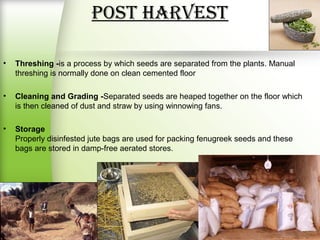
POSt HarVeSt
• Threshing -is a process by which seeds are separated from the plants. Manual
threshing is normally done on clean cemented floor
• Cleaning and Grading -Separated seeds are heaped together on the floor which
is then cleaned of dust and straw by using winnowing fans.
• Storage
Properly disinfested jute bags are used for packing fenugreek seeds and these
bags are stored in damp-free aerated stores.
FENUGREEK SEED USESFENUGREEK SEED USES
FENUGREEK
GALACTOMANNAN
Various industrial applications.
SAPONINS
(DIOSGENIN)
 Flavoring, sweetening, antioxidant, foaming,
complexing, sequestration, anticarcinogenic and
antimicrobial properties
That’s why they are used as nutraceutical in food,
drug, health food and cosmetic industry
FENUGREEK
OLEORESINS
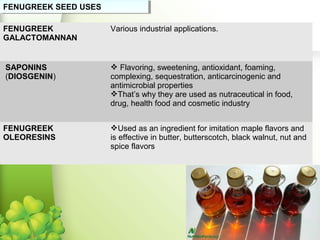
Used as an ingredient for imitation maple flavors and
is effective in butter, butterscotch, black walnut, nut and
spice flavors
IndUStrIaL PrOCeSS
• Destoning - Reliable removal of high-density impurities such as stones and pieces of
metal and glass is achieved on the basis of differences in specific gravity. (Destoner
MTSC)
• Combinator- For the classification of grain into heavy, and removal of light impurities
with additional destoning. (MTKB - Combi-Cleaner with air-cycling system)
• Separation and Classification - Classifies various products according to
size.Excellent separating efficiency. (Buhler Separator Classifier MTRB with
aspiration channel MVSH)
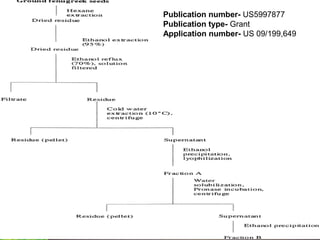
Publication number- US5997877
Publication type- Grant
Application number- US 09/199,649
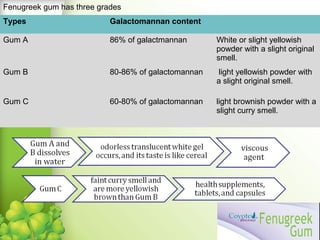
Types Galactomannan content
Gum A 86% of galactmannan White or slight yellowish
powder with a slight original
smell.
Gum B 80-86% of galactomannan light yellowish powder with
a slight original smell.
Gum C 60-80% of galactomannan light brownish powder with a
slight curry smell.
Fenugreek gum has three grades
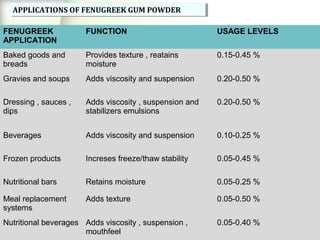
FENUGREEK
APPLICATION
FUNCTION USAGE LEVELS
Baked goods and
breads
Provides texture , reatains
moisture
0.15-0.45 %
Gravies and soups Adds viscosity and suspension 0.20-0.50 %
Dressing , sauces ,
dips
Adds viscosity , suspension and
stabilizers emulsions
0.20-0.50 %
Beverages Adds viscosity and suspension 0.10-0.25 %
Frozen products Increses freeze/thaw stability 0.05-0.45 %
Nutritional bars Retains moisture 0.05-0.25 %
Meal replacement
systems
Adds texture 0.05-0.50 %
Nutritional beverages Adds viscosity , suspension ,
mouthfeel
0.05-0.40 %
APPLICATIONS OF FENUGREEK GUM POWDERAPPLICATIONS OF FENUGREEK GUM POWDER
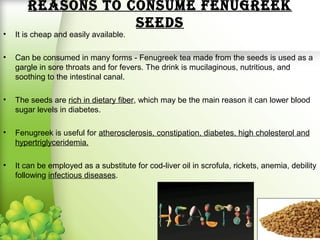
Reasons to consume fenugReek
seeds
• It is cheap and easily available.
• Can be consumed in many forms - Fenugreek tea made from the seeds is used as a
gargle in sore throats and for fevers. The drink is mucilaginous, nutritious, and
soothing to the intestinal canal.
• The seeds are rich in dietary fiber, which may be the main reason it can lower blood
sugar levels in diabetes.
• Fenugreek is useful for atherosclerosis, constipation, diabetes, high cholesterol and
hypertriglyceridemia.
• It can be employed as a substitute for cod-liver oil in scrofula, rickets, anemia, debility
following infectious diseases.
Fenugreek 140223114554-phpapp02

Fenugreek 140223114554-phpapp02

  • 1.
  • 2.
    Description • This isan annual herb, about two feet high. • Three parts : • DESCRIPTION- The hard, brown, red and yellow seeds are the part used medicinally and in cooking. • SHAPE & COLOR - Brownish, about 1/8 inch long, oblong, rhomboidal, with a deep furrow dividing them into two unequal lobes. • QUANTITY- They are contained, ten to twenty together, in long, narrow, sickle-like pods. • TASTE - Bitter Leaves Pea like flowers Seeds
  • 4.
    HistorY • Used sinceancient times in Egypt, Greece and Rome, fenugreek seeds were said to be almost a panacea (good for everything) • Fenugreek is one of the oldest medicinal plants in history; a description of this plant was found on the Ebers Papyrus 1550 BC Egypt • Fenugreek seeds have been recovered from Tell Halal, Iraq, (carbon dated to 4000 BC) Bronze Age levels. • Through the times, been used for a variety of health conditions. • Fenugreek has been around for thousands of years and used as a medicine, spice, and food for both humans and animals.
  • 5.
    FenUGreeK seeDs FenUGreeK seeDs• Fenugreek Seedsare aromatic, bitter, may be eaten raw or cooked. • Bitterness is mainly due to the oil, steroidal saponins and alkaloids. • It has a strong and quite peculiar odor, hence, used in a very small quantity as a spice. • It has beautiful golden yellow color due to its coloring agent called coumadine. • That is why fenugreek seeds were used for a yellow dye by ancient Indians and Egyptians
  • 6.
    classiFication • Other CommonNames - Greek hay, Bird's Foot, Boyotu, Chinagreye, Fenegriek, Fenugreek, Foenum Graecum, Greek Hay-seed, Halva, Helba, Hu Lu Pa, K'U Tou, Kelabat, Koroha, Methi, Shimli, Sickle-fruit Fenugreek and Sicklefruit Fenugreek. Kingdom Plantae Division Magnoliophyta Class Magnoliopsida Order Fabales Family Fabaceae Genus Trigonella Species foenum-graecum Binomial name Trigonella foenum-graecum
  • 7.
    EMBRYO ENDOSPORE SEED COAT SEED STRUCTURE • Thisendosperm contains galactomannan gum. • The endosperm is surrounded by a tenacious, dark brown husk. The color of the gum fraction depends upon the amount of outer husk (brown color) and cotyledon (yellow color) present
  • 8.
    Proximate Composition (%)Of Fenugreek SeedsProximate Composition (%) Of Fenugreek Seeds Principle Nutrient Value(per 100g) Percentage of RDA Energy 323 Kcal 16% Carbohydrates 58.35 g 45% Protein 23 g 41% Total Fat 6.41 g 21% Cholesterol 0 mg 0% Dietary Fiber 24.6 g 65% Vitamins Folates 57 µg 14% Niacin 1.640 mg 7% Pyridoxine 0.600 mg 46% Riboflavin 0.366 mg 28% Thiamin 0.322 mg 27% Vitamin A 60 IU 2% Vitamin C 3 mg 5% Electrolytes Sodium 67 mg 4.5% Potassium 770 mg 16% Minerals Calcium 176 mg 18% Copper 1.110 mg 123% Iron 33.53 mg 419% Magnesium 191 mg 48% Manganese 1.228 mg 53% Phosphorus 296 mg 42% Selenium 6.3 µg 11% Zinc 2.50 mg 23%
  • 9.
    ChEmiCal ConSTiTUEnTS Steroids C27- Sapogenin N- compounds Trigonelline, choline and betaine( anti-diabetic) Anthocyanins Anthocyanidin-3-rhamnoside-5-glucosides Flavonoids Quercitin, Luteolin ( contibutes to anti-microbial activity) Volatile Hexenol, aniline, phenol,hexadecane,heptanoic acid. Odour – 3-hydroxy-4,5- dimethyl-2-furanone ( HDMF) Amino acids Rich in lysine Lipids Mono and di galactosylglycerides ( lenolenic acid) and phospho lipids.
  • 10.
    PRoDUCTion • Fenugreek isa Rabi crop ( Sept-Oct) • It require cool climate during vegetative growth & warm dry climate during maturity. • Well drained loamy soil suits (pH6-7) • Rich in organic matter with good drainage. • Rajasthan with more than 80% area under fenugreek cultivation. • 70-80% of world’s export is from India
  • 11.
    Name Description Colorof the seed Resistance To Rot Average Yield Maturity RMt 1 Semi-erect, tall and moderately branched plants bold and yellow grains Moderate 14.7 q/ha 140–150 days Co 1 Short and green with medium-sized plants brownish- orange seeds tolerant 6.80 q/ha 95 days Rajendra Kanti Tall and bushy green plants golden-yellow seeds moderately 12.50 q/ha 120 days Lam Selection 1 Bushy, green with medium-sized golden yellow seeds tolerant 7.40 q/ha 90 days HM 103 Bushy, semi-erect yellow, attractive seeds moderately 20.1 q/ha. 140–150 days Hissar Sonali Bushy, semi-erect bold, yellow, attractive grains moderately 19.0 q/ha 140–150 days
  • 12.
    Sowing • The landshould be prepared but related ploughing and harrowing (atleast twice). • Ideal sowing time N. India is last week of Oct . • Seeds are sown by the line sowing method • Recommended seed rate for both the crops is 25kg/ha.
  • 13.
    Seed treatment The seedsshould be treated with rhizobium culture before sowing Sowing should be done 30cm apart in rows with a plant-to-plant spacing of 10 cm. The depth of seed should not exceed 5.0cm. 10–15 tons/ha is added to enrich the soil fertility.
  • 14.
    IrrIGatIOn &HarVeStInG • Irrigation-Alight irrigation is recommended soon after the sowing. • Afterwards, about four irrigations are required at 30, 70–75, 85–90 and 105–110 days after sowing. • Water stress during pod development stage is detrimental and hence care should be taken to avoid water stress at pod and seed development stages. • Harvesting - Ideal time for harvesting is when the lower leaves of the plant start shedding and pods become yellowish in color. • Harvesting is done manually by cutting the plants with sickles. Delay in harvesting may lead to shattering of seeds
  • 15.
    POSt HarVeSt • Threshing-is a process by which seeds are separated from the plants. Manual threshing is normally done on clean cemented floor • Cleaning and Grading -Separated seeds are heaped together on the floor which is then cleaned of dust and straw by using winnowing fans. • Storage Properly disinfested jute bags are used for packing fenugreek seeds and these bags are stored in damp-free aerated stores.
  • 16.
    FENUGREEK SEED USESFENUGREEKSEED USES FENUGREEK GALACTOMANNAN Various industrial applications. SAPONINS (DIOSGENIN)  Flavoring, sweetening, antioxidant, foaming, complexing, sequestration, anticarcinogenic and antimicrobial properties That’s why they are used as nutraceutical in food, drug, health food and cosmetic industry FENUGREEK OLEORESINS Used as an ingredient for imitation maple flavors and is effective in butter, butterscotch, black walnut, nut and spice flavors
  • 17.
    IndUStrIaL PrOCeSS • Destoning- Reliable removal of high-density impurities such as stones and pieces of metal and glass is achieved on the basis of differences in specific gravity. (Destoner MTSC) • Combinator- For the classification of grain into heavy, and removal of light impurities with additional destoning. (MTKB - Combi-Cleaner with air-cycling system) • Separation and Classification - Classifies various products according to size.Excellent separating efficiency. (Buhler Separator Classifier MTRB with aspiration channel MVSH)
  • 18.
    Publication number- US5997877 Publicationtype- Grant Application number- US 09/199,649
  • 19.
    Types Galactomannan content GumA 86% of galactmannan White or slight yellowish powder with a slight original smell. Gum B 80-86% of galactomannan light yellowish powder with a slight original smell. Gum C 60-80% of galactomannan light brownish powder with a slight curry smell. Fenugreek gum has three grades
  • 20.
    FENUGREEK APPLICATION FUNCTION USAGE LEVELS Bakedgoods and breads Provides texture , reatains moisture 0.15-0.45 % Gravies and soups Adds viscosity and suspension 0.20-0.50 % Dressing , sauces , dips Adds viscosity , suspension and stabilizers emulsions 0.20-0.50 % Beverages Adds viscosity and suspension 0.10-0.25 % Frozen products Increses freeze/thaw stability 0.05-0.45 % Nutritional bars Retains moisture 0.05-0.25 % Meal replacement systems Adds texture 0.05-0.50 % Nutritional beverages Adds viscosity , suspension , mouthfeel 0.05-0.40 % APPLICATIONS OF FENUGREEK GUM POWDERAPPLICATIONS OF FENUGREEK GUM POWDER
  • 21.
    Reasons to consumefenugReek seeds • It is cheap and easily available. • Can be consumed in many forms - Fenugreek tea made from the seeds is used as a gargle in sore throats and for fevers. The drink is mucilaginous, nutritious, and soothing to the intestinal canal. • The seeds are rich in dietary fiber, which may be the main reason it can lower blood sugar levels in diabetes. • Fenugreek is useful for atherosclerosis, constipation, diabetes, high cholesterol and hypertriglyceridemia. • It can be employed as a substitute for cod-liver oil in scrofula, rickets, anemia, debility following infectious diseases.

Editor's Notes

  • #6 In Fenugreek seeds, the gum (gel fiber) fraction consists of galactomannan which is made up of galactose and mannose units. The gum also resembles guar gum in structure and is very viscous (15 centipoise) when dissoved in water. The neutral detergent fiber is made up of indigestible carbohydrates such as cellulose, hemicellulose and lignin. According to Ribes et al (1984), the defatted fraction of fenugreek seeds contains 50.2% fiber and consists of 17.7% gum, 22% hemicellulose, 8.3% cellulose and 2.2% lignin.
  • #20 When Gum A and B dissolves in water, odorless translucent white gel occurs, and its taste is like cereal. When you use it as a viscous agent, we recommend that you use Gum A and B. Gum C are by-products of Gum A and B, which still have a faint curry smell and are more yellowish brown than Gum B. But if you use it for the things not to be dissolved in water like health supplements, tablets, and capsules. The use of Gum C is recommended because they are cheaper than Gum A and B. Gum A is purest gum and is used for cosmetic raw material.