Cloud Security:Threats & Mitgations
                         Vineet Mago
                       Naresh Khalasi
                              Vayana


                                   1
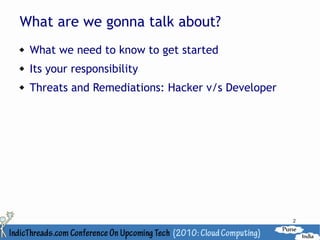
What are we gonna talk about?
   What we need to know to get started
   Its your responsibility
   Threats and Remediations: Hacker v/s Developer


                                                     2
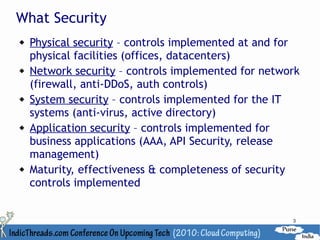
What Security
   Physical security – controls implemented at and for
    physical facilities (offices, datacenters)
   Network security – controls implemented for network
    (firewall, anti-DDoS, auth controls)
   System security – controls implemented for the IT
    systems (anti-virus, active directory)
   Application security – controls implemented for
    business applications (AAA, API Security, release
    management)
   Maturity, effectiveness & completeness of security
    controls implemented


                                                     3
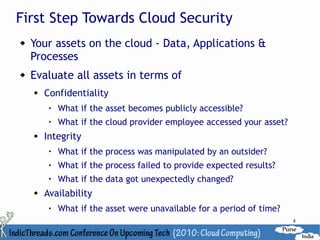
First Step Towards Cloud Security
   Your assets on the cloud - Data, Applications &
    Processes
   Evaluate all assets in terms of
       Confidentiality
            What if the asset becomes publicly accessible?
         
             What if the cloud provider employee accessed your asset?
       Integrity
            What if the process was manipulated by an outsider?
            What if the process failed to provide expected results?
         
             What if the data got unexpectedly changed?
       Availability
            What if the asset were unavailable for a period of time?
                                                                        4
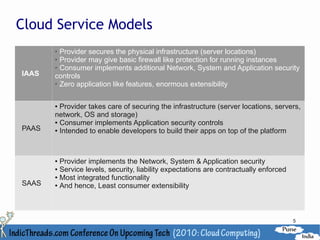
Cloud Service Models
       ➢ Provider secures the physical infrastructure (server locations)
       ➢ Provider may give basic firewall like protection for running instances

       ➢ Consumer implements additional Network, System and Application security

IAAS   controls
       ➢ Zero application like features, enormous extensibility


       ● Provider takes care of securing the infrastructure (server locations, servers,
       network, OS and storage)
       ● Consumer implements Application security controls

PAAS   ● Intended to enable developers to build their apps on top of the platform


       ● Provider implements the Network, System & Application security
       ● Service levels, security, liability expectations are contractually enforced

       ● Most integrated functionality

SAAS   ● And hence, Least consumer extensibility


                                                                                       5
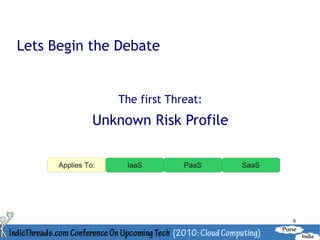
Lets Begin the Debate


                    The first Threat:
                Unknown Risk Profile

      Applies To:    IaaS        PaaS   SaaS


                                               6
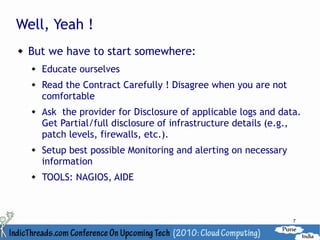
Well, Yeah !
   But we have to start somewhere:
       Educate ourselves
       Read the Contract Carefully ! Disagree when you are not
        comfortable
       Ask the provider for Disclosure of applicable logs and data.
        Get Partial/full disclosure of infrastructure details (e.g.,
        patch levels, firewalls, etc.).
       Setup best possible Monitoring and alerting on necessary
        information
       TOOLS: NAGIOS, AIDE


                                                                   7
Abuse and Nefarious Use of Cloud
Computing


      Applies To:   IaaS   PaaS    SaaS


                                          8
I choose my friends wisely!

   Look for providers with Stricter initial registration
    and validation processes.
   Check levels of credit card fraud monitoring and
    coordination used by the provider
   Is the provider capable of running a Comprehensive
    introspection of customer network traffic
   Monitor public blacklists for one’s own network
    blocks.


                                                            9
Insecure Interfaces and APIs


      Applies To:   IaaS   PaaS   SaaS


                                         10
Yeah, thats a tough one!

   Analyze the security model of cloud provider's
    interfaces.
   Ensure strong authentication and access controls are
    implemented in concert with encrypted transmission.
   Understand the Dependency Chain associated with
    the API.


                                                      11
Malicious Insiders


      Applies To:   IaaS   PaaS   SaaS


                                         12
You can trust no one !
   Enforce strict supply chain management and conduct
    a comprehensive supplier assessment.
   Specify human resource requirements as part of legal
    contracts.
   Require transparency into overall information
    security and management practices, as well as
    compliance reporting.
   Determine security breach notification processes


                                                       13
Shared Technology Issues


      Applies To:   IaaS   PaaS   SaaS


                                         14
Get your own Bag !
   Implement security best practices for installation/
    configuration.
   Monitor environment for unauthorized changes/
    activity.
   Promote strong authentication and access control for
    administrative access and operations.
   Enforce service level agreements for patching and
    vulnerability remediation.
   Conduct vulnerability scanning and configuration
    audits

                                                          15
Data Loss or Leakage


      Applies To:   IaaS   PaaS   SaaS


                                         16
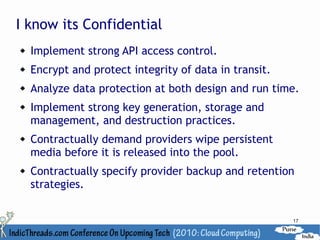
I know its Confidential
   Implement strong API access control.
   Encrypt and protect integrity of data in transit.
   Analyze data protection at both design and run time.
   Implement strong key generation, storage and
    management, and destruction practices.
   Contractually demand providers wipe persistent
    media before it is released into the pool.
   Contractually specify provider backup and retention
    strategies.


                                                        17
Account or Service Hijacking


      Applies To:   IaaS   PaaS   SaaS


                                         18
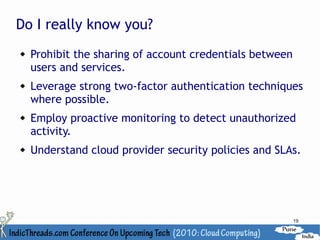
Do I really know you?
   Prohibit the sharing of account credentials between
    users and services.
   Leverage strong two-factor authentication techniques
    where possible.
   Employ proactive monitoring to detect unauthorized
    activity.
   Understand cloud provider security policies and SLAs.


                                                          19
“What do we do now?”


                       20
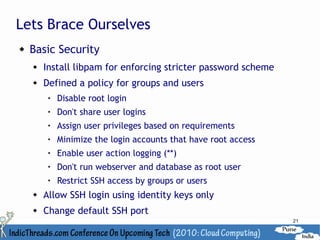
Lets Brace Ourselves
   Basic Security
       Install libpam for enforcing stricter password scheme
       Defined a policy for groups and users
            Disable root login
            Don't share user logins
            Assign user privileges based on requirements
         
             Minimize the login accounts that have root access
            Enable user action logging (**)
            Don't run webserver and database as root user
         
             Restrict SSH access by groups or users
       Allow SSH login using identity keys only
       Change default SSH port
                                                                 21
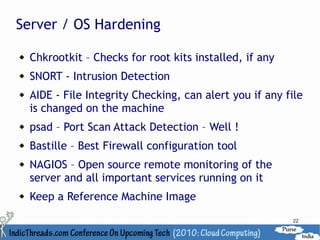
Server / OS Hardening

   Chkrootkit – Checks for root kits installed, if any
   SNORT - Intrusion Detection
   AIDE - File Integrity Checking, can alert you if any file
    is changed on the machine
   psad – Port Scan Attack Detection – Well !
   Bastille – Best Firewall configuration tool
   NAGIOS – Open source remote monitoring of the
    server and all important services running on it
   Keep a Reference Machine Image
                                                          22
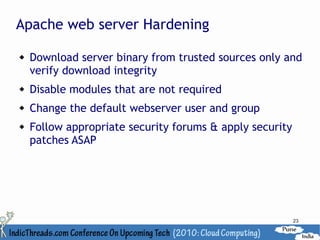
Apache web server Hardening

   Download server binary from trusted sources only and
    verify download integrity
   Disable modules that are not required
   Change the default webserver user and group
   Follow appropriate security forums & apply security
    patches ASAP


                                                          23
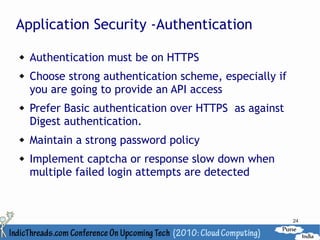
Application Security -Authentication

   Authentication must be on HTTPS
   Choose strong authentication scheme, especially if
    you are going to provide an API access
   Prefer Basic authentication over HTTPS as against
    Digest authentication.
   Maintain a strong password policy
   Implement captcha or response slow down when
    multiple failed login attempts are detected


                                                         24
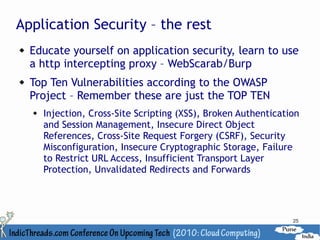
Application Security – the rest
   Educate yourself on application security, learn to use
    a http intercepting proxy – WebScarab/Burp
   Top Ten Vulnerabilities according to the OWASP
    Project – Remember these are just the TOP TEN
       Injection, Cross-Site Scripting (XSS), Broken Authentication
        and Session Management, Insecure Direct Object
        References, Cross-Site Request Forgery (CSRF), Security
        Misconfiguration, Insecure Cryptographic Storage, Failure
        to Restrict URL Access, Insufficient Transport Layer
        Protection, Unvalidated Redirects and Forwards


                                                                  25
What happens next?"
"I'm not sure, exactly. But this world is ours now.
      It's what we make of it." - 9 (2009)


                                                 26

Cloud Security:Threats & Mitgations

  • 1.
    Cloud Security:Threats &Mitgations Vineet Mago Naresh Khalasi Vayana 1
  • 2.
    What are wegonna talk about?  What we need to know to get started  Its your responsibility  Threats and Remediations: Hacker v/s Developer 2
  • 3.
    What Security  Physical security – controls implemented at and for physical facilities (offices, datacenters)  Network security – controls implemented for network (firewall, anti-DDoS, auth controls)  System security – controls implemented for the IT systems (anti-virus, active directory)  Application security – controls implemented for business applications (AAA, API Security, release management)  Maturity, effectiveness & completeness of security controls implemented 3
  • 4.
    First Step TowardsCloud Security  Your assets on the cloud - Data, Applications & Processes  Evaluate all assets in terms of  Confidentiality  What if the asset becomes publicly accessible?  What if the cloud provider employee accessed your asset?  Integrity  What if the process was manipulated by an outsider?  What if the process failed to provide expected results?  What if the data got unexpectedly changed?  Availability  What if the asset were unavailable for a period of time? 4
  • 5.
    Cloud Service Models ➢ Provider secures the physical infrastructure (server locations) ➢ Provider may give basic firewall like protection for running instances ➢ Consumer implements additional Network, System and Application security IAAS controls ➢ Zero application like features, enormous extensibility ● Provider takes care of securing the infrastructure (server locations, servers, network, OS and storage) ● Consumer implements Application security controls PAAS ● Intended to enable developers to build their apps on top of the platform ● Provider implements the Network, System & Application security ● Service levels, security, liability expectations are contractually enforced ● Most integrated functionality SAAS ● And hence, Least consumer extensibility 5
  • 6.
    Lets Begin theDebate The first Threat: Unknown Risk Profile Applies To: IaaS PaaS SaaS 6
  • 7.
    Well, Yeah !  But we have to start somewhere:  Educate ourselves  Read the Contract Carefully ! Disagree when you are not comfortable  Ask the provider for Disclosure of applicable logs and data. Get Partial/full disclosure of infrastructure details (e.g., patch levels, firewalls, etc.).  Setup best possible Monitoring and alerting on necessary information  TOOLS: NAGIOS, AIDE 7
  • 8.
    Abuse and NefariousUse of Cloud Computing Applies To: IaaS PaaS SaaS 8
  • 9.
    I choose myfriends wisely!  Look for providers with Stricter initial registration and validation processes.  Check levels of credit card fraud monitoring and coordination used by the provider  Is the provider capable of running a Comprehensive introspection of customer network traffic  Monitor public blacklists for one’s own network blocks. 9
  • 10.
    Insecure Interfaces andAPIs Applies To: IaaS PaaS SaaS 10
  • 11.
    Yeah, thats atough one!  Analyze the security model of cloud provider's interfaces.  Ensure strong authentication and access controls are implemented in concert with encrypted transmission.  Understand the Dependency Chain associated with the API. 11
  • 12.
    Malicious Insiders Applies To: IaaS PaaS SaaS 12
  • 13.
    You can trustno one !  Enforce strict supply chain management and conduct a comprehensive supplier assessment.  Specify human resource requirements as part of legal contracts.  Require transparency into overall information security and management practices, as well as compliance reporting.  Determine security breach notification processes 13
  • 14.
    Shared Technology Issues Applies To: IaaS PaaS SaaS 14
  • 15.
    Get your ownBag !  Implement security best practices for installation/ configuration.  Monitor environment for unauthorized changes/ activity.  Promote strong authentication and access control for administrative access and operations.  Enforce service level agreements for patching and vulnerability remediation.  Conduct vulnerability scanning and configuration audits 15
  • 16.
    Data Loss orLeakage Applies To: IaaS PaaS SaaS 16
  • 17.
    I know itsConfidential  Implement strong API access control.  Encrypt and protect integrity of data in transit.  Analyze data protection at both design and run time.  Implement strong key generation, storage and management, and destruction practices.  Contractually demand providers wipe persistent media before it is released into the pool.  Contractually specify provider backup and retention strategies. 17
  • 18.
    Account or ServiceHijacking Applies To: IaaS PaaS SaaS 18
  • 19.
    Do I reallyknow you?  Prohibit the sharing of account credentials between users and services.  Leverage strong two-factor authentication techniques where possible.  Employ proactive monitoring to detect unauthorized activity.  Understand cloud provider security policies and SLAs. 19
  • 20.
    “What do wedo now?” 20
  • 21.
    Lets Brace Ourselves  Basic Security  Install libpam for enforcing stricter password scheme  Defined a policy for groups and users  Disable root login  Don't share user logins  Assign user privileges based on requirements  Minimize the login accounts that have root access  Enable user action logging (**)  Don't run webserver and database as root user  Restrict SSH access by groups or users  Allow SSH login using identity keys only  Change default SSH port 21
  • 22.
    Server / OSHardening  Chkrootkit – Checks for root kits installed, if any  SNORT - Intrusion Detection  AIDE - File Integrity Checking, can alert you if any file is changed on the machine  psad – Port Scan Attack Detection – Well !  Bastille – Best Firewall configuration tool  NAGIOS – Open source remote monitoring of the server and all important services running on it  Keep a Reference Machine Image 22
  • 23.
    Apache web serverHardening  Download server binary from trusted sources only and verify download integrity  Disable modules that are not required  Change the default webserver user and group  Follow appropriate security forums & apply security patches ASAP 23
  • 24.
    Application Security -Authentication  Authentication must be on HTTPS  Choose strong authentication scheme, especially if you are going to provide an API access  Prefer Basic authentication over HTTPS as against Digest authentication.  Maintain a strong password policy  Implement captcha or response slow down when multiple failed login attempts are detected 24
  • 25.
    Application Security –the rest  Educate yourself on application security, learn to use a http intercepting proxy – WebScarab/Burp  Top Ten Vulnerabilities according to the OWASP Project – Remember these are just the TOP TEN  Injection, Cross-Site Scripting (XSS), Broken Authentication and Session Management, Insecure Direct Object References, Cross-Site Request Forgery (CSRF), Security Misconfiguration, Insecure Cryptographic Storage, Failure to Restrict URL Access, Insufficient Transport Layer Protection, Unvalidated Redirects and Forwards 25
  • 26.
    What happens next?" "I'mnot sure, exactly. But this world is ours now. It's what we make of it." - 9 (2009) 26