The Cloud Beckons, But is it Safe?
             April 2012
The Cloud
    Beckons, But is it
         Safe?
           #12NTCCSec


Laura Quinn
Michael Enos
Evaluate This Session!
Each entry is a chance to win an NTEN engraved iPad!


         or Online at www.nten.org/ntc/eval
Introductions
                 Laura Quinn
                 Executive Director
                 Idealware


                 Michael Enos
                 Chief Technology Officer,
                 Second Harvest Food Bank of Santa
                 Clara and San Mateo Counties


        What are you hoping to get out of this session?
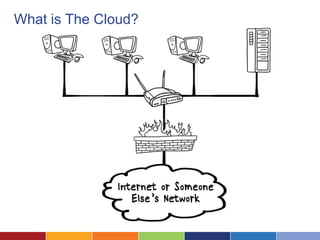
What is The Cloud?
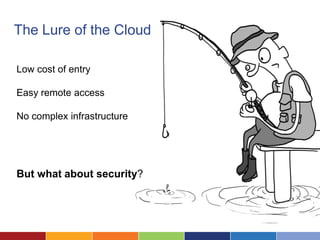
The Lure of the Cloud

Low cost of entry

Easy remote access

No complex infrastructure


But what about security?
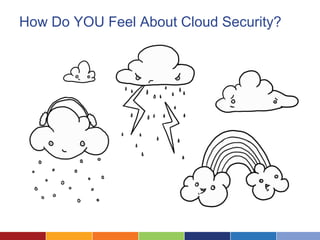
How Do YOU Feel About Cloud Security?
Why the Concern?
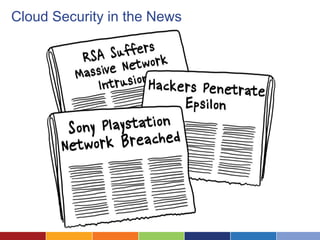
Cloud Security in the News
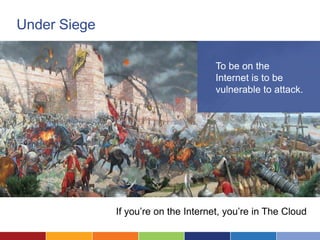
Under Siege

                                      To be on the
                                      Internet is to be
                                      vulnerable to attack.


              If you’re on the Internet, you’re in The Cloud
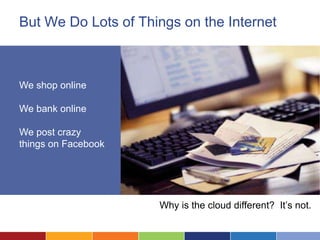
But We Do Lots of Things on the Internet


We shop online

We bank online

We post crazy
things on Facebook


                     Why is the cloud different? It’s not.
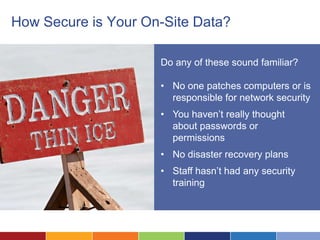
How Secure is Your On-Site Data?

                     Do any of these sound familiar?

                     • No one patches computers or is
                       responsible for network security
                     • You haven’t really thought
                       about passwords or
                       permissions
                     • No disaster recovery plans
                     • Staff hasn’t had any security
                       training
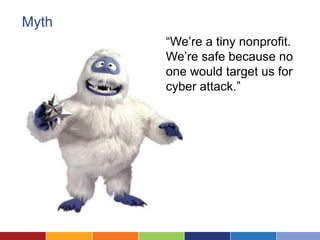
Myth
       “We’re a tiny nonprofit.
       We’re safe because no
       one would target us for
       cyber attack.”
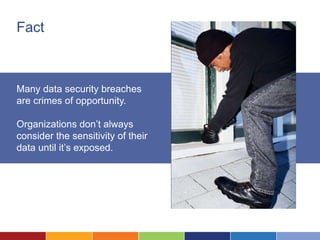
Fact


Many data security breaches
are crimes of opportunity.

Organizations don’t always
consider the sensitivity of their
data until it’s exposed.
Myth


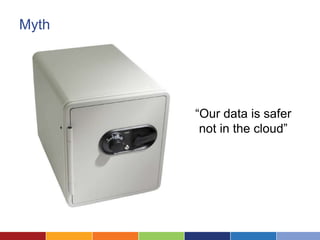
       “Our data is safer
        not in the cloud”
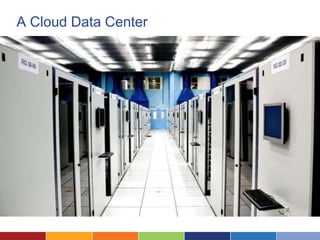
A Cloud Data Center
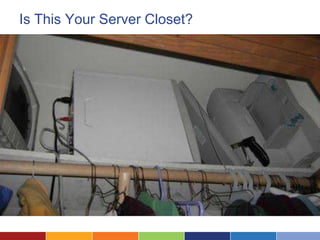
Is This Your Server Closet?
What Does Security Mean?
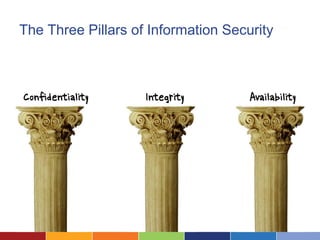
The Three Pillars of Information Security
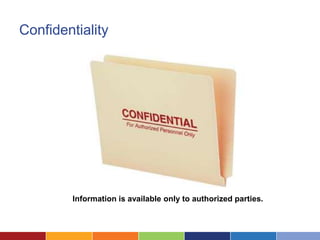
Confidentiality


        Information is available only to authorized parties.
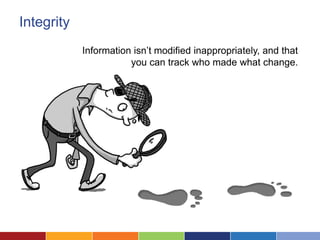
Integrity
            Information isn’t modified inappropriately, and that
                       you can track who made what change.
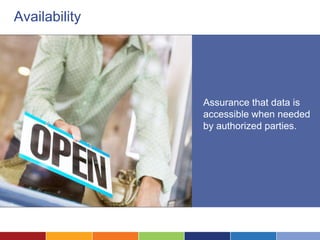
Availability


               Assurance that data is
               accessible when needed
               by authorized parties.
Also: Physical Possession


Whoever has the
data could, for
instance, turn it
over to the
government
How Does This Apply to the Cloud?
Cloud Security
The use of the term “Cloud” is cloudy!


Three general types of clouds:
   – Software-as-a-Service
   – Hosted Private Cloud
   – Co-located Private Cloud

All three have different security
models
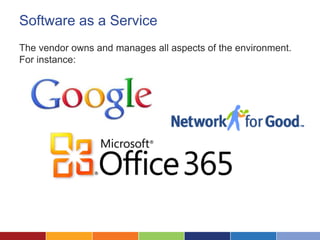
Software as a Service
The vendor owns and manages all aspects of the environment.
For instance:
Hosted Private Cloud
The vendor owns and manages the equipment only, but all
software is managed by the client. The equipment is on the
vendors network. For instance:
Co-located Private Cloud
The vendor provides the physical environment only in a data
center, the client maintains the hardware and the software. For
instance:
What Does Security Mean For You?
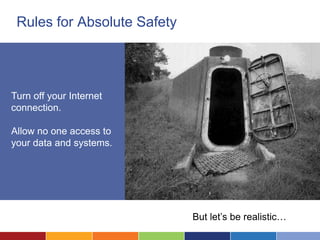
Rules for Absolute Safety


Turn off your Internet
connection.
Allow no one access to
your data and systems.


                             But let’s be realistic…
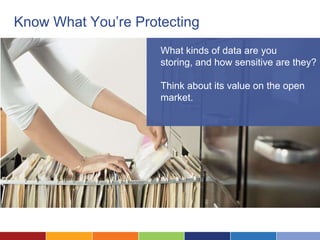
Know What You’re Protecting
                     What kinds of data are you
                     storing, and how sensitive are they?

                     Think about its value on the open
                     market.
Red Flags


            You need extremely tight
            security to store:

            • Donor’s credit card
              numbers.

            • Scanned images of checks.

            • Donor’s bank account
              information.
What’s Your Exposure?

Consider the impact of
exposure of your
confidential
information, both in
monetary terms and
reputation.
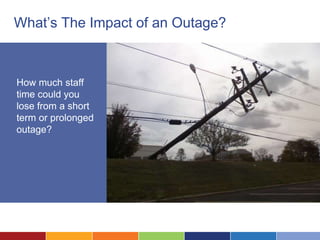
What’s The Impact of an Outage?


How much staff
time could you
lose from a short
term or prolonged
outage?
Testing Your On-Site Security

Have you recently performed a:

   • Check on whether your systems
     have been recently patched?
   • Systems penetration test ?
   • Employee training on security
     procedures?
   • Backup/recovery test?


If not, you’d likely increase your security by moving
to the cloud.
A Multi-Level Security Model
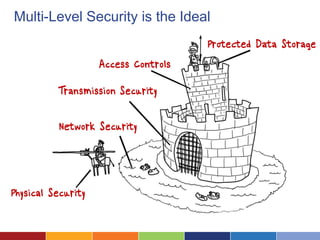
Multi-Level Security is the Ideal
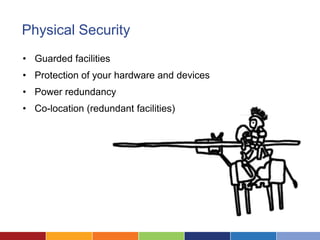
Physical Security
• Guarded facilities
• Protection of your hardware and devices
• Power redundancy
• Co-location (redundant facilities)
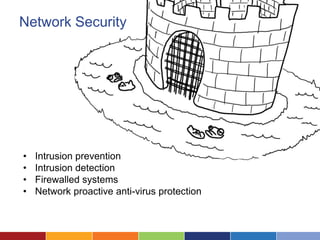
Network Security


•   Intrusion prevention
•   Intrusion detection
•   Firewalled systems
•   Network proactive anti-virus protection
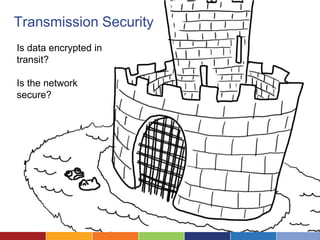
Transmission Security
Is data encrypted in
transit?

Is the network
secure?
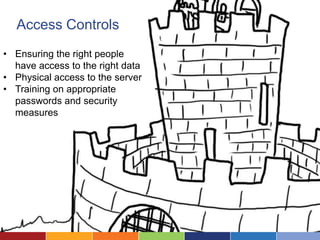
Access Controls
• Ensuring the right people
  have access to the right data
• Physical access to the server
• Training on appropriate
  passwords and security
  measures
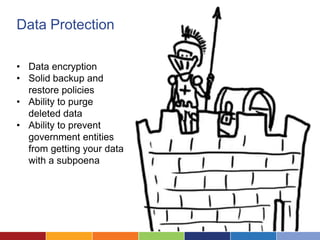
Data Protection

• Data encryption
• Solid backup and
  restore policies
• Ability to purge
  deleted data
• Ability to prevent
  government entities
  from getting your data
  with a subpoena
What to Look For in a Vendor
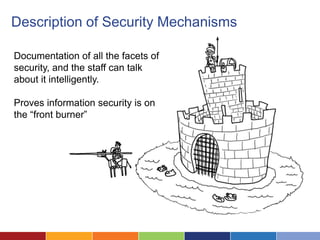
Description of Security Mechanisms

Documentation of all the facets of
security, and the staff can talk
about it intelligently.

Proves information security is on
the “front burner”
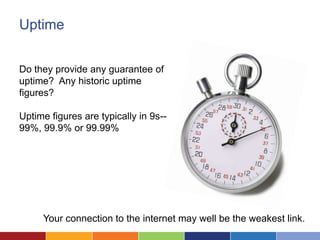
Uptime


Do they provide any guarantee of
uptime? Any historic uptime
figures?

Uptime figures are typically in 9s--
99%, 99.9% or 99.99%


     Your connection to the internet may well be the weakest link.
Regulatory Compliance: HIPAA


Does the vendor support
organizations that need to be
compliant with HIPAA (the
Health Insurance Portability
and Accountability Act)?
Regulatory Compliance: SAS70 and SSAE16


                       Audit for security
                       standards, hardware, and
                       processes.

                       Statement on Accounting
                       Standards 70 (SAS70)

                       Statement of Standards for
                       Attestation Engagements 16
                       (SSAE16)
Regulatory Compliance: PCI DSS Compliance


If you’re storing credit card
numbers, your vendor
needs to be compliant with
PCI DSS (Payment Card
Industry Payment Data
Security Standard)
In Summary
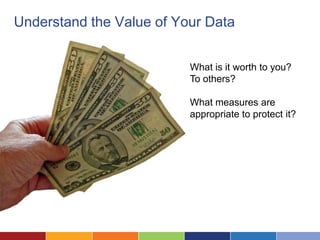
Understand the Value of Your Data


                          What is it worth to you?
                          To others?

                          What measures are
                          appropriate to protect it?
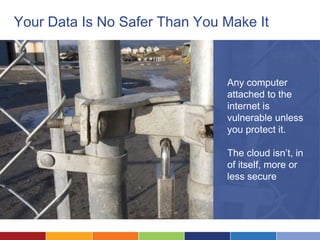
Your Data Is No Safer Than You Make It


                               Any computer
                               attached to the
                               internet is
                               vulnerable unless
                               you protect it.

                               The cloud isn’t, in
                               of itself, more or
                               less secure
But Many Vendors Make Your Data Really Safe


Choose vendors who
show they’re serious
about data protection
(not all vendors are
created equal).

Consider a vendor’s
regulatory compliance.
Questions?

Cloud Security - Idealware

  • 1.
    The Cloud Beckons,But is it Safe? April 2012
  • 2.
    The Cloud Beckons, But is it Safe? #12NTCCSec Laura Quinn Michael Enos
  • 3.
    Evaluate This Session! Eachentry is a chance to win an NTEN engraved iPad! or Online at www.nten.org/ntc/eval
  • 4.
    Introductions Laura Quinn Executive Director Idealware Michael Enos Chief Technology Officer, Second Harvest Food Bank of Santa Clara and San Mateo Counties What are you hoping to get out of this session?
  • 6.
  • 7.
    The Lure ofthe Cloud Low cost of entry Easy remote access No complex infrastructure But what about security?
  • 8.
    How Do YOUFeel About Cloud Security?
  • 9.
  • 10.
  • 11.
    Under Siege To be on the Internet is to be vulnerable to attack. If you’re on the Internet, you’re in The Cloud
  • 12.
    But We DoLots of Things on the Internet We shop online We bank online We post crazy things on Facebook Why is the cloud different? It’s not.
  • 13.
    How Secure isYour On-Site Data? Do any of these sound familiar? • No one patches computers or is responsible for network security • You haven’t really thought about passwords or permissions • No disaster recovery plans • Staff hasn’t had any security training
  • 14.
    Myth “We’re a tiny nonprofit. We’re safe because no one would target us for cyber attack.”
  • 15.
    Fact Many data securitybreaches are crimes of opportunity. Organizations don’t always consider the sensitivity of their data until it’s exposed.
  • 16.
    Myth “Our data is safer not in the cloud”
  • 17.
  • 18.
    Is This YourServer Closet?
  • 19.
  • 20.
    The Three Pillarsof Information Security
  • 21.
    Confidentiality Information is available only to authorized parties.
  • 22.
    Integrity Information isn’t modified inappropriately, and that you can track who made what change.
  • 23.
    Availability Assurance that data is accessible when needed by authorized parties.
  • 24.
    Also: Physical Possession Whoeverhas the data could, for instance, turn it over to the government
  • 25.
    How Does ThisApply to the Cloud?
  • 26.
    Cloud Security The useof the term “Cloud” is cloudy! Three general types of clouds: – Software-as-a-Service – Hosted Private Cloud – Co-located Private Cloud All three have different security models
  • 27.
    Software as aService The vendor owns and manages all aspects of the environment. For instance:
  • 28.
    Hosted Private Cloud Thevendor owns and manages the equipment only, but all software is managed by the client. The equipment is on the vendors network. For instance:
  • 29.
    Co-located Private Cloud Thevendor provides the physical environment only in a data center, the client maintains the hardware and the software. For instance:
  • 30.
    What Does SecurityMean For You?
  • 31.
    Rules for AbsoluteSafety Turn off your Internet connection. Allow no one access to your data and systems. But let’s be realistic…
  • 32.
    Know What You’reProtecting What kinds of data are you storing, and how sensitive are they? Think about its value on the open market.
  • 33.
    Red Flags You need extremely tight security to store: • Donor’s credit card numbers. • Scanned images of checks. • Donor’s bank account information.
  • 34.
    What’s Your Exposure? Considerthe impact of exposure of your confidential information, both in monetary terms and reputation.
  • 35.
    What’s The Impactof an Outage? How much staff time could you lose from a short term or prolonged outage?
  • 36.
    Testing Your On-SiteSecurity Have you recently performed a: • Check on whether your systems have been recently patched? • Systems penetration test ? • Employee training on security procedures? • Backup/recovery test? If not, you’d likely increase your security by moving to the cloud.
  • 37.
  • 38.
  • 39.
    Physical Security • Guardedfacilities • Protection of your hardware and devices • Power redundancy • Co-location (redundant facilities)
  • 40.
    Network Security • Intrusion prevention • Intrusion detection • Firewalled systems • Network proactive anti-virus protection
  • 41.
    Transmission Security Is dataencrypted in transit? Is the network secure?
  • 42.
    Access Controls • Ensuringthe right people have access to the right data • Physical access to the server • Training on appropriate passwords and security measures
  • 43.
    Data Protection • Dataencryption • Solid backup and restore policies • Ability to purge deleted data • Ability to prevent government entities from getting your data with a subpoena
  • 44.
    What to LookFor in a Vendor
  • 45.
    Description of SecurityMechanisms Documentation of all the facets of security, and the staff can talk about it intelligently. Proves information security is on the “front burner”
  • 46.
    Uptime Do they provideany guarantee of uptime? Any historic uptime figures? Uptime figures are typically in 9s-- 99%, 99.9% or 99.99% Your connection to the internet may well be the weakest link.
  • 47.
    Regulatory Compliance: HIPAA Doesthe vendor support organizations that need to be compliant with HIPAA (the Health Insurance Portability and Accountability Act)?
  • 48.
    Regulatory Compliance: SAS70and SSAE16 Audit for security standards, hardware, and processes. Statement on Accounting Standards 70 (SAS70) Statement of Standards for Attestation Engagements 16 (SSAE16)
  • 49.
    Regulatory Compliance: PCIDSS Compliance If you’re storing credit card numbers, your vendor needs to be compliant with PCI DSS (Payment Card Industry Payment Data Security Standard)
  • 50.
  • 51.
    Understand the Valueof Your Data What is it worth to you? To others? What measures are appropriate to protect it?
  • 52.
    Your Data IsNo Safer Than You Make It Any computer attached to the internet is vulnerable unless you protect it. The cloud isn’t, in of itself, more or less secure
  • 53.
    But Many VendorsMake Your Data Really Safe Choose vendors who show they’re serious about data protection (not all vendors are created equal). Consider a vendor’s regulatory compliance.
  • 54.

Editor's Notes

  • #12 Those were examples that illustrate that the Internet itself is a dangerous place. Yet who would give up their Internet connection?
  • #13 If you shop and bank online, and share personal info via social media, you already use the cloud. You probably trust your bank and online merchants like Amazon because you believe they have the capability and the incentive to protect your information. You probably also realize that “free” social media vendors make money by selling information about you.
  • #14 Here are some vulnerabilities that apply to all systems connected to the Internet, including systems in the cloud.Reputable cloud vendors significant resources and teams of computer and security specialists devoted to maintaining the security of the data they handle. They can be far better positioned to protect your data than you are.
  • #15 People target systems for attack when that they know have valuable information, like account numbers, social security numbers and the like. Things that nonprofits don’t typically have.Hackers after fame are more likely to attack big ACME Bancorp, International, than a community food bank’s systems.This means your risk of attack is lower than that of some big company, but it doesn’t mean you’re safe.
  • #16 Cyber crime is often the computer equivalent of trying front doors until you find an unlocked house. IMPORTANT: Payment information SHOULD NOT be stored on your systems. If you have donor’s credit card data for recurring payments, move to a reputable payment processing vendor. Then delete this information. Thieves can’t steal data that you don’t have.
  • #17 People target systems for attack when that they know have valuable information, like account numbers, social security numbers and the like. Things that nonprofits don’t typically have.Hackers after fame are more likely to attack big ACME Bancorp, International, than a community food bank’s systems.This means your risk of attack is lower than that of some big company, but it doesn’t mean you’re safe.
  • #18 Reputable cloud vendors significant resources and teams of computer and security specialists devoted to maintaining the security of the data they handle. They can be far better positioned to protect your data than you are.
  • #19 If you have no full time IT and your server lives in a broom closet, your data is not likely secure.
  • #21 Information security boils down to these three areas, plus privacy.
  • #23 You know whether there is integrety. Like going in to change your salary because everyone has access, no accountablity. No universal login
  • #24 One of the most common. DNS attack. Systems are reliable.
  • #32 If you avoid automobiles, you’ll never be in a car accident. But you won’t get very far, either.Avoiding the Internet will cut your information security risk, but your productivity will be set back a few decades.There are ways to maximize information security, but you can’t entirely eliminate risk.
  • #33 This kind of “discovery” exercise is important. You may find that the data you think you have differs from what you actually. Maybe you have sensitive data that you’re not aware of. Secret Service level security might not be warranted, but its nice to know what protection is appropriate.How old is your server? Is it near the end of its life? What would you do if it crashed tomorrow?Can someone just walk up to your server? Do they need to log in? Is the admin password “letmein”?
  • #34 Don’t keep financial information related to donors on your system. Thieves can’t steal data you don’t have, and there’s no reason for you to take on the risk of handling such sensitive information. Better to outsource to a payment vendor who can guarantee the security of this information.
  • #35 Might the exposure of donor data hurt your ability to raise money in the future? What if that “anonymous” major donor was outted?What would be the financial impact if you couldn’t access key systems (wasted staff hours, missed fundraising opportunities, etc)?
  • #36 Might the exposure of donor data hurt your ability to raise money in the future? What if that “anonymous” major donor was outted?What would be the financial impact if you couldn’t access key systems (wasted staff hours, missed fundraising opportunities, etc)?
  • #37 If data and systems are in house, what are you doing to protect them? Could a cloud vendor do a better job than you can?Systems penetration – reverse engineer passwords, social engineering, known vulnerabilitiesinformation handling/protection procedures? Policies for changing passwords, what you do with old users
  • #39 The greater the depth of security measures, the longer a potential attacker will be delayed. This is important
  • #41 Computer intrusion detection and prevention systems alert you to possible systems breaches and try to thwart them. Look for abnormal patterns. Prevention – alerting someone. More harm than good for small orgs – so many false postives. Data center has “intrusion guy”Firewalls attempt to block entry to your systems by malicious people and information. Let’s in an out things in a circuit. HTTP is generally open, but there are rules to help with attacksAnti-virus software helps prevent malware from installing on your systems, and attempts to clean exisiting infections.
  • #42 Websites use security certificates to encrypt data while in transit *and* verify to you that the URL belongs to the organization you think it belongs to. FTP or secure FTP. PGP. VPN= encrypted tunnel between two trusted partners.https rather than http indicates that the site you’re using has a certificate and is encrypting the data you send. Newer browser allow you to click on icon near the URL (a picture of a lock in the case of Chrome) to show information on the encryption used and the site’s owner.
  • #44 Stolen data is of little use if it’s encryptedUnderstand what is recoverable from backups, and how. Disaster recovery backups do not necessarily mean that you’ll be able to restore data you accidentally overwrite.Business continuity/disaster recovery
  • #47 Designed to protect private health related data, but HIPAA compliance can speak well of how other sensitive data is handled.
  • #48 Designed to protect private health related data, but HIPAA compliance can speak well of how other sensitive data is handled.
  • #49 These audits are performed by CPA firms and verify that a vendor has procedures in place that allow it to meet standards for handling sensitive data and for meeting regulatory requirements like HIPAA.SSAE16 is the newer audit standard and is slowly replacing SAS70. SSAE16 is more internationalized than SAS70
  • #50 Provides guidance on how debit and credit card information should be handled. Especially relevant for payment processing vendors that handle online donations.
  • #52 Provides guidance on how debit and credit card information should be handled. Especially relevant for payment processing vendors that handle online donations.
  • #53 Provides guidance on how debit and credit card information should be handled. Especially relevant for payment processing vendors that handle online donations.