Cloud Security & Mitigating Vulnerabilities
IAPP Knowledge Net
October 4, 2016
Tony UcedaVelez, CISM, CISA, GSEC, CRISC Richard N. Sheinis, CIPP-US
Versprite Hall Booth Smith, PC
10 Glenlake Parkway 13950 Ballantyne Corporate Place
Suite 130 Suite 175
Atlanta, Georgia 30328 Charlotte, NC 28277
tonyuv@versprite.com rsheinis@hallboothsmith.com
(678) 278-8312 (office) (980) 859-0380 (office)
(404) 345-0749 (mobile)
Cloud Insecurity & Privacy Abuse
The Dawn of the Information Matrix
Speaker Bio
 CEO, VerSprite – Global Security Consulting Firm
(www.versprite.com)
 Chapter Leader – OWASP Atlanta
 Author, “Risk Centric Threat Modeling – Process for
Attack Simulation & Threat Analysis”, Wiley June
2015
 Former Sr. Security Director, Fortune 50 | Symantec |
Dell-Secureworks
 ~20 years of global Information Security for various
MNCs
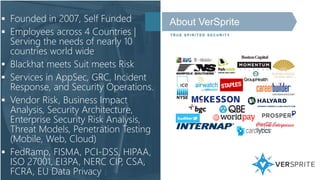
 Founded in 2007, Self Funded
 Employees across 4 Countries |
Serving the needs of nearly 10
countries world wide
 Blackhat meets Suit meets Risk
 Services in AppSec, GRC, Incident
Response, and Security Operations.
 Vendor Risk, Business Impact
Analysis, Security Architecture,
Enterprise Security Risk Analysis,
Threat Models, Penetration Testing
(Mobile, Web, Cloud)
 FedRamp, FISMA, PCI-DSS, HIPAA,
ISO 27001, EI3PA, NERC CIP, CSA,
FCRA, EU Data Privacy
About VerSprite
T R U E S P I R I T E D S E C U R I T Y
Flying Beyond the Cloud
Understanding Beyond Today’s IaaS | PaaS | SaaS | CaaS
Revisiting Key Drivers to Cloud
C L O U D T O M AT R I X F O R M AT I O N
o Dynamic OnPrem environments too costly to manage in long run
o $avings across licensing, network/sys administration,
o Dynamic networks || systems || apps need to respond to growing,
diversified threats
Atmospheric Shift to Agile
C L O U D T O M AT R I X F O R M AT I O N
o Companies becoming more Agile
o Agile development requires more agile environments
o Other key drivers for flying to the Cloud
o Business continuity and network resiliency
oRisk transference opportunities (e.g.. – SLAs, security, compliance, etc..)
o DevOps a new frontier for Cloud Management
oFarming agile services via codified configs
o Spinning up new services w/ control panels
o Virtualization at all levels
Frameworks Trending in the Cloud
F R A M E W O R K S O B F U S C AT E S E C U R I T Y & P R I VA C Y
o Macro Frameworks
oMeant for experienced developers
oHas many built in components to
facilitate authentication, encryption,
& security
o Micro-Frameworks
oGaining Lightweight, quick to get
started
oMeant for websites and smaller
applications
o JavaScript Frameworks
oProvides crisp UI to interface with
web frameworks
Weather Conditions in Cloud
Operations
Process immaturity, security obfuscation, & the rush to B2B/ B2C service
dominance
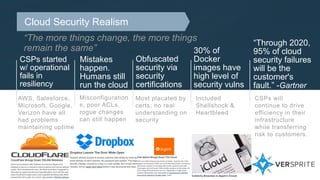
Cloud Security Realism
“The more things change, the more things
remain the same”
CSPs started
w/ operational
fails in
resiliency
AWS, Salesforce,
Microsoft, Google,
Verizon have all
had problems
maintaining uptime
Mistakes
happen.
Humans still
run the cloud
“Through 2020,
95% of cloud
security failures
will be the
customer's
fault.” -Gartner
Most placated by
certs; no real
understanding on
security
30% of
Docker
images have
high level of
security vulns
Included
Shellshock &
Heartbleed
Obfuscated
security via
security
certifications
CSPs will
continue to drive
efficiency in their
infrastructure
while transferring
risk to customers.
Misconfiguration
s, poor ACLs,
rogue changes
can still happen
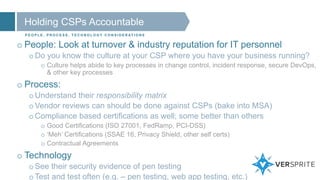
Holding CSPs Accountable
P E O P L E , P R O C E S S , T E C H N O L O G Y C O N S I D E R AT I O N S
o People: Look at turnover & industry reputation for IT personnel
oDo you know the culture at your CSP where you have your business running?
o Culture helps abide to key processes in change control, incident response, secure DevOps,
& other key processes
o Process:
oUnderstand their responsibility matrix
oVendor reviews can should be done against CSPs (bake into MSA)
oCompliance based certifications as well; some better than others
o Good Certifications (ISO 27001, FedRamp, PCI-DSS)
o ‘Meh’ Certifications (SSAE 16, Privacy Shield, other self certs)
o Contractual Agreements
o Technology
oSee their security evidence of pen testing
oTest and test often (e.g. – pen testing, web app testing, etc.)
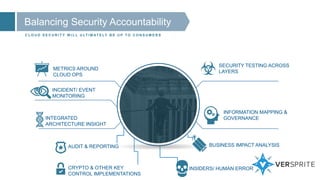
Balancing Security Accountability
C L O U D S E C U R I T Y W I L L U LT I M AT E LY B E U P T O C O N S U M E R S
METRICS AROUND
CLOUD OPS
INTEGRATED
ARCHITECTURE INSIGHT
SECURITY TESTING ACROSS
LAYERS
INFORMATION MAPPING &
GOVERNANCE
INCIDENT/ EVENT
MONITORING
AUDIT & REPORTING
CRYPTO & OTHER KEY
CONTROL IMPLEMENTATIONS
BUSINESS IMPACT ANALYSIS
INSIDERS/ HUMAN ERROR
Rise of the APIs
REST, JSON, SOAP facilitate data exchange known by few and managed
by fewer.
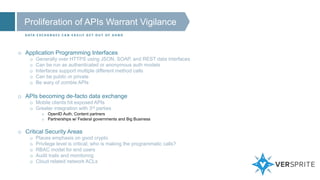
Proliferation of APIs Warrant Vigilance
D ATA E X C H A N G E S C A N E A S I LY G E T O U T O F H A N D
o Application Programming Interfaces
o Generally over HTTPS using JSON, SOAP, and REST data interfaces
o Can be run as authenticated or anonymous auth models
o Interfaces support multiple different method calls
o Can be public or private
o Be wary of zombie APIs
o APIs becoming de-facto data exchange
o Mobile clients hit exposed APIs
o Greater integration with 3rd parties
o OpenID Auth, Content partners
o Partnerships w/ Federal governments and Big Business
o Critical Security Areas
o Places emphasis on good crypto
o Privilege level is critical; who is making the programmatic calls?
o RBAC model for end users
o Audit trails and monitoring
o Cloud related network ACLs
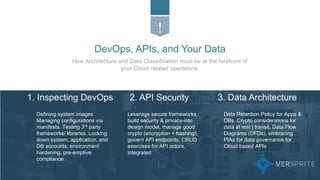
DevOps, APIs, and Your Data
How Architecture and Data Classification must be at the forefront of
your Cloud related operations.
Defining system images.
Managing configurations via
manifests. Testing 3rd party
frameworks/ libraries. Locking
down system, application, and
DB accounts, environment
hardening, pre-emptive
compliance.
1. Inspecting DevOps
Leverage secure frameworks,
build security & privacy-into
design model, manage good
crypto (encryption + hashing),
govern API endpoints, CRUD
exercises for API actors,
integrated
2. API Security
Data Retention Policy for Apps &
DBs. Crypto considerations for
data at rest | transit, Data Flow
Diagrams (DFDs), embracing
PIAs for data governance for
Cloud based APIs
3. Data Architecture
Prescriptive Privacy Guidance for Cloud Adoption
Best practices to limit data loss and data mishandling
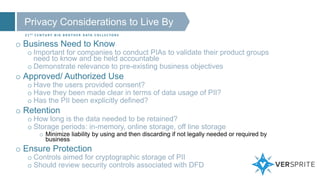
Privacy Considerations to Live By
2 1 S T C E N T U R Y B I G B R O T H E R D ATA C O L L E C T O R S
o Business Need to Know
o Important for companies to conduct PIAs to validate their product groups
need to know and be held accountable
o Demonstrate relevance to pre-existing business objectives
o Approved/ Authorized Use
o Have the users provided consent?
o Have they been made clear in terms of data usage of PII?
o Has the PII been explicitly defined?
o Retention
o How long is the data needed to be retained?
o Storage periods: in-memory, online storage, off line storage
o Minimize liability by using and then discarding if not legally needed or required by
business
o Ensure Protection
o Controls aimed for cryptographic storage of PII
o Should review security controls associated with DFD
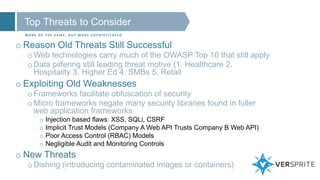
Top Threats to Consider
M O R E O F T H E S A M E , B U T M O R E S O P H I S T I C AT E D
o Reason Old Threats Still Successful
oWeb technologies carry much of the OWASP Top 10 that still apply
oData pilfering still leading threat motive (1. Healthcare 2.
Hospitality 3. Higher Ed 4. SMBs 5. Retail
o Exploiting Old Weaknesses
oFrameworks facilitate obfuscation of security
oMicro frameworks negate many security libraries found in fuller
web application frameworks
o Injection based flaws: XSS, SQLi, CSRF
o Implicit Trust Models (Company A Web API Trusts Company B Web API)
o Poor Access Control (RBAC) Models
o Negligible Audit and Monitoring Controls
o New Threats
oDishing (introducing contaminated images or containers)
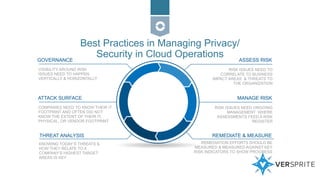
Best Practices in Managing Privacy/
Security in Cloud OperationsGOVERNANCE ASSESS RISK
REMEDIATE & MEASURE
VISIBILITY AROUND RISK
ISSUES NEED TO HAPPEN
VERTICALLY & HORIZONTALLY
RISK ISSUES NEED TO
CORRELATE TO BUSINESS
IMPACT AREAS & THREATS TO
THE ORGANIZATION
REMEDIATION EFFORTS SHOULD BE
MEASURED & MEASURED AGAINST KEY
RISK INDICATORS TO SHOW PROGRESS
THREAT ANALYSIS
KNOWING TODAY’S THREATS &
HOW THEY RELATE TO A
COMPANY’S HIGHEST TARGET
AREAS IS KEY
ATTACK SURFACE MANAGE RISK
COMPANIES NEED TO KNOW THEIR IT
FOOTPRINT AND OFTEN DID NOT
KNOW THE EXTENT OF THEIR IT,
PHYSICAL, OR VENDOR FOOTPRINT
RISK ISSUES NEED ONGOING
MANAGEMENT WHERE
ASSESSMENTS FEED A RISK
REGISTER
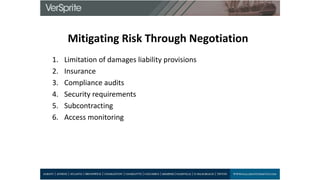
1. Limitation of damages liability provisions
2. Insurance
3. Compliance audits
4. Security requirements
5. Subcontracting
6. Access monitoring
Mitigating Risk Through Negotiation
Examples
IN NO EVENT SHALL VENDORS OR ANY OF ITS SUPPLIERS’ AND LICENSORS’ TOTAL
AGGREGATE LIABILITY UNDER THIS AGREEMENT EXCEED THE TOTAL AMOUNT OF FEES
RECEIVED BY VENDOR FROM CUSTOMER UNDER THIS AGREEMENT IN THE THREE (3)
MONTH PERIOD PRECEDING THE EVENT GIVING RISE TO THE CLAIM.
The exclusions and limitations in this Section 10 shall not apply to:
a. Losses arising out of or relating to a party’s failure to comply with its
obligations under Section 8 (Confidentiality), Exhibit “C” (Data Privacy and Security
Requirements) or the Business Associate Agreement between the parties.
At all times during the Term and for a period of three (3) years thereafter, Vendor shall
procure and maintain, at its sole cost and expense, all insurance coverage required by
applicable law and in any event insurance coverage in the following types and amounts:
a. Cyber Liability Insurance, including first party and third party coverage
with limits no less than $2,000,000.00 per occurrence and $5,000,000.00 in the
aggregate for all claims each policy year.
Subcontracting
Vendor shall not subcontract any Services, in whole or in part, without
Customer’s prior written consent, which consent shall not be unreasonably withheld or
delayed. Without limiting the foregoing:
a. Customer’s consent to any such Subcontractor shall not relieve Vendor
or its representations, warranties, or obligations under this Agreement.
b. Vendor shall remain responsible and liable for any and all (i)
performance required hereunder, including the proper supervision, coordination and
performance of the Services; and (ii) acts and omissions of each Subcontractor
(including such Subcontractor’s employees and agents), are deemed Vendor’s acts and
omissions to the same extent as if such acts or omissions were by Vendors.
c. Any noncompliance by any Subcontractor or its employees or agents
with the provisions of this Agreement or any Service Order will constitute a breach by
Vendor.
EXHIBIT C
DATA PRIVACY AND SECURITY REQUIREMENTS
In addition to any other data or Protected Health Information (“PHI”)
requirements stated in the Agreement, Vendor agrees to the following:
1. Confidential Information
2. HIPAA compliance (BAA)
3. Specific security measures (i.e., access, monitoring, reporting)
4. Access to system by vendor
5. Security questionnaire
6. Redundancy
7. Data Back-up
8. Disaster Recovery
Questions?

Unc charlotte prezo2016

  • 1.
    Cloud Security &Mitigating Vulnerabilities IAPP Knowledge Net October 4, 2016 Tony UcedaVelez, CISM, CISA, GSEC, CRISC Richard N. Sheinis, CIPP-US Versprite Hall Booth Smith, PC 10 Glenlake Parkway 13950 Ballantyne Corporate Place Suite 130 Suite 175 Atlanta, Georgia 30328 Charlotte, NC 28277 tonyuv@versprite.com rsheinis@hallboothsmith.com (678) 278-8312 (office) (980) 859-0380 (office) (404) 345-0749 (mobile)
  • 2.
    Cloud Insecurity &Privacy Abuse The Dawn of the Information Matrix
  • 3.
    Speaker Bio  CEO,VerSprite – Global Security Consulting Firm (www.versprite.com)  Chapter Leader – OWASP Atlanta  Author, “Risk Centric Threat Modeling – Process for Attack Simulation & Threat Analysis”, Wiley June 2015  Former Sr. Security Director, Fortune 50 | Symantec | Dell-Secureworks  ~20 years of global Information Security for various MNCs
  • 4.
     Founded in2007, Self Funded  Employees across 4 Countries | Serving the needs of nearly 10 countries world wide  Blackhat meets Suit meets Risk  Services in AppSec, GRC, Incident Response, and Security Operations.  Vendor Risk, Business Impact Analysis, Security Architecture, Enterprise Security Risk Analysis, Threat Models, Penetration Testing (Mobile, Web, Cloud)  FedRamp, FISMA, PCI-DSS, HIPAA, ISO 27001, EI3PA, NERC CIP, CSA, FCRA, EU Data Privacy About VerSprite T R U E S P I R I T E D S E C U R I T Y
  • 5.
    Flying Beyond theCloud Understanding Beyond Today’s IaaS | PaaS | SaaS | CaaS
  • 6.
    Revisiting Key Driversto Cloud C L O U D T O M AT R I X F O R M AT I O N o Dynamic OnPrem environments too costly to manage in long run o $avings across licensing, network/sys administration, o Dynamic networks || systems || apps need to respond to growing, diversified threats
  • 7.
    Atmospheric Shift toAgile C L O U D T O M AT R I X F O R M AT I O N o Companies becoming more Agile o Agile development requires more agile environments o Other key drivers for flying to the Cloud o Business continuity and network resiliency oRisk transference opportunities (e.g.. – SLAs, security, compliance, etc..) o DevOps a new frontier for Cloud Management oFarming agile services via codified configs o Spinning up new services w/ control panels o Virtualization at all levels
  • 8.
    Frameworks Trending inthe Cloud F R A M E W O R K S O B F U S C AT E S E C U R I T Y & P R I VA C Y o Macro Frameworks oMeant for experienced developers oHas many built in components to facilitate authentication, encryption, & security o Micro-Frameworks oGaining Lightweight, quick to get started oMeant for websites and smaller applications o JavaScript Frameworks oProvides crisp UI to interface with web frameworks
  • 9.
    Weather Conditions inCloud Operations Process immaturity, security obfuscation, & the rush to B2B/ B2C service dominance
  • 10.
    Cloud Security Realism “Themore things change, the more things remain the same” CSPs started w/ operational fails in resiliency AWS, Salesforce, Microsoft, Google, Verizon have all had problems maintaining uptime Mistakes happen. Humans still run the cloud “Through 2020, 95% of cloud security failures will be the customer's fault.” -Gartner Most placated by certs; no real understanding on security 30% of Docker images have high level of security vulns Included Shellshock & Heartbleed Obfuscated security via security certifications CSPs will continue to drive efficiency in their infrastructure while transferring risk to customers. Misconfiguration s, poor ACLs, rogue changes can still happen
  • 11.
    Holding CSPs Accountable PE O P L E , P R O C E S S , T E C H N O L O G Y C O N S I D E R AT I O N S o People: Look at turnover & industry reputation for IT personnel oDo you know the culture at your CSP where you have your business running? o Culture helps abide to key processes in change control, incident response, secure DevOps, & other key processes o Process: oUnderstand their responsibility matrix oVendor reviews can should be done against CSPs (bake into MSA) oCompliance based certifications as well; some better than others o Good Certifications (ISO 27001, FedRamp, PCI-DSS) o ‘Meh’ Certifications (SSAE 16, Privacy Shield, other self certs) o Contractual Agreements o Technology oSee their security evidence of pen testing oTest and test often (e.g. – pen testing, web app testing, etc.)
  • 12.
    Balancing Security Accountability CL O U D S E C U R I T Y W I L L U LT I M AT E LY B E U P T O C O N S U M E R S METRICS AROUND CLOUD OPS INTEGRATED ARCHITECTURE INSIGHT SECURITY TESTING ACROSS LAYERS INFORMATION MAPPING & GOVERNANCE INCIDENT/ EVENT MONITORING AUDIT & REPORTING CRYPTO & OTHER KEY CONTROL IMPLEMENTATIONS BUSINESS IMPACT ANALYSIS INSIDERS/ HUMAN ERROR
  • 13.
    Rise of theAPIs REST, JSON, SOAP facilitate data exchange known by few and managed by fewer.
  • 14.
    Proliferation of APIsWarrant Vigilance D ATA E X C H A N G E S C A N E A S I LY G E T O U T O F H A N D o Application Programming Interfaces o Generally over HTTPS using JSON, SOAP, and REST data interfaces o Can be run as authenticated or anonymous auth models o Interfaces support multiple different method calls o Can be public or private o Be wary of zombie APIs o APIs becoming de-facto data exchange o Mobile clients hit exposed APIs o Greater integration with 3rd parties o OpenID Auth, Content partners o Partnerships w/ Federal governments and Big Business o Critical Security Areas o Places emphasis on good crypto o Privilege level is critical; who is making the programmatic calls? o RBAC model for end users o Audit trails and monitoring o Cloud related network ACLs
  • 15.
    DevOps, APIs, andYour Data How Architecture and Data Classification must be at the forefront of your Cloud related operations. Defining system images. Managing configurations via manifests. Testing 3rd party frameworks/ libraries. Locking down system, application, and DB accounts, environment hardening, pre-emptive compliance. 1. Inspecting DevOps Leverage secure frameworks, build security & privacy-into design model, manage good crypto (encryption + hashing), govern API endpoints, CRUD exercises for API actors, integrated 2. API Security Data Retention Policy for Apps & DBs. Crypto considerations for data at rest | transit, Data Flow Diagrams (DFDs), embracing PIAs for data governance for Cloud based APIs 3. Data Architecture
  • 16.
    Prescriptive Privacy Guidancefor Cloud Adoption Best practices to limit data loss and data mishandling
  • 17.
    Privacy Considerations toLive By 2 1 S T C E N T U R Y B I G B R O T H E R D ATA C O L L E C T O R S o Business Need to Know o Important for companies to conduct PIAs to validate their product groups need to know and be held accountable o Demonstrate relevance to pre-existing business objectives o Approved/ Authorized Use o Have the users provided consent? o Have they been made clear in terms of data usage of PII? o Has the PII been explicitly defined? o Retention o How long is the data needed to be retained? o Storage periods: in-memory, online storage, off line storage o Minimize liability by using and then discarding if not legally needed or required by business o Ensure Protection o Controls aimed for cryptographic storage of PII o Should review security controls associated with DFD
  • 18.
    Top Threats toConsider M O R E O F T H E S A M E , B U T M O R E S O P H I S T I C AT E D o Reason Old Threats Still Successful oWeb technologies carry much of the OWASP Top 10 that still apply oData pilfering still leading threat motive (1. Healthcare 2. Hospitality 3. Higher Ed 4. SMBs 5. Retail o Exploiting Old Weaknesses oFrameworks facilitate obfuscation of security oMicro frameworks negate many security libraries found in fuller web application frameworks o Injection based flaws: XSS, SQLi, CSRF o Implicit Trust Models (Company A Web API Trusts Company B Web API) o Poor Access Control (RBAC) Models o Negligible Audit and Monitoring Controls o New Threats oDishing (introducing contaminated images or containers)
  • 19.
    Best Practices inManaging Privacy/ Security in Cloud OperationsGOVERNANCE ASSESS RISK REMEDIATE & MEASURE VISIBILITY AROUND RISK ISSUES NEED TO HAPPEN VERTICALLY & HORIZONTALLY RISK ISSUES NEED TO CORRELATE TO BUSINESS IMPACT AREAS & THREATS TO THE ORGANIZATION REMEDIATION EFFORTS SHOULD BE MEASURED & MEASURED AGAINST KEY RISK INDICATORS TO SHOW PROGRESS THREAT ANALYSIS KNOWING TODAY’S THREATS & HOW THEY RELATE TO A COMPANY’S HIGHEST TARGET AREAS IS KEY ATTACK SURFACE MANAGE RISK COMPANIES NEED TO KNOW THEIR IT FOOTPRINT AND OFTEN DID NOT KNOW THE EXTENT OF THEIR IT, PHYSICAL, OR VENDOR FOOTPRINT RISK ISSUES NEED ONGOING MANAGEMENT WHERE ASSESSMENTS FEED A RISK REGISTER
  • 20.
    1. Limitation ofdamages liability provisions 2. Insurance 3. Compliance audits 4. Security requirements 5. Subcontracting 6. Access monitoring Mitigating Risk Through Negotiation
  • 21.
    Examples IN NO EVENTSHALL VENDORS OR ANY OF ITS SUPPLIERS’ AND LICENSORS’ TOTAL AGGREGATE LIABILITY UNDER THIS AGREEMENT EXCEED THE TOTAL AMOUNT OF FEES RECEIVED BY VENDOR FROM CUSTOMER UNDER THIS AGREEMENT IN THE THREE (3) MONTH PERIOD PRECEDING THE EVENT GIVING RISE TO THE CLAIM. The exclusions and limitations in this Section 10 shall not apply to: a. Losses arising out of or relating to a party’s failure to comply with its obligations under Section 8 (Confidentiality), Exhibit “C” (Data Privacy and Security Requirements) or the Business Associate Agreement between the parties.
  • 22.
    At all timesduring the Term and for a period of three (3) years thereafter, Vendor shall procure and maintain, at its sole cost and expense, all insurance coverage required by applicable law and in any event insurance coverage in the following types and amounts: a. Cyber Liability Insurance, including first party and third party coverage with limits no less than $2,000,000.00 per occurrence and $5,000,000.00 in the aggregate for all claims each policy year.
  • 23.
    Subcontracting Vendor shall notsubcontract any Services, in whole or in part, without Customer’s prior written consent, which consent shall not be unreasonably withheld or delayed. Without limiting the foregoing: a. Customer’s consent to any such Subcontractor shall not relieve Vendor or its representations, warranties, or obligations under this Agreement. b. Vendor shall remain responsible and liable for any and all (i) performance required hereunder, including the proper supervision, coordination and performance of the Services; and (ii) acts and omissions of each Subcontractor (including such Subcontractor’s employees and agents), are deemed Vendor’s acts and omissions to the same extent as if such acts or omissions were by Vendors. c. Any noncompliance by any Subcontractor or its employees or agents with the provisions of this Agreement or any Service Order will constitute a breach by Vendor.
  • 24.
    EXHIBIT C DATA PRIVACYAND SECURITY REQUIREMENTS In addition to any other data or Protected Health Information (“PHI”) requirements stated in the Agreement, Vendor agrees to the following: 1. Confidential Information 2. HIPAA compliance (BAA) 3. Specific security measures (i.e., access, monitoring, reporting) 4. Access to system by vendor 5. Security questionnaire 6. Redundancy 7. Data Back-up 8. Disaster Recovery
  • 25.