
CRITICAL AREAS OF
FOCUS IN CLOUD
COMPUTING
SOURCE: CLOUD SECURITY ALLIANCE
NIST Special Publication 800-145, ISO/IEC 17788 and ISO/IEC 17789
MAGANATHIN
VEERARAGALOO
DOMAIN 1 - CLOUD
COMPUTING
CONCEPTS AND
ARCHITECTURES
Defining Cloud Computing
Cloud computing is a new operational model and set of technologies for managing shared
pools of computing resources.
NIST defines cloud computing as:
• Cloud computing is a model for enabling ubiquitous, convenient, on-demand network access to a
shared pool of configurable computing resources (e.g., networks, servers, storage, applications, and
services) that can be rapidly provisioned and released with minimal management effort or service
provider interaction.
The ISO/IEC definition
• Paradigm for enabling network access to a scalable and elastic pool of shareable physical or virtual
resources with self-service provisioning and administration on-demand.
Definition: A cloud user is the person or organization requesting and using the resources,
and the cloud provider is the person or organization who delivers it. We also sometimes
use the terms client and consumer to refer to the cloud user, and service or simply cloud
to describe the provider.
NIST 500-292 uses the term “cloud actor” and adds roles for cloud brokers, carriers, and
auditors. ISO/IEC 17788 uses the terms cloud service customer, cloud service partner,
and cloud service provider.
Defining Cloud Computing
Cloud computing is a new operational model and set of technologies for managing
shared pools of computing resources.
NIST defines cloud computing as:
• Cloud computing is a model for enabling ubiquitous, convenient, on-demand network access to a
shared pool of configurable computing resources (e.g., networks, servers, storage, applications,
and services) that can be rapidly provisioned and released with minimal management effort or
service provider interaction.
The ISO/IEC definition
• Paradigm for enabling network access to a scalable and elastic pool of shareable physical or
virtual resources with self-service provisioning and administration on-demand.
Definition: A cloud user is the person or organization requesting and using the
resources, and the cloud provider is the person or organization who delivers it. We
also sometimes use the terms client and consumer to refer to the cloud user, and
service or simply cloud to describe the provider.
NIST 500-292 uses the term “cloud actor” and adds roles for cloud brokers, carriers,
and auditors. ISO/IEC 17788 uses the terms cloud service customer, cloud service
partner, and cloud service provider.
Definitional Model
The Cloud Security Alliance (CSA) uses the NIST model for cloud computing
as its standard for defining cloud computing.
The CSA also endorses the ISO/IEC model which is more in-depth, and
additionally serves as a reference model.
NIST’s publication is generally well accepted, and the Guidance aligns with
the NIST Working Definition of Cloud Computing (NIST 800-145) to bring
coherence and consensus around a common language to focus on use cases
rather than semantic nuances.
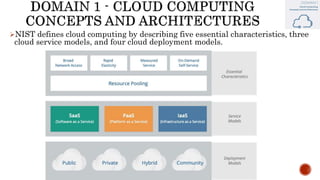
NIST defines cloud computing by describing five essential characteristics, three
cloud service models, and four cloud deployment models.
1. Essential Characteristics
These are the characteristics that make a cloud a cloud. If something has these
characteristics, we consider it cloud computing. If it lacks any of them, it is likely
not a cloud.
i. Resource Pooling is the most fundamental characteristic, as discussed above. The provider
abstracts resources and collects them into a pool, portions of which can be allocated to
different consumers (typically based on policies).
ii. Consumers provision the resources from the pool using on-demand self-service. They manage
their resources themselves, without having to talk to a human administrator.
iii. Broad Network Access means that all resources are available over a network, without any
need for direct physical access; the network is not necessarily part of the service.
iv. Rapid Elasticity allows consumers to expand or contract the resources they use from the pool
(provisioning and deprovisioning), often completely automatically. This allows them to more
closely match resource consumption with demand (for example, adding virtual servers as
demand increases, then shutting them down when demand drops).
v. Measured Service meters what is provided, to ensure that consumers only use what they are
allotted, and, if necessary, to charge them for it. This is where the term utility computing
comes from, since computing resources can now be consumed like water and electricity, with
the client only paying for what they use.
2. Service Models
a. Software as a Service (SaaS) is a full application that’s managed
and hosted by the provider. Consumers access it with a web
browser, mobile app, or a lightweight client app.
b. Platform as a Service (PaaS) abstracts and provides development
or application platforms, such as databases, application platforms
(e.g. a place to run Python, PHP, or other code), file storage and
collaboration, or even proprietary application processing (such as
machine learning, big data processing, or direct Application
Programming Interfaces (API) access to features of a full SaaS
application). The key differentiator is that, with PaaS, you don’t
manage the underlying servers, networks, or other infrastructure.
c. Infrastructure as a Service (IaaS) offers access to a resource pool
of fundamental computing infrastructure, such as compute,
network, or storage.
3. Deployment Models
Both NIST and ISO/IEC use the same four cloud deployment models. These are how the technologies
are deployed and consumed, and they apply across the entire range of service models:
a. Public Cloud. The cloud infrastructure is made available to the general public
or a large industry group and is owned by an organization selling cloud
services.
b. Private Cloud. The cloud infrastructure is operated solely for a single
organization. It may be managed by the organization or by a third party and
may be located on-premises or off- premises.
c. Community Cloud. The cloud infrastructure is shared by several
organizations and supports a specific community that has shared concerns
(e.g. mission, security requirements, policy, or compliance considerations). It
may be managed by the organizations or by a third party and may be located
on-premises or off-premises.
d. Hybrid Cloud. The cloud infrastructure is a composition of two or more clouds
(private, community, or public) that remain unique entities but are bound
together by standardized or proprietary technology that enables data and
application portability (e.g., cloud bursting for load balancing between
clouds). Hybrid is also commonly used to describe a non-cloud data centre
bridged directly to a cloud provider.
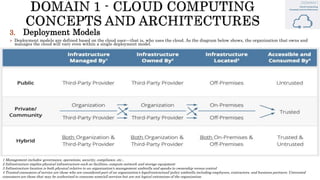
3. Deployment Models
 Deployment models are defined based on the cloud user—that is, who uses the cloud. As the diagram below shows, the organization that owns and
manages the cloud will vary even within a single deployment model.
1 Management includes: governance, operations, security, compliance, etc...
2 Infrastructure implies physical infrastructure such as facilities, compute network and storage equipment
3 Infrastructure location is both physical relative to an organization’s management umbrella and speaks to ownership versus control
4 Trusted consumers of service are those who are considered part of an organization’s legal/contractual/ policy umbrella including employees, contractors, and business partners. Untrusted
consumers are those that may be authorized to consume some/all services but are not logical extensions of the organization.
Reference and Architecture Models
For an in-depth reference architectural model, we again
recommend ISO/IEC 17789 and NIST 500-292, which
complement the NIST definition model.
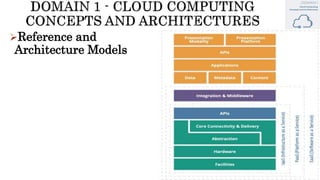
One way of looking at cloud computing is as a stack where
Software as a Service is built on Platform as a Service, which
is built on Infrastructure as a Service. This is not
representative of all (or even most) real-world deployments,
but serves as a useful reference to start the discussion.
Reference and
Architecture Models
Reference and Architecture Models
1. Infrastructure as a Service
Physical facilities and infrastructure hardware form the foundation of IaaS.
With cloud computing we abstract and pool these resources, but at the most basic
level we always need physical hardware, networks, and storage to build on.
These resources are pooled using abstraction and orchestration.
Abstraction, often via virtualization, frees the resources from their physical
constraints to enable pooling.
Then a set of core connectivity and delivery tools (orchestration) ties these
abstracted resources together, creates the pools, and provides the automation to
deliver them to customers.
All this is facilitated using Application Programming Interfaces. APIs are typically
the underlying communications method for components within a cloud, some of
which (or an entirely different set) are exposed to the cloud user to manage their
resources and configurations. Most cloud APIs these days use REST
(Representational State Transfer), which runs over the HTTP protocol, making it
extremely well suited for Internet services.
Reference and Architecture Models
1. Infrastructure as a Service
In most cases, those APIs are both remotely accessible and wrapped into a
web-based user interface.
This combination is the cloud management plane, since consumers use it to
manage and configure the cloud resources, such as launching virtual
machines (instances) or configuring virtual networks.
From a security perspective, it is both the biggest difference from protecting
physical infrastructure (since you can’t rely on physical access as a control)
and the top priority when designing a cloud security program.
If an attacker gets into your management plane, they potentially have full
remote access to your entire cloud deployment.
Thus IaaS consists of a facility, hardware, an abstraction layer, an
orchestration (core connectivity and delivery) layer to tie together the
abstracted resources, and APIs to remotely manage the resources and deliver
Reference and Architecture Models
1. Infrastructure as a Service
Reference and Architecture Models
1. Infrastructure as a Service
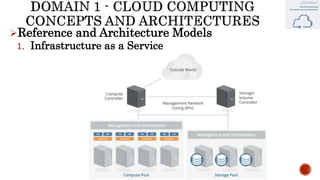
A series of physical servers each run two components: a hypervisor (for
virtualization) and the management/orchestration software to tie in the servers and
connect them to the compute controller.
A customer asks for an instance (virtual server) of a particular size and the cloud
controller determines which server has the capacity and allocates an instance of the
requested size.
The controller then creates a virtual hard drive by requesting storage from the
storage controller, which allocates storage from the storage pool, and connects it to
the appropriate host server and instance over the network (a dedicated network for
storage traffic). Networking, including virtual network interfaces and addresses, is
also allocated and connected to the necessary virtual network.
The controller then sends a copy of the server image into the virtual machine, boots
it, and configures it; this creates an instance running in a virtual machine (VM),
with virtual networking and storage all properly configured. Once this entire process
is complete, the metadata and connectivity information is brokered by the cloud
controller and available to the consumer, who can now connect to the instance and
log in.
Reference and Architecture Models
2. Platform as a Service
Of all the service models, PaaS is the hardest to definitively characterize due to both
the wide range of PaaS offerings and the many ways of building PaaS services.
PaaS adds an additional layer of integration with application development
frameworks, middleware capabilities, and functions such as databases, messaging,
and queuing.
These services allow developers to build applications on the platform with
programming languages and tools that are supported by the stack.
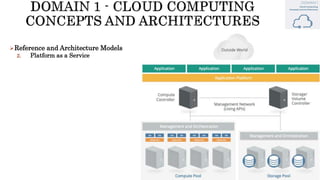
One option, frequently seen in the real world and illustrated in our model, is to build
a platform on top of IaaS.
A layer of integration and middleware is built on IaaS, then pooled together,
orchestrated, and exposed to customers using APIs as PaaS.
For example, a Database as a Service could be built by deploying modified database
management system software on instances running in IaaS.
The customer manages the database via API (and a web console) and accesses it
either through the normal database network protocols, or, again, via API.
Reference and Architecture Models
2. Platform as a Service
In PaaS the cloud user only sees the platform, not the underlying
infrastructure.
In our example, the database expands (or contracts) as needed based on
utilization, without the customer having to manage individual servers,
networking, patches, etc.
Another example is an application deployment platform.
That’s a place where developers can load and run application code without
managing the underlying resources.
Services exist for running nearly any kind of application in any language on
PaaS, freeing the developers from configuring and building servers, keeping
them up to date, or worrying about complexities like clustering and load
balancing.
This simplified architecture diagram shows an application platform (PaaS)
running on top of our IaaS architecture:
Reference and Architecture Models
2. Platform as a Service
Reference and Architecture Models
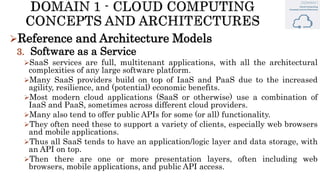
3. Software as a Service
SaaS services are full, multitenant applications, with all the architectural
complexities of any large software platform.
Many SaaS providers build on top of IaaS and PaaS due to the increased
agility, resilience, and (potential) economic benefits.
Most modern cloud applications (SaaS or otherwise) use a combination of
IaaS and PaaS, sometimes across different cloud providers.
Many also tend to offer public APIs for some (or all) functionality.
They often need these to support a variety of clients, especially web browsers
and mobile applications.
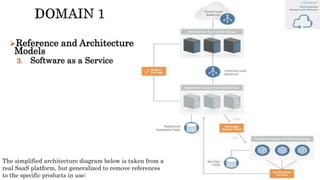
Thus all SaaS tends to have an application/logic layer and data storage, with
an API on top.
Then there are one or more presentation layers, often including web
browsers, mobile applications, and public API access.
Reference and Architecture
Models
3. Software as a Service
The simplified architecture diagram below is taken from a
real SaaS platform, but generalized to remove references
to the specific products in use:
Logical Model
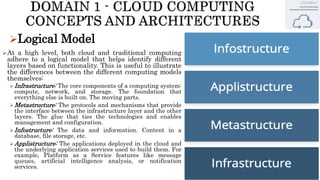
At a high level, both cloud and traditional computing
adhere to a logical model that helps identify different
layers based on functionality. This is useful to illustrate
the differences between the different computing models
themselves:
Infrastructure: The core components of a computing system:
compute, network, and storage. The foundation that
everything else is built on. The moving parts.
Metastructure: The protocols and mechanisms that provide
the interface between the infrastructure layer and the other
layers. The glue that ties the technologies and enables
management and configuration.
Infostructure: The data and information. Content in a
database, file storage, etc.
Applistructure: The applications deployed in the cloud and
the underlying application services used to build them. For
example, Platform as a Service features like message
queues, artificial intelligence analysis, or notification
services.
Logical Model
Different security focuses map to the different logical layers.
Application security maps to Applistructure, data security to
infostructure, and infrastructure security to infrastructure.
The key difference between cloud and traditional computing is the
Metastructure.
Cloud Metastructure includes the management plane components,
which are network-enabled and remotely accessible.
Another key difference is that, in cloud, you tend to double up on each
layer. Infrastructure, for example, includes both the infrastructure
used to create the cloud as well as the virtual infrastructure used and
managed by the cloud user.
In private cloud, the same organization might need to manage both;
in public cloud the provider manages the physical infrastructure
while the consumer manages their portion of the virtual
Logical Model
These layers tend to map to different teams, disciplines, and
technologies commonly found in IT organizations.
While the most obvious and immediate security management
differences are in Metastructure, cloud differs extensively from
traditional computing within each layer.
The scale of the differences will depend not only on the cloud
platform, but on how exactly the cloud user utilizes the
platform.
For example, a cloud-native application that makes heavy
utilization of a cloud provider’s PaaS products will experience
more applistructure differences than the migration of an
Cloud Security Scope, Responsibilities, and Models
1. Cloud Security and Compliance Scope and Responsibilities
It might sound simplistic, but cloud security and compliance includes
everything a security team is responsible for today, just in the cloud. All the
traditional security domains remain, but the nature of risks, roles and
responsibilities, and implementation of controls change, often dramatically.
Though the overall scope of security and compliance doesn’t change, the pieces
any given cloud actor is responsible for most certainly do. Think of it this way:
Cloud computing is a shared technology model where different organizations
are frequently responsible for implementing and managing different parts of
the stack. As a result security responsibilities are also distributed across the
stack, and thus across the organizations involved.
This is commonly referred to as the shared responsibility model. Think of it as a
responsibility matrix that depends on the particular cloud provider and
feature/product, the service model, and the deployment model.
Cloud Security Scope, Responsibilities, and Models
1. Cloud Security and Compliance Scope and Responsibilities
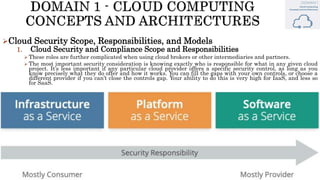
 At a high level, security responsibility maps to the degree of control any given actor has over the architecture
stack:
a) Software as a Service: The cloud provider is responsible for nearly all security, since the
cloud user can only access and manage their use of the application, and can’t alter how the
application works. For example, a SaaS provider is responsible for perimeter security,
logging/ monitoring/auditing, and application security, while the consumer may only be able
to manage authorization and entitlements.
b) Platform as a Service: The cloud provider is responsible for the security of the platform,
while the consumer is responsible for everything they implement on the platform, including
how they configure any offered security features. The responsibilities are thus more evenly
split. For example, when using a Database as a Service, the provider manages fundamental
security, patching, and core configuration, while the cloud user is responsible for everything
else, including which security features of the database to use, managing accounts, or even
authentication methods.
c) Infrastructure as a Service: Just like PaaS, the provider is responsible for foundational
security, while the cloud user is responsible for everything they build on the infrastructure.
Unlike PaaS, this places far more responsibility on the client. For example, the IaaS provider
will likely monitor their perimeter for attacks, but the consumer is fully responsible for how
they define and implement their virtual network security, based on the tools available on the
service.
Cloud Security Scope, Responsibilities, and Models
1. Cloud Security and Compliance Scope and Responsibilities
 These roles are further complicated when using cloud brokers or other intermediaries and partners.
 The most important security consideration is knowing exactly who is responsible for what in any given cloud
project. It’s less important if any particular cloud provider offers a specific security control, as long as you
know precisely what they do offer and how it works. You can fill the gaps with your own controls, or choose a
different provider if you can’t close the controls gap. Your ability to do this is very high for IaaS, and less so
for SaaS.
Cloud Security Scope, Responsibilities, and Models
1. Cloud Security and Compliance Scope and Responsibilities
This is the essence of the security relationship between a cloud provider and
consumer.
What does the provider do?
What does the consumer need to do?
Does the cloud provider enable the consumer to do what they need to?
What is guaranteed in the contract and service level agreements, and what is
implied by the documentation and specifics of the technology?
This shared responsibility model directly correlates to two recommendations:
1. Cloud providers should clearly document their internal security
controls and customer security features so the cloud user can make an
informed decision. Providers should also properly design and
implement those controls.
2. Cloud users should, for any given cloud project, build a responsibilities
matrix to document who is implementing which controls and how. This
should also align with any necessary compliance standards.
Cloud Security Scope, Responsibilities, and Models
1. Cloud Security and Compliance Scope and Responsibilities
The Cloud Security Alliance provides two tools to help meet these
requirements:
a) The Consensus Assessments Initiative Questionnaire (CAIQ). A
standard template for cloud providers to document their security and
compliance controls.
b) The Cloud Controls Matrix (CCM), which lists cloud security controls
and maps them to multiple security and compliance standards. The
CCM can also be used to document security responsibilities.
Both documents will need tuning for specific organizational and project
requirements, but provide a comprehensive starting template and can be
especially useful for ensuring compliance requirements are met.
Cloud Security Scope, Responsibilities, and Models
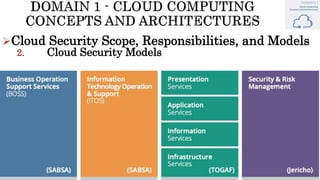
2. Cloud Security Models
Cloud security models are tools to help guide security decisions.
The term “model” can be used a little nebulously, so for our purposes we break out the
following types:
a) Conceptual Models or Frameworks include visualizations and descriptions used to
explain cloud security concepts and principles, such as the CSA logical model in
this document.
b) Controls Models or Frameworks categorize and detail specific cloud security
controls or categories of controls, such as the CSA CCM.
c) Reference Architectures are templates for implementing cloud security, typically
generalized (e.g. an IaaS security reference architecture).
i. They can be very abstract, bordering on conceptual, or quite detailed, down to
specific controls and functions.
d) Design Patterns are reusable solutions to particular problems. In security, an
example is IaaS log management.
i. As with reference architectures, they can be more or less abstract or specific,
even down to common implementation patterns on particular cloud platforms.
The lines between these models often blur and overlap, depending on the goals of the
developer of the model. Even lumping these all together under the heading “model” is
probably inaccurate, but since we see the terms used so interchangeably across different
sources, it makes sense to group them.
Cloud Security Scope, Responsibilities, and Models
2. Cloud Security Models
The CSA has reviewed and recommends the following models:
a) The CSA Enterprise Architecture
b) The CSA Cloud Controls Matrix
c) The NIST draft Cloud Computing Security Reference
Architecture (NIST Special Publication 500-299), which
includes conceptual models, reference architectures, and a
controls framework.
d) ISO/IEC FDIS 27017 Information technology – Security
techniques – Code of practice for information security
controls based on ISO/IEC 27002 for cloud services.
Cloud Security Scope, Responsibilities, and Models
2. Cloud Security Models
Cloud Security Scope, Responsibilities, and Models
2. Cloud Security Models
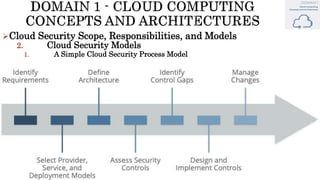
1. A Simple Cloud Security Process Model
While the implementation details, necessary controls, specific
processes, and various reference architectures and design models vary
greatly depending on the specific cloud project, there is is a relatively
straightforward, high-level process for managing cloud security:
i. Identify necessary security and compliance requirements, and
any existing controls.
ii. Select your cloud provider, service, and deployment models.
iii. Define the architecture.
iv. Assess the security controls.
v. Identify control gaps.
vi. Design and implement controls to fill the gaps.
vii. Manage changes over time.
Cloud Security Scope, Responsibilities, and Models
2. Cloud Security Models
1. A Simple Cloud Security Process Model
Since different cloud projects, even on a single provider, will likely
leverage entirely different sets of configurations and technologies,
each project should be evaluated on its own merits. For example, the
security controls for an application deployed on pure IaaS in one
provider may look very different than a similar project that instead
uses more PaaS from that same provider.
The key is to identify requirements, design the architecture, and then
identify the gaps based on the capabilities of the underlying cloud
platform. That’s why you need to know the cloud provider and
architecture before you start translating security requirements into
controls.
Cloud Security Scope, Responsibilities, and Models
2. Cloud Security Models
1. A Simple Cloud Security Process Model
Recommendations
 Understand the differences between cloud computing and traditional
infrastructure or virtualization, and how abstraction and automation
impact security.
 Become familiar with the NIST model for cloud computing and the CSA
reference architecture.
 Use tools such as the CSA Consensus Assessments Initiative Questionnaire
(CAIQ) to evaluate and compare cloud providers.
 Cloud providers should clearly document their security controls and
features and publish them using tools like the CSA CAIQ.
 Use tools like the CSA Cloud Controls Matrix to assess and document cloud
project security and compliance requirements and controls, as well as who
is responsible for each.
 Use a cloud security process model to select providers, design architectures,
identify control gaps, and implement security and compliance controls.
DOMAIN 2 -
GOVERNANCE AND
ENTERPRISE RISK
MANAGEMENT
1. Introduction
For security professionals, cloud computing impacts four areas of governance and risk
management:
a) Governance includes the policy, process, and internal controls that comprise how an
organization is run. Everything from the structures and policies to the leadership and other
mechanisms for management.
b) Enterprise Risk Management includes managing overall risk for the organization, aligned to
the organization’s governance and risk tolerance. Enterprise risk management includes all
areas of risk, not merely those concerned with technology.
c) Information Risk Management covers managing the risk to information, including information
technology. Organizations face all sorts of risks, from financial to physical, and information is
only one of multiple assets an organization needs to manage.
d) Information Security is the tools and practices to manage risk to information. Information
security isn’t the be-all and end-all of managing information risks; policies, contracts,
insurance, and other mechanisms also play a role (including physical security for non-digital
information). However, a - if not the - primary role of information security is to provide the
processes and controls to protect electronic information and the systems we use to access it.
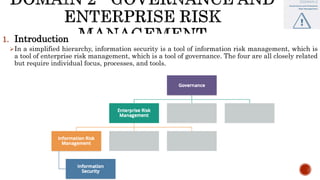
1. Introduction
In a simplified hierarchy, information security is a tool of information risk management, which is
a tool of enterprise risk management, which is a tool of governance. The four are all closely related
but require individual focus, processes, and tools.
2. Overview
a) Governance
Cloud computing affects governance, since it either introduces a third party into the process (in
the case of public cloud or hosted private cloud) or potentially alters internal governance
structures in the case of self-hosted private cloud. The primary issue to remember when
governing cloud computing is that an organization can never outsource responsibility for
governance, even when using external providers. This is always true, cloud or not, but is useful
to keep in mind when navigating cloud computing’s concepts of shared responsibility models.
Cloud service providers try to leverage economies of scale to manage costs and enable
capabilities. This means creating extremely standardized services (including contracts and
service level agreements) that are consistent across all customers. Governance models can’t
necessarily treat cloud providers the same way they’d treat dedicated external service
providers, which typically customize their offerings, including legal agreements, for each client.
Cloud computing changes the responsibilities and mechanisms for implementing and managing
governance. Responsibilities and mechanisms for governance are defined in the contract, as
with any business relationship. If the area of concern isn’t in the contract, there are no
mechanisms available to enforce, and there is a governance gap. Governance gaps don’t
necessarily exclude using the provider, but they do require the customer to adjust their own
processes to close the gaps or accept the associated risks.
2. Overview
a) Governance
i. Tools of Cloud Governance
As with any other area, there are specific management tools used for governance. This list focuses more
on tools for external providers, but these same tools can often be used internally for private
deployments:
1) Contracts: The primary tool of governance is the contract between a cloud provider and a cloud
customer (this is true for public and private cloud). The contract is your only guarantee of any level
of service or commitment—assuming there is no breach of contract, which tosses everything into a
legal scenario. Contracts are the primary tool to extend governance into business partners and
providers.
2. Overview
a) Governance
i. Tools of Cloud Governance
As with any other area, there are specific management tools used for governance. This list focuses more
on tools for external providers, but these same tools can often be used internally for private
deployments:
2) Supplier (cloud provider) Assessments: These assessments are performed by the potential cloud
customer using available information and allowed processes/techniques. They combine contractual
and manual research with third-party attestations (legal statements often used
to communicate the results of an assessment or audit) and technical research. They are very similar
to any supplier assessment and can include aspects like financial viability, history, feature
offerings, third-party attestations, feedback from peers, and so on. More detail on assessments is
covered later in this Domain and in Domain 4.
3) Compliance reporting: Compliance reporting includes all the documentation on a provider’s internal
(i.e. self) and external compliance assessments. They are the reports from audits
of controls, which an organization can perform themselves, a customer can perform on a provider
(although this usually isn’t an option in cloud), or have performed by a trusted third party. Third-
party audits and assessments are preferred since they provide independent validation (assuming
you trust the third party).
2. Overview
a) Governance
i. Tools of Cloud Governance
Assessments and audits should be based on existing standards (of which there are many).
It’s critical to understand the scope, not just the standard used.
Standards like the SSAE 16 have a defined scope, which includes both what is assessed (e.g.
which of the provider’s services) as well as which controls are assessed.
A provider can thus “pass” an audit that doesn’t include any security controls, which isn’t
overly useful for security and risk managers.
Also consider the transitive trust required to treat a third-party assessment as equivalent to
the activities that you might undertake when doing your own assessment.
Not all audit firms (or auditors) are created equal and the experience, history, and
qualifications of the firm should be included in your governance decisions.
The Cloud Security Alliance STAR Registry is an assurance program and documentation
registry for cloud provider assessments based on the CSA Cloud Controls Matrix and
Consensus Assessments Initiative Questionnaire.
Some providers also disclose documentation for additional certifications and assessments
(including self-assessments).
2. Overview
b) Enterprise Risk Management
Enterprise Risk Management (ERM) is the overall management of risk for an organization.
As with governance, the contract defines the roles and responsibilities for risk management
between a cloud provider and a cloud customer. And, as with governance, you can never
outsource your overall responsibility and accountability for risk management to an external
provider.
Risk management in cloud is based on the shared responsibilities model.
The cloud provider accepts some responsibility for certain risks, and the cloud customer is
responsible for anything beyond that.
This is especially evident as you evaluate differences between the service models, where the
provider manages more risks in SaaS and the consumer more in IaaS. But, again, the cloud
user is ultimately responsible for ownership of the risks; they only pass on some of the risk
management to the cloud provider. This holds true even with a self-hosted private cloud;
in those situations an organizational unit is passing on some of their risk management to the
internal cloud provider instead of an external party, and internal SLAs and procedures
replace external contracts.
2. Overview
b) Enterprise Risk Management
 ERM relies on good contracts and documentation to know where the division of responsibilities and potential
for untreated risk lie.
 Whereas governance is nearly exclusively focused on contracts, risk management can delve deeper into the
technology and process capabilities of the provider, based on their documentation.
 For example, a contract will rarely define how network security is actually implemented.
 Review of the provider’s documentation will provide much more information to help with an effective risk
decision.
 Risk tolerance is the amount of risk that the leadership and stakeholders of an organization are willing to
accept.
 It varies based on asset and you shouldn’t make a blanket risk decision about a particular provider;
 rather, assessments should align with the value and requirements of the assets involved.
 Just because a public cloud provider is external and a consumer might be concerned with shared
infrastructure for some assets doesn’t mean it isn’t within risk tolerance for all assets.
 Over time this means that, practically speaking, you will build out a matrix of cloud services along with
which types of assets are allowed in those services.
 Moving to the cloud doesn’t change your risk tolerance, it just changes how risk is managed.
2. Overview
c) The Effects of Service Model and Deployment Model
 In considering the various options available not only in Cloud Service Providers but also in the fundamental
delivery of cloud services, attention must be paid to how the Service and Deployment models affect the ability
to manage governance and risk.
1. Service Models
i. Software as a Service
 In the majority of cases, SaaS presents the most critical example of the need for a negotiated
contract.
 Such a contract will protect the ability to govern or validate risk as it relates to data stored,
processed, and transmitted with and in the application.
 SaaS providers tend to cluster at either end of the size/capability spectrum
and the likelihood of a negotiated contract is much higher when dealing with a small SaaS
provider.
 Unfortunately, many small SaaS providers are not able to operate at a level of sophistication that
meets or exceeds customer governance and risk management capabilities. In concrete terms, the
entire level of visibility into the actual operation of the infrastructure providing the SaaS
application is limited to solely what is exposed in the user interface developed by the Cloud
2. Overview
c) The Effects of Service Model and Deployment Model
 In considering the various options available not only in Cloud Service Providers but also in the fundamental delivery of cloud
services, attention must be paid to how the Service and Deployment models affect the ability to manage governance and risk.
1. Service Models
ii. Platform as a Service
 Continuing through the Service Models, the level of detail that is available (and the consequential
ability to self-manage governance and risk issues) increases.
 The likelihood of a fully negotiated contract is likely lower here than with either of the other
service models.
 That’s because the core driver for most PaaS is to deliver a single capability with very high
efficiency.
 PaaS is typically delivered with a rich API, and many PaaS providers have enabled the collection
of some of the data necessary to prove that SLAs are being adhered to.
 That said, the customer is still in the position of having to exercise a significant effort in
determining whether contract stipulations are effectively providing the level of control or support
required to enable governance or risk management.
2. Overview
c) The Effects of Service Model and Deployment Model
 In considering the various options available not only in Cloud Service Providers but also in the fundamental delivery of cloud
services, attention must be paid to how the Service and Deployment models affect the ability to manage governance and risk.
1. Service Models
iii. Infrastructure as a Service
 Infrastructure as a Service represents the closest that Cloud comes to a traditional data centre (or
even a traditional outsourced managed data centre), and the good news is that the vast majority
of existing governance and risk management activities that organizations have already built and
utilize are directly transferable.
 There are, however, new complexities related to the underlying orchestration and management
layers, as described in Domain 1, that enable the infrastructure which are often overlooked.
 In many ways, the governance and risk management of that orchestration and management layer
is consistent with the underlying infrastructure (network, power, HVAC, etc.) of a traditional data
centre.
 The same governance and risk management issues are present, but the exposure of those systems
is sufficiently different that changes to the existing process are required. For example, controlling
who can make network configuration changes shifts from accounts on individual devices to the
cloud management plane.
2. Overview
c) The Effects of Service Model and Deployment Model
 In considering the various options available not only in Cloud Service Providers but also in the fundamental delivery of cloud
services, attention must be paid to how the Service and Deployment models affect the ability to manage governance and risk.
2. Deployment Models
i. Public
 Cloud customers have a reduced ability to govern operations in a public cloud since the
provider is responsible for the management and governance of their infrastructure,
employees, and everything else. The customers also often have reduced ability to
negotiate contracts, which impacts how they extend their governance model into the
cloud.
 Inflexible contracts are a natural property of multitenancy:
 Providers can’t necessarily adjust contracts and operations for each customer as
everything runs on one set of resources, using one set of processes.
 Adapting for different customers increases costs, causing a trade-off, and often that’s the
dividing line between using public and private cloud. Hosted private cloud allows full
customization, but at increased costs due to the loss of the economies of scale.
2. Overview
c) The Effects of Service Model and Deployment Model
 In considering the various options available not only in Cloud Service Providers but also in the fundamental
delivery of cloud services, attention must be paid to how the Service and Deployment models affect the ability
to manage governance and risk.
2. Deployment Models
i. Public
 This doesn’t mean you shouldn’t try to negotiate your contract, but recognize
that this isn’t always possible; instead, you’ll need to either choose a different
provider (which may actually be less secure), or adjust your needs and use
alternate governance mechanisms to mitigate concerns.
 To use an analogy, think of a shipping service.
 When you use a common carrier/provider you don’t get to define their
operations. You put your sensitive documents in a package and entrust them to
meet their obligations to deliver it safely, securely, and within the expected
Service Level Agreement.
2. Overview
c) The Effects of Service Model and Deployment Model
 In considering the various options available not only in Cloud Service Providers but also in the fundamental delivery of cloud services, attention must be
paid to how the Service and Deployment models affect the ability to manage governance and risk.
2. Deployment Models
ii. Private
 Public cloud isn’t the only model that impacts governance; even private cloud will have an effect. If an
organization allows a third party to own and/or manage the private cloud (which is very common), this is
similar to how governance affects any outsourced provider. There will be shared responsibilities with
obligations that are defined in the contract.
 Although you will likely have more control over contractual terms, it’s still important to ensure they cover the
needed governance mechanisms. As opposed to a public provider—which has various incentives to keep its
service well-documented and at particular standard levels of performance, functionality, and
competitiveness—a hosted private cloud may only offer exactly what is in
 the contract, with everything else at extra cost. This must be considered and accounted for in negotiations,
with clauses to guarantee that the platform itself remains up to date and competitive. For example, by
requiring the vendor to update to the latest version of the private cloud platform within a certain time period
of release and after your sign-off.
 With a self-hosted private cloud governance will focus on internal service level agreements for the cloud users
(business or other organizational units) and chargeback and billing models for providing access to the cloud.
2. Overview
c) The Effects of Service Model and Deployment Model
2. Deployment Models
ii. Hybrid & Community
 When contemplating hybrid cloud environments, the governance strategy must
consider the minimum common set of controls comprised of the Cloud Service
Provider’s contract and the organization’s internal governance agreements.
 The cloud user is connecting either two cloud environments or a cloud
environment and a data centre.
 In either case the overall governance is the intersection of those two models.
 For example, if you connect your data centre to your cloud over a dedicated
network link you need to account for governance issues that will span both
environments.
2. Overview
c) The Effects of Service Model and Deployment Model
2. Deployment Models
ii. Hybrid & Community
 Since community clouds are a shared platform with multiple organizations, but
are not public, governance extends to the relationships with those members of
the community, not just the provider and the customer.
 It’s a mix of how you would approach public cloud and hosted private cloud
governance, where the overall tools of governance and contracts will have some
of the economies of scale of a public cloud provider, but be tuneable based on
community consensus, as with a hosted private cloud.
 This also includes community membership relations, financial relationships,
and how to respond when a member leaves the community.
2. Overview
c) The Effects of Service Model and Deployment Model
2. Cloud Risk Management Trade-Offs
 There are advantages and disadvantages to managing enterprise risk for cloud deployments.
These factors are, as you would expect, more pronounced for public cloud and hosted private
cloud:
1. There is less physical control over assets and their controls and processes. You don’t
physically control the infrastructure or the provider’s internal processes.
2. There is a greater reliance on contracts, audits, and assessments, as you lack day-to-day
visibility or management.
3. This creates an increased requirement for proactive management of relationship and
adherence to contracts, which extends beyond the initial contract signing and audits. Cloud
providers also constantly evolve their products and services to remain competitive and these
ongoing innovations might exceed, strain, or not be covered by existing agreements and
assessments.
4. Cloud customers have a reduced need (and associated reduction in costs) to manage risks
that the cloud provider accepts under the shared responsibility model. You haven’t
outsourced accountability for managing the risk, but you can certainly outsource the
management of some risks.
2. Overview
c) The Effects of Service Model and Deployment Model
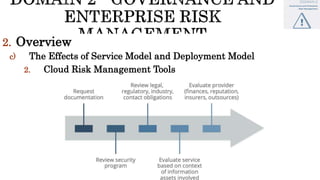
2. Cloud Risk Management Tools
The following processes help form the foundation of managing risk in cloud computing
deployments.
One of the core tenants of risk management is that you can manage, transfer, accept, or
avoid risks. But everything starts with a proper assessment.
The supplier assessment sets the groundwork for the cloud risk management program:
1. Request or acquire documentation.
2. Review their security program and documentation.
3. Review any legal, regulatory, contractual, and jurisdictional requirements for both the
provider and yourself. (See the Domain 3: Legal for more.)
4. Evaluate the contracted service in the context of your information assets.
5. Separately evaluate the overall provider, such as finances/stability, reputation, and
outsourcers.
2. Overview
c) The Effects of Service Model and Deployment Model
2. Cloud Risk Management Tools
2. Overview
c) The Effects of Service Model and Deployment Model
2. Cloud Risk Management Tools
Periodically review audits and assessments to ensure they are up to date:
i. Don’t assume all services from a particular provider meet the same audit/assessment
standards. They can vary.
ii. Periodic assessments should be scheduled and automated if possible.
iii. After reviewing and understanding what risks the cloud provider manages, what remains is
residual risk.
iv. Residual risk may often be managed by controls that you implement (e.g. encryption). The
availability and specific implementation of risk controls vary greatly across cloud providers,
particular
v. services/features, service models, and deployment models. If, after all your assessments and the
controls that you implement yourself there is still residual risk your only options are to transfer
it, accept the risk, or avoid it.
vi. Risk transfer, most often enabled by insurance, is an imperfect mechanism, especially for
information risks. It can compensate some of the financial loss associated with a primary loss
event, but won’t help with a secondary loss event (like loss of customers)—especially an
intangible or difficult to quantify loss, such as reputation damage. From the perspective of
insurance carriers, cyber-insurance is also a nascent field without the depth of actuarial tables
used for other forms of insurance, like those for fire or flooding, and even the financial
compensation may not match the costs associated with the primary loss event. Understand the
limits.
3. Recommendations
Identify the shared responsibilities of security and risk management based on the chosen cloud
deployment and service model. Develop a Cloud Governance Framework/Model as per relevant
industry best practices, global standards, and regulations like CSA CCM, COBIT 5, NIST RMF,
ISO/IEC 27017, HIPAA, PCI DSS, EU GDPR, etc.
Understand how a contract affects your governance framework/model.
• Obtain and review contracts (and any referenced documents) before entering into an agreement.
• Don’t assume that you can effectively negotiate contracts with a cloud provider—but this
• also shouldn’t necessarily stop you from using that provider.
• If a contract can’t be effectively negotiated and you perceive an unacceptable risk,
• consider alternate mechanisms to manage that risk (e.g. monitoring or encryption).
Develop a process for cloud provider assessments.
 This should include:
• Contract review.
• Self-reported compliance review.
• Documentation and policies.
• Available audits and assessments.
• Service reviews adapting to the customer’s requirements.
• Strong change-management policies to monitor changes in the organization’s use of
• the cloud services.
3. Recommendations
Cloud providers should offer easy access to documentation and
reports needed by cloud prospects for assessments.
 For example, the CSA STAR registry.
Align risk requirements to the specific assets involved and the risk
tolerance for those assets.
Create a specific risk management and risk acceptance/mitigation
methodology to assess the risks of every solution in the space
Use controls to manage residual risks.
• If residual risks remain, choose to accept or avoid the risks.
Use tooling to track approved providers based on asset type (e.g.
linked to data classification), cloud usage, and management.
DOMAIN 3 - LEGAL
ISSUES, CONTRACTS
AND ELECTRONIC
DISCOVERY
1. Introduction
Our overview here cannot address every potential legal situation.
To address your specific issues, you should consult with legal counsel in the jurisdiction(s) in
which you intend to operate and/or in which your customers reside. In addition, be aware that
laws and regulations change frequently, and thus you should verify the relevancy of information
contained in this domain before relying on it.
Domain3 is concerned primarily with the legal implications of public cloud computing and third
party- hosted private clouds.
Although this domain includes some aspects of data governance and audit/ compliance, those
topics are covered in more depth in domains 4 and 5.
Specific areas covered in this domain include the following:
a) Legal issues
b) Cloud service agreements (contracts)
c) Third-party access to electronic documents stored in the cloud
2. Overview
a) Legal Frameworks Governing Data Protection and Privacy.
Throughout the world, many countries have adopted legal frameworks requiring public and
private organizations to safeguard the privacy of personal data and the security of information
and computer systems.
Most of these laws are based in part on the fair information privacy principles developed in the
late 1960s and 1970s and later clarified and expanded in the Privacy and Security Guidelines of
the Organization for Economic Cooperation and Development (OECD).
Under these laws, the data controller (typically the entity that has the primary relationship with
an individual) is prohibited from collecting and processing personal data unless certain criteria
are met.
For example, if the data subject has consented to the collection and proposed uses of his or her
data, then the controller may collect and process data, according to the consent agreement.
These laws define numerous obligations, such as confidentiality and security obligations, for the
entities that access personal data.
When entrusting a third party to process data on its behalf (a data processor), a data controller
remains responsible for the collection and processing of that data.
The data controller is required to ensure that any such third parties take adequate technical and
organizational security measures to safeguard the data.
2. Overview
a) Legal Frameworks Governing Data Protection and Privacy.
Despite a common theme, countries on all continents have developed data protection
regimes that occasionally conflict with each other.
As a result, cloud providers and cloud users operating in multiple regions struggle to
meet compliance requirements.
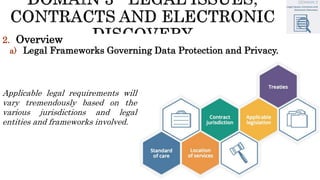
In many cases, the laws of different countries might apply concurrently, in accordance
with the following:
1. The location of the cloud provider
2. The location of the cloud user
3. The location of the data subject
4. The location of the servers
5. The legal jurisdiction of the contract between parties, which may be different than the
locations of any of the parties involved
6. Any treaties or other legal frameworks between those various locations
2. Overview
a) Legal Frameworks Governing Data Protection and Privacy.
Applicable legal requirements will
vary tremendously based on the
various jurisdictions and legal
entities and frameworks involved.
2. Overview
b) Common Themes.
Many countries have adopted national or omnibus laws (applying to all categories of
personal data) or sectoral laws (applying to specified categories of data) that are intended
to protect the privacy of individuals.
1. Required Security Measures
These laws frequently contain provisions requiring the adoption of security measures,
acknowledging that ensuring the security of personal data is essential to ensuring the
protection of individual privacy.
Concurrently, companies may also be expected to adopt reasonable technical, physical, and
administrative measures in order to protect a wide range of data, including personal data,
financial data, trade secrets, and other sensitive company data from loss, misuse or alteration.
2. Overview
b) Common Themes.
Many countries have adopted national or omnibus laws (applying to all categories of personal data) or
sectoral laws (applying to specified categories of data) that are intended to protect the privacy of
individuals.
2. Restrictions to Cross-border Data Transfers
Many countries prohibit or restrict the transfer of information out of their borders.
In most cases, the transfer is permitted only if the country to which the data is transferred offers an
“adequate level of protection” (as defined in the relevant national law) of personal information and privacy
rights of affected individuals.
The purpose of this adequacy requirement is to ensure the individuals whose data is transferred across
borders will remain as protected as they were via policies afforded to them before the transfer of data.
Alternatively, the data importer and exporter may need to sign a contract ensuring the maintenance of
privacy rights for data subjects.
Depending on the country, the requirements for ensuring this adequate protection may be complex and
stringent.
In some cases, it may be necessary to obtain prior permission of the local Data Protection Commissioner
before transferring data in or out of the country.
In addition, some countries are beginning to require that certain data be stored within their territory.
This is the case, for example, with the new data localization laws of Russia and China, which require that
specified personal data pertaining to individuals residing in their countries be stored within the country’s
borders.
2. Overview
b) Common Themes.
Many countries have adopted national or omnibus laws (applying to all categories of personal
data) or sectoral laws (applying to specified categories of data) that are intended to protect the
privacy of individuals.
3. Regional Examples
i. ASIA PACIFIC REGION
a) Australia
In Australia, two key laws provide protection to consumers of cloud services:
1. the Privacy Act of 1988 (Privacy Act) and the Australian Consumer Law (ACL).
2. The Privacy Act includes 13 Australian Privacy Principles (APPs), which apply to
all private sector and not-for-profit organizations with an annual turnover of more
than AUD 3 million, all private health service providers, and some small
businesses.
2. Overview
b) Common Themes.
Many countries have adopted national or omnibus laws (applying to all categories of personal data) or
sectoral laws (applying to specified categories of data) that are intended to protect the privacy of
individuals.
3. Regional Examples
i. ASIA PACIFIC REGION
b) China
1. Its 2017 Cyber Security Law governs the operations of network operators and critical
information infrastructure operators. In May 2017, proposed Measures on the Security
of Cross-Border Transfers of Personal Information and Important Data were published
by the Chinese government and are currently being evaluated for potential
implementation.
2. The 2017 Cyber Security Law requires network operators to comply with a series of
security requirements, including the design and adoption of information security
measures; the formulation of cyber security emergency response plans; and assistance
and support necessary to investigative authorities, where necessary, for protecting
national security and investigating crimes.
2. Overview
b) Common Themes.
 Many countries have adopted national or omnibus laws (applying to all categories of personal data) or sectoral laws
(applying to specified categories of data) that are intended to protect the privacy of individuals.
3. Regional Examples
i. ASIA PACIFIC REGION
b) Japan
1. In Japan, the Act on the Protection of Personal Information (APPI) requires the private sector
to protect personal information and data securely. There are several other national laws, such
as the Law on the Protection of Personal Information Held by Administrative Organs and laws
pertaining to specific sectors, such as the healthcare industry. Profession-specific laws, such as
the Medical Practitioners’ Act; the Act on Public Health Nurses, Midwives and Nurses; and the
Pharmacist Act, require registered health professionals to maintain the confidentiality of
patient information.
2. Beginning in September 2017, amendments to the APPI law will limit the ability to
transfer personal data to third parties, with prior consent of the data subject generally
being required to transfer data to a third party. Consent to the transfer is not required if
the country of destination has an established framework for the protection of personal
information that meets the standard specified by the Personal Information Protection
Commission.
2. Overview
b) Common Themes.
Many countries have adopted national or omnibus laws (applying to all categories of personal
data) or sectoral laws (applying to specified categories of data) that are intended to protect the
privacy of individuals.
3. Regional Examples
i. ASIA PACIFIC REGION
b) Russia
1. The Russian data protection laws contain significant restrictions on data
processing, including a requirement for consent for most forms of data
processing. However, the most important aspect of the Russian legal
framework regarding the handling of personal information is its data
localization law. Since September 2015, companies are required to store
personal data of Russian citizens within Russia. Roskomnadzor, the Russian
Data Protection regulator, has commenced enforcement of the law and has
already blocked access to one foreign social network, which did not have a
physical presence in Russia, but operated a Russian language version of its
website.
2. Overview
b) Common Themes.
Many countries have adopted national or omnibus laws (applying to all categories of personal data) or
sectoral laws (applying to specified categories of data) that are intended to protect the privacy of
individuals.
3. Regional Examples
ii. EUROPEAN UNION AND EUROPEAN ECONOMIC AREA
1. The European Union (EU) adopted the General Data Protection Regulation (GDPR) in
2016, which is binding on all EU member states, as well as members of the European
Economic Area (EEA). The GDPR will become enforceable as of May 25, 2018. On that
date, Directive 95/46/EC on the Protection of Personal Data, which had been the legal
basis of the provisions of the national data protection laws of all EU and EEA member
states, will be repealed.
2. From a security standpoint, the Network Information Security Directive (NIS
Directive) is paving the way to more stringent security requirements. Adopted in 2016,
the NIS Directive requires EU/EEA member states to implement new information
security laws for the protection of critical infrastructure and essential services by May
2018. Cloud service providers and some cloud users are likely to be affected by the
national laws that will implement the overarching NIS Directive.
2. Overview
b) Common Themes.
Many countries have adopted national or omnibus laws (applying to all categories of
personal data) or sectoral laws (applying to specified categories of data) that are intended
to protect the privacy of individuals.
3. Regional Examples
ii. EUROPEAN UNION AND EUROPEAN ECONOMIC
AREA
1. General Data Protection Regulation (GDPR)
The new GDPR is directly binding on any corporation that processes
the data of EU citizens, and will be adjudicated by the data supervisory
authorities or the courts of the member states that have the closest
relationship with the individuals or the entities on both sides of the
2. Overview
b) Common Themes.
3. Regional Examples
ii. EUROPEAN UNION AND EUROPEAN ECONOMIC AREA
1. General Data Protection Regulation (GDPR)
a) Applicability:
 The GDPR applies to the processing of personal data in the context of the activities
of an establishment of a controller or processor in the EU/EEA, regardless of
whether the processing takes place in the EU/EEA or not.
 It also applies to the processing of personal data of data subjects who are in the
EU/EEA by a controller or a processor not established in the EU/EEA if the
processing relates to
 (a) the offering of goods or services irrespective of whether a payment by the
data subject is required; or
 (b) the monitoring of the behaviour of a data subject, when the behaviour takes
place within the EU/EEA.
2. Overview
b) Common Themes.
3. Regional Examples
ii. EUROPEAN UNION AND EUROPEAN ECONOMIC
AREA
1. General Data Protection Regulation (GDPR)
b) Lawfulness:
The processing of personal data is allowed only if
(a) the data subject has freely given specific, informed and
unambiguous indication of his/her consent to the processing of
his/her personal data, or
(b) the processing is authorized by a statutory provision.
2. Overview
b) Common Themes.
3. Regional Examples
ii. EUROPEAN UNION AND EUROPEAN ECONOMIC
AREA
1. General Data Protection Regulation (GDPR)
c) Accountability Obligations
The GDPR has created numerous obligations for companies. For
example, the GDPR requires companies to keep records of their data
processing activities. Certain categories of processing require a prior
“Privacy Impact Assessment.” Companies are expected to develop
and operate their products and services in accordance with “privacy
2. Overview
b) Common Themes.
3. Regional Examples
ii. EUROPEAN UNION AND EUROPEAN ECONOMIC
AREA
1. General Data Protection Regulation (GDPR)
d) Data Subjects’ Rights
Data subjects have rights to information regarding the processing of
their data: the right to object to certain uses of their personal data; to
have their data corrected or erased; to be compensated for damages
suffered as a result of unlawful processing; the right to be forgotten;
and the right to data portability. The existence of these rights
2. Overview
b) Common Themes.
3. Regional Examples
ii. EUROPEAN UNION AND EUROPEAN ECONOMIC AREA
1. General Data Protection Regulation (GDPR)
e) Cross-border Data Transfer Restrictions
 The transfer of personal data outside the EU/EEA to a country that does not offer a
similar range of protection of personal data and privacy rights is prohibited.
To prove that it will be offering the “adequate level of protection” required, a
company may use one of several methods, such as executing Standard Contractual
Clauses (SCC), signing up to the EU-US Privacy Shield, obtaining certification of
Binding Corporate Rules (BCRs), or complying with an approved industry Code of
Conduct or approved certification mechanism. In rare cases, the transfer might be
effected with the explicit, informed, consent of the data subject, or if other
exceptions apply.
2. Overview
b) Common Themes.
3. Regional Examples
ii. EUROPEAN UNION AND EUROPEAN ECONOMIC AREA
1. General Data Protection Regulation (GDPR)
f) Breaches of Security
 The GDPR requires companies to report that they have suffered a breach
of security.
 The reporting requirements are risk-based, and there are different
requirements for reporting the breach to the Supervisory Authority and to
the affected data subjects.
 Breaches must be reported within 72 hours of the company becoming aware
of the incident.
2. Overview
b) Common Themes.
3. Regional Examples
ii. EUROPEAN UNION AND EUROPEAN ECONOMIC
AREA
1. General Data Protection Regulation (GDPR)
g) Discrepancies among Member States
There are numerous instances where each member state may adopt
its own rules.
For example, Germany requires that a Data Protection Officer be
appointed if the company has more than nine employees.
2. Overview
b) Common Themes.
3. Regional Examples
ii. EUROPEAN UNION AND EUROPEAN ECONOMIC
AREA
1. General Data Protection Regulation (GDPR)
h) Sanctions
Violations of the GDPR expose a company to significant sanctions.
These sanctions may reach up to the greater of four percent of their
global turnover or gross income, or up to EUR 20 million.
2. Overview
b) Common Themes.
3. Regional Examples
ii. EUROPEAN UNION AND EUROPEAN ECONOMIC AREA
2. Network Information Security Directive (NIS Directive)
 The NIS Directive entered into force in August 2016, requiring each
EU/EEA member state to implement the Directive into its national
legislation by May 2018.
 The NIS Directive establishes a framework to enable networks and
information systems to resist, at a given level of confidence, actions that
compromise the availability, authenticity, integrity, or confidentiality of
stored, transmitted, or processed data, or the related services that are
offered by or accessible through those networks and information systems.
2. Overview
b) Common Themes.
3. Regional Examples
ii. EUROPEAN UNION AND EUROPEAN ECONOMIC AREA
2. Network Information Security Directive (NIS Directive)
 The NIS Directive requires that member state’s national laws impose
network and information security requirements on operators of essential
services, i.e., entities that provide a service essential for the maintenance of
critical societal and/or economic activities;
 and where an incident to the network and information systems of that
service would have significant disruptive effects on the provision of that
service.
 The requirements to be implemented into national laws include the
following:
2. Overview
b) Common Themes.
3. Regional Examples
ii. EUROPEAN UNION AND EUROPEAN ECONOMIC AREA
2. Network Information Security Directive (NIS Directive)
 The requirements to be implemented into national laws include the following:
a) Taking technical and organizational measures to manage risks posed to the security of
networks and information systems used in their operations;
b) Taking appropriate measures to prevent and minimize the impact of incidents affecting the
security of the networks and information systems used for the provision of such essential
services, to facilitate the continuation of those services;
c) Notifying, without undue delay, the competent authorities or agencies of incidents
having a significant impact on the continuity of the essential services they provide;
d) Providing information necessary to assess the security of their networks and
information systems
e) Providing evidence of the effective implementation of security policies, such as the
results of a security audit.
2. Overview
b) Common Themes.
3. Regional Examples
ii. EUROPEAN UNION AND EUROPEAN ECONOMIC AREA
2. Network Information Security Directive (NIS Directive)
 The NIS Directive also requires that member state’s national laws impose network and information
security requirements on digital service providers, such as online market places (e.g., e-commerce
platforms), cloud computing services; and online search engines. Digital service providers based outside
the EU that provide services within the EU fall under the scope of the NIS Directive.
 Member state’s national laws will also have to require digital service providers to identify and take
appropriate and proportionate technical and organizational measures to manage risks posed to the
security of network and information systems they use, such as incident handling, business continuity
management, monitoring, auditing and testing, and compliance with international standards.
 Member State’s national laws will have to require digital service providers to take measures to prevent
and minimize the impact of incidents. They will be required to notify the competent authorities or
agencies, without undue delay, of any incident having a substantial impact on the provision of a service,
including sufficient information to enable the competent authority or agency to determine the
significance of any cross-border impact. Where an operator of essential services relies on a third party
digital service provider for a service that is essential, the operator will be required to notify any
significant impact on the continuity of the essential services due to an incident affecting the digital
service provider.
2. Overview
b) Common Themes.
3. Regional Examples
iii. THE AMERICAS
1. Central and South America
 Central and South American countries also are adopting data protection laws at a
rapid pace.
 Each of these laws includes a security requirement and places on the data
custodian the burden of ensuring the protection and security of personal data
wherever the data are located, and especially when transferring to a third party.
 For example, Argentina, Chile, Colombia, Mexico, Peru and Uruguay have passed
data protection laws inspired mainly by the European directive 95/46/EC, and may
include references to the APEC Privacy Framework.
 The federal data protection law of Mexico includes security breach disclosure
provisions.
2. Overview
b) Common Themes.
3. Regional Examples
iii. THE AMERICAS
2. North America: United States
 Due to its sectoral approach, the United States has hundreds of federal, state and local
regulations, from the details of a written information security plan to the rules for disclosing
security breaches.
 As a result, organizations that do business in the United States or collect or process personal
or other information of individuals or companies located in the United States are often
subject to several federal, state or local privacy or information security laws.
 The variety and complexity of these rules might be daunting both for providers or users of
cloud services and for the service providers and subcontractors who participate in the
provision of these services.
2. Overview
b) Common Themes.
3. Regional Examples
iii. THE AMERICAS
2. North America: United States
a. U.S. Federal Laws
 Numerous federal laws and their related regulations—such as the Gramm-Leach-Bliley Act (GLBA), the
Health Insurance Portability and Accountability Act of 1996 (HIPAA), and the Children’s Online Privacy
Protection Act of 1998 (COPPA)—contain provisions that pertain to the privacy and the security of
personal information.
 Security-related provisions require companies to adopt reasonable security measures when processing
personal data.
 Most of these laws require companies to take precautions when hiring subcontractors and service
providers. They may also hold organizations responsible for the acts of their subcontractors.
 For example, the security and privacy rules under GLBA and HIPAA require that covered organizations
compel their subcontractors, in written contracts, to use reasonable security measures and comply with
data privacy provisions.
2. Overview
b) Common Themes.
3. Regional Examples
iii. THE AMERICAS
2. North America: United States
a. U.S. State Laws
 In addition to federal laws and regulations, most U.S. states have laws relating to data privacy and/ or data security.
 These laws apply to any entity that collects or processes personal information (as narrowly defined in the applicable
law) of individuals who reside in that state, regardless of where in the United States the data is stored.
 Some state laws are elaborate. See, for example, the extensive requirements under Massachusetts’ “Standards for the
Protection of Personal Information of Residents of the Commonwealth,” or 201 CMR 17.00. Other state laws are more
general (see Washington State law RCW 19.255.020(2)(b) that assigns liability on the basis of compliance) and a small
number of state laws reference other specific standards (such as the Payment Card Industry Data Security Standard,
PCI-DSS, mentioned above). Most state laws that address information security issues require that the company have a
written contract with the service provider with reasonable security measures. Numerous state laws also require
companies to provide adequate privacy protections and security for personal data, and require their service providers
to do the same.
2. Overview
b) Common Themes.
3. Regional Examples
iii. THE AMERICAS
2. North America: United States
a. U.S. State Laws
i. Security Breach Disclosure Laws
 Numerous federal security laws or rules, such as those applying to healthcare providers, as well as
most state laws, require entities that have suffered a breach of security that compromised specified
categories of data, such as PHI (patient health information), to promptly notify affected individuals,
and in many cases, state or federal agencies, of the occurrence of the breach of security.
 Knowledge and understanding of these laws is critical for both cloud customers and cloud
vendors, because breaches of security often trigger significant cost, including for example, the
cost of responding to class action suits. Recent breaches of security have been reported to affect
hundreds of millions of individuals, and the resulting legal costs and damages to be paid out by
affected companies have also been significant.
2. Overview
b) Common Themes.
3. Regional Examples
iii. THE AMERICAS
2. North America: United States
a. U.S. State Laws
ii. Federal and State Agencies
 In addition to specific laws and regulations, cloud providers and users should be aware of the “common law of
privacy and security,” the nickname given to the body of consent orders that have been published by federal and
state government agencies at the conclusion of their investigations into security incidents and events.
 For almost 20 years, U.S. government agencies, such as the Federal Trade Commission (FTC) and the State
Attorneys General have used their power under Federal or state “unfair and deceptive practices” acts to conduct
enforcement actions against companies whose privacy or security practices are inconsistent with claims made in
their public disclosures, making their practices unfair or deceptive.
 The numerous consent decrees issued by the FTC in enforcement cases under Section 5 of the FTC Act: Unfair or
Deceptive Acts or Practices— or by state attorneys general in similar cases under their states’ unfair and deceptive
practices act— at the conclusion of many of these security investigations provide important guidance on the views
and objectives of the Federal or State agencies regarding the collection, use and protection of personal information.
2. Overview
c) Contracts and Provider Selection
If the privacy notice allows individual data subjects to have access to their personal data, and to
have this information modified or deleted, the cloud service provider must also allow these access,
modification, and deletion rights to be exercised to the same extent as it would in a non-cloud
relationship.
When data or operations are transferred to a cloud, the responsibility for protecting and securing the
data typically remains with the collector or custodian of that data, even if in some circumstances this
responsibility may be shared with others.
Even when it relies on a third party to host or process its data, the custodian of the data remains
liable for any loss, damage, or misuse of the data.
It is therefore prudent, and may be required by law or regulation, that the data custodian and the
cloud provider enter into a formal written agreement that clearly defines the roles, the expectations
of the parties, and the allocation of the many responsibilities that are attached to the data at stake.
Such an agreement should also clearly identify the permitted and prohibited uses of the data, and
the measures to be taken if the data were stolen or compromised.
The laws, regulations, standards and the related best practices discussed above also require data
custodians to ensure that these obligations will be fulfilled by conducting due diligence (before
execution of the contract) or security audits (during performance of the contract).
2. Overview
c) Contracts and Provider Selection
i. Internal Due Diligence
Companies are the custodians of data entrusted to them.
As seen above, numerous laws, regulations and contracts prohibit, restrict and limit
disclosure and transfer of data to a third party.
For example, health information protected under HIPAA cannot be transferred to a third
party or “business associate” without imposing specific obligations on that associate.
In addition, if data originates abroad, it is likely that there are significant obstacles to its
transfer across borders into a country that does not provide “adequate protection” to privacy
rights and personal data.
Before entering into a cloud computing arrangement, both the cloud service vendor and the
cloud customer should evaluate respective practices, needs and restrictions to identify
relevant legal barriers and compliance requirements.
For example, a cloud customer should determine whether its business model allows for the
use of cloud computing services, and under which conditions.
The nature of its business might be such that it is restricted by law from relinquishing
control of company data.
A cloud vendor may find it prudent to evaluate in advance the cost of doing business in
certain markets that might be subject to legal requirements with which the vendor is
unfamiliar.
2. Overview
c) Contracts and Provider Selection
i. Internal Due Diligence
A cloud customer should investigate whether it has entered into any confidentiality
agreements or data use agreements that might restrict the transfer of data to third parties,
even if these third parties are service providers.
If the company, or potential cloud customer, has signed a confidentiality agreement to protect
personal information or trade secrets, this agreement probably prohibits hiring a
subcontractor without prior permission of the data owner.
A data use agreement to which the company is a party may require the consent of a customer
if the company plans to subcontract the processing of the customer’s data to a third party.
That restriction would in most cases apply to transfers to a cloud service provider.
Under these circumstances, moving data to a cloud without the prior permission of the
customer (data owner) would cause a breach in the data use agreement with that customer.
In other circumstances, the data processed by the company might be so sensitive or
confidential that it should not be transferred to a cloud service, or the transfer might require
significant precautions.
This might be the case, for example, for files that pertain to high stakes projects such as R&D
(Research & Development) road maps, or plans for an upcoming IPO (Initial Public Offering),
merger, or acquisition.
2. Overview
c) Contracts and Provider Selection
ii. Monitoring, Testing, and Updating
The cloud environment is not static.
It evolves and involved parties must adapt.
Periodic monitoring, testing, and evaluation of cloud services are recommended in
order to insure required privacy and security measures are followed.
Without periodic testing of cloud services, control efficacy may be compromised in an
undetected fashion.
In addition, the legal, regulatory, and technical landscape in which any company
operates changes at a rapid pace.
New security threats, new laws, and new compliance requirements must be
addressed promptly.
Both cloud clients and cloud providers must keep abreast of relevant legal,
regulatory, contractual, and other requirements, and ensure that both their
operations remain compliant with applicable laws and regulations, and that the
security measures in place continue to evolve as new technologies emerge.
2. Overview
c) Contracts and Provider Selection
iii. External Due Diligence
In most cases, the cloud customer will want to evaluate at least the applicable service level, end-
user and legal agreements; privacy policies; security disclosures; and proof of compliance with
applicable legal requirements (e.g., registration requirements) to ensure the conditions stated by
the cloud provider are suitable for the customer’s organization.
Depending on the expected depth and intensity of the due diligence, issues to be investigated may
include the following:
1. Will the service be reliable and easy to use?
2. How will the servers be used to process data?
3. How will the service operate and be provided?
4. Will data be collocated with other customers’ data?
5. How will data be protected from intrusion or disasters?
6. How will the price evolve over time?
7. Will the cloud vendor meet the company’s computing and access needs?
8. Will the cloud vendor remain in business for the next few years? What is its financial profile?
9. What service levels will be offered?
2. Overview
c) Contracts and Provider Selection
iii. External Due Diligence
Depending on the expected depth and intensity of the due diligence, issues
to be investigated may include the following:
10. What security measures are used?
11. What will happen in the event of a security breach?
Reviewing all terms and conditions of the cloud services agreement
(including all annexes, schedules and appendices) is good due diligence for
any new project. It is especially critical for cloud computing, as some
vendor terms and conditions will be non-negotiable.
In those instances, the customer needs to make an informed decision to
use or not use a provider.
2. Overview
c) Contracts and Provider Selection
iv. Contract Negotiations
Cloud contracts are intended to accurately describe the understanding of all
parties.
Numerous precautions and measures can be taken by the parties to reduce
exposure to legal, commercial and reputational risk in connection with the use of
cloud services.
The proposed contract should always be reviewed carefully, even if one is told
that it is not negotiable.
For one thing, it might actually be possible to negotiate changes.
Even if it is not possible to do so, each purchaser of cloud services should
understand the consequences and implications of the engagement it is making.
A contract that cannot be negotiated is likely to lack some of the protections that
the typical customer would need. In this case, the customer should weigh the
risks from foregoing these protections against potential benefits.
2. Overview
c) Contracts and Provider Selection
iv. Reliance on Third-Party Audits and Attestations
Audits and compliance are covered in more detail in Domain 4, but two
considerations may affect contractual and legal/regulatory requirements.
In cloud computing, third-party audits and attestations are frequently used to
assure compliance with aspects of the cloud provider’s infrastructure, allowing a
customer to build their own compliant services on top of the cloud platform.
It is critical for a provider to publish, and a customer to evaluate, the scope of the
assessment, and which features and services are included in the assessment.
For example, a cloud provider’s newest storage offering may not be HIPAA-
compliant (and thus the provider may not be willing to sign a HIPAA Business
Associate Agreement (BAA) covering it), even though many of its other service
offerings are able to be used in a HIPAA-compliant fashion.
2. Overview
d) Electronic Discovery
U.S. rules around “discovery” - the process by which an opposing party obtains private documents for
use in litigation - cover a wide range of potential documents.
In particular, discovery need not be limited to documents known at the outset to be admissible as
evidence in court; instead, discovery will apply to all documents reasonably calculated to lead to
admissible evidence (evidence that is both relevant and probative). See Rule 26, Federal Rules of Civil
Procedure (FRCP).
In recent years, many litigants have deleted, lost or modified evidence that was detrimental to their
case. In these cases, the Federal Rules of Civil Procedure allow, among other penalties, money to be
awarded to the side not responsible for the destruction; in some cases, the jury may be given
an instruction on an “adverse inference” (where a jury is instructed to assume that the destroyed
evidence contains the worst possible information for the party that destroyed it). See Rule 37, FRCP. As
a result of the ongoing litigation in this area, the FRCP have been changed to clarify the obligations of
the parties, especially in the case of electronically stored information (ESI).
Since the cloud will become the repository of most ESI needed in litigation or an investigation, cloud
service providers and their clients must carefully plan how they will be able to identify all documents
that pertain to a case, in order to be able to fulfil the stringent requirements imposed by FRCP 26 with
regard to ESI, and the state equivalents to these laws.
In this regard, the cloud service client and provider need to consider the following issues in matters
when a client is subject to a discovery request and potentially relevant data exists with the cloud
provider.
2. Overview
d) Electronic Discovery
i. Possession, Custody and Control
In most jurisdictions in the United States, a party’s obligation to produce relevant
information is limited to documents and data within its possession, custody or control.
Hosting relevant data via a third party, such as a cloud provider, generally does not
obviate a party’s obligation to produce information.
However, not all data hosted by a cloud provider may be in the control of a client (e.g.,
disaster recovery systems, or certain metadata created and maintained by the cloud
provider to operate its environment).
Distinguishing the data that is and is not available to the client may be in the interest of
both the client and provider at the outset of a relationship.
The obligations of the cloud service provider as cloud data handler with regard to the
production of information in response to legal process is an issue left to each jurisdiction
to resolve.
2. Overview
d) Electronic Discovery
ii. Relevant Cloud Applications and Environment
On occasion, an actual cloud application or environment could itself be relevant to resolving a dispute.
In these circumstances, the application and environment will likely be outside the control of the client
and require that a subpoena or other discovery process be served on the provider directly.
iii. Searchability and E-Discovery Tools
In a cloud environment, a client may not be able to apply or use e-discovery tools that it uses in its own
environment.
Moreover, a client may not have the ability or administrative rights to search or access all the data
hosted in the cloud.
For example, where a client could access multiple employees’ e-mail accounts on its own server at once,
it may not have this ability with e-mail accounts hosted in the cloud. As such, clients need to account for
the potential additional time and expense this limited access will cause.
To the extent the customer is able to negotiate or supplement the cloud service agreement, this issue
could be addressed ahead of time.
Otherwise, the cloud customer may have no option other than to address issues on a case-by-case basis;
and might therefore have to pay for additional services from the cloud provider.
2. Overview
d) Electronic Discovery
iv. Preservation
Depending on the cloud service and deployment model that a client is using, preservation in the
cloud can be similar to preservation in other IT infrastructures, or it can be significantly more
complex.
In the United States, a party is generally obligated to undertake reasonable steps to prevent
the destruction or modification of data in its possession, custody or control that it knows, or
reasonably should know, is relevant either to pending or reasonably anticipated litigation or a
government investigation.
(This is often referred to as a “litigation hold” on document destruction.)
These concerns are addressed broadly by Federal Rule of Civil Procedure 37, though there are
myriad jurisdictional rulings that apply to potential litigants.
In the European Union, information preservation is governed under Directive 2006/24/EC of the
European Parliament and of the Council of 15 March 2006. Japan, South Korea and Singapore
have similar data protection initiatives.
In South America, Brazil and Argentina have the Azeredo Bill and the Argentina Data Retention
Law of 2004, Law No. 25.873, respectively.
2. Overview
d) Electronic Discovery
v. Data Retention Laws and Record Keeping Obligations
In addition to data preservation obligations resulting from U.S. laws regarding e-discovery,
companies need to be aware that data retention laws require covered entities to retain data for a
certain period of time.
a. Costs and Storage:
Preservation can require that large volumes of data be retained for extended periods.
Customers should consider these questions and determine the risk tolerated before moving to
the cloud:
1. What are the ramifications of retaining data under the service level agreement (SLA)?
2. What happens if the preservation requirements outlast the terms of the SLA?
3. If the client preserves the data in place, who pays for the extended storage, and at what
cost?
4. Does the client have the storage capacity under its SLA?
5. Can the client effectively download the data in a forensically sound manner so it can be
preserved off-line or near-line?
2. Overview
d) Electronic Discovery
v. Data Retention Laws and Record Keeping Obligations
b. Scope of Preservation:
A requesting party is entitled only to data hosted in the cloud that contains, or is reasonably
calculated to lead to, relevant, probative information for the legal issue at hand.
The party is not entitled to all the data in the cloud or in the application. (The issue of precise
limits is likely to be resolved in litigation.)
However, if the client does not have the ability to preserve only the relevant information or data
in a granular way, it may be required to over-preserve in order to secure reasonable
preservation, depending on the investigation.
The over-preserved information is then examined for a determination of what must and must
not be turned over as part of the discovery process.
This process, referred to as a document review or privilege review, may be undertaken by client
paid attorney staff or, in some cases, by emerging expert systems.
How to sort the ever-more-voluminous quantities of information that may be produced by
discovery is an ongoing area of both legal and technical research.
2. Overview
d) Electronic Discovery
v. Data Retention Laws and Record Keeping Obligations
c. Dynamic and Shared Storage:
The burden of preserving data in the cloud may be relatively modest if the
client has space to hold it in place, if the data is relatively static, and if the
people with access are limited and know to preserve the data.
However, in a cloud environment that programmatically modifies or purges
data, or one where the data is shared with people unaware of the need to
preserve, preservation can be more difficult.
After a client determines that such data is relevant and needs to be preserved,
the client may need to work with the provider to determine a reasonable way
to preserve such data.
2. Overview
d) Electronic Discovery
vi. Collection
Because of the potential lack of administrative control a client has over
its data in the cloud, collection from the cloud can be more difficult, more
time-consuming and more expensive than from behind a client’s firewall.
In particular, a client may not have the same level of visibility across its
cloud data, and it may have more difficulty comparing the data it has
collected with the data in the cloud to determine that export was
reasonably complete and accurate.
2. Overview
d) Electronic Discovery
vi. Collection
i. Access and Bandwidth
In most cases, a client’s access to its data in the cloud will be determined
by its SLA.
This may limit its ability to collect large volumes of data quickly and in a forensically sound
manner (i.e., with all reasonably relevant metadata preserved).
Clients and cloud providers should consider this issue at the outset of their relationship, and
establish a protocol (and cost) for extraordinary access in the case of litigation.
Absent these agreements, clients are responsible for the extra time and cost implicated by
collection in the cloud when making representations to requesting parties and courts.
Note that FRCP 26(b)(2)(B) excuses a litigant who is able to show that the information
requested is not reasonably accessible.
However, a court may nonetheless order discovery from such sources if the requesting party is
able to show why this information is needed and may not be obtained otherwise.
2. Overview
d) Electronic Discovery
vi. Collection
i. Access and Bandwidth
In a related issue, a client’s right of access may provide them access to a full
range of data, but not provide them the degree of functionality that would best
assist them in a given situation.
For example, a client may have access to three years of retail transactional
data, but may only be able to download data two weeks at a time because of
functionality constraints.
Moreover, a client may not only have view of limited metadata. It is prudent
for a client to learn what is possible with the tools available before it becomes
necessary to use them as a part of active litigation.
2. Overview
d) Electronic Discovery
vi. Collection
ii. Forensics
Bit-by-bit imaging of a cloud data source is generally difficult or impossible.
For obvious security reasons, providers are reluctant to allow access to their hardware,
particularly in a multi- tenant environment where a client could gain access to other
clients’ data.
Even in a private cloud, forensics may be extremely difficult, and clients may need to
notify opposing counsel or the courts of these limitations.
Luckily, this type of forensic analysis is rarely warranted in cloud computing, because
the environment often consists of a structured data hierarchy or virtualization that
does not provide significant additional relevant information in a bit-by-bit analysis.
2. Overview
d) Electronic Discovery
vi. Collection
iii. Reasonable Integrity:
A client subject to a discovery request should undertake reasonable
steps to validate that its collection from its cloud provider is complete
and accurate, especially where ordinary business procedures for the
request are unavailable and litigation-specific measures are being used
to obtain the information.
This process is separate from verifying that the data stored in the cloud
is accurate, authenticated or admissible.
2. Overview
d) Electronic Discovery
vi. Collection
iv. Limits to Accessibility:
Due to differences in how data is stored, and the access rights and
privileges available to the owner of the data, there are cases where a
cloud customer may not be able to access all their data stored in a cloud.
The cloud customer and cloud provider may have to analyse the request
for information and the pertinent data structures for relevance,
materiality, proportionality, or accessibility, when responding to a
discovery request.
2. Overview
d) Electronic Discovery
vii. Direct Access
Outside the cloud environment, a requesting party’s direct access to a
responding party’s IT environment is not generally favoured.
(It does happen from time to time. In fact, some courts have been willing to
allow no-notice seizures of IT equipment for the purpose of evidence
preservation in civil cases, including employment disputes.)
In the cloud environment, it is even less favoured and may be impossible as a
forensic analysis may be impossible.
Some cloud providers may not be able to provide direct access, because the
hardware and facilities are outside its possession, custody or control, and a
requesting party would need to negotiate directly with the provider for such
access.
2. Overview
d) Electronic Discovery
viii. Native Production
Cloud service providers often store data in highly proprietary systems and
applications that clients do not control.
Generally, ESI is expected to be produced in standard formats (such as PDF for
electronic documents), unless information lost by conversion (such as
metadata) is relevant to the dispute.
Data in its cloud-native format may be useless to the requesting party.
In these circumstances, it may be best for all concerned - requesting party,
producing party and provider - that the relevant information be exported using
standard protocols within the cloud environment, with due care given to
preserving relevant information.
2. Overview
d) Electronic Discovery
ix. Authentication
Authentication in this context refers to forensic authentication of data admitted into evidence.
(This should not be confused with user authentication, which is a component of Identity
Management.)
Storing data in the cloud does not affect the authentication of data to determine if it should be
admitted into evidence.
The question is whether the document is what it purports to be.
For example, an e-mail is no more or less authentic because it was stored behind a company’s
firewall or was stored in the cloud;
the question is whether it was stored with integrity, such that the court can trust that it has not
been altered since it was created.
Absent other evidence, such as tampering or hacking, documents should not be considered more
or less admissible or credible merely because they were created or stored in the cloud.
2. Overview
d) Electronic Discovery
ix. Authentication
Authentication in this context refers to forensic authentication of data admitted into evidence.
(This should not be confused with user authentication, which is a component of Identity
Management.)
Storing data in the cloud does not affect the authentication of data to determine if it should be
admitted into evidence.
The question is whether the document is what it purports to be.
For example, an e-mail is no more or less authentic because it was stored behind a company’s
firewall or was stored in the cloud;
the question is whether it was stored with integrity, such that the court can trust that it has not
been altered since it was created.
Absent other evidence, such as tampering or hacking, documents should not be considered more
or less admissible or credible merely because they were created or stored in the cloud.
2. Overview
d) Electronic Discovery
x. Cooperation Between Provider and Client in E-Discovery
It is in the best interests of both providers and clients to consider the
complications caused by discovery at the beginning of their relationship
and to account for it in their SLAs. Providers may want to consider
designing their cloud offerings to include discovery services to attract
clients (“Discovery by Design”). In any event, clients and providers
should consider including an agreement to reasonably cooperate with
each other in the event of discovery requests against either.
2. Overview
d) Electronic Discovery
x. Response to a Subpoena or Search Warrant
 Should a cloud service provider receive, from a third party, a request to provide information;
 this may be in the form of a subpoena, a warrant, or a court order in which access to the client data is demanded.
 The client may want to have the ability to fight the request for access in order to protect the confidentiality of
their data.
 To this end, the cloud service agreement should require the cloud service provider to notify the customer that a
subpoena was received and give the company time to fight the request for access.
 The cloud service provider might be tempted to reply to the request by opening its facilities and providing the
requester with whatever they request.
 Before doing so, the cloud service provider should ensure, in consultation with counsel, that the request is legal
and solid.
 The cloud service provider should carefully analyse the request before disclosing information in its custody, and
consider whether it can meet its obligations to its clients when releasing information. In some cases, a provider
may be better able to serve the needs of its clients by fighting an overbroad or otherwise problematic demand for
information.
3. Recommendations
 Cloud customers should understand the relevant legal and regulatory frameworks, as well as contractual requirements and
restrictions that apply to the handling of their data or data in their custody, and the conduct of their operations, before moving
systems and data to the cloud.
 Cloud providers should clearly and conspicuously disclose their policies, requirements and capabilities, including all terms and
conditions that apply to the services they provide.
 Cloud customers should conduct a comprehensive evaluation of a proposed cloud service provider before signing a contract, and
should regularly update this evaluation and monitor the scope, nature and consistency of the services they purchase.
 Cloud providers should publish their policies, requirements and capabilities to meet legal obligations for customers, such as
electronic discovery.
 Cloud customers should understand the legal implications of using particular cloud providers and match those to their legal
requirements.
 Cloud customers should understand the legal implications of where the cloud provider physically operates and stores information.
 Cloud customer should decide whether to choose where their data will be hosted, if the option is available, to comply with their
own jurisdictional requirements.
 Cloud customers and providers should have a clear understanding of the legal and technical requirements to meet any electronic
discovery requests.
 Cloud customers should understand that click-through legal agreements to use a cloud service do not negate requirements for a
provider to perform due diligence.
DOMAIN 4 -
COMPLIANCE AND
AUDIT MANAGEMENT
1. Introduction
Organizations face new challenges as they migrate from traditional data centres to the cloud.
Delivering, measuring, and communicating compliance with a multitude of regulations across
multiple jurisdictions are among the largest of these challenges.
Customers and providers alike need to understand and appreciate the jurisdictional differences
and their implications on existing compliance and audit standards, processes, and practices.
The distributed and virtualized nature of cloud computing requires significant adjustment from
approaches based on definite and physical instantiations of information and processes.
In addition to providers and customers, regulators and auditors are also adjusting to the new
world of cloud computing.
Few existing regulations were written to account for virtualized environments or cloud
deployments.
A cloud user can be challenged to show auditors that the organization is in compliance.
Understanding the interaction of cloud computing and the regulatory environment is a key
component of any cloud strategy.
Cloud customers, auditors, and providers must consider and understand the following:
1. Introduction
Cloud customers, auditors, and providers must consider and understand the following:
1. Regulatory implications for using a particular cloud service or provider, giving
particular attention to any cross-border or multi-jurisdictional issues when applicable.
2. Assignment of compliance responsibilities between the provider and customer,
including indirect providers (i.e., the cloud provider of your cloud provider).
3. This includes the concept of compliance inheritance where a provider may have parts
of their service certified as compliant which removes this from the audit scope of the
customer, but the customer is still responsible for the compliance of everything they
build on top of the provider.
4. Provider capabilities for demonstrating compliance, including document generation,
evidence production, and process compliance, in a timely manner.
1. Introduction
Some additional cloud-specific issues to pay particular attention to include:
1. The role of provider audits and certifications and how those affect customer audit (or
assessment) scope.
2. Understanding which features and services of a cloud provider are within the scope of
which audits and assessments.
3. Managing compliance and audits over time.
4. Working with regulators and auditors who may lack experience with cloud computing
technology.
5. Working with providers who may lack audit and or regulatory compliance experience.
2. Overview
Achieving and maintaining compliance with a plethora of modern regulations and standards
is a core activity for most information security teams and a critical tool of governance and risk
management.
So much so that the tools and teams in this realm have their own acronym: GRC, for governance,
risk, and compliance.
Although very closely related with audits — which are a key mechanism to support, assure, and
demonstrate compliance — there is more to compliance than audits and more to audits than using
them to assure regulatory compliance. For our purposes:
1. Compliance validates awareness of and adherence to corporate obligations (e.g., corporate social
responsibility, ethics, applicable laws, regulations, contracts, strategies and policies).
2. The compliance process assesses the state of that awareness and adherence, further assessing
the risks and potential costs of non-compliance against the costs to achieve compliance, and
hence prioritize, fund, and initiate any corrective actions deemed necessary.
3. Audits are a key tool for proving (or disproving) compliance.
4. We also use audits and assessments to support non-compliance risk decisions.
5. This section discusses these interrelated domains individually to better focus on the
implications cloud computing has on each.
2. Overview
a) Compliance
Information technology in the cloud (or anywhere really) is increasingly subject to a
plethora of policies and regulations from governments, industry groups, business
relationships, and other stakeholders.
Compliance management is a tool of governance; it is how an organization assesses,
remediates, and proves it is meeting these internal and external obligations.
Regulations, in particular, typically have strong implications for information technology
and its governance, especially in terms of monitoring, management, protection, and
disclosure.
Many regulations and obligations require a certain level of security, which is why
information security is so deeply coupled with compliance.
Security controls are thus an important tool to assure compliance, and evaluation and
testing of these controls is a core activity for security professionals.
This includes assessments even when performed by dedicated internal or external
auditors.
2. Overview
a) Compliance
i. How Cloud Changes Compliance
As with security, compliance in the cloud is a shared responsibility model.
Both the cloud provider and customer have responsibilities, but the customer is always
ultimately responsible for their own compliance.
These responsibilities are defined through contracts, audits/assessments, and specifics of the
compliance requirements.
Cloud customers, particularly in public cloud, must rely more on third-party attestations of the
provider to understand their compliance alignment and gaps.
Since public cloud providers rely on economies of scale to manage costs they often will not allow
customers to perform their own audits.
Instead, similar to financial audits of public companies, they engage with a third-party firm to
perform audits and issue attestations.
Thus the cloud customer doesn’t typically get to define the scope or perform the audit
themselves.
They will instead need to rely on these reports and attestations to determine if the service
meets their compliance obligations.
2. Overview
a) Compliance
i. How Cloud Changes Compliance
 Many cloud providers are certified for various regulations and industry requirements, such as PCI DSS, SOC1,
SOC2, HIPAA, best practices/frameworks like CSA CCM, and global/regional regulations like the EU GDPR.
 These are sometimes referred to as pass-through audits.
 A pass-through audit is a form of compliance inheritance.
 In this model all or some of the cloud provider’s infrastructure and services undergo an audit to a compliance
standard.
 The provider takes responsibility for the costs and maintenance of these certifications. Provider audits, including
pass-through audits, need to be understood within their limitations:
1. They certify that the provider is compliant.
2. It is still the responsibility of the customer to build compliant applications and services on the cloud.
3. This means the provider’s infrastructure/services are not within scope of a customer’s audit/
4. assessment. But everything the customer builds themselves is still within scope.
5. The customer is still ultimately responsible for maintaining the compliance of what they build and
manage.
6. For example, if an IaaS provider is PCI DSS-certified, the customer can build their own PCI-compliant
service on that platform and the provider’s infrastructure and operations should be outside the customer’s
assessment scope.
7. However, the customer can just as easily run afoul of PCI and fail their assessment if they don’t design
2. Overview
a) Compliance
i. How Cloud Changes Compliance
2. Overview
a) Compliance
i. How Cloud Changes Compliance
 Cloud compliance issues aren’t merely limited to pass-through audits; the nature of cloud also
creates additional differentiators.
Many cloud providers offer globally distributed data centres running off a central management
console/platform.
It is still the customer’s responsibility to manage and understand where to deploy data and services
and still maintain their legal compliance across national and international jurisdictions.
Organizations have the same responsibility in traditional computing, but the cloud dramatically
reduces the friction of these potentially international deployments, e.g., a developer can potentially
deploy regulated data in a non-compliant country without having to request an international data
centre and sign off on multiple levels of contracts, should the proper controls not be enabled to
prevent this.
Not all features and services within a given cloud provider are necessarily compliant and
certified/audited with respect to all regulations and standards. It is incumbent on the cloud provider
to communicate certifications and attestations clearly, and for customers to understand the scopes
and limitations.
2. Overview
b) Audit Management
Proper organizational governance naturally includes audit and assurance.
Audits must be independently conducted and should be robustly designed to reflect best practice, appropriate
resources, and tested protocols and standards.
Before delving into cloud implications we need to define the scope of audit management related to
information security.
Audits and assessments are mechanisms to document compliance with internal or external requirements (or
identify deficiencies).
Reporting needs to include a compliance determination, as well as a list of identified issues, risks, and
remediation recommendations.
Audits and assessments aren’t limited to information security, but those related to information security
typically focus on evaluating the effectiveness of security management and controls.
Most organizations are subject to a mix of internal and external audits and assessments to assure
compliance with internal and external requirements.
All audits have variable scope and statement of applicability, which defines what is evaluated (e.g., all
systems with financial data) and to which controls (e.g., an industry standard, custom scope, or both).
An attestation is a legal statement from a third party, which can be used as their statement of audit findings.
Attestations are a key tool when evaluating and working with cloud providers since the cloud customer does
not always get to perform their own assessments.
Audit management includes the management of all activities related to audits and assessments, such as
determining requirements, scope, scheduling, and responsibilities
2. Overview
b) Audit Management
i. How Cloud Changes Audit Management
Some cloud customers may be used to auditing third-party providers, but the nature of cloud
computing and contracts with cloud providers will often preclude things like on-premises
audits.
Customers should understand that providers can (and often should) consider on-premises
audits a security risk when providing multitenant services.
Multiple on-premises audits from large numbers of customers present clear logistical and
security challenges, especially when the provider relies on shared assets to create the resource
pools.
Customers working with these providers will have to rely more on third-party attestations
rather than audits they perform themselves.
Depending on the audit standard, actual results may only be releasable under a nondisclosure
agreement (NDA), which means customers will need to enter into a basic legal agreement
before gaining access to attestations for risk assessments or other evaluative purposes.
This is often due to legal or contractual requirements with the audit firm, not due to any
2. Overview
b) Audit Management
i. How Cloud Changes Audit Management
Cloud providers should understand that customers still need assurance that the provider
meets their contractual and regulatory obligations, and should thus provide rigorous third-party
attestations to prove they meet their obligations, especially when the provider does not allow
direct customer assessments.
These should be based on industry standards, with clearly defined scopes and the list of specific controls
evaluated.
Publishing certifications and attestations (to the degree legally allowed) will greatly assist cloud
customers in evaluating providers.
The Cloud Security Alliance STAR Registry offers a central repository for providers to publicly release
these documents.
Some standards, such as SSAE 16, attest that documented controls work as designed/required.
The standard doesn’t necessarily define the scope of controls, so both are needed to perform a full
evaluation.
Also, attestations and certifications don’t necessarily apply equally to all services offered by a cloud
provider.
Providers should be clear about which services and features are covered, and it is the responsibility of the
customer to pay attention and understand the implications on their use of the provider.
Certain types of customer technical assessments and audits (such as a vulnerability assessment) may be
limited in the provider’s terms of service, and may require permission.
This is often to help the provider distinguish between a legitimate assessment and an attack.
2. Overview
b) Audit Management
i. How Cloud Changes Audit Management
It’s important to remember that attestations and certifications are point-in-time
activities.
An attestation is a statement of an “over a period of time” assessment and may not be
valid at any future point. Providers must keep any published results current or they
risk exposing their customers to risks of non-compliance.
Depending on contracts, this could even lead to legal exposures to the provider.
Customers are also responsible for ensuring they rely on current results and track
when their providers’ statuses change over time.
Artifacts are the logs, documentation, and other materials needed for audits and
compliance; they are the evidence to support compliance activities.
Both providers and customers have responsibilities for producing and managing their
respective artifacts.
Customers are ultimately responsible for the artifacts to support their own audits, and
thus need to know what the provider offers, and create their own artifacts to cover any
gaps. For example, by building more robust logging into an application since server
3. Recommendations
Compliance, audit, and assurance should be continuous.
They should not be seen as merely point-in-time activities, and many standards and regulations are moving
more towards this model.
This is especially true in cloud computing, where both the provider and customer tend to be in more-constant
flux and are rarely ever in a static state.
Cloud Providers should:
1. Clearly communicate their audit results, certifications, and attestations with particular attention to:
i. The scope of assessments.
ii. Which specific features/services are covered in which locations and jurisdictions.
iii. How customers can deploy compliant applications and services in the cloud.
iv. Any additional customer responsibilities and limitations.
2. Cloud providers must maintain their certifications/attestations over time and proactively communicate
any changes in status.
3. Cloud providers should engage in continuous compliance initiatives to avoid creating any gaps, and thus
exposures, for their customers.
4. Provide customers commonly needed evidence and artifacts of compliance, such as logs of administrative
activity the customer cannot otherwise collect on their own.
3. Recommendations
Cloud Customers should:
i. Understand their full compliance obligations before deploying, migrating to, or
developing in the cloud.
ii. Evaluate a provider’s third-party attestations and certifications and align those to
compliance needs.
iii. Understand the scope of assessments and certifications, including both the controls
and the features/services covered.
iv. Attempt to select auditors with experience in cloud computing, especially if pass-
through audits and certifications will be used to manage the customer’s audit scope.
v. Ensure they understand what artifacts of compliance the provider offers, and
effectively collect and manage those artifacts.
vi. • Create and collect their own artifacts when the provider’s artifacts are not
sufficient.
vii. • Keep a register of cloud providers used, relevant compliance requirements, and
current status. The Cloud Security Alliance Cloud Controls Matrix can support this
DOMAIN 5 -
INFORMATION
GOVERNANCE
Introduction
The primary goal of information security is to protect the fundamental data that powers
our systems and applications.
As companies transition to cloud computing, the traditional methods of securing data are
challenged by cloud-based architectures.
Elasticity, multi-tenancy, new physical and logical architectures, and abstracted controls
require new data security strategies. In many cloud deployments, users even transfer
data to external - or even public - environments in ways that would have been
unthinkable only a few years ago.
Managing information in the era of cloud computing is a daunting challenge that affects
all organizations and requires not merely new technical protections but new approaches
to fundamental governance.
Although cloud computing has at least some effect on all areas of information
governance, it particularly impacts compliance, privacy, and corporate policies due to the
increased complexity in working with third parties and managing jurisdictional
boundaries.
Introduction
Definition of information/data governance:
• Ensuring the use of data and information complies with organizational policies, standards and
strategy — including regulatory, contractual, and business objectives
Our data is always subject to a range of requirements: some placed on us by others - like regulatory
agencies or customers and partners - others that are self-defined based on our risk tolerance or
simply how we want to manage operations.
Information governance includes the corporate structures and controls we use to ensure we handle
data in accordance with our goals and requirements.
There are numerous aspects of having data stored in the cloud that have an impact on information
and data governance requirements.
Multitenancy:
Multitenancy presents complicated security implications.
When data is stored in the public cloud, it’s stored on shared infrastructure with other, untrusted
tenants.
Even in a private cloud environment, it is stored and managed on infrastructure that’s shared
across different business units, which likely have different governance needs.
Introduction
Shared security responsibility:
 With greater sharing of environments comes greater shared security responsibilities. Data is now more likely
to be owned and managed by different teams or even organizations. So, it’s important to recognize the
difference between data custodianship and data ownership.
1. Ownership, as the name says, is about who owns the data. It’s not always perfectly clear. If a customer
provides you data, you might own it or they might still legally own it, depending on law, contracts, and
policies. If you host your data on a public cloud provider you should own it, but that might again depend on
contracts.
2. Custodianship refers to who is managing the data. If a customer gives you their personal information and
you don’t have the rights to own it, you are merely the custodian. That means you can only use it in
approved ways. If you use a public cloud provider, they, likewise, become the custodian of the data,
although you likely also have custodial responsibility depending on what controls you implement and
manage yourself. Using a provider doesn’t obviate your responsibility. Basically, the owner defines the rules
(sometimes indirectly through regulation) and the custodian implements the rules. The lines and roles
between owner and custodian are impacted by cloud infrastructure, particularly in the case of public cloud.
Introduction
By hosting customer data in the cloud, we are introducing a third party into the
governance model, the cloud provider.
1. Jurisdictional boundaries and data sovereignty: Since cloud, by definition, enables broad network
access, it increases the opportunities to host data in more locations (jurisdictions) and reduces the
friction in migrating data. Some providers may not be as transparent about the physical location of
the data, while in other cases additional controls may be needed to restrict data to particular
locations.
2. Compliance, regulations, and privacy policies: All of these may be impacted by cloud due to the
combination of a third-party provider and jurisdictional changes, e.g., your customer agreement may
not allow you to share/use data on a cloud provider, or may have certain security requirements (like
encryption).
3. Destruction and removal of data: This ties in to the technical capabilities of the cloud platform. Can
you ensure the destruction and removal of data in accordance with policy?
When migrating to cloud, use it as an opportunity to revisit information architectures.
Many of our information architectures today are quite fractured as they were implemented
over sometimes decades in the face of ever-changing technologies.
Moving to cloud creates a green field opportunity to re-examine how you manage
information and find ways to improve things. Don’t lift and shift existing problems.
Overview
 Data/information governance means ensuring that the use of data and information complies
with organizational policies, standards, and strategy.
 This includes regulatory, contractual, and business requirements and objectives.
 Data is different than information, but we tend to use them interchangeably.
 Information is data with value.
 For our purposes, we use both terms to mean the same thing since that is so common.
1. Cloud Information Governance Domains
 We will not cover all of data governance, but we’ll focus on where hosting in the cloud affects data governance.
 Cloud computing affects most data governance domains:
1. Information Classification.
 This is frequently tied to compliance and affects cloud destinations and handling requirements. Not everyone
necessarily has a data classification program, but if you do you need to adjust it for cloud computing.
2. Information Management Policies.
 These tie to classification and the cloud needs to be added if you have them.
 They should also cover the different SPI tiers, since sending data to a SaaS vendor versus building your own IaaS
app is very different.
 You need to determine what is allowed to go where in the cloud?
 Which products and services?
 With what security requirements?
Overview
1. Cloud Information Governance Domains
Cloud computing affects most data governance domains:
3. Location and Jurisdiction Policies.
 These have very direct cloud implications.
 Any outside hosting must comply with locational and jurisdictional requirements.
 Understand that internal policies can be changed for cloud computing, but legal requirements are hard lines. (See
the Legal Domain for more information on this.)
 Make sure you understand that treaties and laws may create conflicts. You need to work with your legal
department when handling regulated data to ensure you comply as best you can.
4. Authorizations.
 Cloud computing requires minimal changes to authorizations, but see the data security lifecycle to understand if
the cloud impacts.
5. Ownership.
 Your organization is always responsible for data and information and that can’t be abrogated when moving to the
cloud.
6. Custodianship.
 Your cloud provider may become custodian.
 Data hosted but properly encrypted is still under custodianship of the organization.
7. Privacy.
 Privacy is a sum of regulatory requirements, contractual obligations, and commitments to customers (e.g. public
statements). You need to understand the total requirements and ensure information management and security
policies align
Overview
1. Cloud Information Governance Domains
Cloud computing affects most data governance domains:
8. Contractual Controls.
 This is your legal tool for extending governance requirements to a third party, like
a cloud provider.
9. Security Controls.
 Security controls are the tool to implement data governance.
 They change significantly in cloud computing.
 See the Data Security and Encryption domain.
Overview
2. The Data Security Lifecycle
Although Information Lifecycle Management is a fairly mature field, it doesn’t map well
to the needs of security professionals.
The Data Security Lifecycle is different from Information Lifecycle
Management, reflecting the different needs of the security audience.
This is a summary of the lifecycle, and a complete version is available at
http://www.securosis.com/blog/data-security- lifecycle-2.0.
It is simply a tool to help understand the security boundaries and controls around data.
It’s not meant to be used as a rigorous tool for all types of data. It’s a modelling tool to
help evaluate data security at a high level and find focus points.
The lifecycle includes six phases from creation to destruction. Although it is shown as a
linear progression, once created, data can bounce between phases without restriction,
and may not pass through all stages (for example, not all data is eventually destroyed).
Overview
2. The Data Security Lifecycle
Create. Creation is the generation of new digital
content, or the alteration/ updating/modifying of
existing content.
Store. Storing is the act committing the digital
data to some sort of storage repository and
typically occurs nearly simultaneously with
creation.
Use. Data is viewed, processed, or otherwise used
in some sort of activity, not including modification.
Share. Information is made accessible to others,
such as between users, to customers, and to
partners.
Archive. Data leaves active use and enters long-
term storage.
Destroy. Data is permanently destroyed using
Overview
2. The Data Security Lifecycle
1. Locations and Entitlements
The lifecycle represents the phases information passes through but doesn’t address its
location or how it is accessed.
Locations:
This can be illustrated by thinking of the lifecycle not as a single, linear operation, but as a
series of smaller lifecycles running in different operating environments.
At nearly any phase data can move into, out of, and between these environments.
Introduction
2. The Data Security Lifecycle
1. Locations and Entitlements
Data is accessed and stored in multiple locations, each with its own
Overview
2. The Data Security Lifecycle
1. Locations and Entitlements
Due to all the potential regulatory, contractual, and other jurisdictional issues, it is
extremely important to understand both the logical and physical locations of data.
Entitlements:
When users know where the data lives and how it moves, they need to know who is accessing it
and how. There are two factors here:
1. Who accesses the data?
2. How can they access it (device and channel)?
Data today is accessed using a variety of different devices.
These devices have different security characteristics and may use different applications or
clients.
Overview
2. The Data Security Lifecycle
2. Functions, Actors, and Controls
The next step identifies the functions that can be performed with the data, by a given
actor (person or system) and a particular location.
Functions: There are three things we can do with a given datum:
1. Read. View/read the data, including creating, copying, file transfers, dissemination,
and other exchanges of information.
2. Process. Perform a transaction on the data; update it; use it in a business processing
transaction, etc.
3. Store. Hold the data (in a file, database, etc.)
• An actor (person, application, or system/process, as opposed to the access device) performs each function in a
location.
Overview
2. The Data Security Lifecycle
2. Functions, Actors, and Controls
1. Read. View/read the data, including
creating, copying, file transfers,
dissemination, and other exchanges of
information.
2. Process. Perform a transaction on the
data; update it; use it in a business
processing transaction, etc.
3. Store. Hold the data (in a file,
database, etc.).
Table 1- Information Lifecycle Phases
Overview
2. The Data Security Lifecycle
2. Functions, Actors, and Controls
Controls:
A control restricts a list of possible actions
down to allowed actions.
The table shows one way to list the
possibilities, which the user then maps to
controls.
Overview
2. The Data Security Lifecycle
2. Functions, Actors, and Controls
Mapping the lifecycle to functions and controls.
Recommendations
Determine your governance requirements for information before planning a
transition to cloud. This includes legal and regulatory requirements, contractual
obligations and other corporate policies. Your corporate policies and standards may
need to be updated to allow a third party to handle data.
Ensure information governance policies and practices extend to the cloud. This will
be done through contractual and security controls.
When needed, use the data security lifecycle to help model data handling and
controls.
Instead of lifting and shifting existing information architectures take the
opportunity of the
migration to the cloud to re-think and re-structure what is often the fractured
approach used in existing infrastructure. Don’t bring bad habits.
THANK-YOU

Cloud Security (Domain1- 5)

  • 1.
    CRITICAL AREAS OF FOCUSIN CLOUD COMPUTING SOURCE: CLOUD SECURITY ALLIANCE NIST Special Publication 800-145, ISO/IEC 17788 and ISO/IEC 17789 MAGANATHIN VEERARAGALOO
  • 3.
    DOMAIN 1 -CLOUD COMPUTING CONCEPTS AND ARCHITECTURES
  • 4.
    Defining Cloud Computing Cloudcomputing is a new operational model and set of technologies for managing shared pools of computing resources. NIST defines cloud computing as: • Cloud computing is a model for enabling ubiquitous, convenient, on-demand network access to a shared pool of configurable computing resources (e.g., networks, servers, storage, applications, and services) that can be rapidly provisioned and released with minimal management effort or service provider interaction. The ISO/IEC definition • Paradigm for enabling network access to a scalable and elastic pool of shareable physical or virtual resources with self-service provisioning and administration on-demand. Definition: A cloud user is the person or organization requesting and using the resources, and the cloud provider is the person or organization who delivers it. We also sometimes use the terms client and consumer to refer to the cloud user, and service or simply cloud to describe the provider. NIST 500-292 uses the term “cloud actor” and adds roles for cloud brokers, carriers, and auditors. ISO/IEC 17788 uses the terms cloud service customer, cloud service partner, and cloud service provider.
  • 5.
    Defining Cloud Computing Cloudcomputing is a new operational model and set of technologies for managing shared pools of computing resources. NIST defines cloud computing as: • Cloud computing is a model for enabling ubiquitous, convenient, on-demand network access to a shared pool of configurable computing resources (e.g., networks, servers, storage, applications, and services) that can be rapidly provisioned and released with minimal management effort or service provider interaction. The ISO/IEC definition • Paradigm for enabling network access to a scalable and elastic pool of shareable physical or virtual resources with self-service provisioning and administration on-demand. Definition: A cloud user is the person or organization requesting and using the resources, and the cloud provider is the person or organization who delivers it. We also sometimes use the terms client and consumer to refer to the cloud user, and service or simply cloud to describe the provider. NIST 500-292 uses the term “cloud actor” and adds roles for cloud brokers, carriers, and auditors. ISO/IEC 17788 uses the terms cloud service customer, cloud service partner, and cloud service provider.
  • 6.
    Definitional Model The CloudSecurity Alliance (CSA) uses the NIST model for cloud computing as its standard for defining cloud computing. The CSA also endorses the ISO/IEC model which is more in-depth, and additionally serves as a reference model. NIST’s publication is generally well accepted, and the Guidance aligns with the NIST Working Definition of Cloud Computing (NIST 800-145) to bring coherence and consensus around a common language to focus on use cases rather than semantic nuances.
  • 7.
    NIST defines cloudcomputing by describing five essential characteristics, three cloud service models, and four cloud deployment models.
  • 8.
    1. Essential Characteristics Theseare the characteristics that make a cloud a cloud. If something has these characteristics, we consider it cloud computing. If it lacks any of them, it is likely not a cloud. i. Resource Pooling is the most fundamental characteristic, as discussed above. The provider abstracts resources and collects them into a pool, portions of which can be allocated to different consumers (typically based on policies). ii. Consumers provision the resources from the pool using on-demand self-service. They manage their resources themselves, without having to talk to a human administrator. iii. Broad Network Access means that all resources are available over a network, without any need for direct physical access; the network is not necessarily part of the service. iv. Rapid Elasticity allows consumers to expand or contract the resources they use from the pool (provisioning and deprovisioning), often completely automatically. This allows them to more closely match resource consumption with demand (for example, adding virtual servers as demand increases, then shutting them down when demand drops). v. Measured Service meters what is provided, to ensure that consumers only use what they are allotted, and, if necessary, to charge them for it. This is where the term utility computing comes from, since computing resources can now be consumed like water and electricity, with the client only paying for what they use.
  • 9.
    2. Service Models a.Software as a Service (SaaS) is a full application that’s managed and hosted by the provider. Consumers access it with a web browser, mobile app, or a lightweight client app. b. Platform as a Service (PaaS) abstracts and provides development or application platforms, such as databases, application platforms (e.g. a place to run Python, PHP, or other code), file storage and collaboration, or even proprietary application processing (such as machine learning, big data processing, or direct Application Programming Interfaces (API) access to features of a full SaaS application). The key differentiator is that, with PaaS, you don’t manage the underlying servers, networks, or other infrastructure. c. Infrastructure as a Service (IaaS) offers access to a resource pool of fundamental computing infrastructure, such as compute, network, or storage.
  • 10.
    3. Deployment Models BothNIST and ISO/IEC use the same four cloud deployment models. These are how the technologies are deployed and consumed, and they apply across the entire range of service models: a. Public Cloud. The cloud infrastructure is made available to the general public or a large industry group and is owned by an organization selling cloud services. b. Private Cloud. The cloud infrastructure is operated solely for a single organization. It may be managed by the organization or by a third party and may be located on-premises or off- premises. c. Community Cloud. The cloud infrastructure is shared by several organizations and supports a specific community that has shared concerns (e.g. mission, security requirements, policy, or compliance considerations). It may be managed by the organizations or by a third party and may be located on-premises or off-premises. d. Hybrid Cloud. The cloud infrastructure is a composition of two or more clouds (private, community, or public) that remain unique entities but are bound together by standardized or proprietary technology that enables data and application portability (e.g., cloud bursting for load balancing between clouds). Hybrid is also commonly used to describe a non-cloud data centre bridged directly to a cloud provider.
  • 11.
    3. Deployment Models Deployment models are defined based on the cloud user—that is, who uses the cloud. As the diagram below shows, the organization that owns and manages the cloud will vary even within a single deployment model. 1 Management includes: governance, operations, security, compliance, etc... 2 Infrastructure implies physical infrastructure such as facilities, compute network and storage equipment 3 Infrastructure location is both physical relative to an organization’s management umbrella and speaks to ownership versus control 4 Trusted consumers of service are those who are considered part of an organization’s legal/contractual/ policy umbrella including employees, contractors, and business partners. Untrusted consumers are those that may be authorized to consume some/all services but are not logical extensions of the organization.
  • 12.
    Reference and ArchitectureModels For an in-depth reference architectural model, we again recommend ISO/IEC 17789 and NIST 500-292, which complement the NIST definition model. One way of looking at cloud computing is as a stack where Software as a Service is built on Platform as a Service, which is built on Infrastructure as a Service. This is not representative of all (or even most) real-world deployments, but serves as a useful reference to start the discussion.
  • 13.
  • 14.
    Reference and ArchitectureModels 1. Infrastructure as a Service Physical facilities and infrastructure hardware form the foundation of IaaS. With cloud computing we abstract and pool these resources, but at the most basic level we always need physical hardware, networks, and storage to build on. These resources are pooled using abstraction and orchestration. Abstraction, often via virtualization, frees the resources from their physical constraints to enable pooling. Then a set of core connectivity and delivery tools (orchestration) ties these abstracted resources together, creates the pools, and provides the automation to deliver them to customers. All this is facilitated using Application Programming Interfaces. APIs are typically the underlying communications method for components within a cloud, some of which (or an entirely different set) are exposed to the cloud user to manage their resources and configurations. Most cloud APIs these days use REST (Representational State Transfer), which runs over the HTTP protocol, making it extremely well suited for Internet services.
  • 15.
    Reference and ArchitectureModels 1. Infrastructure as a Service In most cases, those APIs are both remotely accessible and wrapped into a web-based user interface. This combination is the cloud management plane, since consumers use it to manage and configure the cloud resources, such as launching virtual machines (instances) or configuring virtual networks. From a security perspective, it is both the biggest difference from protecting physical infrastructure (since you can’t rely on physical access as a control) and the top priority when designing a cloud security program. If an attacker gets into your management plane, they potentially have full remote access to your entire cloud deployment. Thus IaaS consists of a facility, hardware, an abstraction layer, an orchestration (core connectivity and delivery) layer to tie together the abstracted resources, and APIs to remotely manage the resources and deliver
  • 16.
    Reference and ArchitectureModels 1. Infrastructure as a Service
  • 17.
    Reference and ArchitectureModels 1. Infrastructure as a Service A series of physical servers each run two components: a hypervisor (for virtualization) and the management/orchestration software to tie in the servers and connect them to the compute controller. A customer asks for an instance (virtual server) of a particular size and the cloud controller determines which server has the capacity and allocates an instance of the requested size. The controller then creates a virtual hard drive by requesting storage from the storage controller, which allocates storage from the storage pool, and connects it to the appropriate host server and instance over the network (a dedicated network for storage traffic). Networking, including virtual network interfaces and addresses, is also allocated and connected to the necessary virtual network. The controller then sends a copy of the server image into the virtual machine, boots it, and configures it; this creates an instance running in a virtual machine (VM), with virtual networking and storage all properly configured. Once this entire process is complete, the metadata and connectivity information is brokered by the cloud controller and available to the consumer, who can now connect to the instance and log in.
  • 18.
    Reference and ArchitectureModels 2. Platform as a Service Of all the service models, PaaS is the hardest to definitively characterize due to both the wide range of PaaS offerings and the many ways of building PaaS services. PaaS adds an additional layer of integration with application development frameworks, middleware capabilities, and functions such as databases, messaging, and queuing. These services allow developers to build applications on the platform with programming languages and tools that are supported by the stack. One option, frequently seen in the real world and illustrated in our model, is to build a platform on top of IaaS. A layer of integration and middleware is built on IaaS, then pooled together, orchestrated, and exposed to customers using APIs as PaaS. For example, a Database as a Service could be built by deploying modified database management system software on instances running in IaaS. The customer manages the database via API (and a web console) and accesses it either through the normal database network protocols, or, again, via API.
  • 19.
    Reference and ArchitectureModels 2. Platform as a Service In PaaS the cloud user only sees the platform, not the underlying infrastructure. In our example, the database expands (or contracts) as needed based on utilization, without the customer having to manage individual servers, networking, patches, etc. Another example is an application deployment platform. That’s a place where developers can load and run application code without managing the underlying resources. Services exist for running nearly any kind of application in any language on PaaS, freeing the developers from configuring and building servers, keeping them up to date, or worrying about complexities like clustering and load balancing. This simplified architecture diagram shows an application platform (PaaS) running on top of our IaaS architecture:
  • 20.
    Reference and ArchitectureModels 2. Platform as a Service
  • 21.
    Reference and ArchitectureModels 3. Software as a Service SaaS services are full, multitenant applications, with all the architectural complexities of any large software platform. Many SaaS providers build on top of IaaS and PaaS due to the increased agility, resilience, and (potential) economic benefits. Most modern cloud applications (SaaS or otherwise) use a combination of IaaS and PaaS, sometimes across different cloud providers. Many also tend to offer public APIs for some (or all) functionality. They often need these to support a variety of clients, especially web browsers and mobile applications. Thus all SaaS tends to have an application/logic layer and data storage, with an API on top. Then there are one or more presentation layers, often including web browsers, mobile applications, and public API access.
  • 22.
    Reference and Architecture Models 3.Software as a Service The simplified architecture diagram below is taken from a real SaaS platform, but generalized to remove references to the specific products in use:
  • 23.
    Logical Model At ahigh level, both cloud and traditional computing adhere to a logical model that helps identify different layers based on functionality. This is useful to illustrate the differences between the different computing models themselves: Infrastructure: The core components of a computing system: compute, network, and storage. The foundation that everything else is built on. The moving parts. Metastructure: The protocols and mechanisms that provide the interface between the infrastructure layer and the other layers. The glue that ties the technologies and enables management and configuration. Infostructure: The data and information. Content in a database, file storage, etc. Applistructure: The applications deployed in the cloud and the underlying application services used to build them. For example, Platform as a Service features like message queues, artificial intelligence analysis, or notification services.
  • 24.
    Logical Model Different securityfocuses map to the different logical layers. Application security maps to Applistructure, data security to infostructure, and infrastructure security to infrastructure. The key difference between cloud and traditional computing is the Metastructure. Cloud Metastructure includes the management plane components, which are network-enabled and remotely accessible. Another key difference is that, in cloud, you tend to double up on each layer. Infrastructure, for example, includes both the infrastructure used to create the cloud as well as the virtual infrastructure used and managed by the cloud user. In private cloud, the same organization might need to manage both; in public cloud the provider manages the physical infrastructure while the consumer manages their portion of the virtual
  • 25.
    Logical Model These layerstend to map to different teams, disciplines, and technologies commonly found in IT organizations. While the most obvious and immediate security management differences are in Metastructure, cloud differs extensively from traditional computing within each layer. The scale of the differences will depend not only on the cloud platform, but on how exactly the cloud user utilizes the platform. For example, a cloud-native application that makes heavy utilization of a cloud provider’s PaaS products will experience more applistructure differences than the migration of an
  • 26.
    Cloud Security Scope,Responsibilities, and Models 1. Cloud Security and Compliance Scope and Responsibilities It might sound simplistic, but cloud security and compliance includes everything a security team is responsible for today, just in the cloud. All the traditional security domains remain, but the nature of risks, roles and responsibilities, and implementation of controls change, often dramatically. Though the overall scope of security and compliance doesn’t change, the pieces any given cloud actor is responsible for most certainly do. Think of it this way: Cloud computing is a shared technology model where different organizations are frequently responsible for implementing and managing different parts of the stack. As a result security responsibilities are also distributed across the stack, and thus across the organizations involved. This is commonly referred to as the shared responsibility model. Think of it as a responsibility matrix that depends on the particular cloud provider and feature/product, the service model, and the deployment model.
  • 27.
    Cloud Security Scope,Responsibilities, and Models 1. Cloud Security and Compliance Scope and Responsibilities  At a high level, security responsibility maps to the degree of control any given actor has over the architecture stack: a) Software as a Service: The cloud provider is responsible for nearly all security, since the cloud user can only access and manage their use of the application, and can’t alter how the application works. For example, a SaaS provider is responsible for perimeter security, logging/ monitoring/auditing, and application security, while the consumer may only be able to manage authorization and entitlements. b) Platform as a Service: The cloud provider is responsible for the security of the platform, while the consumer is responsible for everything they implement on the platform, including how they configure any offered security features. The responsibilities are thus more evenly split. For example, when using a Database as a Service, the provider manages fundamental security, patching, and core configuration, while the cloud user is responsible for everything else, including which security features of the database to use, managing accounts, or even authentication methods. c) Infrastructure as a Service: Just like PaaS, the provider is responsible for foundational security, while the cloud user is responsible for everything they build on the infrastructure. Unlike PaaS, this places far more responsibility on the client. For example, the IaaS provider will likely monitor their perimeter for attacks, but the consumer is fully responsible for how they define and implement their virtual network security, based on the tools available on the service.
  • 28.
    Cloud Security Scope,Responsibilities, and Models 1. Cloud Security and Compliance Scope and Responsibilities  These roles are further complicated when using cloud brokers or other intermediaries and partners.  The most important security consideration is knowing exactly who is responsible for what in any given cloud project. It’s less important if any particular cloud provider offers a specific security control, as long as you know precisely what they do offer and how it works. You can fill the gaps with your own controls, or choose a different provider if you can’t close the controls gap. Your ability to do this is very high for IaaS, and less so for SaaS.
  • 29.
    Cloud Security Scope,Responsibilities, and Models 1. Cloud Security and Compliance Scope and Responsibilities This is the essence of the security relationship between a cloud provider and consumer. What does the provider do? What does the consumer need to do? Does the cloud provider enable the consumer to do what they need to? What is guaranteed in the contract and service level agreements, and what is implied by the documentation and specifics of the technology? This shared responsibility model directly correlates to two recommendations: 1. Cloud providers should clearly document their internal security controls and customer security features so the cloud user can make an informed decision. Providers should also properly design and implement those controls. 2. Cloud users should, for any given cloud project, build a responsibilities matrix to document who is implementing which controls and how. This should also align with any necessary compliance standards.
  • 30.
    Cloud Security Scope,Responsibilities, and Models 1. Cloud Security and Compliance Scope and Responsibilities The Cloud Security Alliance provides two tools to help meet these requirements: a) The Consensus Assessments Initiative Questionnaire (CAIQ). A standard template for cloud providers to document their security and compliance controls. b) The Cloud Controls Matrix (CCM), which lists cloud security controls and maps them to multiple security and compliance standards. The CCM can also be used to document security responsibilities. Both documents will need tuning for specific organizational and project requirements, but provide a comprehensive starting template and can be especially useful for ensuring compliance requirements are met.
  • 31.
    Cloud Security Scope,Responsibilities, and Models 2. Cloud Security Models Cloud security models are tools to help guide security decisions. The term “model” can be used a little nebulously, so for our purposes we break out the following types: a) Conceptual Models or Frameworks include visualizations and descriptions used to explain cloud security concepts and principles, such as the CSA logical model in this document. b) Controls Models or Frameworks categorize and detail specific cloud security controls or categories of controls, such as the CSA CCM. c) Reference Architectures are templates for implementing cloud security, typically generalized (e.g. an IaaS security reference architecture). i. They can be very abstract, bordering on conceptual, or quite detailed, down to specific controls and functions. d) Design Patterns are reusable solutions to particular problems. In security, an example is IaaS log management. i. As with reference architectures, they can be more or less abstract or specific, even down to common implementation patterns on particular cloud platforms. The lines between these models often blur and overlap, depending on the goals of the developer of the model. Even lumping these all together under the heading “model” is probably inaccurate, but since we see the terms used so interchangeably across different sources, it makes sense to group them.
  • 32.
    Cloud Security Scope,Responsibilities, and Models 2. Cloud Security Models The CSA has reviewed and recommends the following models: a) The CSA Enterprise Architecture b) The CSA Cloud Controls Matrix c) The NIST draft Cloud Computing Security Reference Architecture (NIST Special Publication 500-299), which includes conceptual models, reference architectures, and a controls framework. d) ISO/IEC FDIS 27017 Information technology – Security techniques – Code of practice for information security controls based on ISO/IEC 27002 for cloud services.
  • 33.
    Cloud Security Scope,Responsibilities, and Models 2. Cloud Security Models
  • 34.
    Cloud Security Scope,Responsibilities, and Models 2. Cloud Security Models 1. A Simple Cloud Security Process Model While the implementation details, necessary controls, specific processes, and various reference architectures and design models vary greatly depending on the specific cloud project, there is is a relatively straightforward, high-level process for managing cloud security: i. Identify necessary security and compliance requirements, and any existing controls. ii. Select your cloud provider, service, and deployment models. iii. Define the architecture. iv. Assess the security controls. v. Identify control gaps. vi. Design and implement controls to fill the gaps. vii. Manage changes over time.
  • 35.
    Cloud Security Scope,Responsibilities, and Models 2. Cloud Security Models 1. A Simple Cloud Security Process Model Since different cloud projects, even on a single provider, will likely leverage entirely different sets of configurations and technologies, each project should be evaluated on its own merits. For example, the security controls for an application deployed on pure IaaS in one provider may look very different than a similar project that instead uses more PaaS from that same provider. The key is to identify requirements, design the architecture, and then identify the gaps based on the capabilities of the underlying cloud platform. That’s why you need to know the cloud provider and architecture before you start translating security requirements into controls.
  • 36.
    Cloud Security Scope,Responsibilities, and Models 2. Cloud Security Models 1. A Simple Cloud Security Process Model
  • 37.
    Recommendations  Understand thedifferences between cloud computing and traditional infrastructure or virtualization, and how abstraction and automation impact security.  Become familiar with the NIST model for cloud computing and the CSA reference architecture.  Use tools such as the CSA Consensus Assessments Initiative Questionnaire (CAIQ) to evaluate and compare cloud providers.  Cloud providers should clearly document their security controls and features and publish them using tools like the CSA CAIQ.  Use tools like the CSA Cloud Controls Matrix to assess and document cloud project security and compliance requirements and controls, as well as who is responsible for each.  Use a cloud security process model to select providers, design architectures, identify control gaps, and implement security and compliance controls.
  • 38.
    DOMAIN 2 - GOVERNANCEAND ENTERPRISE RISK MANAGEMENT
  • 39.
    1. Introduction For securityprofessionals, cloud computing impacts four areas of governance and risk management: a) Governance includes the policy, process, and internal controls that comprise how an organization is run. Everything from the structures and policies to the leadership and other mechanisms for management. b) Enterprise Risk Management includes managing overall risk for the organization, aligned to the organization’s governance and risk tolerance. Enterprise risk management includes all areas of risk, not merely those concerned with technology. c) Information Risk Management covers managing the risk to information, including information technology. Organizations face all sorts of risks, from financial to physical, and information is only one of multiple assets an organization needs to manage. d) Information Security is the tools and practices to manage risk to information. Information security isn’t the be-all and end-all of managing information risks; policies, contracts, insurance, and other mechanisms also play a role (including physical security for non-digital information). However, a - if not the - primary role of information security is to provide the processes and controls to protect electronic information and the systems we use to access it.
  • 40.
    1. Introduction In asimplified hierarchy, information security is a tool of information risk management, which is a tool of enterprise risk management, which is a tool of governance. The four are all closely related but require individual focus, processes, and tools.
  • 41.
    2. Overview a) Governance Cloudcomputing affects governance, since it either introduces a third party into the process (in the case of public cloud or hosted private cloud) or potentially alters internal governance structures in the case of self-hosted private cloud. The primary issue to remember when governing cloud computing is that an organization can never outsource responsibility for governance, even when using external providers. This is always true, cloud or not, but is useful to keep in mind when navigating cloud computing’s concepts of shared responsibility models. Cloud service providers try to leverage economies of scale to manage costs and enable capabilities. This means creating extremely standardized services (including contracts and service level agreements) that are consistent across all customers. Governance models can’t necessarily treat cloud providers the same way they’d treat dedicated external service providers, which typically customize their offerings, including legal agreements, for each client. Cloud computing changes the responsibilities and mechanisms for implementing and managing governance. Responsibilities and mechanisms for governance are defined in the contract, as with any business relationship. If the area of concern isn’t in the contract, there are no mechanisms available to enforce, and there is a governance gap. Governance gaps don’t necessarily exclude using the provider, but they do require the customer to adjust their own processes to close the gaps or accept the associated risks.
  • 42.
    2. Overview a) Governance i.Tools of Cloud Governance As with any other area, there are specific management tools used for governance. This list focuses more on tools for external providers, but these same tools can often be used internally for private deployments: 1) Contracts: The primary tool of governance is the contract between a cloud provider and a cloud customer (this is true for public and private cloud). The contract is your only guarantee of any level of service or commitment—assuming there is no breach of contract, which tosses everything into a legal scenario. Contracts are the primary tool to extend governance into business partners and providers.
  • 43.
    2. Overview a) Governance i.Tools of Cloud Governance As with any other area, there are specific management tools used for governance. This list focuses more on tools for external providers, but these same tools can often be used internally for private deployments: 2) Supplier (cloud provider) Assessments: These assessments are performed by the potential cloud customer using available information and allowed processes/techniques. They combine contractual and manual research with third-party attestations (legal statements often used to communicate the results of an assessment or audit) and technical research. They are very similar to any supplier assessment and can include aspects like financial viability, history, feature offerings, third-party attestations, feedback from peers, and so on. More detail on assessments is covered later in this Domain and in Domain 4. 3) Compliance reporting: Compliance reporting includes all the documentation on a provider’s internal (i.e. self) and external compliance assessments. They are the reports from audits of controls, which an organization can perform themselves, a customer can perform on a provider (although this usually isn’t an option in cloud), or have performed by a trusted third party. Third- party audits and assessments are preferred since they provide independent validation (assuming you trust the third party).
  • 44.
    2. Overview a) Governance i.Tools of Cloud Governance Assessments and audits should be based on existing standards (of which there are many). It’s critical to understand the scope, not just the standard used. Standards like the SSAE 16 have a defined scope, which includes both what is assessed (e.g. which of the provider’s services) as well as which controls are assessed. A provider can thus “pass” an audit that doesn’t include any security controls, which isn’t overly useful for security and risk managers. Also consider the transitive trust required to treat a third-party assessment as equivalent to the activities that you might undertake when doing your own assessment. Not all audit firms (or auditors) are created equal and the experience, history, and qualifications of the firm should be included in your governance decisions. The Cloud Security Alliance STAR Registry is an assurance program and documentation registry for cloud provider assessments based on the CSA Cloud Controls Matrix and Consensus Assessments Initiative Questionnaire. Some providers also disclose documentation for additional certifications and assessments (including self-assessments).
  • 45.
    2. Overview b) EnterpriseRisk Management Enterprise Risk Management (ERM) is the overall management of risk for an organization. As with governance, the contract defines the roles and responsibilities for risk management between a cloud provider and a cloud customer. And, as with governance, you can never outsource your overall responsibility and accountability for risk management to an external provider. Risk management in cloud is based on the shared responsibilities model. The cloud provider accepts some responsibility for certain risks, and the cloud customer is responsible for anything beyond that. This is especially evident as you evaluate differences between the service models, where the provider manages more risks in SaaS and the consumer more in IaaS. But, again, the cloud user is ultimately responsible for ownership of the risks; they only pass on some of the risk management to the cloud provider. This holds true even with a self-hosted private cloud; in those situations an organizational unit is passing on some of their risk management to the internal cloud provider instead of an external party, and internal SLAs and procedures replace external contracts.
  • 46.
    2. Overview b) EnterpriseRisk Management  ERM relies on good contracts and documentation to know where the division of responsibilities and potential for untreated risk lie.  Whereas governance is nearly exclusively focused on contracts, risk management can delve deeper into the technology and process capabilities of the provider, based on their documentation.  For example, a contract will rarely define how network security is actually implemented.  Review of the provider’s documentation will provide much more information to help with an effective risk decision.  Risk tolerance is the amount of risk that the leadership and stakeholders of an organization are willing to accept.  It varies based on asset and you shouldn’t make a blanket risk decision about a particular provider;  rather, assessments should align with the value and requirements of the assets involved.  Just because a public cloud provider is external and a consumer might be concerned with shared infrastructure for some assets doesn’t mean it isn’t within risk tolerance for all assets.  Over time this means that, practically speaking, you will build out a matrix of cloud services along with which types of assets are allowed in those services.  Moving to the cloud doesn’t change your risk tolerance, it just changes how risk is managed.
  • 47.
    2. Overview c) TheEffects of Service Model and Deployment Model  In considering the various options available not only in Cloud Service Providers but also in the fundamental delivery of cloud services, attention must be paid to how the Service and Deployment models affect the ability to manage governance and risk. 1. Service Models i. Software as a Service  In the majority of cases, SaaS presents the most critical example of the need for a negotiated contract.  Such a contract will protect the ability to govern or validate risk as it relates to data stored, processed, and transmitted with and in the application.  SaaS providers tend to cluster at either end of the size/capability spectrum and the likelihood of a negotiated contract is much higher when dealing with a small SaaS provider.  Unfortunately, many small SaaS providers are not able to operate at a level of sophistication that meets or exceeds customer governance and risk management capabilities. In concrete terms, the entire level of visibility into the actual operation of the infrastructure providing the SaaS application is limited to solely what is exposed in the user interface developed by the Cloud
  • 48.
    2. Overview c) TheEffects of Service Model and Deployment Model  In considering the various options available not only in Cloud Service Providers but also in the fundamental delivery of cloud services, attention must be paid to how the Service and Deployment models affect the ability to manage governance and risk. 1. Service Models ii. Platform as a Service  Continuing through the Service Models, the level of detail that is available (and the consequential ability to self-manage governance and risk issues) increases.  The likelihood of a fully negotiated contract is likely lower here than with either of the other service models.  That’s because the core driver for most PaaS is to deliver a single capability with very high efficiency.  PaaS is typically delivered with a rich API, and many PaaS providers have enabled the collection of some of the data necessary to prove that SLAs are being adhered to.  That said, the customer is still in the position of having to exercise a significant effort in determining whether contract stipulations are effectively providing the level of control or support required to enable governance or risk management.
  • 49.
    2. Overview c) TheEffects of Service Model and Deployment Model  In considering the various options available not only in Cloud Service Providers but also in the fundamental delivery of cloud services, attention must be paid to how the Service and Deployment models affect the ability to manage governance and risk. 1. Service Models iii. Infrastructure as a Service  Infrastructure as a Service represents the closest that Cloud comes to a traditional data centre (or even a traditional outsourced managed data centre), and the good news is that the vast majority of existing governance and risk management activities that organizations have already built and utilize are directly transferable.  There are, however, new complexities related to the underlying orchestration and management layers, as described in Domain 1, that enable the infrastructure which are often overlooked.  In many ways, the governance and risk management of that orchestration and management layer is consistent with the underlying infrastructure (network, power, HVAC, etc.) of a traditional data centre.  The same governance and risk management issues are present, but the exposure of those systems is sufficiently different that changes to the existing process are required. For example, controlling who can make network configuration changes shifts from accounts on individual devices to the cloud management plane.
  • 50.
    2. Overview c) TheEffects of Service Model and Deployment Model  In considering the various options available not only in Cloud Service Providers but also in the fundamental delivery of cloud services, attention must be paid to how the Service and Deployment models affect the ability to manage governance and risk. 2. Deployment Models i. Public  Cloud customers have a reduced ability to govern operations in a public cloud since the provider is responsible for the management and governance of their infrastructure, employees, and everything else. The customers also often have reduced ability to negotiate contracts, which impacts how they extend their governance model into the cloud.  Inflexible contracts are a natural property of multitenancy:  Providers can’t necessarily adjust contracts and operations for each customer as everything runs on one set of resources, using one set of processes.  Adapting for different customers increases costs, causing a trade-off, and often that’s the dividing line between using public and private cloud. Hosted private cloud allows full customization, but at increased costs due to the loss of the economies of scale.
  • 51.
    2. Overview c) TheEffects of Service Model and Deployment Model  In considering the various options available not only in Cloud Service Providers but also in the fundamental delivery of cloud services, attention must be paid to how the Service and Deployment models affect the ability to manage governance and risk. 2. Deployment Models i. Public  This doesn’t mean you shouldn’t try to negotiate your contract, but recognize that this isn’t always possible; instead, you’ll need to either choose a different provider (which may actually be less secure), or adjust your needs and use alternate governance mechanisms to mitigate concerns.  To use an analogy, think of a shipping service.  When you use a common carrier/provider you don’t get to define their operations. You put your sensitive documents in a package and entrust them to meet their obligations to deliver it safely, securely, and within the expected Service Level Agreement.
  • 52.
    2. Overview c) TheEffects of Service Model and Deployment Model  In considering the various options available not only in Cloud Service Providers but also in the fundamental delivery of cloud services, attention must be paid to how the Service and Deployment models affect the ability to manage governance and risk. 2. Deployment Models ii. Private  Public cloud isn’t the only model that impacts governance; even private cloud will have an effect. If an organization allows a third party to own and/or manage the private cloud (which is very common), this is similar to how governance affects any outsourced provider. There will be shared responsibilities with obligations that are defined in the contract.  Although you will likely have more control over contractual terms, it’s still important to ensure they cover the needed governance mechanisms. As opposed to a public provider—which has various incentives to keep its service well-documented and at particular standard levels of performance, functionality, and competitiveness—a hosted private cloud may only offer exactly what is in  the contract, with everything else at extra cost. This must be considered and accounted for in negotiations, with clauses to guarantee that the platform itself remains up to date and competitive. For example, by requiring the vendor to update to the latest version of the private cloud platform within a certain time period of release and after your sign-off.  With a self-hosted private cloud governance will focus on internal service level agreements for the cloud users (business or other organizational units) and chargeback and billing models for providing access to the cloud.
  • 53.
    2. Overview c) TheEffects of Service Model and Deployment Model 2. Deployment Models ii. Hybrid & Community  When contemplating hybrid cloud environments, the governance strategy must consider the minimum common set of controls comprised of the Cloud Service Provider’s contract and the organization’s internal governance agreements.  The cloud user is connecting either two cloud environments or a cloud environment and a data centre.  In either case the overall governance is the intersection of those two models.  For example, if you connect your data centre to your cloud over a dedicated network link you need to account for governance issues that will span both environments.
  • 54.
    2. Overview c) TheEffects of Service Model and Deployment Model 2. Deployment Models ii. Hybrid & Community  Since community clouds are a shared platform with multiple organizations, but are not public, governance extends to the relationships with those members of the community, not just the provider and the customer.  It’s a mix of how you would approach public cloud and hosted private cloud governance, where the overall tools of governance and contracts will have some of the economies of scale of a public cloud provider, but be tuneable based on community consensus, as with a hosted private cloud.  This also includes community membership relations, financial relationships, and how to respond when a member leaves the community.
  • 55.
    2. Overview c) TheEffects of Service Model and Deployment Model 2. Cloud Risk Management Trade-Offs  There are advantages and disadvantages to managing enterprise risk for cloud deployments. These factors are, as you would expect, more pronounced for public cloud and hosted private cloud: 1. There is less physical control over assets and their controls and processes. You don’t physically control the infrastructure or the provider’s internal processes. 2. There is a greater reliance on contracts, audits, and assessments, as you lack day-to-day visibility or management. 3. This creates an increased requirement for proactive management of relationship and adherence to contracts, which extends beyond the initial contract signing and audits. Cloud providers also constantly evolve their products and services to remain competitive and these ongoing innovations might exceed, strain, or not be covered by existing agreements and assessments. 4. Cloud customers have a reduced need (and associated reduction in costs) to manage risks that the cloud provider accepts under the shared responsibility model. You haven’t outsourced accountability for managing the risk, but you can certainly outsource the management of some risks.
  • 56.
    2. Overview c) TheEffects of Service Model and Deployment Model 2. Cloud Risk Management Tools The following processes help form the foundation of managing risk in cloud computing deployments. One of the core tenants of risk management is that you can manage, transfer, accept, or avoid risks. But everything starts with a proper assessment. The supplier assessment sets the groundwork for the cloud risk management program: 1. Request or acquire documentation. 2. Review their security program and documentation. 3. Review any legal, regulatory, contractual, and jurisdictional requirements for both the provider and yourself. (See the Domain 3: Legal for more.) 4. Evaluate the contracted service in the context of your information assets. 5. Separately evaluate the overall provider, such as finances/stability, reputation, and outsourcers.
  • 57.
    2. Overview c) TheEffects of Service Model and Deployment Model 2. Cloud Risk Management Tools
  • 58.
    2. Overview c) TheEffects of Service Model and Deployment Model 2. Cloud Risk Management Tools Periodically review audits and assessments to ensure they are up to date: i. Don’t assume all services from a particular provider meet the same audit/assessment standards. They can vary. ii. Periodic assessments should be scheduled and automated if possible. iii. After reviewing and understanding what risks the cloud provider manages, what remains is residual risk. iv. Residual risk may often be managed by controls that you implement (e.g. encryption). The availability and specific implementation of risk controls vary greatly across cloud providers, particular v. services/features, service models, and deployment models. If, after all your assessments and the controls that you implement yourself there is still residual risk your only options are to transfer it, accept the risk, or avoid it. vi. Risk transfer, most often enabled by insurance, is an imperfect mechanism, especially for information risks. It can compensate some of the financial loss associated with a primary loss event, but won’t help with a secondary loss event (like loss of customers)—especially an intangible or difficult to quantify loss, such as reputation damage. From the perspective of insurance carriers, cyber-insurance is also a nascent field without the depth of actuarial tables used for other forms of insurance, like those for fire or flooding, and even the financial compensation may not match the costs associated with the primary loss event. Understand the limits.
  • 59.
    3. Recommendations Identify theshared responsibilities of security and risk management based on the chosen cloud deployment and service model. Develop a Cloud Governance Framework/Model as per relevant industry best practices, global standards, and regulations like CSA CCM, COBIT 5, NIST RMF, ISO/IEC 27017, HIPAA, PCI DSS, EU GDPR, etc. Understand how a contract affects your governance framework/model. • Obtain and review contracts (and any referenced documents) before entering into an agreement. • Don’t assume that you can effectively negotiate contracts with a cloud provider—but this • also shouldn’t necessarily stop you from using that provider. • If a contract can’t be effectively negotiated and you perceive an unacceptable risk, • consider alternate mechanisms to manage that risk (e.g. monitoring or encryption). Develop a process for cloud provider assessments.  This should include: • Contract review. • Self-reported compliance review. • Documentation and policies. • Available audits and assessments. • Service reviews adapting to the customer’s requirements. • Strong change-management policies to monitor changes in the organization’s use of • the cloud services.
  • 60.
    3. Recommendations Cloud providersshould offer easy access to documentation and reports needed by cloud prospects for assessments.  For example, the CSA STAR registry. Align risk requirements to the specific assets involved and the risk tolerance for those assets. Create a specific risk management and risk acceptance/mitigation methodology to assess the risks of every solution in the space Use controls to manage residual risks. • If residual risks remain, choose to accept or avoid the risks. Use tooling to track approved providers based on asset type (e.g. linked to data classification), cloud usage, and management.
  • 61.
    DOMAIN 3 -LEGAL ISSUES, CONTRACTS AND ELECTRONIC DISCOVERY
  • 62.
    1. Introduction Our overviewhere cannot address every potential legal situation. To address your specific issues, you should consult with legal counsel in the jurisdiction(s) in which you intend to operate and/or in which your customers reside. In addition, be aware that laws and regulations change frequently, and thus you should verify the relevancy of information contained in this domain before relying on it. Domain3 is concerned primarily with the legal implications of public cloud computing and third party- hosted private clouds. Although this domain includes some aspects of data governance and audit/ compliance, those topics are covered in more depth in domains 4 and 5. Specific areas covered in this domain include the following: a) Legal issues b) Cloud service agreements (contracts) c) Third-party access to electronic documents stored in the cloud
  • 63.
    2. Overview a) LegalFrameworks Governing Data Protection and Privacy. Throughout the world, many countries have adopted legal frameworks requiring public and private organizations to safeguard the privacy of personal data and the security of information and computer systems. Most of these laws are based in part on the fair information privacy principles developed in the late 1960s and 1970s and later clarified and expanded in the Privacy and Security Guidelines of the Organization for Economic Cooperation and Development (OECD). Under these laws, the data controller (typically the entity that has the primary relationship with an individual) is prohibited from collecting and processing personal data unless certain criteria are met. For example, if the data subject has consented to the collection and proposed uses of his or her data, then the controller may collect and process data, according to the consent agreement. These laws define numerous obligations, such as confidentiality and security obligations, for the entities that access personal data. When entrusting a third party to process data on its behalf (a data processor), a data controller remains responsible for the collection and processing of that data. The data controller is required to ensure that any such third parties take adequate technical and organizational security measures to safeguard the data.
  • 64.
    2. Overview a) LegalFrameworks Governing Data Protection and Privacy. Despite a common theme, countries on all continents have developed data protection regimes that occasionally conflict with each other. As a result, cloud providers and cloud users operating in multiple regions struggle to meet compliance requirements. In many cases, the laws of different countries might apply concurrently, in accordance with the following: 1. The location of the cloud provider 2. The location of the cloud user 3. The location of the data subject 4. The location of the servers 5. The legal jurisdiction of the contract between parties, which may be different than the locations of any of the parties involved 6. Any treaties or other legal frameworks between those various locations
  • 65.
    2. Overview a) LegalFrameworks Governing Data Protection and Privacy. Applicable legal requirements will vary tremendously based on the various jurisdictions and legal entities and frameworks involved.
  • 66.
    2. Overview b) CommonThemes. Many countries have adopted national or omnibus laws (applying to all categories of personal data) or sectoral laws (applying to specified categories of data) that are intended to protect the privacy of individuals. 1. Required Security Measures These laws frequently contain provisions requiring the adoption of security measures, acknowledging that ensuring the security of personal data is essential to ensuring the protection of individual privacy. Concurrently, companies may also be expected to adopt reasonable technical, physical, and administrative measures in order to protect a wide range of data, including personal data, financial data, trade secrets, and other sensitive company data from loss, misuse or alteration.
  • 67.
    2. Overview b) CommonThemes. Many countries have adopted national or omnibus laws (applying to all categories of personal data) or sectoral laws (applying to specified categories of data) that are intended to protect the privacy of individuals. 2. Restrictions to Cross-border Data Transfers Many countries prohibit or restrict the transfer of information out of their borders. In most cases, the transfer is permitted only if the country to which the data is transferred offers an “adequate level of protection” (as defined in the relevant national law) of personal information and privacy rights of affected individuals. The purpose of this adequacy requirement is to ensure the individuals whose data is transferred across borders will remain as protected as they were via policies afforded to them before the transfer of data. Alternatively, the data importer and exporter may need to sign a contract ensuring the maintenance of privacy rights for data subjects. Depending on the country, the requirements for ensuring this adequate protection may be complex and stringent. In some cases, it may be necessary to obtain prior permission of the local Data Protection Commissioner before transferring data in or out of the country. In addition, some countries are beginning to require that certain data be stored within their territory. This is the case, for example, with the new data localization laws of Russia and China, which require that specified personal data pertaining to individuals residing in their countries be stored within the country’s borders.
  • 68.
    2. Overview b) CommonThemes. Many countries have adopted national or omnibus laws (applying to all categories of personal data) or sectoral laws (applying to specified categories of data) that are intended to protect the privacy of individuals. 3. Regional Examples i. ASIA PACIFIC REGION a) Australia In Australia, two key laws provide protection to consumers of cloud services: 1. the Privacy Act of 1988 (Privacy Act) and the Australian Consumer Law (ACL). 2. The Privacy Act includes 13 Australian Privacy Principles (APPs), which apply to all private sector and not-for-profit organizations with an annual turnover of more than AUD 3 million, all private health service providers, and some small businesses.
  • 69.
    2. Overview b) CommonThemes. Many countries have adopted national or omnibus laws (applying to all categories of personal data) or sectoral laws (applying to specified categories of data) that are intended to protect the privacy of individuals. 3. Regional Examples i. ASIA PACIFIC REGION b) China 1. Its 2017 Cyber Security Law governs the operations of network operators and critical information infrastructure operators. In May 2017, proposed Measures on the Security of Cross-Border Transfers of Personal Information and Important Data were published by the Chinese government and are currently being evaluated for potential implementation. 2. The 2017 Cyber Security Law requires network operators to comply with a series of security requirements, including the design and adoption of information security measures; the formulation of cyber security emergency response plans; and assistance and support necessary to investigative authorities, where necessary, for protecting national security and investigating crimes.
  • 70.
    2. Overview b) CommonThemes.  Many countries have adopted national or omnibus laws (applying to all categories of personal data) or sectoral laws (applying to specified categories of data) that are intended to protect the privacy of individuals. 3. Regional Examples i. ASIA PACIFIC REGION b) Japan 1. In Japan, the Act on the Protection of Personal Information (APPI) requires the private sector to protect personal information and data securely. There are several other national laws, such as the Law on the Protection of Personal Information Held by Administrative Organs and laws pertaining to specific sectors, such as the healthcare industry. Profession-specific laws, such as the Medical Practitioners’ Act; the Act on Public Health Nurses, Midwives and Nurses; and the Pharmacist Act, require registered health professionals to maintain the confidentiality of patient information. 2. Beginning in September 2017, amendments to the APPI law will limit the ability to transfer personal data to third parties, with prior consent of the data subject generally being required to transfer data to a third party. Consent to the transfer is not required if the country of destination has an established framework for the protection of personal information that meets the standard specified by the Personal Information Protection Commission.
  • 71.
    2. Overview b) CommonThemes. Many countries have adopted national or omnibus laws (applying to all categories of personal data) or sectoral laws (applying to specified categories of data) that are intended to protect the privacy of individuals. 3. Regional Examples i. ASIA PACIFIC REGION b) Russia 1. The Russian data protection laws contain significant restrictions on data processing, including a requirement for consent for most forms of data processing. However, the most important aspect of the Russian legal framework regarding the handling of personal information is its data localization law. Since September 2015, companies are required to store personal data of Russian citizens within Russia. Roskomnadzor, the Russian Data Protection regulator, has commenced enforcement of the law and has already blocked access to one foreign social network, which did not have a physical presence in Russia, but operated a Russian language version of its website.
  • 72.
    2. Overview b) CommonThemes. Many countries have adopted national or omnibus laws (applying to all categories of personal data) or sectoral laws (applying to specified categories of data) that are intended to protect the privacy of individuals. 3. Regional Examples ii. EUROPEAN UNION AND EUROPEAN ECONOMIC AREA 1. The European Union (EU) adopted the General Data Protection Regulation (GDPR) in 2016, which is binding on all EU member states, as well as members of the European Economic Area (EEA). The GDPR will become enforceable as of May 25, 2018. On that date, Directive 95/46/EC on the Protection of Personal Data, which had been the legal basis of the provisions of the national data protection laws of all EU and EEA member states, will be repealed. 2. From a security standpoint, the Network Information Security Directive (NIS Directive) is paving the way to more stringent security requirements. Adopted in 2016, the NIS Directive requires EU/EEA member states to implement new information security laws for the protection of critical infrastructure and essential services by May 2018. Cloud service providers and some cloud users are likely to be affected by the national laws that will implement the overarching NIS Directive.
  • 73.
    2. Overview b) CommonThemes. Many countries have adopted national or omnibus laws (applying to all categories of personal data) or sectoral laws (applying to specified categories of data) that are intended to protect the privacy of individuals. 3. Regional Examples ii. EUROPEAN UNION AND EUROPEAN ECONOMIC AREA 1. General Data Protection Regulation (GDPR) The new GDPR is directly binding on any corporation that processes the data of EU citizens, and will be adjudicated by the data supervisory authorities or the courts of the member states that have the closest relationship with the individuals or the entities on both sides of the
  • 74.
    2. Overview b) CommonThemes. 3. Regional Examples ii. EUROPEAN UNION AND EUROPEAN ECONOMIC AREA 1. General Data Protection Regulation (GDPR) a) Applicability:  The GDPR applies to the processing of personal data in the context of the activities of an establishment of a controller or processor in the EU/EEA, regardless of whether the processing takes place in the EU/EEA or not.  It also applies to the processing of personal data of data subjects who are in the EU/EEA by a controller or a processor not established in the EU/EEA if the processing relates to  (a) the offering of goods or services irrespective of whether a payment by the data subject is required; or  (b) the monitoring of the behaviour of a data subject, when the behaviour takes place within the EU/EEA.
  • 75.
    2. Overview b) CommonThemes. 3. Regional Examples ii. EUROPEAN UNION AND EUROPEAN ECONOMIC AREA 1. General Data Protection Regulation (GDPR) b) Lawfulness: The processing of personal data is allowed only if (a) the data subject has freely given specific, informed and unambiguous indication of his/her consent to the processing of his/her personal data, or (b) the processing is authorized by a statutory provision.
  • 76.
    2. Overview b) CommonThemes. 3. Regional Examples ii. EUROPEAN UNION AND EUROPEAN ECONOMIC AREA 1. General Data Protection Regulation (GDPR) c) Accountability Obligations The GDPR has created numerous obligations for companies. For example, the GDPR requires companies to keep records of their data processing activities. Certain categories of processing require a prior “Privacy Impact Assessment.” Companies are expected to develop and operate their products and services in accordance with “privacy
  • 77.
    2. Overview b) CommonThemes. 3. Regional Examples ii. EUROPEAN UNION AND EUROPEAN ECONOMIC AREA 1. General Data Protection Regulation (GDPR) d) Data Subjects’ Rights Data subjects have rights to information regarding the processing of their data: the right to object to certain uses of their personal data; to have their data corrected or erased; to be compensated for damages suffered as a result of unlawful processing; the right to be forgotten; and the right to data portability. The existence of these rights
  • 78.
    2. Overview b) CommonThemes. 3. Regional Examples ii. EUROPEAN UNION AND EUROPEAN ECONOMIC AREA 1. General Data Protection Regulation (GDPR) e) Cross-border Data Transfer Restrictions  The transfer of personal data outside the EU/EEA to a country that does not offer a similar range of protection of personal data and privacy rights is prohibited. To prove that it will be offering the “adequate level of protection” required, a company may use one of several methods, such as executing Standard Contractual Clauses (SCC), signing up to the EU-US Privacy Shield, obtaining certification of Binding Corporate Rules (BCRs), or complying with an approved industry Code of Conduct or approved certification mechanism. In rare cases, the transfer might be effected with the explicit, informed, consent of the data subject, or if other exceptions apply.
  • 79.
    2. Overview b) CommonThemes. 3. Regional Examples ii. EUROPEAN UNION AND EUROPEAN ECONOMIC AREA 1. General Data Protection Regulation (GDPR) f) Breaches of Security  The GDPR requires companies to report that they have suffered a breach of security.  The reporting requirements are risk-based, and there are different requirements for reporting the breach to the Supervisory Authority and to the affected data subjects.  Breaches must be reported within 72 hours of the company becoming aware of the incident.
  • 80.
    2. Overview b) CommonThemes. 3. Regional Examples ii. EUROPEAN UNION AND EUROPEAN ECONOMIC AREA 1. General Data Protection Regulation (GDPR) g) Discrepancies among Member States There are numerous instances where each member state may adopt its own rules. For example, Germany requires that a Data Protection Officer be appointed if the company has more than nine employees.
  • 81.
    2. Overview b) CommonThemes. 3. Regional Examples ii. EUROPEAN UNION AND EUROPEAN ECONOMIC AREA 1. General Data Protection Regulation (GDPR) h) Sanctions Violations of the GDPR expose a company to significant sanctions. These sanctions may reach up to the greater of four percent of their global turnover or gross income, or up to EUR 20 million.
  • 82.
    2. Overview b) CommonThemes. 3. Regional Examples ii. EUROPEAN UNION AND EUROPEAN ECONOMIC AREA 2. Network Information Security Directive (NIS Directive)  The NIS Directive entered into force in August 2016, requiring each EU/EEA member state to implement the Directive into its national legislation by May 2018.  The NIS Directive establishes a framework to enable networks and information systems to resist, at a given level of confidence, actions that compromise the availability, authenticity, integrity, or confidentiality of stored, transmitted, or processed data, or the related services that are offered by or accessible through those networks and information systems.
  • 83.
    2. Overview b) CommonThemes. 3. Regional Examples ii. EUROPEAN UNION AND EUROPEAN ECONOMIC AREA 2. Network Information Security Directive (NIS Directive)  The NIS Directive requires that member state’s national laws impose network and information security requirements on operators of essential services, i.e., entities that provide a service essential for the maintenance of critical societal and/or economic activities;  and where an incident to the network and information systems of that service would have significant disruptive effects on the provision of that service.  The requirements to be implemented into national laws include the following:
  • 84.
    2. Overview b) CommonThemes. 3. Regional Examples ii. EUROPEAN UNION AND EUROPEAN ECONOMIC AREA 2. Network Information Security Directive (NIS Directive)  The requirements to be implemented into national laws include the following: a) Taking technical and organizational measures to manage risks posed to the security of networks and information systems used in their operations; b) Taking appropriate measures to prevent and minimize the impact of incidents affecting the security of the networks and information systems used for the provision of such essential services, to facilitate the continuation of those services; c) Notifying, without undue delay, the competent authorities or agencies of incidents having a significant impact on the continuity of the essential services they provide; d) Providing information necessary to assess the security of their networks and information systems e) Providing evidence of the effective implementation of security policies, such as the results of a security audit.
  • 85.
    2. Overview b) CommonThemes. 3. Regional Examples ii. EUROPEAN UNION AND EUROPEAN ECONOMIC AREA 2. Network Information Security Directive (NIS Directive)  The NIS Directive also requires that member state’s national laws impose network and information security requirements on digital service providers, such as online market places (e.g., e-commerce platforms), cloud computing services; and online search engines. Digital service providers based outside the EU that provide services within the EU fall under the scope of the NIS Directive.  Member state’s national laws will also have to require digital service providers to identify and take appropriate and proportionate technical and organizational measures to manage risks posed to the security of network and information systems they use, such as incident handling, business continuity management, monitoring, auditing and testing, and compliance with international standards.  Member State’s national laws will have to require digital service providers to take measures to prevent and minimize the impact of incidents. They will be required to notify the competent authorities or agencies, without undue delay, of any incident having a substantial impact on the provision of a service, including sufficient information to enable the competent authority or agency to determine the significance of any cross-border impact. Where an operator of essential services relies on a third party digital service provider for a service that is essential, the operator will be required to notify any significant impact on the continuity of the essential services due to an incident affecting the digital service provider.
  • 86.
    2. Overview b) CommonThemes. 3. Regional Examples iii. THE AMERICAS 1. Central and South America  Central and South American countries also are adopting data protection laws at a rapid pace.  Each of these laws includes a security requirement and places on the data custodian the burden of ensuring the protection and security of personal data wherever the data are located, and especially when transferring to a third party.  For example, Argentina, Chile, Colombia, Mexico, Peru and Uruguay have passed data protection laws inspired mainly by the European directive 95/46/EC, and may include references to the APEC Privacy Framework.  The federal data protection law of Mexico includes security breach disclosure provisions.
  • 87.
    2. Overview b) CommonThemes. 3. Regional Examples iii. THE AMERICAS 2. North America: United States  Due to its sectoral approach, the United States has hundreds of federal, state and local regulations, from the details of a written information security plan to the rules for disclosing security breaches.  As a result, organizations that do business in the United States or collect or process personal or other information of individuals or companies located in the United States are often subject to several federal, state or local privacy or information security laws.  The variety and complexity of these rules might be daunting both for providers or users of cloud services and for the service providers and subcontractors who participate in the provision of these services.
  • 88.
    2. Overview b) CommonThemes. 3. Regional Examples iii. THE AMERICAS 2. North America: United States a. U.S. Federal Laws  Numerous federal laws and their related regulations—such as the Gramm-Leach-Bliley Act (GLBA), the Health Insurance Portability and Accountability Act of 1996 (HIPAA), and the Children’s Online Privacy Protection Act of 1998 (COPPA)—contain provisions that pertain to the privacy and the security of personal information.  Security-related provisions require companies to adopt reasonable security measures when processing personal data.  Most of these laws require companies to take precautions when hiring subcontractors and service providers. They may also hold organizations responsible for the acts of their subcontractors.  For example, the security and privacy rules under GLBA and HIPAA require that covered organizations compel their subcontractors, in written contracts, to use reasonable security measures and comply with data privacy provisions.
  • 89.
    2. Overview b) CommonThemes. 3. Regional Examples iii. THE AMERICAS 2. North America: United States a. U.S. State Laws  In addition to federal laws and regulations, most U.S. states have laws relating to data privacy and/ or data security.  These laws apply to any entity that collects or processes personal information (as narrowly defined in the applicable law) of individuals who reside in that state, regardless of where in the United States the data is stored.  Some state laws are elaborate. See, for example, the extensive requirements under Massachusetts’ “Standards for the Protection of Personal Information of Residents of the Commonwealth,” or 201 CMR 17.00. Other state laws are more general (see Washington State law RCW 19.255.020(2)(b) that assigns liability on the basis of compliance) and a small number of state laws reference other specific standards (such as the Payment Card Industry Data Security Standard, PCI-DSS, mentioned above). Most state laws that address information security issues require that the company have a written contract with the service provider with reasonable security measures. Numerous state laws also require companies to provide adequate privacy protections and security for personal data, and require their service providers to do the same.
  • 90.
    2. Overview b) CommonThemes. 3. Regional Examples iii. THE AMERICAS 2. North America: United States a. U.S. State Laws i. Security Breach Disclosure Laws  Numerous federal security laws or rules, such as those applying to healthcare providers, as well as most state laws, require entities that have suffered a breach of security that compromised specified categories of data, such as PHI (patient health information), to promptly notify affected individuals, and in many cases, state or federal agencies, of the occurrence of the breach of security.  Knowledge and understanding of these laws is critical for both cloud customers and cloud vendors, because breaches of security often trigger significant cost, including for example, the cost of responding to class action suits. Recent breaches of security have been reported to affect hundreds of millions of individuals, and the resulting legal costs and damages to be paid out by affected companies have also been significant.
  • 91.
    2. Overview b) CommonThemes. 3. Regional Examples iii. THE AMERICAS 2. North America: United States a. U.S. State Laws ii. Federal and State Agencies  In addition to specific laws and regulations, cloud providers and users should be aware of the “common law of privacy and security,” the nickname given to the body of consent orders that have been published by federal and state government agencies at the conclusion of their investigations into security incidents and events.  For almost 20 years, U.S. government agencies, such as the Federal Trade Commission (FTC) and the State Attorneys General have used their power under Federal or state “unfair and deceptive practices” acts to conduct enforcement actions against companies whose privacy or security practices are inconsistent with claims made in their public disclosures, making their practices unfair or deceptive.  The numerous consent decrees issued by the FTC in enforcement cases under Section 5 of the FTC Act: Unfair or Deceptive Acts or Practices— or by state attorneys general in similar cases under their states’ unfair and deceptive practices act— at the conclusion of many of these security investigations provide important guidance on the views and objectives of the Federal or State agencies regarding the collection, use and protection of personal information.
  • 92.
    2. Overview c) Contractsand Provider Selection If the privacy notice allows individual data subjects to have access to their personal data, and to have this information modified or deleted, the cloud service provider must also allow these access, modification, and deletion rights to be exercised to the same extent as it would in a non-cloud relationship. When data or operations are transferred to a cloud, the responsibility for protecting and securing the data typically remains with the collector or custodian of that data, even if in some circumstances this responsibility may be shared with others. Even when it relies on a third party to host or process its data, the custodian of the data remains liable for any loss, damage, or misuse of the data. It is therefore prudent, and may be required by law or regulation, that the data custodian and the cloud provider enter into a formal written agreement that clearly defines the roles, the expectations of the parties, and the allocation of the many responsibilities that are attached to the data at stake. Such an agreement should also clearly identify the permitted and prohibited uses of the data, and the measures to be taken if the data were stolen or compromised. The laws, regulations, standards and the related best practices discussed above also require data custodians to ensure that these obligations will be fulfilled by conducting due diligence (before execution of the contract) or security audits (during performance of the contract).
  • 93.
    2. Overview c) Contractsand Provider Selection i. Internal Due Diligence Companies are the custodians of data entrusted to them. As seen above, numerous laws, regulations and contracts prohibit, restrict and limit disclosure and transfer of data to a third party. For example, health information protected under HIPAA cannot be transferred to a third party or “business associate” without imposing specific obligations on that associate. In addition, if data originates abroad, it is likely that there are significant obstacles to its transfer across borders into a country that does not provide “adequate protection” to privacy rights and personal data. Before entering into a cloud computing arrangement, both the cloud service vendor and the cloud customer should evaluate respective practices, needs and restrictions to identify relevant legal barriers and compliance requirements. For example, a cloud customer should determine whether its business model allows for the use of cloud computing services, and under which conditions. The nature of its business might be such that it is restricted by law from relinquishing control of company data. A cloud vendor may find it prudent to evaluate in advance the cost of doing business in certain markets that might be subject to legal requirements with which the vendor is unfamiliar.
  • 94.
    2. Overview c) Contractsand Provider Selection i. Internal Due Diligence A cloud customer should investigate whether it has entered into any confidentiality agreements or data use agreements that might restrict the transfer of data to third parties, even if these third parties are service providers. If the company, or potential cloud customer, has signed a confidentiality agreement to protect personal information or trade secrets, this agreement probably prohibits hiring a subcontractor without prior permission of the data owner. A data use agreement to which the company is a party may require the consent of a customer if the company plans to subcontract the processing of the customer’s data to a third party. That restriction would in most cases apply to transfers to a cloud service provider. Under these circumstances, moving data to a cloud without the prior permission of the customer (data owner) would cause a breach in the data use agreement with that customer. In other circumstances, the data processed by the company might be so sensitive or confidential that it should not be transferred to a cloud service, or the transfer might require significant precautions. This might be the case, for example, for files that pertain to high stakes projects such as R&D (Research & Development) road maps, or plans for an upcoming IPO (Initial Public Offering), merger, or acquisition.
  • 95.
    2. Overview c) Contractsand Provider Selection ii. Monitoring, Testing, and Updating The cloud environment is not static. It evolves and involved parties must adapt. Periodic monitoring, testing, and evaluation of cloud services are recommended in order to insure required privacy and security measures are followed. Without periodic testing of cloud services, control efficacy may be compromised in an undetected fashion. In addition, the legal, regulatory, and technical landscape in which any company operates changes at a rapid pace. New security threats, new laws, and new compliance requirements must be addressed promptly. Both cloud clients and cloud providers must keep abreast of relevant legal, regulatory, contractual, and other requirements, and ensure that both their operations remain compliant with applicable laws and regulations, and that the security measures in place continue to evolve as new technologies emerge.
  • 96.
    2. Overview c) Contractsand Provider Selection iii. External Due Diligence In most cases, the cloud customer will want to evaluate at least the applicable service level, end- user and legal agreements; privacy policies; security disclosures; and proof of compliance with applicable legal requirements (e.g., registration requirements) to ensure the conditions stated by the cloud provider are suitable for the customer’s organization. Depending on the expected depth and intensity of the due diligence, issues to be investigated may include the following: 1. Will the service be reliable and easy to use? 2. How will the servers be used to process data? 3. How will the service operate and be provided? 4. Will data be collocated with other customers’ data? 5. How will data be protected from intrusion or disasters? 6. How will the price evolve over time? 7. Will the cloud vendor meet the company’s computing and access needs? 8. Will the cloud vendor remain in business for the next few years? What is its financial profile? 9. What service levels will be offered?
  • 97.
    2. Overview c) Contractsand Provider Selection iii. External Due Diligence Depending on the expected depth and intensity of the due diligence, issues to be investigated may include the following: 10. What security measures are used? 11. What will happen in the event of a security breach? Reviewing all terms and conditions of the cloud services agreement (including all annexes, schedules and appendices) is good due diligence for any new project. It is especially critical for cloud computing, as some vendor terms and conditions will be non-negotiable. In those instances, the customer needs to make an informed decision to use or not use a provider.
  • 98.
    2. Overview c) Contractsand Provider Selection iv. Contract Negotiations Cloud contracts are intended to accurately describe the understanding of all parties. Numerous precautions and measures can be taken by the parties to reduce exposure to legal, commercial and reputational risk in connection with the use of cloud services. The proposed contract should always be reviewed carefully, even if one is told that it is not negotiable. For one thing, it might actually be possible to negotiate changes. Even if it is not possible to do so, each purchaser of cloud services should understand the consequences and implications of the engagement it is making. A contract that cannot be negotiated is likely to lack some of the protections that the typical customer would need. In this case, the customer should weigh the risks from foregoing these protections against potential benefits.
  • 99.
    2. Overview c) Contractsand Provider Selection iv. Reliance on Third-Party Audits and Attestations Audits and compliance are covered in more detail in Domain 4, but two considerations may affect contractual and legal/regulatory requirements. In cloud computing, third-party audits and attestations are frequently used to assure compliance with aspects of the cloud provider’s infrastructure, allowing a customer to build their own compliant services on top of the cloud platform. It is critical for a provider to publish, and a customer to evaluate, the scope of the assessment, and which features and services are included in the assessment. For example, a cloud provider’s newest storage offering may not be HIPAA- compliant (and thus the provider may not be willing to sign a HIPAA Business Associate Agreement (BAA) covering it), even though many of its other service offerings are able to be used in a HIPAA-compliant fashion.
  • 100.
    2. Overview d) ElectronicDiscovery U.S. rules around “discovery” - the process by which an opposing party obtains private documents for use in litigation - cover a wide range of potential documents. In particular, discovery need not be limited to documents known at the outset to be admissible as evidence in court; instead, discovery will apply to all documents reasonably calculated to lead to admissible evidence (evidence that is both relevant and probative). See Rule 26, Federal Rules of Civil Procedure (FRCP). In recent years, many litigants have deleted, lost or modified evidence that was detrimental to their case. In these cases, the Federal Rules of Civil Procedure allow, among other penalties, money to be awarded to the side not responsible for the destruction; in some cases, the jury may be given an instruction on an “adverse inference” (where a jury is instructed to assume that the destroyed evidence contains the worst possible information for the party that destroyed it). See Rule 37, FRCP. As a result of the ongoing litigation in this area, the FRCP have been changed to clarify the obligations of the parties, especially in the case of electronically stored information (ESI). Since the cloud will become the repository of most ESI needed in litigation or an investigation, cloud service providers and their clients must carefully plan how they will be able to identify all documents that pertain to a case, in order to be able to fulfil the stringent requirements imposed by FRCP 26 with regard to ESI, and the state equivalents to these laws. In this regard, the cloud service client and provider need to consider the following issues in matters when a client is subject to a discovery request and potentially relevant data exists with the cloud provider.
  • 101.
    2. Overview d) ElectronicDiscovery i. Possession, Custody and Control In most jurisdictions in the United States, a party’s obligation to produce relevant information is limited to documents and data within its possession, custody or control. Hosting relevant data via a third party, such as a cloud provider, generally does not obviate a party’s obligation to produce information. However, not all data hosted by a cloud provider may be in the control of a client (e.g., disaster recovery systems, or certain metadata created and maintained by the cloud provider to operate its environment). Distinguishing the data that is and is not available to the client may be in the interest of both the client and provider at the outset of a relationship. The obligations of the cloud service provider as cloud data handler with regard to the production of information in response to legal process is an issue left to each jurisdiction to resolve.
  • 102.
    2. Overview d) ElectronicDiscovery ii. Relevant Cloud Applications and Environment On occasion, an actual cloud application or environment could itself be relevant to resolving a dispute. In these circumstances, the application and environment will likely be outside the control of the client and require that a subpoena or other discovery process be served on the provider directly. iii. Searchability and E-Discovery Tools In a cloud environment, a client may not be able to apply or use e-discovery tools that it uses in its own environment. Moreover, a client may not have the ability or administrative rights to search or access all the data hosted in the cloud. For example, where a client could access multiple employees’ e-mail accounts on its own server at once, it may not have this ability with e-mail accounts hosted in the cloud. As such, clients need to account for the potential additional time and expense this limited access will cause. To the extent the customer is able to negotiate or supplement the cloud service agreement, this issue could be addressed ahead of time. Otherwise, the cloud customer may have no option other than to address issues on a case-by-case basis; and might therefore have to pay for additional services from the cloud provider.
  • 103.
    2. Overview d) ElectronicDiscovery iv. Preservation Depending on the cloud service and deployment model that a client is using, preservation in the cloud can be similar to preservation in other IT infrastructures, or it can be significantly more complex. In the United States, a party is generally obligated to undertake reasonable steps to prevent the destruction or modification of data in its possession, custody or control that it knows, or reasonably should know, is relevant either to pending or reasonably anticipated litigation or a government investigation. (This is often referred to as a “litigation hold” on document destruction.) These concerns are addressed broadly by Federal Rule of Civil Procedure 37, though there are myriad jurisdictional rulings that apply to potential litigants. In the European Union, information preservation is governed under Directive 2006/24/EC of the European Parliament and of the Council of 15 March 2006. Japan, South Korea and Singapore have similar data protection initiatives. In South America, Brazil and Argentina have the Azeredo Bill and the Argentina Data Retention Law of 2004, Law No. 25.873, respectively.
  • 104.
    2. Overview d) ElectronicDiscovery v. Data Retention Laws and Record Keeping Obligations In addition to data preservation obligations resulting from U.S. laws regarding e-discovery, companies need to be aware that data retention laws require covered entities to retain data for a certain period of time. a. Costs and Storage: Preservation can require that large volumes of data be retained for extended periods. Customers should consider these questions and determine the risk tolerated before moving to the cloud: 1. What are the ramifications of retaining data under the service level agreement (SLA)? 2. What happens if the preservation requirements outlast the terms of the SLA? 3. If the client preserves the data in place, who pays for the extended storage, and at what cost? 4. Does the client have the storage capacity under its SLA? 5. Can the client effectively download the data in a forensically sound manner so it can be preserved off-line or near-line?
  • 105.
    2. Overview d) ElectronicDiscovery v. Data Retention Laws and Record Keeping Obligations b. Scope of Preservation: A requesting party is entitled only to data hosted in the cloud that contains, or is reasonably calculated to lead to, relevant, probative information for the legal issue at hand. The party is not entitled to all the data in the cloud or in the application. (The issue of precise limits is likely to be resolved in litigation.) However, if the client does not have the ability to preserve only the relevant information or data in a granular way, it may be required to over-preserve in order to secure reasonable preservation, depending on the investigation. The over-preserved information is then examined for a determination of what must and must not be turned over as part of the discovery process. This process, referred to as a document review or privilege review, may be undertaken by client paid attorney staff or, in some cases, by emerging expert systems. How to sort the ever-more-voluminous quantities of information that may be produced by discovery is an ongoing area of both legal and technical research.
  • 106.
    2. Overview d) ElectronicDiscovery v. Data Retention Laws and Record Keeping Obligations c. Dynamic and Shared Storage: The burden of preserving data in the cloud may be relatively modest if the client has space to hold it in place, if the data is relatively static, and if the people with access are limited and know to preserve the data. However, in a cloud environment that programmatically modifies or purges data, or one where the data is shared with people unaware of the need to preserve, preservation can be more difficult. After a client determines that such data is relevant and needs to be preserved, the client may need to work with the provider to determine a reasonable way to preserve such data.
  • 107.
    2. Overview d) ElectronicDiscovery vi. Collection Because of the potential lack of administrative control a client has over its data in the cloud, collection from the cloud can be more difficult, more time-consuming and more expensive than from behind a client’s firewall. In particular, a client may not have the same level of visibility across its cloud data, and it may have more difficulty comparing the data it has collected with the data in the cloud to determine that export was reasonably complete and accurate.
  • 108.
    2. Overview d) ElectronicDiscovery vi. Collection i. Access and Bandwidth In most cases, a client’s access to its data in the cloud will be determined by its SLA. This may limit its ability to collect large volumes of data quickly and in a forensically sound manner (i.e., with all reasonably relevant metadata preserved). Clients and cloud providers should consider this issue at the outset of their relationship, and establish a protocol (and cost) for extraordinary access in the case of litigation. Absent these agreements, clients are responsible for the extra time and cost implicated by collection in the cloud when making representations to requesting parties and courts. Note that FRCP 26(b)(2)(B) excuses a litigant who is able to show that the information requested is not reasonably accessible. However, a court may nonetheless order discovery from such sources if the requesting party is able to show why this information is needed and may not be obtained otherwise.
  • 109.
    2. Overview d) ElectronicDiscovery vi. Collection i. Access and Bandwidth In a related issue, a client’s right of access may provide them access to a full range of data, but not provide them the degree of functionality that would best assist them in a given situation. For example, a client may have access to three years of retail transactional data, but may only be able to download data two weeks at a time because of functionality constraints. Moreover, a client may not only have view of limited metadata. It is prudent for a client to learn what is possible with the tools available before it becomes necessary to use them as a part of active litigation.
  • 110.
    2. Overview d) ElectronicDiscovery vi. Collection ii. Forensics Bit-by-bit imaging of a cloud data source is generally difficult or impossible. For obvious security reasons, providers are reluctant to allow access to their hardware, particularly in a multi- tenant environment where a client could gain access to other clients’ data. Even in a private cloud, forensics may be extremely difficult, and clients may need to notify opposing counsel or the courts of these limitations. Luckily, this type of forensic analysis is rarely warranted in cloud computing, because the environment often consists of a structured data hierarchy or virtualization that does not provide significant additional relevant information in a bit-by-bit analysis.
  • 111.
    2. Overview d) ElectronicDiscovery vi. Collection iii. Reasonable Integrity: A client subject to a discovery request should undertake reasonable steps to validate that its collection from its cloud provider is complete and accurate, especially where ordinary business procedures for the request are unavailable and litigation-specific measures are being used to obtain the information. This process is separate from verifying that the data stored in the cloud is accurate, authenticated or admissible.
  • 112.
    2. Overview d) ElectronicDiscovery vi. Collection iv. Limits to Accessibility: Due to differences in how data is stored, and the access rights and privileges available to the owner of the data, there are cases where a cloud customer may not be able to access all their data stored in a cloud. The cloud customer and cloud provider may have to analyse the request for information and the pertinent data structures for relevance, materiality, proportionality, or accessibility, when responding to a discovery request.
  • 113.
    2. Overview d) ElectronicDiscovery vii. Direct Access Outside the cloud environment, a requesting party’s direct access to a responding party’s IT environment is not generally favoured. (It does happen from time to time. In fact, some courts have been willing to allow no-notice seizures of IT equipment for the purpose of evidence preservation in civil cases, including employment disputes.) In the cloud environment, it is even less favoured and may be impossible as a forensic analysis may be impossible. Some cloud providers may not be able to provide direct access, because the hardware and facilities are outside its possession, custody or control, and a requesting party would need to negotiate directly with the provider for such access.
  • 114.
    2. Overview d) ElectronicDiscovery viii. Native Production Cloud service providers often store data in highly proprietary systems and applications that clients do not control. Generally, ESI is expected to be produced in standard formats (such as PDF for electronic documents), unless information lost by conversion (such as metadata) is relevant to the dispute. Data in its cloud-native format may be useless to the requesting party. In these circumstances, it may be best for all concerned - requesting party, producing party and provider - that the relevant information be exported using standard protocols within the cloud environment, with due care given to preserving relevant information.
  • 115.
    2. Overview d) ElectronicDiscovery ix. Authentication Authentication in this context refers to forensic authentication of data admitted into evidence. (This should not be confused with user authentication, which is a component of Identity Management.) Storing data in the cloud does not affect the authentication of data to determine if it should be admitted into evidence. The question is whether the document is what it purports to be. For example, an e-mail is no more or less authentic because it was stored behind a company’s firewall or was stored in the cloud; the question is whether it was stored with integrity, such that the court can trust that it has not been altered since it was created. Absent other evidence, such as tampering or hacking, documents should not be considered more or less admissible or credible merely because they were created or stored in the cloud.
  • 116.
    2. Overview d) ElectronicDiscovery ix. Authentication Authentication in this context refers to forensic authentication of data admitted into evidence. (This should not be confused with user authentication, which is a component of Identity Management.) Storing data in the cloud does not affect the authentication of data to determine if it should be admitted into evidence. The question is whether the document is what it purports to be. For example, an e-mail is no more or less authentic because it was stored behind a company’s firewall or was stored in the cloud; the question is whether it was stored with integrity, such that the court can trust that it has not been altered since it was created. Absent other evidence, such as tampering or hacking, documents should not be considered more or less admissible or credible merely because they were created or stored in the cloud.
  • 117.
    2. Overview d) ElectronicDiscovery x. Cooperation Between Provider and Client in E-Discovery It is in the best interests of both providers and clients to consider the complications caused by discovery at the beginning of their relationship and to account for it in their SLAs. Providers may want to consider designing their cloud offerings to include discovery services to attract clients (“Discovery by Design”). In any event, clients and providers should consider including an agreement to reasonably cooperate with each other in the event of discovery requests against either.
  • 118.
    2. Overview d) ElectronicDiscovery x. Response to a Subpoena or Search Warrant  Should a cloud service provider receive, from a third party, a request to provide information;  this may be in the form of a subpoena, a warrant, or a court order in which access to the client data is demanded.  The client may want to have the ability to fight the request for access in order to protect the confidentiality of their data.  To this end, the cloud service agreement should require the cloud service provider to notify the customer that a subpoena was received and give the company time to fight the request for access.  The cloud service provider might be tempted to reply to the request by opening its facilities and providing the requester with whatever they request.  Before doing so, the cloud service provider should ensure, in consultation with counsel, that the request is legal and solid.  The cloud service provider should carefully analyse the request before disclosing information in its custody, and consider whether it can meet its obligations to its clients when releasing information. In some cases, a provider may be better able to serve the needs of its clients by fighting an overbroad or otherwise problematic demand for information.
  • 119.
    3. Recommendations  Cloudcustomers should understand the relevant legal and regulatory frameworks, as well as contractual requirements and restrictions that apply to the handling of their data or data in their custody, and the conduct of their operations, before moving systems and data to the cloud.  Cloud providers should clearly and conspicuously disclose their policies, requirements and capabilities, including all terms and conditions that apply to the services they provide.  Cloud customers should conduct a comprehensive evaluation of a proposed cloud service provider before signing a contract, and should regularly update this evaluation and monitor the scope, nature and consistency of the services they purchase.  Cloud providers should publish their policies, requirements and capabilities to meet legal obligations for customers, such as electronic discovery.  Cloud customers should understand the legal implications of using particular cloud providers and match those to their legal requirements.  Cloud customers should understand the legal implications of where the cloud provider physically operates and stores information.  Cloud customer should decide whether to choose where their data will be hosted, if the option is available, to comply with their own jurisdictional requirements.  Cloud customers and providers should have a clear understanding of the legal and technical requirements to meet any electronic discovery requests.  Cloud customers should understand that click-through legal agreements to use a cloud service do not negate requirements for a provider to perform due diligence.
  • 120.
    DOMAIN 4 - COMPLIANCEAND AUDIT MANAGEMENT
  • 121.
    1. Introduction Organizations facenew challenges as they migrate from traditional data centres to the cloud. Delivering, measuring, and communicating compliance with a multitude of regulations across multiple jurisdictions are among the largest of these challenges. Customers and providers alike need to understand and appreciate the jurisdictional differences and their implications on existing compliance and audit standards, processes, and practices. The distributed and virtualized nature of cloud computing requires significant adjustment from approaches based on definite and physical instantiations of information and processes. In addition to providers and customers, regulators and auditors are also adjusting to the new world of cloud computing. Few existing regulations were written to account for virtualized environments or cloud deployments. A cloud user can be challenged to show auditors that the organization is in compliance. Understanding the interaction of cloud computing and the regulatory environment is a key component of any cloud strategy. Cloud customers, auditors, and providers must consider and understand the following:
  • 122.
    1. Introduction Cloud customers,auditors, and providers must consider and understand the following: 1. Regulatory implications for using a particular cloud service or provider, giving particular attention to any cross-border or multi-jurisdictional issues when applicable. 2. Assignment of compliance responsibilities between the provider and customer, including indirect providers (i.e., the cloud provider of your cloud provider). 3. This includes the concept of compliance inheritance where a provider may have parts of their service certified as compliant which removes this from the audit scope of the customer, but the customer is still responsible for the compliance of everything they build on top of the provider. 4. Provider capabilities for demonstrating compliance, including document generation, evidence production, and process compliance, in a timely manner.
  • 123.
    1. Introduction Some additionalcloud-specific issues to pay particular attention to include: 1. The role of provider audits and certifications and how those affect customer audit (or assessment) scope. 2. Understanding which features and services of a cloud provider are within the scope of which audits and assessments. 3. Managing compliance and audits over time. 4. Working with regulators and auditors who may lack experience with cloud computing technology. 5. Working with providers who may lack audit and or regulatory compliance experience.
  • 124.
    2. Overview Achieving andmaintaining compliance with a plethora of modern regulations and standards is a core activity for most information security teams and a critical tool of governance and risk management. So much so that the tools and teams in this realm have their own acronym: GRC, for governance, risk, and compliance. Although very closely related with audits — which are a key mechanism to support, assure, and demonstrate compliance — there is more to compliance than audits and more to audits than using them to assure regulatory compliance. For our purposes: 1. Compliance validates awareness of and adherence to corporate obligations (e.g., corporate social responsibility, ethics, applicable laws, regulations, contracts, strategies and policies). 2. The compliance process assesses the state of that awareness and adherence, further assessing the risks and potential costs of non-compliance against the costs to achieve compliance, and hence prioritize, fund, and initiate any corrective actions deemed necessary. 3. Audits are a key tool for proving (or disproving) compliance. 4. We also use audits and assessments to support non-compliance risk decisions. 5. This section discusses these interrelated domains individually to better focus on the implications cloud computing has on each.
  • 125.
    2. Overview a) Compliance Informationtechnology in the cloud (or anywhere really) is increasingly subject to a plethora of policies and regulations from governments, industry groups, business relationships, and other stakeholders. Compliance management is a tool of governance; it is how an organization assesses, remediates, and proves it is meeting these internal and external obligations. Regulations, in particular, typically have strong implications for information technology and its governance, especially in terms of monitoring, management, protection, and disclosure. Many regulations and obligations require a certain level of security, which is why information security is so deeply coupled with compliance. Security controls are thus an important tool to assure compliance, and evaluation and testing of these controls is a core activity for security professionals. This includes assessments even when performed by dedicated internal or external auditors.
  • 126.
    2. Overview a) Compliance i.How Cloud Changes Compliance As with security, compliance in the cloud is a shared responsibility model. Both the cloud provider and customer have responsibilities, but the customer is always ultimately responsible for their own compliance. These responsibilities are defined through contracts, audits/assessments, and specifics of the compliance requirements. Cloud customers, particularly in public cloud, must rely more on third-party attestations of the provider to understand their compliance alignment and gaps. Since public cloud providers rely on economies of scale to manage costs they often will not allow customers to perform their own audits. Instead, similar to financial audits of public companies, they engage with a third-party firm to perform audits and issue attestations. Thus the cloud customer doesn’t typically get to define the scope or perform the audit themselves. They will instead need to rely on these reports and attestations to determine if the service meets their compliance obligations.
  • 127.
    2. Overview a) Compliance i.How Cloud Changes Compliance  Many cloud providers are certified for various regulations and industry requirements, such as PCI DSS, SOC1, SOC2, HIPAA, best practices/frameworks like CSA CCM, and global/regional regulations like the EU GDPR.  These are sometimes referred to as pass-through audits.  A pass-through audit is a form of compliance inheritance.  In this model all or some of the cloud provider’s infrastructure and services undergo an audit to a compliance standard.  The provider takes responsibility for the costs and maintenance of these certifications. Provider audits, including pass-through audits, need to be understood within their limitations: 1. They certify that the provider is compliant. 2. It is still the responsibility of the customer to build compliant applications and services on the cloud. 3. This means the provider’s infrastructure/services are not within scope of a customer’s audit/ 4. assessment. But everything the customer builds themselves is still within scope. 5. The customer is still ultimately responsible for maintaining the compliance of what they build and manage. 6. For example, if an IaaS provider is PCI DSS-certified, the customer can build their own PCI-compliant service on that platform and the provider’s infrastructure and operations should be outside the customer’s assessment scope. 7. However, the customer can just as easily run afoul of PCI and fail their assessment if they don’t design
  • 128.
    2. Overview a) Compliance i.How Cloud Changes Compliance
  • 129.
    2. Overview a) Compliance i.How Cloud Changes Compliance  Cloud compliance issues aren’t merely limited to pass-through audits; the nature of cloud also creates additional differentiators. Many cloud providers offer globally distributed data centres running off a central management console/platform. It is still the customer’s responsibility to manage and understand where to deploy data and services and still maintain their legal compliance across national and international jurisdictions. Organizations have the same responsibility in traditional computing, but the cloud dramatically reduces the friction of these potentially international deployments, e.g., a developer can potentially deploy regulated data in a non-compliant country without having to request an international data centre and sign off on multiple levels of contracts, should the proper controls not be enabled to prevent this. Not all features and services within a given cloud provider are necessarily compliant and certified/audited with respect to all regulations and standards. It is incumbent on the cloud provider to communicate certifications and attestations clearly, and for customers to understand the scopes and limitations.
  • 130.
    2. Overview b) AuditManagement Proper organizational governance naturally includes audit and assurance. Audits must be independently conducted and should be robustly designed to reflect best practice, appropriate resources, and tested protocols and standards. Before delving into cloud implications we need to define the scope of audit management related to information security. Audits and assessments are mechanisms to document compliance with internal or external requirements (or identify deficiencies). Reporting needs to include a compliance determination, as well as a list of identified issues, risks, and remediation recommendations. Audits and assessments aren’t limited to information security, but those related to information security typically focus on evaluating the effectiveness of security management and controls. Most organizations are subject to a mix of internal and external audits and assessments to assure compliance with internal and external requirements. All audits have variable scope and statement of applicability, which defines what is evaluated (e.g., all systems with financial data) and to which controls (e.g., an industry standard, custom scope, or both). An attestation is a legal statement from a third party, which can be used as their statement of audit findings. Attestations are a key tool when evaluating and working with cloud providers since the cloud customer does not always get to perform their own assessments. Audit management includes the management of all activities related to audits and assessments, such as determining requirements, scope, scheduling, and responsibilities
  • 131.
    2. Overview b) AuditManagement i. How Cloud Changes Audit Management Some cloud customers may be used to auditing third-party providers, but the nature of cloud computing and contracts with cloud providers will often preclude things like on-premises audits. Customers should understand that providers can (and often should) consider on-premises audits a security risk when providing multitenant services. Multiple on-premises audits from large numbers of customers present clear logistical and security challenges, especially when the provider relies on shared assets to create the resource pools. Customers working with these providers will have to rely more on third-party attestations rather than audits they perform themselves. Depending on the audit standard, actual results may only be releasable under a nondisclosure agreement (NDA), which means customers will need to enter into a basic legal agreement before gaining access to attestations for risk assessments or other evaluative purposes. This is often due to legal or contractual requirements with the audit firm, not due to any
  • 132.
    2. Overview b) AuditManagement i. How Cloud Changes Audit Management Cloud providers should understand that customers still need assurance that the provider meets their contractual and regulatory obligations, and should thus provide rigorous third-party attestations to prove they meet their obligations, especially when the provider does not allow direct customer assessments. These should be based on industry standards, with clearly defined scopes and the list of specific controls evaluated. Publishing certifications and attestations (to the degree legally allowed) will greatly assist cloud customers in evaluating providers. The Cloud Security Alliance STAR Registry offers a central repository for providers to publicly release these documents. Some standards, such as SSAE 16, attest that documented controls work as designed/required. The standard doesn’t necessarily define the scope of controls, so both are needed to perform a full evaluation. Also, attestations and certifications don’t necessarily apply equally to all services offered by a cloud provider. Providers should be clear about which services and features are covered, and it is the responsibility of the customer to pay attention and understand the implications on their use of the provider. Certain types of customer technical assessments and audits (such as a vulnerability assessment) may be limited in the provider’s terms of service, and may require permission. This is often to help the provider distinguish between a legitimate assessment and an attack.
  • 133.
    2. Overview b) AuditManagement i. How Cloud Changes Audit Management It’s important to remember that attestations and certifications are point-in-time activities. An attestation is a statement of an “over a period of time” assessment and may not be valid at any future point. Providers must keep any published results current or they risk exposing their customers to risks of non-compliance. Depending on contracts, this could even lead to legal exposures to the provider. Customers are also responsible for ensuring they rely on current results and track when their providers’ statuses change over time. Artifacts are the logs, documentation, and other materials needed for audits and compliance; they are the evidence to support compliance activities. Both providers and customers have responsibilities for producing and managing their respective artifacts. Customers are ultimately responsible for the artifacts to support their own audits, and thus need to know what the provider offers, and create their own artifacts to cover any gaps. For example, by building more robust logging into an application since server
  • 134.
    3. Recommendations Compliance, audit,and assurance should be continuous. They should not be seen as merely point-in-time activities, and many standards and regulations are moving more towards this model. This is especially true in cloud computing, where both the provider and customer tend to be in more-constant flux and are rarely ever in a static state. Cloud Providers should: 1. Clearly communicate their audit results, certifications, and attestations with particular attention to: i. The scope of assessments. ii. Which specific features/services are covered in which locations and jurisdictions. iii. How customers can deploy compliant applications and services in the cloud. iv. Any additional customer responsibilities and limitations. 2. Cloud providers must maintain their certifications/attestations over time and proactively communicate any changes in status. 3. Cloud providers should engage in continuous compliance initiatives to avoid creating any gaps, and thus exposures, for their customers. 4. Provide customers commonly needed evidence and artifacts of compliance, such as logs of administrative activity the customer cannot otherwise collect on their own.
  • 135.
    3. Recommendations Cloud Customersshould: i. Understand their full compliance obligations before deploying, migrating to, or developing in the cloud. ii. Evaluate a provider’s third-party attestations and certifications and align those to compliance needs. iii. Understand the scope of assessments and certifications, including both the controls and the features/services covered. iv. Attempt to select auditors with experience in cloud computing, especially if pass- through audits and certifications will be used to manage the customer’s audit scope. v. Ensure they understand what artifacts of compliance the provider offers, and effectively collect and manage those artifacts. vi. • Create and collect their own artifacts when the provider’s artifacts are not sufficient. vii. • Keep a register of cloud providers used, relevant compliance requirements, and current status. The Cloud Security Alliance Cloud Controls Matrix can support this
  • 136.
  • 137.
    Introduction The primary goalof information security is to protect the fundamental data that powers our systems and applications. As companies transition to cloud computing, the traditional methods of securing data are challenged by cloud-based architectures. Elasticity, multi-tenancy, new physical and logical architectures, and abstracted controls require new data security strategies. In many cloud deployments, users even transfer data to external - or even public - environments in ways that would have been unthinkable only a few years ago. Managing information in the era of cloud computing is a daunting challenge that affects all organizations and requires not merely new technical protections but new approaches to fundamental governance. Although cloud computing has at least some effect on all areas of information governance, it particularly impacts compliance, privacy, and corporate policies due to the increased complexity in working with third parties and managing jurisdictional boundaries.
  • 138.
    Introduction Definition of information/datagovernance: • Ensuring the use of data and information complies with organizational policies, standards and strategy — including regulatory, contractual, and business objectives Our data is always subject to a range of requirements: some placed on us by others - like regulatory agencies or customers and partners - others that are self-defined based on our risk tolerance or simply how we want to manage operations. Information governance includes the corporate structures and controls we use to ensure we handle data in accordance with our goals and requirements. There are numerous aspects of having data stored in the cloud that have an impact on information and data governance requirements. Multitenancy: Multitenancy presents complicated security implications. When data is stored in the public cloud, it’s stored on shared infrastructure with other, untrusted tenants. Even in a private cloud environment, it is stored and managed on infrastructure that’s shared across different business units, which likely have different governance needs.
  • 139.
    Introduction Shared security responsibility: With greater sharing of environments comes greater shared security responsibilities. Data is now more likely to be owned and managed by different teams or even organizations. So, it’s important to recognize the difference between data custodianship and data ownership. 1. Ownership, as the name says, is about who owns the data. It’s not always perfectly clear. If a customer provides you data, you might own it or they might still legally own it, depending on law, contracts, and policies. If you host your data on a public cloud provider you should own it, but that might again depend on contracts. 2. Custodianship refers to who is managing the data. If a customer gives you their personal information and you don’t have the rights to own it, you are merely the custodian. That means you can only use it in approved ways. If you use a public cloud provider, they, likewise, become the custodian of the data, although you likely also have custodial responsibility depending on what controls you implement and manage yourself. Using a provider doesn’t obviate your responsibility. Basically, the owner defines the rules (sometimes indirectly through regulation) and the custodian implements the rules. The lines and roles between owner and custodian are impacted by cloud infrastructure, particularly in the case of public cloud.
  • 140.
    Introduction By hosting customerdata in the cloud, we are introducing a third party into the governance model, the cloud provider. 1. Jurisdictional boundaries and data sovereignty: Since cloud, by definition, enables broad network access, it increases the opportunities to host data in more locations (jurisdictions) and reduces the friction in migrating data. Some providers may not be as transparent about the physical location of the data, while in other cases additional controls may be needed to restrict data to particular locations. 2. Compliance, regulations, and privacy policies: All of these may be impacted by cloud due to the combination of a third-party provider and jurisdictional changes, e.g., your customer agreement may not allow you to share/use data on a cloud provider, or may have certain security requirements (like encryption). 3. Destruction and removal of data: This ties in to the technical capabilities of the cloud platform. Can you ensure the destruction and removal of data in accordance with policy? When migrating to cloud, use it as an opportunity to revisit information architectures. Many of our information architectures today are quite fractured as they were implemented over sometimes decades in the face of ever-changing technologies. Moving to cloud creates a green field opportunity to re-examine how you manage information and find ways to improve things. Don’t lift and shift existing problems.
  • 141.
    Overview  Data/information governancemeans ensuring that the use of data and information complies with organizational policies, standards, and strategy.  This includes regulatory, contractual, and business requirements and objectives.  Data is different than information, but we tend to use them interchangeably.  Information is data with value.  For our purposes, we use both terms to mean the same thing since that is so common. 1. Cloud Information Governance Domains  We will not cover all of data governance, but we’ll focus on where hosting in the cloud affects data governance.  Cloud computing affects most data governance domains: 1. Information Classification.  This is frequently tied to compliance and affects cloud destinations and handling requirements. Not everyone necessarily has a data classification program, but if you do you need to adjust it for cloud computing. 2. Information Management Policies.  These tie to classification and the cloud needs to be added if you have them.  They should also cover the different SPI tiers, since sending data to a SaaS vendor versus building your own IaaS app is very different.  You need to determine what is allowed to go where in the cloud?  Which products and services?  With what security requirements?
  • 142.
    Overview 1. Cloud InformationGovernance Domains Cloud computing affects most data governance domains: 3. Location and Jurisdiction Policies.  These have very direct cloud implications.  Any outside hosting must comply with locational and jurisdictional requirements.  Understand that internal policies can be changed for cloud computing, but legal requirements are hard lines. (See the Legal Domain for more information on this.)  Make sure you understand that treaties and laws may create conflicts. You need to work with your legal department when handling regulated data to ensure you comply as best you can. 4. Authorizations.  Cloud computing requires minimal changes to authorizations, but see the data security lifecycle to understand if the cloud impacts. 5. Ownership.  Your organization is always responsible for data and information and that can’t be abrogated when moving to the cloud. 6. Custodianship.  Your cloud provider may become custodian.  Data hosted but properly encrypted is still under custodianship of the organization. 7. Privacy.  Privacy is a sum of regulatory requirements, contractual obligations, and commitments to customers (e.g. public statements). You need to understand the total requirements and ensure information management and security policies align
  • 143.
    Overview 1. Cloud InformationGovernance Domains Cloud computing affects most data governance domains: 8. Contractual Controls.  This is your legal tool for extending governance requirements to a third party, like a cloud provider. 9. Security Controls.  Security controls are the tool to implement data governance.  They change significantly in cloud computing.  See the Data Security and Encryption domain.
  • 144.
    Overview 2. The DataSecurity Lifecycle Although Information Lifecycle Management is a fairly mature field, it doesn’t map well to the needs of security professionals. The Data Security Lifecycle is different from Information Lifecycle Management, reflecting the different needs of the security audience. This is a summary of the lifecycle, and a complete version is available at http://www.securosis.com/blog/data-security- lifecycle-2.0. It is simply a tool to help understand the security boundaries and controls around data. It’s not meant to be used as a rigorous tool for all types of data. It’s a modelling tool to help evaluate data security at a high level and find focus points. The lifecycle includes six phases from creation to destruction. Although it is shown as a linear progression, once created, data can bounce between phases without restriction, and may not pass through all stages (for example, not all data is eventually destroyed).
  • 145.
    Overview 2. The DataSecurity Lifecycle Create. Creation is the generation of new digital content, or the alteration/ updating/modifying of existing content. Store. Storing is the act committing the digital data to some sort of storage repository and typically occurs nearly simultaneously with creation. Use. Data is viewed, processed, or otherwise used in some sort of activity, not including modification. Share. Information is made accessible to others, such as between users, to customers, and to partners. Archive. Data leaves active use and enters long- term storage. Destroy. Data is permanently destroyed using
  • 146.
    Overview 2. The DataSecurity Lifecycle 1. Locations and Entitlements The lifecycle represents the phases information passes through but doesn’t address its location or how it is accessed. Locations: This can be illustrated by thinking of the lifecycle not as a single, linear operation, but as a series of smaller lifecycles running in different operating environments. At nearly any phase data can move into, out of, and between these environments.
  • 147.
    Introduction 2. The DataSecurity Lifecycle 1. Locations and Entitlements Data is accessed and stored in multiple locations, each with its own
  • 148.
    Overview 2. The DataSecurity Lifecycle 1. Locations and Entitlements Due to all the potential regulatory, contractual, and other jurisdictional issues, it is extremely important to understand both the logical and physical locations of data. Entitlements: When users know where the data lives and how it moves, they need to know who is accessing it and how. There are two factors here: 1. Who accesses the data? 2. How can they access it (device and channel)? Data today is accessed using a variety of different devices. These devices have different security characteristics and may use different applications or clients.
  • 149.
    Overview 2. The DataSecurity Lifecycle 2. Functions, Actors, and Controls The next step identifies the functions that can be performed with the data, by a given actor (person or system) and a particular location. Functions: There are three things we can do with a given datum: 1. Read. View/read the data, including creating, copying, file transfers, dissemination, and other exchanges of information. 2. Process. Perform a transaction on the data; update it; use it in a business processing transaction, etc. 3. Store. Hold the data (in a file, database, etc.) • An actor (person, application, or system/process, as opposed to the access device) performs each function in a location.
  • 150.
    Overview 2. The DataSecurity Lifecycle 2. Functions, Actors, and Controls 1. Read. View/read the data, including creating, copying, file transfers, dissemination, and other exchanges of information. 2. Process. Perform a transaction on the data; update it; use it in a business processing transaction, etc. 3. Store. Hold the data (in a file, database, etc.). Table 1- Information Lifecycle Phases
  • 151.
    Overview 2. The DataSecurity Lifecycle 2. Functions, Actors, and Controls Controls: A control restricts a list of possible actions down to allowed actions. The table shows one way to list the possibilities, which the user then maps to controls.
  • 152.
    Overview 2. The DataSecurity Lifecycle 2. Functions, Actors, and Controls Mapping the lifecycle to functions and controls.
  • 153.
    Recommendations Determine your governancerequirements for information before planning a transition to cloud. This includes legal and regulatory requirements, contractual obligations and other corporate policies. Your corporate policies and standards may need to be updated to allow a third party to handle data. Ensure information governance policies and practices extend to the cloud. This will be done through contractual and security controls. When needed, use the data security lifecycle to help model data handling and controls. Instead of lifting and shifting existing information architectures take the opportunity of the migration to the cloud to re-think and re-structure what is often the fractured approach used in existing infrastructure. Don’t bring bad habits.
  • 154.