Cloud Computing
Prepared by:
MD. Nadim Hossain Sonet
P a g e | 1
Cloud Computing:
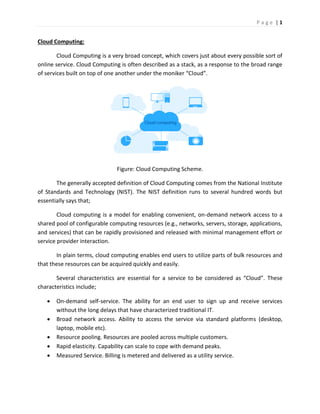
Cloud Computing is a very broad concept, which covers just about every possible sort of
online service. Cloud Computing is often described as a stack, as a response to the broad range
of services built on top of one another under the moniker “Cloud”.
Figure: Cloud Computing Scheme.
The generally accepted definition of Cloud Computing comes from the National Institute
of Standards and Technology (NIST). The NIST definition runs to several hundred words but
essentially says that;
Cloud computing is a model for enabling convenient, on-demand network access to a
shared pool of configurable computing resources (e.g., networks, servers, storage, applications,
and services) that can be rapidly provisioned and released with minimal management effort or
service provider interaction.
In plain terms, cloud computing enables end users to utilize parts of bulk resources and
that these resources can be acquired quickly and easily.
Several characteristics are essential for a service to be considered as “Cloud”. These
characteristics include;
 On-demand self-service. The ability for an end user to sign up and receive services
without the long delays that have characterized traditional IT.
 Broad network access. Ability to access the service via standard platforms (desktop,
laptop, mobile etc).
 Resource pooling. Resources are pooled across multiple customers.
 Rapid elasticity. Capability can scale to cope with demand peaks.
 Measured Service. Billing is metered and delivered as a utility service.
P a g e | 2
Cloud Computing Model:
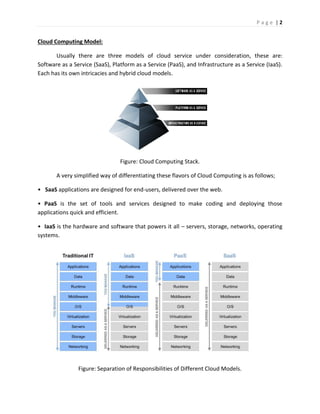
Usually there are three models of cloud service under consideration, these are:
Software as a Service (SaaS), Platform as a Service (PaaS), and Infrastructure as a Service (IaaS).
Each has its own intricacies and hybrid cloud models.
Figure: Cloud Computing Stack.
A very simplified way of differentiating these flavors of Cloud Computing is as follows;
• SaaS applications are designed for end-users, delivered over the web.
• PaaS is the set of tools and services designed to make coding and deploying those
applications quick and efficient.
• IaaS is the hardware and software that powers it all – servers, storage, networks, operating
systems.
Figure: Separation of Responsibilities of Different Cloud Models.
P a g e | 3
SaaS: Software as a Service
Cloud application services, or Software as a Service (SaaS) is basically software that is
deployed over the internet. SaaS moves the task of managing software and its deployment to
third-party services. SaaS is the most familiar form of cloud service for consumers.
Use of SaaS applications tends to reduce the cost of software ownership by removing
the need for technical staff to install, manage, and upgrade software, as well as reduce the cost
of licensing software. SaaS applications are usually provided on a subscription model.
Characteristics of SaaS:
 Web access to commercial software.
 Software is managed from a central location.
 Software delivered in a “one to many” model.
 Users not required to handle software upgrades and patches.
 APIs allow for integration between different pieces of software.
P a g e | 4
PaaS: Platform as a Service
Cloud platform services, or Platform as a Service (Paas) functions at a lower level than
SaaS, typically providing a platform on which software can be developed and deployed.
PaaS providers abstract much of the work of dealing with servers and give clients an
environment in which the operating system and server software, as well as the underlying
server hardware and network infrastructure are taken care of, leaving users free to focus on the
business side of scalability, and the application development of their product or service.
PaaS is analogous to SaaS except that, rather than being software delivered over the
web, it is a platform for the creation of software, delivered over the web.
Characteristics of PaaS:
 Software is developed, tested, deployed, host and maintained in an integrated
development environment.
 Web based user interface creation tools help to create, modify, test and deploy
different UI scenarios.
 Multi-tenant architecture where multiple concurrent users utilize the same
development application.
 Built in scalability of deployed software including load balancing and failover.
 Integration with web services and databases via common standards.
 Support for development team collaboration.
 Tools to handle billing and subscription management.
P a g e | 5
IaaS: Infrastructure as a Service
Cloud infrastructure services, or Infrastructure as a Service (IaaS) is the fundamental
building blocks for cloud services. Instead of purchasing datacenter space, network, server,
storage and software equipments, clients buy those resources as a fully outsourced service on
demand.
IaaS providers offer these cloud servers and their associated resources via dashboard
and/or API. IaaS clients have access to many of the same technologies and resource capabilities
of a traditional data center without having to invest in capacity planning or the physical
maintenance and management of it.
IaaS is the most flexible cloud computing model and allows for automated deployment
of servers, processing power, storage, and networking. IaaS clients have true control over their
infrastructure than users of PaaS or SaaS services. The main uses of IaaS include the actual
development and deployment of PaaS, SaaS, and web-scale applications.
Generally IaaS can be obtained as public or private infrastructure or a combination of
the two. “Public cloud” is infrastructure that consists of shared resources, deployed on a self-
service basis over the Internet. “Private cloud” is infrastructure that emulates some of Cloud
Computing features, like virtualization, but does so on a private network. Additionally, some
hosting providers are beginning to offer a combination of traditional dedicated hosting
alongside public and/ or private cloud networks. This combination approach is generally called
“Hybrid Cloud”.
Characteristics of IaaS:
 Resources are distributed as a service.
 Allows for dynamic scaling.
 Has a variable cost, utility pricing model.
 Generally includes multiple users on a single piece of hardware.
P a g e | 6
Conclusion:
Cloud Computing is a term that doesn’t describe a single thing – rather it is a general
term that sits over a variety of services from Infrastructure as a Service at the base, through
Platform as a Service as a development tool and through to Software as a Service replacing on-
premise applications.

Cloud Computing

  • 1.
  • 2.
    P a ge | 1 Cloud Computing: Cloud Computing is a very broad concept, which covers just about every possible sort of online service. Cloud Computing is often described as a stack, as a response to the broad range of services built on top of one another under the moniker “Cloud”. Figure: Cloud Computing Scheme. The generally accepted definition of Cloud Computing comes from the National Institute of Standards and Technology (NIST). The NIST definition runs to several hundred words but essentially says that; Cloud computing is a model for enabling convenient, on-demand network access to a shared pool of configurable computing resources (e.g., networks, servers, storage, applications, and services) that can be rapidly provisioned and released with minimal management effort or service provider interaction. In plain terms, cloud computing enables end users to utilize parts of bulk resources and that these resources can be acquired quickly and easily. Several characteristics are essential for a service to be considered as “Cloud”. These characteristics include;  On-demand self-service. The ability for an end user to sign up and receive services without the long delays that have characterized traditional IT.  Broad network access. Ability to access the service via standard platforms (desktop, laptop, mobile etc).  Resource pooling. Resources are pooled across multiple customers.  Rapid elasticity. Capability can scale to cope with demand peaks.  Measured Service. Billing is metered and delivered as a utility service.
  • 3.
    P a ge | 2 Cloud Computing Model: Usually there are three models of cloud service under consideration, these are: Software as a Service (SaaS), Platform as a Service (PaaS), and Infrastructure as a Service (IaaS). Each has its own intricacies and hybrid cloud models. Figure: Cloud Computing Stack. A very simplified way of differentiating these flavors of Cloud Computing is as follows; • SaaS applications are designed for end-users, delivered over the web. • PaaS is the set of tools and services designed to make coding and deploying those applications quick and efficient. • IaaS is the hardware and software that powers it all – servers, storage, networks, operating systems. Figure: Separation of Responsibilities of Different Cloud Models.
  • 4.
    P a ge | 3 SaaS: Software as a Service Cloud application services, or Software as a Service (SaaS) is basically software that is deployed over the internet. SaaS moves the task of managing software and its deployment to third-party services. SaaS is the most familiar form of cloud service for consumers. Use of SaaS applications tends to reduce the cost of software ownership by removing the need for technical staff to install, manage, and upgrade software, as well as reduce the cost of licensing software. SaaS applications are usually provided on a subscription model. Characteristics of SaaS:  Web access to commercial software.  Software is managed from a central location.  Software delivered in a “one to many” model.  Users not required to handle software upgrades and patches.  APIs allow for integration between different pieces of software.
  • 5.
    P a ge | 4 PaaS: Platform as a Service Cloud platform services, or Platform as a Service (Paas) functions at a lower level than SaaS, typically providing a platform on which software can be developed and deployed. PaaS providers abstract much of the work of dealing with servers and give clients an environment in which the operating system and server software, as well as the underlying server hardware and network infrastructure are taken care of, leaving users free to focus on the business side of scalability, and the application development of their product or service. PaaS is analogous to SaaS except that, rather than being software delivered over the web, it is a platform for the creation of software, delivered over the web. Characteristics of PaaS:  Software is developed, tested, deployed, host and maintained in an integrated development environment.  Web based user interface creation tools help to create, modify, test and deploy different UI scenarios.  Multi-tenant architecture where multiple concurrent users utilize the same development application.  Built in scalability of deployed software including load balancing and failover.  Integration with web services and databases via common standards.  Support for development team collaboration.  Tools to handle billing and subscription management.
  • 6.
    P a ge | 5 IaaS: Infrastructure as a Service Cloud infrastructure services, or Infrastructure as a Service (IaaS) is the fundamental building blocks for cloud services. Instead of purchasing datacenter space, network, server, storage and software equipments, clients buy those resources as a fully outsourced service on demand. IaaS providers offer these cloud servers and their associated resources via dashboard and/or API. IaaS clients have access to many of the same technologies and resource capabilities of a traditional data center without having to invest in capacity planning or the physical maintenance and management of it. IaaS is the most flexible cloud computing model and allows for automated deployment of servers, processing power, storage, and networking. IaaS clients have true control over their infrastructure than users of PaaS or SaaS services. The main uses of IaaS include the actual development and deployment of PaaS, SaaS, and web-scale applications. Generally IaaS can be obtained as public or private infrastructure or a combination of the two. “Public cloud” is infrastructure that consists of shared resources, deployed on a self- service basis over the Internet. “Private cloud” is infrastructure that emulates some of Cloud Computing features, like virtualization, but does so on a private network. Additionally, some hosting providers are beginning to offer a combination of traditional dedicated hosting alongside public and/ or private cloud networks. This combination approach is generally called “Hybrid Cloud”. Characteristics of IaaS:  Resources are distributed as a service.  Allows for dynamic scaling.  Has a variable cost, utility pricing model.  Generally includes multiple users on a single piece of hardware.
  • 7.
    P a ge | 6 Conclusion: Cloud Computing is a term that doesn’t describe a single thing – rather it is a general term that sits over a variety of services from Infrastructure as a Service at the base, through Platform as a Service as a development tool and through to Software as a Service replacing on- premise applications.