DIGITAL TRUST
FRAMEWORK (DTF)
Maganathin Veeraragaloo
7th December 2021
The TMForum's Open Digital Architecture (ODA)will be used as
the cornerstone for this Framework
https://www.tmforum.org/oda/
ODA was initially designed for the Telecommunications Industry
inclusive of 5G Services.
The Digital Trust Framework is developed for the 4IR Environment
The Digital Trust Framework (DTF) will be a blueprint for modular,
cloud-based, open digital platforms that can be orchestrated using AI
ODA will be integrated with COBIT 2019, ITIL 4 and ISO 27005 RISK
MANAGER – this is to ensure an overall Digital Trust approach for a
continuous evolving SYSTEMS Environment
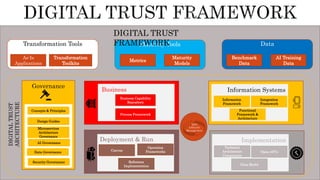
Transformation Tools
As-Is
Applications
Transformation
Toolkits
Maturity Tools
Metrics
Maturity
Models
Data
Benchmark
Data
AI Training
Data
DIGITAL TRUST
FRAMEWORK
DIGITAL
TRUST
ARCHITECTURE
Governance
Concepts & Principles
Design Guides
Microservices
Architecture
Governance
AI Governance
Data Governance
Security Governance
Agile
Lifecycle
Management
Business
Deployment & Run
Information Systems
Implementation
Business Capability
Repository
Process Framework
Information
Framework
Integration
Framework
Functional
Framework &
Architecture
Canvas
Operation
Frameworks
Reference
Implementation
Technical
Architecture
Components
Open API’s
Data Model
ITIL 4
Capability Framework
DIGITAL TRUST
FRAMEWORK
Governance &
Processes
Cybersecurity Mesh
Architecture
ITIL 4
OVERVIEW
SOURCE: https://www.bmc.com/blogs/itil-four-dimensions-service-management/
Guiding Principles
• Recommendations that guide
an organization and its
people on how to work
flexibly in all circumstances
Governance
• The means by which an
organization is directed and
controlled
The Service Value Chain
• An operating model which outlines the
key activities required to respond to
demand and facilitate value creation
through the creation and management
of products and services
Practices
• Sets of organizational resources
designed for performing work or
accomplishing an objective,
including process and capabilities
Continual Improvement
• A recurring organizational
activity performed at all
levels to ensure that an
organization’s performance
continually improves in
meeting stakeholders’
expectations
SOURCE: https://www.bmc.com/blogs/itil-four-dimensions-service-management/
1. Organizations and
People
• To ensure a shred understanding
of the vision, current status and
improvement direction for all
four dimensions and all products
and services across the
organization
2. Information and
Technology
• To ensure a shred understanding
of the vision, current status and
improvement direction for all
four dimensions and all products
and services across the
organization
3. Partner and Suppliers
• To ensure a shred
understanding of the vision,
current status and
improvement direction for all
four dimensions and all
products and services across the
organization
4. Value Streams and
Processes
• To ensure a shred understanding
of the vision, current status and
improvement direction for all
four dimensions and all products
and services across the
organization
Continual Improvement
• This dimension covers contracts and other agreements between the organization and its partners.
• Relationships between organizations with regards to service design and provisioning can often be complex in nature and may involve
different levels of integration and formality. Some partners and suppliers will be mission critical and require more intense management
and engagement, others may be more commodity or point of time base and require less rigour.
PLAN - Purpose
• To ensure a shred understanding
of the vision, current status and
improvement direction for all
four dimensions and all products
and services across the
organization
SOURCE: https://www.bmc.com/blogs/itil-four-dimensions-service-management/
IMPROVE - Purpose
• To ensure continual
improvement of products,
services and practices across all
value chain activities and the
four dimensions of service
management
ENGAGE - Purpose
• To provide a good understanding
of stakeholder needs, continual
engagement with all stakeholders,
transparency and good
relationships with all
stakeholders
DESIGN AND TRANSITION
– Purpose
• To ensure that products and
services continually meet
stakeholder expectations for
quality, costs and time to market
OBTAIN/BUILD – Purpose
• To ensure that service components are
available when and where they are needed,
and meet agreed specifications
DELIVER AND SUPPORT – Purpose
• To ensure that services are delivered and
supported according to agreed specifications
and stakeholders’ expectations
A guiding principle is a recommendation that guides an
organization in ALL circumstances regardless of
changes in its goals, strategies, types of work or
management structure. A guiding principle is universal
and enduring.
Guiding principles support success actions and good
decisions of all types and at all levels of the
organization, these principles are reflected in Lean,
DevOps, Agile, etc and allow for interaction and
integration of multiple methods into a consolidated
approach to service management.
SOURCE: https://www.bmc.com/blogs/itil-four-dimensions-service-management/
1. Focus on Value
2. Start where you are
3. Progress iteratively with feedback
4. Collaborate and promote visibility
5. Think and work holistically
6. Keep it simple and practical
7. Optimise and automate
SOURCE: https://www.bmc.com/blogs/itil-four-dimensions-service-management/
1. Focus on Value
a) Everything an organization does needs to link back to value, this value should be clear
for providers, customers and stakeholders. To enable a focus on value the organization
has to identify who is receiving services and how they will receive and measure value
through the services being delivered.
b) There are 4 key characteristics of value that an organization must understand:
i. It is defined by the customer
ii. It changes over time and circumstance
iii. There must be an affordable mix of features
iv. There must be an achievement of objective
c) The service provider needs to know what is of value to the consumer(s)
i. Why consumers use the services
ii. What the services help them to do
iii. How the services help them to meet their goals
iv. The risks involved for the consumer
v. The role of cost/financial consequences to the customer
SOURCE: https://www.bmc.com/blogs/itil-four-dimensions-service-management/
2. Start where you are
a) This guiding principle encourages the organization to avoid “re-inventing the wheel”
and starting over without first considering what is already available (the current
state) and can be leveraged.
b) Starting where you are can avoid unnecessary cost and shorten the time to value
realisation for the customer.
c) When assessing current state care should be given to ensure reports match the reality,
measurements should be used in live with existing data to give a true picture of
performance and capability.
SOURCE: https://www.bmc.com/blogs/itil-four-dimensions-service-management/
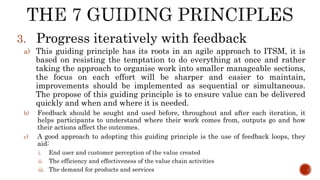
3. Progress iteratively with feedback
a) This guiding principle has its roots in an agile approach to ITSM, it is
based on resisting the temptation to do everything at once and rather
taking the approach to organise work into smaller manageable sections,
the focus on each effort will be sharper and easier to maintain,
improvements should be implemented as sequential or simultaneous.
The propose of this guiding principle is to ensure value can be delivered
quickly and when and where it is needed.
b) Feedback should be sought and used before, throughout and after each iteration, it
helps participants to understand where their work comes from, outputs go and how
their actions affect the outcomes.
c) A good approach to adopting this guiding principle is the use of feedback loops, they
aid:
i. End user and customer perception of the value created
ii. The efficiency and effectiveness of the value chain activities
iii. The demand for products and services
4. Collaborate and promote visibility
a) This guiding principle is essentially about breakdown silos within organizations and promoting
effective collaboration. This comes from the ethos that inclusion is generally better than exclusion
and collaboration with cooperation is better than isolated work. Collaboration should have no
limits to its scope all stakeholders should be encouraged to engage regularly and effectively.
b) Recognition of the need for genuine collaboration has been one of the driving factors in the
evolution of what is now known as DevOps. Without effective collaboration, neither Agile, Lean,
nor any other ITSM framework or method will work.
c) Collaboration and visibility promote:
i. •Shared goals
ii. •Trust • End user and customer perception of the value created
iii. The efficiency and effectiveness of the value chain activities
iv. The demand for products and services
v. Improved decision making
vi. Increased chances of success
vii. A clear understanding of the way forward
viii. Alignment will be kept as work progresses
5. Think and work holistically
a) This guiding principle in based in the fundamental understanding that no service, process,
department or supplier stands alone, all services must be delivered through the capabilities
enabled within the 4 dimensions of service management.
b) Taking a holistic approach enables an understanding of how all parts of the organization work
together in an integrated way, it recognises that systems may be complex and as such need to
not only deliver to detail but never lose site of the complete picture.
c) Collaboration is key to thinking and working holistically, the service provider will need to draw
on knowledge in every area to identify what is essential for success.
d) “Holistic” – Dealing with or treating the whole of something and not just a part. It suggests
some simple rules to follow to enable the principle:
i. Ensure value – Every activity should contribute to the creation of value
ii. • Simplicity is the ultimate sophistication –it may seem harder to simplify but it is often more effective
iii. • Do fewer things but do them better – allows focus on quality
iv. • Respect the time for the people involve
v. • Avoid bureaucracy
vi. • Easier to understand, more likely to adopt
6. Keep it simple and practical
a) This guiding principle suggests that an effective approach to
ITSM is to use the minimum number of steps and avoid over
complication.
b) Keeping it simple and practical is the best route to achieving
quick wins.
c) Documents that are simple can be significantly more effective
in communication than large detailed volumes. Processes that
are simple will have a better chance of being seen, understood
and observed.
SOURCE: https://www.bmc.com/blogs/itil-four-dimensions-service-management/
7. Optimise and automate
a) This guiding principle is key to effectiveness and efficiency. Automation
frees up expensive human resources and enables them to concentrate
on more human intensive areas and the overall customer experience.
b) “Optimisation” - To make something as effective and useful as it needs to
be
c) “Automation” - Typically refers to the use of technology to perform a step
or series of steps correctly and consistently with limited or no human
intervention
d) To enable success in adoption of this guiding principle, organizations
should:
i. Optimise before automating
ii. Define relevant metrics intended and actual results should be evaluated, metrics
should be outcome based and focused on value
iii. Eliminate anything that is truly wasteful and use technology to achieve whatever it
is capable of
SOURCE: https://www.bmc.com/blogs/itil-four-dimensions-service-management/
1. Management Practices
a) – These have been adopted and adapted for service
management from general business domains
2. Service Management Practices
a) These have been developed in service management and
ITSM industries
3. Technical Management Practices
a) These have been adapted from technology management
domains for service management purposes by expanding
or shifting their focus from technology solutions to IT
services
SOURCE: https://www.bmc.com/blogs/itil-four-dimensions-service-management/
1. Architecture management
2. Continual improvement
3. Information security management • Knowledge management
4. Measurement and reporting
5. Portfolio management
6. Organizational change management • Project management
7. Relationship management
8. Risk management
9. Service financial management
10. Strategy management
11. Supplier management
12. Workforce and talent management
1. Architecture management
2. Availability management
3. Business analysis
4. Capacity and performance
management
5. Change enablement
6. Incident management
7. IT asset management
8. Monitoring and event
management
9. Problem management
10. Release management
11. Service catalogue management
12. Service configuration management
13. Service continuity management
14. Service design
15. Service desk
16. Service level management
17. Service request management
18. Service validation and testing
1. Deployment management
2. Infrastructure and platform management
3. Software development and management
 “Service Management”
 A set of organizational capabilities for enabling value to customers in the form of services
 “Service”
 A means of enabling value co-creation by facilitating outcomes that customers want to achieve, without customers having to manage specific
costs and risk
 “Value”
 The perceived benefits, usefulness and importance of something
 “Product”
 A configuration of an organization’s resources designed to offer value to a customer
 “Organization”
 A person or a group of people that has its own functions with responsibilities, authorities and relationships to achieve its objectives
 “Customer”
 A person who defines requirements for services and takes responsibility for outcomes from service consumption
 “User”
 A person who uses services
 “Sponsor”
 A person who authorizes the budget for service consumption
 “Stakeholder”
 A person with a (vested) interest in the service provision, this can include shareholders, executive, customers and users etc
 “Output”
 The tangible or intangible delivery of an activity
 “Service Management”
 A set of organizational capabilities for enabling value to customers in the form of services
 “Outcome”
 A result for a stakeholder enabled by one or more activities
 These terms can cause confusion but a simple way to look at this is a car manufacturer produces an output
(car) which is use by the stakeholder to achieve a required outcome (completion of a journey)
 “Utility”
 The functionality offered by a product or service to meet a particular need
 This is more easily understood as considering “what the service does”
 “Warranty”
 The assurance that a product or service will meet agreed requirements
 This is more easily understood as considering “how the service performs”
 “Service Offering”
 A formal description of one or more services, designed to meet the needs of
a target consumer group. A service offering may include goods, access to resources and service actions
 “Service Relationship”
 A cooperation between a service provider and a service consumer. Service relationships include service provision, service
consumption and service relationship management
 “Service Consumer”
 A role performed by an organization in a service relationship to consume services
 “Service Management”
 A set of organizational capabilities for enabling value to customers in the form of services
 “Service Provider”
 A role performed by an organization in a service relationship to provide services to consumers
 “Service Relationship Management”
 Joint activities performed by a service provider and a service consumer to ensure continual value co-
creation based on agreed available service offerings
 “Output”
 A tangible or intangible delivery of an activity
 “Outcome”
 A result for a stakeholder enabled by one or more outputs
 “Cost”
 The amount of money spent on a specific activity or resource
 “Risk”
 A possible event that could cause harm or loss or make it more difficult to achieve objectives. Risk can
also be defined as uncertainty of outcome, and can be used in the context of measuring the probability
of positive outcomes as well as negative outcomes
THANK-YOU

ITIL4 - DIGITAL TRUST FRAMEWORK

  • 1.
    DIGITAL TRUST FRAMEWORK (DTF) MaganathinVeeraragaloo 7th December 2021
  • 2.
    The TMForum's OpenDigital Architecture (ODA)will be used as the cornerstone for this Framework https://www.tmforum.org/oda/ ODA was initially designed for the Telecommunications Industry inclusive of 5G Services. The Digital Trust Framework is developed for the 4IR Environment The Digital Trust Framework (DTF) will be a blueprint for modular, cloud-based, open digital platforms that can be orchestrated using AI ODA will be integrated with COBIT 2019, ITIL 4 and ISO 27005 RISK MANAGER – this is to ensure an overall Digital Trust approach for a continuous evolving SYSTEMS Environment
  • 3.
    Transformation Tools As-Is Applications Transformation Toolkits Maturity Tools Metrics Maturity Models Data Benchmark Data AITraining Data DIGITAL TRUST FRAMEWORK DIGITAL TRUST ARCHITECTURE Governance Concepts & Principles Design Guides Microservices Architecture Governance AI Governance Data Governance Security Governance Agile Lifecycle Management Business Deployment & Run Information Systems Implementation Business Capability Repository Process Framework Information Framework Integration Framework Functional Framework & Architecture Canvas Operation Frameworks Reference Implementation Technical Architecture Components Open API’s Data Model
  • 4.
    ITIL 4 Capability Framework DIGITALTRUST FRAMEWORK Governance & Processes Cybersecurity Mesh Architecture
  • 5.
  • 6.
    SOURCE: https://www.bmc.com/blogs/itil-four-dimensions-service-management/ Guiding Principles •Recommendations that guide an organization and its people on how to work flexibly in all circumstances Governance • The means by which an organization is directed and controlled The Service Value Chain • An operating model which outlines the key activities required to respond to demand and facilitate value creation through the creation and management of products and services Practices • Sets of organizational resources designed for performing work or accomplishing an objective, including process and capabilities Continual Improvement • A recurring organizational activity performed at all levels to ensure that an organization’s performance continually improves in meeting stakeholders’ expectations
  • 7.
    SOURCE: https://www.bmc.com/blogs/itil-four-dimensions-service-management/ 1. Organizationsand People • To ensure a shred understanding of the vision, current status and improvement direction for all four dimensions and all products and services across the organization 2. Information and Technology • To ensure a shred understanding of the vision, current status and improvement direction for all four dimensions and all products and services across the organization 3. Partner and Suppliers • To ensure a shred understanding of the vision, current status and improvement direction for all four dimensions and all products and services across the organization 4. Value Streams and Processes • To ensure a shred understanding of the vision, current status and improvement direction for all four dimensions and all products and services across the organization Continual Improvement • This dimension covers contracts and other agreements between the organization and its partners. • Relationships between organizations with regards to service design and provisioning can often be complex in nature and may involve different levels of integration and formality. Some partners and suppliers will be mission critical and require more intense management and engagement, others may be more commodity or point of time base and require less rigour.
  • 8.
    PLAN - Purpose •To ensure a shred understanding of the vision, current status and improvement direction for all four dimensions and all products and services across the organization SOURCE: https://www.bmc.com/blogs/itil-four-dimensions-service-management/ IMPROVE - Purpose • To ensure continual improvement of products, services and practices across all value chain activities and the four dimensions of service management ENGAGE - Purpose • To provide a good understanding of stakeholder needs, continual engagement with all stakeholders, transparency and good relationships with all stakeholders DESIGN AND TRANSITION – Purpose • To ensure that products and services continually meet stakeholder expectations for quality, costs and time to market OBTAIN/BUILD – Purpose • To ensure that service components are available when and where they are needed, and meet agreed specifications DELIVER AND SUPPORT – Purpose • To ensure that services are delivered and supported according to agreed specifications and stakeholders’ expectations
  • 9.
    A guiding principleis a recommendation that guides an organization in ALL circumstances regardless of changes in its goals, strategies, types of work or management structure. A guiding principle is universal and enduring. Guiding principles support success actions and good decisions of all types and at all levels of the organization, these principles are reflected in Lean, DevOps, Agile, etc and allow for interaction and integration of multiple methods into a consolidated approach to service management. SOURCE: https://www.bmc.com/blogs/itil-four-dimensions-service-management/
  • 10.
    1. Focus onValue 2. Start where you are 3. Progress iteratively with feedback 4. Collaborate and promote visibility 5. Think and work holistically 6. Keep it simple and practical 7. Optimise and automate SOURCE: https://www.bmc.com/blogs/itil-four-dimensions-service-management/
  • 11.
    1. Focus onValue a) Everything an organization does needs to link back to value, this value should be clear for providers, customers and stakeholders. To enable a focus on value the organization has to identify who is receiving services and how they will receive and measure value through the services being delivered. b) There are 4 key characteristics of value that an organization must understand: i. It is defined by the customer ii. It changes over time and circumstance iii. There must be an affordable mix of features iv. There must be an achievement of objective c) The service provider needs to know what is of value to the consumer(s) i. Why consumers use the services ii. What the services help them to do iii. How the services help them to meet their goals iv. The risks involved for the consumer v. The role of cost/financial consequences to the customer SOURCE: https://www.bmc.com/blogs/itil-four-dimensions-service-management/
  • 12.
    2. Start whereyou are a) This guiding principle encourages the organization to avoid “re-inventing the wheel” and starting over without first considering what is already available (the current state) and can be leveraged. b) Starting where you are can avoid unnecessary cost and shorten the time to value realisation for the customer. c) When assessing current state care should be given to ensure reports match the reality, measurements should be used in live with existing data to give a true picture of performance and capability. SOURCE: https://www.bmc.com/blogs/itil-four-dimensions-service-management/
  • 13.
    3. Progress iterativelywith feedback a) This guiding principle has its roots in an agile approach to ITSM, it is based on resisting the temptation to do everything at once and rather taking the approach to organise work into smaller manageable sections, the focus on each effort will be sharper and easier to maintain, improvements should be implemented as sequential or simultaneous. The propose of this guiding principle is to ensure value can be delivered quickly and when and where it is needed. b) Feedback should be sought and used before, throughout and after each iteration, it helps participants to understand where their work comes from, outputs go and how their actions affect the outcomes. c) A good approach to adopting this guiding principle is the use of feedback loops, they aid: i. End user and customer perception of the value created ii. The efficiency and effectiveness of the value chain activities iii. The demand for products and services
  • 14.
    4. Collaborate andpromote visibility a) This guiding principle is essentially about breakdown silos within organizations and promoting effective collaboration. This comes from the ethos that inclusion is generally better than exclusion and collaboration with cooperation is better than isolated work. Collaboration should have no limits to its scope all stakeholders should be encouraged to engage regularly and effectively. b) Recognition of the need for genuine collaboration has been one of the driving factors in the evolution of what is now known as DevOps. Without effective collaboration, neither Agile, Lean, nor any other ITSM framework or method will work. c) Collaboration and visibility promote: i. •Shared goals ii. •Trust • End user and customer perception of the value created iii. The efficiency and effectiveness of the value chain activities iv. The demand for products and services v. Improved decision making vi. Increased chances of success vii. A clear understanding of the way forward viii. Alignment will be kept as work progresses
  • 15.
    5. Think andwork holistically a) This guiding principle in based in the fundamental understanding that no service, process, department or supplier stands alone, all services must be delivered through the capabilities enabled within the 4 dimensions of service management. b) Taking a holistic approach enables an understanding of how all parts of the organization work together in an integrated way, it recognises that systems may be complex and as such need to not only deliver to detail but never lose site of the complete picture. c) Collaboration is key to thinking and working holistically, the service provider will need to draw on knowledge in every area to identify what is essential for success. d) “Holistic” – Dealing with or treating the whole of something and not just a part. It suggests some simple rules to follow to enable the principle: i. Ensure value – Every activity should contribute to the creation of value ii. • Simplicity is the ultimate sophistication –it may seem harder to simplify but it is often more effective iii. • Do fewer things but do them better – allows focus on quality iv. • Respect the time for the people involve v. • Avoid bureaucracy vi. • Easier to understand, more likely to adopt
  • 16.
    6. Keep itsimple and practical a) This guiding principle suggests that an effective approach to ITSM is to use the minimum number of steps and avoid over complication. b) Keeping it simple and practical is the best route to achieving quick wins. c) Documents that are simple can be significantly more effective in communication than large detailed volumes. Processes that are simple will have a better chance of being seen, understood and observed. SOURCE: https://www.bmc.com/blogs/itil-four-dimensions-service-management/
  • 17.
    7. Optimise andautomate a) This guiding principle is key to effectiveness and efficiency. Automation frees up expensive human resources and enables them to concentrate on more human intensive areas and the overall customer experience. b) “Optimisation” - To make something as effective and useful as it needs to be c) “Automation” - Typically refers to the use of technology to perform a step or series of steps correctly and consistently with limited or no human intervention d) To enable success in adoption of this guiding principle, organizations should: i. Optimise before automating ii. Define relevant metrics intended and actual results should be evaluated, metrics should be outcome based and focused on value iii. Eliminate anything that is truly wasteful and use technology to achieve whatever it is capable of SOURCE: https://www.bmc.com/blogs/itil-four-dimensions-service-management/
  • 18.
    1. Management Practices a)– These have been adopted and adapted for service management from general business domains 2. Service Management Practices a) These have been developed in service management and ITSM industries 3. Technical Management Practices a) These have been adapted from technology management domains for service management purposes by expanding or shifting their focus from technology solutions to IT services SOURCE: https://www.bmc.com/blogs/itil-four-dimensions-service-management/
  • 19.
    1. Architecture management 2.Continual improvement 3. Information security management • Knowledge management 4. Measurement and reporting 5. Portfolio management 6. Organizational change management • Project management 7. Relationship management 8. Risk management 9. Service financial management 10. Strategy management 11. Supplier management 12. Workforce and talent management
  • 20.
    1. Architecture management 2.Availability management 3. Business analysis 4. Capacity and performance management 5. Change enablement 6. Incident management 7. IT asset management 8. Monitoring and event management 9. Problem management 10. Release management 11. Service catalogue management 12. Service configuration management 13. Service continuity management 14. Service design 15. Service desk 16. Service level management 17. Service request management 18. Service validation and testing
  • 21.
    1. Deployment management 2.Infrastructure and platform management 3. Software development and management
  • 22.
     “Service Management” A set of organizational capabilities for enabling value to customers in the form of services  “Service”  A means of enabling value co-creation by facilitating outcomes that customers want to achieve, without customers having to manage specific costs and risk  “Value”  The perceived benefits, usefulness and importance of something  “Product”  A configuration of an organization’s resources designed to offer value to a customer  “Organization”  A person or a group of people that has its own functions with responsibilities, authorities and relationships to achieve its objectives  “Customer”  A person who defines requirements for services and takes responsibility for outcomes from service consumption  “User”  A person who uses services  “Sponsor”  A person who authorizes the budget for service consumption  “Stakeholder”  A person with a (vested) interest in the service provision, this can include shareholders, executive, customers and users etc  “Output”  The tangible or intangible delivery of an activity
  • 23.
     “Service Management” A set of organizational capabilities for enabling value to customers in the form of services  “Outcome”  A result for a stakeholder enabled by one or more activities  These terms can cause confusion but a simple way to look at this is a car manufacturer produces an output (car) which is use by the stakeholder to achieve a required outcome (completion of a journey)  “Utility”  The functionality offered by a product or service to meet a particular need  This is more easily understood as considering “what the service does”  “Warranty”  The assurance that a product or service will meet agreed requirements  This is more easily understood as considering “how the service performs”  “Service Offering”  A formal description of one or more services, designed to meet the needs of a target consumer group. A service offering may include goods, access to resources and service actions  “Service Relationship”  A cooperation between a service provider and a service consumer. Service relationships include service provision, service consumption and service relationship management  “Service Consumer”  A role performed by an organization in a service relationship to consume services
  • 24.
     “Service Management” A set of organizational capabilities for enabling value to customers in the form of services  “Service Provider”  A role performed by an organization in a service relationship to provide services to consumers  “Service Relationship Management”  Joint activities performed by a service provider and a service consumer to ensure continual value co- creation based on agreed available service offerings  “Output”  A tangible or intangible delivery of an activity  “Outcome”  A result for a stakeholder enabled by one or more outputs  “Cost”  The amount of money spent on a specific activity or resource  “Risk”  A possible event that could cause harm or loss or make it more difficult to achieve objectives. Risk can also be defined as uncertainty of outcome, and can be used in the context of measuring the probability of positive outcomes as well as negative outcomes
  • 25.