Agenda
 Introduction
 Cloud Definitions
 NIST Architecture
 Introduction to Amazon AWS
 Launching a New Instance in Amazon EC2
 Creating a Static Web Application
03/05/2025
2
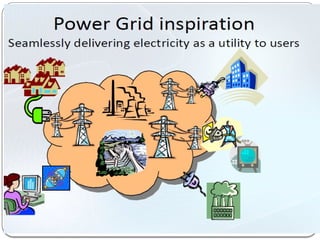
On-Demand (Utility) Computing
 Utility computing merely means "Pay and Use", with regards to
computing power.
 Firms off-loading peak demand for computing power to remote,
large-scale data processing centers
 Firms pay only for the computing power they use, as with an
electrical utility.
 Developed by IBM, SUN, and HP
 Excellent for firms with spiked demand curves caused by
Seasonal variations in consumer demand, e.g. holiday
shopping
 Saves firms from purchasing excessive levels of
infrastructure
Distributed computing
 Distributed systems are groups of networked computers,
which have the same goal for their work.
 In distributed computing, each processor has its own
private memory (distributed memory). Information is
exchanged by passing messages between the processors.
 In parallel computing, all processors may have access to a
shared memory to exchange information between
processors
K.S.SENDHIL KUMAR
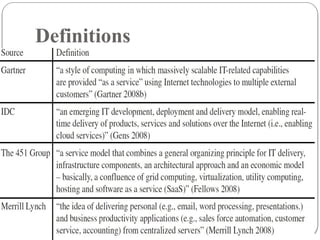
Definitions
K.S.SENDHIL KUMAR
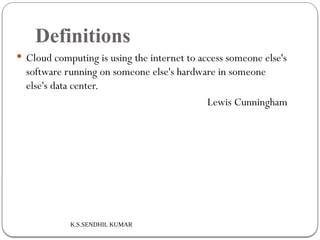
Definitions
 Cloud computing is using the internet to access someone else's
software running on someone else's hardware in someone
else's data center.
Lewis Cunningham
K.S.SENDHIL KUMAR
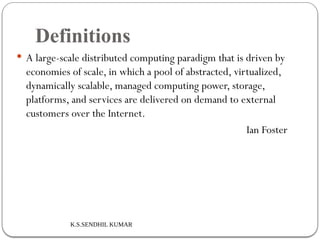
Definitions
 A large-scale distributed computing paradigm that is driven by
economies of scale, in which a pool of abstracted, virtualized,
dynamically scalable, managed computing power, storage,
platforms, and services are delivered on demand to external
customers over the Internet.
Ian Foster
K.S.SENDHIL KUMAR
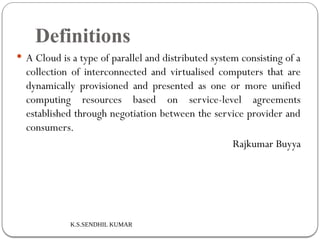
Definitions
 A Cloud is a type of parallel and distributed system consisting of a
collection of interconnected and virtualised computers that are
dynamically provisioned and presented as one or more unified
computing resources based on service-level agreements
established through negotiation between the service provider and
consumers.
Rajkumar Buyya
Cloud Computing
K.S.SENDHIL KUMAR
Definition
 Cloud computing is a model for enabling ubiquitous,
convenient, on-demand network access to a shared pool of
configurable computing resources (e.g., networks, servers,
storage, applications, and services) that can be rapidly
provisioned and released with minimal management effort or
service provider interaction.
 This cloud model is composed of five essential
characteristics, three service models, and four deployment
models.
NIST (National Institute of Standards and Technology) , Sep 2011.
WHY CLOUD COMPUTING?
Conventional
 Manually Provisioned dedicated Hardware Fixed Capacity
 Pay for Capacity
 Capital & Operational Expenses
 Managed via Sysadmins
Cloud
 Automatic Shared Hardware Elastic Capacity Pay for Use
 Operational Expenses
 Managed via APIs Service
K.S.SENDHIL KUMAR
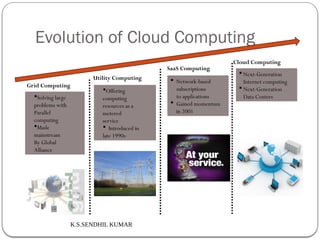
Evolution of Cloud Computing
Grid Computing
Utility Computing
SaaS Computing
Cloud Computing
Solving large
problems with
Parallel
computing
Made
mainstream
By Global
Alliance
Offering
computing
resources as a
metered
service
 Introduced in
late 1990s
 Network-based
subscriptions
to applications
 Gained momentum
in 2001
 Next-Generation
Internet computing
 Next-Generation
Data Centers
K.S.SENDHIL KUMAR
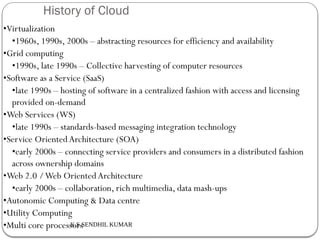
History of Cloud
•Virtualization
•1960s, 1990s, 2000s – abstracting resources for efficiency and availability
•Grid computing
•1990s, late 1990s – Collective harvesting of computer resources
•Software as a Service (SaaS)
•late 1990s – hosting of software in a centralized fashion with access and licensing
provided on-demand
•Web Services (WS)
•late 1990s – standards-based messaging integration technology
•Service Oriented Architecture (SOA)
•early 2000s – connecting service providers and consumers in a distributed fashion
across ownership domains
•Web 2.0 /Web OrientedArchitecture
•early 2000s – collaboration, rich multimedia, data mash-ups
•Autonomic Computing & Data centre
•Utility Computing
•Multi core processors
K.S.SENDHIL KUMAR
BENEFITS
 Turns Capital Expenditure into Operational Expenditure
 Measured Service & Utility billing
 On demand & Responsive delivery of services
 Elasticity & Scalability
 Green IT & Optimization of resources
 Delivers FasterTime toValue
 Requires FewerTechnical Resources; No Up-Front Capital
Expense
K.S.SENDHIL KUMAR
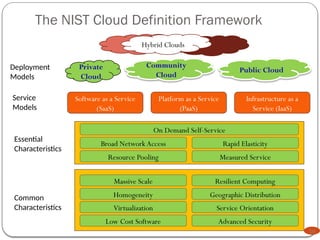
The NIST Cloud Definition Framework
16
Community
Cloud
Private
Cloud
Public Cloud
Hybrid Clouds
Deployment
Models
Service
Models
Essential
Characteristics
Common
Characteristics
Software as a Service
(SaaS)
Platform as a Service
(PaaS)
Infrastructure as a
Service (IaaS)
Resource Pooling
Broad NetworkAccess Rapid Elasticity
Measured Service
On Demand Self-Service
Low Cost Software
Virtualization Service Orientation
Advanced Security
Homogeneity
Massive Scale Resilient Computing
Geographic Distribution
K.S.SENDHIL KUMAR
Essential Characteristics
 Broad network access.
 Capabilities are available over the network and accessed through
standard mechanisms that promote use by heterogeneous thin or
thick client platforms (e.g., mobile phones, laptops, and PDAs) as
well as other traditional or cloudbased software services.
K.S.SENDHIL KUMAR
Essential Characteristics
 Rapid elasticity.
 Capabilities can be rapidly and elastically provisioned - in some
cases automatically - to quickly scale out; and rapidly released to
quickly scale in.
 To the consumer, the capabilities available for provisioning often
appear to be unlimited and can be purchased in any quantity at any
time.
K.S.SENDHIL KUMAR
Essential Characteristics
 Measured service.
 Cloud systems automatically control and optimize resource usage by
leveraging a metering capability at some level of abstraction
appropriate to the type of service.
 Resource usage can be monitored, controlled, and reported -
providing transparency for both the provider and consumer of the
service.
K.S.SENDHIL KUMAR
Essential Characteristics
 On-demand self-service.
 A consumer can unilaterally provision computing capabilities
such as server time and network storage as needed automatically,
without requiring human interaction with a service provider.
K.S.SENDHIL KUMAR
Essential Characteristics
 Resource pooling
 The provider’s computing resources are pooled to serve multiple
consumers using a multi-tenant model, with different physical
and virtual resources dynamically assigned and reassigned
according to consumer demand.
DEPLOYMENT
MODEL
• Public cloud
• Private cloud
• Community
Cloud
• Hybrid Cloud
PUBLIC
CLOUD
In public cloud system a third party data center
provide both disk space and computing power for all
the application software.
Applications, storage, and other resources are made
available to the general public by a service provider.
Public cloud services may be free or offered on a pay-
per-usage model.
cloud used to provide utility computing
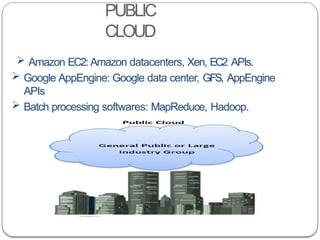
PUBLIC
CLOUD
 Amazon EC2: Amazon datacenters, Xen, EC2 APIs.
 Google AppEngine: Google data center, GFS, AppEngine
APIs
 Batch processing softwares: MapReduce, Hadoop.
PRIVATE CLOUD
 Private cloud- unlike public cloud, you need to set up your own
data center and also bear all the installation & maintenance cost,
and have complete control of all your data.
 Cloud Computing private to an enterprise
 Datacenters, not available for rental
BENEFITS
 Maximize the utilization of computing resources
 Provide more security and privacy
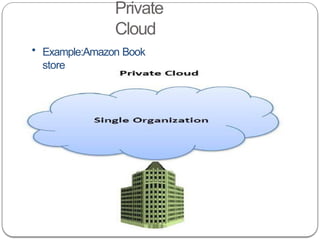
Private
Cloud
• Example:Amazon Book
store
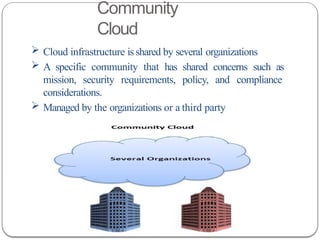
Community
Cloud
 Cloud infrastructure is shared by several organizations
 A specific community that has shared concerns such as
mission, security requirements, policy, and compliance
considerations.
 Managed by the organizations or a third party
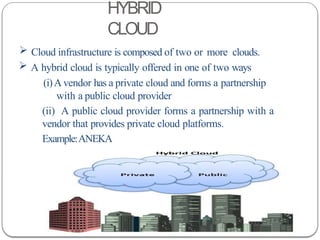
HYBRID
CLOUD
 Cloud infrastructure is composed of two or more clouds.
 A hybrid cloud is typically offered in one of two ways
(i)A vendor has a private cloud and forms a partnership
with a public cloud provider
(ii) A public cloud provider forms a partnership with a
vendor that provides private cloud platforms.
Example:ANEKA
CLOUD PROVIDERS
• A service provider that offers customers storage or
software services available via a private (private
cloud) or public network (cloud).
• Usually, it means the storage and software is
available for access via the Internet.
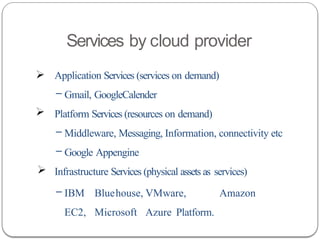
Services by cloud provider
Application Services (services on demand)
– Gmail, GoogleCalender
Platform Services (resources on demand)
– Middleware, Messaging, Information, connectivity etc
– Google Appengine
Infrastructure Services (physical assets as services)
– IBM Bluehouse, VMware, Amazon
EC2, Microsoft Azure Platform.
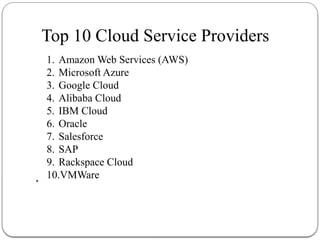
1. Amazon Web Services (AWS)
2. Microsoft Azure
3. Google Cloud
4. Alibaba Cloud
5. IBM Cloud
6. Oracle
7. Salesforce
8. SAP
9. Rackspace Cloud
10.VMWare
•
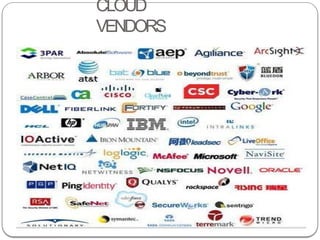
Top 10 Cloud Service Providers
Cloud
vendor
• “Cloud Vendor” is a Virtual Organization ( may/ may not own
any infrastructure, platform or software)
• It will use resources from various vendors and original providers
to offer services that meet SLAwith guaranteed QoS.
Types of
vendors
• Cloud Platform Vendors
• Cloud Infrastructure Vendors
• Cloud Security Vendors
• Cloud Storage and Data center
Vendors
• Cloud software vendors
CLOUD
VENDORS
SAA
S
• Application is used as an on demand service. Often provided via
the Internet
• Eliminates the need to install and run the application on the
customer's own computer.
• Activities that are managed from central locations rather than at each
customer's site, enabling customers to access applications remotely
via the Web .
• Application delivery that typically is closer to a one -to-many model
(single instance, multi-tenant architecture) than to a one -to-one model,
including architecture, pricing, partnering, and management
characteristic
• Example: Google App (online office)
IAA
S
• Infrastructure-As-A-Service (Standards under development)
– The delivery of computer IaaS, typically platform
virtualization
– Rather than purchasing servers, software, data center space
or
network equipment, clients instead buy those resources as
a fully outsourced service.
- "Infrastructure as a Service ( IaaS)" delivers computer
infrastructures like,
– Processors/CPUs
– Memory
– Storages
– Networking
– Vendors (e.g. Amazon, Eucalyptus, IBM, VMware
partners)
– For example:
• Virtual desktops
• Grid computing
Paa
S
• Platform-As-A-Service (Technology under development)
– Delivers a computing platform and/or solution stack as a
service over the Internet, eliminating the need to install
and run the application on the customer's own
computers and simplifying maintenance and support
– Facilitates deployment of applications without the cost
and complexity of buying and managing the underlying
hardware and software layers
– Vendors (e.g. Google, Microsoft, Force.com, RightScale)
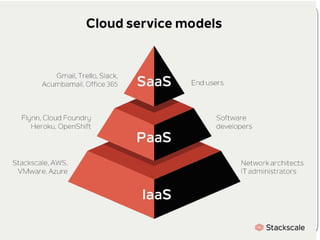
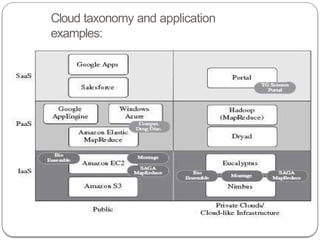
Cloud taxonomy and application
examples:
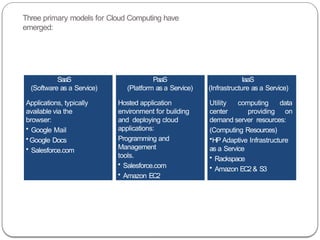
SaaS
(Software as a Service)
Applications, typically
available via the
browser:
• Google Mail
•Google Docs
• Salesforce.com
PaaS
(Platform as a Service)
Hosted application
environment for building
and deploying cloud
applications:
Programming and
Management
tools.
• Salesforce.com
• Amazon EC2
• Microsoft Azure
IaaS
(Infrastructure as a Service)
Utility computing data
center providing on
demand server resources:
(Computing Resources)
•HP Adaptive Infrastructure
as a Service
• Rackspace
• Amazon EC2& S3
Three primary models for Cloud Computing have
emerged:
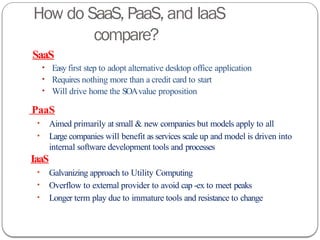
How do SaaS, PaaS, and IaaS
compare?
SaaS
• Easy first step to adopt alternative desktop office application
• Requires nothing more than a credit card to start
• Will drive home the SOAvalue proposition
PaaS
• Aimed primarily at small & new companies but models apply to all
• Large companies will benefit as services scale up and model is driven into
internal software development tools and processes
IaaS
• Galvanizing approach to Utility Computing
• Overflow to external provider to avoid cap -ex to meet peaks
• Longer term play due to immature tools and resistance to change
Queries
?
Thank You

Cloud_Lecture_Bharathiyaruniversity.pptx

  • 2.
    Agenda  Introduction  CloudDefinitions  NIST Architecture  Introduction to Amazon AWS  Launching a New Instance in Amazon EC2  Creating a Static Web Application 03/05/2025 2
  • 4.
    On-Demand (Utility) Computing Utility computing merely means "Pay and Use", with regards to computing power.  Firms off-loading peak demand for computing power to remote, large-scale data processing centers  Firms pay only for the computing power they use, as with an electrical utility.  Developed by IBM, SUN, and HP  Excellent for firms with spiked demand curves caused by Seasonal variations in consumer demand, e.g. holiday shopping  Saves firms from purchasing excessive levels of infrastructure
  • 5.
    Distributed computing  Distributedsystems are groups of networked computers, which have the same goal for their work.  In distributed computing, each processor has its own private memory (distributed memory). Information is exchanged by passing messages between the processors.  In parallel computing, all processors may have access to a shared memory to exchange information between processors
  • 6.
  • 7.
    K.S.SENDHIL KUMAR Definitions  Cloudcomputing is using the internet to access someone else's software running on someone else's hardware in someone else's data center. Lewis Cunningham
  • 8.
    K.S.SENDHIL KUMAR Definitions  Alarge-scale distributed computing paradigm that is driven by economies of scale, in which a pool of abstracted, virtualized, dynamically scalable, managed computing power, storage, platforms, and services are delivered on demand to external customers over the Internet. Ian Foster
  • 9.
    K.S.SENDHIL KUMAR Definitions  ACloud is a type of parallel and distributed system consisting of a collection of interconnected and virtualised computers that are dynamically provisioned and presented as one or more unified computing resources based on service-level agreements established through negotiation between the service provider and consumers. Rajkumar Buyya
  • 10.
    Cloud Computing K.S.SENDHIL KUMAR Definition Cloud computing is a model for enabling ubiquitous, convenient, on-demand network access to a shared pool of configurable computing resources (e.g., networks, servers, storage, applications, and services) that can be rapidly provisioned and released with minimal management effort or service provider interaction.  This cloud model is composed of five essential characteristics, three service models, and four deployment models. NIST (National Institute of Standards and Technology) , Sep 2011.
  • 11.
    WHY CLOUD COMPUTING? Conventional Manually Provisioned dedicated Hardware Fixed Capacity  Pay for Capacity  Capital & Operational Expenses  Managed via Sysadmins Cloud  Automatic Shared Hardware Elastic Capacity Pay for Use  Operational Expenses  Managed via APIs Service
  • 12.
    K.S.SENDHIL KUMAR Evolution ofCloud Computing Grid Computing Utility Computing SaaS Computing Cloud Computing Solving large problems with Parallel computing Made mainstream By Global Alliance Offering computing resources as a metered service  Introduced in late 1990s  Network-based subscriptions to applications  Gained momentum in 2001  Next-Generation Internet computing  Next-Generation Data Centers
  • 13.
    K.S.SENDHIL KUMAR History ofCloud •Virtualization •1960s, 1990s, 2000s – abstracting resources for efficiency and availability •Grid computing •1990s, late 1990s – Collective harvesting of computer resources •Software as a Service (SaaS) •late 1990s – hosting of software in a centralized fashion with access and licensing provided on-demand •Web Services (WS) •late 1990s – standards-based messaging integration technology •Service Oriented Architecture (SOA) •early 2000s – connecting service providers and consumers in a distributed fashion across ownership domains •Web 2.0 /Web OrientedArchitecture •early 2000s – collaboration, rich multimedia, data mash-ups •Autonomic Computing & Data centre •Utility Computing •Multi core processors
  • 14.
    K.S.SENDHIL KUMAR BENEFITS  TurnsCapital Expenditure into Operational Expenditure  Measured Service & Utility billing  On demand & Responsive delivery of services  Elasticity & Scalability  Green IT & Optimization of resources  Delivers FasterTime toValue  Requires FewerTechnical Resources; No Up-Front Capital Expense
  • 15.
  • 16.
    The NIST CloudDefinition Framework 16 Community Cloud Private Cloud Public Cloud Hybrid Clouds Deployment Models Service Models Essential Characteristics Common Characteristics Software as a Service (SaaS) Platform as a Service (PaaS) Infrastructure as a Service (IaaS) Resource Pooling Broad NetworkAccess Rapid Elasticity Measured Service On Demand Self-Service Low Cost Software Virtualization Service Orientation Advanced Security Homogeneity Massive Scale Resilient Computing Geographic Distribution
  • 17.
    K.S.SENDHIL KUMAR Essential Characteristics Broad network access.  Capabilities are available over the network and accessed through standard mechanisms that promote use by heterogeneous thin or thick client platforms (e.g., mobile phones, laptops, and PDAs) as well as other traditional or cloudbased software services.
  • 18.
    K.S.SENDHIL KUMAR Essential Characteristics Rapid elasticity.  Capabilities can be rapidly and elastically provisioned - in some cases automatically - to quickly scale out; and rapidly released to quickly scale in.  To the consumer, the capabilities available for provisioning often appear to be unlimited and can be purchased in any quantity at any time.
  • 19.
    K.S.SENDHIL KUMAR Essential Characteristics Measured service.  Cloud systems automatically control and optimize resource usage by leveraging a metering capability at some level of abstraction appropriate to the type of service.  Resource usage can be monitored, controlled, and reported - providing transparency for both the provider and consumer of the service.
  • 20.
    K.S.SENDHIL KUMAR Essential Characteristics On-demand self-service.  A consumer can unilaterally provision computing capabilities such as server time and network storage as needed automatically, without requiring human interaction with a service provider.
  • 21.
    K.S.SENDHIL KUMAR Essential Characteristics Resource pooling  The provider’s computing resources are pooled to serve multiple consumers using a multi-tenant model, with different physical and virtual resources dynamically assigned and reassigned according to consumer demand.
  • 22.
    DEPLOYMENT MODEL • Public cloud •Private cloud • Community Cloud • Hybrid Cloud
  • 23.
    PUBLIC CLOUD In public cloudsystem a third party data center provide both disk space and computing power for all the application software. Applications, storage, and other resources are made available to the general public by a service provider. Public cloud services may be free or offered on a pay- per-usage model. cloud used to provide utility computing
  • 24.
    PUBLIC CLOUD  Amazon EC2:Amazon datacenters, Xen, EC2 APIs.  Google AppEngine: Google data center, GFS, AppEngine APIs  Batch processing softwares: MapReduce, Hadoop.
  • 25.
    PRIVATE CLOUD  Privatecloud- unlike public cloud, you need to set up your own data center and also bear all the installation & maintenance cost, and have complete control of all your data.  Cloud Computing private to an enterprise  Datacenters, not available for rental BENEFITS  Maximize the utilization of computing resources  Provide more security and privacy
  • 26.
  • 27.
    Community Cloud  Cloud infrastructureis shared by several organizations  A specific community that has shared concerns such as mission, security requirements, policy, and compliance considerations.  Managed by the organizations or a third party
  • 28.
    HYBRID CLOUD  Cloud infrastructureis composed of two or more clouds.  A hybrid cloud is typically offered in one of two ways (i)A vendor has a private cloud and forms a partnership with a public cloud provider (ii) A public cloud provider forms a partnership with a vendor that provides private cloud platforms. Example:ANEKA
  • 29.
    CLOUD PROVIDERS • Aservice provider that offers customers storage or software services available via a private (private cloud) or public network (cloud). • Usually, it means the storage and software is available for access via the Internet.
  • 30.
    Services by cloudprovider Application Services (services on demand) – Gmail, GoogleCalender Platform Services (resources on demand) – Middleware, Messaging, Information, connectivity etc – Google Appengine Infrastructure Services (physical assets as services) – IBM Bluehouse, VMware, Amazon EC2, Microsoft Azure Platform.
  • 31.
    1. Amazon WebServices (AWS) 2. Microsoft Azure 3. Google Cloud 4. Alibaba Cloud 5. IBM Cloud 6. Oracle 7. Salesforce 8. SAP 9. Rackspace Cloud 10.VMWare • Top 10 Cloud Service Providers
  • 32.
    Cloud vendor • “Cloud Vendor”is a Virtual Organization ( may/ may not own any infrastructure, platform or software) • It will use resources from various vendors and original providers to offer services that meet SLAwith guaranteed QoS.
  • 33.
    Types of vendors • CloudPlatform Vendors • Cloud Infrastructure Vendors • Cloud Security Vendors • Cloud Storage and Data center Vendors • Cloud software vendors
  • 34.
  • 36.
    SAA S • Application isused as an on demand service. Often provided via the Internet • Eliminates the need to install and run the application on the customer's own computer. • Activities that are managed from central locations rather than at each customer's site, enabling customers to access applications remotely via the Web . • Application delivery that typically is closer to a one -to-many model (single instance, multi-tenant architecture) than to a one -to-one model, including architecture, pricing, partnering, and management characteristic • Example: Google App (online office)
  • 37.
    IAA S • Infrastructure-As-A-Service (Standardsunder development) – The delivery of computer IaaS, typically platform virtualization – Rather than purchasing servers, software, data center space or network equipment, clients instead buy those resources as a fully outsourced service. - "Infrastructure as a Service ( IaaS)" delivers computer infrastructures like, – Processors/CPUs – Memory – Storages – Networking – Vendors (e.g. Amazon, Eucalyptus, IBM, VMware partners) – For example: • Virtual desktops • Grid computing
  • 38.
    Paa S • Platform-As-A-Service (Technologyunder development) – Delivers a computing platform and/or solution stack as a service over the Internet, eliminating the need to install and run the application on the customer's own computers and simplifying maintenance and support – Facilitates deployment of applications without the cost and complexity of buying and managing the underlying hardware and software layers – Vendors (e.g. Google, Microsoft, Force.com, RightScale)
  • 39.
    Cloud taxonomy andapplication examples:
  • 40.
    SaaS (Software as aService) Applications, typically available via the browser: • Google Mail •Google Docs • Salesforce.com PaaS (Platform as a Service) Hosted application environment for building and deploying cloud applications: Programming and Management tools. • Salesforce.com • Amazon EC2 • Microsoft Azure IaaS (Infrastructure as a Service) Utility computing data center providing on demand server resources: (Computing Resources) •HP Adaptive Infrastructure as a Service • Rackspace • Amazon EC2& S3 Three primary models for Cloud Computing have emerged:
  • 41.
    How do SaaS,PaaS, and IaaS compare? SaaS • Easy first step to adopt alternative desktop office application • Requires nothing more than a credit card to start • Will drive home the SOAvalue proposition PaaS • Aimed primarily at small & new companies but models apply to all • Large companies will benefit as services scale up and model is driven into internal software development tools and processes IaaS • Galvanizing approach to Utility Computing • Overflow to external provider to avoid cap -ex to meet peaks • Longer term play due to immature tools and resistance to change
  • 42.
  • 43.

Editor's Notes

  • #16 Cloud diagram idea inspired by Maria Spinola 8-31-09