Punjab College Of Technical Education    Presentation    On   Cloud Computing
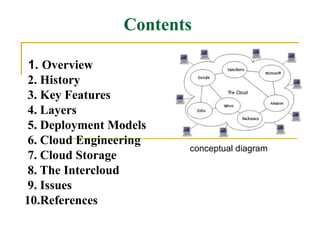
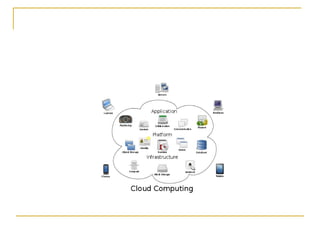
1.  Overview 2. History 3. Key Features 4. Layers 5. Deployment Models 6. Cloud Engineering 7. Cloud Storage 8. The Intercloud 9. Issues 10.References Contents conceptual diagram
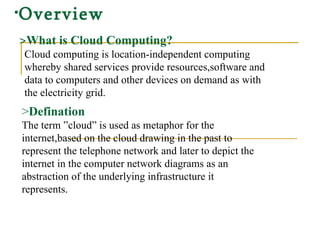
Overview   > What is Cloud Computing? Cloud computing is location-independent computing  whereby shared services provide resources,software and data to computers and other devices on demand as with the electricity grid. > Defination The term ”cloud” is used as metaphor for the internet,based on the cloud drawing in the past to represent the telephone network and later to depict the internet in the computer network diagrams as an abstraction of the underlying infrastructure it represents.
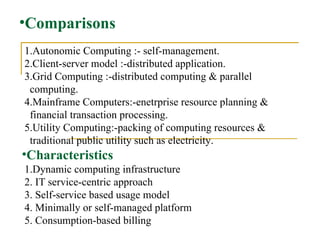
Comparisons 1.Autonomic Computing :- self-management.  2.Client-server model :-distributed application.  3.Grid Computing :-distributed computing & parallel  computing.  4.Mainframe Computers:-enetrprise resource planning & financial transaction processing.   5.Utility Computing:-packing of computing resources &  traditional public utility such as electricity.  Characteristics   1.Dynamic computing infrastructure  2. IT service-centric approach  3. Self-service based usage model  4. Minimally or self-managed platform  5. Consumption-based billing
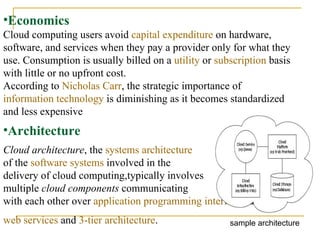
Economics Cloud computing users avoid  capital expenditure  on hardware, software, and services when they pay a provider only for what they use. Consumption is usually billed on a  utility  or  subscription  basis with little or no upfront cost.  According to  Nicholas Carr , the strategic importance of  information technology  is diminishing as it becomes standardized and less expensive     Cloud architecture , the  systems architecture   of the  software systems  involved in the  delivery of cloud computing,typically involves  multiple  cloud components  communicating  with each other over  application programming interfaces ,usually  web services  and  3-tier architecture .   Architecture sample architecture
History The underlying concept of cloud computingdates back to the 1960s, when  John McCarthy  opined that "computation may someday be organized as a  public utility ."  The actual term”cloud”borrows from telephony in that telecommunication companies who until the 1990’s primarily offered dedicated point-to-point data circuits,began offering Virtual Private Network(VPN)services with comparable quilty of service but at a match lower cost.
Key Features Agility Application Programing Interface Cost  Device and location independence Multi-Tenancy Reliability Scalability Security
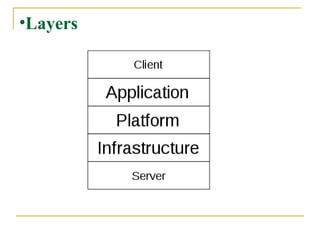
Layers
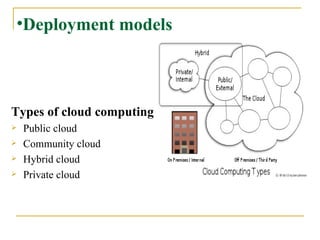
Deployment models Types of cloud computing   Public cloud Community cloud Hybrid cloud Private cloud
Cloud engineering Cloud engineering is the application of a systematic, disciplined, quantifiable, and interdisciplinary approach to the ideation, conceptualization, development, operation, and maintenance of cloud computing, as well as the study and applied research of the approach   Cloud storage Cloud storage is a model of networked  computer data storage  where data is stored on multiple virtual servers, generally hosted by third parties, rather than being hosted on dedicated servers.
The Intercloud The  Intercloud  is an interconnected global "cloud of clouds" and an extension of the  Internet  "network of networks" on which it is based. The term was first used in the context of cloud computing in 2007 when  Kevin Kelly  stated that "eventually we'll have the intercloud, the cloud of clouds. This Intercloud will have the dimensions of one machine comprising all servers and attendant  cloudbooks  on the planet.". It became popular in 2009 and has also been used to describe the datacenter of the future.  The Intercloud scenario is based on the key concept that each single cloud does not have infinite physical resources. If a cloud saturates the computational and storage resources of its virtualization infrastructure, it could not be able to satisfy further requests for service allocations sent from its clients.
Issues > Privacy The cloud model has been criticized by privacy advocates for the greater ease in which the companies hosting the cloud services control, and thus, can monitor at will, lawfully or unlawfully, the communication and data stored between the user and the host company.   > Legal In March 2007,  Dell  applied to  trademark  the term "cloud computing"  in the United States.   On October 29, 2010, Google filed a lawsuit against the U.S. Department of Interior, which opened up a bid for software that required that bidders use Microsoft's Business Productivity Online Suite.
> Open source   Open source software  has provided the foundation for many cloud computing implementations. In November 2007, the  Free Software Foundation  released the  Affero General Public License , a version of  GPLv3  intended to close a perceived  legal loophole  associated with  free software  designed to be run over a network. > Open standards Most cloud providers expose  APIs  which are typically well-documented (often under a  Creative Commons  license but also unique to their implementation and thus not interoperable.
> Security The relative security of cloud computing services is a contentious issue which may be delaying its adoption. Issues barring the adoption of cloud computing are due in large part to the private and public sectors unease surrounding the external management of security based services.
 

Cloud computing ppts

  • 1.
    Punjab College OfTechnical Education Presentation On Cloud Computing
  • 2.
    1. Overview2. History 3. Key Features 4. Layers 5. Deployment Models 6. Cloud Engineering 7. Cloud Storage 8. The Intercloud 9. Issues 10.References Contents conceptual diagram
  • 3.
    Overview > What is Cloud Computing? Cloud computing is location-independent computing whereby shared services provide resources,software and data to computers and other devices on demand as with the electricity grid. > Defination The term ”cloud” is used as metaphor for the internet,based on the cloud drawing in the past to represent the telephone network and later to depict the internet in the computer network diagrams as an abstraction of the underlying infrastructure it represents.
  • 4.
    Comparisons 1.Autonomic Computing:- self-management. 2.Client-server model :-distributed application. 3.Grid Computing :-distributed computing & parallel computing. 4.Mainframe Computers:-enetrprise resource planning & financial transaction processing. 5.Utility Computing:-packing of computing resources & traditional public utility such as electricity. Characteristics   1.Dynamic computing infrastructure  2. IT service-centric approach  3. Self-service based usage model 4. Minimally or self-managed platform 5. Consumption-based billing
  • 5.
    Economics Cloud computingusers avoid capital expenditure on hardware, software, and services when they pay a provider only for what they use. Consumption is usually billed on a utility or subscription basis with little or no upfront cost. According to Nicholas Carr , the strategic importance of information technology is diminishing as it becomes standardized and less expensive Cloud architecture , the systems architecture of the software systems involved in the delivery of cloud computing,typically involves multiple cloud components communicating with each other over application programming interfaces ,usually web services and 3-tier architecture . Architecture sample architecture
  • 6.
    History The underlyingconcept of cloud computingdates back to the 1960s, when John McCarthy opined that "computation may someday be organized as a public utility ." The actual term”cloud”borrows from telephony in that telecommunication companies who until the 1990’s primarily offered dedicated point-to-point data circuits,began offering Virtual Private Network(VPN)services with comparable quilty of service but at a match lower cost.
  • 7.
    Key Features AgilityApplication Programing Interface Cost Device and location independence Multi-Tenancy Reliability Scalability Security
  • 8.
  • 9.
    Deployment models Typesof cloud computing Public cloud Community cloud Hybrid cloud Private cloud
  • 10.
    Cloud engineering Cloudengineering is the application of a systematic, disciplined, quantifiable, and interdisciplinary approach to the ideation, conceptualization, development, operation, and maintenance of cloud computing, as well as the study and applied research of the approach Cloud storage Cloud storage is a model of networked computer data storage where data is stored on multiple virtual servers, generally hosted by third parties, rather than being hosted on dedicated servers.
  • 11.
    The Intercloud The Intercloud is an interconnected global "cloud of clouds" and an extension of the Internet "network of networks" on which it is based. The term was first used in the context of cloud computing in 2007 when Kevin Kelly stated that "eventually we'll have the intercloud, the cloud of clouds. This Intercloud will have the dimensions of one machine comprising all servers and attendant cloudbooks on the planet.". It became popular in 2009 and has also been used to describe the datacenter of the future. The Intercloud scenario is based on the key concept that each single cloud does not have infinite physical resources. If a cloud saturates the computational and storage resources of its virtualization infrastructure, it could not be able to satisfy further requests for service allocations sent from its clients.
  • 12.
    Issues > PrivacyThe cloud model has been criticized by privacy advocates for the greater ease in which the companies hosting the cloud services control, and thus, can monitor at will, lawfully or unlawfully, the communication and data stored between the user and the host company. > Legal In March 2007, Dell applied to trademark the term "cloud computing" in the United States. On October 29, 2010, Google filed a lawsuit against the U.S. Department of Interior, which opened up a bid for software that required that bidders use Microsoft's Business Productivity Online Suite.
  • 13.
    > Open source Open source software has provided the foundation for many cloud computing implementations. In November 2007, the Free Software Foundation released the Affero General Public License , a version of GPLv3 intended to close a perceived legal loophole associated with free software designed to be run over a network. > Open standards Most cloud providers expose APIs which are typically well-documented (often under a Creative Commons license but also unique to their implementation and thus not interoperable.
  • 14.
    > Security Therelative security of cloud computing services is a contentious issue which may be delaying its adoption. Issues barring the adoption of cloud computing are due in large part to the private and public sectors unease surrounding the external management of security based services.
  • 15.