Sustainability and Fog Computing:
Applications, Advantages and Challenges
Abdul Majid Farooqi
School of Engineering Sciences and Technology (SEST)
Jamia Hamdard
(Deemed to be University)
New Delhi. India
3rd International Conference
on
Computing and Communication Technologies
(ICCCT’19)
Chennai, India
Presentation Summery
• Introduction to Fog Computing
• Fog Computing Definition
• Problem Statement
• Literature Review
• Fog Computing Applications
• Fog Computing Advantages
• Fog Computing Challenges
• Fog Computing Architecture
• Fog Computing vs Cloud Computing
• Conclusion
• References
Introduction to Fog Computing
• In recent years fog computing has emerged as a load balancer for data centers.
• Enormous amount of internet traffic is generated every day and growing.
• Global IP traffic in 2016 was 96 exabyte per month and will nearly triple by 2021,
Consumer IP traffic will reach 232.7 exabyte per month and business IP traffic
will be 45.5 exabyte per month by 2021 [1] .
• Due to this tremendous amount of data transaction, data centers require more
powerful computing devices to perform certain tasks efficiently.
Introduction to Fog Computing
Continued…
• Powerful computing devices consume electricity
and emit CO2 in the atmosphere which is very
harmful for the environment [2].
• Another term related to cloud computing has
emerged recently, called Internet of Things (IoT).
• In simple words IoT means “connect the
unconnected” [3] through the Internet.
• According to International Data Corporation (IDC)
statistics [4] by 2020:
Introduction to Fog Computing
Continued…
• Data center burden has been further increasing because cloud computing is
the only cost-efficient choice left that can handle such massive amount of
data to be stored and processed.
• Such issues compelled researchers to think about an alternative of the cloud
or something which can at least extend the cloud services so that data center’s
load could be lighter.
• That’s why fog computing came into limelight in 2012 [5] and became
further prevalent in 2015 [6].
Fog Computing Definition
• Fog computing horizontally provides cloud computing features at the edge of
user premises and distributes storage, networking and computing hardware
without compromising security, latency and performance.
Problem Statement
• In 2017, approximately 8 million data centers all over the globe were handling the
entire data load. They required 416.2 terawatt-hours of electricity [7].
• In real world such amount of energy emits as much CO2 as more than 33 million
houses emit in one year [8].
• That is 2 percent of total global use, and it’s most likely to reach a never before 5
percent of global electricity consumption by 2020 [7]
• To reduce the heavy burden of data centers fog computing emerges as an extended
solution of cloud.
Literature Review
• Wei Li et al. focused on building a sustainable edge computing, they proposed a
unified energy management framework for sustainable edge computing.
• To reduce energy consumption in fog computing Jianwen Xu et al. applied in-
memory caching techniques. They designed two kinds of Time to Live (TTL) in
four cache replacement policies: (i) FIFO (ii) LFU (iii) LRU and (iv) RR to cache
data at the fog.
• C. Mouradian presents a comprehensive survey on fog computing with research
challenges and critically review the state of the art
Fog Computing Applications
• Smart City
• Real-time vehicular ad hoc networks (VANETs)
• Smart Grid
• Health care system
Fog Computing Advantages
• It reduces the latency, cost and geographical distance between consumer
and data center.
• It increases the performance of data processing and security of data in
comparison to cloud.
• It is more reliable and confidential.
Fog Computing Challenges
• Application Offloading
• Resource Sharing
• Energy Consumption
• Security and Privacy
Fog Computing
Architecture
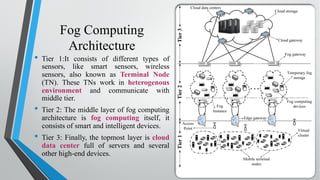
• Tier 1:It consists of different types of
sensors, like smart sensors, wireless
sensors, also known as Terminal Node
(TN). These TNs work in heterogenous
environment and communicate with
middle tier.
• Tier 2: The middle layer of fog computing
architecture is fog computing itself, it
consists of smart and intelligent devices.
• Tier 3: Finally, the topmost layer is cloud
data center full of servers and several
other high-end devices.
Fog Computing vs Cloud
Computing
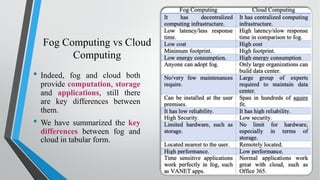
• Indeed, fog and cloud both
provide computation, storage
and applications, still there
are key differences between
them.
• We have summarized the key
differences between fog and
cloud in tabular form.
Conclusion
• In this survey we defined fog computing and discussed why we need fog, also we
surveyed challenges of fog computing.
• We also talked about some fog applications and discussed how we can achieve
sustainability in smart city, VANETs, smart grid and health care applications.
• We reviewed several research and survey papers.
• Our main goal is stablishing a sustainable modern computing environment for the
world.
For full paper please visit https://ieeexplore.ieee.org/document/8824983
References
[1] “Cisco Visual Networking Index: Forecast and Methodology, 2016–2021,” p. 17, 2017.
[2] A. Jain, M. Mishra, S. K. Peddoju, and N. Jain, “Energy efficient computing- Green cloud computing,” 2013 International
Conference on Energy Efficient Technologies for Sustainability, ICEETS 2013, pp. 978–982, 2013.
[3] D. Hanes, IoT fundamentals : networking technologies, protocols, and use cases for the Internet of Things, 1st ed. Cisco
Press, 2017.
[4] M. Mukherjee, L. Shu, and D. Wang, “Survey of Fog Computing: Fundamental, Network Applications, and Research
Challenges,” IEEE Communications Surveys & Tutorials, no. c, p. 30, 2018.
[5] F. Bonomi, R. Milito, J. Zhu, and S. Addepalli, “Fog Computing and Its Role in the Internet of Things,” Proceedings of the
first edition of the MCC workshop on Mobile cloud computing, pp. 13–16, 2012.
[6] M. Janakiram, “Is Fog Computing The Next Big Thing In Internet of Things?,” Forbes Magazine, 2016. [Online]. Available:
https://www.forbes.com/sites/janakirammsv/2016/04/18/is-fog-computing-the-next-big-thing-in-internet-of-
things/#563dd9b5608d. [Accessed: 08-Oct-2018].
[7] Jim Witham, “Achieving Data Center Energy Efficiency,” 2018. [Online]. Available:
https://www.datacenterknowledge.com/industry-perspectives/achieving-data-center-energy-efficiency. [Accessed: 15-Oct-2018].
[8] C. US EPA, OAR,OAP, “Greenhouse Gas Equivalencies Calculator,” United States Environmental Protection Agency, 2018.
[Online]. Available: https://www.epa.gov/energy/greenhouse-gas-equivalencies-calculator. [Accessed: 16-Oct-2018].
Thank You
Abdul Majid Farooqi

Sustainability and fog computing applications, advantages and challenges

  • 1.
    Sustainability and FogComputing: Applications, Advantages and Challenges Abdul Majid Farooqi School of Engineering Sciences and Technology (SEST) Jamia Hamdard (Deemed to be University) New Delhi. India 3rd International Conference on Computing and Communication Technologies (ICCCT’19) Chennai, India
  • 2.
    Presentation Summery • Introductionto Fog Computing • Fog Computing Definition • Problem Statement • Literature Review • Fog Computing Applications • Fog Computing Advantages • Fog Computing Challenges • Fog Computing Architecture • Fog Computing vs Cloud Computing • Conclusion • References
  • 3.
    Introduction to FogComputing • In recent years fog computing has emerged as a load balancer for data centers. • Enormous amount of internet traffic is generated every day and growing. • Global IP traffic in 2016 was 96 exabyte per month and will nearly triple by 2021, Consumer IP traffic will reach 232.7 exabyte per month and business IP traffic will be 45.5 exabyte per month by 2021 [1] . • Due to this tremendous amount of data transaction, data centers require more powerful computing devices to perform certain tasks efficiently.
  • 4.
    Introduction to FogComputing Continued… • Powerful computing devices consume electricity and emit CO2 in the atmosphere which is very harmful for the environment [2]. • Another term related to cloud computing has emerged recently, called Internet of Things (IoT). • In simple words IoT means “connect the unconnected” [3] through the Internet. • According to International Data Corporation (IDC) statistics [4] by 2020:
  • 5.
    Introduction to FogComputing Continued… • Data center burden has been further increasing because cloud computing is the only cost-efficient choice left that can handle such massive amount of data to be stored and processed. • Such issues compelled researchers to think about an alternative of the cloud or something which can at least extend the cloud services so that data center’s load could be lighter. • That’s why fog computing came into limelight in 2012 [5] and became further prevalent in 2015 [6].
  • 6.
    Fog Computing Definition •Fog computing horizontally provides cloud computing features at the edge of user premises and distributes storage, networking and computing hardware without compromising security, latency and performance.
  • 7.
    Problem Statement • In2017, approximately 8 million data centers all over the globe were handling the entire data load. They required 416.2 terawatt-hours of electricity [7]. • In real world such amount of energy emits as much CO2 as more than 33 million houses emit in one year [8]. • That is 2 percent of total global use, and it’s most likely to reach a never before 5 percent of global electricity consumption by 2020 [7] • To reduce the heavy burden of data centers fog computing emerges as an extended solution of cloud.
  • 8.
    Literature Review • WeiLi et al. focused on building a sustainable edge computing, they proposed a unified energy management framework for sustainable edge computing. • To reduce energy consumption in fog computing Jianwen Xu et al. applied in- memory caching techniques. They designed two kinds of Time to Live (TTL) in four cache replacement policies: (i) FIFO (ii) LFU (iii) LRU and (iv) RR to cache data at the fog. • C. Mouradian presents a comprehensive survey on fog computing with research challenges and critically review the state of the art
  • 9.
    Fog Computing Applications •Smart City • Real-time vehicular ad hoc networks (VANETs) • Smart Grid • Health care system
  • 10.
    Fog Computing Advantages •It reduces the latency, cost and geographical distance between consumer and data center. • It increases the performance of data processing and security of data in comparison to cloud. • It is more reliable and confidential.
  • 11.
    Fog Computing Challenges •Application Offloading • Resource Sharing • Energy Consumption • Security and Privacy
  • 12.
    Fog Computing Architecture • Tier1:It consists of different types of sensors, like smart sensors, wireless sensors, also known as Terminal Node (TN). These TNs work in heterogenous environment and communicate with middle tier. • Tier 2: The middle layer of fog computing architecture is fog computing itself, it consists of smart and intelligent devices. • Tier 3: Finally, the topmost layer is cloud data center full of servers and several other high-end devices.
  • 13.
    Fog Computing vsCloud Computing • Indeed, fog and cloud both provide computation, storage and applications, still there are key differences between them. • We have summarized the key differences between fog and cloud in tabular form.
  • 14.
    Conclusion • In thissurvey we defined fog computing and discussed why we need fog, also we surveyed challenges of fog computing. • We also talked about some fog applications and discussed how we can achieve sustainability in smart city, VANETs, smart grid and health care applications. • We reviewed several research and survey papers. • Our main goal is stablishing a sustainable modern computing environment for the world. For full paper please visit https://ieeexplore.ieee.org/document/8824983
  • 15.
    References [1] “Cisco VisualNetworking Index: Forecast and Methodology, 2016–2021,” p. 17, 2017. [2] A. Jain, M. Mishra, S. K. Peddoju, and N. Jain, “Energy efficient computing- Green cloud computing,” 2013 International Conference on Energy Efficient Technologies for Sustainability, ICEETS 2013, pp. 978–982, 2013. [3] D. Hanes, IoT fundamentals : networking technologies, protocols, and use cases for the Internet of Things, 1st ed. Cisco Press, 2017. [4] M. Mukherjee, L. Shu, and D. Wang, “Survey of Fog Computing: Fundamental, Network Applications, and Research Challenges,” IEEE Communications Surveys & Tutorials, no. c, p. 30, 2018. [5] F. Bonomi, R. Milito, J. Zhu, and S. Addepalli, “Fog Computing and Its Role in the Internet of Things,” Proceedings of the first edition of the MCC workshop on Mobile cloud computing, pp. 13–16, 2012. [6] M. Janakiram, “Is Fog Computing The Next Big Thing In Internet of Things?,” Forbes Magazine, 2016. [Online]. Available: https://www.forbes.com/sites/janakirammsv/2016/04/18/is-fog-computing-the-next-big-thing-in-internet-of- things/#563dd9b5608d. [Accessed: 08-Oct-2018]. [7] Jim Witham, “Achieving Data Center Energy Efficiency,” 2018. [Online]. Available: https://www.datacenterknowledge.com/industry-perspectives/achieving-data-center-energy-efficiency. [Accessed: 15-Oct-2018]. [8] C. US EPA, OAR,OAP, “Greenhouse Gas Equivalencies Calculator,” United States Environmental Protection Agency, 2018. [Online]. Available: https://www.epa.gov/energy/greenhouse-gas-equivalencies-calculator. [Accessed: 16-Oct-2018].
  • 16.