CLOUD COMPUTING – AN OVERVIEW Research done by:-Beant Singh Duggal
Cloud Computing - Some terms Term cloud is used as a metaphor for internet Concept generally incorporates combinations of the following Infrastructure as a service (IaaS) Platform as a service (PaaS) Software as a service(SaaS) Not to be confused with Grid Computing – a form of distributed computing Cluster of loosely coupled, networked computers acting in concert to perform very large tasks Utility Computing – packaging of computing resources such as computing power, storage, also a metered services Autonomic computing – self managed
Grid Computing Share Computers and data Evolved to harness inexpensive computers in Data center to solve variety of problems Harness power of loosely coupled computers to solve a technical or mathematical problem Used in commercial applications for drug discovery, economic forecasting, sesimic analysis and back-office Small to big Can be confined to a corporation Large public collaboration across many companies and networks Most grid solutions are built on Computer Agents Resource Manager Scheduler Compute grids Batch up jobs Submit the job to the scheduler, specifiying requirements and SLA(specs) required for running the job Scheduler matches specs with available resources and schedules the job to be run Farms could be as large as 10K cpus Most financial firms has grids like this Grids lack automation, agility, simplicity and SLA guarantees
Utility Computing More related to cloud computing Applications, storage, computing power and network Requires cloud like infrastructure Pay by the drink model Similar to electric service at home Pay for extra resources when needed To handle expected surge in demand Unanticipated surges in demand Better economics
Cloud computing – History Evolved over a period of time Roots traced back to Application Service Providers in the 1990’s Parallels to SaaS Evolved from Utility computing and is a broader concept
Cloud computing Much more broader concept Encompasses IIAS, PAAS, SAAS Dynamic provision of services/resource pools in a co-ordinated fashion On demand computing – No waiting period Location of resource is irrelevant May be relevant from performance(network latency) perspective, data locality Applications run somewhere on the cloud Web applications fulfill these for end user However, for application developers and IT Allows develop, deploy and run applications that can easily grow capacity(scalability), work fast(performance), and offer good reliability Without concern for the nature and location of underlying infrastructure Activate, retire resources Dynamically update infrastructure elements without affecting the business
Clouds Versus Grids Clouds and Grids are distinct Cloud Full private cluster is provisioned Individual user can only get a tiny fraction of the total resource pool No support for cloud federation except through the client interface Opaque with respect to resources Grid Built so that individual users can get most, if not all of the resources in a single request Middleware approach takes federation as a first principle Resources are exposed, often as bare metal These differences mandate different architectures for each
Cloud Mythologies Cloud computing infrastructure is just a web service interface to operating system virtualization. “ I’m running Xen in my data center – I’m running a private cloud.” Cloud computing imposes a significant performance penalty over “bare metal” provisioning. “ I won’t be able to run a private cloud because my users will not tolerate the performance hit.” Clouds and Grids are equivalent “ In the mid 1990s, the term grid was coined to describe technologies that would allow consumers to obtain computing power on demand.”
Commercial clouds
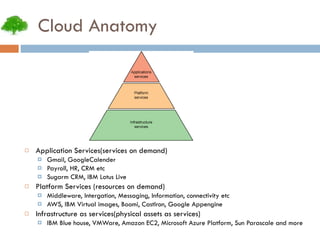
Cloud Anatomy Application Services(services on demand) Gmail, GoogleCalender Payroll, HR, CRM etc Sugarm CRM, IBM Lotus Live Platform Services (resources on demand) Middleware, Intergation, Messaging, Information, connectivity etc AWS, IBM Virtual images, Boomi, CastIron, Google Appengine Infrastructure as services(physical assets as services) IBM Blue house, VMWare, Amazon EC2, Microsoft Azure Platform, Sun Parascale and more
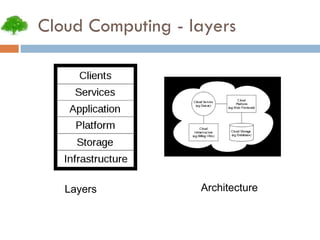
Cloud Computing - layers Layers Architecture
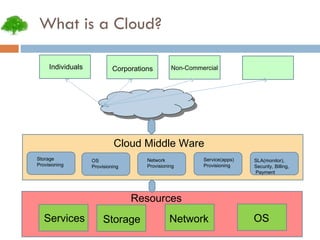
What is a Cloud? Individuals Corporations Non-Commercial Cloud Middle Ware Storage  Provisioning OS Provisioning Network Provisioning Service(apps) Provisioning SLA(monitor),  Security, Billing, Payment Services Storage Network OS Resources
Why cloud computing Data centers are notoriously underutilized, often idle 85% of the time Over provisioning Insufficient capacity planning and sizing Improper understanding of scalability requirements etc including thought leaders from Gartner, Forrester, and IDC—agree that this new model offers significant advantages for fast-paced startups, SMBs and enterprises alike.  Cost effective solutions to key business demands Move workloads to improve efficiency
How do they work? Public clouds are opaque What applications will work well in a cloud? Many of the advantages offered by Public Clouds appear useful for “on premise” IT Self-service provisioning Legacy support Flexible resource allocation What extensions or modifications are required to support a wider variety of services and applications? Data assimilation Multiplayer gaming Mobile devices
Cloud computing - Characteristics Agility – On demand computing infrastructure Linearly scalable – challenge Reliability and fault tolerance Self healing – Hot backups, etc SLA driven – Policies on how quickly requests are processed Multi-tenancy – Several customers share infrastructure, without compromising privacy and security of each of the customer’s data Service-oriented – compose applications out of loosely coupled services. One service failure will not disrupt other services. Expose these services as API’s Virtualized – decoupled from underlying hardware. Multiple applications can run in one computer Data, Data, Data Distributing, partitioning, security, and synchronization
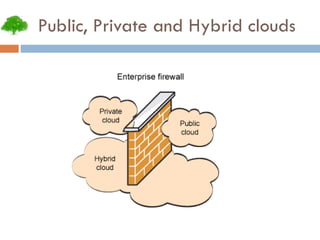
Public, Private and Hybrid clouds
Public clouds Open for use by general public Exist beyond firewall, fully hosted and managed by the vendor Individuals, corporations and others Amazon's Web Services and Google appEngine are examples Offers startups and SMB’s quick setup, scalability, flexibility and automated management. Pay as you go model helps startups to start small and go big Security and compliance? Reliability concerns hinder the adoption of cloud Amazon S3 services were down for 6 hours
Public Clouds (Now) Large scale infrastructure available on a rental basis Operating System virtualization (e.g. Xen, kvm) provides CPU isolation “ Roll-your-own” network provisioning provides network isolation Locally specific storage abstractions Fully customer self-service Service Level Agreements (SLAs) are advertized Requests are accepted and resources granted via web services Customers access resources remotely via the Internet Accountability is e-commerce based Web-based transaction “ Pay-as-you-go” and flat-rate subscription Customer service, refunds, etc.
Private Clouds Within the boundaries(firewall) of the organization All advantages of public cloud with one major difference Reduce operation costs Has to be managed by the enterprise Fine grained control over resources More secure as they are internal to org Schedule and reshuffle resources based on business demands Ideal for apps related to tight security and regulatory concerns Development requires hardware investments and in-house expertise Cost could be prohibitive and cost might exceed public clouds
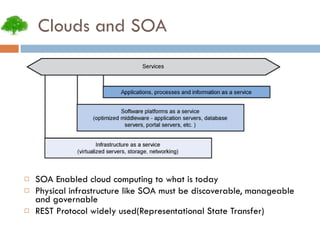
Clouds and SOA SOA Enabled cloud computing to what is today Physical infrastructure like SOA must be discoverable, manageable and governable REST Protocol widely used(Representational State Transfer)
Clouds for Developers Ability to acquire, deploy, configure and host environments Perform development unit testing, prototyping and full product testing
Open Source Cloud Infrastructure Simple Transparent => need to “see” into the cloud Scalable => complexity often limits scalability Secure => limits adoptability Extensible New application classes and service classes may require new features Clouds are new => need to extend while retaining useful features Commodity-based Must leverage extensive catalog of open source software offerings New, unstable, and unsupported infrastructure design is a barrier to uptake, experimentation, and adoption Easy To install => system administration time is expensive To maintain => system administration time is really expensive
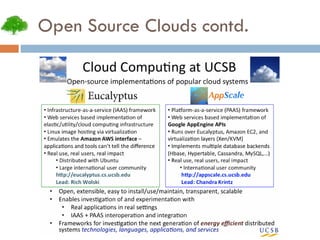
Microsoft and Amazon face challenges Globus/Nimbus Client-side cloud-computing interface to Globus-enabled TeraPort cluster at U of C Based on GT4 and the Globus Virtual Workspace Service Shares upsides and downsides of Globus-based grid technologies Enomalism (now called ECP) Start-up company distributing open source  REST APIs Reservoir European open cloud project Many layers of cloud services and tools Ambitious and wide-reaching but not yet accessible as an implementation Eucalyptus Cloud Computing on Clusters Amazon Web Services compatible Supports kvm and Xen Open Nebulous Joyent Based on Java Script and Git
Open Source Cloud Ecosystem - Tools RightScale Startup focused on providing client tools as SaaS hosted in AWS Uses the REST interface Canonical Ubuntu 9.10 (Karmic Koala) Includes KVM and Xen Hypervisors
Open Source Cloud Anatomy Extensibility Simple architecture and open internal APIs Client-side interface Amazon’s AWS interface and functionality (familiar and testable) Networking Virtual private network per cloud Must function as an overlay => cannot supplant local networking Security Must be compatible with local security policies Packaging, installation, maintenance system administration staff is an important constituency for uptake
Open Source Cloud Anatomy .. cntd Private clouds are really hybrid clouds Users want private clouds to export the same APIs as the public clouds In the Enterprise, the storage model is key Scalable “blob” storage doesn’t quite fit the notion of “data file.” Cloud Federation is a policy mediation problem No good way to translate SLAs in a cloud allocation chain “ Cloud Bursting” will only work if SLAs are congruent Customer SLAs allow applications to consider cost as first-class principle Buy the computational, network, and storage capabilities that are required
Open Source Clouds contd.
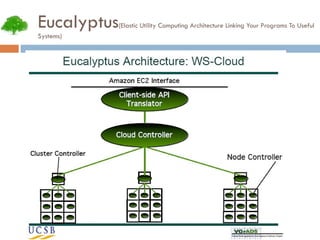
Eucalyptus (Elastic Utility Computing Architecture Linking Your Programs To Useful Systems)
Clouds and Virtualization Operating System virtualization (Xen, KVM, VMWare, HyperV) is only apparent for IaaS AppEngine =  BigTable Hypervisors virtualize CPU, Memory, and local device access as a  single  virtual machine (VM) IaaS Cloud allocation is Set of VMs Set of storage resources Private network Allocation is atomic SLA Monitoring
Cloud Performance Extensive performance study using HPC applications and benchmarks Two questions: Performance impact of virtualization Performance impact of cloud infrastructure Observations: Random access disk is slower with Xen CPU bound can be  faster  with Xen -> depends on configuration Kernel version is far more important No statistically detectable overhead AWS small appears to throttle network bandwidth and (maybe) disk bandwidth ->  $0.10 / CPU hour
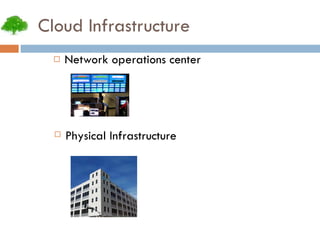
Cloud Infrastructure Network operations center Physical Infrastructure
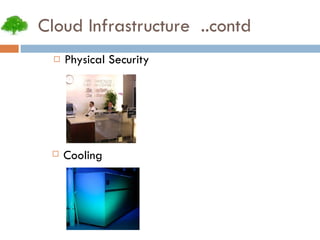
Cloud Infrastructure  ..contd Physical Security Cooling
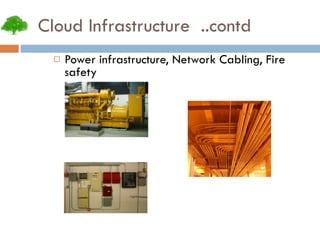
Cloud Infrastructure  ..contd Power infrastructure, Network Cabling, Fire safety
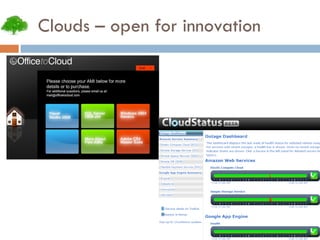
Clouds – open for innovation
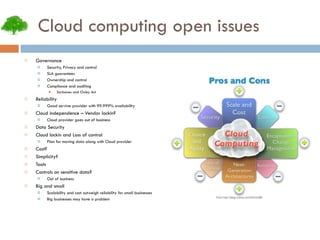
Cloud computing open issues Governance Security, Privacy and control SLA guarantees Ownership and control Compliance and auditing Sarbanes and Oxley Act Reliability Good servive provider with 99.999% availability Cloud independence – Vendor lockin? Cloud provider goes out of business Data Security Cloud lockin and Loss of control Plan for moving data along with Cloud provider Cost? Simplicity? Tools Controls on sensitive data? Out of business Big and small Scalability and cost outweigh reliability for small businesses Big businesses may have a problem
Battle in the cloud Amazon Web Services Google App Engine Free upto 500 MB, Free for small scale applications? Universities? Pay when you scale GoGrid .. Some more Hosting companies Where is HP, IBM, Oracle(+sun) and Dell?

Introduction To Cloud Computing By Beant Singh Duggal

  • 1.
    CLOUD COMPUTING –AN OVERVIEW Research done by:-Beant Singh Duggal
  • 2.
    Cloud Computing -Some terms Term cloud is used as a metaphor for internet Concept generally incorporates combinations of the following Infrastructure as a service (IaaS) Platform as a service (PaaS) Software as a service(SaaS) Not to be confused with Grid Computing – a form of distributed computing Cluster of loosely coupled, networked computers acting in concert to perform very large tasks Utility Computing – packaging of computing resources such as computing power, storage, also a metered services Autonomic computing – self managed
  • 3.
    Grid Computing ShareComputers and data Evolved to harness inexpensive computers in Data center to solve variety of problems Harness power of loosely coupled computers to solve a technical or mathematical problem Used in commercial applications for drug discovery, economic forecasting, sesimic analysis and back-office Small to big Can be confined to a corporation Large public collaboration across many companies and networks Most grid solutions are built on Computer Agents Resource Manager Scheduler Compute grids Batch up jobs Submit the job to the scheduler, specifiying requirements and SLA(specs) required for running the job Scheduler matches specs with available resources and schedules the job to be run Farms could be as large as 10K cpus Most financial firms has grids like this Grids lack automation, agility, simplicity and SLA guarantees
  • 4.
    Utility Computing Morerelated to cloud computing Applications, storage, computing power and network Requires cloud like infrastructure Pay by the drink model Similar to electric service at home Pay for extra resources when needed To handle expected surge in demand Unanticipated surges in demand Better economics
  • 5.
    Cloud computing –History Evolved over a period of time Roots traced back to Application Service Providers in the 1990’s Parallels to SaaS Evolved from Utility computing and is a broader concept
  • 6.
    Cloud computing Muchmore broader concept Encompasses IIAS, PAAS, SAAS Dynamic provision of services/resource pools in a co-ordinated fashion On demand computing – No waiting period Location of resource is irrelevant May be relevant from performance(network latency) perspective, data locality Applications run somewhere on the cloud Web applications fulfill these for end user However, for application developers and IT Allows develop, deploy and run applications that can easily grow capacity(scalability), work fast(performance), and offer good reliability Without concern for the nature and location of underlying infrastructure Activate, retire resources Dynamically update infrastructure elements without affecting the business
  • 7.
    Clouds Versus GridsClouds and Grids are distinct Cloud Full private cluster is provisioned Individual user can only get a tiny fraction of the total resource pool No support for cloud federation except through the client interface Opaque with respect to resources Grid Built so that individual users can get most, if not all of the resources in a single request Middleware approach takes federation as a first principle Resources are exposed, often as bare metal These differences mandate different architectures for each
  • 8.
    Cloud Mythologies Cloudcomputing infrastructure is just a web service interface to operating system virtualization. “ I’m running Xen in my data center – I’m running a private cloud.” Cloud computing imposes a significant performance penalty over “bare metal” provisioning. “ I won’t be able to run a private cloud because my users will not tolerate the performance hit.” Clouds and Grids are equivalent “ In the mid 1990s, the term grid was coined to describe technologies that would allow consumers to obtain computing power on demand.”
  • 9.
  • 10.
    Cloud Anatomy ApplicationServices(services on demand) Gmail, GoogleCalender Payroll, HR, CRM etc Sugarm CRM, IBM Lotus Live Platform Services (resources on demand) Middleware, Intergation, Messaging, Information, connectivity etc AWS, IBM Virtual images, Boomi, CastIron, Google Appengine Infrastructure as services(physical assets as services) IBM Blue house, VMWare, Amazon EC2, Microsoft Azure Platform, Sun Parascale and more
  • 11.
    Cloud Computing -layers Layers Architecture
  • 12.
    What is aCloud? Individuals Corporations Non-Commercial Cloud Middle Ware Storage Provisioning OS Provisioning Network Provisioning Service(apps) Provisioning SLA(monitor), Security, Billing, Payment Services Storage Network OS Resources
  • 13.
    Why cloud computingData centers are notoriously underutilized, often idle 85% of the time Over provisioning Insufficient capacity planning and sizing Improper understanding of scalability requirements etc including thought leaders from Gartner, Forrester, and IDC—agree that this new model offers significant advantages for fast-paced startups, SMBs and enterprises alike. Cost effective solutions to key business demands Move workloads to improve efficiency
  • 14.
    How do theywork? Public clouds are opaque What applications will work well in a cloud? Many of the advantages offered by Public Clouds appear useful for “on premise” IT Self-service provisioning Legacy support Flexible resource allocation What extensions or modifications are required to support a wider variety of services and applications? Data assimilation Multiplayer gaming Mobile devices
  • 15.
    Cloud computing -Characteristics Agility – On demand computing infrastructure Linearly scalable – challenge Reliability and fault tolerance Self healing – Hot backups, etc SLA driven – Policies on how quickly requests are processed Multi-tenancy – Several customers share infrastructure, without compromising privacy and security of each of the customer’s data Service-oriented – compose applications out of loosely coupled services. One service failure will not disrupt other services. Expose these services as API’s Virtualized – decoupled from underlying hardware. Multiple applications can run in one computer Data, Data, Data Distributing, partitioning, security, and synchronization
  • 16.
    Public, Private andHybrid clouds
  • 17.
    Public clouds Openfor use by general public Exist beyond firewall, fully hosted and managed by the vendor Individuals, corporations and others Amazon's Web Services and Google appEngine are examples Offers startups and SMB’s quick setup, scalability, flexibility and automated management. Pay as you go model helps startups to start small and go big Security and compliance? Reliability concerns hinder the adoption of cloud Amazon S3 services were down for 6 hours
  • 18.
    Public Clouds (Now)Large scale infrastructure available on a rental basis Operating System virtualization (e.g. Xen, kvm) provides CPU isolation “ Roll-your-own” network provisioning provides network isolation Locally specific storage abstractions Fully customer self-service Service Level Agreements (SLAs) are advertized Requests are accepted and resources granted via web services Customers access resources remotely via the Internet Accountability is e-commerce based Web-based transaction “ Pay-as-you-go” and flat-rate subscription Customer service, refunds, etc.
  • 19.
    Private Clouds Withinthe boundaries(firewall) of the organization All advantages of public cloud with one major difference Reduce operation costs Has to be managed by the enterprise Fine grained control over resources More secure as they are internal to org Schedule and reshuffle resources based on business demands Ideal for apps related to tight security and regulatory concerns Development requires hardware investments and in-house expertise Cost could be prohibitive and cost might exceed public clouds
  • 20.
    Clouds and SOASOA Enabled cloud computing to what is today Physical infrastructure like SOA must be discoverable, manageable and governable REST Protocol widely used(Representational State Transfer)
  • 21.
    Clouds for DevelopersAbility to acquire, deploy, configure and host environments Perform development unit testing, prototyping and full product testing
  • 22.
    Open Source CloudInfrastructure Simple Transparent => need to “see” into the cloud Scalable => complexity often limits scalability Secure => limits adoptability Extensible New application classes and service classes may require new features Clouds are new => need to extend while retaining useful features Commodity-based Must leverage extensive catalog of open source software offerings New, unstable, and unsupported infrastructure design is a barrier to uptake, experimentation, and adoption Easy To install => system administration time is expensive To maintain => system administration time is really expensive
  • 23.
    Microsoft and Amazonface challenges Globus/Nimbus Client-side cloud-computing interface to Globus-enabled TeraPort cluster at U of C Based on GT4 and the Globus Virtual Workspace Service Shares upsides and downsides of Globus-based grid technologies Enomalism (now called ECP) Start-up company distributing open source REST APIs Reservoir European open cloud project Many layers of cloud services and tools Ambitious and wide-reaching but not yet accessible as an implementation Eucalyptus Cloud Computing on Clusters Amazon Web Services compatible Supports kvm and Xen Open Nebulous Joyent Based on Java Script and Git
  • 24.
    Open Source CloudEcosystem - Tools RightScale Startup focused on providing client tools as SaaS hosted in AWS Uses the REST interface Canonical Ubuntu 9.10 (Karmic Koala) Includes KVM and Xen Hypervisors
  • 25.
    Open Source CloudAnatomy Extensibility Simple architecture and open internal APIs Client-side interface Amazon’s AWS interface and functionality (familiar and testable) Networking Virtual private network per cloud Must function as an overlay => cannot supplant local networking Security Must be compatible with local security policies Packaging, installation, maintenance system administration staff is an important constituency for uptake
  • 26.
    Open Source CloudAnatomy .. cntd Private clouds are really hybrid clouds Users want private clouds to export the same APIs as the public clouds In the Enterprise, the storage model is key Scalable “blob” storage doesn’t quite fit the notion of “data file.” Cloud Federation is a policy mediation problem No good way to translate SLAs in a cloud allocation chain “ Cloud Bursting” will only work if SLAs are congruent Customer SLAs allow applications to consider cost as first-class principle Buy the computational, network, and storage capabilities that are required
  • 27.
  • 28.
    Eucalyptus (Elastic UtilityComputing Architecture Linking Your Programs To Useful Systems)
  • 29.
    Clouds and VirtualizationOperating System virtualization (Xen, KVM, VMWare, HyperV) is only apparent for IaaS AppEngine = BigTable Hypervisors virtualize CPU, Memory, and local device access as a single virtual machine (VM) IaaS Cloud allocation is Set of VMs Set of storage resources Private network Allocation is atomic SLA Monitoring
  • 30.
    Cloud Performance Extensiveperformance study using HPC applications and benchmarks Two questions: Performance impact of virtualization Performance impact of cloud infrastructure Observations: Random access disk is slower with Xen CPU bound can be faster with Xen -> depends on configuration Kernel version is far more important No statistically detectable overhead AWS small appears to throttle network bandwidth and (maybe) disk bandwidth -> $0.10 / CPU hour
  • 31.
    Cloud Infrastructure Networkoperations center Physical Infrastructure
  • 32.
    Cloud Infrastructure ..contd Physical Security Cooling
  • 33.
    Cloud Infrastructure ..contd Power infrastructure, Network Cabling, Fire safety
  • 34.
    Clouds – openfor innovation
  • 35.
    Cloud computing openissues Governance Security, Privacy and control SLA guarantees Ownership and control Compliance and auditing Sarbanes and Oxley Act Reliability Good servive provider with 99.999% availability Cloud independence – Vendor lockin? Cloud provider goes out of business Data Security Cloud lockin and Loss of control Plan for moving data along with Cloud provider Cost? Simplicity? Tools Controls on sensitive data? Out of business Big and small Scalability and cost outweigh reliability for small businesses Big businesses may have a problem
  • 36.
    Battle in thecloud Amazon Web Services Google App Engine Free upto 500 MB, Free for small scale applications? Universities? Pay when you scale GoGrid .. Some more Hosting companies Where is HP, IBM, Oracle(+sun) and Dell?

Editor's Notes

  • #6 So although they are often lumped together, the differences between utility computing and cloud computing are crucial. Utility computing relates to the business model in which application infrastructure resources — hardware and/or software — are delivered. While cloud computing relates to the way we design, build, deploy and run applications that operate in an a virtualized environment, sharing resources and boasting the ability to dynamically grow, shrink and self-heal.
  • #26 What challenges do we need to meet to solve the problem? -- enumerate them