Project report for Fog Computing project.
ABSTRACT
Cloud computing promises to significantly change the way we use
computers and access and store our personal and business information. With these new
computing and communications paradigms arise new data security challenges. Existing
data protection mechanisms such as encryption have failed in preventing data theft
attacks, especially those perpetrated by an insider to the cloud provider. We propose a
different approach for securing data in the cloud using offensive decoy technology. We
monitor data access in the cloud and detect abnormal data access patterns. When
unauthorized access is suspected and then verified using challenge questions, we launch a
disinformation attack by returning large amounts of decoy information to the attacker.
This protects against the misuse of the user’s real data. Experiments conducted in a local
file setting provide evidence that this approach may provide unprecedented levels of user
data security in a Cloud environment.
EXISTING SYSTEM
Existing data protection mechanisms such as encryption have failed
in preventing data theft attacks, especially those perpetrated by an insider to the cloud
provider. Much research in Cloud computing security has focused on ways of preventing
unauthorized and illegitimate access to data by developing sophisticated access control
and encryption mechanisms. However these mechanisms have not been able to prevent
data compromise.
PROPOSED SYSTEM
We propose a completely different approach to securing the cloud using decoy
information technology, that we have come to call Fog computing. We use this
technology to launch disinformation attacks against malicious insiders, preventing them
from distinguishing the real sensitive customer data from fake worthless data. The
decoys, then, serve two purposes: (1) validating whether data access is authorized
when abnormal information access is detected, and (2) confusing the attacker with bogus
information.
MODULE DESCRIPTION:
1. Cloud Computing.
2. User Behavior Profiling:
3. Decoy documents.
1. Cloud Computing
Cloud computing is a model for enabling convenient, ondemand network
access to a shared pool of configurable computing resources (for example, networks,
servers, storage, applications, and services) that can be rapidly provisioned and released
with minimal management effort or service-provider interaction. It divide into three
type
1.Application as a service.
2.Infrastructure as a service.
3.Platform as a service.
Cloud computing exhibits the following key characteristics:
1. Agility improves with users' ability to re-provision technological infrastructure
resources.
2. Cost is claimed to be reduced and in a public cloud delivery model capital
expenditure is converted to operational expenditure. This is purported to
lower barriers to entry, as infrastructure is typically provided by a third-party and
does not need to be purchased for one-time or infrequent intensive computing tasks.
Pricing on a utility computing basis is fine-grained with usage-based options and
fewer IT skills are required for implementation. The e-FISCAL project's state of the
art repository contains several articles looking into cost aspects in more detail, most
of them concluding that costs savings depend on the type of activities supported and
the type of infrastructure available in-house.
3. Virtualization technology allows servers and storage devices to be shared and
utilization be increased. Applications can be easily migrated from one physical server
to another.
4. Multi tenancy enables sharing of resources and costs across a large pool of
users thus allowing for:
5. Centralization of infrastructure in locations with lower costs (such as real
estate, electricity, etc.)
6. Utilization and efficiency improvements for systems that are often only 10–
20% utilized.
7. Reliability is improved if multiple redundant sites are used, which makes well-
designed cloud computing suitable for business continuity and disaster
recovery.
8. Performance is monitored and consistent and loosely coupled architectures are
constructed using web services as the system interface.
9. Security could improve due to centralization of data, increased security-focused
resources, etc., but concerns can persist about loss of control over certain sensitive data,
and the lack of security for stored kernels. Security is often as good as or better than other
traditional systems, in part because providers are able to devote resources to solving
security issues that many customers cannot afford. However, the complexity of security is
greatly increased when data is distributed over a wider area or greater number of devices
and in multi-tenant systems that are being shared by unrelated users. In addition, user
access to security audit logs may be difficult or impossible. Private cloud installations are
in part motivated by users' desire to retain control over the infrastructure and avoid losing
control of information security.
10. Maintenance of cloud computing applications is easier, because they do not
need to be installed on each user's computer and can be accessed from different
places.
2. User Behavior Profiling:
We monitor data access in the cloud and detect abnormal data access patterns
User profiling is a well known Technique that can be applied here to model how, when,
and how much a user accesses their information in the Cloud. Such ‘normal user’
behavior can be continuously checked to determine whether abnormal access to a user’s
information is occurring. This method of behavior-based security is commonly used in
fraud detection applications. Such profiles would naturally include volumetric
information, how many documents are typically read and how often. We monitor for
abnormal search behaviors that exhibit deviations from the user baseline the correlation
of search behavior anomaly detection with trap-based decoy files should provide stronger
evidence of malfeasance, and therefore improve a detector’s accuracy.
3.Decoy documents.
We propose a different approach for securing data in thecloud using
offensive decoy technology. We monitor data access in the cloud and detect abnormal
data access patterns. we launch a disinformation attack by returning large amounts of
decoy information to the attacker. This protects against the misuse of the user’s real data.
We use this technology to launch disinformation attacks against malicious insiders,
preventing them from distinguishing the real sensitive customer data from fake worthless
data the decoys, then, serve two purposes:
(1) Validating whether data access is authorized when abnormal information access is
detected, and
(2) Confusing the attacker with bogus information..
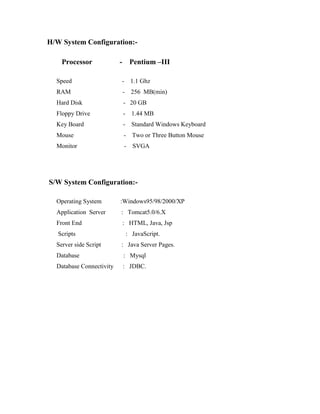
H/W System Configuration:-
Processor - Pentium –III
Speed - 1.1 Ghz
RAM - 256 MB(min)
Hard Disk - 20 GB
Floppy Drive - 1.44 MB
Key Board - Standard Windows Keyboard
Mouse - Two or Three Button Mouse
Monitor - SVGA
S/W System Configuration:-
Operating System :Windows95/98/2000/XP
Application Server : Tomcat5.0/6.X
Front End : HTML, Java, Jsp
Scripts : JavaScript.
Server side Script : Java Server Pages.
Database : Mysql
Database Connectivity : JDBC.
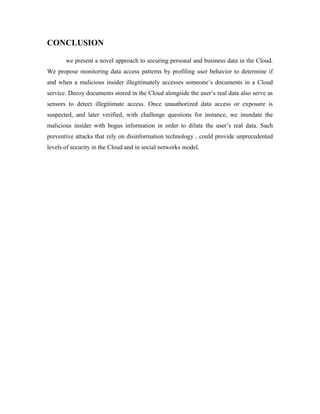
CONCLUSION
we present a novel approach to securing personal and business data in the Cloud.
We propose monitoring data access patterns by profiling user behavior to determine if
and when a malicious insider illegitimately accesses someone’s documents in a Cloud
service. Decoy documents stored in the Cloud alongside the user’s real data also serve as
sensors to detect illegitimate access. Once unauthorized data access or exposure is
suspected, and later verified, with challenge questions for instance, we inundate the
malicious insider with bogus information in order to dilute the user’s real data. Such
preventive attacks that rely on disinformation technology , could provide unprecedented
levels of security in the Cloud and in social networks model.

FOGCOMPUTING

  • 1.
    Project report forFog Computing project. ABSTRACT Cloud computing promises to significantly change the way we use computers and access and store our personal and business information. With these new computing and communications paradigms arise new data security challenges. Existing data protection mechanisms such as encryption have failed in preventing data theft attacks, especially those perpetrated by an insider to the cloud provider. We propose a different approach for securing data in the cloud using offensive decoy technology. We monitor data access in the cloud and detect abnormal data access patterns. When unauthorized access is suspected and then verified using challenge questions, we launch a disinformation attack by returning large amounts of decoy information to the attacker. This protects against the misuse of the user’s real data. Experiments conducted in a local file setting provide evidence that this approach may provide unprecedented levels of user data security in a Cloud environment. EXISTING SYSTEM Existing data protection mechanisms such as encryption have failed in preventing data theft attacks, especially those perpetrated by an insider to the cloud provider. Much research in Cloud computing security has focused on ways of preventing unauthorized and illegitimate access to data by developing sophisticated access control and encryption mechanisms. However these mechanisms have not been able to prevent data compromise. PROPOSED SYSTEM We propose a completely different approach to securing the cloud using decoy information technology, that we have come to call Fog computing. We use this technology to launch disinformation attacks against malicious insiders, preventing them
  • 2.
    from distinguishing thereal sensitive customer data from fake worthless data. The decoys, then, serve two purposes: (1) validating whether data access is authorized when abnormal information access is detected, and (2) confusing the attacker with bogus information. MODULE DESCRIPTION: 1. Cloud Computing. 2. User Behavior Profiling: 3. Decoy documents. 1. Cloud Computing Cloud computing is a model for enabling convenient, ondemand network access to a shared pool of configurable computing resources (for example, networks, servers, storage, applications, and services) that can be rapidly provisioned and released with minimal management effort or service-provider interaction. It divide into three type 1.Application as a service. 2.Infrastructure as a service. 3.Platform as a service. Cloud computing exhibits the following key characteristics: 1. Agility improves with users' ability to re-provision technological infrastructure resources. 2. Cost is claimed to be reduced and in a public cloud delivery model capital expenditure is converted to operational expenditure. This is purported to lower barriers to entry, as infrastructure is typically provided by a third-party and does not need to be purchased for one-time or infrequent intensive computing tasks. Pricing on a utility computing basis is fine-grained with usage-based options and fewer IT skills are required for implementation. The e-FISCAL project's state of the art repository contains several articles looking into cost aspects in more detail, most
  • 3.
    of them concludingthat costs savings depend on the type of activities supported and the type of infrastructure available in-house. 3. Virtualization technology allows servers and storage devices to be shared and utilization be increased. Applications can be easily migrated from one physical server to another. 4. Multi tenancy enables sharing of resources and costs across a large pool of users thus allowing for: 5. Centralization of infrastructure in locations with lower costs (such as real estate, electricity, etc.) 6. Utilization and efficiency improvements for systems that are often only 10– 20% utilized. 7. Reliability is improved if multiple redundant sites are used, which makes well- designed cloud computing suitable for business continuity and disaster recovery. 8. Performance is monitored and consistent and loosely coupled architectures are constructed using web services as the system interface. 9. Security could improve due to centralization of data, increased security-focused resources, etc., but concerns can persist about loss of control over certain sensitive data, and the lack of security for stored kernels. Security is often as good as or better than other traditional systems, in part because providers are able to devote resources to solving security issues that many customers cannot afford. However, the complexity of security is greatly increased when data is distributed over a wider area or greater number of devices and in multi-tenant systems that are being shared by unrelated users. In addition, user access to security audit logs may be difficult or impossible. Private cloud installations are in part motivated by users' desire to retain control over the infrastructure and avoid losing control of information security.
  • 4.
    10. Maintenance ofcloud computing applications is easier, because they do not need to be installed on each user's computer and can be accessed from different places. 2. User Behavior Profiling: We monitor data access in the cloud and detect abnormal data access patterns User profiling is a well known Technique that can be applied here to model how, when, and how much a user accesses their information in the Cloud. Such ‘normal user’ behavior can be continuously checked to determine whether abnormal access to a user’s information is occurring. This method of behavior-based security is commonly used in fraud detection applications. Such profiles would naturally include volumetric information, how many documents are typically read and how often. We monitor for abnormal search behaviors that exhibit deviations from the user baseline the correlation of search behavior anomaly detection with trap-based decoy files should provide stronger evidence of malfeasance, and therefore improve a detector’s accuracy. 3.Decoy documents. We propose a different approach for securing data in thecloud using offensive decoy technology. We monitor data access in the cloud and detect abnormal data access patterns. we launch a disinformation attack by returning large amounts of decoy information to the attacker. This protects against the misuse of the user’s real data. We use this technology to launch disinformation attacks against malicious insiders, preventing them from distinguishing the real sensitive customer data from fake worthless data the decoys, then, serve two purposes: (1) Validating whether data access is authorized when abnormal information access is detected, and (2) Confusing the attacker with bogus information..
  • 5.
    H/W System Configuration:- Processor- Pentium –III Speed - 1.1 Ghz RAM - 256 MB(min) Hard Disk - 20 GB Floppy Drive - 1.44 MB Key Board - Standard Windows Keyboard Mouse - Two or Three Button Mouse Monitor - SVGA S/W System Configuration:- Operating System :Windows95/98/2000/XP Application Server : Tomcat5.0/6.X Front End : HTML, Java, Jsp Scripts : JavaScript. Server side Script : Java Server Pages. Database : Mysql Database Connectivity : JDBC.
  • 6.
    CONCLUSION we present anovel approach to securing personal and business data in the Cloud. We propose monitoring data access patterns by profiling user behavior to determine if and when a malicious insider illegitimately accesses someone’s documents in a Cloud service. Decoy documents stored in the Cloud alongside the user’s real data also serve as sensors to detect illegitimate access. Once unauthorized data access or exposure is suspected, and later verified, with challenge questions for instance, we inundate the malicious insider with bogus information in order to dilute the user’s real data. Such preventive attacks that rely on disinformation technology , could provide unprecedented levels of security in the Cloud and in social networks model.