Seminar
on
Cloud Computing
Submitted By:
Sarvesh Kumar Meena
M.Tech-CSE
Cloud Computing
 Introduction
 What Is Cloud Computing?
 History of Cloud Computing
 Components of Cloud Computing
 Architecture of Cloud Computing
 Types of Cloud Computing
 Recent Development’s of Cloud Computing
 Advantages of Cloud Computing
 Disadvantages of Cloud Computing
 Conclusion Cloud Computing
Introduction
• Cloud computing is Internet-based computing, whereby
shared resources, software, and information are
provided to computers and other devices on demand,
like the electricity grid.
• Cloud computing is a paradigm shift following the shift
from mainframe to client–server in the early 1980s.
Details are abstracted from the users, who no longer
have need for expertise in, or control over, the
technology infrastructure "in the cloud" that supports
them.
What Is Cloud Computing?
• Cloud computing is Internet based computing where
virtual shared servers provide software, infrastructure,
platform, devices and other resources and hosting to
customers on a pay-as-you-use basis.
• All information that a digitized system has to offer is
provided as a service in the cloud computing model.
Users can access these services available on the
"Internet cloud" without having any previous know-
how on managing the resources involved.
History
• Concept originated from telecommunication companies
changing to VPN
• 1999:Salesforce. com ‐ Delivery of applications via
web
• 2002: Amazon launches Amazon Web Services (AWS)
• 2006: Google Docs, Amazon Elastic Compute Cloud
(EC2)
• 2008: Eucalyptus
• 2009: Microsoft Azure
Architecture
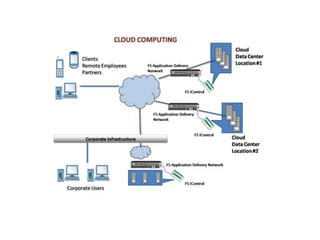
• Cloud architecture, the systems architecture of
the software systems involved in the delivery
of cloud computing, typically involves
multiple cloud components communicating
with each other over application programming
interfaces, usually web services.
Cloud computing sample architecture
• This resembles the UNIX philosophy of having multiple
programs each doing one thing well and working together over
universal interfaces. Complexity is controlled and the resulting
systems are more manageable than their monolithic
counterparts.
• The two most significant components of cloud computing
architecture are known as the front end and the back end.
• The front end is the part seen by the client, i.e. the computer
user. This includes the client’s network (or computer) and the
applications used to access the cloud via a user interface such
as a web browser.
• The back end of the cloud computing architecture is the
‘cloud’ itself, comprising various computers, servers and data
storage devices.
Types of Cloud Computing
• Public cloud :- Public clouds are made available to the
general public by a service provider who hosts the cloud
infrastructure. Generally, public cloud providers like
Amazon AWS, Microsoft and Google own and operate
the infrastructure and offer access over the Internet. With
this model, customers have no visibility or control over
where the infrastructure is located. It is important to note
that all customers on public clouds share the same
infrastructure pool with limited configuration, security
protections and availability variances.
Private cloud :- Private cloud is cloud infrastructure
dedicated to a particular organization. Private clouds
allow businesses to host applications in the cloud, while
addressing concerns regarding data security and control,
which is often lacking in a public cloud environment. It
is not shared with other organizations, whether managed
internally or by a third-party, and it can be hosted
internally or externally.
Hybrid cloud :-Hybrid Clouds are a composition of two or
more clouds (private, community or public) that remain unique
entities but are bound together offering the advantages of
multiple deployment models. In a hybrid cloud, you can leverage
third party cloud providers in either a full or partial manner;
increasing the flexibility of computing. Augmenting a traditional
private cloud with the resources of a public cloud can be used to
manage any unexpected surges in workload.
Components
• SaaS (software as a service): SaaS refers to software that’s made
available as a web-based service.
• Utility computing: The predecessor of cloud computing, utility computing
provides the ability to access storage and virtual servers on demand.
• Cloud-based web services: Similar to Saas, web services in the cloud
allow you to offer services online, such as credit card processing services,
employee payroll processing or viewing an interactive map.
• MSP (managed service providers): The grandfather of cloud computing,
an MSP delivers applications to IT instead of end-users.
• IaaS (infrastructure as a service): IaaS refers to computer infrastructure
(e.g., virtualization) that’s delivered as a service.
Recent Development’s
• In 2007, Google, IBM, and a number of universities
embarked on a large scale cloud computing research
project. In early 2008, Eucalyptus became the first
open source AWS API compatible platform for
deploying private clouds.
Advantages of Cloud Computing
• Flexibility:There is a high rate of flexibility.
• Low Cost:Companies can save big by employing
cloud computing as it eliminates cost for
hardware and software.
• Speed & Scales :Traditional methods to buy and
configure hardware and software are time
consuming.
• Easier Management of Data and
Information:Since all data are located on a
centralized location, data are more organized
making it easy to manage.
• Device Diversity :We can access our applications
and data anywhere in the world, on any system.
Advantages of Cloud Computing
• Increased Storage Capacity:- Increased Storage
Capacity is another benefit of the cloud computing,
as it can store more data as compared to a personal
computer.
• Easy to Learn and Understand :- Since people
are quiet used to cloud applications like Gmail,
Google Docs, so anything related to the same is
most likely to be understood by the users.
• Automatic Updating :- It saves companies time
and effort to update multiples server.
• Customize Setting :- Cloud computing also allows
you to customize your business applications.
Disadvantages of Cloud Computing
• Dependency :- One major disadvantages of cloud
computing is user’s dependency on the provider.
• Risk :- Cloud computing services means taking services
from remote servers.
• Requires a Constant internet connection:-The
most obvious disadvantage is that Cloud computing
completely relies on network connections.
• Security:-Security and privacy are the biggest concerns
about cloud computing.
• Migration Issue:-Migration problem is also a big
concern about cloud computing.
Conclusion
• So, while cloud computing is really really great
and you’re probably already using it, either for
business of for personal means, here’s what we’ve
learned from taking a look at the pros and cons:
• Cloud computing is a really cheap way for
companies to have all the resources they need in
once place.
• It’s a much better way to spread your resources,
and it becomes easier to access things from longer
distances.
Cloud computing ppt
Cloud computing ppt

Cloud computing ppt

  • 1.
  • 2.
    Cloud Computing  Introduction What Is Cloud Computing?  History of Cloud Computing  Components of Cloud Computing  Architecture of Cloud Computing  Types of Cloud Computing  Recent Development’s of Cloud Computing  Advantages of Cloud Computing  Disadvantages of Cloud Computing  Conclusion Cloud Computing
  • 4.
    Introduction • Cloud computingis Internet-based computing, whereby shared resources, software, and information are provided to computers and other devices on demand, like the electricity grid. • Cloud computing is a paradigm shift following the shift from mainframe to client–server in the early 1980s. Details are abstracted from the users, who no longer have need for expertise in, or control over, the technology infrastructure "in the cloud" that supports them.
  • 5.
    What Is CloudComputing? • Cloud computing is Internet based computing where virtual shared servers provide software, infrastructure, platform, devices and other resources and hosting to customers on a pay-as-you-use basis. • All information that a digitized system has to offer is provided as a service in the cloud computing model. Users can access these services available on the "Internet cloud" without having any previous know- how on managing the resources involved.
  • 6.
    History • Concept originatedfrom telecommunication companies changing to VPN • 1999:Salesforce. com ‐ Delivery of applications via web • 2002: Amazon launches Amazon Web Services (AWS) • 2006: Google Docs, Amazon Elastic Compute Cloud (EC2) • 2008: Eucalyptus • 2009: Microsoft Azure
  • 7.
    Architecture • Cloud architecture,the systems architecture of the software systems involved in the delivery of cloud computing, typically involves multiple cloud components communicating with each other over application programming interfaces, usually web services.
  • 9.
    Cloud computing samplearchitecture • This resembles the UNIX philosophy of having multiple programs each doing one thing well and working together over universal interfaces. Complexity is controlled and the resulting systems are more manageable than their monolithic counterparts. • The two most significant components of cloud computing architecture are known as the front end and the back end. • The front end is the part seen by the client, i.e. the computer user. This includes the client’s network (or computer) and the applications used to access the cloud via a user interface such as a web browser. • The back end of the cloud computing architecture is the ‘cloud’ itself, comprising various computers, servers and data storage devices.
  • 10.
    Types of CloudComputing
  • 11.
    • Public cloud:- Public clouds are made available to the general public by a service provider who hosts the cloud infrastructure. Generally, public cloud providers like Amazon AWS, Microsoft and Google own and operate the infrastructure and offer access over the Internet. With this model, customers have no visibility or control over where the infrastructure is located. It is important to note that all customers on public clouds share the same infrastructure pool with limited configuration, security protections and availability variances.
  • 13.
    Private cloud :-Private cloud is cloud infrastructure dedicated to a particular organization. Private clouds allow businesses to host applications in the cloud, while addressing concerns regarding data security and control, which is often lacking in a public cloud environment. It is not shared with other organizations, whether managed internally or by a third-party, and it can be hosted internally or externally.
  • 14.
    Hybrid cloud :-HybridClouds are a composition of two or more clouds (private, community or public) that remain unique entities but are bound together offering the advantages of multiple deployment models. In a hybrid cloud, you can leverage third party cloud providers in either a full or partial manner; increasing the flexibility of computing. Augmenting a traditional private cloud with the resources of a public cloud can be used to manage any unexpected surges in workload.
  • 15.
    Components • SaaS (softwareas a service): SaaS refers to software that’s made available as a web-based service. • Utility computing: The predecessor of cloud computing, utility computing provides the ability to access storage and virtual servers on demand. • Cloud-based web services: Similar to Saas, web services in the cloud allow you to offer services online, such as credit card processing services, employee payroll processing or viewing an interactive map. • MSP (managed service providers): The grandfather of cloud computing, an MSP delivers applications to IT instead of end-users. • IaaS (infrastructure as a service): IaaS refers to computer infrastructure (e.g., virtualization) that’s delivered as a service.
  • 16.
    Recent Development’s • In2007, Google, IBM, and a number of universities embarked on a large scale cloud computing research project. In early 2008, Eucalyptus became the first open source AWS API compatible platform for deploying private clouds.
  • 17.
    Advantages of CloudComputing • Flexibility:There is a high rate of flexibility. • Low Cost:Companies can save big by employing cloud computing as it eliminates cost for hardware and software. • Speed & Scales :Traditional methods to buy and configure hardware and software are time consuming. • Easier Management of Data and Information:Since all data are located on a centralized location, data are more organized making it easy to manage. • Device Diversity :We can access our applications and data anywhere in the world, on any system.
  • 18.
    Advantages of CloudComputing • Increased Storage Capacity:- Increased Storage Capacity is another benefit of the cloud computing, as it can store more data as compared to a personal computer. • Easy to Learn and Understand :- Since people are quiet used to cloud applications like Gmail, Google Docs, so anything related to the same is most likely to be understood by the users. • Automatic Updating :- It saves companies time and effort to update multiples server. • Customize Setting :- Cloud computing also allows you to customize your business applications.
  • 19.
    Disadvantages of CloudComputing • Dependency :- One major disadvantages of cloud computing is user’s dependency on the provider. • Risk :- Cloud computing services means taking services from remote servers. • Requires a Constant internet connection:-The most obvious disadvantage is that Cloud computing completely relies on network connections. • Security:-Security and privacy are the biggest concerns about cloud computing. • Migration Issue:-Migration problem is also a big concern about cloud computing.
  • 20.
    Conclusion • So, whilecloud computing is really really great and you’re probably already using it, either for business of for personal means, here’s what we’ve learned from taking a look at the pros and cons: • Cloud computing is a really cheap way for companies to have all the resources they need in once place. • It’s a much better way to spread your resources, and it becomes easier to access things from longer distances.