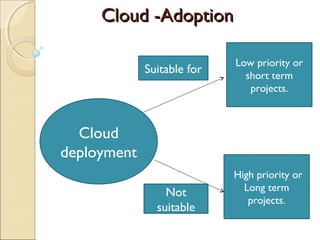
Cloud -AdoptionCloud -Adoption
Cloud
deployment
High priority or
Long term
projects.
Low priority or
short term
projects.
Suitable for
Not
suitable
Cloud - AdoptionCloud - Adoption
Here Cloud Means The environment of cloud
where the cloud services are being operated.
Adoption term states that accepting the services
of newTechnology.
Adoption means following some kind of new trend
or existing trend or a technology.
Cloud-AdoptionCloud-Adoption
This Cloud adoption is suitable for low
priority business applications.
Because as we have already discussed that
the cloud computing is not beneficial for
long term projects.
It supports some interactive applications
that combines two or more data sources.
Cloud-AdoptionCloud-Adoption
These applications must having low
availability requirements and short life
spans.
For example:-if a marketing company
requires to grow his business in the
whole country in a short span of time
then it must need a quick promotion or
short promotion across the country.
Cloud - AdoptionCloud - Adoption
Cloud Adoption is useful when the
recovery management, backup recovery
based implementations are required.
By considering the above key points we
conclude that it is only suitable for the
applications that are modular and loosely
coupled.
Cloud -AdoptionCloud -Adoption
It will works well with research and
development projects.
It means the testing of new services
,design models and also the applications
that can be get adjusted on small servers.
Cloud-AdoptionCloud-Adoption
Applications which requires different
level of infrastructure throughout the day
or throughout the month should be
deployed Through the cloud.
The applications whose demand is
unknown can also be deployed using
clouds.
Cloud- AdoptionCloud- Adoption
Cloud-
Adoption Goal-Critical
Core
Business
ApplicationsData
Sensitive
Applications
Not suitable
Not suitable
Not suitable
Cloud-RudimentsCloud-Rudiments
 In this Topic we will discuss the Essentials or
rudiments of cloud-computing.
 Cloud-Market
Saas,paas,iaas
Delivering
application
infrastructure
Cloud-RudimentsCloud-Rudiments
 Here the higher level capabilities of the cloud is as
follows:-
 Resource Aggregation and integration
Virtualization
management
Physical
Server
Provisioning
System
management
Environment
Central Logical View
Cloud-RudimentsCloud-Rudiments
 Resource Aggregation and integration
 Cloud solution Integrates or aggregates the information
of These 3 resources which are shown in the fig of
previous slide.
 After That the integrated information will be sent into a
central logical view.
Cloud - RudimentsCloud - Rudiments
 Application Services here app services states that the
services related to a particular s/w .
 The Application instances represents the agreement
between service provider and the consumer to use
services on On- Demand basis.
 Cloud also provides the facility of reservation of
resources.
 It means that it is guaranteed that at a given point of
time the resources or the services will surely available
for consumer
Cloud-RudimentsCloud-Rudiments
Reservation of services On-demand capacity
Application
Cloud-RudimentsCloud-Rudiments
 Self-Service portal
 An ex of self-service
r
 Self-service is facility provided by cloud to consumers.
 This supports the account – owners signing up and being able to
use the purchased capacity.
 Users can request machine or entire multi-machine environments
and monitor and control them using a web based self-service
portal.
Restaurants
I need
one glass
of water
But
there is
nobody
to serve
Customer will go
itself and take a glass
of water
Cloud-RudimentsCloud-Rudiments
 Allocation Engine The DRM provides the automated
allocation and reallocations of resources.
 The DRM is key component of any cloud solutions that
maximize the efficiency the IAAS.
 The DRM is a Dynamic resource management.
 Reporting and accounting The actual resource
allocation and the actual cloud usage will be get
recorded or collected in an accounting database.
 The data will be available centrally to create reports of
usage .
 For example:-capacity allocated vs. capacity used by the
consumer
Cloud-RudimentsCloud-Rudiments
Self-service We have discussed earlier
that this a self service portal provided by
the cloud.
Dynamic Workload management Here
Cloud virtual machines are enabled with
automated s/w’s that controls the workflow
requests.
Also the virtual machines are enabled with a
lifecycle that increase the effective
utilization of resources.
Cloud- RudimentsCloud- Rudiments
Resource AutomationIt clearly shows
that the resources will automatically plus
effectively utilized As and when they are
required by the service consumers.
Metering of resources With the help of
the metering of resources in any cloud
user organization would bring the
transparency to the business and
environment for the management to see
the usage of resources.

Cloud adoption and rudiments

  • 1.
    Cloud -AdoptionCloud -Adoption Cloud deployment Highpriority or Long term projects. Low priority or short term projects. Suitable for Not suitable
  • 2.
    Cloud - AdoptionCloud- Adoption Here Cloud Means The environment of cloud where the cloud services are being operated. Adoption term states that accepting the services of newTechnology. Adoption means following some kind of new trend or existing trend or a technology.
  • 3.
    Cloud-AdoptionCloud-Adoption This Cloud adoptionis suitable for low priority business applications. Because as we have already discussed that the cloud computing is not beneficial for long term projects. It supports some interactive applications that combines two or more data sources.
  • 4.
    Cloud-AdoptionCloud-Adoption These applications musthaving low availability requirements and short life spans. For example:-if a marketing company requires to grow his business in the whole country in a short span of time then it must need a quick promotion or short promotion across the country.
  • 5.
    Cloud - AdoptionCloud- Adoption Cloud Adoption is useful when the recovery management, backup recovery based implementations are required. By considering the above key points we conclude that it is only suitable for the applications that are modular and loosely coupled.
  • 6.
    Cloud -AdoptionCloud -Adoption Itwill works well with research and development projects. It means the testing of new services ,design models and also the applications that can be get adjusted on small servers.
  • 7.
    Cloud-AdoptionCloud-Adoption Applications which requiresdifferent level of infrastructure throughout the day or throughout the month should be deployed Through the cloud. The applications whose demand is unknown can also be deployed using clouds.
  • 8.
    Cloud- AdoptionCloud- Adoption Cloud- AdoptionGoal-Critical Core Business ApplicationsData Sensitive Applications Not suitable Not suitable Not suitable
  • 9.
    Cloud-RudimentsCloud-Rudiments  In thisTopic we will discuss the Essentials or rudiments of cloud-computing.  Cloud-Market Saas,paas,iaas Delivering application infrastructure
  • 10.
    Cloud-RudimentsCloud-Rudiments  Here thehigher level capabilities of the cloud is as follows:-  Resource Aggregation and integration Virtualization management Physical Server Provisioning System management Environment Central Logical View
  • 11.
    Cloud-RudimentsCloud-Rudiments  Resource Aggregationand integration  Cloud solution Integrates or aggregates the information of These 3 resources which are shown in the fig of previous slide.  After That the integrated information will be sent into a central logical view.
  • 12.
    Cloud - RudimentsCloud- Rudiments  Application Services here app services states that the services related to a particular s/w .  The Application instances represents the agreement between service provider and the consumer to use services on On- Demand basis.  Cloud also provides the facility of reservation of resources.  It means that it is guaranteed that at a given point of time the resources or the services will surely available for consumer
  • 13.
  • 14.
    Cloud-RudimentsCloud-Rudiments  Self-Service portal An ex of self-service r  Self-service is facility provided by cloud to consumers.  This supports the account – owners signing up and being able to use the purchased capacity.  Users can request machine or entire multi-machine environments and monitor and control them using a web based self-service portal. Restaurants I need one glass of water But there is nobody to serve Customer will go itself and take a glass of water
  • 15.
    Cloud-RudimentsCloud-Rudiments  Allocation EngineThe DRM provides the automated allocation and reallocations of resources.  The DRM is key component of any cloud solutions that maximize the efficiency the IAAS.  The DRM is a Dynamic resource management.  Reporting and accounting The actual resource allocation and the actual cloud usage will be get recorded or collected in an accounting database.  The data will be available centrally to create reports of usage .  For example:-capacity allocated vs. capacity used by the consumer
  • 16.
    Cloud-RudimentsCloud-Rudiments Self-service We havediscussed earlier that this a self service portal provided by the cloud. Dynamic Workload management Here Cloud virtual machines are enabled with automated s/w’s that controls the workflow requests. Also the virtual machines are enabled with a lifecycle that increase the effective utilization of resources.
  • 17.
    Cloud- RudimentsCloud- Rudiments ResourceAutomationIt clearly shows that the resources will automatically plus effectively utilized As and when they are required by the service consumers. Metering of resources With the help of the metering of resources in any cloud user organization would bring the transparency to the business and environment for the management to see the usage of resources.