"Cloud" - a revolution in IT
  and a great job opportunity

GROUP 9
DHANANJAY JADHAV
ASHWINI POKHARKAR
SUMA SOMASEKHAR
SWAPNIL MUKE
PARUL SHARMA
ASEEM HALANI
CONTENTS
• What is cloud computing   • Opportunities
• Full-Virtualization       • Major cloud providers
• Para-virtualization       • Latest news
                            • Job Opportunities
• Types of clouds           • Conclusion
• Services                  • References
• Advantages
• Security Practices
WHAT IS CLOUD
 COMPUTING
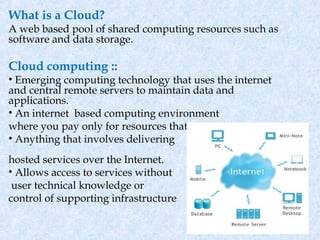
What is a Cloud?
A web based pool of shared computing resources such as
software and data storage.

Cloud computing ::
• Emerging computing technology that uses the internet
and central remote servers to maintain data and
applications.
• An internet based computing environment
where you pay only for resources that you use
• Anything that involves delivering
hosted services over the Internet.
• Allows access to services without
 user technical knowledge or
control of supporting infrastructure
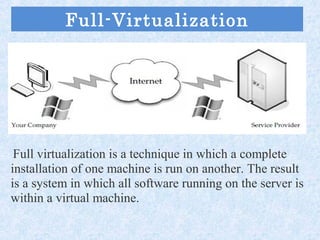
Full-Virtualization


 Full virtualization is a technique in which a complete
installation of one machine is run on another. The result
is a system in which all software running on the server is
within a virtual machine.
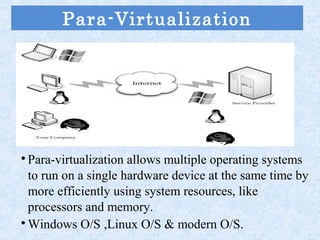
Para-Virtualization



  Para-virtualization allows multiple operating systems
  to run on a single hardware device at the same time by
  more efficiently using system resources, like
  processors and memory.

  Windows O/S ,Linux O/S & modern O/S.
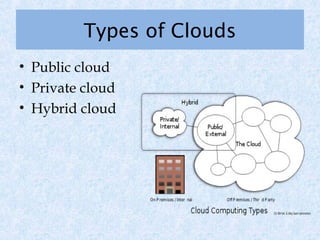
Types of Clouds
• Public cloud
• Private cloud
• Hybrid cloud
• Private: Data center that supplies hosted services to
  a limited number of people
• Public: Sells services to anyone on the Internet.
• Example:- Amazon Web Services is the largest
  public cloud provider.
• Hybrid : A hybrid cloud is typically offered in one
  of two ways:
    -a vendor has a private cloud and forms a
  partnership with a public cloud provider
    - a public cloud provider forms a partnership with
  a vendor that provides private cloud platforms.
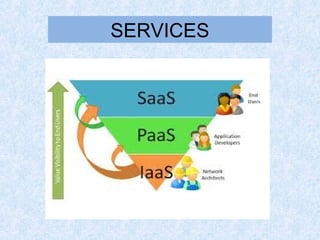
SERVICES
SAAS

•   Software as a service
•   Delivering applications
•   Services
•   Access to application
•   Most promising development in
    marketing and business world. 
PAAS

•   Platform as a service
•   Application
•   Available over the internet
•   No need to download any software
•   Facilitates deployment of applications
IAAS

• Infrastructure as a Service
• Hardware as a Service
• Organization outsources the equipment
  used to support operations
• Responsible for housing, running and
  maintaining it
Advantages
• Customer can get the service at any time.
• No problems of computer crash or server down
           -responsibility of the service provider.
• No investment cost for computers, servers,
  software
• Amount can be paid according to usage
• Service providers provide service on monthly
  basis.
• Provider and customer can cancel the agreement
  at any time.
Security practices

•Be vigilant around updates
• Ask where the data is kept
• Seek an independent security audit of the host
• Which third parties the company deals with
• Good policies around passwords
• Accommodate your own security policies

Example: Google was forced to make an
embarrassing apology in February when its Gmail
service collapsed in Europe,
Opportunities

• Enterprises moving towards building
their private clouds.
• Vendors-setting up public clouds.
• Future- all IT products will feature
built- in cloud architecture
• No need for individual enterprises and
users to buy physical resources or
licenses
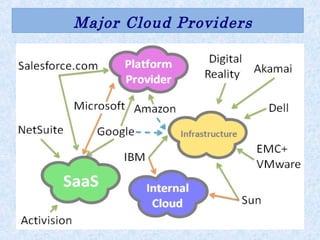
Major Cloud Providers
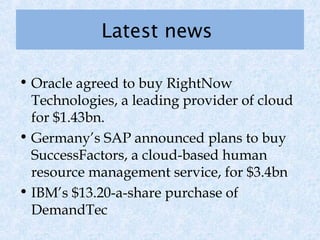
Latest news

• Oracle agreed to buy RightNow
  Technologies, a leading provider of cloud
  for $1.43bn.
• Germany’s SAP announced plans to buy
  SuccessFactors, a cloud-based human
  resource management service, for $3.4bn
• IBM’s $13.20-a-share purchase of
  DemandTec
Job Opportunities
Cloud computing will be a $70
billion (Rs 3,28,260 crore) global
business by 2015 and expects an
additional 300,000 new cloud
service jobs - involving
customization and support - in India
over the next five years.
Conclusion
Cloud computing holds some strong
  promises
• Highly scalable
• Highly available
• Dynamically allocate resources
• Pay only for resources that you use
• Reduce IT hardware, software and
  services costs
REFERENCES
[1] Cloud Computing:A Practical Approach by Anthony T. Velte Toby
       Velte, Ph.D.Robert Elsenpeter-McGraw-Hill

[2] Cloud Computing Implementation,Management,
   and Security John W. Rittinghouse James F. Ransome-CRC
      Press.

[3] Executive’s Guide to Cloud Computing by Eric A. Marks Bob
         Lozano-John Wiley & Sons, Inc.

[4] Cloud Computing for Dummies by Judith Hurwitz, Robin Bloor,
      Marcia Kaufman, and Dr. Fern Halper.

[5] http://www.microsoft.com/en-us/cloud/default.aspx#tab2-small
THANK YOU

Cloud computing

  • 1.
    "Cloud" - arevolution in IT and a great job opportunity GROUP 9 DHANANJAY JADHAV ASHWINI POKHARKAR SUMA SOMASEKHAR SWAPNIL MUKE PARUL SHARMA ASEEM HALANI
  • 2.
    CONTENTS • What iscloud computing • Opportunities • Full-Virtualization • Major cloud providers • Para-virtualization • Latest news • Job Opportunities • Types of clouds • Conclusion • Services • References • Advantages • Security Practices
  • 3.
    WHAT IS CLOUD COMPUTING
  • 4.
    What is aCloud? A web based pool of shared computing resources such as software and data storage. Cloud computing :: • Emerging computing technology that uses the internet and central remote servers to maintain data and applications. • An internet based computing environment where you pay only for resources that you use • Anything that involves delivering hosted services over the Internet. • Allows access to services without user technical knowledge or control of supporting infrastructure
  • 5.
    Full-Virtualization Full virtualizationis a technique in which a complete installation of one machine is run on another. The result is a system in which all software running on the server is within a virtual machine.
  • 6.
    Para-Virtualization  Para-virtualizationallows multiple operating systems to run on a single hardware device at the same time by more efficiently using system resources, like processors and memory.  Windows O/S ,Linux O/S & modern O/S.
  • 7.
    Types of Clouds •Public cloud • Private cloud • Hybrid cloud
  • 8.
    • Private: Datacenter that supplies hosted services to a limited number of people • Public: Sells services to anyone on the Internet. • Example:- Amazon Web Services is the largest public cloud provider. • Hybrid : A hybrid cloud is typically offered in one of two ways: -a vendor has a private cloud and forms a partnership with a public cloud provider - a public cloud provider forms a partnership with a vendor that provides private cloud platforms.
  • 9.
  • 10.
    SAAS • Software as a service • Delivering applications • Services • Access to application • Most promising development in marketing and business world. 
  • 11.
    PAAS • Platform as a service • Application • Available over the internet • No need to download any software • Facilitates deployment of applications
  • 12.
    IAAS • Infrastructure asa Service • Hardware as a Service • Organization outsources the equipment used to support operations • Responsible for housing, running and maintaining it
  • 13.
    Advantages • Customer canget the service at any time. • No problems of computer crash or server down -responsibility of the service provider. • No investment cost for computers, servers, software • Amount can be paid according to usage • Service providers provide service on monthly basis. • Provider and customer can cancel the agreement at any time.
  • 14.
    Security practices •Be vigilantaround updates • Ask where the data is kept • Seek an independent security audit of the host • Which third parties the company deals with • Good policies around passwords • Accommodate your own security policies Example: Google was forced to make an embarrassing apology in February when its Gmail service collapsed in Europe,
  • 15.
    Opportunities • Enterprises movingtowards building their private clouds. • Vendors-setting up public clouds. • Future- all IT products will feature built- in cloud architecture • No need for individual enterprises and users to buy physical resources or licenses
  • 16.
  • 17.
    Latest news • Oracleagreed to buy RightNow Technologies, a leading provider of cloud for $1.43bn. • Germany’s SAP announced plans to buy SuccessFactors, a cloud-based human resource management service, for $3.4bn • IBM’s $13.20-a-share purchase of DemandTec
  • 18.
    Job Opportunities Cloud computingwill be a $70 billion (Rs 3,28,260 crore) global business by 2015 and expects an additional 300,000 new cloud service jobs - involving customization and support - in India over the next five years.
  • 19.
    Conclusion Cloud computing holdssome strong promises • Highly scalable • Highly available • Dynamically allocate resources • Pay only for resources that you use • Reduce IT hardware, software and services costs
  • 20.
    REFERENCES [1] Cloud Computing:APractical Approach by Anthony T. Velte Toby Velte, Ph.D.Robert Elsenpeter-McGraw-Hill [2] Cloud Computing Implementation,Management, and Security John W. Rittinghouse James F. Ransome-CRC Press. [3] Executive’s Guide to Cloud Computing by Eric A. Marks Bob Lozano-John Wiley & Sons, Inc. [4] Cloud Computing for Dummies by Judith Hurwitz, Robin Bloor, Marcia Kaufman, and Dr. Fern Halper. [5] http://www.microsoft.com/en-us/cloud/default.aspx#tab2-small
  • 21.