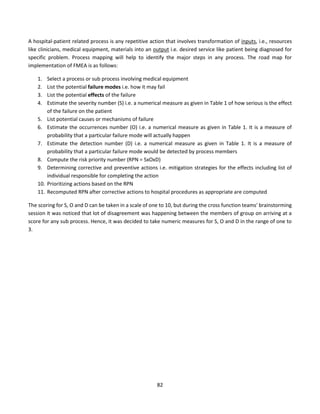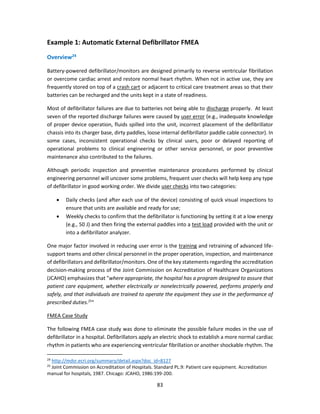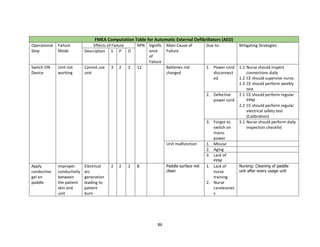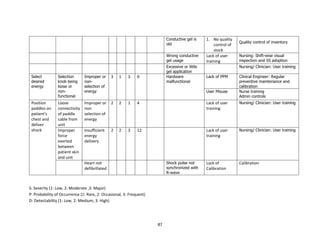


1
CLINICAL ENGINEERING PRINCIPLES
PROF. BASSEL TAWFIK
CAIRO UNIVERSITY
2018
2
TABLE OF CONTENTS
Page
PREFACE 2
CHAPTER 1: Introduction 3
1.1 Healthcare Delivery Systems 3
1.1.1 Major Stakeholders 4
1.1.2 Referral System 5
1.2 What is Clinical Engineering 6
1.2.1 Clinical Engineering versus Biomedical Engineering 6
1.2.2 Scope of Work of the Clinical Engineer 6
CHAPTER II: Medical Equipment Planning 7
2.1 Hospital Departments 7
2.1.1 Administration 7
2.1.2 Medico-Surgical Services 7
2.1.3 Support Services 7
2.1.4 Hospital Organogram 8
2.2 Hospital Lifecycle 9
2.2.1 The Lifecycle Concept
2.2.2 Hospital Construction Lifecycle
2.3 Medical Planning
3
PREFACE
Starting from the late Seventies of the Twentieth Century, technology has been playing
an ever-increasing role in medicine. Compared to the medical practice of the early
Twentieth Century, where physicians relied almost completely on their senses to discern
the origins of ailments, modern-day medicine is a far cry. Medical technology has become
both pervasive and ubiquitous. This impressive achievement is due in large part to
thousands of Biomedical Engineers who have been working day and night to invent new
techniques for detection and treatment of disorders.
Alongside this technological revolution, the need for market regulation became pressing.
It became apparent, throughout the years, that medical devices carry within them certain
inherent risks and hazards that must not only be accounted for, but also mitigated.
Governmental agencies around the world, such as the FDA in the USA, were created to
serve this purpose. The design process as well as the production line must satisfy certain
requirements in order for the Original Equipment Manufacturer (OEM) to be granted a
production license.
Another need has also risen in the after sales market, mainly that of calibration,
maintenance and repair (in addition to other things), which are collectively referred to as
Asset Management. Since medical equipment constituted a significant investment for
healthcare organizations, their efficient and cost-effective management became a
strategic target. This has become the playground of Clinical Engineers who are working
at both ends of the market: the supplier (agent) and the consumer (hospital/Clinic). On
both ends, clinical engineers are committed to keep the equipment up and running with
minimum downtime and maximum safety and performance. The art of doing this is the
core of clinical engineering.
Another role for the clinical engineer which emerged lately is that of medical equipment
planning; a process of fitting medical equipment in healthcare facilities during the
architectural design phase.
4
CHAPTER 1
INTRODUCTION
5
1.1 Healthcare Delivery Systems
1.1.1 Stakeholders
The healthcare delivery system is almost identical around the world with minor variations
relating to public versus private sector role. The basic components of the system are (1)
the healthcare provider (will refer to it for now as the hospital), (2) health insurance
organizations, medical staff (doctors, nurses, and paramedics), medical device
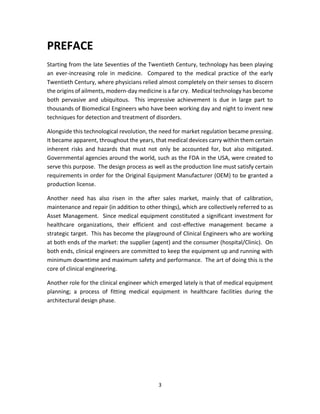
manufacturers (and pharmaceuticals), and the patient. This is shown in the figure below.
In addition to these basic entities, there are organizations whose role is to ensure quality
of performance. Therefore, a hospital performance is checked by accreditation
organizations such as The Joint Commission (TJC), medical device manufacturers are
monitored and approved by regulatory organizations such as the Food & Drug
Administration (FDA) and the CE Mark, and physicians (together with nurses and
paramedics) are also certified by certification organizations.
There is a hidden layer of standards organizations that work behind the accreditation
organizations which provide standards of performance of certain environmental and
design features in the hospital such as the NFPA, ASHRAE, and others. Similarly, there are
Figure1: Major stakeholders in the healthcare delivery system
Healthcare
Provider
Health
Insurance
Organizations
Medical
Staff
certification
Medical Device
Manufacturers
Regulatory
Agencies
Patient
Accreditation
Organizations
6
standards organizations that work behind the FDA such as NEMA, ASTM, NEC, and many
others.
1.1.2 Referral System
The referral system was devised by the British in order to absorb demand on healthcare
providers in an economically efficient way. Since most ailments, luckily, are elementary
in nature such as headaches, vomiting, sore throats, and onset of pregnancy, a wide base
consisting of many small health units receives all patients. This is called primary care. If
the problem is not solved or discovered, the patient is referred to the higher level, called
secondary care. Other names for secondary care facilities are Infirmaries, district
hospitals, and out-patient clinics.
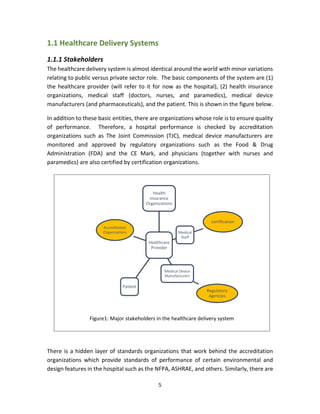
If the health problem is not yet
solved, the patient is referred to the
higher level, called tertiary care.
This is the highest level in public
hospitals with the exception of
university hospitals and specialized
centers such as cancer or liver
centers. The higher the level of care,
the higher the qualifications of the
staff and the technology and variety
of medical equipment.
As an example, let us take pregnancy
as a medical condition. Simple
pregnancy tests are conducted in
primary care such as urine test and
fetal heart sounds (using fetal heart
detectors). In secondary hospitals,
more advanced blood tests and
basic (low-end) ultrasonic devices
are available. In tertiary care, more
advanced (high-end) ultrasonic
devices are used such as 3D or 4D
US.
Figure 2: Basic referral system in a primary
healthcare system
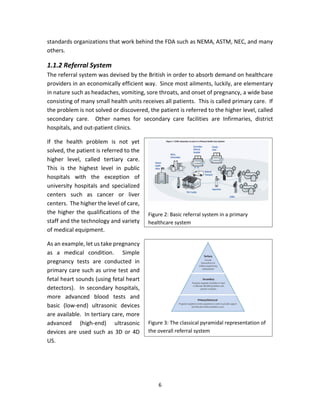
Figure 3: The classical pyramidal representation of
the overall referral system
7
1.2 What is Clinical Engineering?
1.2.1 Clinical Engineering versus Biomedical Engineering
Clinical Engineering (CE) is that specialty in Biomedical Engineering (BME) which is
concerned with the technical services and support a BME can offer in the hospital setting
that is related to medical equipment. According to this definition, the CE may be required
to maintain, repair, install, or calibrate a medical device. There are many more services
that are offered by the CE which we will elaborate upon in the following section.
As opposed to CE, BME is more
inclined to R&D (Research &
Development) activities such as
the design of medical devices,
modeling of physiological
systems (such as the dynamics
of respiration or blood flow in
the aorta), enhancement of a
medical image (such as that
obtained from an MRI or US), or
processing of a physiological
signal (such as EEG). As such,
BME is concerned more with
new frontiers while CE is a
pragmatic, hands-on problem-
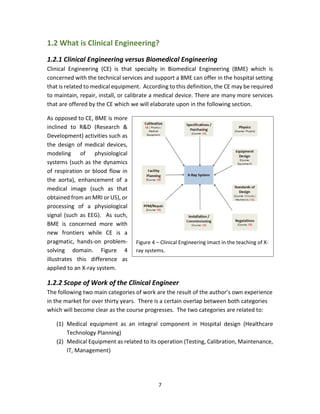
solving domain. Figure 4
illustrates this difference as
applied to an X-ray system.
1.2.2 Scope of Work of the Clinical Engineer
The following two main categories of work are the result of the author’s own experience
in the market for over thirty years. There is a certain overlap between both categories
which will become clear as the course progresses. The two categories are related to:
(1) Medical equipment as an integral component in Hospital design (Healthcare
Technology Planning)
(2) Medical Equipment as related to its operation (Testing, Calibration, Maintenance,
IT, Management)
Figure 4 – Clinical Engineering imact in the teaching of X-
ray systems.
8
CHAPTER II
MEDICAL PLANNING & MEDICAL
EQUIPMENT PLANNING
(The Role of the Clinical Engineer in the Design & Construction of Hospitals)
9
2.1 HOSPITAL DEPARTMENTS
Although each hospital department performs specific functions, departments are
generally grouped according to similarity of duties. Departments are also grouped
together in order to promote efficiency of the healthcare facility. It is common to group
hospital operations into: administrational, medico-surgical, and support services.
Support services would include engineering, ICT, dietary, pharmacy, etc.
2.1.1 Administration
The administration is a collection of departments which manage and oversee the
operation of hospital transactions such as budgeting and finance, procurement and
stores, quality management such as establishing and implementing hospital policies and
procedures, public relation duties, and patient affairs. Positions such as CEO (Chief
Executive Officer), Managing Director, Executive Assistants, and Department Heads are
considered part of the Administration. Legal affairs are also part of the administration.
2.1.2 Medico-surgical Services
Medical services cover all diagnostic and therapeutic functions except for surgery which
is usually a separate entity. Therefore, medical services are provided in outpatient clinics,
diagnostic and interventional imaging, clinical labs, emergency care, inpatient suites,
physiotherapy, hemodialysis, and intensive care units. Meanwhile, surgical services are
confined to the operating/surgical suite.
2.1.3 Support Services
These are non-medical but technical services which support the medical staff in their
duties. These include all engineering services (clinical engineering, electromechanical,
electrical, and civil), security, kitchen, laundry, dietary and catering services, pharmacy,
and information & communication technology (ICT). Therefore, computer networks,
medical devices, elevators, boilers, medical gas systems, and many other systems belong
to engineering. It goes without saying that engineering services make or break hospital
reputation and performance.
2.1.4 Organogram
From the management point of view, every organization has its own organizational
structure (OS), or organogram. An organizational structure is block representation of how
different layers of an organization are related to each other, such as who reports to who
and who supervises whom. There are different types of OS, the most frequent of which is
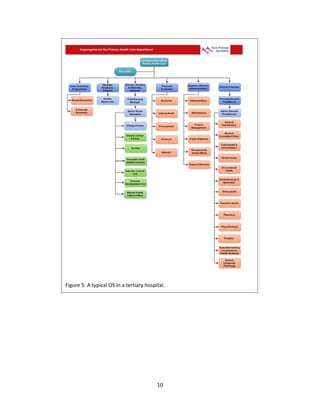
the pyramidal or hierarchical one. Figure 5 below shows an example of such structure in
a certain hospital.
10
Figure 5: A typical OS in a tertiary hospital.
11
2.2 THE HOSPITAL LIFECYCLE: FROM DESIGN TO DEMOLITION
2.2.1 The Lifecycle Concept
The concept of a lifecycle is originally biological.
Incubation (pregnancy) followed by birth,
growth, maturity, then decline and death is
well known. This same concept has been
applied to almost all facets of business life from
products to services and from software
development to the construction of buildings.
Building life cycle, therefore, views the building
as a living organism, starting with design, then
moving through construction, operation,
demolition and waste treatment. Some of the
phase names may differ. For instance, the word
“incubation” is used instead of “startup” or
“birth”, and “plateau” instead of “saturation”, etc.
2.2.2 The Hospital Construction Lifecycle
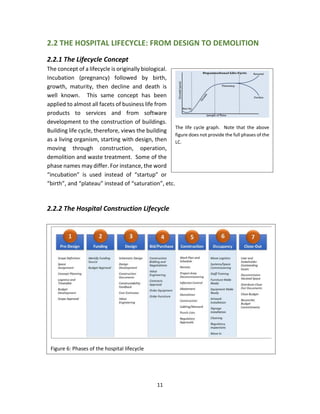
Figure 6: Phases of the hospital lifecycle
The life cycle graph. Note that the above
figure does not provide the full phases of the
LC.
12
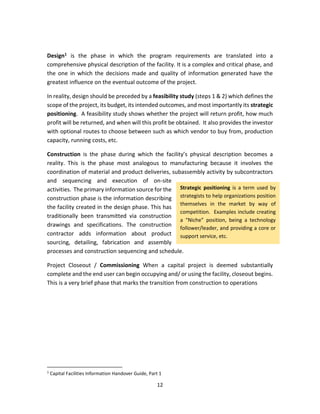
Design1 is the phase in which the program requirements are translated into a
comprehensive physical description of the facility. It is a complex and critical phase, and
the one in which the decisions made and quality of information generated have the
greatest influence on the eventual outcome of the project.
In reality, design should be preceded by a feasibility study (steps 1 & 2) which defines the
scope of the project, its budget, its intended outcomes, and most importantly its strategic
positioning. A feasibility study shows whether the project will return profit, how much
profit will be returned, and when will this profit be obtained. It also provides the investor
with optional routes to choose between such as which vendor to buy from, production
capacity, running costs, etc.
Construction is the phase during which the facility’s physical description becomes a
reality. This is the phase most analogous to manufacturing because it involves the
coordination of material and product deliveries, subassembly activity by subcontractors
and sequencing and execution of on-site
activities. The primary information source for the
construction phase is the information describing
the facility created in the design phase. This has
traditionally been transmitted via construction
drawings and specifications. The construction
contractor adds information about product
sourcing, detailing, fabrication and assembly
processes and construction sequencing and schedule.
Project Closeout / Commissioning When a capital project is deemed substantially
complete and the end user can begin occupying and/ or using the facility, closeout begins.
This is a very brief phase that marks the transition from construction to operations
1
Capital Facilities Information Handover Guide, Part 1
Strategic positioning is a term used by
strategists to help organizations position
themselves in the market by way of
competition. Examples include creating
a “Niche” position, being a technology
follower/leader, and providing a core or
support service, etc.
13
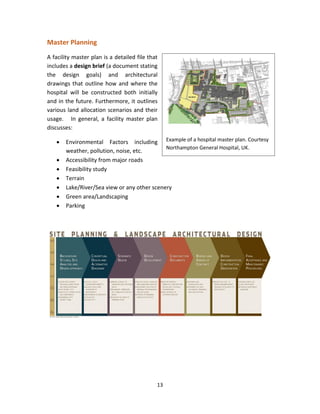
Master Planning
A facility master plan is a detailed file that
includes a design brief (a document stating
the design goals) and architectural
drawings that outline how and where the
hospital will be constructed both initially
and in the future. Furthermore, it outlines
various land allocation scenarios and their
usage. In general, a facility master plan
discusses:
• Environmental Factors including
weather, pollution, noise, etc.
• Accessibility from major roads
• Feasibility study
• Terrain
• Lake/River/Sea view or any other scenery
• Green area/Landscaping
• Parking
Example of a hospital master plan. Courtesy
Northampton General Hospital, UK.
14
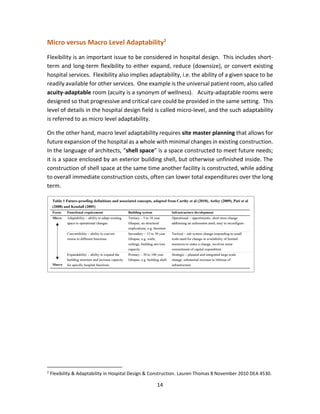
Micro versus Macro Level Adaptability2
Flexibility is an important issue to be considered in hospital design. This includes short-
term and long-term flexibility to either expand, reduce (downsize), or convert existing
hospital services. Flexibility also implies adaptability, i.e. the ability of a given space to be
readily available for other services. One example is the universal patient room, also called
acuity-adaptable room (acuity is a synonym of wellness). Acuity-adaptable rooms were
designed so that progressive and critical care could be provided in the same setting. This
level of details in the hospital design field is called micro-level, and the such adaptability
is referred to as micro level adaptability.
On the other hand, macro level adaptability requires site master planning that allows for
future expansion of the hospital as a whole with minimal changes in existing construction.
In the language of architects, “shell space” is a space constructed to meet future needs;
it is a space enclosed by an exterior building shell, but otherwise unfinished inside. The
construction of shell space at the same time another facility is constructed, while adding
to overall immediate construction costs, often can lower total expenditures over the long
term.
2
Flexibility & Adaptability in Hospital Design & Construction. Lauren Thomas 8 November 2010 DEA 4530.
15
Schematic Design
16
Review Questions
[1] An interstitial floor is one which is sandwiched between two floors with about half the
regular height. It is used to accommodate all sorts of infrastructure components such as
ventilation pipes.
(a) Which hospital department benefits the most from interstitial floors?
(b) What other services can be provided by the interstitial floor?
(c) Would you consider an interstitial floor as a micro or macro level adaptability?
Why?
(d) Show where in this drawing would interstitial space exist.
(e) Give an example of the kind of hardware you may find in the interstitial space.
(f) From the engineering drawing point of view, give an appropriate name for
this section.
(g) From the medical planning point of view, give an appropriate name for this
kind of drawing.
(h) Suggest names for the other (non-interstitial) spaces by writing them on the
figure. Explain your choices. [4 points]
(i) Make a room-by-room list for the non-interstitial spaces. Make any
REASONABLE assumptions.
17
2.3 MEDICAL PLANNING (MP)
At the time the hospital (or healthcare institution) is being designed on paper (or more
accurately using CAD or REVIT), there is a need for a medical planner. The role of the
medical planner can be fulfilled by either an experienced physician, a clinical engineer, or
an architect. The main role of the MP is to make sure the architectural design provides
optimum spaces that are well connected and offers optimal patient and material
circulation.
2.3.1 Main Deliverables of the medical planner
Concept design (Applied to the whole building)
Concept design generally takes place after feasibility studies and options appraisals have
been carried out and a project brief has been prepared. The concept design represents
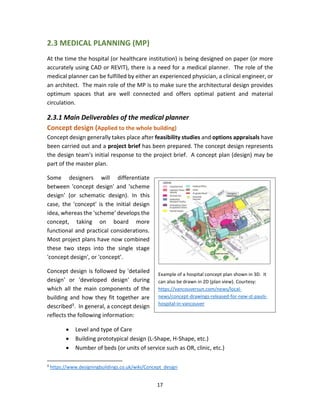
the design team's initial response to the project brief. A concept plan (design) may be
part of the master plan.
Some designers will differentiate
between 'concept design' and 'scheme
design' (or schematic design). In this
case, the 'concept' is the initial design
idea, whereas the 'scheme' develops the
concept, taking on board more
functional and practical considerations.
Most project plans have now combined
these two steps into the single stage
'concept design', or 'concept'.
Concept design is followed by 'detailed
design' or 'developed design' during
which all the main components of the
building and how they fit together are
described3. In general, a concept design
reflects the following information:
• Level and type of Care
• Building prototypical design (L-Shape, H-Shape, etc.)
• Number of beds (or units of service such as OR, clinic, etc.)
3
https://www.designingbuildings.co.uk/wiki/Concept_design
Example of a hospital concept plan shown in 3D. It
can also be drawn in 2D (plan view). Courtesy:
https://vancouversun.com/news/local-
news/concept-drawings-released-for-new-st-pauls-
hospital-in-vancouver
18
• Dedicated Emergency entrance
• Separate service road
• Parking spaces for visitors/staff/patients
• Loading docks for materials such as food, medical supplies, drugs, etc.
• Future expansion
Adjacencies
How medical units/departments are located relative to each other (functional
relationships)
Zoning
Bubble Diagram
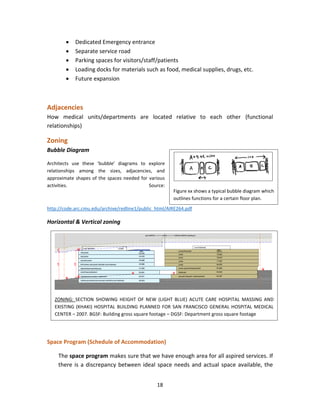
Architects use these ‘bubble’ diagrams to explore
relationships among the sizes, adjacencies, and
approximate shapes of the spaces needed for various
activities. Source:
http://code.arc.cmu.edu/archive/redline1/public_html/AIRE264.pdf
Horizontal & Vertical zoning
Space Program (Schedule of Accommodation)
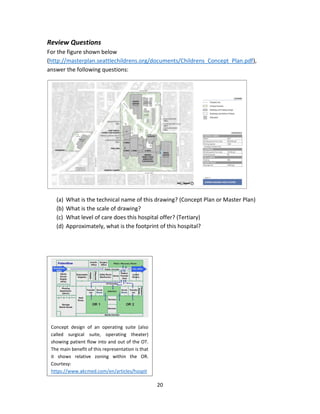
The space program makes sure that we have enough area for all aspired services. If
there is a discrepancy between ideal space needs and actual space available, the
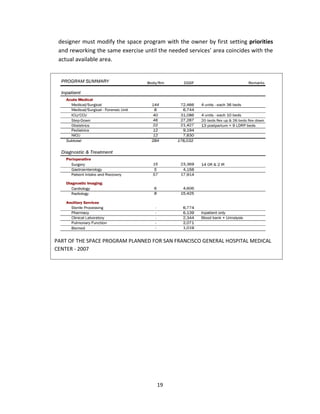
ZONING: SECTION SHOWING HEIGHT OF NEW (LIGHT BLUE) ACUTE CARE HOSPITAL MASSING AND
EXISTING (KHAKI) HOSPITAL BUILDING PLANNED FOR SAN FRANCISCO GENERAL HOSPITAL MEDICAL
CENTER – 2007. BGSF: Building gross square footage – DGSF: Department gross square footage
Figure xx shows a typical bubble diagram which
outlines functions for a certain floor plan.
19
designer must modify the space program with the owner by first setting priorities
and reworking the same exercise until the needed services’ area coincides with the
actual available area.
PART OF THE SPACE PROGRAM PLANNED FOR SAN FRANCISCO GENERAL HOSPITAL MEDICAL
CENTER - 2007
20
Review Questions
For the figure shown below
(http://masterplan.seattlechildrens.org/documents/Childrens_Concept_Plan.pdf),
answer the following questions:
(a) What is the technical name of this drawing? (Concept Plan or Master Plan)
(b) What is the scale of drawing?
(c) What level of care does this hospital offer? (Tertiary)
(d) Approximately, what is the footprint of this hospital?
Concept design of an operating suite (also
called surgical suite, operating theater)
showing patient flow into and out of the OT.
The main benefit of this representation is that
it shows relative zoning within the OR.
Courtesy:
https://www.akcmed.com/en/articles/hospit
al-concept-and-design
21
Definitions:
[Source: http://edissues.wikidot.com/estimating-
departmental-gross-square-footage ]
Net Square Feet (NSF): The space within the walls of a
room or the usable floor area assigned to a function in
an open area, e.g., cubicles or workstations. The space
includes casework, fixtures and door swings but does
not include wall thicknesses.
Departmental Gross Square Feet (DGSF): the space
inside the centerline of the walls separating a
department from adjoining areas; includes internal
walls, corridors, etc.
Building Gross Square Feet (BGSF): It is the total area of
the facility including outside walls, mechanical spaces
and canopies.
Net to Gross Factor or Grossing Factor: It is a multiplication factor applied to space to increase the
allotment to accommodate elements not in the base number. A grossing factor is applied to space
lists on Net Square feet to take into account internal circulation and walls to give Departmental
Gross Square Feet (DGSF). Another factor is used to increase DGSF to Building Gross Square Feet
(BGSF) and estimate the amount required for major vertical circulation, shafts and building
circulation. As a rule of thumb, building gross is approximately twice the amount of net area in a
hospital.
22
2.4 MEDICAL EQUIPMENT PLANNING
Definitions: Equipment, Furniture, Fittings and Fixtures
The term “Equipment” is usually used to refer to as items which have a service provision
such as power, water and data. Furniture and fixtures are defined as items that are
movable and have no utilities or permanent connection to the structure of a building.
Fittings, on the other hand, are considered as items which are fixed to the structure of
the building but can be removed. A small secondary or tertiary hospital would typically
house several hundreds of pieces of equipment (fixed and movable medical and non-
medical), furniture (same), fixtures, and fittings.
Examples of some common fixtures and fittings are:
Fixtures
• Light fixtures
• Central heating systems (including radiators)
• Kitchen units
• Bathroom suites
Fittings
• Paintings, pictures (hung on wall)
• Curtains and rails
• Free standing furniture (i.e. chairs)
• Brackets attached to walls or ceilings
Room-by-Room list
It provides a rough estimate of the medical equipment needed in each room wherein
medical service is provided.
Non-clinical (or non-
medical) equipment (or
furniture) can be defined as
any equipment not
required by clinicians to
perform a service directly
to the patient.
23
Bill of Quantities (BOQ)
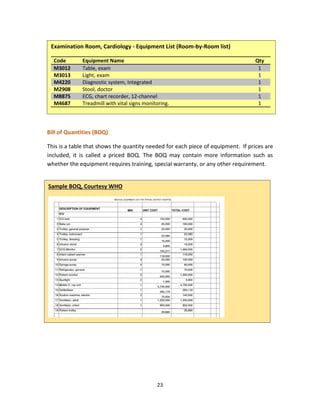
This is a table that shows the quantity needed for each piece of equipment. If prices are
included, it is called a priced BOQ. The BOQ may contain more information such as
whether the equipment requires training, special warranty, or any other requirement.
Examination Room, Cardiology - Equipment List (Room-by-Room list)
Code Equipment Name Qty
M3012 Table, exam 1
M3013 Light, exam 1
M4220 Diagnostic system, Integrated 1
M2908 Stool, doctor 1
M8875 ECG, chart recorder, 12-channel 1
M4687 Treadmill with vital signs monitoring. 1
Sample BOQ, Courtesy WHO
24
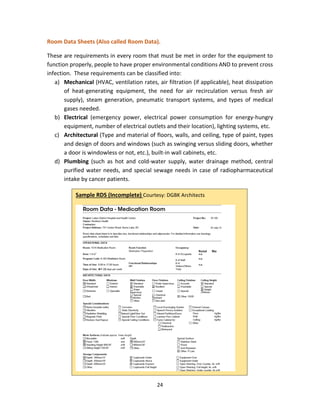
Room Data Sheets (Also called Room Data).
These are requirements in every room that must be met in order for the equipment to
function properly, people to have proper environmental conditions AND to prevent cross
infection. These requirements can be classified into:
a) Mechanical (HVAC, ventilation rates, air filtration (if applicable), heat dissipation
of heat-generating equipment, the need for air recirculation versus fresh air
supply), steam generation, pneumatic transport systems, and types of medical
gases needed.
b) Electrical (emergency power, electrical power consumption for energy-hungry
equipment, number of electrical outlets and their location), lighting systems, etc.
c) Architectural (Type and material of floors, walls, and ceiling, type of paint, types
and design of doors and windows (such as swinging versus sliding doors, whether
a door is windowless or not, etc.), built-in wall cabinets, etc.
d) Plumbing (such as hot and cold-water supply, water drainage method, central
purified water needs, and special sewage needs in case of radiopharmaceutical
intake by cancer patients.
Sample RDS (Incomplete) Courtesy: DGBK Architects
25
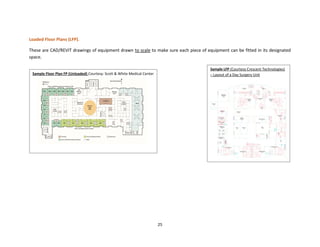
Loaded Floor Plans (LFP).
These are CAD/REVIT drawings of equipment drawn to scale to make sure each piece of equipment can be fitted in its designated
space.
Sample Floor Plan FP (Unloaded) Courtesy: Scott & White Medical Center
Sample LFP (Courtesy Crescent Technologies)
– Layout of a Day Surgery Unit
26
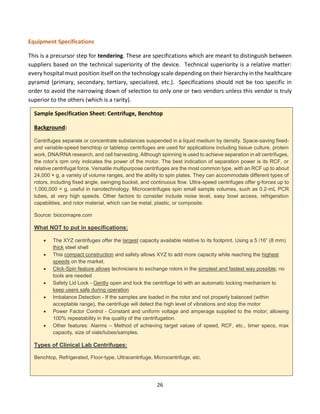
Equipment Specifications
This is a precursor step for tendering. These are specifications which are meant to distinguish between
suppliers based on the technical superiority of the device. Technical superiority is a relative matter:
every hospital must position itself on the technology scale depending on their hierarchy in the healthcare
pyramid (primary, secondary, tertiary, specialized, etc.). Specifications should not be too specific in
order to avoid the narrowing down of selection to only one or two vendors unless this vendor is truly
superior to the others (which is a rarity).
Sample Specification Sheet: Centrifuge, Benchtop
Background:
Centrifuges separate or concentrate substances suspended in a liquid medium by density. Space-saving fixed-
and variable-speed benchtop or tabletop centrifuges are used for applications including tissue culture, protein
work, DNA/RNA research, and cell harvesting. Although spinning is used to achieve separation in all centrifuges,
the rotor’s rpm only indicates the power of the motor. The best indication of separation power is its RCF, or
relative centrifugal force. Versatile multipurpose centrifuges are the most common type, with an RCF up to about
24,000 × g, a variety of volume ranges, and the ability to spin plates. They can accommodate different types of
rotors, including fixed angle, swinging bucket, and continuous flow. Ultra-speed centrifuges offer g-forces up to
1,000,000 × g, useful in nanotechnology. Microcentrifuges spin small sample volumes, such as 0.2-mL PCR
tubes, at very high speeds. Other factors to consider include noise level, easy bowl access, refrigeration
capabilities, and rotor material, which can be metal, plastic, or composite.
Source: biocomapre.com
What NOT to put in specifications:
• The XYZ centrifuges offer the largest capacity available relative to its footprint. Using a 5 /16” (8 mm)
thick steel shell
• This compact construction and safety allows XYZ to add more capacity while reaching the highest
speeds on the market.
• Click-Spin feature allows technicians to exchange rotors in the simplest and fastest way possible; no
tools are needed
• Safety Lid Lock - Gently open and lock the centrifuge lid with an automatic locking mechanism to
keep users safe during operation
• Imbalance Detection - If the samples are loaded in the rotor and not properly balanced (within
acceptable range), the centrifuge will detect the high level of vibrations and stop the motor
• Power Factor Control - Constant and uniform voltage and amperage supplied to the motor; allowing
100% repeatability in the quality of the centrifugation.
• Other features: Alarms – Method of achieving target values of speed, RCF, etc., timer specs, max
capacity, size of vials/tubes/samples.
Types of Clinical Lab Centrifuges:
Benchtop, Refrigerated, Floor-type, Ultracentrifuge, Microcentrifuge, etc.
27
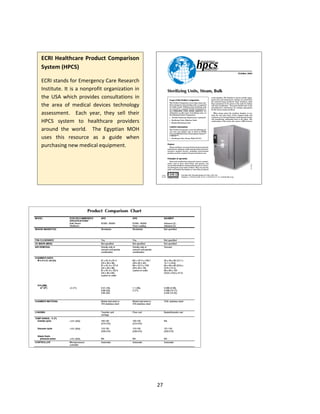
ECRI Healthcare Product Comparison
System (HPCS)
ECRI stands for Emergency Care Research
Institute. It is a nonprofit organization in
the USA which provides consultations in
the area of medical devices technology
assessment. Each year, they sell their
HPCS system to healthcare providers
around the world. The Egyptian MOH
uses this resource as a guide when
purchasing new medical equipment.
28
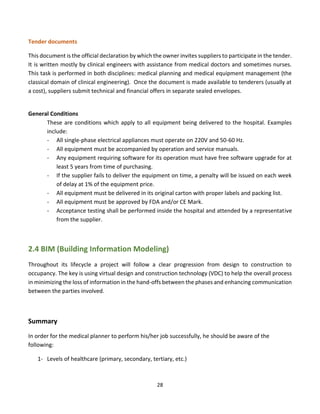
Tender documents
This document is the official declaration by which the owner invites suppliers to participate in the tender.
It is written mostly by clinical engineers with assistance from medical doctors and sometimes nurses.
This task is performed in both disciplines: medical planning and medical equipment management (the
classical domain of clinical engineering). Once the document is made available to tenderers (usually at
a cost), suppliers submit technical and financial offers in separate sealed envelopes.
General Conditions
These are conditions which apply to all equipment being delivered to the hospital. Examples
include:
- All single-phase electrical appliances must operate on 220V and 50-60 Hz.
- All equipment must be accompanied by operation and service manuals.
- Any equipment requiring software for its operation must have free software upgrade for at
least 5 years from time of purchasing.
- If the supplier fails to deliver the equipment on time, a penalty will be issued on each week
of delay at 1% of the equipment price.
- All equipment must be delivered in its original carton with proper labels and packing list.
- All equipment must be approved by FDA and/or CE Mark.
- Acceptance testing shall be performed inside the hospital and attended by a representative
from the supplier.
2.4 BIM (Building Information Modeling)
Throughout its lifecycle a project will follow a clear progression from design to construction to
occupancy. The key is using virtual design and construction technology (VDC) to help the overall process
in minimizing the loss of information in the hand-offs between the phases and enhancing communication
between the parties involved.
Summary
In order for the medical planner to perform his/her job successfully, he should be aware of the
following:
1- Levels of healthcare (primary, secondary, tertiary, etc.)
29
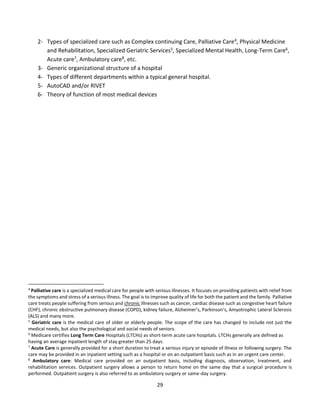
2- Types of specialized care such as Complex continuing Care, Palliative Care4, Physical Medicine
and Rehabilitation, Specialized Geriatric Services5, Specialized Mental Health, Long-Term Care6,
Acute care7, Ambulatory care8, etc.
3- Generic organizational structure of a hospital
4- Types of different departments within a typical general hospital.
5- AutoCAD and/or RIVET
6- Theory of function of most medical devices
4
Palliative care is a specialized medical care for people with serious illnesses. It focuses on providing patients with relief from
the symptoms and stress of a serious illness. The goal is to improve quality of life for both the patient and the family. Palliative
care treats people suffering from serious and chronic illnesses such as cancer, cardiac disease such as congestive heart failure
(CHF), chronic obstructive pulmonary disease (COPD), kidney failure, Alzheimer’s, Parkinson’s, Amyotrophic Lateral Sclerosis
(ALS) and many more.
5
Geriatric care is the medical care of older or elderly people. The scope of the care has changed to include not just the
medical needs, but also the psychological and social needs of seniors.
6
Medicare certifies Long Term Care Hospitals (LTCHs) as short-term acute care hospitals. LTCHs generally are defined as
having an average inpatient length of stay greater than 25 days.
7
Acute Care is generally provided for a short duration to treat a serious injury or episode of illness or following surgery. The
care may be provided in an inpatient setting such as a hospital or on an outpatient basis such as in an urgent care center.
8
Ambulatory care: Medical care provided on an outpatient basis, including diagnosis, observation, treatment, and
rehabilitation services. Outpatient surgery allows a person to return home on the same day that a surgical procedure is
performed. Outpatient surgery is also referred to as ambulatory surgery or same-day surgery.
30
2.5 RISK MANAGEMENT & THE HOSPITAL LIFECYCLE
Overview of Risk
There are many definitions of risk, the simplest of which is that risk is an “uncertain event or condition that usually
has a negative impact on the project’s objectives.” Basically, risk is any unexpected event that can affect a project.
Risk can affect anything: people, processes, technology, and resources. Risks are not the same as issues (Issues
are things you know you’ll have to deal with). For instance, scheduled vacations of doctors, or a spike in demand
of chest physicians in certain seasons are examples of issues which can be planned ahead of time and taken care
of. In contrast, sudden absence of a surgeon before a scheduled surgery, unusually long power outages, and the
outbreak of infection are examples of risks.
Risks arise at all stages through the life cycle of any project. For the optimum outcome, risk management
approaches need to be applied considering the entire duration of the project. Remember that the major phases
in the life cycle of a facility are:
1. Concept and Design
2. Construction
3. Commissioning
4. Certification/Accreditation
5. Operation/Production
6. Decommissioning
7. Disposal/Demolition/Deconstruction
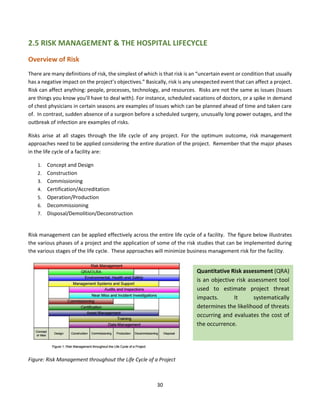
Risk management can be applied effectively across the entire life cycle of a facility. The figure below illustrates
the various phases of a project and the application of some of the risk studies that can be implemented during
the various stages of the life cycle. These approaches will minimize business management risk for the facility.
Figure: Risk Management throughout the Life Cycle of a Project
Quantitative Risk assessment (QRA)
is an objective risk assessment tool
used to estimate project threat
impacts. It systematically
determines the likelihood of threats
occurring and evaluates the cost of
the occurrence.
31
Project Risk Assessment
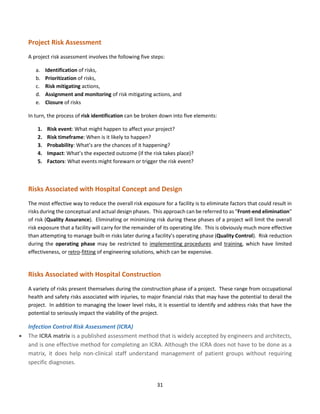
A project risk assessment involves the following five steps:
a. Identification of risks,
b. Prioritization of risks,
c. Risk mitigating actions,
d. Assignment and monitoring of risk mitigating actions, and
e. Closure of risks
In turn, the process of risk identification can be broken down into five elements:
1. Risk event: What might happen to affect your project?
2. Risk timeframe: When is it likely to happen?
3. Probability: What’s are the chances of it happening?
4. Impact: What’s the expected outcome (if the risk takes place)?
5. Factors: What events might forewarn or trigger the risk event?
Risks Associated with Hospital Concept and Design
The most effective way to reduce the overall risk exposure for a facility is to eliminate factors that could result in
risks during the conceptual and actual design phases. This approach can be referred to as “Front-end elimination”
of risk (Quality Assurance). Eliminating or minimizing risk during these phases of a project will limit the overall
risk exposure that a facility will carry for the remainder of its operating life. This is obviously much more effective
than attempting to manage built-in risks later during a facility’s operating phase (Quality Control). Risk reduction
during the operating phase may be restricted to implementing procedures and training, which have limited
effectiveness, or retro-fitting of engineering solutions, which can be expensive.
Risks Associated with Hospital Construction
A variety of risks present themselves during the construction phase of a project. These range from occupational
health and safety risks associated with injuries, to major financial risks that may have the potential to derail the
project. In addition to managing the lower level risks, it is essential to identify and address risks that have the
potential to seriously impact the viability of the project.
Infection Control Risk Assessment (ICRA)
• The ICRA matrix is a published assessment method that is widely accepted by engineers and architects,
and is one effective method for completing an ICRA. Although the ICRA does not have to be done as a
matrix, it does help non-clinical staff understand management of patient groups without requiring
specific diagnoses.
32
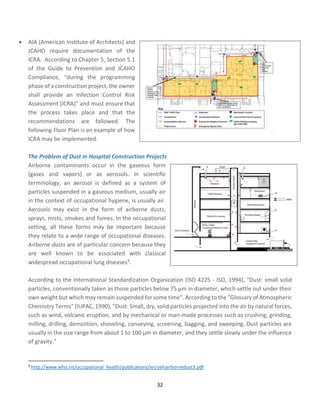
• AIA (American Institute of Architects) and
JCAHO require documentation of the
ICRA. According to Chapter 5, Section 5.1
of the Guide to Prevention and JCAHO
Compliance, “during the programming
phase of a construction project, the owner
shall provide an Infection Control Risk
Assessment (ICRA)” and must ensure that
the process takes place and that the
recommendations are followed. The
following Floor Plan is an example of how
ICRA may be implemented.
The Problem of Dust in Hospital Construction Projects
Airborne contaminants occur in the gaseous form
(gases and vapors) or as aerosols. In scientific
terminology, an aerosol is defined as a system of
particles suspended in a gaseous medium, usually air
in the context of occupational hygiene, is usually air.
Aerosols may exist in the form of airborne dusts,
sprays, mists, smokes and fumes. In the occupational
setting, all these forms may be important because
they relate to a wide range of occupational diseases.
Airborne dusts are of particular concern because they
are well known to be associated with classical
widespread occupational lung diseases9.
According to the International Standardization Organization (ISO 4225 - ISO, 1994), "Dust: small solid
particles, conventionally taken as those particles below 75 µm in diameter, which settle out under their
own weight but which may remain suspended for some time". According to the "Glossary of Atmospheric
Chemistry Terms" (IUPAC, 1990), "Dust: Small, dry, solid particles projected into the air by natural forces,
such as wind, volcanic eruption, and by mechanical or man-made processes such as crushing, grinding,
milling, drilling, demolition, shoveling, conveying, screening, bagging, and sweeping. Dust particles are
usually in the size range from about 1 to 100 µm in diameter, and they settle slowly under the influence
of gravity."
9
http://www.who.int/occupational_health/publications/en/oehairbornedust3.pdf
33
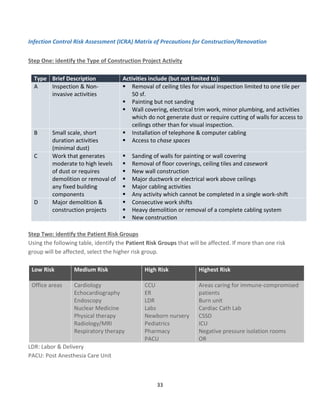
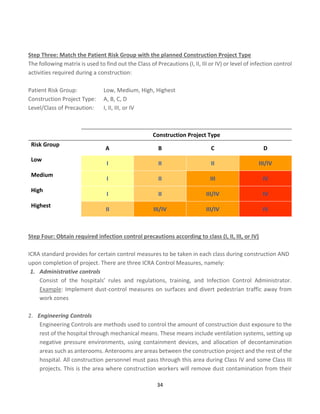
Infection Control Risk Assessment (ICRA) Matrix of Precautions for Construction/Renovation
Step One: identify the Type of Construction Project Activity
Type Brief Description Activities include (but not limited to):
A Inspection & Non-
invasive activities
▪ Removal of ceiling tiles for visual inspection limited to one tile per
50 sf.
▪ Painting but not sanding
▪ Wall covering, electrical trim work, minor plumbing, and activities
which do not generate dust or require cutting of walls for access to
ceilings other than for visual inspection.
B Small scale, short
duration activities
(minimal dust)
▪ Installation of telephone & computer cabling
▪ Access to chase spaces
C Work that generates
moderate to high levels
of dust or requires
demolition or removal of
any fixed building
components
▪ Sanding of walls for painting or wall covering
▪ Removal of floor coverings, ceiling tiles and casework
▪ New wall construction
▪ Major ductwork or electrical work above ceilings
▪ Major cabling activities
▪ Any activity which cannot be completed in a single work-shift
D Major demolition &
construction projects
▪ Consecutive work shifts
▪ Heavy demolition or removal of a complete cabling system
▪ New construction
Step Two: identify the Patient Risk Groups
Using the following table, identify the Patient Risk Groups that will be affected. If more than one risk
group will be affected, select the higher risk group.
Low Risk Medium Risk High Risk Highest Risk
Office areas Cardiology
Echocardiography
Endoscopy
Nuclear Medicine
Physical therapy
Radiology/MRI
Respiratory therapy
CCU
ER
LDR
Labs
Newborn nursery
Pediatrics
Pharmacy
PACU
Areas caring for immune-compromised
patients
Burn unit
Cardiac Cath Lab
CSSD
ICU
Negative pressure isolation rooms
OR
LDR: Labor & Delivery
PACU: Post Anesthesia Care Unit
34
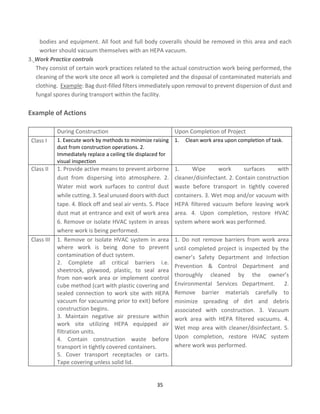
Step Three: Match the Patient Risk Group with the planned Construction Project Type
The following matrix is used to find out the Class of Precautions (I, II, III or IV) or level of infection control
activities required during a construction:
Patient Risk Group: Low, Medium, High, Highest
Construction Project Type: A, B, C, D
Level/Class of Precaution: I, II, III, or IV
Construction Project Type
Risk Group
A B C D
Low
I II II III/IV
Medium
I II III IV
High
I II III/IV IV
Highest
II III/IV III/IV IV
Step Four: Obtain required infection control precautions according to class (I, II, III, or IV)
ICRA standard provides for certain control measures to be taken in each class during construction AND
upon completion of project. There are three ICRA Control Measures, namely:
1. Administrative controls
Consist of the hospitals’ rules and regulations, training, and Infection Control Administrator.
Example: Implement dust-control measures on surfaces and divert pedestrian traffic away from
work zones
2. Engineering Controls
Engineering Controls are methods used to control the amount of construction dust exposure to the
rest of the hospital through mechanical means. These means include ventilation systems, setting up
negative pressure environments, using containment devices, and allocation of decontamination
areas such as anterooms. Anterooms are areas between the construction project and the rest of the
hospital. All construction personnel must pass through this area during Class IV and some Class III
projects. This is the area where construction workers will remove dust contamination from their
35
bodies and equipment. All foot and full body coveralls should be removed in this area and each
worker should vacuum themselves with an HEPA vacuum.
3. Work Practice controls
They consist of certain work practices related to the actual construction work being performed, the
cleaning of the work site once all work is completed and the disposal of contaminated materials and
clothing. Example: Bag dust-filled filters immediately upon removal to prevent dispersion of dust and
fungal spores during transport within the facility.
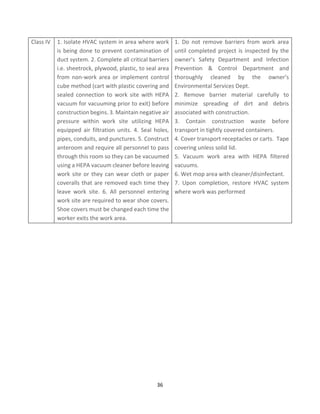
Example of Actions
During Construction Upon Completion of Project
Class I 1. Execute work by methods to minimize raising
dust from construction operations. 2.
Immediately replace a ceiling tile displaced for
visual inspection
1. Clean work area upon completion of task.
Class II 1. Provide active means to prevent airborne
dust from dispersing into atmosphere. 2.
Water mist work surfaces to control dust
while cutting. 3. Seal unused doors with duct
tape. 4. Block off and seal air vents. 5. Place
dust mat at entrance and exit of work area
6. Remove or isolate HVAC system in areas
where work is being performed.
1. Wipe work surfaces with
cleaner/disinfectant. 2. Contain construction
waste before transport in tightly covered
containers. 3. Wet mop and/or vacuum with
HEPA filtered vacuum before leaving work
area. 4. Upon completion, restore HVAC
system where work was performed.
Class III 1. Remove or Isolate HVAC system in area
where work is being done to prevent
contamination of duct system.
2. Complete all critical barriers i.e.
sheetrock, plywood, plastic, to seal area
from non-work area or implement control
cube method (cart with plastic covering and
sealed connection to work site with HEPA
vacuum for vacuuming prior to exit) before
construction begins.
3. Maintain negative air pressure within
work site utilizing HEPA equipped air
filtration units.
4. Contain construction waste before
transport in tightly covered containers.
5. Cover transport receptacles or carts.
Tape covering unless solid lid.
1. Do not remove barriers from work area
until completed project is inspected by the
owner’s Safety Department and Infection
Prevention & Control Department and
thoroughly cleaned by the owner’s
Environmental Services Department. 2.
Remove barrier materials carefully to
minimize spreading of dirt and debris
associated with construction. 3. Vacuum
work area with HEPA filtered vacuums. 4.
Wet mop area with cleaner/disinfectant. 5.
Upon completion, restore HVAC system
where work was performed.
36
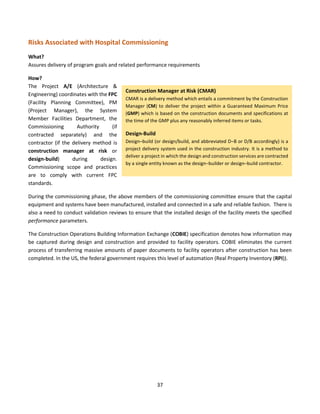
Class IV 1. Isolate HVAC system in area where work
is being done to prevent contamination of
duct system. 2. Complete all critical barriers
i.e. sheetrock, plywood, plastic, to seal area
from non-work area or implement control
cube method (cart with plastic covering and
sealed connection to work site with HEPA
vacuum for vacuuming prior to exit) before
construction begins. 3. Maintain negative air
pressure within work site utilizing HEPA
equipped air filtration units. 4. Seal holes,
pipes, conduits, and punctures. 5. Construct
anteroom and require all personnel to pass
through this room so they can be vacuumed
using a HEPA vacuum cleaner before leaving
work site or they can wear cloth or paper
coveralls that are removed each time they
leave work site. 6. All personnel entering
work site are required to wear shoe covers.
Shoe covers must be changed each time the
worker exits the work area.
1. Do not remove barriers from work area
until completed project is inspected by the
owner’s Safety Department and Infection
Prevention & Control Department and
thoroughly cleaned by the owner’s
Environmental Services Dept.
2. Remove barrier material carefully to
minimize spreading of dirt and debris
associated with construction.
3. Contain construction waste before
transport in tightly covered containers.
4. Cover transport receptacles or carts. Tape
covering unless solid lid.
5. Vacuum work area with HEPA filtered
vacuums.
6. Wet mop area with cleaner/disinfectant.
7. Upon completion, restore HVAC system
where work was performed
37
Risks Associated with Hospital Commissioning
What?
Assures delivery of program goals and related performance requirements
How?
The Project A/E (Architecture &
Engineering) coordinates with the FPC
(Facility Planning Committee), PM
(Project Manager), the System
Member Facilities Department, the
Commissioning Authority (if
contracted separately) and the
contractor (if the delivery method is
construction manager at risk or
design-build) during design.
Commissioning scope and practices
are to comply with current FPC
standards.
During the commissioning phase, the above members of the commissioning committee ensure that the capital
equipment and systems have been manufactured, installed and connected in a safe and reliable fashion. There is
also a need to conduct validation reviews to ensure that the installed design of the facility meets the specified
performance parameters.
The Construction Operations Building Information Exchange (COBIE) specification denotes how information may
be captured during design and construction and provided to facility operators. COBIE eliminates the current
process of transferring massive amounts of paper documents to facility operators after construction has been
completed. In the US, the federal government requires this level of automation (Real Property Inventory (RPI)).
Construction Manager at Risk (CMAR)
CMAR is a delivery method which entails a commitment by the Construction
Manager (CM) to deliver the project within a Guaranteed Maximum Price
(GMP) which is based on the construction documents and specifications at
the time of the GMP plus any reasonably inferred items or tasks.
Design-Build
Design–build (or design/build, and abbreviated D–B or D/B accordingly) is a
project delivery system used in the construction industry. It is a method to
deliver a project in which the design and construction services are contracted
by a single entity known as the design–builder or design–build contractor.
38
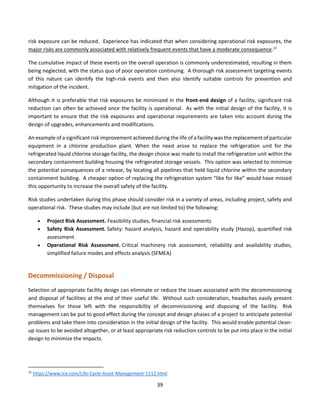
The MIMOSA10
(An Operations and Maintenance
Information Open System Alliance) Common
Relational Information Schema (CRIS) is a database
that captures data of manufacturers, asset
inventories, system components, condition status,
and associated work orders. The petrochemical
industry already uses MIMOSA standards for the
exchange of product information supporting a range
of supply chain activities.
The SDAIR (Structured Digital Asset Interoperability Registry) manages any asset-related master information that
must be shared between two or more systems. This includes:
• Organization, site, and functional locations
• Breakdown structures and mesh networks
• Serialized assets
• Location-asset associations
• Manufacturers and make/models
• Data sheets, templates and properties
• Bills of material
• Documents
• Systems (including applications and databases)
• Any reference data (types/classes) that is referenced by the above objects
• Reference data sets utilized by sites and systems
The goal of the International Alliance for Interoperability (IAI) is to develop an open-source framework for
exchange of facility information throughout the project life-cycle. The model produced by the IAI is the Industry
Foundation Class (IFC) model.
Risks Associated with Hospital Operation
During the operation phase of a facility, implementation of additional risk control measures is confined to
procedures related to the installation of improved control systems to manage safety-related hazards, or
procedures related to the improvement of maintenance practices to manage operational risks.
Unfortunately, many facility owners & operators (OO) confront risk for the first time during the operational phase
because risk control measures were not implemented in the earlier phases of the lifecycle. Risk assessment can
typically be triggered by regulatory requirements (such as JCI in Healthcare facilities) or unsatisfactory
performance (e.g. in either safety or operational performance). These assessments may identify areas where the
10
http://www.mimosa.org/mimosa-sdair
MIMOSA is a not-for-profit trade association dedicated
to developing and encouraging the adoption of open
information standards for Operations and Maintenance
(O & M) in manufacturing, fleet, and facility
environments. MIMOSA's open standards enable
collaborative asset lifecycle management in both
commercial and military applications.
39
risk exposure can be reduced. Experience has indicated that when considering operational risk exposures, the
major risks are commonly associated with relatively frequent events that have a moderate consequence.11
The cumulative impact of these events on the overall operation is commonly underestimated, resulting in them
being neglected, with the status quo of poor operation continuing. A thorough risk assessment targeting events
of this nature can identify the high-risk events and then also identify suitable controls for prevention and
mitigation of the incident.
Although it is preferable that risk exposures be minimized in the front-end design of a facility, significant risk
reduction can often be achieved once the facility is operational. As with the initial design of the facility, it is
important to ensure that the risk exposures and operational requirements are taken into account during the
design of upgrades, enhancements and modifications.
An example of a significant risk improvement achieved during the life of a facility was the replacement of particular
equipment in a chlorine production plant. When the need arose to replace the refrigeration unit for the
refrigerated liquid chlorine storage facility, the design choice was made to install the refrigeration unit within the
secondary containment building housing the refrigerated storage vessels. This option was selected to minimize
the potential consequences of a release, by locating all pipelines that held liquid chlorine within the secondary
containment building. A cheaper option of replacing the refrigeration system “like for like” would have missed
this opportunity to increase the overall safety of the facility.
Risk studies undertaken during this phase should consider risk in a variety of areas, including project, safety and
operational risk. These studies may include (but are not limited to) the following:
• Project Risk Assessment. Feasibility studies, financial risk assessments
• Safety Risk Assessment. Safety: hazard analysis, hazard and operability study (Hazop), quantified risk
assessment
• Operational Risk Assessment. Critical machinery risk assessment, reliability and availability studies,
simplified failure modes and effects analysis (SFMEA)
Decommissioning / Disposal
Selection of appropriate facility design can eliminate or reduce the issues associated with the decommissioning
and disposal of facilities at the end of their useful life. Without such consideration, headaches easily present
themselves for those left with the responsibility of decommissioning and disposing of the facility. Risk
management can be put to good effect during the concept and design phases of a project to anticipate potential
problems and take them into consideration in the initial design of the facility. This would enable potential clean-
up issues to be avoided altogether, or at least appropriate risk reduction controls to be put into place in the initial
design to minimize the impacts.
11
https://www.lce.com/Life-Cycle-Asset-Management-1112.html
40
Site remediation is an issue that often raises itself during the final phases of the life of a facility. It is during this
phase that major costs that have remained hidden for years will become evident. An example of this is major
contamination of the facility site, caused by chemicals leaking into the ground. The extent of the contamination
is commonly not known until the clean-up begins and many companies have faced potential financial ruin from
the clean-up obligations that have been imposed on them following cessation of operations. To avoid this
situation, it is important to identify potential risks early on and act accordingly, such as by providing appropriate
leak prevention and spill containment systems.
Conclusion
The examples discussed above highlight the importance of considering the overall risk implications of decisions
during the early phases of a project development. Decisions made during this time can have major implications
for the risk exposure over the lifetime of the facility. Good decisions made early in the project will enable safety,
operational and business risks to be eliminated or, at worst, minimized if elimination is not possible.
Mission Dependency Index (MDI)12
The Mission Dependency Index (MDI) was developed for U.S. Army facility asset management. It is an indicator
of mission-related importance of Army infrastructure elements to be used for the purpose of providing more
effective local prioritization of facilities for sustainment, restoration, and modernization (SRM) actions. It does
this by evaluating the mission impact of interrupting a function or relocating where it is provided. The goal of MDI
is not to eliminate risk, but to identify risk severity so the mission is accomplished with the minimum amount of
loss.
The index is reported on a scale of 0–100 and is analogous in that respect with existing Corps of Engineers
Sustainment Management System (SMS) indices. The results of an MDI analysis will enable facility decision
makers to focus on infrastructure most critical to mission effectiveness.
The information needed to calculate the MDI metric is generated from interviews with operations and facility
decision makers. The first step in the MDI process is to categorize the list of missions performed at each installation
and identify the points of contact (POC) for each mission. Intra-dependencies are then created by linking the
specific buildings and other support structures at the installation to each mission.
For each facility, the interview process then determines facility interruptability, which measures how long
functions supported by the facility could be stopped without adverse impact on the mission. The interview process
also determines relocatability, which measures whether the mission could be relocated to other fixed or
temporary facilities. These questions have been tailored to reflect the way the Army uses its facilities and responds
to contingencies.
Interdependencies measure the indirect effect of other facilities not controlled by the unit. In other words, it
evaluates the dependency of one mission’s output on the execution of a different mission. The result of this
12
Development of the Army Facility Mission Dependency Index for Infrastructure Asset Management:
http://www.dtic.mil/dtic/tr/fulltext/u2/a552791.pdf
41
process is an MDI score on a scale of 0–100 that indicates the importance or criticality of a facility. Because the
process to obtain this score is standardized, the result is objective, auditable, and credible. By linking facilities to
mission, MDI scores communicate a critical and previously missing detail in infrastructure-related decision-
making.
The MDI enables installations to determine the relationship between infrastructure and mission, and it provides
a credible means for prioritizing sustainment, restoration, and modernization (SRM) requirements for existing
facilities and local projects. As a consequence, resource focus is applied to those facilities providing the best
military value. MDI information can be stored in the BUILDER Sustainment Management System (SMS) program
and used in facility SRM project prioritization.
Question #1: How long could the "functions" supported by your facility (functional element) be stopped without
adverse impact to the mission?
• Immediate (any interruption will immediately impact mission readiness),
• Brief (minutes or hours not to exceed 24 hours),
• Short (days not to exceed 7 days), or
• Prolonged (more than a week).
Question #2: If your facility was no longer functional, could you continue performing your mission by using
another facility, or by setting up temporary facilities? (Are there workarounds?)
• Impossible (an alternate location is not available),
• Extremely Difficult (an alternate location exists with
minimally acceptable capabilities, but would require either
a significant effort (money/man-hours), dislocation of
another major occupant, or contracting for additional
services and/or facilities to complete),
• Difficult (an alternate location exists with acceptable
capabilities and capacity but relocation would require a
measurable level of effort (money/man-hours), but mission
readiness capabilities would not be compromised in the
process),
• Possible (an alternate location is readily available with sufficient capabilities and capacity, in addition the
level of effort has been budgeted for or can be easily absorbed).
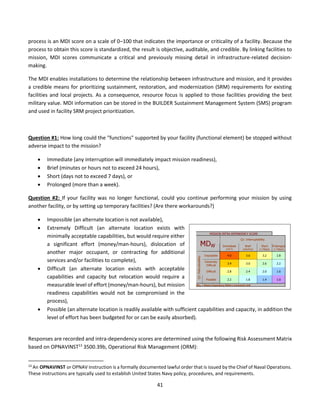
Responses are recorded and intra-dependency scores are determined using the following Risk Assessment Matrix
based on OPNAVINST13
3500.39b, Operational Risk Management (ORM):
13
An OPNAVINST or OPNAV Instruction is a formally documented lawful order that is issued by the Chief of Naval Operations.
These instructions are typically used to establish United States Navy policy, procedures, and requirements.
42
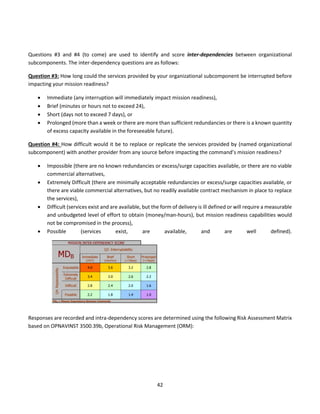
Questions #3 and #4 (to come) are used to identify and score inter-dependencies between organizational
subcomponents. The inter-dependency questions are as follows:
Question #3: How long could the services provided by your organizational subcomponent be interrupted before
impacting your mission readiness?
• Immediate (any interruption will immediately impact mission readiness),
• Brief (minutes or hours not to exceed 24),
• Short (days not to exceed 7 days), or
• Prolonged (more than a week or there are more than sufficient redundancies or there is a known quantity
of excess capacity available in the foreseeable future).
Question #4: How difficult would it be to replace or replicate the services provided by (named organizational
subcomponent) with another provider from any source before impacting the command’s mission readiness?
• Impossible (there are no known redundancies or excess/surge capacities available, or there are no viable
commercial alternatives,
• Extremely Difficult (there are minimally acceptable redundancies or excess/surge capacities available, or
there are viable commercial alternatives, but no readily available contract mechanism in place to replace
the services),
• Difficult (services exist and are available, but the form of delivery is ill defined or will require a measurable
and unbudgeted level of effort to obtain (money/man-hours), but mission readiness capabilities would
not be compromised in the process),
• Possible (services exist, are available, and are well defined).
Responses are recorded and intra-dependency scores are determined using the following Risk Assessment Matrix
based on OPNAVINST 3500.39b, Operational Risk Management (ORM):
43
Calculating the MDI score
The scoring matrices shown in Tables 1 and 2 are used in conjunction with the MDI algorithm to calculate the MDI
score. Using a matrix to quantify and prioritize risk severity does not eliminate the inherently subjective nature of
risk assessment; however, a matrix does provide a consistent framework for evaluating risk.
The MDI is calculated using an equation with three coefficients. The MD(Within) and MD(Between) scores are a
resultant of the matrices used in the intra and inter- dependency lines of question. The third input is the number
(n) of other subcomponents recognizing the subject subcomponent as a mission critical service provider. The
following MDI equation and weighted coefficients are the result of three years of extensive field-testing by Navy,
Coast Guard and NASA facility engineers and managers:
MDI = [MD(Within) + *MD(Between Average) + Ln(n)] –
Where:
• MDI = Mission Dependency Index normalized from zero to 100
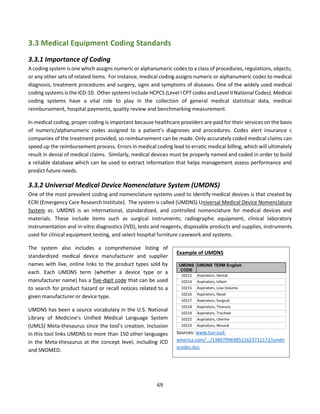
• MD(Within) = Intra-dependency Score; response to questions 1 and 2 (see Table 1)
• MD(Between) = (Interdependency Score): The average response to questions 3 and 4, (see Table 2)
• Ln( ) = natural log function
• n = number of Interdependencies with other Functional Areas
The natural log function is used because the difference between 1 and 2 is much more relevant than the difference
between 11 and 12.
The MDI color code and nomenclature used is as follows:
Scoring is divided into five categories with a 15 point spread separating critical, significant, relevant, moderate,
and low. The MDI equation is weighted to allow functional elements with high inter-dependency scores to move
up to the next level of criticality. The exception is functional elements with very low intra-dependency scores (less
than 25).
The MDI has been recognized by the US General Services Administration in 2003 as a “Best Practice” and by the
Federal Facilities Council (Cable and Davis 2005) as “a promising process indicator for prioritizing projects and
funding to support an organization’s overall mission”. When combined with other metrics, such as a Condition
Index (CI), MDI can be used to prioritize funding for projects having the most positive impact. MDI is valuable for
prioritizing real property resources in the conduct of facility assessments. In this area, facilities with high MDI
44
scores would be inspected more frequently and in greater depth than facilities with low MDI scores. The MDI’s
true power is that it is risk-based, straightforward and simple to implement.
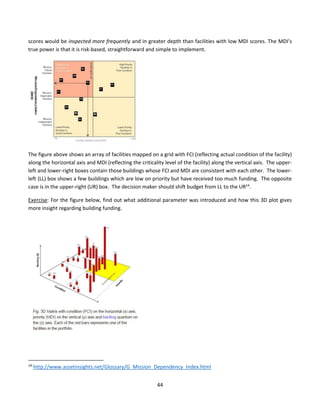
The figure above shows an array of facilities mapped on a grid with FCI (reflecting actual condition of the facility)
along the horizontal axis and MDI (reflecting the criticality level of the facility) along the vertical axis. The upper-
left and lower-right boxes contain those buildings whose FCI and MDI are consistent with each other. The lower-
left (LL) box shows a few buildings which are low on priority but have received too much funding. The opposite
case is in the upper-right (UR) box. The decision maker should shift budget from LL to the UR14
.
Exercise: For the figure below, find out what additional parameter was introduced and how this 3D plot gives
more insight regarding building funding.
14
http://www.assetinsights.net/Glossary/G_Mission_Dependency_Index.html
45
Additional Readings:
1. “Planning Hospitals of the Future” by Richard Sprow.
2. “Understanding the Hospital Planning, Design, and Construction Process”, California Healthcare
Foundation, February 2007.
BUILDER™ Sustainment Management System (SMS)
The BUILDER™ Sustainment Management System (SMS) is a web-based software application developed by
ERDC’s Construction Engineering Research Laboratory (CERL) to help civil engineers, technicians and managers
decide when, where and how to best maintain building infrastructure. Because building assets are so vast and
diverse, a “knowledge-based” philosophy drives the BUILDER™ SMS process. The process starts with the
automated download of real property data, and then more detailed system inventory is modeled and/or
collected which identifies components and their key life cycle attributes such as the age and material. From
this inventory, Condition Index (CI) measures for each component are predicted based on its expected stage
in the life-cycle. Objective and repeatable inspections can then be performed on various components to verify
their condition with respect to the expected life-cycle deterioration. The level of detail and frequency of these
inspections are not fixed like other processes; they are dependent on knowledge of component criticality, the
expected and measured condition and rate of deterioration, and remaining maintenance and service life. This
“knowledge-based” inspection focuses attention to the most critical components at the time.
46
Chapter Questions
[1] Design a minor operating room and its related services following the steps discussed in this
chapter.
Hint
In the concept design phase, we should describe the design requirements in a general but definite way.
First, we must define what is meant by minor surgery. A minor surgery is a surgical procedure that does
not require general anesthetic such as:
Main Category Operations
Injections intra-articular, peri-articular, varicose veins, haemorrhoids
Aspirations joints, cysts, bursae, hydrocele
Incisions abscesses, cysts, thrombosed piles
Excisions sebaceous cysts, lipoma, warts, skin lesions for histology, intradermal naevi,
papilloma,
dermatofibroma and similar lesions, removal of toenails
Curette, cautery and
cryo-cautery
warts and verrucae, other skin lesions (skin surgery) (e.g. molluscum
contagiosum)
Other removal of foreign bodies, nasal cautery
Second, these procedures should be mapped into services and medical equipment.
[2] Make a room-by-room list of a typical Examination Room in the Outpatient Clinic
Answer
Exam Table: An adjustable exam table, ideally with cabinets and storage beneath, is an absolute “must
have” and will provide a place to examine patients while also providing much needed storage without
taking up extra floor space. There are many new laws in the works that address the ADA (Americans
with Disabilities Act). A power exam table that goes as low as 18” should be considered. Not only will it
be ADA friendly, but could increase the workflow of an office, allowing more patients to be seen in a day.
Integrated Diagnostic System: An integrated diagnostic system provides you everything you will require
for a basic examination. You will be able to perform checks using an ophthalmoscope, otoscope,
sphygmomanometer, and an electronic thermometer. Having a wall-mounted diagnostic system will
keep everything you need for the medical exam at arms-reach, as well as keeping everything charged so
you never have to worry about having your equipment fail while you are mid-exam. If wall space is
limited you can also consider a wall-mounted transformer with heads that can be switched up as
required based on the patient’s needs. If you cannot accommodate an integrated system you will
47
require, at least, a modular “vital signs” monitor as well as otoscopes, ophthalmoscopes and varied
specula.
Spot Vitals: These are all-in-one modular vital signs instruments and will be the easiest and most efficient
tool in the exam rooms to capture blood pressure, pulse rate, temperature, and SpO2. They can also be
mobile so that one can be ordered and used for multiple exam rooms.
Exam Lights: An exam light is a must for many medical assessments. There are a number of choices
from fiber optics to halogen lights and from mobile units to portable headlights.
ECG Devices: There are many ECG devices from which to choose and the size and services provided at
your facility will play a role in what models will work the best for you. Newer models will allow you to
generate and manage patient data ideal for use with EHR systems.
Spirometer: The latest in spirometer technology can provide you with the tool you need to assess
pulmonary issues such as obstructive restrictive disorders. Many models are child friendly to encourage
them to follow the required steps for the best results.
AED: Automated External Defibrillators are a must for any medical location. Ready at a moment's
notice, the latest models of AED's will allow you to improve outcomes for emergency situations and is
an obvious must for your equipment planning.
Anoscope: If you want to have all tools available an anoscope will allow you to rule out many issues
without calling for further tests somewhere else. It will expedite exams in many cases, allowing you to
make an accurate diagnosis or call for further detailed tests as required. Although some healthcare
providers might not include this as a “must have” in equipment planning, it is a definite plus.
Computer Stand or Cart: With the advent of EHR systems, it is imperative to have a cart or stand to
accommodate computers to record and access patient health information.
Exam Stool: An adjustable stool on wheels will make examinations easier and offer seating during
conversations with the patient and family members.
Guest Seating: Guest seating for family members will make it easier to keep people comfortable as well
as keep them out of the way when conducting exams.
Storage Cabinetry: There are a number of storage options to accommodate all of the supplies required
for procedures as well as to contain diagnostic test materials, cleaning products, PPE, etc.
Sink and Counter: Having a sink and counter area will provide counter space to label blood work, prepare
tests and also encourage proper hand washing procedures. You will also have additional storage space
in cabinets below for optimum use of space.
48
• Scale: Along with a vital signs monitor, a scale is a must. You can have one in a central area or one in
each individual exam room. There are even some power exam tables that have scales incorporated into
the table that should be considered, depending on your patient mix. If you see any pediatric patients, a
pediatric scale is needed also.
• Miscellaneous items: There are many other items that might be required for your office set-up. These
include IV poles, mayo stands, glove dispensers, sharps containers, trashcans and refrigerators.
49
CHAPTER III: MEDICAL EQUIPMENT (ASSET)
MANAGEMENT
HOSPITAL OPERATIONS
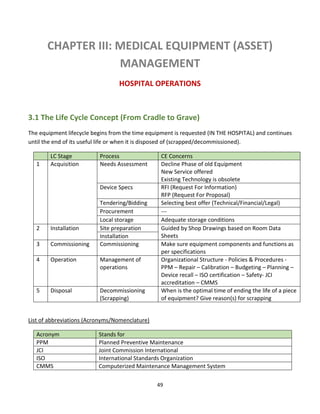
3.1 The Life Cycle Concept (From Cradle to Grave)
The equipment lifecycle begins from the time equipment is requested (IN THE HOSPITAL) and continues
until the end of its useful life or when it is disposed of (scrapped/decommissioned).
LC Stage Process CE Concerns
1 Acquisition Needs Assessment Decline Phase of old Equipment
New Service offered
Existing Technology is obsolete
Device Specs RFI (Request For Information)
RFP (Request For Proposal)
Tendering/Bidding Selecting best offer (Technical/Financial/Legal)
Procurement ---
Local storage Adequate storage conditions
2 Installation Site preparation Guided by Shop Drawings based on Room Data
SheetsInstallation
3 Commissioning Commissioning Make sure equipment components and functions as
per specifications
4 Operation Management of
operations
Organizational Structure - Policies & Procedures -
PPM – Repair – Calibration – Budgeting – Planning –
Device recall – ISO certification – Safety- JCI
accreditation – CMMS
5 Disposal Decommissioning
(Scrapping)
When is the optimal time of ending the life of a piece
of equipment? Give reason(s) for scrapping
List of abbreviations (Acronyms/Nomenclature)
Acronym Stands for
PPM Planned Preventive Maintenance
JCI Joint Commission International
ISO International Standards Organization
CMMS Computerized Maintenance Management System
50
3.1.1 Overview
Life Cycle Asset Management (LCAM) (also called Enterprise Asset Management, EAM15) is an integrated
approach to optimizing the life cycle of assets beginning with user requirements specifications,
continuing through operation and decommissioning. Thorough planning, analysis and timely execution
allow appropriate data-driven decision-making to occur and enable LCAM to deliver optimum:
• Operating and maintenance strategies
• Organizational structure
• Staffing requirements
• Optimized PM/PdM (Preventive & Predictive Maintenance) procedures
15
Enterprise asset management software is a computer software that handles every aspect of running a modern public works
or asset-intensive organization. Effective enterprise asset management (EAM) software solutions include many powerful
features, such as complete asset life-cycle management, flexible preventive maintenance scheduling, complete warranty
management, integrated mobile wireless handheld options and portal-based software interface. [2] Rapid development and
availability of mobile devices also affected EAM software which now often supports Mobile enterprise asset management.
(WIKI)
The above figure obtained from the website of Steris Corporation (a company specialized in the production of sterilizers)
life cycle representation covers BOTH equipment production in the factory AND equipment acquisition in the hospital. In
this course, we separate the two environments of the factory and the hospital in order for the student to grasp the concept
and know how to apply it to the relevant working environment.
51
• Reliability engineering processes
• Work control/planning and scheduling processes
• Equipment criticality and hierarchy in the appropriate enterprise resource system format
• Purchasing and stores processes
• Maintenance inventory requirements with min./max. stocking levels
• Training plan
• Start up and commissioning plan
• Decommissioning plan
• Executive dashboards with performance baselines and targets
To ensure effective asset
investment decision-making
and to achieve sustainable
results in business
performance, companies
must take a holistic
approach that addresses not
only infrastructure assets,
but also the supporting
resources, business
processes, data and
enabling technologies that
are critical to success.
3.1.2 Basic Management Issues
Three foundational elements must be in place to support life cycle asset management: management
strategy, optimum organizational design and long-term asset planning.
Management Strategy Development
A shared vision, strategy and action plan is the foundation for a successful life cycle asset management
program. Developing a vision brings company stakeholders together to create a common understanding
of asset management, reach consensus on business objectives and prepare a plan for successful program
implementation. At the end of the vision development process, you will achieve:
• A common understanding of strategic asset management concepts and benefits
• Defined service level targets on which to base a life cycle asset management strategy
Infrastructure Assets
Infrastructure consists of long-lived capital assets that are normally
stationary in nature and can be preserved for a long time. Examples include
the building itself, plumbing facilities, electrical grid, etc.
Supporting Resources
Such as patents, software products, etc.
Business Processes
BPM (Business Process Management) sees processes as important assets of
an organization that must be understood, managed, and developed to
produce value-added products and services to clients or customers.
52
• An assessment of your current asset management activities and recommendations for
improvement
• A structured plan, schedule and business case for improving your asset management capabilities
The final outcome of the visioning process is an asset management strategic plan that provides a plan,
schedule, budget and business case for moving forward with a viable life cycle asset management
process.
Organizational Design
Business success is based on the right people, processes, data, and information technology, coming
together at the right time to form the foundation of a successful asset management program. It also
requires the appropriate organizational structure with roles and responsibilities defined and qualified
resources available at the right time to achieve program objectives.
Long-term Asset Planning
The ability to forecast where and when infrastructure investments should occur is critical to a company’s
product quality and performance reliability. Deciding how to best invest limited capital and Operations
and Maintenance (O&M) dollars requires an understanding of the current condition and capacity of the
company’s infrastructure, as well as future capacity and reliability requirements. It also requires an
understanding of the cost and risk associated with implementing or deferring system expansions and
improvements. As a minimum, the planning process must:
• Prioritize capital projects over a five to ten-year period based on strategic objectives
• Forecast capital renewal, replacement and expansion costs over a ten to fifteen-year period
• Forecast infrastructure-funding requirements based on long-term revenue and cost.
3.1.3 Life Cycle Costs (LCC)16
Equipment life-cycle cost analysis (LCCA) is typically used as one component of the equipment
management process and allows the CE manager to make equipment repair, replacement, and retention
decisions on the basis of a given piece of equipment’s economic life. The decision to repair, overhaul, or
replace a piece of equipment in a public hospital is a function of ownership and operating costs.
The life of an asset can be viewed from different perspectives. The fundamental question is when to stop
using an existing piece of equipment or plant. The answer “when the present one wears out” is obviously
not sufficient, because it is possible to keep for instance a 1950s classic car running up to the present
16
Adapted from: “Major Equipment Life-cycle Cost Analysis”: Minnesota Department of Transportation, Research Services
& Library, April 2015.
53
day, if one is prepared to spend enough money on it. On the other hand, it may be worth to replace a
laptop computer by a latest generation tablet computer well before the former breaks down. Hence, a
distinction should be made between the physical life of an asset and its economic life. Both physical and
economic life must be defined and calculated because they ultimately make an equipment replacement
decision.
Physical life
The physical life of equipment will be identified as the service life. This time period ends when equipment
can no longer be operated. This stage is greatly impacted by the repair and maintenance attention that
the machine has been provided over its lifespan. A piece of equipment that has not been given adequate
maintenance throughout its lifespan will deteriorate at a faster rate than a machine that was been given
substantial preventative maintenance. Thus, the service lives will vary depending on the piece of
equipment and the amount of upkeep it has been provided.
Economic life17
Most tangible assets have a finite life span—usually a period of several years or more with a well-defined
beginning and end. The life span concept is central to asset life cycle management (methods for guiding
asset acquisition, use and disposal). The concept is the heart of total cost of ownership (TCO) analysis
(methods for uncovering the full range of costs brought by asset ownership). Asset life span can be
defined and measured in several different ways, including depreciable life, economic life, and service
life.
Depreciable life
It is defined as the time period over which an asset can lawfully be depreciated. Each year of depreciable
life, a depreciation expense is calculated and declared for the asset using standard accounting methods.
This expense lowers the book value (balance sheet value) of the asset, lowers the company's reported
income, and creates a tax savings.
When the asset’s depreciable life is over, the asset is said to be fully depreciated or fully expensed. If the
asset is kept beyond that point, its book value is called either its residual value or its salvage value. Asset
residual (or salvage value) is typically just a few percent of the asset's original purchase price or it may
even be zero.
For some assets, management can simply choose a number of years for the depreciable life, based on
the asset's expected useful life. For other kinds of assets, however, the depreciable life is prescribed by
the country's tax authorities. In the US, for instance, computing hardware has a prescribed depreciable
17
Economic Life, Asset Life, Depreciable Life, Service Life, and Ownership Life Explained: Definitions, Meaning, and
Examples. Business Encyclopedia, ISBN 978-1-929500-10-9. Updated 11-07-2015.
54
life of 5 years, and depreciation must follow the MACRS (Modified Accelerated Cost Recovery System)
depreciation schedule.
Economic life (of an asset) is defined as the number of years in which the asset returns more value to
the owner than it costs to own, operate, and maintain. When these costs exceed returns, the acquisition
is beyond its economic life. The asset's economic life must be known in order to calculate investment
metrics such as net present value (NPV), internal rate of return (IIR), and return on investment (ROI). An
asset's expected economic life is also an important consideration for vendors and customers alike when
establishing warranties and service plans.
An asset's economic life can be shortened or terminated
by a number of different factors, including:
• Wear, degradation, or damage which can lower
asset performance and raise maintenance and
operation costs.
• Obsolescence, which can raise maintenance
costs and render asset performance relatively inefficient when compared to more current
alternatives.
• Changes in company operations, product offerings, or the company's business model, which
reduce the value the current assets can deliver.
The concepts of depreciation, inflation, investment, maintenance and repairs, downtime, and
obsolescence are all integral to replacement analysis. If a piece of equipment is not replaced at the end
of its economic service life, maintenance, repair, and fuel consumption costs will outweigh the value of
its purpose.
The Life Span of a medical device increases or decreases depending on a number of factors, including
the:
• Frequency of use
• Nature of use
• Environment of use
• Experience and knowledge of the user
• Care and attention paid to use and operator maintenance
• Existence, capability and cost of maintenance support
• Stage in product life cycle
• Management of scheduled and unscheduled maintenance
• Availability and cost of consumables and spare parts
• Availability and cost of replacement devices
“The proper timing of equipment
replacement prevents an erosion of
profitability by the increased cost of
maintenance and operation as the
equipment ages beyond its economic life”.
55
• Relative efficacy and effectiveness of the alternative methods and devices
• Business and safety risks associated with continued or discontinued use
• Strategic and political risks associated with continued or discontinued use
• Compliance with current codes and standards
• Technological or clinical redundancy
• Funding availability
56
Other related financial terms
1- Fixed Cost (Capital cost)
It is a cost that remains the same and does not depend on the amount of goods and services a company
produces. Examples: purchasing price of equipment, apartment rent, and store rent, etc.
2- Variable Cost
It is a cost that varies as the amount of goods and services a company produces varies. A variable cost
is dependent on a company's production volume. Variable Costs include indirect overhead costs such
as Cell Phone Services, Computer Supplies, Credit Card Processing, Electrical use, Janitorial Supplies,
MRO, Office Products, Payroll Services, Telecom, Uniforms, Utilities, or Waste Disposal etc. (WiKi)
3- Asset
A resource with economic value that an individual, corporation or country owns or controls with the
expectation that it will provide future benefit. In the context of accounting, assets are either current
or fixed (non-current). Current means that the asset will be consumed within one year. Generally, this
includes things like cash, accounts receivable and inventory. Fixed assets are those that are expected
to keep providing benefit for more than one year, such as equipment, buildings and real estate.
4- Net present value (NPV)
PV = FV / (1+r)n
where
PV is Present Value, FV is Future Value, r is the interest rate (as a decimal, so 0.10, not 10%),
and n is the number of years.
[Source: http://www.mathsisfun.com/money/net-present-value.html]
5- Internal rate of return (IIR)
6- Return on investment (ROI)
57
3.2 Medical Equipment Management (Operations)
Facilities operations and maintenance covers a broad spectrum of services, competencies, processes, and tools
required to assure the built environment will perform the functions for which a facility was designed and
constructed. Operations and maintenance typically includes the day-to-day activities necessary for the
building/built structures, its systems and equipment, and occupants/users to perform their intended function.
Operations and maintenance are combined into the common term O&M because a facility cannot operate at
peak efficiency without being maintained. The Facilities O&M section offers guidance in the following areas18
:
Real Property Inventory (RPI)—Provides an overview on the type of system needed to maintain an inventory of
an organization's physical assets and manage those assets.
Computerized Maintenance Management Systems (CMMS)—Contains descriptions of procedures and practices
used to track the maintenance of an organization's assets and associated costs. The following list summarizes key
data necessary to build an CMMS.
• Inventory number
• Department
• Warranty period
• Fault description
• Serial number
• Local agent
• Job number
• Cause of fault
• Model number
• Manufacture
• Technician name
• Action taken
• Device's name
• Installation date
• Start date of job order
• Price
• Predictive maintenance Scheduling
• History/Reports
Computer Aided Facilities Management—originally referred to space planning technologies, however, is not used
more generically to describe a variety of technologies addressing any or all aspects of Facilities Management.
Examples include CMMS, BIM, IWMS, and others.
18
https://www.wbdg.org/facilities-operations-maintenance
58
O&M Manuals—it is now widely recognized that O&M represents the greatest expense in owning and operating
a facility over its life cycle. The accuracy, relevancy, and timeliness of well-developed, user-friendly O&M manuals
cannot be overstated. Hence, it is becoming more common for detailed, facility-specific O&M manuals to be
required as a part of the total commissioning process. These manuals describe the processes, methods, tools,
components, and frequencies involved for requisite operations and management of physical assets.
Janitorial/Cleaning—As the building is opened the keys are turned over to the janitorial, custodial or
housekeeping staff for interior "cleaning" and maintenance. Using environmentally friendly cleaning
products and incorporating safer methods to clean buildings provides for better property asset
management and a healthier workplace. Grounds maintenance and proper cleaning of exterior surfaces
are also important to an effective overall facility maintenance and cleaning program. Janitorial/Cleaning,
as well as Landscaping, Snowplowing, etc. are considered to be General Maintenance Activities.
59
3.2.1 Acceptance and Commissioning (of Medical Equipment)
While initial acceptance of equipment is performed to make sure that the delivered goods match the packing list,
final acceptance and commissioning tests are performed following the installation of the equipment. In summary,
acceptance constitutes the set of actions aimed at demonstrating that all terms and conditions of the purchase
document have been met. These include (but are not limited to) mechanical, electrical and radiation safety tests.
On the other hand, commissioning establishes baseline values against which subsequent routine quality control
results are to be compared. Acceptance and commissioning tests are often performed together. In diagnostic
imaging devices, phantom images and exposure parameters are usually registered to establish this baseline.
The following steps are standard procedures for acceptance:
A. Paperwork
• The contents of the delivery box are checked against the packing list (which in turn is compared
against the “order to deliver”).
• Manuals, compliance and calibration certificates, test results all included where relevant
• Warranty & Guarantee documents
B. Visual inspection
• Outer packaging intact and undamaged
• No damage apparent on inspection
• Case markings where relevant – CE marking, notified body number, electrical class, applied part type
(B/BF/CF)
• Does the device (or any component part or accessory) need sterilizing before the first use?
C. Functional check
• Are accessories/parts compatible?
• Do indicators and displays function correctly when powered up?
• Does it start when you press “ON”?
• Action of knobs and switches as intended
3.2.2 Determining Manpower Requirements
There must be enough clinical engineers and technicians to meet the hospital objectives in terms of
medical equipment serviceability (maintenance, repair, etc.). Overestimating the number of personnel
(manpower) results in additional cost in the form of salaries and benefits. Underestimation results in
backlogs and financial losses due to increased downtime of equipment. It is, therefore, important to
determine the right number of employees.
In order to reach this number, certain decisions must be made first. The most important piece of
information needed is the workload, i.e., how many pieces of equipment will be maintained, repaired,
and calibrated in-house versus those to be outsourced. Outsourcing means that an outside agency will
do the job. This may be the official agent/distributor or to a third-party service company. This
60
distribution of duties should be based upon (1) the degree of training obtained by in-house staff, (2) the
budget available, (3) the availability of spare parts to the hospital, and (4) the availability of service
instrumentation which is used to measure, calibrate and adjust mechanical, electrical, and electronic
systems.
Once the in-house workload is determined, the simplest way to calculate manpower needs is to estimate
the total number of PPM hours needed per year. Historical data (from the same hospital or other
hospitals) coupled with published data from specialized organizations such as ECRI and AAMI can help
determine average times needed to finish PPM jobs for most medical devices. Given that on average,
the serviceman spends about 1,800 – 2,000 hours annually on the job (300 days per year and 6 net hours
of work per day), and that PPM should occupy about 80% of the serviceman time, it is easy to calculate
the manpower needs for a given hospital.
Example: A hospital has medical equipment assets requiring 5000 hours of PPM per year. This means
the total number of hours of service for this lot is 5000/0.8 = 6250 hours. This translates into 6250/1800
= 3.47 persons, to be approximated to the highest integer, i.e. 4 technicians plus one manager. Of
course, there is an underlying assumption here, namely that each technician can perform about ¼ of all
PPM’s by himself which is unrealistic due to specializations of medical equipment. Usually, one would
need double this number to allow for specialized service and additional tasks such as daily inspection.
Note: There are other factors affecting the productivity of a serviceman such as the quantity of similar
equipment. Usually, if a person repeats the same task several times, it takes less time in the second
piece than the first, and the third less than the second, etc.
3.2.3 Determining Best Work Shift Scheduling
The following example is adapted from a report produced by RAND corporation in the sixties aimed at
finding best work shift policies for squadron servicing. In the context of clinical engineering, we assume
it applies for a medical city or a Ministry of Health. Keywords: Scheduling theory, Queuing theory,
manpower reduction, work-shift policies.
A medical city has several departments and buildings in its campus. In order to meet maintenance and
repair requests, a centralized service station was created. The station manager has decided to assemble
service teams to be dispatched to the various departments upon request. Each team is specialized and
trained in specific medical equipment. The manager divided the 24 hours of a typical day into three
shifts: from 8:00 am to 4:00 pm, from 4:00 pm to 12:00 midnight, and from 12:00 midnight to 8:00 am.
The manager wanted to record how many teams were needed every hour of the day for a certain number
of days. The result was the matrix shown below. Study the table well and then answer the following
questions. [Hint: The x-axis is hour of the day and the y-axis is the number of teams dispatched. The
61
value in each cell of the matrix is the number of days. For example, the value in cell (1,1) is 3, meaning
that between midnight and 1:00 am no teams were needed for three days.]
62
24-
01
01-
02
02-
03
03-
04
04-
05
05-
06
06-
07
07-
08
08-
09
09-
10
10-
11
11-
12
12-
13
13-
14
14-
15
15-
16
16-
17
17-
18
18-
19
19-
20
20-
21
21-
22
22-
23
23-
24
12 12
11 1 11
10 1 2 2 1 1 10
9 2 0 0 1 2 1 2 1 9
8 2 0 2 1 1 1 3 2 1 1 3 1 8
7 2 1 2 1 1 0 0 0 1 2 1 1 2 0 1 7
6 2 2 1 2 3 2 2 2 3 1 2 2 3 2 3 2 6
5 0 0 0 0 0 1 0 0 0 0 1 2 1 0 0 0 5
4 1 2 1 1 1 2 1 1 1 1 2 3 1 2 2 1 2 3 1 x 4
3 2 2 1 2 0 1 0 0 1 0 1 1 1 0 0 0 0 0 0 0 2 2 1 3
2 3 2 3 4 4 2 2 1 1 1 1 1 1 1 1 2 2 1 2 1 1 3 3 3 2
1 1 4 3 2 0 0 0 0 1 0 0 0 0 0 1 2 0 1 2 0 0 1 0 1 1
0 3 2 3 4 2 1 0 0 0 1 1 1 0 1 2 1 2 1 0 0 2 3 5 4 0
24-
01
01-
02
02-
03
03-
04
04-
05
05-
06
06-
07
07-
08
08-
09
09-
10
10-
11
11-
12
12-
13
13-
14
14-
15
15-
16
16-
17
17-
18
18-
19
19-
20
20-
21
21-
22
22-
23
23-
24
(a) For how many days did the manager collect this data? (1 point) Answer: 10 days
(b) Between 11 pm and midnight, what is the value of “x”? (1 point) Answer: 10 – (4+1+3+1) = 1
(c) At what time is there peak demand for service teams? (1 point) Answer: 7:00 am - 8:00 am
(d) How many teams are needed in this peak demand? Answer: 11
(e) How many teams were dispatched at 2:00 pm? (1 point) Answer: 8
(f) Do you have any logical explanation why the peak occurred at that specific hour? (2 points) Answer:
Before departments start receiving patients, daily inspection is done and problems arise that need
fixing.
(g) The manager noticed that if he/she changed the starting and ending times of the shifts (but they are all
8-hour shifts), he may be able to reduce the total number of service teams needed. What is the new
shift arrangement? How many teams did he save after rescheduling the work shifts (Explain your answer
in details)? (5 points) Answer: During the first shift, the total number of teams needed is 11. In the
second, it is 9, and the third is 10 (total of 30). If the first shift starts at 05 am, the required manpower
would be 11, 9, 4 (total of 24), thereby saving six teams. This is called “work shift policy)
63
3.2.3 Daily Inspection
Best practices have shown us that most, if not all, valuable medical equipment must be quickly inspected
at the beginning of each day by the operator in order to make sure that every thing is OK with the
equipment. This is different from the so-called “power-on self-test” (POST) which is a process performed
by firmware or software routines immediately after a computer or other digital electronic device is
powered on. A “POST” checks that basic system devices are present and working properly, such as
peripheral devices and other hardware elements like the processor, storage devices, and memory.
64
3.2.4 Preventive Maintenance
In general, Preventive Maintenance (PM) is the planned maintenance of plant infrastructure and
equipment with the goal of improving equipment life, maintaining standard performance, verifying
safety, and preventing sudden equipment failure. This is done by adjustments, cleaning, removal of dust,
lubrication, repairs, replacements, and other specialized procedures. Due to the varying needs of
different equipment, the type and amount of preventive maintenance required also varies greatly. Due
to this, it is difficult to establish a successful preventive maintenance program without the proper
guidelines and instructions which are usually provided in the service manuals produced by equipment
manufacturers.
Once a PM is finished, the device performance must be checked and verified. This is usually done
through calibration. The serviceman should always document any work done. Best practices show that
the use of checkboxes is the optimal way to describe the work performed. Another best practice is the
attachment of labels to the device preferably with a barcode or RFID tag to simplify the auditing process.
Preventive (or preventative) maintenance can be further classified as:
1- Planned Preventive Maintenance (PPM), which is time-based maintenance
2- Predictive Maintenance (PdM) which is condition-based maintenance. This maintenance
strategy involves periodic or continuous equipment condition monitoring to detect the onset of
equipment degradation. This information is used to predict future maintenance requirements
and schedule maintenance at a time just before equipment experiences a loss of performance.
In other words, each equipment condition is considered a unique case because the
environmental conditions, frequency of use, and efficiency of use differ from one equipment to
the other.
3- Reactive Maintenance (Corrective, Breakdown or Run-to-Failure Maintenance) – a maintenance
strategy based upon a “run it until it breaks” philosophy, where maintenance or replacement is
performed only after equipment fails or experiences a problem. This strategy may be acceptable
for equipment that is disposable or low cost, and presents little or no risk to health and safety if
it fails.
New Service Contract Features
• Move toward data-based preventive maintenance schedules instead of calendar based.
• Shift service contracts from break/fix and numbers of preventive maintenance visits to contracts
that guarantee business outcomes, such as hours of peak performance per day, or uptime.
• Perform ongoing reviews of preventive maintenance checklists based on common service issues
you notice in your service and machine performance data.
65
Risk-based PM (RBPM)
Although we are going to devote a full chapter to “risk management” and its implementation in the
clinical engineering department, we will give a very brief overview of the topic of risk-based PPM. With
the objective of reducing risk (to patient, doctor, or environment) the planner tries to analyze and
understand these risks, assess them and adjust our support for those devices to a level that is
proportional to the risk in each case. This methodology allows us to give priorities of service and
maintenance to medical devices so that when a conflict of interest occurs, priority is given to the higher
risk device.
Example: Three medical devices have been assigned risk factors of 20, 19, 14. If PPM schedules are either
every 6 months or 12 months, assign PPM intervals to each device. Answer: 6, 6, 12.
3.2.5 Calibration
Calibration is the process of making sure the output(s) measured from the device are true. For instance,
the display shows that the incubator temperature is 38 Celsius but the actual temperature may be
different. Bringing the two values to become reasonably close to each other constitutes a calibration
process.
3.2.6 Computerized Maintenance Management System (CMMS)
Using a Computerized Maintenance Management System (CMMS) to manage medical equipment will
help track several key factors needed to make informed decisions that will ultimately influence revenue
stream. A best-in-class CMMS tracking and management system features a comprehensive inventory
support, service history data, device alerts/recalls, operations benchmark metrics, and documentation
of all service costs during the life of the asset. An effective CMMS will also capture common criteria like19:
1. Service response time
2. Equipment downtime
3. Preventive maintenance completion rates (Backlog)
4. Repair turn-around time (TAT)
5. Clinical engineering productivity (PPM completion time, etc.)
6. Equipment acquisition costs
7. Medical equipment alerts, hazards and recalls and documented actions
8. Repair and PM costs
19
Developing a Best-in-Class Clinical Engineering Department”, White Paper, TriMedx. www.trimedx.com
66
A CMMS is much more than just a way to schedule
preventive maintenance (PM). By using a CMMS, you can
create equipment logs to record events associated with a
piece of equipment; create work orders automatically
according to a schedule or manually from service requests;
record authorized uses of equipment; and track scheduled
services or PMs, training, maintenance history, employee
time, downtime of a device, parts inventory, purchase
orders, and much more20.
Data Types
Information is either static or dynamic. Static information represents a certain moment in time. When
static information has been completed, it is never updated. Examples include certificates, standard
drawings, technical specifications and inspection reports. If newer files are generated, older ones are
kept intact. On the other hand, dynamic information reflects changes in the facility on a regular basis
(how regular?). Industry regulations and quality systems (such as ISO and JCI) require that the latest
version of the information be made clear to the end user. It may also be necessary to maintain the
revision history of the information. Examples of dynamic information include process flow diagrams,
equipment maintenance reports, and lists of safety-critical equipment.
Other classifications of data include proprietary (format created by specific software applications such
as CAD or word processing) vs. standard, and structured (e.g. ASCII) versus unstructured data (for
example JPEG).
Data Fields (in CMMS)
• Nomenclature (Device name)
• Manufacturer (also known as the Original Equipment Manufacturer (OEM) or Mother
Company)
• Agent/Supplier
• Service Provider (Agent, Third Party, or In-house)
• Nameplate model (Also called model number)
• Serial number (This number is crucial to device alerts and recalls)
• Installation Date
• Condition code
20
Selecting a Computerized Maintenance Management System, by Ilir Kullolli, CLINICAL ENGINEERING MANAGEMENT,
July/August 2008.
You can think of a database as an
electronic filing system. Traditional
databases are organized by fields,
records, and files. A field is a single piece
of information; a record is one complete
set of fields; and a file is a collection of
records.
67
• Maintenance assessment
• Location (Room/Department/Floor)
• ID code: Hospital-specific equipment code
• Contact data of agent
• Contact data of manufacturer
• All work performed on the device such as repair (corrective maintenance, PPM, etc.)
3.2.7 Work Order Management (https://www.emaint.com/what-is-a-work-order/)
A work order is an authorization of maintenance, repair or
calibration work to be completed. Work orders can be
manually generated through a work request submitted by
the client, or automatically generated through a work
order management software. Work Orders can also be
generated via follow ups to Inspections or Audits.
What is the purpose of generating a work order?
• Offer an explanation of the problem, repair or installation
• Schedule resources and tools needed for maintenance
• Provide technicians with detailed instructions on the work to be performed
• Document the labor, materials and resources used to complete the work
• Track all maintenance and repair work that has been performed on each asset
What are work orders comprised of?
• Who is requesting the work?
• Who is authorizing the work?
• Who will perform the labor?
• What the task at hand is?
• When the work needs to be completed by?
• Where the work needs to be performed?
• How to complete the tasks, with necessary parts listed?
Work order management may be paper-based or
computer-base and includes the maintenance of
active (open or uncompleted) and completed
work orders which provide a comprehensive
maintenance history of all medical equipment.
Work order management includes all safety,
preventive, calibration, test, and repair services
performed on all such medical devices.
68
Manually created work orders have been prevalent in the maintenance world until PC’s became popular
in the eighties and nineties. Since then, Computerized Maintenance Management Systems have
gradually replaced the paper-based systems as they produce results faster, remove human error almost
completely, and allow decision makers to make queries which reveal strengths and weaknesses of
performance and forecast future needs accurately.
Work Order Life Cycle
69
3.3 Medical Equipment Coding Standards
3.3.1 Importance of Coding
A coding system is one which assigns numeric or alphanumeric codes to a class of procedures, regulations, objects,
or any other sets of related items. For instance, medical coding assigns numeric or alphanumeric codes to medical
diagnosis, treatment procedures and surgery, signs and symptoms of diseases. One of the widely used medical
coding systems is the ICD-10. Other systems include HCPCS (Level I CPT codes and Level II National Codes). Medical
coding systems have a vital role to play in the collection of general medical statistical data, medical
reimbursement, hospital payments, quality review and benchmarking measurement.
In medical coding, proper coding is important because healthcare providers are paid for their services on the basis
of numeric/alphanumeric codes assigned to a patient’s diagnoses and procedures. Codes alert insurance c
companies of the treatment provided, so reimbursement can be made. Only accurately coded medical claims can
speed up the reimbursement process. Errors in medical coding lead to erratic medical billing, which will ultimately
result in denial of medical claims. Similarly, medical devices must be properly named and coded in order to build
a reliable database which can be used to extract information that helps management assess performance and
predict future needs.
3.3.2 Universal Medical Device Nomenclature System (UMDNS)
One of the most prevalent coding and nomenclature systems used to identify medical devices is that created by
ECRI (Emergency Care Research Institute). The system is called (UMDNS) Universal Medical Device Nomenclature
System as. UMDNS is an international, standardized, and controlled nomenclature for medical devices and
materials. These include items such as surgical instruments; radiographic equipment, clinical laboratory
instrumentation and in-vitro diagnostics (IVD), tests and reagents, disposable products and supplies, instruments
used for clinical equipment testing, and select hospital furniture casework and systems.
The system also includes a comprehensive listing of
standardized medical device manufacturer and supplier
names with live, online links to the product types sold by
each. Each UMDNS term (whether a device type or a
manufacturer name) has a five-digit code that can be used
to search for product hazard or recall notices related to a
given manufacturer or device type.
UMDNS has been a source vocabulary in the U.S. National
Library of Medicine’s Unified Medical Language System
(UMLS) Meta-thesaurus since the tool’s creation. Inclusion
in this tool links UMDNS to more than 150 other languages
in the Meta-thesaurus at the concept level, including ICD
and SNOMED.
Example of UMDNS
UMDNS
CODE
UMDNS TERM English
10212 Aspirators, Dental
10214 Aspirators, Infant
10215 Aspirators, Low-Volume
10216 Aspirators, Nasal
10217 Aspirators, Surgical
10218 Aspirators, Thoracic
10219 Aspirators, Tracheal
10222 Aspirators, Uterine
10223 Aspirators, Wound
Sources: www.tuv-sud-
america.com/.../1389799698521623711172/umdn
scodes.doc
70
Currently, there are several well-recognized medical device nomenclatures available, including the Global Medical
Device Nomenclature (GMDN) maintained by the European Union, the Universal Medical Device Nomenclature
System (UMDNS) maintained by ECRI and a dedicated portion of the UNSPSC terminology maintained by the
Uniform Code Council on behalf of the United Nations. FDA also maintains its Standard Product Nomenclature;
however, it is currently working with GMDN and ECRI on a harmonized system (this was written back in 2005).
3.3.3 Quality Features in a nomenclature system21
1- Non-redundancy - A terminology cannot contain two or more formal concepts with the same meaning.
(This does not exclude the incorporation of synonyms to improve usability).
2- Non-ambiguity - Within a given terminology, no formal concept identifier can have more than one
meaning.
3- Internal Consistency - Relationships between concepts should be uniform across parallel domains within
the terminology. For example, if component devices are related to the overall system in one case, this
should be present across the terminology.
4- Mapping - Concept information (e.g., definitions, entry terms) should support the cross-mapping from
one nomenclature to another. This is particularly important in a domain (e.g., medical devices) where
there is more than one accepted terminology.
5- Definitions - Definitions should be explicit and ideally, available to all users.
6- Multiple Hierarchies -- Concepts should be accessible through all reasonable hierarchical paths (i.e. they
must allow multiple semantic parents), e.g., an implantable cardiac pacemaker can be viewed as an active
implantable device as well as a specific type of stimulator. A balance between number of parents (as
siblings) and number of children in a hierarchy should be maintained. This feature assumes obvious
advantages for natural navigation of' terms (for retrieval and analysis), as a concept of interest can be
21
http://www.fda.gov/OHRMS/dockets/dockets/06n0292/06n-0292-bkg0001-05-Tab-04-vol2.pdf
Unified Medical Language System
The National Library of Medicine (NLM) produces the Unified Medical Language System® (UMLS®) to facilitate
the development of computer systems that behave as if they "understand" the meaning of the language of
biomedicine and health. As part of the UMLS, NLM produces and distributes the UMLS Knowledge Sources
(databases) and associated software tools (programs) for use by system developers in building or enhancing
electronic information systems that create, process, retrieve, integrate, and/or aggregate biomedical and
health data and information, as well as in informatics research.
There are three UMLS Knowledge Sources: the Metathesaurus®, the Semantic Network, and the SPECIALIST
Lexicon. They are distributed with the Lexical Tools and the MetamorphoSys installation and customization
program. NLM updates the UMLS twice a year in May and November.
71
found by following intuitive paths (i .e . users should not have to guess where a particular concept was
instantiated). .
7- Context Free Identifiers -- Unique codes attached to concepts must not be tied to hierarchical position or
other contexts; their format must not carry meaning. Because health knowledge is being constantly
updated, how we categorize health concepts is likely to change. For this reason, the "code" assigned to a
concept must not be inextricably bound to a hierarchy position in the terminology, so that we need not
change the code as we update our understanding of, in this case, the disease. Changing the code may
make historical patient data confusing or erroneous.
8- Persistence of Identifiers - Codes must not be re-used when a concept is obsolete or superseded. This
encompasses the notion of Concept Permanence.
9- Version Control -- Updates and modifications must be referable to consistent version identifiers.
Automatic identification of Medical Devices
Bar codes are a type of automatic identification technology -- automatic (or "auto") identification is the broad
term given to a host of technologies that are used to help machines identify objects or persons. Automatic
identification is often coupled with automated data capture. There are other auto identification technologies such
as smart cards, voice recognition, biometric technologies (retinal scans, for instance), optical character
recognition, radio frequency identification (RFID) and others.
Additional Information
The Healthcare Common Procedure Coding System (HCPCS) is a collection of codes that represent procedures,
supplies, products and services which may be provided to Medicare beneficiaries and to individuals enrolled in
private health insurance programs. The codes are divided into two levels, or groups, as described Below:
Level I
Codes and descriptors copyrighted by the American Medical Association's (AMA) Current Procedural Terminology,
fourth edition (CPT-4). These are 5 position numeric codes representing physician and non-physician services.
Level II
Includes codes and descriptors copyrighted by the American Dental Association's (ADA) Current Dental
Terminology, (CDT-2018). These are 5 position alpha-numeric codes comprising the d series. All level II codes and
descriptors are approved and maintained jointly by the alpha-numeric editorial panel (consisting of CMS, the
Health Insurance Association of America, and the Blue Cross and Blue Shield Association). These are 5 position
alpha- numeric codes representing primarily items and non-physician services that are not represented in the level
I codes.
72
3.4 Risk Management of Medical Devices
3.4.1 The Concept of Risk Revisited
A hazard is simply a condition or a set of circumstances that present a potential for harm. Hazards are divided into
two broad categories:
• Health hazards (cause occupational illnesses)
• Safety Hazards (cause physical harm - injuries)
3.4.2 Risk Assessment as Part of Filing for FDA Approval
Risk Management activities and techniques include:
• Hazard Identification,
• Human Factors/Usability,
• Fault Tree Analysis (FTA),
• Design Failure Mode and Effects Analysis
(DFMEA),
• Process Failure Mode and Effects Analysis
(PFMEA),
• Hazard and Operability Study (HAZOP),
• Hazard Analysis and Critical Control Point
(HACCP),
• Risk Benefit Analysis
Human factors hazard identification identifies
human related hazards and the possible causes of
them so designs can be modified to mitigate or
tolerate such hazards. Between 30% and 100% of
industrial accidents can be attributed, at least in
part, to human causes. Examples include:
• Attempting to maintain faulty but live
equipment.
• Forgetting a step in a procedure, whether it is an operational or maintenance step
• Not recognizing an important alarm during an emergency.
• Not returning plant (or equipment) to operational state after maintenance.
(http://www.itee.uq.edu.au/cerg/filething/get/2476/HFES2011HassallEtAlHumHIDModelValidation.pdf)
A Brief on Usability & its Relation to Medical
Device Design
For safe and effective application of new medical
technologies, engineers must make basic assumptions
about the skill and level of training of the device users
(nurses, physicians, technicians, etc.). The reason is
that unskilled or uneducated users may use the device
in unintended ways which are hazardous to patients.
Designers must be prepared for these usability
problems and mitigate their effect in the design itself.
Field studies show that a combination of careful
device design coupled with adequate training
programs improve and accelerate successful
introduction and use of new technologies. While
training and education may appear expensive, they
are in fact cost-effective because they save
considerable amounts of money in the form of
protection against equipment damage and patient
injury.
73
3.4.3 Risk Assessment for Prioritization of Equipment Service
A criticality rating given to a piece of equipment is used to determine how often the equipment should be
inspected or maintained, as well as to give a scheduler a guide as to which notifications and work orders can be
rescheduled to a future date, and which require more immediate attention.
When giving criticality ratings to equipment, one should assess the vulnerability (likelihood of failure) versus the
criticality (consequence of the failure) of each equipment.
Equipment Location
Medical equipment may be classified as either:
• Portable: Example: ECG, Infusion pump, suction pump, etc.
• Mobile: Examples include mobile X-ray, C-arm,
• Fixed: Examples: CT Scanners, MRI’s, etc.
How to Rank your Equipment
• List your equipment
• Form an assessment team
• Score your equipment
• Consider the business risk if an item fails
• Convert score to risk rating
Equipment Risk Matrix
74
Equipment Reliability Reporting
• Use criticality when viewing work lists or new notifications.
• Create a variant sorted by criticality to allow concentration of greatest risk equipment.
• Use criticality for a long-term view to concentrate team efforts.
Prioritization Guidelines
Ensuring correct priority means your plant output will be interrupted less often.
• Draw up some guidance rules to follow
• Use the rules to decide which PM routines may be missed, and how many times they can be missed
• Use criticality-based fields in our ERP like ABC indicator to prioritize new defects
In summary, best practices for conducting an asset criticality assessment are:
1. Assemble a team to rate the equipment, and include several departments with different needs and
priorities
2. Decide the equipment that you want to rate
3. Rank your equipment
4. Determine the criticality for the equipment
5. Establish guidance rules to decide how to prioritize preventive work and defects
6. Use reporting to show where to concentrate team efforts to maximize availability and reliability
3.4.4 Software Criticality & Maintenance Contracts
The following service level agreement (SLA) is adapted from: https://www.iccube.com/sla/
1. Introduction
This Service Level Agreement (“SLA”) describes the Maintenance and Support services provided by company.
2. Common Provisions
End User Support includes error correction; this is the correction of any reproducible error in the software, which
causes the software to deviate materially from the specifications as contained in the standard documentation
released by company.
3. Maintenance
3.1 Maintenance services includes making available for download new Releases of the Software. 3.2
Implementation or integration of new Releases is not included; End Users are responsible for such implementation
or integration. We are not responsible for data loss as a result of implementing or integrating new Releases.
75
4. Support: Error Classification
• Level 1 (Critical): an error that causes the software in its production environment to be completely down.
• Level 2 (High): the error dramatically impacts the software in its production environment (e.g. significant
loss of functionality, or a major function is seriously degraded, incorrect or missing functionality without
a workaround), or causes a test or development environment to be completely down.
• Level 3 (Medium): there is a technical or functional problem but a workaround exists. However the issue
needs to be resolved as soon as practicably possible as the workaround has a major impact on the
software and is only sustainable on the short term.
• Level 4 (Low); there is a fault, but with limited impact on use of the software, or there is an accepted
workaround.
5. Service Levels
• There are three levels of Support: Silver, Gold and Platinum
• The following levels of response, targeted solution times and engagement apply.
Description
Error
Level
Silver Gold Platinum
Target Response Time 1 2 Business Day 1 Business Day < 2 Business Hours
2 3 Business Days 1 Business Day < 2 Business Hours
3 5 Business Days 2 Business Days 1 Business Day
4 10 Business Days 3 Business Days 1 Business Day
Guaranteed Response
Time
1 5 Business Days 2 Business Days 1 Business Day
2 5 Business Days 2 Business Days 1 Business Day
3 10 Business Days 3 Business Days 2 Business Days
4 10 Business Days 3 Business Days 2 Business Days
Target workaround time 1 5 Business Days 2 Business Days 1 Business Day
2 5 Business Days 2 Business Days 1 Business Day
3 5 Business Days 3 Business Days 2 Business Days
4 5 Business Days 3 Business Days 2 Business Days
Target fix time 1 Next Release As soon as reasonably
possible
As soon as reasonably
possible on branch
2 Next Release As soon as reasonably
possible
As soon as reasonably
possible on branch
3 Next Release Next Release reasonable time on
branch
4 Next Release Next Release reasonable time on
branch)
Support contact level N/A Company member Company member /
Core team member
Top priority / Core team
member
Communication Channel N/A Same as Silver, plus:
Dedicated email
Same as Gold, plus:
Dedicated phone number
76
Dedicated Branch/Version
for hot fixes and quick
turnaround times
No No Yes
Mission Criticality
Mission Critical software is software whose failure might cause catastrophic consequences (such as someone
dying, damage to property, severe financial losses, etc.)
While the two frequently go hand-in-hand (much real-time software is also mission-critical); the two concepts are
orthogonal.
• The control software for a medical radiation device is likely both real-time and mission critical. As a control
system, it undoubtedly has a real-time component. As a medical device, it is mission critical. Several
people were killed when the control software for the TheracTwentyFive malfunctioned (though this
wasn't a failure due to not meeting a Real Time constraint).
• The control software which runs the printhead on a cheap HP inkjet printer is real-time, but not mission-
critical. Were the software to not calculate the appropriate amount of ink to deposit before the printhead
reaches the point, one would end up with a spoiled page. One would not end up with someone dead,
however. (Assuming that the failure of this software will not cause the printer to catch fire, or something
like that)
• The software which handles banking transactions (in the millions of dollars) is mission-critical but not real-
time. Were it to fail, severe financial losses would result. However, there isn't any time interval in which
a transaction must complete, else the system is considered to have failed.
Does the term "mission-critical" really have to imply catastrophic consequences when it fails? I thought it just
meant that correct operation was necessary for the users to be able to perform their mission, whatever that is. A
printer component could be mission critical if that was the only printer available to an organization that makes its
money by printing things. An X-Box could be mission-critical if you are seeking to entertain some kids.
Note: RealTime software is software which fails if a timing deadline is not met. Hard real-time systems must not
miss a deadline. "A late answer is a wrong answer". In certain cases, an early answer is also a wrong answer.
Generally, the deadlines are not negotiable - they are often determined by the physics of the other objects
involved. An example of hard real-time is an air bag for a car.
Soft real-time systems can handle missing some deadlines (or their deadlines are soft), although their functionality
does depend on speedy processing.
77
3.4.5 Risk-based biomedical equipment management program22
Equipment inclusion criteria have been developed to evaluate each piece of equipment in use at a hospital or
health facility. The following details a modified version of the Fennigkoh and Smith model where a numerical value
has been assigned to each device type by classifying its equipment function, clinical application and required
maintenance. Adding the number from each subgroup and adding or subtracting a factor based on equipment
failure history yields an equipment management (EM) number.
EM number equation: EM # = Function # + Application # + Maintenance # + History #
1) Equipment function #
Includes various areas in which therapeutic, diagnostic, analytical and miscellaneous equipment is used.
2) Physical risk associated with clinical application
Lists the potential patient or equipment risk during use:
22
Source: DEPARTMENT OF HEALTH & HUMAN SERVICES, Centers for Medicare & Medicaid Services. DATE: December 2,
2011 TO: State Survey Agency Directors FROM: Director Survey and Certification Group SUBJECT: Clarification of Hospital
Equipment Maintenance Requirements
78
3) Maintenance requirements
Describes the level and frequency of maintenance required as noted by the manufacturer or through experience.
4) Equipment incident history
Describes any information available regarding service history that can be considered when evaluating the device
type to determine an EM number
Included devices
All devices with a total EM number of 12 or more will be included in the program and scheduled for inspections
and preventive maintenance. During the acceptance testing, any new device will be included in the program if the
device has been previously evaluated and classified for inclusion. If the device has not been previously evaluated,
a new device classification will be created. It will be evaluated according to the outlined procedure to produce an
EM number and will be included in the program if appropriate. If included, a performance assurance inspection
and preventive maintenance procedure will be written for the new device.
Maintenance interval
The maintenance requirement values are also used to determine the interval between each inspection and
maintenance procedure for each device type.
• All devices classified as extensive (characteristic value of 4 or 5) are given a preventive maintenance
interval of six months.
• Devices with average or minimal requirements (values of 3, 2 or 1) are scheduled for preventive
maintenance annually.
79
• Devices with an EM number of 15 or above will be scheduled for inspection at least every six months.
• Devices with an EM number of 19 or 20 will be given an inspection interval of four months.
Devices not included in the program
All patient care-related equipment including therapeutic, monitoring, diagnostic or analytical equipment not
included in the program, because it did not receive an EM number of 12 or above, may still be included in the
hospital’s biomedical equipment inventory and be covered on a repair-only basis.
80
4.2 Failure Modes & Effects Analysis (FMEA)
4.2.1 What is FMEA?23
Originally developed by the US military in WWII, Failure Modes and Effects Analysis (FMEA) is a process used to
identify possible failures in a design, process, product, or service. It is used as a tool to document and guide design
decisions for new products and processes and when changes are made to or effect those products and processes.
You may also hear FMEA used interchangeably with FMECA. FMECA adds a criticality analysis step to identify
possible failures that may be mission critical.
• Failure Modes: They are the possible ways in which
something may fail. such as fracture of a structural
member bearing a load or short circuit in a power
amplifier. The failure mode is normally observed by
inspection of the item or functional testing.
• Effects analysis: It is the analysis of the failure and
its effects. the impact a particular Failure Mode has
at the Local Level (Component or Sub-Assembly),
Next Higher Level (sub-system or System), and
Mission Level.
• Occurrence: A numerical value assigned to the
likelihood that a failure mode, due to a certain
cause, will occur.
• Severity: A numerical value assessing the
seriousness of the potential failure effect (1-10)
• Mitigation: A numerical value assigned to the ability
of a design to mitigate the potential failure effect.
High values are assigned when mitigation is difficult
and vice versa (10-1).
• Detection: A numerical value assigned to the ability
of a process to prevent, detect, or minimize the
impact of a potential failure.
• Risk Priority Number (RPN): The product of
Occurrence, Severity, and Mitigation or Detection
values. Used to prioritize risks from potential failure
modes.
23
http://www.informaticspro.com/blog/clinical-informatics-question-of-the-week/fmea-informatics-practice-question/
Redundancy as a design feature to minimize
hazards
https://rsdo.gsfc.nasa.gov/documents/rapid-iii-
documents/mar-reference/gsfc-fap-322-208-fmea-
draft.pdf
Definition: More than one independent means of
performing a function.
Types of Redundancy
a. Operational: Redundant items, all of which are
energized during the operating cycle; includes load-
sharing, wherein redundant items are connected in a
manner such that upon failure of one item, the other
will continue to perform the function. It is not
necessary to switch out the failed item or switch in
the redundant one.
b. Cold Standby: Items that are inoperative (have no
power applied) until they are switched in upon
failure of the primary item.
c. Like Redundancy: Identical items performing the
same function.
d. Unlike Redundancy: Nonidentical items
performing the same function.
e. Functional Redundancy/Operational Workarounds
81
In India, for example, The NABH (National Accreditation Board for Hospitals & Healthcare Providers) one of the
accreditation standards (ROM 6a), mandates that top management of hospitals should ensure proactive risk
management across the organization. As per NABH accreditation standard FMS 1a, the hazard identification and
risk analysis (HIRA) exercise is to be conducted by hospital and it should take all the necessary steps to eliminate
or reduce such hazards and associated risks. It is mandatory to monitor adverse events and near misses in the
hospital, as per NABH accreditation standard CQI 4f.
Table 1: Numerical Effects Scoring
Severity (S) Occurrence (O) Detectability (D)
Major : 3 Frequent : 3 Low : 3
Moderate : 2 Occasional : 2 Medium : 2
Minor: 1 Rare : 1 High : 1
FMEA is one of the tools that can be used for performing HIRA on processes involving medical equipment. The
FMEA, like any other process improvement methodology, is a team activity. This means that relevant members
from different departments will be involved. The goals of FMEA are as follows:
• To identify the failure modes in the process involving medical equipment
• Establish the risks and the consequences of these failure modes
• Identify and implement mitigation strategies for the effects
• Assess the success of the mitigation strategies
• Implement modifications to hospital procedures as appropriate
82
A hospital-patient related process is any repetitive action that involves transformation of inputs, i.e., resources
like clinicians, medical equipment, materials into an output i.e. desired service like patient being diagnosed for
specific problem. Process mapping will help to identify the major steps in any process. The road map for
implementation of FMEA is as follows:
1. Select a process or sub process involving medical equipment
2. List the potential failure modes i.e. how it may fail
3. List the potential effects of the failure
4. Estimate the severity number (S) i.e. a numerical measure as given in Table 1 of how serious is the effect
of the failure on the patient
5. List potential causes or mechanisms of failure
6. Estimate the occurrences number (O) i.e. a numerical measure as given in Table 1. It is a measure of
probability that a particular failure mode will actually happen
7. Estimate the detection number (D) i.e. a numerical measure as given in Table 1. It is a measure of
probability that a particular failure mode would be detected by process members
8. Compute the risk priority number (RPN = SxOxD)
9. Determining corrective and preventive actions i.e. mitigation strategies for the effects including list of
individual responsible for completing the action
10. Prioritizing actions based on the RPN
11. Recomputed RPN after corrective actions to hospital procedures as appropriate are computed
The scoring for S, O and D can be taken in a scale of one to 10, but during the cross function teams' brainstorming
session it was noticed that lot of disagreement was happening between the members of group on arriving at a
score for any sub process. Hence, it was decided to take numeric measures for S, O and D in the range of one to
3.
83
Example 1: Automatic External Defibrillator FMEA
Overview24
Battery-powered defibrillator/monitors are designed primarily to reverse ventricular fibrillation
or overcome cardiac arrest and restore normal heart rhythm. When not in active use, they are
frequently stored on top of a crash cart or adjacent to critical care treatment areas so that their
batteries can be recharged and the units kept in a state of readiness.
Most of defibrillator failures are due to batteries not being able to discharge properly. At least
seven of the reported discharge failures were caused by user error (e.g., inadequate knowledge
of proper device operation, fluids spilled into the unit, incorrect placement of the defibrillator
chassis into its charger base, dirty paddles, loose internal defibrillator paddle cable connector). In
some cases, inconsistent operational checks by clinical users, poor or delayed reporting of
operational problems to clinical engineering or other service personnel, or poor preventive
maintenance also contributed to the failures.
Although periodic inspection and preventive maintenance procedures performed by clinical
engineering personnel will uncover some problems, frequent user checks will help keep any type
of defibrillator in good working order. We divide user checks into two categories:
• Daily checks (and after each use of the device) consisting of quick visual inspections to
ensure that units are available and ready for use;
• Weekly checks to confirm that the defibrillator is functioning by setting it at a low energy
(e.g., 50 J) and then firing the external paddles into a test load provided with the unit or
into a defibrillator analyzer.
One major factor involved in reducing user error is the training and retraining of advanced life-
support teams and other clinical personnel in the proper operation, inspection, and maintenance
of defibrillators and defibrillator/monitors. One of the key statements regarding the accreditation
decision-making process of the Joint Commission on Accreditation of Healthcare Organizations
(JCAHO) emphasizes that "where appropriate, the hospital has a program designed to assure that
patient care equipment, whether electrically or nonelectrically powered, performs properly and
safely, and that individuals are trained to operate the equipment they use in the performance of
prescribed duties.25
"
FMEA Case Study
The following FMEA case study was done to eliminate the possible failure modes in the use of
defibrillator in a hospital. Defibrillators apply an electric shock to establish a more normal cardiac
rhythm in patients who are experiencing ventricular fibrillation or another shockable rhythm. The
24
http://mdsr.ecri.org/summary/detail.aspx?doc_id=8127
25
Joint Commission on Accreditation of Hospitals. Standard PL.9: Patient care equipment. Accreditation
manual for hospitals, 1987. Chicago: JCAHO, 1986:199-200.
84
defibrillator is a lifesaving equipment used in emergency situations and any failure/ wrong use
while applying electric shock can lead to first or second degree burns or death of the patient.
The process of using a defibrillator with an external paddle whenever code blue is initiated in a
hospital is shown in the FMEA computation table. The failure mode for each sub process is
tabulated along with effect of each failure, its severity, occurrence and detectability. The possible
cause of failure and mitigating strategies is also filled. The rating for S, O and D are fixed based on
detailed brainstorming session between nursing team, clinicians, head of emergency department
and clinical engineering. The risk priority number for each failure is calculated to understand
which sub process needs priority focus. As we can notice, the following sub process needs
improvements.
1) Switching on defibrillator
2) Positioning of paddles on patient chest and deliver shock
6) Application of conductive gel on paddle
The team assigned the relevant members to work on mitigating strategy. The hospital team, based
on FMEA study, revisited process on maintenance of life saving equipment including defibrillator
and improved on timely preventive maintenance and calibration. The frequency of training and
visual inspection process during daily rounds also increased. The team decided to review the sub
process again after three months, based on the corrective action taken and to revisit the RPN
number. The RPN score for step 1, 2 and 6 came down to 6, 4 and 8 respectively, after
implementing the corrective measures on ground.
The FMEA for defibrillator helped the organisation to strengthen internal processes and to avoid
the potential defect in process, which could have affected patient care. Similar studies can be
done in other areas where medical equipment is involved, as part of the HIRA exercise.
UMDNS Terms
• Defibrillator/Monitors [11-129]
• Defibrillator/Monitors, Line Powered [15-029]
• Defibrillators, Battery Powered [11-134]
• Defibrillators, Line Powered [11-137]
Causes of Device-Related Incident
Device factors:
Improper maintenance, testing, repair, or lack or failure of incoming inspection; Random
component failure
85
User errors: Accidental spill; Failure to perform pre-use inspection; Failure to read label; Incorrect
clinical use
Support system failure: Failure to train and/or credential
Mechanism of Injury or Death: Failure to deliver therapy
86
FMEA Computation Table for Automatic External Defibrillators (AED)
Operational
Step
Failure
Mode
Effects of Failure RPN Signific
ance
of
Failure
Main Cause of
Failure
Due to: Mitigating Strategies
Description S P D
Switch ON
Device
Unit not
working
Cannot use
unit
3 2 2 12 Batteries not
charged
1. Power cord
disconnect
ed
1.1 Nurse should inspect
connections daily
1.2 CE should supervise nurse.
1.3 CE should perform weekly
test
2. Defective
power cord
2.1 CE should perform regular
PPM
2.2 CE should perform regular
electrical safety test
(Calibration)
3. Forgot to
switch on
mains
power
3.1 Nurse should perform daily
inspection checklist
Unit malfunction 1. Misuse
2. Aging
3. Lack of
PPM
Apply
conductive
gel on
paddle
Improper
conductivity
between
the patient
skin and
unit
Electrical
arc
generation
leading to
patient
burn
2 2 2 8 Paddle surface not
clean
1. Lack of
nurse
training
2. Nurse
carelessnes
s
Nursing: Cleaning of paddle
unit after every usage unit
87
Conductive gel is
old
1. No quality
control of
stock
Quality control of inventory
Wrong conductive
gel usage
Lack of user
training
Nursing: Shift-wise visual
inspection and SS adoption
Excessive or little
gel application
Nursing/ Clinician: User training
Select
desired
energy
Selection
knob being
loose or
non-
functional
Improper or
non-
selection of
energy
3 1 3 9 Hardware
malfunctional
Lack of PPM Clinical Engineer: Regular
preventive maintenance and
calibration
User Misuse Nurse training
Admin controls
Position
paddles on
patient's
chest and
deliver
shock
Loose
connectivity
of paddle
cable from
unit
Improper or
non
selection of
energy
2 2 1 4 Lack of user
training
Nursing/ Clinician: User training
Improper
force
exerted
between
patient skin
and unit
Insufficient
energy
delivery
2 2 3 12 Lack of user
training
Nursing/ Clinician: User training
Heart not
defibrillated
Shock pulse not
synchronized with
R-wave
Lack of
Calibration
Calibration
S: Severity (1: Low, 2: Moderate ,3: Major)
P: Probability of Occurrence (1: Rare, 2: Occasional, 3: Frequent)
D: Detectability (1: Low, 2: Medium, 3: High)
88
Commentary: The Use and Misuse of FMEA in Risk Analysis
Failure modes and effects analysis can be a helpful tool in risk management
for medical devices, but it has several inherent traps that should be
recognized and avoided.
Mike W. Schmidt
March 1, 2004Testing
In 2000, ISO published the first standard for medical devices that takes a broad approach to
identifying, evaluating, and mitigating risk: ISO 14971. In its class, this standard is unique. Unlike
its predecessors (such as EN 1441), it does not look only at the identification, analysis, and control
of the risks associated with a medical device. Rather, it adds significant detail to that process and
extends it to the full life cycle of the device. In other words, ISO 14971 provides a comprehensive
approach to reducing risk to the lowest reasonable level.
In the United States, the standard has been recognized by FDA, and in Europe, it will replace EN
1441 in April of this year. (At the same time, EN 1441 will be withdrawn.) Compliance with ISO
14971 will therefore be crucial not only in assuring the safety of medical equipment, but in
meeting regulatory requirements as well.
While the new standard is much broader, many of its requirements are similar to those in
standards such as EN 1441. The most fundamental of these are to analyze, evaluate, and control
each risk. Within the medical device industry, by far the most common tool for documenting these
processes is an adaptation of failure modes and effects analysis (FMEA) or its close variant, failure
modes, effects, and criticality analysis (FMECA). For the purposes of this article, the term FMEA
encompasses both.
It has been estimated that roughly 80% of manufacturers use some form of FMEA for risk analysis,
evaluation, and control. While this approach can be effective, there are several inherent traps
that can reduce the effectiveness of the risk management process. This article will attempt to
identify those traps and offer ways to overcome them.
Risk Management Basics
Before going into the specifics of using FMEA, a brief review of the risk analysis phase of risk
management is in order.
In analyzing risk, the first step is to identify all hazards and harms associated with the device based
on its characteristics and intended use. Why distinguish between hazard and harm? Because while
a hazard is a potential source of harm, many hazards (such as electrical, mechanical, or thermal
energy) result in multiple forms of harm. It is in fact the harm that we are addressing in the risk
89
analysis process. Sometimes, of course, a given hazard may be linked with a single harm. In this
case, the two terms can (and frequently are) used interchangeably.
Once all hazards and harms have been identified, the analysis process is completed by estimating
the likelihood that the harm will occur and, in the event that it does, the severity of the resulting
damage. Combining likelihood and severity (either graphically or mathematically) results in an
expression of the risk associated with the hazard.
Following this analysis, the risk is evaluated. Is it necessary to reduce the risk? Or is it inherently
acceptable? Where the risk is not considered acceptable, specific actions, or mitigations, are
identified to reduce, or control, the risk.
After putting these controls in place, a new value for risk is established for the hazard or harm.
The mitigation is then evaluated to determine whether any new hazards or harms have been
created. Then the evaluation and, if necessary, control processes are repeated until the risk is
found to be acceptable.
While the description above is only a brief overview of the process, it does establish a context for
the following discussion of the use of FMEA.
FMEA and Risk
Where should one look for guidance on using FMEA and FMECA to manage medical device risk?
Among the first sources one should consider are ISO and IEC standards. These standards
frequently carry a presumption of compliance with device safety regulations in most developed
countries.
In the ISO and IEC catalogs, only one standard, IEC 60812, addresses the subject. Titled Analysis
techniques for system reliability—Procedure for failure modes and effects analysis (FMEA), it was
published in 1985.
As its title indicates, this standard does not directly address the issue of using FMEA as a tool for
managing risk. It does, however, provide insight into the general use of FMEA.
The first characteristic of traditional FMEA that complicates its use in risk management is right in
the title: failure modes. It is certainly true that many risks associated with medical devices are in
fact created by failures (such as the “single faults” identified in IEC 60601-1). But medical devices
have many risks associated with their use under normal conditions and as intended by the
manufacturer.
Many medical devices derive clinical benefit by effectively doing controlled harm. A scalpel that
cannot cut tissue might be considered extremely safe—but is useless for surgery. This is a crucial
point, since both ISO 14971 and EN 1441 require that these inherent risks be analyzed, evaluated,
and reduced as far as is reasonably possible. It is not uncommon for risk management processes
based on FMEA to lose sight of this fact, and to focus only on failures of the equipment or those
90
using it. Such implementations of risk management are incomplete and do not comply with either
standard.
Another characteristic of FMEA that must be carefully scrutinized is found in clause 2.2.4 of IEC
60812:
FMEA is extremely efficient when it is applied to the analysis of elements which cause a failure of
the entire system.
However, FMEA may be very difficult and tedious for the case of complex systems which have
multiple functions consisting of a number of components. This is because of the quantity of
detailed system information which must be considered. This difficulty can be increased by the
number of possible operating modes, as well as by including consideration of repair and
maintenance policies.
In the medical device industry, not just devices but also the environment in which they are used
have become extremely complex. Moreover, the circumstances in which they are used have
nearly unlimited permutations and combinations. To properly perform risk analysis per EN 1441
or risk management per ISO 14971, all of these combinations must be evaluated. Doing so
correctly using FMEA techniques as defined in the IEC standard can be daunting and, in the end,
inefficient.
Fault Tree Analysis
One way to overcome these difficulties is to use fault tree analysis to focus the FMEA on the
components and subassemblies that can actually result in hazards. A true FMEA would evaluate
each component's failure modes to determine whether they would result in a hazard.
By contrast, fault tree analysis begins by looking at the equipment and its interface with its
expected operating environment to determine what harm can occur. It then traces those harms
back to all possible sources, including component or subsystem failures and harms that arise from
the use of the device or environmental effects. FMEA is then applied only to those elements of
the design that could result in hazards.
The ideal application of these two techniques would involve evaluating all components using
FMEA and fault tree analysis to trace all hazards back to the component level, thereby validating
the outcome of each against the other. But doing so can be time- and resource-consuming. By
using fault tree analysis to direct FMEA efforts, those resources are applied most efficiently.
Detectability and Risk
In applying FMEA to risk management, some manufacturers use the concept of detectability to
generate an initial risk priority number (RPN). This troubling practice is not found in IEC 60812. It
comes not from design FMEA techniques but from the use of FMEA to evaluate manufacturing
processes.
91
As defined in ISO 14971, RPN involves numeric techniques to represent the relative severity of
risk. The value to be given to the severity of each risk is determined by assigning a value indicating
the significance of the harm that would occur. This number is multiplied by a value assigned to
the probability that the harm will occur. (Risk as defined in the standard is the product of severity
and likelihood of occurrence.) This process is virtually identical to the one described for device
FMEA in IEC 60812.
However, process FMEA introduces a third term into the calculation. During manufacture, when
a defect that could result in harm is detected, action can be taken to either repair the defect
immediately or impound the product until it is repaired. In these circumstances, the use of
detectability to figure the RPN is completely appropriate. The time lag between detection during
manufacture and the actual use, where the harm typically occurs, is substantial.
However, detection of a hazard during use of the device may not assure that the harm will be
avoided. An example of how detection can be virtually irrelevant to preventing harm would be as
follows: The pin is pulled from a hand grenade with a 10-second fuse. After waiting eight seconds,
the grenade is tossed into the room. It is detected, and then everyone in the room is dead.
Detection in fact was irrelevant to the prevention of harm.
While the example is extreme, it shows that considering detectability as equivalent to severity
and probability in determining the base RPN value is inappropriate when use is involved.
Detection is in fact a mitigation of risk. It reduces the likelihood that the harm will occur.
Therefore, its value in preventing the harm must reflect several aspects of the circumstances
under which the hazard is detected. The first is the amount of time available to take action. The
second is whether those present will have the presence of mind to recognize what is happening
and take appropriate action. Finally, the knowledge and training of those present will determine
whether they know what action must be taken to avoid the harm.
These significant factors (and there may be others) may certainly be considered during the
determination of a value for detectability. But without specific instructions on how these factors
are to be evaluated in determining that value, consistency will suffer.
In addition, the evaluation of each factor and the underlying assumptions must be documented
for each hazard. Otherwise, the value will be virtually meaningless when the risk analysis is
reviewed and updated throughout the product's life cycle (a critical element of risk management
as defined in ISO 14971). How, then, can detectability be built into the evaluation of risks without
compromising the analysis?
Ideally, detectability becomes a mitigation that reduces the RPN (generated by severity and
likelihood only), just like inherently safe design, guarding, or warnings. By identifying detection
and the necessary action to avoid the harm as one mitigating factor, the elements time, presence
of mind, and knowledge will be evaluated and the assumptions validated.
92
This ideal approach would ensure that the evaluations are consistent and that the results and
validations are documented. The documentation will then be available when design changes are
made, so that the changes do not inadvertently negate the effects of detection. It also allows the
assumptions made to be reviewed, should field data cast doubt on the original results of the risk
analysis. Unfortunately, the ideal is not always practical. In an organization that has been using
detectability in calculating the RPN for risks, resistance caused by the perception that detectability
is being taken away can be formidable.
I was working with a device manufacturer recently in an attempt to bring its risk management
process into full compliance with ISO 14971. While meeting with design engineering personnel to
understand their current process (which used severity, likelihood, and detectability to calculate
the RPN for each risk) I was told of a major disadvantage to using detectability: They often
encountered hazards that were in fact undetectable.
For purposes of this example, we will look at a shock hazard presented by an unearthed piece of
metal on the outside of the device with insulated wiring behind it (carrying a hazardous voltage).
We will say that the severity scale used is 1 to 10, with 10 being death. The likelihood scale is the
same, with 10 being a certainty of occurrence (probability = 1). Finally, detectability will be
assigned a scale of 1 to 4, with 1 being completely detectable and 4 being undetectable.
The potential severity of the electric shock in our example is a 10, because the voltage could result
in fibrillation. However, because robust insulation is used (double insulation as defined in IEC
60601-1), the likelihood is extremely low, so we will give the likelihood a 1. But if the insulation is
broken and the unearthed metal is energized, there is no way to detect the condition until
someone touches it and is injured. Therefore detectability is set at 4. The resulting RPN (10 ¥ 1 ¥
4) is 40.
Unfortunately, the threshold number for mitigation is 30. This means that mitigating action must
be taken, even though we have already established that the likelihood is so low that no action
should be required. And if detectability had not been included in the calculation, no action would
have been required. When we suggested eliminating detectability from the equation, the
designers were relieved.
For organizations with cultural resistance to eliminating detectability, there are alternative ways
to address concerns about detectability while allowing it to be used in calculating the RPN. The
first way is to require that the assumptions behind the value assigned to detectability be
documented in writing. The assumptions are then referenced adjacent to the detectability value.
To save time, it is reasonable to require the documentation only in those cases where the value
assigned to detectability reduces or eliminates the need to further mitigate the risk.
The second way is to combine detectability and probability into a single number. The effect of
detectability on risk levels is to reduce the likelihood that harm will occur. Therefore, it makes
some sense to simply combine the two.
93
This was the approach ultimately taken by the manufacturer I mentioned earlier. We included the
concept of detection in the scale for likelihood, resulting in a scale of 1 to 40 for the numbers used
in the example.
To acknowledge the role of presence of mind in detection, the impact of detection on the
likelihood value was made variable. In short, detection is not used at the lowest likelihood values.
The reasoning is that users of the equipment will be unfamiliar with infrequent events and
therefore unlikely to remember what action to take. They may well be confused enough that even
if they did remember, they may not act on it for lack of presence of mind.
As the likelihood of events increases, detectability may be considered as a factor in adjusting the
assigned likelihood value. In this case, detectability will be a significant factor for events likely to
occur frequently. Effectively, this approach puts detectability onto a sliding scale relative to
likelihood.
Conclusion
There is nothing inappropriate about factoring the detectability of an event that could result in
harm into the estimation of risk associated with the hazard. In fact, detectability can be a
significant factor as long as the three cardinal factors of detectability are considered and
documented:
• Is there enough time to react after detection?
• Is information provided to the user to indicate specific actions and their sequence to avoid the
harm?
• Will the user have the presence of mind to remember what is to be done and take action?
94
Source:http://www.atlco.com/files/005_How_To_Do_A_Process_FMEA_For_Medical_Devices_
After_ISO-14971_Risk_Analysis_WT.pdf
It is also advisable to take your RPN’s (Risk Priority Numbers” and make a Pareto Chart. This chart
will tell you which problems you need to address and those problems that are not significant. In
the Pareto Chart above we would concentrate most improvement efforts on the first seven items
listed. These demonstrate the highest risk (81.2% of the potential failures).
95
Example 2: Crash Cart FMEA26
Step Description
1 Code Blue
Failure Mode Causes Effects P D S RPN Actions
No defibrillator pads
present on the cart
Cart not completely or properly
restocked previously.
Pads "borrowed" from one cart
to utilize for the other.
Patient
death
5 3 10 150 Prepare a secured
lockbox with easily
visible sets of
defibrillator pads
for the top of the
cart. Update the
crash cart check
logs with better
wording other
than "STAT pads"
so any nurse
(including agency)
knows they are to
be checking for
the presence o
Correct IV tubing not
present on the cart due
to a change in the
pumps being used in the
facility.
Ignorance to the fact that IV
tubing is not always
interchangable between pumps
Patient
death
8 2 10 160 Have the nursing
and respiratory
departments aide
in the monthly
checks of all crash
cart supplies.
Physically open
the cart and
inspect the
contents to
become familiar.
Update the
drawer's inventory
sheets with
reorder numbers
to assist in
noticing a wr
Step Description
2 Restocking of medications
Failure Mode Causes Effects Oc
c
De
t
Se
v
RP
N
Actions
26
http://app.ihi.org/Workspace/tools/fmea/ProcessDetailDataReport.aspx?ToolId=11700&ScenarioId=13399&Type=1
96
Previously prepared
back-up medication
tray(s) not utilized
to replenish crash
cart.
Nurse pressed for time to finish all
of the other processes after a code
(i.e., documentation, end of shift,
other acute patients to care for)
Patient
death.
5 1 10 50 Pharmacy will re-
educate the
nursing and
respiratory
departments
during staff
meetings of the
importance of
completing this
process since the
facility does not
have a 24 hour
pharmacy. Greater
emphasis during
pharmacy
orientation on the
importance and th
Step Description
3 Restocking of supplies
Failure Mode Causes Effects P D S RP
N
Actions
The restocking of the
suppliles used from the
cart during the code may
not be completed
accurately.
Nurse involved in the
code may not be the one
restocking it, so the
knowledge of what
supplies were used may
not be accurate.
Patient death 9 9 10 81
0
Start utilizing back up
trays for supplies (nursing
and respiratory) like
already being done for
medications. Assign a
specific person each shift
to be responsible for
replenishment of the cart
with the back up trays
and then restocking of
new back up tr
Step Description
4 Re-securing crash cart
Failure Mode Causes Effects P D S R
P
N
Actions
97
Crash cart may be re-secured
before an accurate restocking
process has been completed.
Nurse "thought"
everything was restocked.
End of shift and the
process gets left for the
next shift to complete.
Patient death 5 5 10 2
5
0
Assign one specific
person each shift
for the restocking
procedure should a
code blue occur on
that shift. Review
each drawer's
inventory sheets to
make sure the old
inventory sheet
was replaced with
a new one based
on the new tray.
Calculated Totals
Total Risk Priority Number for the process 1420
P: Likelihood of Occurrence (1-10)
D: Likelihood of Detection (1-10)
NOTE: 1 = Very likely it WILL be detected
10 = Very likely it WILL NOT be detected
S: Severity (1-10)
RPN: Risk Priority Number (P × D × S)
98
CHAPTER IV: RELIABILITY THEORY
4.1 Overview
Reliability is the probability of a component, or system, functioning correctly over a given period
of time under a given set of operating conditions. Related to the reliability of a component is the
rate at which a device fails. The failure rate λ of a device is the number of failures in a given period
of time. From experience, it has been shown that the failure rate of electronic components follow
the characteristics of a bathtub curve. Initially, components exhibit high “infant mortality” due to
the presence of manufacturing faults that were not detected during the testing stage of the
manufacture. As time passes, the number of components containing defects diminishes and the
failure rate drops to a fairly constant level. At a later time, the failure rate increases as the
component “wears out.”
Manufacturers usually aim to use the components only during the useful life period during which
the failure rate is constant. It can be shown that during this useful life stage, the failure rate is
related to the reliability of the device through the following expression:
R (t) = e –λ ⋅ t
This exponential relationship between reliability and time is known as the exponential failure law.
For a constant failure rate “λ”, the reliability falls exponentially with time.
During the design stage, it is important to be able to compute the reliability of a system containing
different components. Combinational reliability models allow the reliability of a system to be
calculated from the reliability of its component parts. This model distinguishes between two
situations:
99
The ever evolving role of technology in healthcare services now allow hospitals to diagnose
faster, with greater accuracy than ever before and increasingly in a manner
100
House of Quality
Unlike the classical House of Quality (HoQ) proposed by the Quality Function Deployment suite,
HoQ-e is an adaptation of the classical HoQ, designed for the problem of Software Engineering
and IT.
The House of Quality is part of Quality Functional Deployment (QFD) family and employs a
planning matrix, used for defining the relationship between customer desires and the product or
business capabilities. The methodology maps the “whats” to the “Hows” and can also
be cascaded, with “Hows” from one level becoming the “Whats” of a lower level and so on. QFD
helps transform customer needs (the voice of the customer) into engineering characteristics and
in our context HoQ-e helps transform customer needs (the voice of the customer) into software
engineering and IT characteristics.
The Methodology
The methods of using the classical House of Quality is simple. Firstly, one identifies the customer
or business needs and capture the importance. Secondly, the key design attributes required to
realise the business needs are identified. Then one rates how much each of the design attribute
contribute towards achieving each of the customer need. The methods are summarised in the
following diagram.
101
The Drill Down Process
The House of Quality (HoQ) provides a systematic drill down process to refine or break down the
high level requirements or verbatim of the business or customer into more detailed
requirements or specifications. And whilst one refines the requirements, the ability to trace
back or tie back the detailed requirements against the first levels of customer needs orvoice of
the customer is preserved and made easy. The HoQ enable fast tracking and reliable validation
of requirement throughout the life cycle. For this reason the HoQ is often referred to as
a Traceability Matrix.
102
The House of Quality enhanced
The domain of Software Engineering and IT is different from other physical typed engineering.
As a result the HoQ proposed by the QFD family had to be re engineered without losing the
essential characteristics of the methodology. We propose the HoQ-e.
HoQ-e is an enterprise solution package that logically and mathematically blends other key
methods of problem solving into the framework of the House of Quality without hurting the
flow of the methods and avoiding any operational friction. The tools that we integrated into the
HoQ-e are as follows:
• AHP (Analytical Hierarchy Process) – allows pair-wise comparisons of requirement
attributes to minimise the inconsistencies in the activity of subjective prioritisation;
• Affinity Diagram – enables the grouping of requirements sharing
common characteristics together which is a key exercise of abstraction for devising the
architecture of the solution,
• Value Stream Map – enables business decision makers to identify the parts of their
business processes which provide the most value to their customers and markets and
103
• GQ(I)M – (Goal Question Indicator Matrix) – derives measurable quality attributes,
i.e. CTQs (Critical To Quality) from high level non-functional requirements, SLAs or
inefficient drivers of the business process.
• TRiZ – The Theory of Inventive Problem Solving – uses inventive principles to dissolve
the key contradictions of problem attributes, i.e. a scientific approach to support
creativity and invention.
104
MEDICAL GASES SYSTEM
,

Clinical engineering principles 2018

  • 1.
    1 CLINICAL ENGINEERING PRINCIPLES PROF.BASSEL TAWFIK CAIRO UNIVERSITY 2018
  • 2.
    2 TABLE OF CONTENTS Page PREFACE2 CHAPTER 1: Introduction 3 1.1 Healthcare Delivery Systems 3 1.1.1 Major Stakeholders 4 1.1.2 Referral System 5 1.2 What is Clinical Engineering 6 1.2.1 Clinical Engineering versus Biomedical Engineering 6 1.2.2 Scope of Work of the Clinical Engineer 6 CHAPTER II: Medical Equipment Planning 7 2.1 Hospital Departments 7 2.1.1 Administration 7 2.1.2 Medico-Surgical Services 7 2.1.3 Support Services 7 2.1.4 Hospital Organogram 8 2.2 Hospital Lifecycle 9 2.2.1 The Lifecycle Concept 2.2.2 Hospital Construction Lifecycle 2.3 Medical Planning
  • 3.
    3 PREFACE Starting from thelate Seventies of the Twentieth Century, technology has been playing an ever-increasing role in medicine. Compared to the medical practice of the early Twentieth Century, where physicians relied almost completely on their senses to discern the origins of ailments, modern-day medicine is a far cry. Medical technology has become both pervasive and ubiquitous. This impressive achievement is due in large part to thousands of Biomedical Engineers who have been working day and night to invent new techniques for detection and treatment of disorders. Alongside this technological revolution, the need for market regulation became pressing. It became apparent, throughout the years, that medical devices carry within them certain inherent risks and hazards that must not only be accounted for, but also mitigated. Governmental agencies around the world, such as the FDA in the USA, were created to serve this purpose. The design process as well as the production line must satisfy certain requirements in order for the Original Equipment Manufacturer (OEM) to be granted a production license. Another need has also risen in the after sales market, mainly that of calibration, maintenance and repair (in addition to other things), which are collectively referred to as Asset Management. Since medical equipment constituted a significant investment for healthcare organizations, their efficient and cost-effective management became a strategic target. This has become the playground of Clinical Engineers who are working at both ends of the market: the supplier (agent) and the consumer (hospital/Clinic). On both ends, clinical engineers are committed to keep the equipment up and running with minimum downtime and maximum safety and performance. The art of doing this is the core of clinical engineering. Another role for the clinical engineer which emerged lately is that of medical equipment planning; a process of fitting medical equipment in healthcare facilities during the architectural design phase.
  • 4.
  • 5.
    5 1.1 Healthcare DeliverySystems 1.1.1 Stakeholders The healthcare delivery system is almost identical around the world with minor variations relating to public versus private sector role. The basic components of the system are (1) the healthcare provider (will refer to it for now as the hospital), (2) health insurance organizations, medical staff (doctors, nurses, and paramedics), medical device manufacturers (and pharmaceuticals), and the patient. This is shown in the figure below. In addition to these basic entities, there are organizations whose role is to ensure quality of performance. Therefore, a hospital performance is checked by accreditation organizations such as The Joint Commission (TJC), medical device manufacturers are monitored and approved by regulatory organizations such as the Food & Drug Administration (FDA) and the CE Mark, and physicians (together with nurses and paramedics) are also certified by certification organizations. There is a hidden layer of standards organizations that work behind the accreditation organizations which provide standards of performance of certain environmental and design features in the hospital such as the NFPA, ASHRAE, and others. Similarly, there are Figure1: Major stakeholders in the healthcare delivery system Healthcare Provider Health Insurance Organizations Medical Staff certification Medical Device Manufacturers Regulatory Agencies Patient Accreditation Organizations
  • 6.
    6 standards organizations thatwork behind the FDA such as NEMA, ASTM, NEC, and many others. 1.1.2 Referral System The referral system was devised by the British in order to absorb demand on healthcare providers in an economically efficient way. Since most ailments, luckily, are elementary in nature such as headaches, vomiting, sore throats, and onset of pregnancy, a wide base consisting of many small health units receives all patients. This is called primary care. If the problem is not solved or discovered, the patient is referred to the higher level, called secondary care. Other names for secondary care facilities are Infirmaries, district hospitals, and out-patient clinics. If the health problem is not yet solved, the patient is referred to the higher level, called tertiary care. This is the highest level in public hospitals with the exception of university hospitals and specialized centers such as cancer or liver centers. The higher the level of care, the higher the qualifications of the staff and the technology and variety of medical equipment. As an example, let us take pregnancy as a medical condition. Simple pregnancy tests are conducted in primary care such as urine test and fetal heart sounds (using fetal heart detectors). In secondary hospitals, more advanced blood tests and basic (low-end) ultrasonic devices are available. In tertiary care, more advanced (high-end) ultrasonic devices are used such as 3D or 4D US. Figure 2: Basic referral system in a primary healthcare system Figure 3: The classical pyramidal representation of the overall referral system
  • 7.
    7 1.2 What isClinical Engineering? 1.2.1 Clinical Engineering versus Biomedical Engineering Clinical Engineering (CE) is that specialty in Biomedical Engineering (BME) which is concerned with the technical services and support a BME can offer in the hospital setting that is related to medical equipment. According to this definition, the CE may be required to maintain, repair, install, or calibrate a medical device. There are many more services that are offered by the CE which we will elaborate upon in the following section. As opposed to CE, BME is more inclined to R&D (Research & Development) activities such as the design of medical devices, modeling of physiological systems (such as the dynamics of respiration or blood flow in the aorta), enhancement of a medical image (such as that obtained from an MRI or US), or processing of a physiological signal (such as EEG). As such, BME is concerned more with new frontiers while CE is a pragmatic, hands-on problem- solving domain. Figure 4 illustrates this difference as applied to an X-ray system. 1.2.2 Scope of Work of the Clinical Engineer The following two main categories of work are the result of the author’s own experience in the market for over thirty years. There is a certain overlap between both categories which will become clear as the course progresses. The two categories are related to: (1) Medical equipment as an integral component in Hospital design (Healthcare Technology Planning) (2) Medical Equipment as related to its operation (Testing, Calibration, Maintenance, IT, Management) Figure 4 – Clinical Engineering imact in the teaching of X- ray systems.
  • 8.
    8 CHAPTER II MEDICAL PLANNING& MEDICAL EQUIPMENT PLANNING (The Role of the Clinical Engineer in the Design & Construction of Hospitals)
  • 9.
    9 2.1 HOSPITAL DEPARTMENTS Althougheach hospital department performs specific functions, departments are generally grouped according to similarity of duties. Departments are also grouped together in order to promote efficiency of the healthcare facility. It is common to group hospital operations into: administrational, medico-surgical, and support services. Support services would include engineering, ICT, dietary, pharmacy, etc. 2.1.1 Administration The administration is a collection of departments which manage and oversee the operation of hospital transactions such as budgeting and finance, procurement and stores, quality management such as establishing and implementing hospital policies and procedures, public relation duties, and patient affairs. Positions such as CEO (Chief Executive Officer), Managing Director, Executive Assistants, and Department Heads are considered part of the Administration. Legal affairs are also part of the administration. 2.1.2 Medico-surgical Services Medical services cover all diagnostic and therapeutic functions except for surgery which is usually a separate entity. Therefore, medical services are provided in outpatient clinics, diagnostic and interventional imaging, clinical labs, emergency care, inpatient suites, physiotherapy, hemodialysis, and intensive care units. Meanwhile, surgical services are confined to the operating/surgical suite. 2.1.3 Support Services These are non-medical but technical services which support the medical staff in their duties. These include all engineering services (clinical engineering, electromechanical, electrical, and civil), security, kitchen, laundry, dietary and catering services, pharmacy, and information & communication technology (ICT). Therefore, computer networks, medical devices, elevators, boilers, medical gas systems, and many other systems belong to engineering. It goes without saying that engineering services make or break hospital reputation and performance. 2.1.4 Organogram From the management point of view, every organization has its own organizational structure (OS), or organogram. An organizational structure is block representation of how different layers of an organization are related to each other, such as who reports to who and who supervises whom. There are different types of OS, the most frequent of which is the pyramidal or hierarchical one. Figure 5 below shows an example of such structure in a certain hospital.
  • 10.
    10 Figure 5: Atypical OS in a tertiary hospital.
  • 11.
    11 2.2 THE HOSPITALLIFECYCLE: FROM DESIGN TO DEMOLITION 2.2.1 The Lifecycle Concept The concept of a lifecycle is originally biological. Incubation (pregnancy) followed by birth, growth, maturity, then decline and death is well known. This same concept has been applied to almost all facets of business life from products to services and from software development to the construction of buildings. Building life cycle, therefore, views the building as a living organism, starting with design, then moving through construction, operation, demolition and waste treatment. Some of the phase names may differ. For instance, the word “incubation” is used instead of “startup” or “birth”, and “plateau” instead of “saturation”, etc. 2.2.2 The Hospital Construction Lifecycle Figure 6: Phases of the hospital lifecycle The life cycle graph. Note that the above figure does not provide the full phases of the LC.
  • 12.
    12 Design1 is thephase in which the program requirements are translated into a comprehensive physical description of the facility. It is a complex and critical phase, and the one in which the decisions made and quality of information generated have the greatest influence on the eventual outcome of the project. In reality, design should be preceded by a feasibility study (steps 1 & 2) which defines the scope of the project, its budget, its intended outcomes, and most importantly its strategic positioning. A feasibility study shows whether the project will return profit, how much profit will be returned, and when will this profit be obtained. It also provides the investor with optional routes to choose between such as which vendor to buy from, production capacity, running costs, etc. Construction is the phase during which the facility’s physical description becomes a reality. This is the phase most analogous to manufacturing because it involves the coordination of material and product deliveries, subassembly activity by subcontractors and sequencing and execution of on-site activities. The primary information source for the construction phase is the information describing the facility created in the design phase. This has traditionally been transmitted via construction drawings and specifications. The construction contractor adds information about product sourcing, detailing, fabrication and assembly processes and construction sequencing and schedule. Project Closeout / Commissioning When a capital project is deemed substantially complete and the end user can begin occupying and/ or using the facility, closeout begins. This is a very brief phase that marks the transition from construction to operations 1 Capital Facilities Information Handover Guide, Part 1 Strategic positioning is a term used by strategists to help organizations position themselves in the market by way of competition. Examples include creating a “Niche” position, being a technology follower/leader, and providing a core or support service, etc.
  • 13.
    13 Master Planning A facilitymaster plan is a detailed file that includes a design brief (a document stating the design goals) and architectural drawings that outline how and where the hospital will be constructed both initially and in the future. Furthermore, it outlines various land allocation scenarios and their usage. In general, a facility master plan discusses: • Environmental Factors including weather, pollution, noise, etc. • Accessibility from major roads • Feasibility study • Terrain • Lake/River/Sea view or any other scenery • Green area/Landscaping • Parking Example of a hospital master plan. Courtesy Northampton General Hospital, UK.
  • 14.
    14 Micro versus MacroLevel Adaptability2 Flexibility is an important issue to be considered in hospital design. This includes short- term and long-term flexibility to either expand, reduce (downsize), or convert existing hospital services. Flexibility also implies adaptability, i.e. the ability of a given space to be readily available for other services. One example is the universal patient room, also called acuity-adaptable room (acuity is a synonym of wellness). Acuity-adaptable rooms were designed so that progressive and critical care could be provided in the same setting. This level of details in the hospital design field is called micro-level, and the such adaptability is referred to as micro level adaptability. On the other hand, macro level adaptability requires site master planning that allows for future expansion of the hospital as a whole with minimal changes in existing construction. In the language of architects, “shell space” is a space constructed to meet future needs; it is a space enclosed by an exterior building shell, but otherwise unfinished inside. The construction of shell space at the same time another facility is constructed, while adding to overall immediate construction costs, often can lower total expenditures over the long term. 2 Flexibility & Adaptability in Hospital Design & Construction. Lauren Thomas 8 November 2010 DEA 4530.
  • 15.
  • 16.
    16 Review Questions [1] Aninterstitial floor is one which is sandwiched between two floors with about half the regular height. It is used to accommodate all sorts of infrastructure components such as ventilation pipes. (a) Which hospital department benefits the most from interstitial floors? (b) What other services can be provided by the interstitial floor? (c) Would you consider an interstitial floor as a micro or macro level adaptability? Why? (d) Show where in this drawing would interstitial space exist. (e) Give an example of the kind of hardware you may find in the interstitial space. (f) From the engineering drawing point of view, give an appropriate name for this section. (g) From the medical planning point of view, give an appropriate name for this kind of drawing. (h) Suggest names for the other (non-interstitial) spaces by writing them on the figure. Explain your choices. [4 points] (i) Make a room-by-room list for the non-interstitial spaces. Make any REASONABLE assumptions.
  • 17.
    17 2.3 MEDICAL PLANNING(MP) At the time the hospital (or healthcare institution) is being designed on paper (or more accurately using CAD or REVIT), there is a need for a medical planner. The role of the medical planner can be fulfilled by either an experienced physician, a clinical engineer, or an architect. The main role of the MP is to make sure the architectural design provides optimum spaces that are well connected and offers optimal patient and material circulation. 2.3.1 Main Deliverables of the medical planner Concept design (Applied to the whole building) Concept design generally takes place after feasibility studies and options appraisals have been carried out and a project brief has been prepared. The concept design represents the design team's initial response to the project brief. A concept plan (design) may be part of the master plan. Some designers will differentiate between 'concept design' and 'scheme design' (or schematic design). In this case, the 'concept' is the initial design idea, whereas the 'scheme' develops the concept, taking on board more functional and practical considerations. Most project plans have now combined these two steps into the single stage 'concept design', or 'concept'. Concept design is followed by 'detailed design' or 'developed design' during which all the main components of the building and how they fit together are described3. In general, a concept design reflects the following information: • Level and type of Care • Building prototypical design (L-Shape, H-Shape, etc.) • Number of beds (or units of service such as OR, clinic, etc.) 3 https://www.designingbuildings.co.uk/wiki/Concept_design Example of a hospital concept plan shown in 3D. It can also be drawn in 2D (plan view). Courtesy: https://vancouversun.com/news/local- news/concept-drawings-released-for-new-st-pauls- hospital-in-vancouver
  • 18.
    18 • Dedicated Emergencyentrance • Separate service road • Parking spaces for visitors/staff/patients • Loading docks for materials such as food, medical supplies, drugs, etc. • Future expansion Adjacencies How medical units/departments are located relative to each other (functional relationships) Zoning Bubble Diagram Architects use these ‘bubble’ diagrams to explore relationships among the sizes, adjacencies, and approximate shapes of the spaces needed for various activities. Source: http://code.arc.cmu.edu/archive/redline1/public_html/AIRE264.pdf Horizontal & Vertical zoning Space Program (Schedule of Accommodation) The space program makes sure that we have enough area for all aspired services. If there is a discrepancy between ideal space needs and actual space available, the ZONING: SECTION SHOWING HEIGHT OF NEW (LIGHT BLUE) ACUTE CARE HOSPITAL MASSING AND EXISTING (KHAKI) HOSPITAL BUILDING PLANNED FOR SAN FRANCISCO GENERAL HOSPITAL MEDICAL CENTER – 2007. BGSF: Building gross square footage – DGSF: Department gross square footage Figure xx shows a typical bubble diagram which outlines functions for a certain floor plan.
  • 19.
    19 designer must modifythe space program with the owner by first setting priorities and reworking the same exercise until the needed services’ area coincides with the actual available area. PART OF THE SPACE PROGRAM PLANNED FOR SAN FRANCISCO GENERAL HOSPITAL MEDICAL CENTER - 2007
  • 20.
    20 Review Questions For thefigure shown below (http://masterplan.seattlechildrens.org/documents/Childrens_Concept_Plan.pdf), answer the following questions: (a) What is the technical name of this drawing? (Concept Plan or Master Plan) (b) What is the scale of drawing? (c) What level of care does this hospital offer? (Tertiary) (d) Approximately, what is the footprint of this hospital? Concept design of an operating suite (also called surgical suite, operating theater) showing patient flow into and out of the OT. The main benefit of this representation is that it shows relative zoning within the OR. Courtesy: https://www.akcmed.com/en/articles/hospit al-concept-and-design
  • 21.
    21 Definitions: [Source: http://edissues.wikidot.com/estimating- departmental-gross-square-footage ] NetSquare Feet (NSF): The space within the walls of a room or the usable floor area assigned to a function in an open area, e.g., cubicles or workstations. The space includes casework, fixtures and door swings but does not include wall thicknesses. Departmental Gross Square Feet (DGSF): the space inside the centerline of the walls separating a department from adjoining areas; includes internal walls, corridors, etc. Building Gross Square Feet (BGSF): It is the total area of the facility including outside walls, mechanical spaces and canopies. Net to Gross Factor or Grossing Factor: It is a multiplication factor applied to space to increase the allotment to accommodate elements not in the base number. A grossing factor is applied to space lists on Net Square feet to take into account internal circulation and walls to give Departmental Gross Square Feet (DGSF). Another factor is used to increase DGSF to Building Gross Square Feet (BGSF) and estimate the amount required for major vertical circulation, shafts and building circulation. As a rule of thumb, building gross is approximately twice the amount of net area in a hospital.
  • 22.
    22 2.4 MEDICAL EQUIPMENTPLANNING Definitions: Equipment, Furniture, Fittings and Fixtures The term “Equipment” is usually used to refer to as items which have a service provision such as power, water and data. Furniture and fixtures are defined as items that are movable and have no utilities or permanent connection to the structure of a building. Fittings, on the other hand, are considered as items which are fixed to the structure of the building but can be removed. A small secondary or tertiary hospital would typically house several hundreds of pieces of equipment (fixed and movable medical and non- medical), furniture (same), fixtures, and fittings. Examples of some common fixtures and fittings are: Fixtures • Light fixtures • Central heating systems (including radiators) • Kitchen units • Bathroom suites Fittings • Paintings, pictures (hung on wall) • Curtains and rails • Free standing furniture (i.e. chairs) • Brackets attached to walls or ceilings Room-by-Room list It provides a rough estimate of the medical equipment needed in each room wherein medical service is provided. Non-clinical (or non- medical) equipment (or furniture) can be defined as any equipment not required by clinicians to perform a service directly to the patient.
  • 23.
    23 Bill of Quantities(BOQ) This is a table that shows the quantity needed for each piece of equipment. If prices are included, it is called a priced BOQ. The BOQ may contain more information such as whether the equipment requires training, special warranty, or any other requirement. Examination Room, Cardiology - Equipment List (Room-by-Room list) Code Equipment Name Qty M3012 Table, exam 1 M3013 Light, exam 1 M4220 Diagnostic system, Integrated 1 M2908 Stool, doctor 1 M8875 ECG, chart recorder, 12-channel 1 M4687 Treadmill with vital signs monitoring. 1 Sample BOQ, Courtesy WHO
  • 24.
    24 Room Data Sheets(Also called Room Data). These are requirements in every room that must be met in order for the equipment to function properly, people to have proper environmental conditions AND to prevent cross infection. These requirements can be classified into: a) Mechanical (HVAC, ventilation rates, air filtration (if applicable), heat dissipation of heat-generating equipment, the need for air recirculation versus fresh air supply), steam generation, pneumatic transport systems, and types of medical gases needed. b) Electrical (emergency power, electrical power consumption for energy-hungry equipment, number of electrical outlets and their location), lighting systems, etc. c) Architectural (Type and material of floors, walls, and ceiling, type of paint, types and design of doors and windows (such as swinging versus sliding doors, whether a door is windowless or not, etc.), built-in wall cabinets, etc. d) Plumbing (such as hot and cold-water supply, water drainage method, central purified water needs, and special sewage needs in case of radiopharmaceutical intake by cancer patients. Sample RDS (Incomplete) Courtesy: DGBK Architects
  • 25.
    25 Loaded Floor Plans(LFP). These are CAD/REVIT drawings of equipment drawn to scale to make sure each piece of equipment can be fitted in its designated space. Sample Floor Plan FP (Unloaded) Courtesy: Scott & White Medical Center Sample LFP (Courtesy Crescent Technologies) – Layout of a Day Surgery Unit
  • 26.
    26 Equipment Specifications This isa precursor step for tendering. These are specifications which are meant to distinguish between suppliers based on the technical superiority of the device. Technical superiority is a relative matter: every hospital must position itself on the technology scale depending on their hierarchy in the healthcare pyramid (primary, secondary, tertiary, specialized, etc.). Specifications should not be too specific in order to avoid the narrowing down of selection to only one or two vendors unless this vendor is truly superior to the others (which is a rarity). Sample Specification Sheet: Centrifuge, Benchtop Background: Centrifuges separate or concentrate substances suspended in a liquid medium by density. Space-saving fixed- and variable-speed benchtop or tabletop centrifuges are used for applications including tissue culture, protein work, DNA/RNA research, and cell harvesting. Although spinning is used to achieve separation in all centrifuges, the rotor’s rpm only indicates the power of the motor. The best indication of separation power is its RCF, or relative centrifugal force. Versatile multipurpose centrifuges are the most common type, with an RCF up to about 24,000 × g, a variety of volume ranges, and the ability to spin plates. They can accommodate different types of rotors, including fixed angle, swinging bucket, and continuous flow. Ultra-speed centrifuges offer g-forces up to 1,000,000 × g, useful in nanotechnology. Microcentrifuges spin small sample volumes, such as 0.2-mL PCR tubes, at very high speeds. Other factors to consider include noise level, easy bowl access, refrigeration capabilities, and rotor material, which can be metal, plastic, or composite. Source: biocomapre.com What NOT to put in specifications: • The XYZ centrifuges offer the largest capacity available relative to its footprint. Using a 5 /16” (8 mm) thick steel shell • This compact construction and safety allows XYZ to add more capacity while reaching the highest speeds on the market. • Click-Spin feature allows technicians to exchange rotors in the simplest and fastest way possible; no tools are needed • Safety Lid Lock - Gently open and lock the centrifuge lid with an automatic locking mechanism to keep users safe during operation • Imbalance Detection - If the samples are loaded in the rotor and not properly balanced (within acceptable range), the centrifuge will detect the high level of vibrations and stop the motor • Power Factor Control - Constant and uniform voltage and amperage supplied to the motor; allowing 100% repeatability in the quality of the centrifugation. • Other features: Alarms – Method of achieving target values of speed, RCF, etc., timer specs, max capacity, size of vials/tubes/samples. Types of Clinical Lab Centrifuges: Benchtop, Refrigerated, Floor-type, Ultracentrifuge, Microcentrifuge, etc.
  • 27.
    27 ECRI Healthcare ProductComparison System (HPCS) ECRI stands for Emergency Care Research Institute. It is a nonprofit organization in the USA which provides consultations in the area of medical devices technology assessment. Each year, they sell their HPCS system to healthcare providers around the world. The Egyptian MOH uses this resource as a guide when purchasing new medical equipment.
  • 28.
    28 Tender documents This documentis the official declaration by which the owner invites suppliers to participate in the tender. It is written mostly by clinical engineers with assistance from medical doctors and sometimes nurses. This task is performed in both disciplines: medical planning and medical equipment management (the classical domain of clinical engineering). Once the document is made available to tenderers (usually at a cost), suppliers submit technical and financial offers in separate sealed envelopes. General Conditions These are conditions which apply to all equipment being delivered to the hospital. Examples include: - All single-phase electrical appliances must operate on 220V and 50-60 Hz. - All equipment must be accompanied by operation and service manuals. - Any equipment requiring software for its operation must have free software upgrade for at least 5 years from time of purchasing. - If the supplier fails to deliver the equipment on time, a penalty will be issued on each week of delay at 1% of the equipment price. - All equipment must be delivered in its original carton with proper labels and packing list. - All equipment must be approved by FDA and/or CE Mark. - Acceptance testing shall be performed inside the hospital and attended by a representative from the supplier. 2.4 BIM (Building Information Modeling) Throughout its lifecycle a project will follow a clear progression from design to construction to occupancy. The key is using virtual design and construction technology (VDC) to help the overall process in minimizing the loss of information in the hand-offs between the phases and enhancing communication between the parties involved. Summary In order for the medical planner to perform his/her job successfully, he should be aware of the following: 1- Levels of healthcare (primary, secondary, tertiary, etc.)
  • 29.
    29 2- Types ofspecialized care such as Complex continuing Care, Palliative Care4, Physical Medicine and Rehabilitation, Specialized Geriatric Services5, Specialized Mental Health, Long-Term Care6, Acute care7, Ambulatory care8, etc. 3- Generic organizational structure of a hospital 4- Types of different departments within a typical general hospital. 5- AutoCAD and/or RIVET 6- Theory of function of most medical devices 4 Palliative care is a specialized medical care for people with serious illnesses. It focuses on providing patients with relief from the symptoms and stress of a serious illness. The goal is to improve quality of life for both the patient and the family. Palliative care treats people suffering from serious and chronic illnesses such as cancer, cardiac disease such as congestive heart failure (CHF), chronic obstructive pulmonary disease (COPD), kidney failure, Alzheimer’s, Parkinson’s, Amyotrophic Lateral Sclerosis (ALS) and many more. 5 Geriatric care is the medical care of older or elderly people. The scope of the care has changed to include not just the medical needs, but also the psychological and social needs of seniors. 6 Medicare certifies Long Term Care Hospitals (LTCHs) as short-term acute care hospitals. LTCHs generally are defined as having an average inpatient length of stay greater than 25 days. 7 Acute Care is generally provided for a short duration to treat a serious injury or episode of illness or following surgery. The care may be provided in an inpatient setting such as a hospital or on an outpatient basis such as in an urgent care center. 8 Ambulatory care: Medical care provided on an outpatient basis, including diagnosis, observation, treatment, and rehabilitation services. Outpatient surgery allows a person to return home on the same day that a surgical procedure is performed. Outpatient surgery is also referred to as ambulatory surgery or same-day surgery.
  • 30.
    30 2.5 RISK MANAGEMENT& THE HOSPITAL LIFECYCLE Overview of Risk There are many definitions of risk, the simplest of which is that risk is an “uncertain event or condition that usually has a negative impact on the project’s objectives.” Basically, risk is any unexpected event that can affect a project. Risk can affect anything: people, processes, technology, and resources. Risks are not the same as issues (Issues are things you know you’ll have to deal with). For instance, scheduled vacations of doctors, or a spike in demand of chest physicians in certain seasons are examples of issues which can be planned ahead of time and taken care of. In contrast, sudden absence of a surgeon before a scheduled surgery, unusually long power outages, and the outbreak of infection are examples of risks. Risks arise at all stages through the life cycle of any project. For the optimum outcome, risk management approaches need to be applied considering the entire duration of the project. Remember that the major phases in the life cycle of a facility are: 1. Concept and Design 2. Construction 3. Commissioning 4. Certification/Accreditation 5. Operation/Production 6. Decommissioning 7. Disposal/Demolition/Deconstruction Risk management can be applied effectively across the entire life cycle of a facility. The figure below illustrates the various phases of a project and the application of some of the risk studies that can be implemented during the various stages of the life cycle. These approaches will minimize business management risk for the facility. Figure: Risk Management throughout the Life Cycle of a Project Quantitative Risk assessment (QRA) is an objective risk assessment tool used to estimate project threat impacts. It systematically determines the likelihood of threats occurring and evaluates the cost of the occurrence.
  • 31.
    31 Project Risk Assessment Aproject risk assessment involves the following five steps: a. Identification of risks, b. Prioritization of risks, c. Risk mitigating actions, d. Assignment and monitoring of risk mitigating actions, and e. Closure of risks In turn, the process of risk identification can be broken down into five elements: 1. Risk event: What might happen to affect your project? 2. Risk timeframe: When is it likely to happen? 3. Probability: What’s are the chances of it happening? 4. Impact: What’s the expected outcome (if the risk takes place)? 5. Factors: What events might forewarn or trigger the risk event? Risks Associated with Hospital Concept and Design The most effective way to reduce the overall risk exposure for a facility is to eliminate factors that could result in risks during the conceptual and actual design phases. This approach can be referred to as “Front-end elimination” of risk (Quality Assurance). Eliminating or minimizing risk during these phases of a project will limit the overall risk exposure that a facility will carry for the remainder of its operating life. This is obviously much more effective than attempting to manage built-in risks later during a facility’s operating phase (Quality Control). Risk reduction during the operating phase may be restricted to implementing procedures and training, which have limited effectiveness, or retro-fitting of engineering solutions, which can be expensive. Risks Associated with Hospital Construction A variety of risks present themselves during the construction phase of a project. These range from occupational health and safety risks associated with injuries, to major financial risks that may have the potential to derail the project. In addition to managing the lower level risks, it is essential to identify and address risks that have the potential to seriously impact the viability of the project. Infection Control Risk Assessment (ICRA) • The ICRA matrix is a published assessment method that is widely accepted by engineers and architects, and is one effective method for completing an ICRA. Although the ICRA does not have to be done as a matrix, it does help non-clinical staff understand management of patient groups without requiring specific diagnoses.
  • 32.
    32 • AIA (AmericanInstitute of Architects) and JCAHO require documentation of the ICRA. According to Chapter 5, Section 5.1 of the Guide to Prevention and JCAHO Compliance, “during the programming phase of a construction project, the owner shall provide an Infection Control Risk Assessment (ICRA)” and must ensure that the process takes place and that the recommendations are followed. The following Floor Plan is an example of how ICRA may be implemented. The Problem of Dust in Hospital Construction Projects Airborne contaminants occur in the gaseous form (gases and vapors) or as aerosols. In scientific terminology, an aerosol is defined as a system of particles suspended in a gaseous medium, usually air in the context of occupational hygiene, is usually air. Aerosols may exist in the form of airborne dusts, sprays, mists, smokes and fumes. In the occupational setting, all these forms may be important because they relate to a wide range of occupational diseases. Airborne dusts are of particular concern because they are well known to be associated with classical widespread occupational lung diseases9. According to the International Standardization Organization (ISO 4225 - ISO, 1994), "Dust: small solid particles, conventionally taken as those particles below 75 µm in diameter, which settle out under their own weight but which may remain suspended for some time". According to the "Glossary of Atmospheric Chemistry Terms" (IUPAC, 1990), "Dust: Small, dry, solid particles projected into the air by natural forces, such as wind, volcanic eruption, and by mechanical or man-made processes such as crushing, grinding, milling, drilling, demolition, shoveling, conveying, screening, bagging, and sweeping. Dust particles are usually in the size range from about 1 to 100 µm in diameter, and they settle slowly under the influence of gravity." 9 http://www.who.int/occupational_health/publications/en/oehairbornedust3.pdf
  • 33.
    33 Infection Control RiskAssessment (ICRA) Matrix of Precautions for Construction/Renovation Step One: identify the Type of Construction Project Activity Type Brief Description Activities include (but not limited to): A Inspection & Non- invasive activities ▪ Removal of ceiling tiles for visual inspection limited to one tile per 50 sf. ▪ Painting but not sanding ▪ Wall covering, electrical trim work, minor plumbing, and activities which do not generate dust or require cutting of walls for access to ceilings other than for visual inspection. B Small scale, short duration activities (minimal dust) ▪ Installation of telephone & computer cabling ▪ Access to chase spaces C Work that generates moderate to high levels of dust or requires demolition or removal of any fixed building components ▪ Sanding of walls for painting or wall covering ▪ Removal of floor coverings, ceiling tiles and casework ▪ New wall construction ▪ Major ductwork or electrical work above ceilings ▪ Major cabling activities ▪ Any activity which cannot be completed in a single work-shift D Major demolition & construction projects ▪ Consecutive work shifts ▪ Heavy demolition or removal of a complete cabling system ▪ New construction Step Two: identify the Patient Risk Groups Using the following table, identify the Patient Risk Groups that will be affected. If more than one risk group will be affected, select the higher risk group. Low Risk Medium Risk High Risk Highest Risk Office areas Cardiology Echocardiography Endoscopy Nuclear Medicine Physical therapy Radiology/MRI Respiratory therapy CCU ER LDR Labs Newborn nursery Pediatrics Pharmacy PACU Areas caring for immune-compromised patients Burn unit Cardiac Cath Lab CSSD ICU Negative pressure isolation rooms OR LDR: Labor & Delivery PACU: Post Anesthesia Care Unit
  • 34.
    34 Step Three: Matchthe Patient Risk Group with the planned Construction Project Type The following matrix is used to find out the Class of Precautions (I, II, III or IV) or level of infection control activities required during a construction: Patient Risk Group: Low, Medium, High, Highest Construction Project Type: A, B, C, D Level/Class of Precaution: I, II, III, or IV Construction Project Type Risk Group A B C D Low I II II III/IV Medium I II III IV High I II III/IV IV Highest II III/IV III/IV IV Step Four: Obtain required infection control precautions according to class (I, II, III, or IV) ICRA standard provides for certain control measures to be taken in each class during construction AND upon completion of project. There are three ICRA Control Measures, namely: 1. Administrative controls Consist of the hospitals’ rules and regulations, training, and Infection Control Administrator. Example: Implement dust-control measures on surfaces and divert pedestrian traffic away from work zones 2. Engineering Controls Engineering Controls are methods used to control the amount of construction dust exposure to the rest of the hospital through mechanical means. These means include ventilation systems, setting up negative pressure environments, using containment devices, and allocation of decontamination areas such as anterooms. Anterooms are areas between the construction project and the rest of the hospital. All construction personnel must pass through this area during Class IV and some Class III projects. This is the area where construction workers will remove dust contamination from their
  • 35.
    35 bodies and equipment.All foot and full body coveralls should be removed in this area and each worker should vacuum themselves with an HEPA vacuum. 3. Work Practice controls They consist of certain work practices related to the actual construction work being performed, the cleaning of the work site once all work is completed and the disposal of contaminated materials and clothing. Example: Bag dust-filled filters immediately upon removal to prevent dispersion of dust and fungal spores during transport within the facility. Example of Actions During Construction Upon Completion of Project Class I 1. Execute work by methods to minimize raising dust from construction operations. 2. Immediately replace a ceiling tile displaced for visual inspection 1. Clean work area upon completion of task. Class II 1. Provide active means to prevent airborne dust from dispersing into atmosphere. 2. Water mist work surfaces to control dust while cutting. 3. Seal unused doors with duct tape. 4. Block off and seal air vents. 5. Place dust mat at entrance and exit of work area 6. Remove or isolate HVAC system in areas where work is being performed. 1. Wipe work surfaces with cleaner/disinfectant. 2. Contain construction waste before transport in tightly covered containers. 3. Wet mop and/or vacuum with HEPA filtered vacuum before leaving work area. 4. Upon completion, restore HVAC system where work was performed. Class III 1. Remove or Isolate HVAC system in area where work is being done to prevent contamination of duct system. 2. Complete all critical barriers i.e. sheetrock, plywood, plastic, to seal area from non-work area or implement control cube method (cart with plastic covering and sealed connection to work site with HEPA vacuum for vacuuming prior to exit) before construction begins. 3. Maintain negative air pressure within work site utilizing HEPA equipped air filtration units. 4. Contain construction waste before transport in tightly covered containers. 5. Cover transport receptacles or carts. Tape covering unless solid lid. 1. Do not remove barriers from work area until completed project is inspected by the owner’s Safety Department and Infection Prevention & Control Department and thoroughly cleaned by the owner’s Environmental Services Department. 2. Remove barrier materials carefully to minimize spreading of dirt and debris associated with construction. 3. Vacuum work area with HEPA filtered vacuums. 4. Wet mop area with cleaner/disinfectant. 5. Upon completion, restore HVAC system where work was performed.
  • 36.
    36 Class IV 1.Isolate HVAC system in area where work is being done to prevent contamination of duct system. 2. Complete all critical barriers i.e. sheetrock, plywood, plastic, to seal area from non-work area or implement control cube method (cart with plastic covering and sealed connection to work site with HEPA vacuum for vacuuming prior to exit) before construction begins. 3. Maintain negative air pressure within work site utilizing HEPA equipped air filtration units. 4. Seal holes, pipes, conduits, and punctures. 5. Construct anteroom and require all personnel to pass through this room so they can be vacuumed using a HEPA vacuum cleaner before leaving work site or they can wear cloth or paper coveralls that are removed each time they leave work site. 6. All personnel entering work site are required to wear shoe covers. Shoe covers must be changed each time the worker exits the work area. 1. Do not remove barriers from work area until completed project is inspected by the owner’s Safety Department and Infection Prevention & Control Department and thoroughly cleaned by the owner’s Environmental Services Dept. 2. Remove barrier material carefully to minimize spreading of dirt and debris associated with construction. 3. Contain construction waste before transport in tightly covered containers. 4. Cover transport receptacles or carts. Tape covering unless solid lid. 5. Vacuum work area with HEPA filtered vacuums. 6. Wet mop area with cleaner/disinfectant. 7. Upon completion, restore HVAC system where work was performed
  • 37.
    37 Risks Associated withHospital Commissioning What? Assures delivery of program goals and related performance requirements How? The Project A/E (Architecture & Engineering) coordinates with the FPC (Facility Planning Committee), PM (Project Manager), the System Member Facilities Department, the Commissioning Authority (if contracted separately) and the contractor (if the delivery method is construction manager at risk or design-build) during design. Commissioning scope and practices are to comply with current FPC standards. During the commissioning phase, the above members of the commissioning committee ensure that the capital equipment and systems have been manufactured, installed and connected in a safe and reliable fashion. There is also a need to conduct validation reviews to ensure that the installed design of the facility meets the specified performance parameters. The Construction Operations Building Information Exchange (COBIE) specification denotes how information may be captured during design and construction and provided to facility operators. COBIE eliminates the current process of transferring massive amounts of paper documents to facility operators after construction has been completed. In the US, the federal government requires this level of automation (Real Property Inventory (RPI)). Construction Manager at Risk (CMAR) CMAR is a delivery method which entails a commitment by the Construction Manager (CM) to deliver the project within a Guaranteed Maximum Price (GMP) which is based on the construction documents and specifications at the time of the GMP plus any reasonably inferred items or tasks. Design-Build Design–build (or design/build, and abbreviated D–B or D/B accordingly) is a project delivery system used in the construction industry. It is a method to deliver a project in which the design and construction services are contracted by a single entity known as the design–builder or design–build contractor.
  • 38.
    38 The MIMOSA10 (An Operationsand Maintenance Information Open System Alliance) Common Relational Information Schema (CRIS) is a database that captures data of manufacturers, asset inventories, system components, condition status, and associated work orders. The petrochemical industry already uses MIMOSA standards for the exchange of product information supporting a range of supply chain activities. The SDAIR (Structured Digital Asset Interoperability Registry) manages any asset-related master information that must be shared between two or more systems. This includes: • Organization, site, and functional locations • Breakdown structures and mesh networks • Serialized assets • Location-asset associations • Manufacturers and make/models • Data sheets, templates and properties • Bills of material • Documents • Systems (including applications and databases) • Any reference data (types/classes) that is referenced by the above objects • Reference data sets utilized by sites and systems The goal of the International Alliance for Interoperability (IAI) is to develop an open-source framework for exchange of facility information throughout the project life-cycle. The model produced by the IAI is the Industry Foundation Class (IFC) model. Risks Associated with Hospital Operation During the operation phase of a facility, implementation of additional risk control measures is confined to procedures related to the installation of improved control systems to manage safety-related hazards, or procedures related to the improvement of maintenance practices to manage operational risks. Unfortunately, many facility owners & operators (OO) confront risk for the first time during the operational phase because risk control measures were not implemented in the earlier phases of the lifecycle. Risk assessment can typically be triggered by regulatory requirements (such as JCI in Healthcare facilities) or unsatisfactory performance (e.g. in either safety or operational performance). These assessments may identify areas where the 10 http://www.mimosa.org/mimosa-sdair MIMOSA is a not-for-profit trade association dedicated to developing and encouraging the adoption of open information standards for Operations and Maintenance (O & M) in manufacturing, fleet, and facility environments. MIMOSA's open standards enable collaborative asset lifecycle management in both commercial and military applications.
  • 39.
    39 risk exposure canbe reduced. Experience has indicated that when considering operational risk exposures, the major risks are commonly associated with relatively frequent events that have a moderate consequence.11 The cumulative impact of these events on the overall operation is commonly underestimated, resulting in them being neglected, with the status quo of poor operation continuing. A thorough risk assessment targeting events of this nature can identify the high-risk events and then also identify suitable controls for prevention and mitigation of the incident. Although it is preferable that risk exposures be minimized in the front-end design of a facility, significant risk reduction can often be achieved once the facility is operational. As with the initial design of the facility, it is important to ensure that the risk exposures and operational requirements are taken into account during the design of upgrades, enhancements and modifications. An example of a significant risk improvement achieved during the life of a facility was the replacement of particular equipment in a chlorine production plant. When the need arose to replace the refrigeration unit for the refrigerated liquid chlorine storage facility, the design choice was made to install the refrigeration unit within the secondary containment building housing the refrigerated storage vessels. This option was selected to minimize the potential consequences of a release, by locating all pipelines that held liquid chlorine within the secondary containment building. A cheaper option of replacing the refrigeration system “like for like” would have missed this opportunity to increase the overall safety of the facility. Risk studies undertaken during this phase should consider risk in a variety of areas, including project, safety and operational risk. These studies may include (but are not limited to) the following: • Project Risk Assessment. Feasibility studies, financial risk assessments • Safety Risk Assessment. Safety: hazard analysis, hazard and operability study (Hazop), quantified risk assessment • Operational Risk Assessment. Critical machinery risk assessment, reliability and availability studies, simplified failure modes and effects analysis (SFMEA) Decommissioning / Disposal Selection of appropriate facility design can eliminate or reduce the issues associated with the decommissioning and disposal of facilities at the end of their useful life. Without such consideration, headaches easily present themselves for those left with the responsibility of decommissioning and disposing of the facility. Risk management can be put to good effect during the concept and design phases of a project to anticipate potential problems and take them into consideration in the initial design of the facility. This would enable potential clean- up issues to be avoided altogether, or at least appropriate risk reduction controls to be put into place in the initial design to minimize the impacts. 11 https://www.lce.com/Life-Cycle-Asset-Management-1112.html
  • 40.
    40 Site remediation isan issue that often raises itself during the final phases of the life of a facility. It is during this phase that major costs that have remained hidden for years will become evident. An example of this is major contamination of the facility site, caused by chemicals leaking into the ground. The extent of the contamination is commonly not known until the clean-up begins and many companies have faced potential financial ruin from the clean-up obligations that have been imposed on them following cessation of operations. To avoid this situation, it is important to identify potential risks early on and act accordingly, such as by providing appropriate leak prevention and spill containment systems. Conclusion The examples discussed above highlight the importance of considering the overall risk implications of decisions during the early phases of a project development. Decisions made during this time can have major implications for the risk exposure over the lifetime of the facility. Good decisions made early in the project will enable safety, operational and business risks to be eliminated or, at worst, minimized if elimination is not possible. Mission Dependency Index (MDI)12 The Mission Dependency Index (MDI) was developed for U.S. Army facility asset management. It is an indicator of mission-related importance of Army infrastructure elements to be used for the purpose of providing more effective local prioritization of facilities for sustainment, restoration, and modernization (SRM) actions. It does this by evaluating the mission impact of interrupting a function or relocating where it is provided. The goal of MDI is not to eliminate risk, but to identify risk severity so the mission is accomplished with the minimum amount of loss. The index is reported on a scale of 0–100 and is analogous in that respect with existing Corps of Engineers Sustainment Management System (SMS) indices. The results of an MDI analysis will enable facility decision makers to focus on infrastructure most critical to mission effectiveness. The information needed to calculate the MDI metric is generated from interviews with operations and facility decision makers. The first step in the MDI process is to categorize the list of missions performed at each installation and identify the points of contact (POC) for each mission. Intra-dependencies are then created by linking the specific buildings and other support structures at the installation to each mission. For each facility, the interview process then determines facility interruptability, which measures how long functions supported by the facility could be stopped without adverse impact on the mission. The interview process also determines relocatability, which measures whether the mission could be relocated to other fixed or temporary facilities. These questions have been tailored to reflect the way the Army uses its facilities and responds to contingencies. Interdependencies measure the indirect effect of other facilities not controlled by the unit. In other words, it evaluates the dependency of one mission’s output on the execution of a different mission. The result of this 12 Development of the Army Facility Mission Dependency Index for Infrastructure Asset Management: http://www.dtic.mil/dtic/tr/fulltext/u2/a552791.pdf
  • 41.
    41 process is anMDI score on a scale of 0–100 that indicates the importance or criticality of a facility. Because the process to obtain this score is standardized, the result is objective, auditable, and credible. By linking facilities to mission, MDI scores communicate a critical and previously missing detail in infrastructure-related decision- making. The MDI enables installations to determine the relationship between infrastructure and mission, and it provides a credible means for prioritizing sustainment, restoration, and modernization (SRM) requirements for existing facilities and local projects. As a consequence, resource focus is applied to those facilities providing the best military value. MDI information can be stored in the BUILDER Sustainment Management System (SMS) program and used in facility SRM project prioritization. Question #1: How long could the "functions" supported by your facility (functional element) be stopped without adverse impact to the mission? • Immediate (any interruption will immediately impact mission readiness), • Brief (minutes or hours not to exceed 24 hours), • Short (days not to exceed 7 days), or • Prolonged (more than a week). Question #2: If your facility was no longer functional, could you continue performing your mission by using another facility, or by setting up temporary facilities? (Are there workarounds?) • Impossible (an alternate location is not available), • Extremely Difficult (an alternate location exists with minimally acceptable capabilities, but would require either a significant effort (money/man-hours), dislocation of another major occupant, or contracting for additional services and/or facilities to complete), • Difficult (an alternate location exists with acceptable capabilities and capacity but relocation would require a measurable level of effort (money/man-hours), but mission readiness capabilities would not be compromised in the process), • Possible (an alternate location is readily available with sufficient capabilities and capacity, in addition the level of effort has been budgeted for or can be easily absorbed). Responses are recorded and intra-dependency scores are determined using the following Risk Assessment Matrix based on OPNAVINST13 3500.39b, Operational Risk Management (ORM): 13 An OPNAVINST or OPNAV Instruction is a formally documented lawful order that is issued by the Chief of Naval Operations. These instructions are typically used to establish United States Navy policy, procedures, and requirements.
  • 42.
    42 Questions #3 and#4 (to come) are used to identify and score inter-dependencies between organizational subcomponents. The inter-dependency questions are as follows: Question #3: How long could the services provided by your organizational subcomponent be interrupted before impacting your mission readiness? • Immediate (any interruption will immediately impact mission readiness), • Brief (minutes or hours not to exceed 24), • Short (days not to exceed 7 days), or • Prolonged (more than a week or there are more than sufficient redundancies or there is a known quantity of excess capacity available in the foreseeable future). Question #4: How difficult would it be to replace or replicate the services provided by (named organizational subcomponent) with another provider from any source before impacting the command’s mission readiness? • Impossible (there are no known redundancies or excess/surge capacities available, or there are no viable commercial alternatives, • Extremely Difficult (there are minimally acceptable redundancies or excess/surge capacities available, or there are viable commercial alternatives, but no readily available contract mechanism in place to replace the services), • Difficult (services exist and are available, but the form of delivery is ill defined or will require a measurable and unbudgeted level of effort to obtain (money/man-hours), but mission readiness capabilities would not be compromised in the process), • Possible (services exist, are available, and are well defined). Responses are recorded and intra-dependency scores are determined using the following Risk Assessment Matrix based on OPNAVINST 3500.39b, Operational Risk Management (ORM):
  • 43.
    43 Calculating the MDIscore The scoring matrices shown in Tables 1 and 2 are used in conjunction with the MDI algorithm to calculate the MDI score. Using a matrix to quantify and prioritize risk severity does not eliminate the inherently subjective nature of risk assessment; however, a matrix does provide a consistent framework for evaluating risk. The MDI is calculated using an equation with three coefficients. The MD(Within) and MD(Between) scores are a resultant of the matrices used in the intra and inter- dependency lines of question. The third input is the number (n) of other subcomponents recognizing the subject subcomponent as a mission critical service provider. The following MDI equation and weighted coefficients are the result of three years of extensive field-testing by Navy, Coast Guard and NASA facility engineers and managers: MDI = [MD(Within) + *MD(Between Average) + Ln(n)] – Where: • MDI = Mission Dependency Index normalized from zero to 100 • MD(Within) = Intra-dependency Score; response to questions 1 and 2 (see Table 1) • MD(Between) = (Interdependency Score): The average response to questions 3 and 4, (see Table 2) • Ln( ) = natural log function • n = number of Interdependencies with other Functional Areas The natural log function is used because the difference between 1 and 2 is much more relevant than the difference between 11 and 12. The MDI color code and nomenclature used is as follows: Scoring is divided into five categories with a 15 point spread separating critical, significant, relevant, moderate, and low. The MDI equation is weighted to allow functional elements with high inter-dependency scores to move up to the next level of criticality. The exception is functional elements with very low intra-dependency scores (less than 25). The MDI has been recognized by the US General Services Administration in 2003 as a “Best Practice” and by the Federal Facilities Council (Cable and Davis 2005) as “a promising process indicator for prioritizing projects and funding to support an organization’s overall mission”. When combined with other metrics, such as a Condition Index (CI), MDI can be used to prioritize funding for projects having the most positive impact. MDI is valuable for prioritizing real property resources in the conduct of facility assessments. In this area, facilities with high MDI
  • 44.
    44 scores would beinspected more frequently and in greater depth than facilities with low MDI scores. The MDI’s true power is that it is risk-based, straightforward and simple to implement. The figure above shows an array of facilities mapped on a grid with FCI (reflecting actual condition of the facility) along the horizontal axis and MDI (reflecting the criticality level of the facility) along the vertical axis. The upper- left and lower-right boxes contain those buildings whose FCI and MDI are consistent with each other. The lower- left (LL) box shows a few buildings which are low on priority but have received too much funding. The opposite case is in the upper-right (UR) box. The decision maker should shift budget from LL to the UR14 . Exercise: For the figure below, find out what additional parameter was introduced and how this 3D plot gives more insight regarding building funding. 14 http://www.assetinsights.net/Glossary/G_Mission_Dependency_Index.html
  • 45.
    45 Additional Readings: 1. “PlanningHospitals of the Future” by Richard Sprow. 2. “Understanding the Hospital Planning, Design, and Construction Process”, California Healthcare Foundation, February 2007. BUILDER™ Sustainment Management System (SMS) The BUILDER™ Sustainment Management System (SMS) is a web-based software application developed by ERDC’s Construction Engineering Research Laboratory (CERL) to help civil engineers, technicians and managers decide when, where and how to best maintain building infrastructure. Because building assets are so vast and diverse, a “knowledge-based” philosophy drives the BUILDER™ SMS process. The process starts with the automated download of real property data, and then more detailed system inventory is modeled and/or collected which identifies components and their key life cycle attributes such as the age and material. From this inventory, Condition Index (CI) measures for each component are predicted based on its expected stage in the life-cycle. Objective and repeatable inspections can then be performed on various components to verify their condition with respect to the expected life-cycle deterioration. The level of detail and frequency of these inspections are not fixed like other processes; they are dependent on knowledge of component criticality, the expected and measured condition and rate of deterioration, and remaining maintenance and service life. This “knowledge-based” inspection focuses attention to the most critical components at the time.
  • 46.
    46 Chapter Questions [1] Designa minor operating room and its related services following the steps discussed in this chapter. Hint In the concept design phase, we should describe the design requirements in a general but definite way. First, we must define what is meant by minor surgery. A minor surgery is a surgical procedure that does not require general anesthetic such as: Main Category Operations Injections intra-articular, peri-articular, varicose veins, haemorrhoids Aspirations joints, cysts, bursae, hydrocele Incisions abscesses, cysts, thrombosed piles Excisions sebaceous cysts, lipoma, warts, skin lesions for histology, intradermal naevi, papilloma, dermatofibroma and similar lesions, removal of toenails Curette, cautery and cryo-cautery warts and verrucae, other skin lesions (skin surgery) (e.g. molluscum contagiosum) Other removal of foreign bodies, nasal cautery Second, these procedures should be mapped into services and medical equipment. [2] Make a room-by-room list of a typical Examination Room in the Outpatient Clinic Answer Exam Table: An adjustable exam table, ideally with cabinets and storage beneath, is an absolute “must have” and will provide a place to examine patients while also providing much needed storage without taking up extra floor space. There are many new laws in the works that address the ADA (Americans with Disabilities Act). A power exam table that goes as low as 18” should be considered. Not only will it be ADA friendly, but could increase the workflow of an office, allowing more patients to be seen in a day. Integrated Diagnostic System: An integrated diagnostic system provides you everything you will require for a basic examination. You will be able to perform checks using an ophthalmoscope, otoscope, sphygmomanometer, and an electronic thermometer. Having a wall-mounted diagnostic system will keep everything you need for the medical exam at arms-reach, as well as keeping everything charged so you never have to worry about having your equipment fail while you are mid-exam. If wall space is limited you can also consider a wall-mounted transformer with heads that can be switched up as required based on the patient’s needs. If you cannot accommodate an integrated system you will
  • 47.
    47 require, at least,a modular “vital signs” monitor as well as otoscopes, ophthalmoscopes and varied specula. Spot Vitals: These are all-in-one modular vital signs instruments and will be the easiest and most efficient tool in the exam rooms to capture blood pressure, pulse rate, temperature, and SpO2. They can also be mobile so that one can be ordered and used for multiple exam rooms. Exam Lights: An exam light is a must for many medical assessments. There are a number of choices from fiber optics to halogen lights and from mobile units to portable headlights. ECG Devices: There are many ECG devices from which to choose and the size and services provided at your facility will play a role in what models will work the best for you. Newer models will allow you to generate and manage patient data ideal for use with EHR systems. Spirometer: The latest in spirometer technology can provide you with the tool you need to assess pulmonary issues such as obstructive restrictive disorders. Many models are child friendly to encourage them to follow the required steps for the best results. AED: Automated External Defibrillators are a must for any medical location. Ready at a moment's notice, the latest models of AED's will allow you to improve outcomes for emergency situations and is an obvious must for your equipment planning. Anoscope: If you want to have all tools available an anoscope will allow you to rule out many issues without calling for further tests somewhere else. It will expedite exams in many cases, allowing you to make an accurate diagnosis or call for further detailed tests as required. Although some healthcare providers might not include this as a “must have” in equipment planning, it is a definite plus. Computer Stand or Cart: With the advent of EHR systems, it is imperative to have a cart or stand to accommodate computers to record and access patient health information. Exam Stool: An adjustable stool on wheels will make examinations easier and offer seating during conversations with the patient and family members. Guest Seating: Guest seating for family members will make it easier to keep people comfortable as well as keep them out of the way when conducting exams. Storage Cabinetry: There are a number of storage options to accommodate all of the supplies required for procedures as well as to contain diagnostic test materials, cleaning products, PPE, etc. Sink and Counter: Having a sink and counter area will provide counter space to label blood work, prepare tests and also encourage proper hand washing procedures. You will also have additional storage space in cabinets below for optimum use of space.
  • 48.
    48 • Scale: Alongwith a vital signs monitor, a scale is a must. You can have one in a central area or one in each individual exam room. There are even some power exam tables that have scales incorporated into the table that should be considered, depending on your patient mix. If you see any pediatric patients, a pediatric scale is needed also. • Miscellaneous items: There are many other items that might be required for your office set-up. These include IV poles, mayo stands, glove dispensers, sharps containers, trashcans and refrigerators.
  • 49.
    49 CHAPTER III: MEDICALEQUIPMENT (ASSET) MANAGEMENT HOSPITAL OPERATIONS 3.1 The Life Cycle Concept (From Cradle to Grave) The equipment lifecycle begins from the time equipment is requested (IN THE HOSPITAL) and continues until the end of its useful life or when it is disposed of (scrapped/decommissioned). LC Stage Process CE Concerns 1 Acquisition Needs Assessment Decline Phase of old Equipment New Service offered Existing Technology is obsolete Device Specs RFI (Request For Information) RFP (Request For Proposal) Tendering/Bidding Selecting best offer (Technical/Financial/Legal) Procurement --- Local storage Adequate storage conditions 2 Installation Site preparation Guided by Shop Drawings based on Room Data SheetsInstallation 3 Commissioning Commissioning Make sure equipment components and functions as per specifications 4 Operation Management of operations Organizational Structure - Policies & Procedures - PPM – Repair – Calibration – Budgeting – Planning – Device recall – ISO certification – Safety- JCI accreditation – CMMS 5 Disposal Decommissioning (Scrapping) When is the optimal time of ending the life of a piece of equipment? Give reason(s) for scrapping List of abbreviations (Acronyms/Nomenclature) Acronym Stands for PPM Planned Preventive Maintenance JCI Joint Commission International ISO International Standards Organization CMMS Computerized Maintenance Management System
  • 50.
    50 3.1.1 Overview Life CycleAsset Management (LCAM) (also called Enterprise Asset Management, EAM15) is an integrated approach to optimizing the life cycle of assets beginning with user requirements specifications, continuing through operation and decommissioning. Thorough planning, analysis and timely execution allow appropriate data-driven decision-making to occur and enable LCAM to deliver optimum: • Operating and maintenance strategies • Organizational structure • Staffing requirements • Optimized PM/PdM (Preventive & Predictive Maintenance) procedures 15 Enterprise asset management software is a computer software that handles every aspect of running a modern public works or asset-intensive organization. Effective enterprise asset management (EAM) software solutions include many powerful features, such as complete asset life-cycle management, flexible preventive maintenance scheduling, complete warranty management, integrated mobile wireless handheld options and portal-based software interface. [2] Rapid development and availability of mobile devices also affected EAM software which now often supports Mobile enterprise asset management. (WIKI) The above figure obtained from the website of Steris Corporation (a company specialized in the production of sterilizers) life cycle representation covers BOTH equipment production in the factory AND equipment acquisition in the hospital. In this course, we separate the two environments of the factory and the hospital in order for the student to grasp the concept and know how to apply it to the relevant working environment.
  • 51.
    51 • Reliability engineeringprocesses • Work control/planning and scheduling processes • Equipment criticality and hierarchy in the appropriate enterprise resource system format • Purchasing and stores processes • Maintenance inventory requirements with min./max. stocking levels • Training plan • Start up and commissioning plan • Decommissioning plan • Executive dashboards with performance baselines and targets To ensure effective asset investment decision-making and to achieve sustainable results in business performance, companies must take a holistic approach that addresses not only infrastructure assets, but also the supporting resources, business processes, data and enabling technologies that are critical to success. 3.1.2 Basic Management Issues Three foundational elements must be in place to support life cycle asset management: management strategy, optimum organizational design and long-term asset planning. Management Strategy Development A shared vision, strategy and action plan is the foundation for a successful life cycle asset management program. Developing a vision brings company stakeholders together to create a common understanding of asset management, reach consensus on business objectives and prepare a plan for successful program implementation. At the end of the vision development process, you will achieve: • A common understanding of strategic asset management concepts and benefits • Defined service level targets on which to base a life cycle asset management strategy Infrastructure Assets Infrastructure consists of long-lived capital assets that are normally stationary in nature and can be preserved for a long time. Examples include the building itself, plumbing facilities, electrical grid, etc. Supporting Resources Such as patents, software products, etc. Business Processes BPM (Business Process Management) sees processes as important assets of an organization that must be understood, managed, and developed to produce value-added products and services to clients or customers.
  • 52.
    52 • An assessmentof your current asset management activities and recommendations for improvement • A structured plan, schedule and business case for improving your asset management capabilities The final outcome of the visioning process is an asset management strategic plan that provides a plan, schedule, budget and business case for moving forward with a viable life cycle asset management process. Organizational Design Business success is based on the right people, processes, data, and information technology, coming together at the right time to form the foundation of a successful asset management program. It also requires the appropriate organizational structure with roles and responsibilities defined and qualified resources available at the right time to achieve program objectives. Long-term Asset Planning The ability to forecast where and when infrastructure investments should occur is critical to a company’s product quality and performance reliability. Deciding how to best invest limited capital and Operations and Maintenance (O&M) dollars requires an understanding of the current condition and capacity of the company’s infrastructure, as well as future capacity and reliability requirements. It also requires an understanding of the cost and risk associated with implementing or deferring system expansions and improvements. As a minimum, the planning process must: • Prioritize capital projects over a five to ten-year period based on strategic objectives • Forecast capital renewal, replacement and expansion costs over a ten to fifteen-year period • Forecast infrastructure-funding requirements based on long-term revenue and cost. 3.1.3 Life Cycle Costs (LCC)16 Equipment life-cycle cost analysis (LCCA) is typically used as one component of the equipment management process and allows the CE manager to make equipment repair, replacement, and retention decisions on the basis of a given piece of equipment’s economic life. The decision to repair, overhaul, or replace a piece of equipment in a public hospital is a function of ownership and operating costs. The life of an asset can be viewed from different perspectives. The fundamental question is when to stop using an existing piece of equipment or plant. The answer “when the present one wears out” is obviously not sufficient, because it is possible to keep for instance a 1950s classic car running up to the present 16 Adapted from: “Major Equipment Life-cycle Cost Analysis”: Minnesota Department of Transportation, Research Services & Library, April 2015.
  • 53.
    53 day, if oneis prepared to spend enough money on it. On the other hand, it may be worth to replace a laptop computer by a latest generation tablet computer well before the former breaks down. Hence, a distinction should be made between the physical life of an asset and its economic life. Both physical and economic life must be defined and calculated because they ultimately make an equipment replacement decision. Physical life The physical life of equipment will be identified as the service life. This time period ends when equipment can no longer be operated. This stage is greatly impacted by the repair and maintenance attention that the machine has been provided over its lifespan. A piece of equipment that has not been given adequate maintenance throughout its lifespan will deteriorate at a faster rate than a machine that was been given substantial preventative maintenance. Thus, the service lives will vary depending on the piece of equipment and the amount of upkeep it has been provided. Economic life17 Most tangible assets have a finite life span—usually a period of several years or more with a well-defined beginning and end. The life span concept is central to asset life cycle management (methods for guiding asset acquisition, use and disposal). The concept is the heart of total cost of ownership (TCO) analysis (methods for uncovering the full range of costs brought by asset ownership). Asset life span can be defined and measured in several different ways, including depreciable life, economic life, and service life. Depreciable life It is defined as the time period over which an asset can lawfully be depreciated. Each year of depreciable life, a depreciation expense is calculated and declared for the asset using standard accounting methods. This expense lowers the book value (balance sheet value) of the asset, lowers the company's reported income, and creates a tax savings. When the asset’s depreciable life is over, the asset is said to be fully depreciated or fully expensed. If the asset is kept beyond that point, its book value is called either its residual value or its salvage value. Asset residual (or salvage value) is typically just a few percent of the asset's original purchase price or it may even be zero. For some assets, management can simply choose a number of years for the depreciable life, based on the asset's expected useful life. For other kinds of assets, however, the depreciable life is prescribed by the country's tax authorities. In the US, for instance, computing hardware has a prescribed depreciable 17 Economic Life, Asset Life, Depreciable Life, Service Life, and Ownership Life Explained: Definitions, Meaning, and Examples. Business Encyclopedia, ISBN 978-1-929500-10-9. Updated 11-07-2015.
  • 54.
    54 life of 5years, and depreciation must follow the MACRS (Modified Accelerated Cost Recovery System) depreciation schedule. Economic life (of an asset) is defined as the number of years in which the asset returns more value to the owner than it costs to own, operate, and maintain. When these costs exceed returns, the acquisition is beyond its economic life. The asset's economic life must be known in order to calculate investment metrics such as net present value (NPV), internal rate of return (IIR), and return on investment (ROI). An asset's expected economic life is also an important consideration for vendors and customers alike when establishing warranties and service plans. An asset's economic life can be shortened or terminated by a number of different factors, including: • Wear, degradation, or damage which can lower asset performance and raise maintenance and operation costs. • Obsolescence, which can raise maintenance costs and render asset performance relatively inefficient when compared to more current alternatives. • Changes in company operations, product offerings, or the company's business model, which reduce the value the current assets can deliver. The concepts of depreciation, inflation, investment, maintenance and repairs, downtime, and obsolescence are all integral to replacement analysis. If a piece of equipment is not replaced at the end of its economic service life, maintenance, repair, and fuel consumption costs will outweigh the value of its purpose. The Life Span of a medical device increases or decreases depending on a number of factors, including the: • Frequency of use • Nature of use • Environment of use • Experience and knowledge of the user • Care and attention paid to use and operator maintenance • Existence, capability and cost of maintenance support • Stage in product life cycle • Management of scheduled and unscheduled maintenance • Availability and cost of consumables and spare parts • Availability and cost of replacement devices “The proper timing of equipment replacement prevents an erosion of profitability by the increased cost of maintenance and operation as the equipment ages beyond its economic life”.
  • 55.
    55 • Relative efficacyand effectiveness of the alternative methods and devices • Business and safety risks associated with continued or discontinued use • Strategic and political risks associated with continued or discontinued use • Compliance with current codes and standards • Technological or clinical redundancy • Funding availability
  • 56.
    56 Other related financialterms 1- Fixed Cost (Capital cost) It is a cost that remains the same and does not depend on the amount of goods and services a company produces. Examples: purchasing price of equipment, apartment rent, and store rent, etc. 2- Variable Cost It is a cost that varies as the amount of goods and services a company produces varies. A variable cost is dependent on a company's production volume. Variable Costs include indirect overhead costs such as Cell Phone Services, Computer Supplies, Credit Card Processing, Electrical use, Janitorial Supplies, MRO, Office Products, Payroll Services, Telecom, Uniforms, Utilities, or Waste Disposal etc. (WiKi) 3- Asset A resource with economic value that an individual, corporation or country owns or controls with the expectation that it will provide future benefit. In the context of accounting, assets are either current or fixed (non-current). Current means that the asset will be consumed within one year. Generally, this includes things like cash, accounts receivable and inventory. Fixed assets are those that are expected to keep providing benefit for more than one year, such as equipment, buildings and real estate. 4- Net present value (NPV) PV = FV / (1+r)n where PV is Present Value, FV is Future Value, r is the interest rate (as a decimal, so 0.10, not 10%), and n is the number of years. [Source: http://www.mathsisfun.com/money/net-present-value.html] 5- Internal rate of return (IIR) 6- Return on investment (ROI)
  • 57.
    57 3.2 Medical EquipmentManagement (Operations) Facilities operations and maintenance covers a broad spectrum of services, competencies, processes, and tools required to assure the built environment will perform the functions for which a facility was designed and constructed. Operations and maintenance typically includes the day-to-day activities necessary for the building/built structures, its systems and equipment, and occupants/users to perform their intended function. Operations and maintenance are combined into the common term O&M because a facility cannot operate at peak efficiency without being maintained. The Facilities O&M section offers guidance in the following areas18 : Real Property Inventory (RPI)—Provides an overview on the type of system needed to maintain an inventory of an organization's physical assets and manage those assets. Computerized Maintenance Management Systems (CMMS)—Contains descriptions of procedures and practices used to track the maintenance of an organization's assets and associated costs. The following list summarizes key data necessary to build an CMMS. • Inventory number • Department • Warranty period • Fault description • Serial number • Local agent • Job number • Cause of fault • Model number • Manufacture • Technician name • Action taken • Device's name • Installation date • Start date of job order • Price • Predictive maintenance Scheduling • History/Reports Computer Aided Facilities Management—originally referred to space planning technologies, however, is not used more generically to describe a variety of technologies addressing any or all aspects of Facilities Management. Examples include CMMS, BIM, IWMS, and others. 18 https://www.wbdg.org/facilities-operations-maintenance
  • 58.
    58 O&M Manuals—it isnow widely recognized that O&M represents the greatest expense in owning and operating a facility over its life cycle. The accuracy, relevancy, and timeliness of well-developed, user-friendly O&M manuals cannot be overstated. Hence, it is becoming more common for detailed, facility-specific O&M manuals to be required as a part of the total commissioning process. These manuals describe the processes, methods, tools, components, and frequencies involved for requisite operations and management of physical assets. Janitorial/Cleaning—As the building is opened the keys are turned over to the janitorial, custodial or housekeeping staff for interior "cleaning" and maintenance. Using environmentally friendly cleaning products and incorporating safer methods to clean buildings provides for better property asset management and a healthier workplace. Grounds maintenance and proper cleaning of exterior surfaces are also important to an effective overall facility maintenance and cleaning program. Janitorial/Cleaning, as well as Landscaping, Snowplowing, etc. are considered to be General Maintenance Activities.
  • 59.
    59 3.2.1 Acceptance andCommissioning (of Medical Equipment) While initial acceptance of equipment is performed to make sure that the delivered goods match the packing list, final acceptance and commissioning tests are performed following the installation of the equipment. In summary, acceptance constitutes the set of actions aimed at demonstrating that all terms and conditions of the purchase document have been met. These include (but are not limited to) mechanical, electrical and radiation safety tests. On the other hand, commissioning establishes baseline values against which subsequent routine quality control results are to be compared. Acceptance and commissioning tests are often performed together. In diagnostic imaging devices, phantom images and exposure parameters are usually registered to establish this baseline. The following steps are standard procedures for acceptance: A. Paperwork • The contents of the delivery box are checked against the packing list (which in turn is compared against the “order to deliver”). • Manuals, compliance and calibration certificates, test results all included where relevant • Warranty & Guarantee documents B. Visual inspection • Outer packaging intact and undamaged • No damage apparent on inspection • Case markings where relevant – CE marking, notified body number, electrical class, applied part type (B/BF/CF) • Does the device (or any component part or accessory) need sterilizing before the first use? C. Functional check • Are accessories/parts compatible? • Do indicators and displays function correctly when powered up? • Does it start when you press “ON”? • Action of knobs and switches as intended 3.2.2 Determining Manpower Requirements There must be enough clinical engineers and technicians to meet the hospital objectives in terms of medical equipment serviceability (maintenance, repair, etc.). Overestimating the number of personnel (manpower) results in additional cost in the form of salaries and benefits. Underestimation results in backlogs and financial losses due to increased downtime of equipment. It is, therefore, important to determine the right number of employees. In order to reach this number, certain decisions must be made first. The most important piece of information needed is the workload, i.e., how many pieces of equipment will be maintained, repaired, and calibrated in-house versus those to be outsourced. Outsourcing means that an outside agency will do the job. This may be the official agent/distributor or to a third-party service company. This
  • 60.
    60 distribution of dutiesshould be based upon (1) the degree of training obtained by in-house staff, (2) the budget available, (3) the availability of spare parts to the hospital, and (4) the availability of service instrumentation which is used to measure, calibrate and adjust mechanical, electrical, and electronic systems. Once the in-house workload is determined, the simplest way to calculate manpower needs is to estimate the total number of PPM hours needed per year. Historical data (from the same hospital or other hospitals) coupled with published data from specialized organizations such as ECRI and AAMI can help determine average times needed to finish PPM jobs for most medical devices. Given that on average, the serviceman spends about 1,800 – 2,000 hours annually on the job (300 days per year and 6 net hours of work per day), and that PPM should occupy about 80% of the serviceman time, it is easy to calculate the manpower needs for a given hospital. Example: A hospital has medical equipment assets requiring 5000 hours of PPM per year. This means the total number of hours of service for this lot is 5000/0.8 = 6250 hours. This translates into 6250/1800 = 3.47 persons, to be approximated to the highest integer, i.e. 4 technicians plus one manager. Of course, there is an underlying assumption here, namely that each technician can perform about ¼ of all PPM’s by himself which is unrealistic due to specializations of medical equipment. Usually, one would need double this number to allow for specialized service and additional tasks such as daily inspection. Note: There are other factors affecting the productivity of a serviceman such as the quantity of similar equipment. Usually, if a person repeats the same task several times, it takes less time in the second piece than the first, and the third less than the second, etc. 3.2.3 Determining Best Work Shift Scheduling The following example is adapted from a report produced by RAND corporation in the sixties aimed at finding best work shift policies for squadron servicing. In the context of clinical engineering, we assume it applies for a medical city or a Ministry of Health. Keywords: Scheduling theory, Queuing theory, manpower reduction, work-shift policies. A medical city has several departments and buildings in its campus. In order to meet maintenance and repair requests, a centralized service station was created. The station manager has decided to assemble service teams to be dispatched to the various departments upon request. Each team is specialized and trained in specific medical equipment. The manager divided the 24 hours of a typical day into three shifts: from 8:00 am to 4:00 pm, from 4:00 pm to 12:00 midnight, and from 12:00 midnight to 8:00 am. The manager wanted to record how many teams were needed every hour of the day for a certain number of days. The result was the matrix shown below. Study the table well and then answer the following questions. [Hint: The x-axis is hour of the day and the y-axis is the number of teams dispatched. The
  • 61.
    61 value in eachcell of the matrix is the number of days. For example, the value in cell (1,1) is 3, meaning that between midnight and 1:00 am no teams were needed for three days.]
  • 62.
    62 24- 01 01- 02 02- 03 03- 04 04- 05 05- 06 06- 07 07- 08 08- 09 09- 10 10- 11 11- 12 12- 13 13- 14 14- 15 15- 16 16- 17 17- 18 18- 19 19- 20 20- 21 21- 22 22- 23 23- 24 12 12 11 111 10 1 2 2 1 1 10 9 2 0 0 1 2 1 2 1 9 8 2 0 2 1 1 1 3 2 1 1 3 1 8 7 2 1 2 1 1 0 0 0 1 2 1 1 2 0 1 7 6 2 2 1 2 3 2 2 2 3 1 2 2 3 2 3 2 6 5 0 0 0 0 0 1 0 0 0 0 1 2 1 0 0 0 5 4 1 2 1 1 1 2 1 1 1 1 2 3 1 2 2 1 2 3 1 x 4 3 2 2 1 2 0 1 0 0 1 0 1 1 1 0 0 0 0 0 0 0 2 2 1 3 2 3 2 3 4 4 2 2 1 1 1 1 1 1 1 1 2 2 1 2 1 1 3 3 3 2 1 1 4 3 2 0 0 0 0 1 0 0 0 0 0 1 2 0 1 2 0 0 1 0 1 1 0 3 2 3 4 2 1 0 0 0 1 1 1 0 1 2 1 2 1 0 0 2 3 5 4 0 24- 01 01- 02 02- 03 03- 04 04- 05 05- 06 06- 07 07- 08 08- 09 09- 10 10- 11 11- 12 12- 13 13- 14 14- 15 15- 16 16- 17 17- 18 18- 19 19- 20 20- 21 21- 22 22- 23 23- 24 (a) For how many days did the manager collect this data? (1 point) Answer: 10 days (b) Between 11 pm and midnight, what is the value of “x”? (1 point) Answer: 10 – (4+1+3+1) = 1 (c) At what time is there peak demand for service teams? (1 point) Answer: 7:00 am - 8:00 am (d) How many teams are needed in this peak demand? Answer: 11 (e) How many teams were dispatched at 2:00 pm? (1 point) Answer: 8 (f) Do you have any logical explanation why the peak occurred at that specific hour? (2 points) Answer: Before departments start receiving patients, daily inspection is done and problems arise that need fixing. (g) The manager noticed that if he/she changed the starting and ending times of the shifts (but they are all 8-hour shifts), he may be able to reduce the total number of service teams needed. What is the new shift arrangement? How many teams did he save after rescheduling the work shifts (Explain your answer in details)? (5 points) Answer: During the first shift, the total number of teams needed is 11. In the second, it is 9, and the third is 10 (total of 30). If the first shift starts at 05 am, the required manpower would be 11, 9, 4 (total of 24), thereby saving six teams. This is called “work shift policy)
  • 63.
    63 3.2.3 Daily Inspection Bestpractices have shown us that most, if not all, valuable medical equipment must be quickly inspected at the beginning of each day by the operator in order to make sure that every thing is OK with the equipment. This is different from the so-called “power-on self-test” (POST) which is a process performed by firmware or software routines immediately after a computer or other digital electronic device is powered on. A “POST” checks that basic system devices are present and working properly, such as peripheral devices and other hardware elements like the processor, storage devices, and memory.
  • 64.
    64 3.2.4 Preventive Maintenance Ingeneral, Preventive Maintenance (PM) is the planned maintenance of plant infrastructure and equipment with the goal of improving equipment life, maintaining standard performance, verifying safety, and preventing sudden equipment failure. This is done by adjustments, cleaning, removal of dust, lubrication, repairs, replacements, and other specialized procedures. Due to the varying needs of different equipment, the type and amount of preventive maintenance required also varies greatly. Due to this, it is difficult to establish a successful preventive maintenance program without the proper guidelines and instructions which are usually provided in the service manuals produced by equipment manufacturers. Once a PM is finished, the device performance must be checked and verified. This is usually done through calibration. The serviceman should always document any work done. Best practices show that the use of checkboxes is the optimal way to describe the work performed. Another best practice is the attachment of labels to the device preferably with a barcode or RFID tag to simplify the auditing process. Preventive (or preventative) maintenance can be further classified as: 1- Planned Preventive Maintenance (PPM), which is time-based maintenance 2- Predictive Maintenance (PdM) which is condition-based maintenance. This maintenance strategy involves periodic or continuous equipment condition monitoring to detect the onset of equipment degradation. This information is used to predict future maintenance requirements and schedule maintenance at a time just before equipment experiences a loss of performance. In other words, each equipment condition is considered a unique case because the environmental conditions, frequency of use, and efficiency of use differ from one equipment to the other. 3- Reactive Maintenance (Corrective, Breakdown or Run-to-Failure Maintenance) – a maintenance strategy based upon a “run it until it breaks” philosophy, where maintenance or replacement is performed only after equipment fails or experiences a problem. This strategy may be acceptable for equipment that is disposable or low cost, and presents little or no risk to health and safety if it fails. New Service Contract Features • Move toward data-based preventive maintenance schedules instead of calendar based. • Shift service contracts from break/fix and numbers of preventive maintenance visits to contracts that guarantee business outcomes, such as hours of peak performance per day, or uptime. • Perform ongoing reviews of preventive maintenance checklists based on common service issues you notice in your service and machine performance data.
  • 65.
    65 Risk-based PM (RBPM) Althoughwe are going to devote a full chapter to “risk management” and its implementation in the clinical engineering department, we will give a very brief overview of the topic of risk-based PPM. With the objective of reducing risk (to patient, doctor, or environment) the planner tries to analyze and understand these risks, assess them and adjust our support for those devices to a level that is proportional to the risk in each case. This methodology allows us to give priorities of service and maintenance to medical devices so that when a conflict of interest occurs, priority is given to the higher risk device. Example: Three medical devices have been assigned risk factors of 20, 19, 14. If PPM schedules are either every 6 months or 12 months, assign PPM intervals to each device. Answer: 6, 6, 12. 3.2.5 Calibration Calibration is the process of making sure the output(s) measured from the device are true. For instance, the display shows that the incubator temperature is 38 Celsius but the actual temperature may be different. Bringing the two values to become reasonably close to each other constitutes a calibration process. 3.2.6 Computerized Maintenance Management System (CMMS) Using a Computerized Maintenance Management System (CMMS) to manage medical equipment will help track several key factors needed to make informed decisions that will ultimately influence revenue stream. A best-in-class CMMS tracking and management system features a comprehensive inventory support, service history data, device alerts/recalls, operations benchmark metrics, and documentation of all service costs during the life of the asset. An effective CMMS will also capture common criteria like19: 1. Service response time 2. Equipment downtime 3. Preventive maintenance completion rates (Backlog) 4. Repair turn-around time (TAT) 5. Clinical engineering productivity (PPM completion time, etc.) 6. Equipment acquisition costs 7. Medical equipment alerts, hazards and recalls and documented actions 8. Repair and PM costs 19 Developing a Best-in-Class Clinical Engineering Department”, White Paper, TriMedx. www.trimedx.com
  • 66.
    66 A CMMS ismuch more than just a way to schedule preventive maintenance (PM). By using a CMMS, you can create equipment logs to record events associated with a piece of equipment; create work orders automatically according to a schedule or manually from service requests; record authorized uses of equipment; and track scheduled services or PMs, training, maintenance history, employee time, downtime of a device, parts inventory, purchase orders, and much more20. Data Types Information is either static or dynamic. Static information represents a certain moment in time. When static information has been completed, it is never updated. Examples include certificates, standard drawings, technical specifications and inspection reports. If newer files are generated, older ones are kept intact. On the other hand, dynamic information reflects changes in the facility on a regular basis (how regular?). Industry regulations and quality systems (such as ISO and JCI) require that the latest version of the information be made clear to the end user. It may also be necessary to maintain the revision history of the information. Examples of dynamic information include process flow diagrams, equipment maintenance reports, and lists of safety-critical equipment. Other classifications of data include proprietary (format created by specific software applications such as CAD or word processing) vs. standard, and structured (e.g. ASCII) versus unstructured data (for example JPEG). Data Fields (in CMMS) • Nomenclature (Device name) • Manufacturer (also known as the Original Equipment Manufacturer (OEM) or Mother Company) • Agent/Supplier • Service Provider (Agent, Third Party, or In-house) • Nameplate model (Also called model number) • Serial number (This number is crucial to device alerts and recalls) • Installation Date • Condition code 20 Selecting a Computerized Maintenance Management System, by Ilir Kullolli, CLINICAL ENGINEERING MANAGEMENT, July/August 2008. You can think of a database as an electronic filing system. Traditional databases are organized by fields, records, and files. A field is a single piece of information; a record is one complete set of fields; and a file is a collection of records.
  • 67.
    67 • Maintenance assessment •Location (Room/Department/Floor) • ID code: Hospital-specific equipment code • Contact data of agent • Contact data of manufacturer • All work performed on the device such as repair (corrective maintenance, PPM, etc.) 3.2.7 Work Order Management (https://www.emaint.com/what-is-a-work-order/) A work order is an authorization of maintenance, repair or calibration work to be completed. Work orders can be manually generated through a work request submitted by the client, or automatically generated through a work order management software. Work Orders can also be generated via follow ups to Inspections or Audits. What is the purpose of generating a work order? • Offer an explanation of the problem, repair or installation • Schedule resources and tools needed for maintenance • Provide technicians with detailed instructions on the work to be performed • Document the labor, materials and resources used to complete the work • Track all maintenance and repair work that has been performed on each asset What are work orders comprised of? • Who is requesting the work? • Who is authorizing the work? • Who will perform the labor? • What the task at hand is? • When the work needs to be completed by? • Where the work needs to be performed? • How to complete the tasks, with necessary parts listed? Work order management may be paper-based or computer-base and includes the maintenance of active (open or uncompleted) and completed work orders which provide a comprehensive maintenance history of all medical equipment. Work order management includes all safety, preventive, calibration, test, and repair services performed on all such medical devices.
  • 68.
    68 Manually created workorders have been prevalent in the maintenance world until PC’s became popular in the eighties and nineties. Since then, Computerized Maintenance Management Systems have gradually replaced the paper-based systems as they produce results faster, remove human error almost completely, and allow decision makers to make queries which reveal strengths and weaknesses of performance and forecast future needs accurately. Work Order Life Cycle
  • 69.
    69 3.3 Medical EquipmentCoding Standards 3.3.1 Importance of Coding A coding system is one which assigns numeric or alphanumeric codes to a class of procedures, regulations, objects, or any other sets of related items. For instance, medical coding assigns numeric or alphanumeric codes to medical diagnosis, treatment procedures and surgery, signs and symptoms of diseases. One of the widely used medical coding systems is the ICD-10. Other systems include HCPCS (Level I CPT codes and Level II National Codes). Medical coding systems have a vital role to play in the collection of general medical statistical data, medical reimbursement, hospital payments, quality review and benchmarking measurement. In medical coding, proper coding is important because healthcare providers are paid for their services on the basis of numeric/alphanumeric codes assigned to a patient’s diagnoses and procedures. Codes alert insurance c companies of the treatment provided, so reimbursement can be made. Only accurately coded medical claims can speed up the reimbursement process. Errors in medical coding lead to erratic medical billing, which will ultimately result in denial of medical claims. Similarly, medical devices must be properly named and coded in order to build a reliable database which can be used to extract information that helps management assess performance and predict future needs. 3.3.2 Universal Medical Device Nomenclature System (UMDNS) One of the most prevalent coding and nomenclature systems used to identify medical devices is that created by ECRI (Emergency Care Research Institute). The system is called (UMDNS) Universal Medical Device Nomenclature System as. UMDNS is an international, standardized, and controlled nomenclature for medical devices and materials. These include items such as surgical instruments; radiographic equipment, clinical laboratory instrumentation and in-vitro diagnostics (IVD), tests and reagents, disposable products and supplies, instruments used for clinical equipment testing, and select hospital furniture casework and systems. The system also includes a comprehensive listing of standardized medical device manufacturer and supplier names with live, online links to the product types sold by each. Each UMDNS term (whether a device type or a manufacturer name) has a five-digit code that can be used to search for product hazard or recall notices related to a given manufacturer or device type. UMDNS has been a source vocabulary in the U.S. National Library of Medicine’s Unified Medical Language System (UMLS) Meta-thesaurus since the tool’s creation. Inclusion in this tool links UMDNS to more than 150 other languages in the Meta-thesaurus at the concept level, including ICD and SNOMED. Example of UMDNS UMDNS CODE UMDNS TERM English 10212 Aspirators, Dental 10214 Aspirators, Infant 10215 Aspirators, Low-Volume 10216 Aspirators, Nasal 10217 Aspirators, Surgical 10218 Aspirators, Thoracic 10219 Aspirators, Tracheal 10222 Aspirators, Uterine 10223 Aspirators, Wound Sources: www.tuv-sud- america.com/.../1389799698521623711172/umdn scodes.doc
  • 70.
    70 Currently, there areseveral well-recognized medical device nomenclatures available, including the Global Medical Device Nomenclature (GMDN) maintained by the European Union, the Universal Medical Device Nomenclature System (UMDNS) maintained by ECRI and a dedicated portion of the UNSPSC terminology maintained by the Uniform Code Council on behalf of the United Nations. FDA also maintains its Standard Product Nomenclature; however, it is currently working with GMDN and ECRI on a harmonized system (this was written back in 2005). 3.3.3 Quality Features in a nomenclature system21 1- Non-redundancy - A terminology cannot contain two or more formal concepts with the same meaning. (This does not exclude the incorporation of synonyms to improve usability). 2- Non-ambiguity - Within a given terminology, no formal concept identifier can have more than one meaning. 3- Internal Consistency - Relationships between concepts should be uniform across parallel domains within the terminology. For example, if component devices are related to the overall system in one case, this should be present across the terminology. 4- Mapping - Concept information (e.g., definitions, entry terms) should support the cross-mapping from one nomenclature to another. This is particularly important in a domain (e.g., medical devices) where there is more than one accepted terminology. 5- Definitions - Definitions should be explicit and ideally, available to all users. 6- Multiple Hierarchies -- Concepts should be accessible through all reasonable hierarchical paths (i.e. they must allow multiple semantic parents), e.g., an implantable cardiac pacemaker can be viewed as an active implantable device as well as a specific type of stimulator. A balance between number of parents (as siblings) and number of children in a hierarchy should be maintained. This feature assumes obvious advantages for natural navigation of' terms (for retrieval and analysis), as a concept of interest can be 21 http://www.fda.gov/OHRMS/dockets/dockets/06n0292/06n-0292-bkg0001-05-Tab-04-vol2.pdf Unified Medical Language System The National Library of Medicine (NLM) produces the Unified Medical Language System® (UMLS®) to facilitate the development of computer systems that behave as if they "understand" the meaning of the language of biomedicine and health. As part of the UMLS, NLM produces and distributes the UMLS Knowledge Sources (databases) and associated software tools (programs) for use by system developers in building or enhancing electronic information systems that create, process, retrieve, integrate, and/or aggregate biomedical and health data and information, as well as in informatics research. There are three UMLS Knowledge Sources: the Metathesaurus®, the Semantic Network, and the SPECIALIST Lexicon. They are distributed with the Lexical Tools and the MetamorphoSys installation and customization program. NLM updates the UMLS twice a year in May and November.
  • 71.
    71 found by followingintuitive paths (i .e . users should not have to guess where a particular concept was instantiated). . 7- Context Free Identifiers -- Unique codes attached to concepts must not be tied to hierarchical position or other contexts; their format must not carry meaning. Because health knowledge is being constantly updated, how we categorize health concepts is likely to change. For this reason, the "code" assigned to a concept must not be inextricably bound to a hierarchy position in the terminology, so that we need not change the code as we update our understanding of, in this case, the disease. Changing the code may make historical patient data confusing or erroneous. 8- Persistence of Identifiers - Codes must not be re-used when a concept is obsolete or superseded. This encompasses the notion of Concept Permanence. 9- Version Control -- Updates and modifications must be referable to consistent version identifiers. Automatic identification of Medical Devices Bar codes are a type of automatic identification technology -- automatic (or "auto") identification is the broad term given to a host of technologies that are used to help machines identify objects or persons. Automatic identification is often coupled with automated data capture. There are other auto identification technologies such as smart cards, voice recognition, biometric technologies (retinal scans, for instance), optical character recognition, radio frequency identification (RFID) and others. Additional Information The Healthcare Common Procedure Coding System (HCPCS) is a collection of codes that represent procedures, supplies, products and services which may be provided to Medicare beneficiaries and to individuals enrolled in private health insurance programs. The codes are divided into two levels, or groups, as described Below: Level I Codes and descriptors copyrighted by the American Medical Association's (AMA) Current Procedural Terminology, fourth edition (CPT-4). These are 5 position numeric codes representing physician and non-physician services. Level II Includes codes and descriptors copyrighted by the American Dental Association's (ADA) Current Dental Terminology, (CDT-2018). These are 5 position alpha-numeric codes comprising the d series. All level II codes and descriptors are approved and maintained jointly by the alpha-numeric editorial panel (consisting of CMS, the Health Insurance Association of America, and the Blue Cross and Blue Shield Association). These are 5 position alpha- numeric codes representing primarily items and non-physician services that are not represented in the level I codes.
  • 72.
    72 3.4 Risk Managementof Medical Devices 3.4.1 The Concept of Risk Revisited A hazard is simply a condition or a set of circumstances that present a potential for harm. Hazards are divided into two broad categories: • Health hazards (cause occupational illnesses) • Safety Hazards (cause physical harm - injuries) 3.4.2 Risk Assessment as Part of Filing for FDA Approval Risk Management activities and techniques include: • Hazard Identification, • Human Factors/Usability, • Fault Tree Analysis (FTA), • Design Failure Mode and Effects Analysis (DFMEA), • Process Failure Mode and Effects Analysis (PFMEA), • Hazard and Operability Study (HAZOP), • Hazard Analysis and Critical Control Point (HACCP), • Risk Benefit Analysis Human factors hazard identification identifies human related hazards and the possible causes of them so designs can be modified to mitigate or tolerate such hazards. Between 30% and 100% of industrial accidents can be attributed, at least in part, to human causes. Examples include: • Attempting to maintain faulty but live equipment. • Forgetting a step in a procedure, whether it is an operational or maintenance step • Not recognizing an important alarm during an emergency. • Not returning plant (or equipment) to operational state after maintenance. (http://www.itee.uq.edu.au/cerg/filething/get/2476/HFES2011HassallEtAlHumHIDModelValidation.pdf) A Brief on Usability & its Relation to Medical Device Design For safe and effective application of new medical technologies, engineers must make basic assumptions about the skill and level of training of the device users (nurses, physicians, technicians, etc.). The reason is that unskilled or uneducated users may use the device in unintended ways which are hazardous to patients. Designers must be prepared for these usability problems and mitigate their effect in the design itself. Field studies show that a combination of careful device design coupled with adequate training programs improve and accelerate successful introduction and use of new technologies. While training and education may appear expensive, they are in fact cost-effective because they save considerable amounts of money in the form of protection against equipment damage and patient injury.
  • 73.
    73 3.4.3 Risk Assessmentfor Prioritization of Equipment Service A criticality rating given to a piece of equipment is used to determine how often the equipment should be inspected or maintained, as well as to give a scheduler a guide as to which notifications and work orders can be rescheduled to a future date, and which require more immediate attention. When giving criticality ratings to equipment, one should assess the vulnerability (likelihood of failure) versus the criticality (consequence of the failure) of each equipment. Equipment Location Medical equipment may be classified as either: • Portable: Example: ECG, Infusion pump, suction pump, etc. • Mobile: Examples include mobile X-ray, C-arm, • Fixed: Examples: CT Scanners, MRI’s, etc. How to Rank your Equipment • List your equipment • Form an assessment team • Score your equipment • Consider the business risk if an item fails • Convert score to risk rating Equipment Risk Matrix
  • 74.
    74 Equipment Reliability Reporting •Use criticality when viewing work lists or new notifications. • Create a variant sorted by criticality to allow concentration of greatest risk equipment. • Use criticality for a long-term view to concentrate team efforts. Prioritization Guidelines Ensuring correct priority means your plant output will be interrupted less often. • Draw up some guidance rules to follow • Use the rules to decide which PM routines may be missed, and how many times they can be missed • Use criticality-based fields in our ERP like ABC indicator to prioritize new defects In summary, best practices for conducting an asset criticality assessment are: 1. Assemble a team to rate the equipment, and include several departments with different needs and priorities 2. Decide the equipment that you want to rate 3. Rank your equipment 4. Determine the criticality for the equipment 5. Establish guidance rules to decide how to prioritize preventive work and defects 6. Use reporting to show where to concentrate team efforts to maximize availability and reliability 3.4.4 Software Criticality & Maintenance Contracts The following service level agreement (SLA) is adapted from: https://www.iccube.com/sla/ 1. Introduction This Service Level Agreement (“SLA”) describes the Maintenance and Support services provided by company. 2. Common Provisions End User Support includes error correction; this is the correction of any reproducible error in the software, which causes the software to deviate materially from the specifications as contained in the standard documentation released by company. 3. Maintenance 3.1 Maintenance services includes making available for download new Releases of the Software. 3.2 Implementation or integration of new Releases is not included; End Users are responsible for such implementation or integration. We are not responsible for data loss as a result of implementing or integrating new Releases.
  • 75.
    75 4. Support: ErrorClassification • Level 1 (Critical): an error that causes the software in its production environment to be completely down. • Level 2 (High): the error dramatically impacts the software in its production environment (e.g. significant loss of functionality, or a major function is seriously degraded, incorrect or missing functionality without a workaround), or causes a test or development environment to be completely down. • Level 3 (Medium): there is a technical or functional problem but a workaround exists. However the issue needs to be resolved as soon as practicably possible as the workaround has a major impact on the software and is only sustainable on the short term. • Level 4 (Low); there is a fault, but with limited impact on use of the software, or there is an accepted workaround. 5. Service Levels • There are three levels of Support: Silver, Gold and Platinum • The following levels of response, targeted solution times and engagement apply. Description Error Level Silver Gold Platinum Target Response Time 1 2 Business Day 1 Business Day < 2 Business Hours 2 3 Business Days 1 Business Day < 2 Business Hours 3 5 Business Days 2 Business Days 1 Business Day 4 10 Business Days 3 Business Days 1 Business Day Guaranteed Response Time 1 5 Business Days 2 Business Days 1 Business Day 2 5 Business Days 2 Business Days 1 Business Day 3 10 Business Days 3 Business Days 2 Business Days 4 10 Business Days 3 Business Days 2 Business Days Target workaround time 1 5 Business Days 2 Business Days 1 Business Day 2 5 Business Days 2 Business Days 1 Business Day 3 5 Business Days 3 Business Days 2 Business Days 4 5 Business Days 3 Business Days 2 Business Days Target fix time 1 Next Release As soon as reasonably possible As soon as reasonably possible on branch 2 Next Release As soon as reasonably possible As soon as reasonably possible on branch 3 Next Release Next Release reasonable time on branch 4 Next Release Next Release reasonable time on branch) Support contact level N/A Company member Company member / Core team member Top priority / Core team member Communication Channel N/A Same as Silver, plus: Dedicated email Same as Gold, plus: Dedicated phone number
  • 76.
    76 Dedicated Branch/Version for hotfixes and quick turnaround times No No Yes Mission Criticality Mission Critical software is software whose failure might cause catastrophic consequences (such as someone dying, damage to property, severe financial losses, etc.) While the two frequently go hand-in-hand (much real-time software is also mission-critical); the two concepts are orthogonal. • The control software for a medical radiation device is likely both real-time and mission critical. As a control system, it undoubtedly has a real-time component. As a medical device, it is mission critical. Several people were killed when the control software for the TheracTwentyFive malfunctioned (though this wasn't a failure due to not meeting a Real Time constraint). • The control software which runs the printhead on a cheap HP inkjet printer is real-time, but not mission- critical. Were the software to not calculate the appropriate amount of ink to deposit before the printhead reaches the point, one would end up with a spoiled page. One would not end up with someone dead, however. (Assuming that the failure of this software will not cause the printer to catch fire, or something like that) • The software which handles banking transactions (in the millions of dollars) is mission-critical but not real- time. Were it to fail, severe financial losses would result. However, there isn't any time interval in which a transaction must complete, else the system is considered to have failed. Does the term "mission-critical" really have to imply catastrophic consequences when it fails? I thought it just meant that correct operation was necessary for the users to be able to perform their mission, whatever that is. A printer component could be mission critical if that was the only printer available to an organization that makes its money by printing things. An X-Box could be mission-critical if you are seeking to entertain some kids. Note: RealTime software is software which fails if a timing deadline is not met. Hard real-time systems must not miss a deadline. "A late answer is a wrong answer". In certain cases, an early answer is also a wrong answer. Generally, the deadlines are not negotiable - they are often determined by the physics of the other objects involved. An example of hard real-time is an air bag for a car. Soft real-time systems can handle missing some deadlines (or their deadlines are soft), although their functionality does depend on speedy processing.
  • 77.
    77 3.4.5 Risk-based biomedicalequipment management program22 Equipment inclusion criteria have been developed to evaluate each piece of equipment in use at a hospital or health facility. The following details a modified version of the Fennigkoh and Smith model where a numerical value has been assigned to each device type by classifying its equipment function, clinical application and required maintenance. Adding the number from each subgroup and adding or subtracting a factor based on equipment failure history yields an equipment management (EM) number. EM number equation: EM # = Function # + Application # + Maintenance # + History # 1) Equipment function # Includes various areas in which therapeutic, diagnostic, analytical and miscellaneous equipment is used. 2) Physical risk associated with clinical application Lists the potential patient or equipment risk during use: 22 Source: DEPARTMENT OF HEALTH & HUMAN SERVICES, Centers for Medicare & Medicaid Services. DATE: December 2, 2011 TO: State Survey Agency Directors FROM: Director Survey and Certification Group SUBJECT: Clarification of Hospital Equipment Maintenance Requirements
  • 78.
    78 3) Maintenance requirements Describesthe level and frequency of maintenance required as noted by the manufacturer or through experience. 4) Equipment incident history Describes any information available regarding service history that can be considered when evaluating the device type to determine an EM number Included devices All devices with a total EM number of 12 or more will be included in the program and scheduled for inspections and preventive maintenance. During the acceptance testing, any new device will be included in the program if the device has been previously evaluated and classified for inclusion. If the device has not been previously evaluated, a new device classification will be created. It will be evaluated according to the outlined procedure to produce an EM number and will be included in the program if appropriate. If included, a performance assurance inspection and preventive maintenance procedure will be written for the new device. Maintenance interval The maintenance requirement values are also used to determine the interval between each inspection and maintenance procedure for each device type. • All devices classified as extensive (characteristic value of 4 or 5) are given a preventive maintenance interval of six months. • Devices with average or minimal requirements (values of 3, 2 or 1) are scheduled for preventive maintenance annually.
  • 79.
    79 • Devices withan EM number of 15 or above will be scheduled for inspection at least every six months. • Devices with an EM number of 19 or 20 will be given an inspection interval of four months. Devices not included in the program All patient care-related equipment including therapeutic, monitoring, diagnostic or analytical equipment not included in the program, because it did not receive an EM number of 12 or above, may still be included in the hospital’s biomedical equipment inventory and be covered on a repair-only basis.
  • 80.
    80 4.2 Failure Modes& Effects Analysis (FMEA) 4.2.1 What is FMEA?23 Originally developed by the US military in WWII, Failure Modes and Effects Analysis (FMEA) is a process used to identify possible failures in a design, process, product, or service. It is used as a tool to document and guide design decisions for new products and processes and when changes are made to or effect those products and processes. You may also hear FMEA used interchangeably with FMECA. FMECA adds a criticality analysis step to identify possible failures that may be mission critical. • Failure Modes: They are the possible ways in which something may fail. such as fracture of a structural member bearing a load or short circuit in a power amplifier. The failure mode is normally observed by inspection of the item or functional testing. • Effects analysis: It is the analysis of the failure and its effects. the impact a particular Failure Mode has at the Local Level (Component or Sub-Assembly), Next Higher Level (sub-system or System), and Mission Level. • Occurrence: A numerical value assigned to the likelihood that a failure mode, due to a certain cause, will occur. • Severity: A numerical value assessing the seriousness of the potential failure effect (1-10) • Mitigation: A numerical value assigned to the ability of a design to mitigate the potential failure effect. High values are assigned when mitigation is difficult and vice versa (10-1). • Detection: A numerical value assigned to the ability of a process to prevent, detect, or minimize the impact of a potential failure. • Risk Priority Number (RPN): The product of Occurrence, Severity, and Mitigation or Detection values. Used to prioritize risks from potential failure modes. 23 http://www.informaticspro.com/blog/clinical-informatics-question-of-the-week/fmea-informatics-practice-question/ Redundancy as a design feature to minimize hazards https://rsdo.gsfc.nasa.gov/documents/rapid-iii- documents/mar-reference/gsfc-fap-322-208-fmea- draft.pdf Definition: More than one independent means of performing a function. Types of Redundancy a. Operational: Redundant items, all of which are energized during the operating cycle; includes load- sharing, wherein redundant items are connected in a manner such that upon failure of one item, the other will continue to perform the function. It is not necessary to switch out the failed item or switch in the redundant one. b. Cold Standby: Items that are inoperative (have no power applied) until they are switched in upon failure of the primary item. c. Like Redundancy: Identical items performing the same function. d. Unlike Redundancy: Nonidentical items performing the same function. e. Functional Redundancy/Operational Workarounds
  • 81.
    81 In India, forexample, The NABH (National Accreditation Board for Hospitals & Healthcare Providers) one of the accreditation standards (ROM 6a), mandates that top management of hospitals should ensure proactive risk management across the organization. As per NABH accreditation standard FMS 1a, the hazard identification and risk analysis (HIRA) exercise is to be conducted by hospital and it should take all the necessary steps to eliminate or reduce such hazards and associated risks. It is mandatory to monitor adverse events and near misses in the hospital, as per NABH accreditation standard CQI 4f. Table 1: Numerical Effects Scoring Severity (S) Occurrence (O) Detectability (D) Major : 3 Frequent : 3 Low : 3 Moderate : 2 Occasional : 2 Medium : 2 Minor: 1 Rare : 1 High : 1 FMEA is one of the tools that can be used for performing HIRA on processes involving medical equipment. The FMEA, like any other process improvement methodology, is a team activity. This means that relevant members from different departments will be involved. The goals of FMEA are as follows: • To identify the failure modes in the process involving medical equipment • Establish the risks and the consequences of these failure modes • Identify and implement mitigation strategies for the effects • Assess the success of the mitigation strategies • Implement modifications to hospital procedures as appropriate
  • 82.
    82 A hospital-patient relatedprocess is any repetitive action that involves transformation of inputs, i.e., resources like clinicians, medical equipment, materials into an output i.e. desired service like patient being diagnosed for specific problem. Process mapping will help to identify the major steps in any process. The road map for implementation of FMEA is as follows: 1. Select a process or sub process involving medical equipment 2. List the potential failure modes i.e. how it may fail 3. List the potential effects of the failure 4. Estimate the severity number (S) i.e. a numerical measure as given in Table 1 of how serious is the effect of the failure on the patient 5. List potential causes or mechanisms of failure 6. Estimate the occurrences number (O) i.e. a numerical measure as given in Table 1. It is a measure of probability that a particular failure mode will actually happen 7. Estimate the detection number (D) i.e. a numerical measure as given in Table 1. It is a measure of probability that a particular failure mode would be detected by process members 8. Compute the risk priority number (RPN = SxOxD) 9. Determining corrective and preventive actions i.e. mitigation strategies for the effects including list of individual responsible for completing the action 10. Prioritizing actions based on the RPN 11. Recomputed RPN after corrective actions to hospital procedures as appropriate are computed The scoring for S, O and D can be taken in a scale of one to 10, but during the cross function teams' brainstorming session it was noticed that lot of disagreement was happening between the members of group on arriving at a score for any sub process. Hence, it was decided to take numeric measures for S, O and D in the range of one to 3.
  • 83.
    83 Example 1: AutomaticExternal Defibrillator FMEA Overview24 Battery-powered defibrillator/monitors are designed primarily to reverse ventricular fibrillation or overcome cardiac arrest and restore normal heart rhythm. When not in active use, they are frequently stored on top of a crash cart or adjacent to critical care treatment areas so that their batteries can be recharged and the units kept in a state of readiness. Most of defibrillator failures are due to batteries not being able to discharge properly. At least seven of the reported discharge failures were caused by user error (e.g., inadequate knowledge of proper device operation, fluids spilled into the unit, incorrect placement of the defibrillator chassis into its charger base, dirty paddles, loose internal defibrillator paddle cable connector). In some cases, inconsistent operational checks by clinical users, poor or delayed reporting of operational problems to clinical engineering or other service personnel, or poor preventive maintenance also contributed to the failures. Although periodic inspection and preventive maintenance procedures performed by clinical engineering personnel will uncover some problems, frequent user checks will help keep any type of defibrillator in good working order. We divide user checks into two categories: • Daily checks (and after each use of the device) consisting of quick visual inspections to ensure that units are available and ready for use; • Weekly checks to confirm that the defibrillator is functioning by setting it at a low energy (e.g., 50 J) and then firing the external paddles into a test load provided with the unit or into a defibrillator analyzer. One major factor involved in reducing user error is the training and retraining of advanced life- support teams and other clinical personnel in the proper operation, inspection, and maintenance of defibrillators and defibrillator/monitors. One of the key statements regarding the accreditation decision-making process of the Joint Commission on Accreditation of Healthcare Organizations (JCAHO) emphasizes that "where appropriate, the hospital has a program designed to assure that patient care equipment, whether electrically or nonelectrically powered, performs properly and safely, and that individuals are trained to operate the equipment they use in the performance of prescribed duties.25 " FMEA Case Study The following FMEA case study was done to eliminate the possible failure modes in the use of defibrillator in a hospital. Defibrillators apply an electric shock to establish a more normal cardiac rhythm in patients who are experiencing ventricular fibrillation or another shockable rhythm. The 24 http://mdsr.ecri.org/summary/detail.aspx?doc_id=8127 25 Joint Commission on Accreditation of Hospitals. Standard PL.9: Patient care equipment. Accreditation manual for hospitals, 1987. Chicago: JCAHO, 1986:199-200.
  • 84.
    84 defibrillator is alifesaving equipment used in emergency situations and any failure/ wrong use while applying electric shock can lead to first or second degree burns or death of the patient. The process of using a defibrillator with an external paddle whenever code blue is initiated in a hospital is shown in the FMEA computation table. The failure mode for each sub process is tabulated along with effect of each failure, its severity, occurrence and detectability. The possible cause of failure and mitigating strategies is also filled. The rating for S, O and D are fixed based on detailed brainstorming session between nursing team, clinicians, head of emergency department and clinical engineering. The risk priority number for each failure is calculated to understand which sub process needs priority focus. As we can notice, the following sub process needs improvements. 1) Switching on defibrillator 2) Positioning of paddles on patient chest and deliver shock 6) Application of conductive gel on paddle The team assigned the relevant members to work on mitigating strategy. The hospital team, based on FMEA study, revisited process on maintenance of life saving equipment including defibrillator and improved on timely preventive maintenance and calibration. The frequency of training and visual inspection process during daily rounds also increased. The team decided to review the sub process again after three months, based on the corrective action taken and to revisit the RPN number. The RPN score for step 1, 2 and 6 came down to 6, 4 and 8 respectively, after implementing the corrective measures on ground. The FMEA for defibrillator helped the organisation to strengthen internal processes and to avoid the potential defect in process, which could have affected patient care. Similar studies can be done in other areas where medical equipment is involved, as part of the HIRA exercise. UMDNS Terms • Defibrillator/Monitors [11-129] • Defibrillator/Monitors, Line Powered [15-029] • Defibrillators, Battery Powered [11-134] • Defibrillators, Line Powered [11-137] Causes of Device-Related Incident Device factors: Improper maintenance, testing, repair, or lack or failure of incoming inspection; Random component failure
  • 85.
    85 User errors: Accidentalspill; Failure to perform pre-use inspection; Failure to read label; Incorrect clinical use Support system failure: Failure to train and/or credential Mechanism of Injury or Death: Failure to deliver therapy
  • 86.
    86 FMEA Computation Tablefor Automatic External Defibrillators (AED) Operational Step Failure Mode Effects of Failure RPN Signific ance of Failure Main Cause of Failure Due to: Mitigating Strategies Description S P D Switch ON Device Unit not working Cannot use unit 3 2 2 12 Batteries not charged 1. Power cord disconnect ed 1.1 Nurse should inspect connections daily 1.2 CE should supervise nurse. 1.3 CE should perform weekly test 2. Defective power cord 2.1 CE should perform regular PPM 2.2 CE should perform regular electrical safety test (Calibration) 3. Forgot to switch on mains power 3.1 Nurse should perform daily inspection checklist Unit malfunction 1. Misuse 2. Aging 3. Lack of PPM Apply conductive gel on paddle Improper conductivity between the patient skin and unit Electrical arc generation leading to patient burn 2 2 2 8 Paddle surface not clean 1. Lack of nurse training 2. Nurse carelessnes s Nursing: Cleaning of paddle unit after every usage unit
  • 87.
    87 Conductive gel is old 1.No quality control of stock Quality control of inventory Wrong conductive gel usage Lack of user training Nursing: Shift-wise visual inspection and SS adoption Excessive or little gel application Nursing/ Clinician: User training Select desired energy Selection knob being loose or non- functional Improper or non- selection of energy 3 1 3 9 Hardware malfunctional Lack of PPM Clinical Engineer: Regular preventive maintenance and calibration User Misuse Nurse training Admin controls Position paddles on patient's chest and deliver shock Loose connectivity of paddle cable from unit Improper or non selection of energy 2 2 1 4 Lack of user training Nursing/ Clinician: User training Improper force exerted between patient skin and unit Insufficient energy delivery 2 2 3 12 Lack of user training Nursing/ Clinician: User training Heart not defibrillated Shock pulse not synchronized with R-wave Lack of Calibration Calibration S: Severity (1: Low, 2: Moderate ,3: Major) P: Probability of Occurrence (1: Rare, 2: Occasional, 3: Frequent) D: Detectability (1: Low, 2: Medium, 3: High)
  • 88.
    88 Commentary: The Useand Misuse of FMEA in Risk Analysis Failure modes and effects analysis can be a helpful tool in risk management for medical devices, but it has several inherent traps that should be recognized and avoided. Mike W. Schmidt March 1, 2004Testing In 2000, ISO published the first standard for medical devices that takes a broad approach to identifying, evaluating, and mitigating risk: ISO 14971. In its class, this standard is unique. Unlike its predecessors (such as EN 1441), it does not look only at the identification, analysis, and control of the risks associated with a medical device. Rather, it adds significant detail to that process and extends it to the full life cycle of the device. In other words, ISO 14971 provides a comprehensive approach to reducing risk to the lowest reasonable level. In the United States, the standard has been recognized by FDA, and in Europe, it will replace EN 1441 in April of this year. (At the same time, EN 1441 will be withdrawn.) Compliance with ISO 14971 will therefore be crucial not only in assuring the safety of medical equipment, but in meeting regulatory requirements as well. While the new standard is much broader, many of its requirements are similar to those in standards such as EN 1441. The most fundamental of these are to analyze, evaluate, and control each risk. Within the medical device industry, by far the most common tool for documenting these processes is an adaptation of failure modes and effects analysis (FMEA) or its close variant, failure modes, effects, and criticality analysis (FMECA). For the purposes of this article, the term FMEA encompasses both. It has been estimated that roughly 80% of manufacturers use some form of FMEA for risk analysis, evaluation, and control. While this approach can be effective, there are several inherent traps that can reduce the effectiveness of the risk management process. This article will attempt to identify those traps and offer ways to overcome them. Risk Management Basics Before going into the specifics of using FMEA, a brief review of the risk analysis phase of risk management is in order. In analyzing risk, the first step is to identify all hazards and harms associated with the device based on its characteristics and intended use. Why distinguish between hazard and harm? Because while a hazard is a potential source of harm, many hazards (such as electrical, mechanical, or thermal energy) result in multiple forms of harm. It is in fact the harm that we are addressing in the risk
  • 89.
    89 analysis process. Sometimes,of course, a given hazard may be linked with a single harm. In this case, the two terms can (and frequently are) used interchangeably. Once all hazards and harms have been identified, the analysis process is completed by estimating the likelihood that the harm will occur and, in the event that it does, the severity of the resulting damage. Combining likelihood and severity (either graphically or mathematically) results in an expression of the risk associated with the hazard. Following this analysis, the risk is evaluated. Is it necessary to reduce the risk? Or is it inherently acceptable? Where the risk is not considered acceptable, specific actions, or mitigations, are identified to reduce, or control, the risk. After putting these controls in place, a new value for risk is established for the hazard or harm. The mitigation is then evaluated to determine whether any new hazards or harms have been created. Then the evaluation and, if necessary, control processes are repeated until the risk is found to be acceptable. While the description above is only a brief overview of the process, it does establish a context for the following discussion of the use of FMEA. FMEA and Risk Where should one look for guidance on using FMEA and FMECA to manage medical device risk? Among the first sources one should consider are ISO and IEC standards. These standards frequently carry a presumption of compliance with device safety regulations in most developed countries. In the ISO and IEC catalogs, only one standard, IEC 60812, addresses the subject. Titled Analysis techniques for system reliability—Procedure for failure modes and effects analysis (FMEA), it was published in 1985. As its title indicates, this standard does not directly address the issue of using FMEA as a tool for managing risk. It does, however, provide insight into the general use of FMEA. The first characteristic of traditional FMEA that complicates its use in risk management is right in the title: failure modes. It is certainly true that many risks associated with medical devices are in fact created by failures (such as the “single faults” identified in IEC 60601-1). But medical devices have many risks associated with their use under normal conditions and as intended by the manufacturer. Many medical devices derive clinical benefit by effectively doing controlled harm. A scalpel that cannot cut tissue might be considered extremely safe—but is useless for surgery. This is a crucial point, since both ISO 14971 and EN 1441 require that these inherent risks be analyzed, evaluated, and reduced as far as is reasonably possible. It is not uncommon for risk management processes based on FMEA to lose sight of this fact, and to focus only on failures of the equipment or those
  • 90.
    90 using it. Suchimplementations of risk management are incomplete and do not comply with either standard. Another characteristic of FMEA that must be carefully scrutinized is found in clause 2.2.4 of IEC 60812: FMEA is extremely efficient when it is applied to the analysis of elements which cause a failure of the entire system. However, FMEA may be very difficult and tedious for the case of complex systems which have multiple functions consisting of a number of components. This is because of the quantity of detailed system information which must be considered. This difficulty can be increased by the number of possible operating modes, as well as by including consideration of repair and maintenance policies. In the medical device industry, not just devices but also the environment in which they are used have become extremely complex. Moreover, the circumstances in which they are used have nearly unlimited permutations and combinations. To properly perform risk analysis per EN 1441 or risk management per ISO 14971, all of these combinations must be evaluated. Doing so correctly using FMEA techniques as defined in the IEC standard can be daunting and, in the end, inefficient. Fault Tree Analysis One way to overcome these difficulties is to use fault tree analysis to focus the FMEA on the components and subassemblies that can actually result in hazards. A true FMEA would evaluate each component's failure modes to determine whether they would result in a hazard. By contrast, fault tree analysis begins by looking at the equipment and its interface with its expected operating environment to determine what harm can occur. It then traces those harms back to all possible sources, including component or subsystem failures and harms that arise from the use of the device or environmental effects. FMEA is then applied only to those elements of the design that could result in hazards. The ideal application of these two techniques would involve evaluating all components using FMEA and fault tree analysis to trace all hazards back to the component level, thereby validating the outcome of each against the other. But doing so can be time- and resource-consuming. By using fault tree analysis to direct FMEA efforts, those resources are applied most efficiently. Detectability and Risk In applying FMEA to risk management, some manufacturers use the concept of detectability to generate an initial risk priority number (RPN). This troubling practice is not found in IEC 60812. It comes not from design FMEA techniques but from the use of FMEA to evaluate manufacturing processes.
  • 91.
    91 As defined inISO 14971, RPN involves numeric techniques to represent the relative severity of risk. The value to be given to the severity of each risk is determined by assigning a value indicating the significance of the harm that would occur. This number is multiplied by a value assigned to the probability that the harm will occur. (Risk as defined in the standard is the product of severity and likelihood of occurrence.) This process is virtually identical to the one described for device FMEA in IEC 60812. However, process FMEA introduces a third term into the calculation. During manufacture, when a defect that could result in harm is detected, action can be taken to either repair the defect immediately or impound the product until it is repaired. In these circumstances, the use of detectability to figure the RPN is completely appropriate. The time lag between detection during manufacture and the actual use, where the harm typically occurs, is substantial. However, detection of a hazard during use of the device may not assure that the harm will be avoided. An example of how detection can be virtually irrelevant to preventing harm would be as follows: The pin is pulled from a hand grenade with a 10-second fuse. After waiting eight seconds, the grenade is tossed into the room. It is detected, and then everyone in the room is dead. Detection in fact was irrelevant to the prevention of harm. While the example is extreme, it shows that considering detectability as equivalent to severity and probability in determining the base RPN value is inappropriate when use is involved. Detection is in fact a mitigation of risk. It reduces the likelihood that the harm will occur. Therefore, its value in preventing the harm must reflect several aspects of the circumstances under which the hazard is detected. The first is the amount of time available to take action. The second is whether those present will have the presence of mind to recognize what is happening and take appropriate action. Finally, the knowledge and training of those present will determine whether they know what action must be taken to avoid the harm. These significant factors (and there may be others) may certainly be considered during the determination of a value for detectability. But without specific instructions on how these factors are to be evaluated in determining that value, consistency will suffer. In addition, the evaluation of each factor and the underlying assumptions must be documented for each hazard. Otherwise, the value will be virtually meaningless when the risk analysis is reviewed and updated throughout the product's life cycle (a critical element of risk management as defined in ISO 14971). How, then, can detectability be built into the evaluation of risks without compromising the analysis? Ideally, detectability becomes a mitigation that reduces the RPN (generated by severity and likelihood only), just like inherently safe design, guarding, or warnings. By identifying detection and the necessary action to avoid the harm as one mitigating factor, the elements time, presence of mind, and knowledge will be evaluated and the assumptions validated.
  • 92.
    92 This ideal approachwould ensure that the evaluations are consistent and that the results and validations are documented. The documentation will then be available when design changes are made, so that the changes do not inadvertently negate the effects of detection. It also allows the assumptions made to be reviewed, should field data cast doubt on the original results of the risk analysis. Unfortunately, the ideal is not always practical. In an organization that has been using detectability in calculating the RPN for risks, resistance caused by the perception that detectability is being taken away can be formidable. I was working with a device manufacturer recently in an attempt to bring its risk management process into full compliance with ISO 14971. While meeting with design engineering personnel to understand their current process (which used severity, likelihood, and detectability to calculate the RPN for each risk) I was told of a major disadvantage to using detectability: They often encountered hazards that were in fact undetectable. For purposes of this example, we will look at a shock hazard presented by an unearthed piece of metal on the outside of the device with insulated wiring behind it (carrying a hazardous voltage). We will say that the severity scale used is 1 to 10, with 10 being death. The likelihood scale is the same, with 10 being a certainty of occurrence (probability = 1). Finally, detectability will be assigned a scale of 1 to 4, with 1 being completely detectable and 4 being undetectable. The potential severity of the electric shock in our example is a 10, because the voltage could result in fibrillation. However, because robust insulation is used (double insulation as defined in IEC 60601-1), the likelihood is extremely low, so we will give the likelihood a 1. But if the insulation is broken and the unearthed metal is energized, there is no way to detect the condition until someone touches it and is injured. Therefore detectability is set at 4. The resulting RPN (10 ¥ 1 ¥ 4) is 40. Unfortunately, the threshold number for mitigation is 30. This means that mitigating action must be taken, even though we have already established that the likelihood is so low that no action should be required. And if detectability had not been included in the calculation, no action would have been required. When we suggested eliminating detectability from the equation, the designers were relieved. For organizations with cultural resistance to eliminating detectability, there are alternative ways to address concerns about detectability while allowing it to be used in calculating the RPN. The first way is to require that the assumptions behind the value assigned to detectability be documented in writing. The assumptions are then referenced adjacent to the detectability value. To save time, it is reasonable to require the documentation only in those cases where the value assigned to detectability reduces or eliminates the need to further mitigate the risk. The second way is to combine detectability and probability into a single number. The effect of detectability on risk levels is to reduce the likelihood that harm will occur. Therefore, it makes some sense to simply combine the two.
  • 93.
    93 This was theapproach ultimately taken by the manufacturer I mentioned earlier. We included the concept of detection in the scale for likelihood, resulting in a scale of 1 to 40 for the numbers used in the example. To acknowledge the role of presence of mind in detection, the impact of detection on the likelihood value was made variable. In short, detection is not used at the lowest likelihood values. The reasoning is that users of the equipment will be unfamiliar with infrequent events and therefore unlikely to remember what action to take. They may well be confused enough that even if they did remember, they may not act on it for lack of presence of mind. As the likelihood of events increases, detectability may be considered as a factor in adjusting the assigned likelihood value. In this case, detectability will be a significant factor for events likely to occur frequently. Effectively, this approach puts detectability onto a sliding scale relative to likelihood. Conclusion There is nothing inappropriate about factoring the detectability of an event that could result in harm into the estimation of risk associated with the hazard. In fact, detectability can be a significant factor as long as the three cardinal factors of detectability are considered and documented: • Is there enough time to react after detection? • Is information provided to the user to indicate specific actions and their sequence to avoid the harm? • Will the user have the presence of mind to remember what is to be done and take action?
  • 94.
    94 Source:http://www.atlco.com/files/005_How_To_Do_A_Process_FMEA_For_Medical_Devices_ After_ISO-14971_Risk_Analysis_WT.pdf It is alsoadvisable to take your RPN’s (Risk Priority Numbers” and make a Pareto Chart. This chart will tell you which problems you need to address and those problems that are not significant. In the Pareto Chart above we would concentrate most improvement efforts on the first seven items listed. These demonstrate the highest risk (81.2% of the potential failures).
  • 95.
    95 Example 2: CrashCart FMEA26 Step Description 1 Code Blue Failure Mode Causes Effects P D S RPN Actions No defibrillator pads present on the cart Cart not completely or properly restocked previously. Pads "borrowed" from one cart to utilize for the other. Patient death 5 3 10 150 Prepare a secured lockbox with easily visible sets of defibrillator pads for the top of the cart. Update the crash cart check logs with better wording other than "STAT pads" so any nurse (including agency) knows they are to be checking for the presence o Correct IV tubing not present on the cart due to a change in the pumps being used in the facility. Ignorance to the fact that IV tubing is not always interchangable between pumps Patient death 8 2 10 160 Have the nursing and respiratory departments aide in the monthly checks of all crash cart supplies. Physically open the cart and inspect the contents to become familiar. Update the drawer's inventory sheets with reorder numbers to assist in noticing a wr Step Description 2 Restocking of medications Failure Mode Causes Effects Oc c De t Se v RP N Actions 26 http://app.ihi.org/Workspace/tools/fmea/ProcessDetailDataReport.aspx?ToolId=11700&ScenarioId=13399&Type=1
  • 96.
    96 Previously prepared back-up medication tray(s)not utilized to replenish crash cart. Nurse pressed for time to finish all of the other processes after a code (i.e., documentation, end of shift, other acute patients to care for) Patient death. 5 1 10 50 Pharmacy will re- educate the nursing and respiratory departments during staff meetings of the importance of completing this process since the facility does not have a 24 hour pharmacy. Greater emphasis during pharmacy orientation on the importance and th Step Description 3 Restocking of supplies Failure Mode Causes Effects P D S RP N Actions The restocking of the suppliles used from the cart during the code may not be completed accurately. Nurse involved in the code may not be the one restocking it, so the knowledge of what supplies were used may not be accurate. Patient death 9 9 10 81 0 Start utilizing back up trays for supplies (nursing and respiratory) like already being done for medications. Assign a specific person each shift to be responsible for replenishment of the cart with the back up trays and then restocking of new back up tr Step Description 4 Re-securing crash cart Failure Mode Causes Effects P D S R P N Actions
  • 97.
    97 Crash cart maybe re-secured before an accurate restocking process has been completed. Nurse "thought" everything was restocked. End of shift and the process gets left for the next shift to complete. Patient death 5 5 10 2 5 0 Assign one specific person each shift for the restocking procedure should a code blue occur on that shift. Review each drawer's inventory sheets to make sure the old inventory sheet was replaced with a new one based on the new tray. Calculated Totals Total Risk Priority Number for the process 1420 P: Likelihood of Occurrence (1-10) D: Likelihood of Detection (1-10) NOTE: 1 = Very likely it WILL be detected 10 = Very likely it WILL NOT be detected S: Severity (1-10) RPN: Risk Priority Number (P × D × S)
  • 98.
    98 CHAPTER IV: RELIABILITYTHEORY 4.1 Overview Reliability is the probability of a component, or system, functioning correctly over a given period of time under a given set of operating conditions. Related to the reliability of a component is the rate at which a device fails. The failure rate λ of a device is the number of failures in a given period of time. From experience, it has been shown that the failure rate of electronic components follow the characteristics of a bathtub curve. Initially, components exhibit high “infant mortality” due to the presence of manufacturing faults that were not detected during the testing stage of the manufacture. As time passes, the number of components containing defects diminishes and the failure rate drops to a fairly constant level. At a later time, the failure rate increases as the component “wears out.” Manufacturers usually aim to use the components only during the useful life period during which the failure rate is constant. It can be shown that during this useful life stage, the failure rate is related to the reliability of the device through the following expression: R (t) = e –λ ⋅ t This exponential relationship between reliability and time is known as the exponential failure law. For a constant failure rate “λ”, the reliability falls exponentially with time. During the design stage, it is important to be able to compute the reliability of a system containing different components. Combinational reliability models allow the reliability of a system to be calculated from the reliability of its component parts. This model distinguishes between two situations:
  • 99.
    99 The ever evolvingrole of technology in healthcare services now allow hospitals to diagnose faster, with greater accuracy than ever before and increasingly in a manner
  • 100.
    100 House of Quality Unlikethe classical House of Quality (HoQ) proposed by the Quality Function Deployment suite, HoQ-e is an adaptation of the classical HoQ, designed for the problem of Software Engineering and IT. The House of Quality is part of Quality Functional Deployment (QFD) family and employs a planning matrix, used for defining the relationship between customer desires and the product or business capabilities. The methodology maps the “whats” to the “Hows” and can also be cascaded, with “Hows” from one level becoming the “Whats” of a lower level and so on. QFD helps transform customer needs (the voice of the customer) into engineering characteristics and in our context HoQ-e helps transform customer needs (the voice of the customer) into software engineering and IT characteristics. The Methodology The methods of using the classical House of Quality is simple. Firstly, one identifies the customer or business needs and capture the importance. Secondly, the key design attributes required to realise the business needs are identified. Then one rates how much each of the design attribute contribute towards achieving each of the customer need. The methods are summarised in the following diagram.
  • 101.
    101 The Drill DownProcess The House of Quality (HoQ) provides a systematic drill down process to refine or break down the high level requirements or verbatim of the business or customer into more detailed requirements or specifications. And whilst one refines the requirements, the ability to trace back or tie back the detailed requirements against the first levels of customer needs orvoice of the customer is preserved and made easy. The HoQ enable fast tracking and reliable validation of requirement throughout the life cycle. For this reason the HoQ is often referred to as a Traceability Matrix.
  • 102.
    102 The House ofQuality enhanced The domain of Software Engineering and IT is different from other physical typed engineering. As a result the HoQ proposed by the QFD family had to be re engineered without losing the essential characteristics of the methodology. We propose the HoQ-e. HoQ-e is an enterprise solution package that logically and mathematically blends other key methods of problem solving into the framework of the House of Quality without hurting the flow of the methods and avoiding any operational friction. The tools that we integrated into the HoQ-e are as follows: • AHP (Analytical Hierarchy Process) – allows pair-wise comparisons of requirement attributes to minimise the inconsistencies in the activity of subjective prioritisation; • Affinity Diagram – enables the grouping of requirements sharing common characteristics together which is a key exercise of abstraction for devising the architecture of the solution, • Value Stream Map – enables business decision makers to identify the parts of their business processes which provide the most value to their customers and markets and
  • 103.
    103 • GQ(I)M –(Goal Question Indicator Matrix) – derives measurable quality attributes, i.e. CTQs (Critical To Quality) from high level non-functional requirements, SLAs or inefficient drivers of the business process. • TRiZ – The Theory of Inventive Problem Solving – uses inventive principles to dissolve the key contradictions of problem attributes, i.e. a scientific approach to support creativity and invention.
  • 104.