s
Topics covered
• Artificial Intelligence
• Founder of Artificial Intelligence
• Applications of AI
• Benefits of AI
• Growth of AI in healthcare
• Use of Robots
• Artificial Intelligence – Advantages and Disadvantages
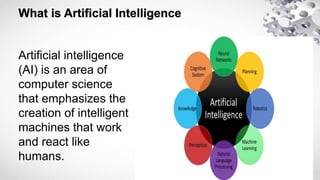
What is Artificial Intelligence
Artificial intelligence
(AI) is an area of
computer science
that emphasizes the
creation of intelligent
machines that work
and react like
humans.
What are the activities included in AI
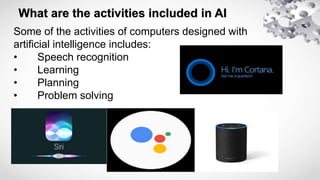
Some of the activities of computers designed with
artificial intelligence includes:
• Speech recognition
• Learning
• Planning
• Problem solving
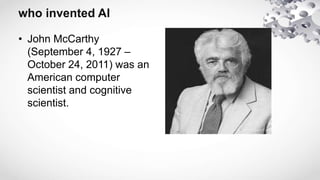
• John McCarthy
(September 4, 1927 –
October 24, 2011) was an
American computer
scientist and cognitive
scientist.
ADVANTAGES
• Less Errors
• Faster Decisions
• Daily Applications
• No Emotions
• Digital Assistants
• No Breaks
• Taking risks on behalf of
humans
DISADVANTAGES
• High Costs
• Unemployment
• Can’t think out of box
• Can’t feel Compassion
and Sympathy
• Highly dependent on
machines
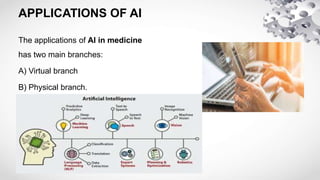
APPLICATIONS OF AI
The applications of AI in medicine
has two main branches:
A) Virtual branch
B) Physical branch.
Artificial intelligence in medicine:
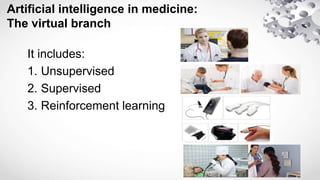
The virtual branch
It includes:
1. Unsupervised
2. Supervised
3. Reinforcement learning
Artificial intelligence in medicine:
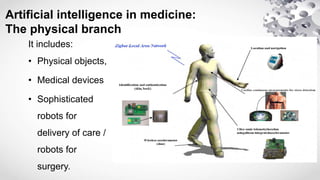
The physical branch
It includes:
• Physical objects,
• Medical devices
• Sophisticated
robots for
delivery of care /
robots for
surgery.
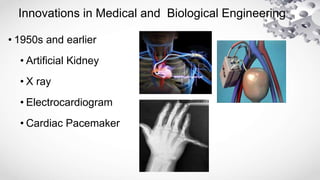
Innovations in Medical and Biological Engineering
• 1950s and earlier
• Artificial Kidney
• X ray
• Electrocardiogram
• Cardiac Pacemaker
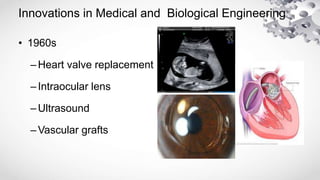
Innovations in Medical and Biological Engineering
• 1960s
–Heart valve replacement
–Intraocular lens
–Ultrasound
–Vascular grafts
Innovations in Medical and Biological Engineering
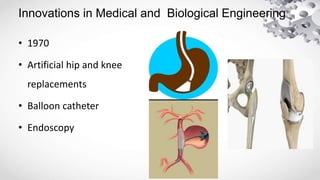
• 1970
• Artificial hip and knee
replacements
• Balloon catheter
• Endoscopy
Innovations in Medical and Biological Engineering
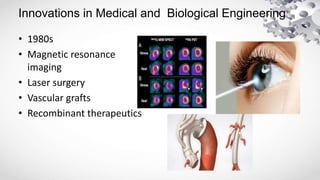
• 1980s
• Magnetic resonance
imaging
• Laser surgery
• Vascular grafts
• Recombinant therapeutics
Innovations in Medical and Biological Engineering
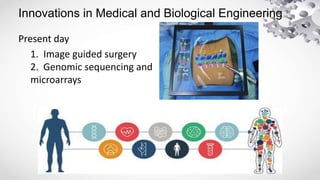
Present day
1. Image guided surgery
2. Genomic sequencing and
microarrays
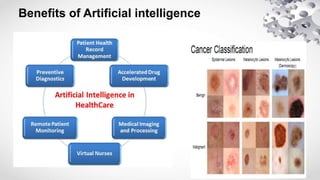
Benefits of Artificial intelligence
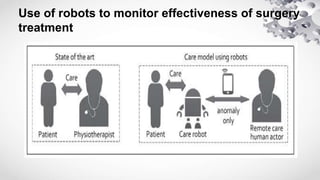
Use of robots to monitor effectiveness of surgery
treatment
Use of robots to deliver treatment..robotic surgery
Use of robots to deliver treatment Robotic surgery
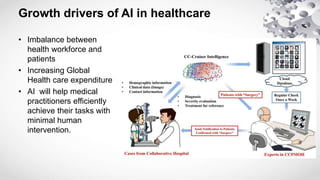
Growth drivers of AI in healthcare
• Imbalance between
health workforce and
patients
• Increasing Global
Health care expenditure
• AI will help medical
practitioners efficiently
achieve their tasks with
minimal human
intervention.
CONCLUSION
In its short existence , AI has increased understanding of
the nature of intelligence and provided an impressive array
of application in a wide range of areas.
THANK YOU

Artificial intelligence in medicine

  • 1.
  • 2.
    Topics covered • ArtificialIntelligence • Founder of Artificial Intelligence • Applications of AI • Benefits of AI • Growth of AI in healthcare • Use of Robots • Artificial Intelligence – Advantages and Disadvantages
  • 3.
    What is ArtificialIntelligence Artificial intelligence (AI) is an area of computer science that emphasizes the creation of intelligent machines that work and react like humans.
  • 4.
    What are theactivities included in AI Some of the activities of computers designed with artificial intelligence includes: • Speech recognition • Learning • Planning • Problem solving
  • 5.
    • John McCarthy (September4, 1927 – October 24, 2011) was an American computer scientist and cognitive scientist.
  • 6.
    ADVANTAGES • Less Errors •Faster Decisions • Daily Applications • No Emotions • Digital Assistants • No Breaks • Taking risks on behalf of humans DISADVANTAGES • High Costs • Unemployment • Can’t think out of box • Can’t feel Compassion and Sympathy • Highly dependent on machines
  • 7.
    APPLICATIONS OF AI Theapplications of AI in medicine has two main branches: A) Virtual branch B) Physical branch.
  • 8.
    Artificial intelligence inmedicine: The virtual branch It includes: 1. Unsupervised 2. Supervised 3. Reinforcement learning
  • 9.
    Artificial intelligence inmedicine: The physical branch It includes: • Physical objects, • Medical devices • Sophisticated robots for delivery of care / robots for surgery.
  • 10.
    Innovations in Medicaland Biological Engineering • 1950s and earlier • Artificial Kidney • X ray • Electrocardiogram • Cardiac Pacemaker
  • 11.
    Innovations in Medicaland Biological Engineering • 1960s –Heart valve replacement –Intraocular lens –Ultrasound –Vascular grafts
  • 12.
    Innovations in Medicaland Biological Engineering • 1970 • Artificial hip and knee replacements • Balloon catheter • Endoscopy
  • 13.
    Innovations in Medicaland Biological Engineering • 1980s • Magnetic resonance imaging • Laser surgery • Vascular grafts • Recombinant therapeutics
  • 14.
    Innovations in Medicaland Biological Engineering Present day 1. Image guided surgery 2. Genomic sequencing and microarrays
  • 15.
  • 16.
    Use of robotsto monitor effectiveness of surgery treatment
  • 17.
    Use of robotsto deliver treatment..robotic surgery Use of robots to deliver treatment Robotic surgery
  • 18.
    Growth drivers ofAI in healthcare • Imbalance between health workforce and patients • Increasing Global Health care expenditure • AI will help medical practitioners efficiently achieve their tasks with minimal human intervention.
  • 19.
    CONCLUSION In its shortexistence , AI has increased understanding of the nature of intelligence and provided an impressive array of application in a wide range of areas.
  • 20.