Mr. A. S. Kulkarni
M. Pharm (Pharmaceutics)
HOSPITALS
Learning Outcomes
After completion of this presentation, learners will be able to:
✓ Define the hospital
✓ Remember the various functions of hospital
✓ Understand the classification of hospital and organization
and management of hospital
✓ Evaluate the health delivery system in India
Roadmap
➢ Introduction
➢ Functions of Hospital
➢ Classification of Hospital
➢ Concept of District Hospital
➢ Organization and management of the Hospital
➢ Health delivery system in India
Reflection Spot
What is the concept and functions of hospital?
Introduction to Hospital
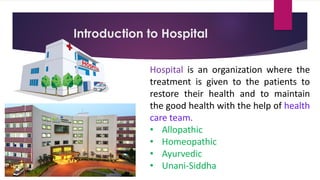
Hospital is an organization where the
treatment is given to the patients to
restore their health and to maintain
the good health with the help of health
care team.
• Allopathic
• Homeopathic
• Ayurvedic
• Unani-Siddha
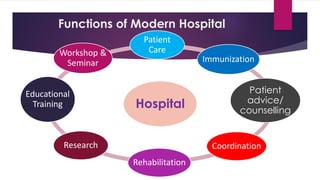
Functions of Modern Hospital
Hospital
Patient
Care
Immunization
Patient
advice/
counselling
Coordination
Rehabilitation
Research
Educational
Training
Workshop &
Seminar
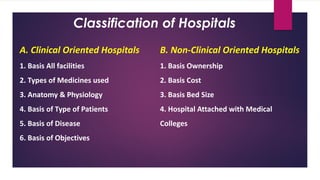
Classification of Hospitals
A. Clinical Oriented Hospitals
1. Basis All facilities
2. Types of Medicines used
3. Anatomy & Physiology
4. Basis of Type of Patients
5. Basis of Disease
6. Basis of Objectives
B. Non-Clinical Oriented Hospitals
1. Basis Ownership
2. Basis Cost
3. Basis Bed Size
4. Hospital Attached with Medical
Colleges
Classification of Hospitals
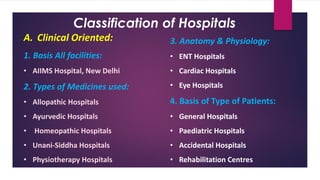
A. Clinical Oriented:
1. Basis All facilities:
• AIIMS Hospital, New Delhi
2. Types of Medicines used:
• Allopathic Hospitals
• Ayurvedic Hospitals
• Homeopathic Hospitals
• Unani-Siddha Hospitals
• Physiotherapy Hospitals
3. Anatomy & Physiology:
• ENT Hospitals
• Cardiac Hospitals
• Eye Hospitals
4. Basis of Type of Patients:
• General Hospitals
• Paediatric Hospitals
• Accidental Hospitals
• Rehabilitation Centres
Classification of Hospitals
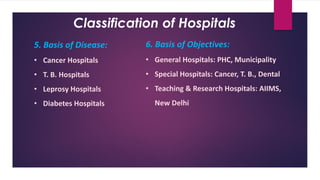
5. Basis of Disease:
• Cancer Hospitals
• T. B. Hospitals
• Leprosy Hospitals
• Diabetes Hospitals
6. Basis of Objectives:
• General Hospitals: PHC, Municipality
• Special Hospitals: Cancer, T. B., Dental
• Teaching & Research Hospitals: AIIMS,
New Delhi
Classification of Hospitals
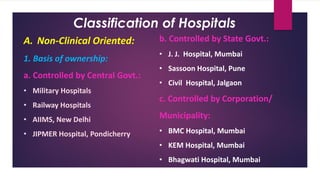
A. Non-Clinical Oriented:
1. Basis of ownership:
a. Controlled by Central Govt.:
• Military Hospitals
• Railway Hospitals
• AIIMS, New Delhi
• JIPMER Hospital, Pondicherry
b. Controlled by State Govt.:
• J. J. Hospital, Mumbai
• Sassoon Hospital, Pune
• Civil Hospital, Jalgaon
c. Controlled by Corporation/
Municipality:
• BMC Hospital, Mumbai
• KEM Hospital, Mumbai
• Bhagwati Hospital, Mumbai
Classification of Hospitals
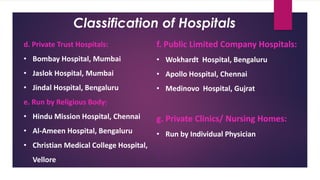
d. Private Trust Hospitals:
• Bombay Hospital, Mumbai
• Jaslok Hospital, Mumbai
• Jindal Hospital, Bengaluru
e. Run by Religious Body:
• Hindu Mission Hospital, Chennai
• Al-Ameen Hospital, Bengaluru
• Christian Medical College Hospital,
Vellore
f. Public Limited Company Hospitals:
• Wokhardt Hospital, Bengaluru
• Apollo Hospital, Chennai
• Medinovo Hospital, Gujrat
g. Private Clinics/ Nursing Homes:
• Run by Individual Physician
Classification of Hospitals
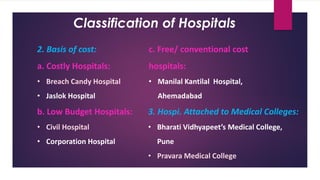
2. Basis of cost:
a. Costly Hospitals:
• Breach Candy Hospital
• Jaslok Hospital
b. Low Budget Hospitals:
• Civil Hospital
• Corporation Hospital
c. Free/ conventional cost
hospitals:
• Manilal Kantilal Hospital,
Ahemadabad
3. Hospi. Attached to Medical Colleges:
• Bharati Vidhyapeet’s Medical College,
Pune
• Pravara Medical College
Classification of Hospitals
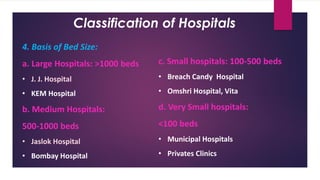
4. Basis of Bed Size:
a. Large Hospitals: >1000 beds
• J. J. Hospital
• KEM Hospital
b. Medium Hospitals:
500-1000 beds
• Jaslok Hospital
• Bombay Hospital
c. Small hospitals: 100-500 beds
• Breach Candy Hospital
• Omshri Hospital, Vita
d. Very Small hospitals:
<100 beds
• Municipal Hospitals
• Privates Clinics
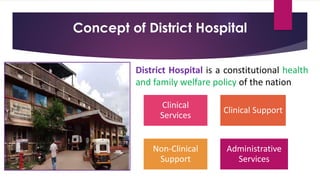
Concept of District Hospital
Clinical
Services
Clinical Support
Non-Clinical
Support
Administrative
Services
District Hospital is a constitutional health
and family welfare policy of the nation
Reflection spot
How will you analyse organization of the hospital?
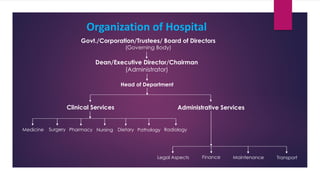
Dean/Executive Director/Chairman
(Administrator)
Nursing
Head of Department
Dietary Pathology RadiologyPharmacySurgeryMedicine
Govt./Corporation/Trustees/ Board of Directors
(Governing Body)
Organization of Hospital
Clinical Services Administrative Services
TransportMaintenanceFinanceLegal Aspects
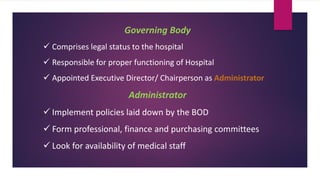
Governing Body
✓ Comprises legal status to the hospital
✓ Responsible for proper functioning of Hospital
✓ Appointed Executive Director/ Chairperson as Administrator
Administrator
✓ Implement policies laid down by the BOD
✓ Form professional, finance and purchasing committees
✓ Look for availability of medical staff
Medical Staff
1. Residential Medical Officer (RMO): Available 24 hours
2. Consultants: Come in the hospital on a particular day and time
3. Visiting Specialist: Expert in specific branch of medicine, come when any
emergency to give his expert opinion
4. Honorary Staff: Retired medical professionals and provide honorary
services to the hospital
5. Head of Department (HOD): Competent, experienced and expert, full time
(Medicine and Surgery Dept.)
Functions of HOD:
1. Overall responsible the activities in the department
2. Responsible to give quality service
3. About future plan, as well as training programs in the dept.
4. Send monthly reports to the Administrator
Clinical Departments
• Depends on specialised medical staff
• Services like medicine, surgery, pathology, radiology
• Supportive services – dietary and house keeping
Surgical Division
• Operation Theatre:
✓ Professionally skilled person
✓ Sterile (CSS dept.)
✓ Having vital instruments, surgical accessories/ instruments
Radiology
• Radiologist
• Diagnostic and therapeutic value (Radio-isotopes)
• Computer aided instruments – CT scan, sonography, CAT
Maternity
• Delivery ward
• Proper records such as infants record – birth record
• Case – premature birth (special care)
Clinical and Pathological Services
• Headed by pathologist
• Blood sample/biochemistry testing
Blood Bank
• FDA declared as a therapeutic agent
• Require licence to function
• Instruments for collection, processing, testing and storage
• All records maintained about donors and receivers
➢ Steps:
✓ Receiving of Examination of donor:
✓ Collecting, processing and storage of blood:
✓ ABO grouping and compatibility testing before transfusion
Nursing Services
• Largest and integral part, Plays an important role in the Hospital
• Nursing administrator (HOD/Superintendent/Matron)
➢ Responsibilities:
✓ Coordination to all the departments
✓ Administration of medicine to the patient
✓ Send monthly report to the higher authority
✓ Maintain the records and give quality and professional services to the patient
✓ Look to need of the department and arrange training program for fellow
nurses
Importance of Nursing Services
1. For Ambulatory patients:
a. Preparation of case paper
b. Guide to the patient
c. Assistance to the physician
2. For Inpatients:
a. Patient care
b. For operating patients
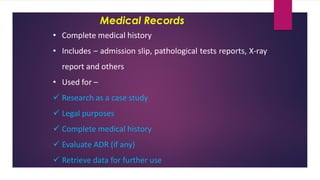
Medical Records
• Complete medical history
• Includes – admission slip, pathological tests reports, X-ray
report and others
• Used for –
✓ Research as a case study
✓ Legal purposes
✓ Complete medical history
✓ Evaluate ADR (if any)
✓ Retrieve data for further use
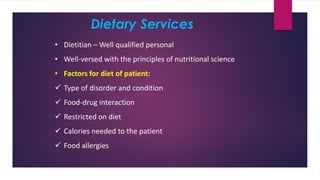
Dietary Services
• Dietitian – Well qualified personal
• Well-versed with the principles of nutritional science
• Factors for diet of patient:
✓ Type of disorder and condition
✓ Food-drug interaction
✓ Restricted on diet
✓ Calories needed to the patient
✓ Food allergies
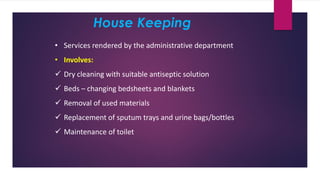
House Keeping
• Services rendered by the administrative department
• Involves:
✓ Dry cleaning with suitable antiseptic solution
✓ Beds – changing bedsheets and blankets
✓ Removal of used materials
✓ Replacement of sputum trays and urine bags/bottles
✓ Maintenance of toilet
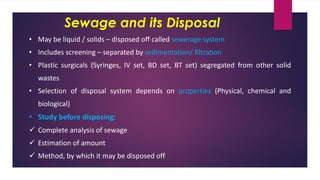
Sewage and its Disposal
• May be liquid / solids – disposed off called sewerage system
• Includes screening – separated by sedimentation/ filtration
• Plastic surgicals (Syringes, IV set, BD set, BT set) segregated from other solid
wastes
• Selection of disposal system depends on properties (Physical, chemical and
biological)
• Study before disposing:
✓ Complete analysis of sewage
✓ Estimation of amount
✓ Method, by which it may be disposed off
• Raw material consists of organic and inorganic material
• Decomposed by
✓ Aerobic bacteria: Needs oxygen for survival
✓ Anaerobic bacteria: CO2 enhances the growth
✓ Facultative bacteria: Survive in absence of oxygen under a favourable
condition the sewage get composed itself.
Disposal of Solid Waste
• Cotton, wool, bandages, plasters, etc.
• Incineration method
• Plastics items, syringes and IV sets
• Grinding method – cutter mill
• Plastic granule sold to plastic industries for fabrication of
domestic articles
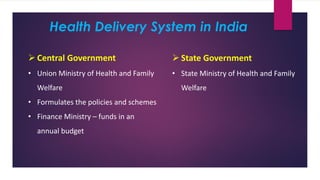
Health Delivery System in India
➢ Central Government
• Union Ministry of Health and Family
Welfare
• Formulates the policies and schemes
• Finance Ministry – funds in an
annual budget
➢ State Government
• State Ministry of Health and Family
Welfare
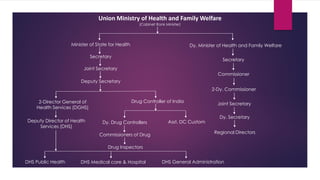
Minister of State for Health Dy. Minister of Health and Family Welfare
Secretary
Joint Secretary
Deputy Secretary
Drug Controller of India2-Director General of
Health Services (DGHS)
Deputy Director of Health
Services (DHS)
Dy. Drug Controllers Asst. DC Custom
Commissioners of Drug
Drug Inspectors
DHS Public Health DHS Medical care & Hospital DHS General Administration
Secretary
Commissioner
2-Dy. Commissioner
Joint Secretary
Dy. Secretary
Regional Directors
Union Ministry of Health and Family Welfare
(Cabinet Rank Minister)
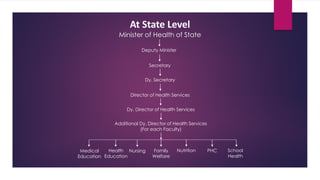
Deputy Minister
Family
Welfare
Secretary
Dy. Secretary
Director of Health Services
Dy. Director of Health Services
Additional Dy. Director of Health Services
(For each Faculty)
Nutrition PHC School
Health
NursingHealth
Education
Medical
Education
At State Level
Minister of Health of State
Mr. A. S. Kulkarni
M.Pharm (Pharmaceutics)
(M) : +919975417949
email: amarkulkarni123@gmail.com

Hospitals

  • 1.
    Mr. A. S.Kulkarni M. Pharm (Pharmaceutics) HOSPITALS
  • 2.
    Learning Outcomes After completionof this presentation, learners will be able to: ✓ Define the hospital ✓ Remember the various functions of hospital ✓ Understand the classification of hospital and organization and management of hospital ✓ Evaluate the health delivery system in India
  • 3.
    Roadmap ➢ Introduction ➢ Functionsof Hospital ➢ Classification of Hospital ➢ Concept of District Hospital ➢ Organization and management of the Hospital ➢ Health delivery system in India
  • 4.
    Reflection Spot What isthe concept and functions of hospital?
  • 5.
    Introduction to Hospital Hospitalis an organization where the treatment is given to the patients to restore their health and to maintain the good health with the help of health care team. • Allopathic • Homeopathic • Ayurvedic • Unani-Siddha
  • 6.
    Functions of ModernHospital Hospital Patient Care Immunization Patient advice/ counselling Coordination Rehabilitation Research Educational Training Workshop & Seminar
  • 7.
    Classification of Hospitals A.Clinical Oriented Hospitals 1. Basis All facilities 2. Types of Medicines used 3. Anatomy & Physiology 4. Basis of Type of Patients 5. Basis of Disease 6. Basis of Objectives B. Non-Clinical Oriented Hospitals 1. Basis Ownership 2. Basis Cost 3. Basis Bed Size 4. Hospital Attached with Medical Colleges
  • 8.
    Classification of Hospitals A.Clinical Oriented: 1. Basis All facilities: • AIIMS Hospital, New Delhi 2. Types of Medicines used: • Allopathic Hospitals • Ayurvedic Hospitals • Homeopathic Hospitals • Unani-Siddha Hospitals • Physiotherapy Hospitals 3. Anatomy & Physiology: • ENT Hospitals • Cardiac Hospitals • Eye Hospitals 4. Basis of Type of Patients: • General Hospitals • Paediatric Hospitals • Accidental Hospitals • Rehabilitation Centres
  • 9.
    Classification of Hospitals 5.Basis of Disease: • Cancer Hospitals • T. B. Hospitals • Leprosy Hospitals • Diabetes Hospitals 6. Basis of Objectives: • General Hospitals: PHC, Municipality • Special Hospitals: Cancer, T. B., Dental • Teaching & Research Hospitals: AIIMS, New Delhi
  • 10.
    Classification of Hospitals A.Non-Clinical Oriented: 1. Basis of ownership: a. Controlled by Central Govt.: • Military Hospitals • Railway Hospitals • AIIMS, New Delhi • JIPMER Hospital, Pondicherry b. Controlled by State Govt.: • J. J. Hospital, Mumbai • Sassoon Hospital, Pune • Civil Hospital, Jalgaon c. Controlled by Corporation/ Municipality: • BMC Hospital, Mumbai • KEM Hospital, Mumbai • Bhagwati Hospital, Mumbai
  • 11.
    Classification of Hospitals d.Private Trust Hospitals: • Bombay Hospital, Mumbai • Jaslok Hospital, Mumbai • Jindal Hospital, Bengaluru e. Run by Religious Body: • Hindu Mission Hospital, Chennai • Al-Ameen Hospital, Bengaluru • Christian Medical College Hospital, Vellore f. Public Limited Company Hospitals: • Wokhardt Hospital, Bengaluru • Apollo Hospital, Chennai • Medinovo Hospital, Gujrat g. Private Clinics/ Nursing Homes: • Run by Individual Physician
  • 12.
    Classification of Hospitals 2.Basis of cost: a. Costly Hospitals: • Breach Candy Hospital • Jaslok Hospital b. Low Budget Hospitals: • Civil Hospital • Corporation Hospital c. Free/ conventional cost hospitals: • Manilal Kantilal Hospital, Ahemadabad 3. Hospi. Attached to Medical Colleges: • Bharati Vidhyapeet’s Medical College, Pune • Pravara Medical College
  • 13.
    Classification of Hospitals 4.Basis of Bed Size: a. Large Hospitals: >1000 beds • J. J. Hospital • KEM Hospital b. Medium Hospitals: 500-1000 beds • Jaslok Hospital • Bombay Hospital c. Small hospitals: 100-500 beds • Breach Candy Hospital • Omshri Hospital, Vita d. Very Small hospitals: <100 beds • Municipal Hospitals • Privates Clinics
  • 14.
    Concept of DistrictHospital Clinical Services Clinical Support Non-Clinical Support Administrative Services District Hospital is a constitutional health and family welfare policy of the nation
  • 15.
    Reflection spot How willyou analyse organization of the hospital?
  • 16.
    Dean/Executive Director/Chairman (Administrator) Nursing Head ofDepartment Dietary Pathology RadiologyPharmacySurgeryMedicine Govt./Corporation/Trustees/ Board of Directors (Governing Body) Organization of Hospital Clinical Services Administrative Services TransportMaintenanceFinanceLegal Aspects
  • 17.
    Governing Body ✓ Compriseslegal status to the hospital ✓ Responsible for proper functioning of Hospital ✓ Appointed Executive Director/ Chairperson as Administrator Administrator ✓ Implement policies laid down by the BOD ✓ Form professional, finance and purchasing committees ✓ Look for availability of medical staff
  • 18.
    Medical Staff 1. ResidentialMedical Officer (RMO): Available 24 hours 2. Consultants: Come in the hospital on a particular day and time 3. Visiting Specialist: Expert in specific branch of medicine, come when any emergency to give his expert opinion 4. Honorary Staff: Retired medical professionals and provide honorary services to the hospital 5. Head of Department (HOD): Competent, experienced and expert, full time (Medicine and Surgery Dept.)
  • 19.
    Functions of HOD: 1.Overall responsible the activities in the department 2. Responsible to give quality service 3. About future plan, as well as training programs in the dept. 4. Send monthly reports to the Administrator
  • 20.
    Clinical Departments • Dependson specialised medical staff • Services like medicine, surgery, pathology, radiology • Supportive services – dietary and house keeping Surgical Division • Operation Theatre: ✓ Professionally skilled person ✓ Sterile (CSS dept.) ✓ Having vital instruments, surgical accessories/ instruments
  • 21.
    Radiology • Radiologist • Diagnosticand therapeutic value (Radio-isotopes) • Computer aided instruments – CT scan, sonography, CAT Maternity • Delivery ward • Proper records such as infants record – birth record • Case – premature birth (special care)
  • 22.
    Clinical and PathologicalServices • Headed by pathologist • Blood sample/biochemistry testing
  • 23.
    Blood Bank • FDAdeclared as a therapeutic agent • Require licence to function • Instruments for collection, processing, testing and storage • All records maintained about donors and receivers ➢ Steps: ✓ Receiving of Examination of donor: ✓ Collecting, processing and storage of blood: ✓ ABO grouping and compatibility testing before transfusion
  • 24.
    Nursing Services • Largestand integral part, Plays an important role in the Hospital • Nursing administrator (HOD/Superintendent/Matron) ➢ Responsibilities: ✓ Coordination to all the departments ✓ Administration of medicine to the patient ✓ Send monthly report to the higher authority ✓ Maintain the records and give quality and professional services to the patient ✓ Look to need of the department and arrange training program for fellow nurses
  • 25.
    Importance of NursingServices 1. For Ambulatory patients: a. Preparation of case paper b. Guide to the patient c. Assistance to the physician 2. For Inpatients: a. Patient care b. For operating patients
  • 26.
    Medical Records • Completemedical history • Includes – admission slip, pathological tests reports, X-ray report and others • Used for – ✓ Research as a case study ✓ Legal purposes ✓ Complete medical history ✓ Evaluate ADR (if any) ✓ Retrieve data for further use
  • 27.
    Dietary Services • Dietitian– Well qualified personal • Well-versed with the principles of nutritional science • Factors for diet of patient: ✓ Type of disorder and condition ✓ Food-drug interaction ✓ Restricted on diet ✓ Calories needed to the patient ✓ Food allergies
  • 28.
    House Keeping • Servicesrendered by the administrative department • Involves: ✓ Dry cleaning with suitable antiseptic solution ✓ Beds – changing bedsheets and blankets ✓ Removal of used materials ✓ Replacement of sputum trays and urine bags/bottles ✓ Maintenance of toilet
  • 29.
    Sewage and itsDisposal • May be liquid / solids – disposed off called sewerage system • Includes screening – separated by sedimentation/ filtration • Plastic surgicals (Syringes, IV set, BD set, BT set) segregated from other solid wastes • Selection of disposal system depends on properties (Physical, chemical and biological) • Study before disposing: ✓ Complete analysis of sewage ✓ Estimation of amount ✓ Method, by which it may be disposed off
  • 30.
    • Raw materialconsists of organic and inorganic material • Decomposed by ✓ Aerobic bacteria: Needs oxygen for survival ✓ Anaerobic bacteria: CO2 enhances the growth ✓ Facultative bacteria: Survive in absence of oxygen under a favourable condition the sewage get composed itself.
  • 31.
    Disposal of SolidWaste • Cotton, wool, bandages, plasters, etc. • Incineration method • Plastics items, syringes and IV sets • Grinding method – cutter mill • Plastic granule sold to plastic industries for fabrication of domestic articles
  • 32.
    Health Delivery Systemin India ➢ Central Government • Union Ministry of Health and Family Welfare • Formulates the policies and schemes • Finance Ministry – funds in an annual budget ➢ State Government • State Ministry of Health and Family Welfare
  • 33.
    Minister of Statefor Health Dy. Minister of Health and Family Welfare Secretary Joint Secretary Deputy Secretary Drug Controller of India2-Director General of Health Services (DGHS) Deputy Director of Health Services (DHS) Dy. Drug Controllers Asst. DC Custom Commissioners of Drug Drug Inspectors DHS Public Health DHS Medical care & Hospital DHS General Administration Secretary Commissioner 2-Dy. Commissioner Joint Secretary Dy. Secretary Regional Directors Union Ministry of Health and Family Welfare (Cabinet Rank Minister)
  • 34.
    Deputy Minister Family Welfare Secretary Dy. Secretary Directorof Health Services Dy. Director of Health Services Additional Dy. Director of Health Services (For each Faculty) Nutrition PHC School Health NursingHealth Education Medical Education At State Level Minister of Health of State
  • 36.
    Mr. A. S.Kulkarni M.Pharm (Pharmaceutics) (M) : +919975417949 email: amarkulkarni123@gmail.com