ML in Healthcare
BigR.io, LLC | Boston | Harrisburg | New York | San Jose | www.bigr.io
● U.S. healthcare spending hit ~$3.5T in 2017*
● U.S. healthcare spending to climb 5.3 percent in 2018
● Aging baby boomer population (retiring without proper knowledge transfer)
● Increasing drug prices and usage growth (especially for specialty drugs such as those for
genetic disorders and oncology)
● EHR adoption was incentivised and then enforced with penalties for noncompliance
● Data disparity and information sharing challenges (poor business models)
● Doctors know best
● AI is estimated to save up to $150 billion annually for the U.S. healthcare by 2026**
State of US Healthcare & the Call for AI
*Source: US Centers for Medicare and Medicaid Services (CMS)
**Source: Accenture report on “near-term value” of AI applications in healthcare
2
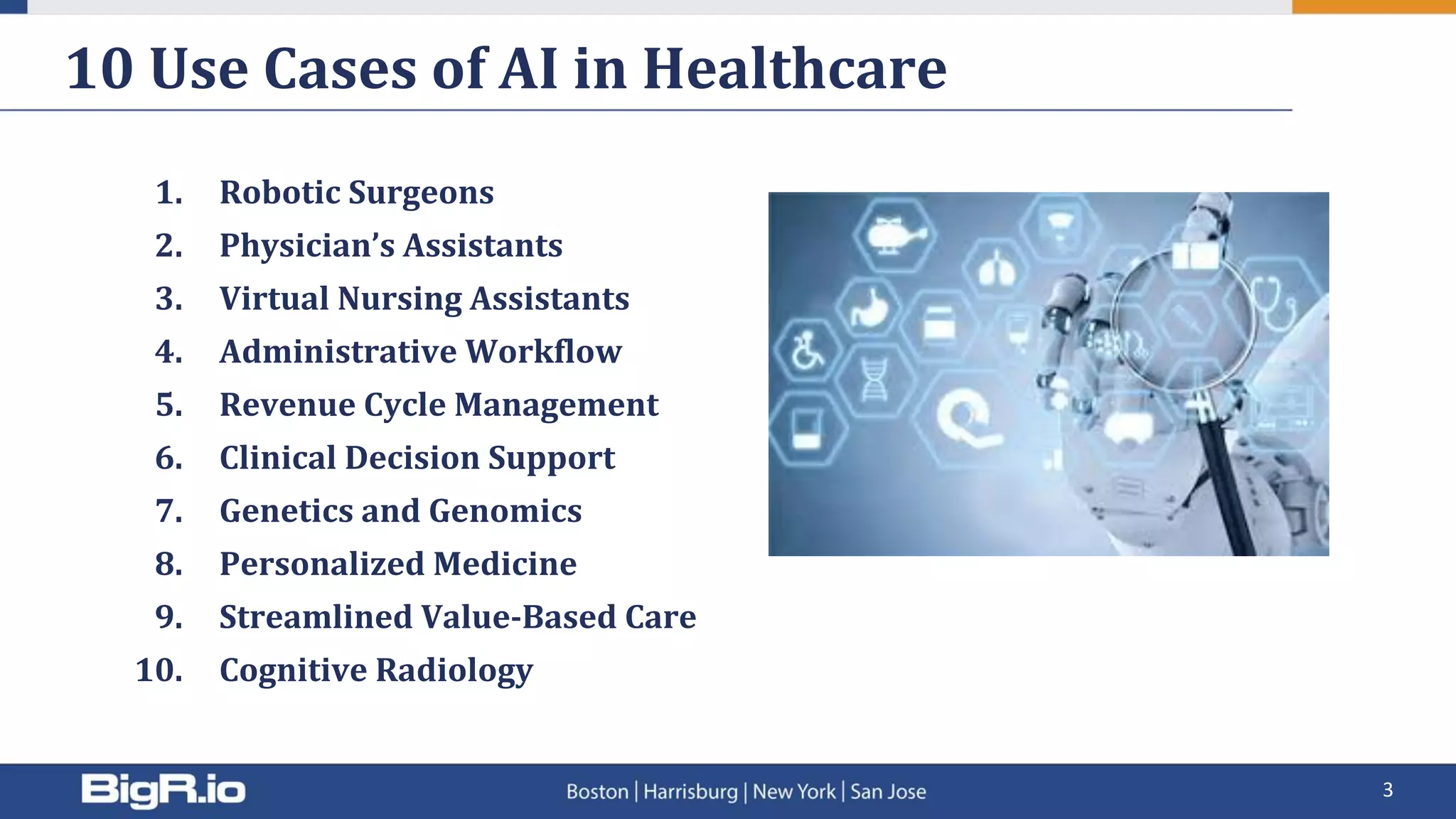
10 Use Cases of AI in Healthcare
3
1. Robotic Surgeons
2. Physician’s Assistants
3. Virtual Nursing Assistants
4. Administrative Workflow
5. Revenue Cycle Management
6. Clinical Decision Support
7. Genetics and Genomics
8. Personalized Medicine
9. Streamlined Value-Based Care
10. Cognitive Radiology
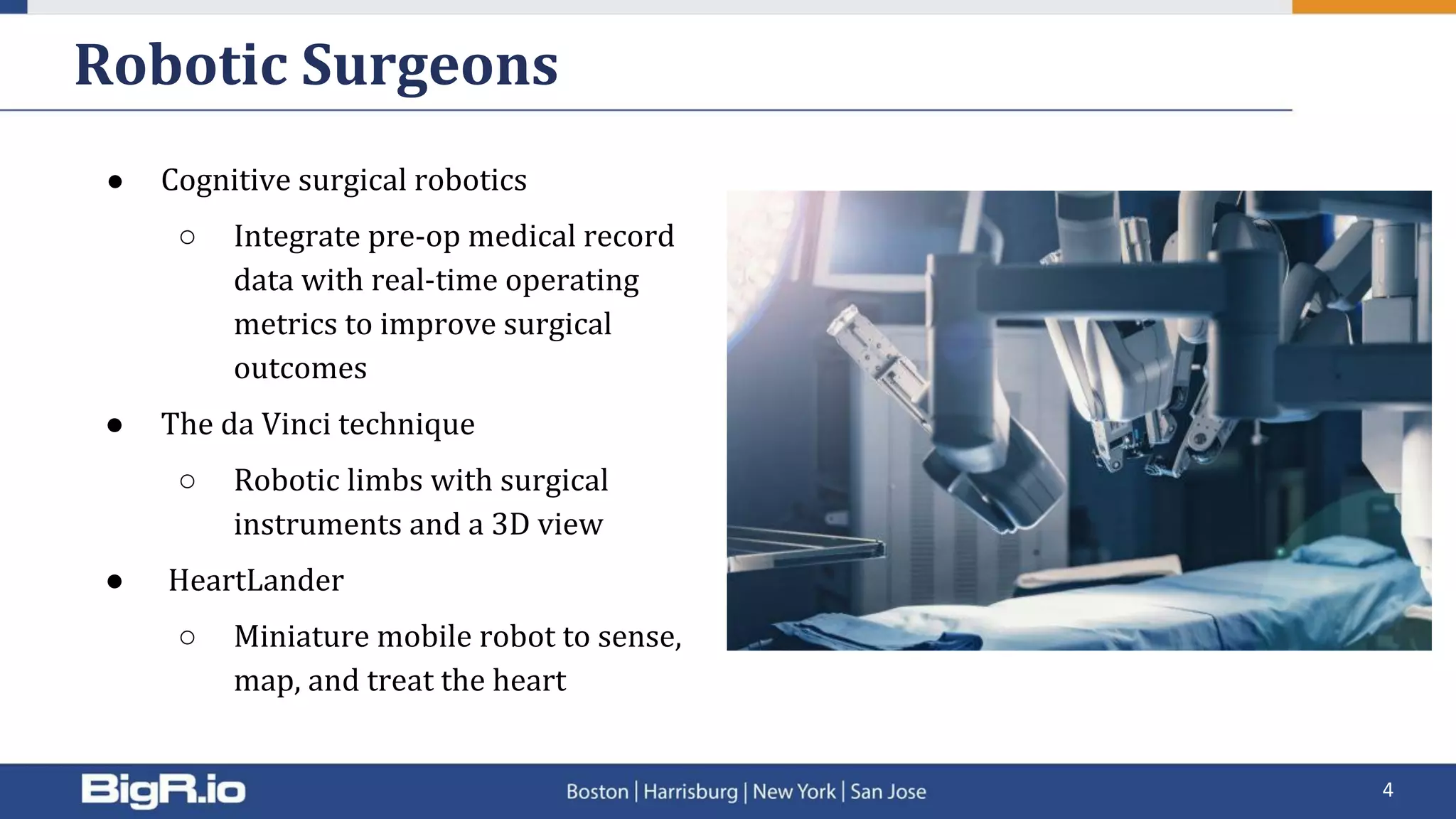
● Cognitive surgical robotics
○ Integrate pre-op medical record
data with real-time operating
metrics to improve surgical
outcomes
● The da Vinci technique
○ Robotic limbs with surgical
instruments and a 3D view
● HeartLander
○ Miniature mobile robot to sense,
map, and treat the heart
Robotic Surgeons
4
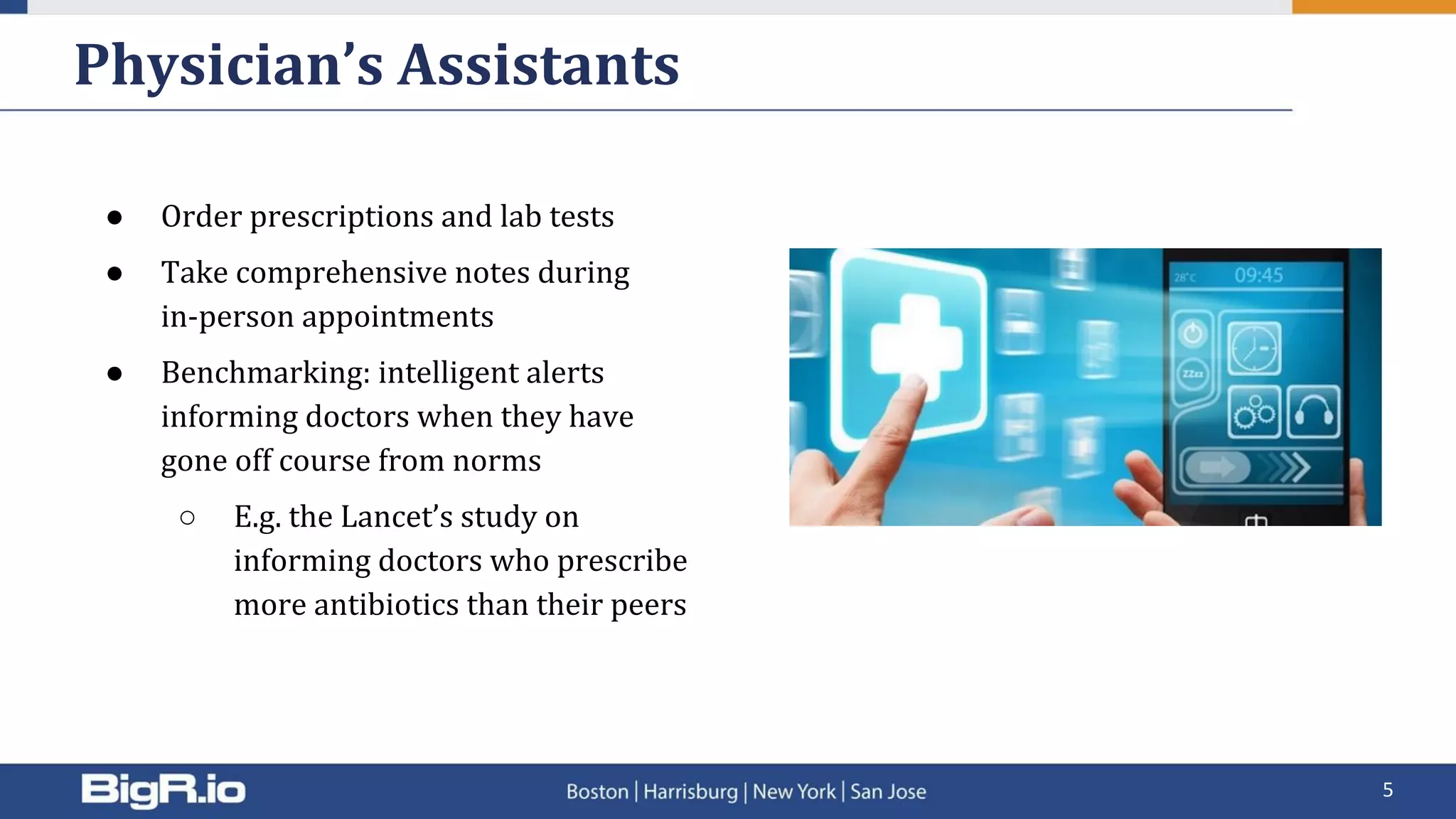
● Order prescriptions and lab tests
● Take comprehensive notes during
in-person appointments
● Benchmarking: intelligent alerts
informing doctors when they have
gone off course from norms
○ E.g. the Lancet’s study on
informing doctors who prescribe
more antibiotics than their peers
Physician’s Assistants
5
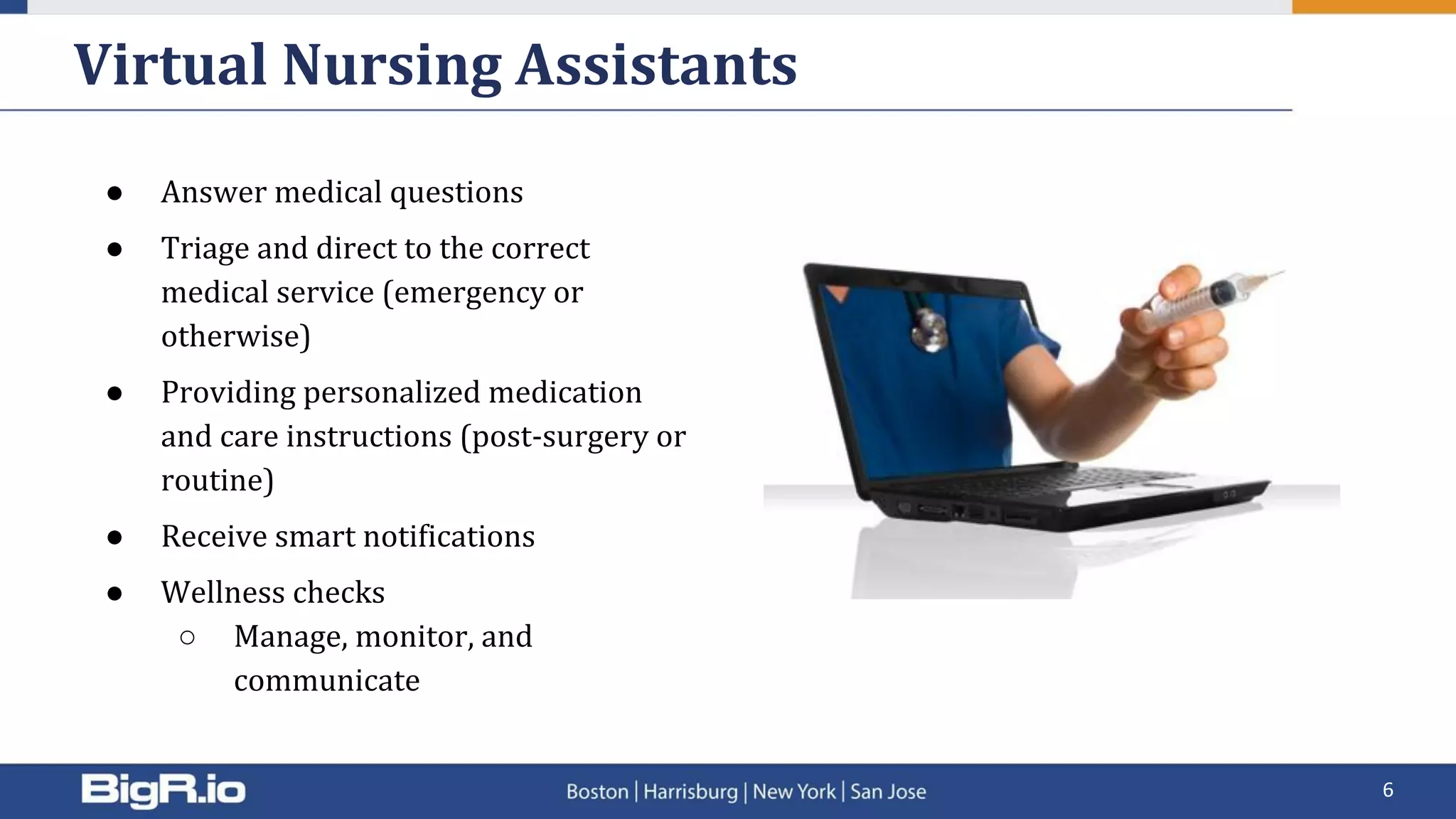
● Answer medical questions
● Triage and direct to the correct
medical service (emergency or
otherwise)
● Providing personalized medication
and care instructions (post-surgery or
routine)
● Receive smart notifications
● Wellness checks
○ Manage, monitor, and
communicate
Virtual Nursing Assistants
6
Administrative Workflow
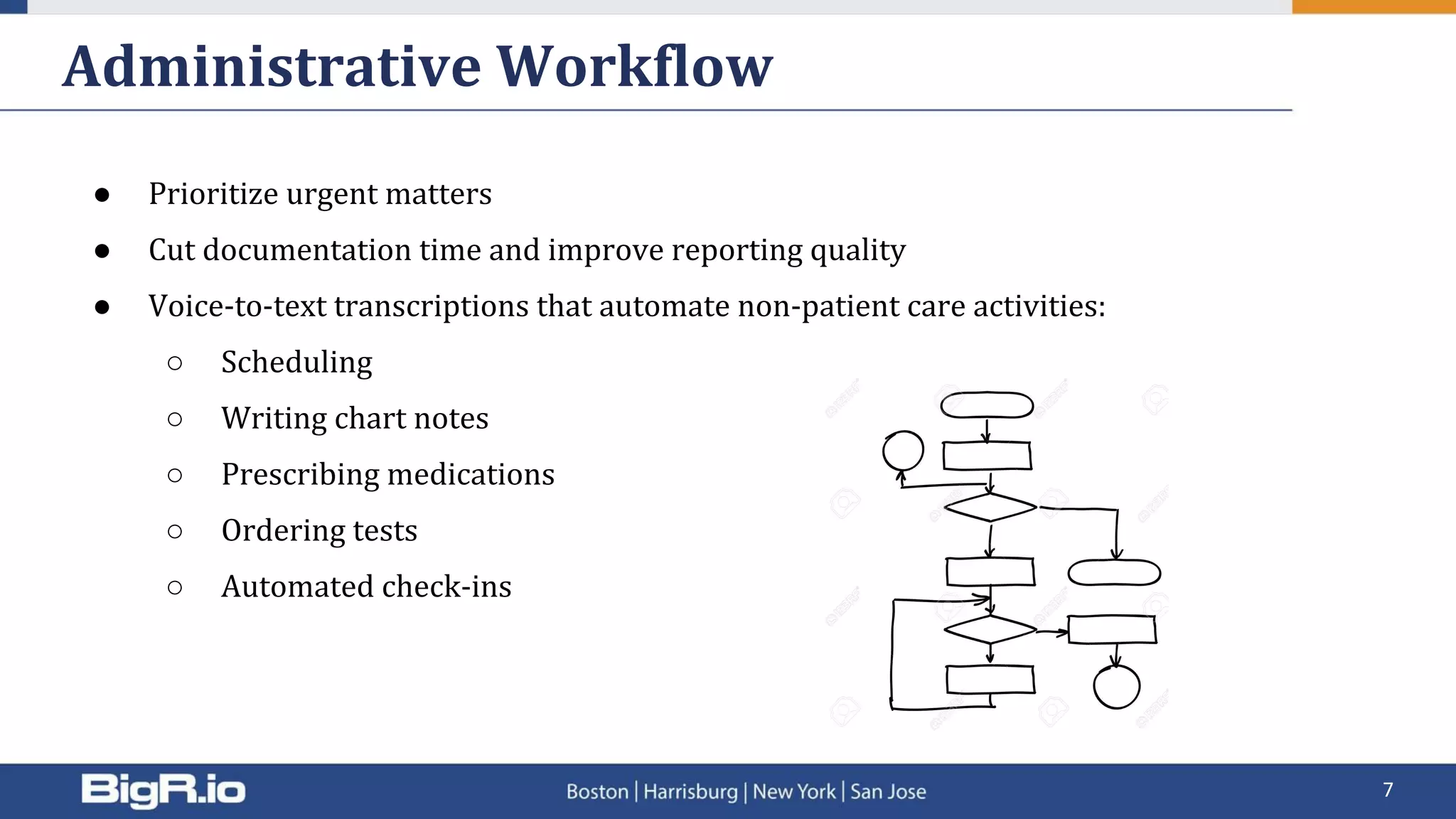
● Prioritize urgent matters
● Cut documentation time and improve reporting quality
● Voice-to-text transcriptions that automate non-patient care activities:
○ Scheduling
○ Writing chart notes
○ Prescribing medications
○ Ordering tests
○ Automated check-ins
7
Revenue Cycle Management
Analysis of financial records to maximize book
value.
● Selecting which past-due accounts need
collections actions based on size and
likelihood of payout (using demographics,
psychographics, and historicals to make
weighted predictions), and avoidance of
negative PR situations.
● Analysis of missing charges based on
common procedural groupings.
8
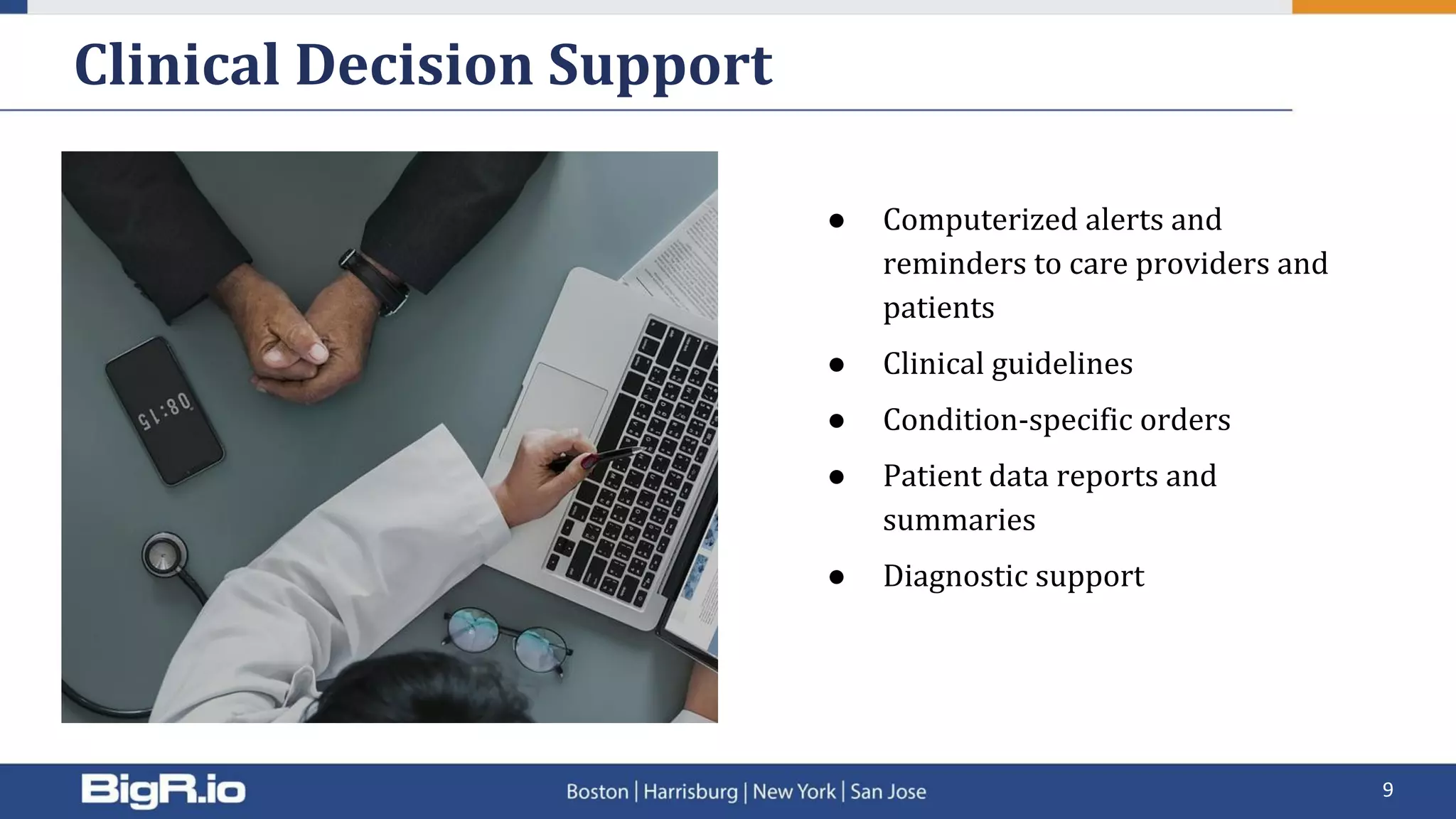
● Computerized alerts and
reminders to care providers and
patients
● Clinical guidelines
● Condition-specific orders
● Patient data reports and
summaries
● Diagnostic support
Clinical Decision Support
9
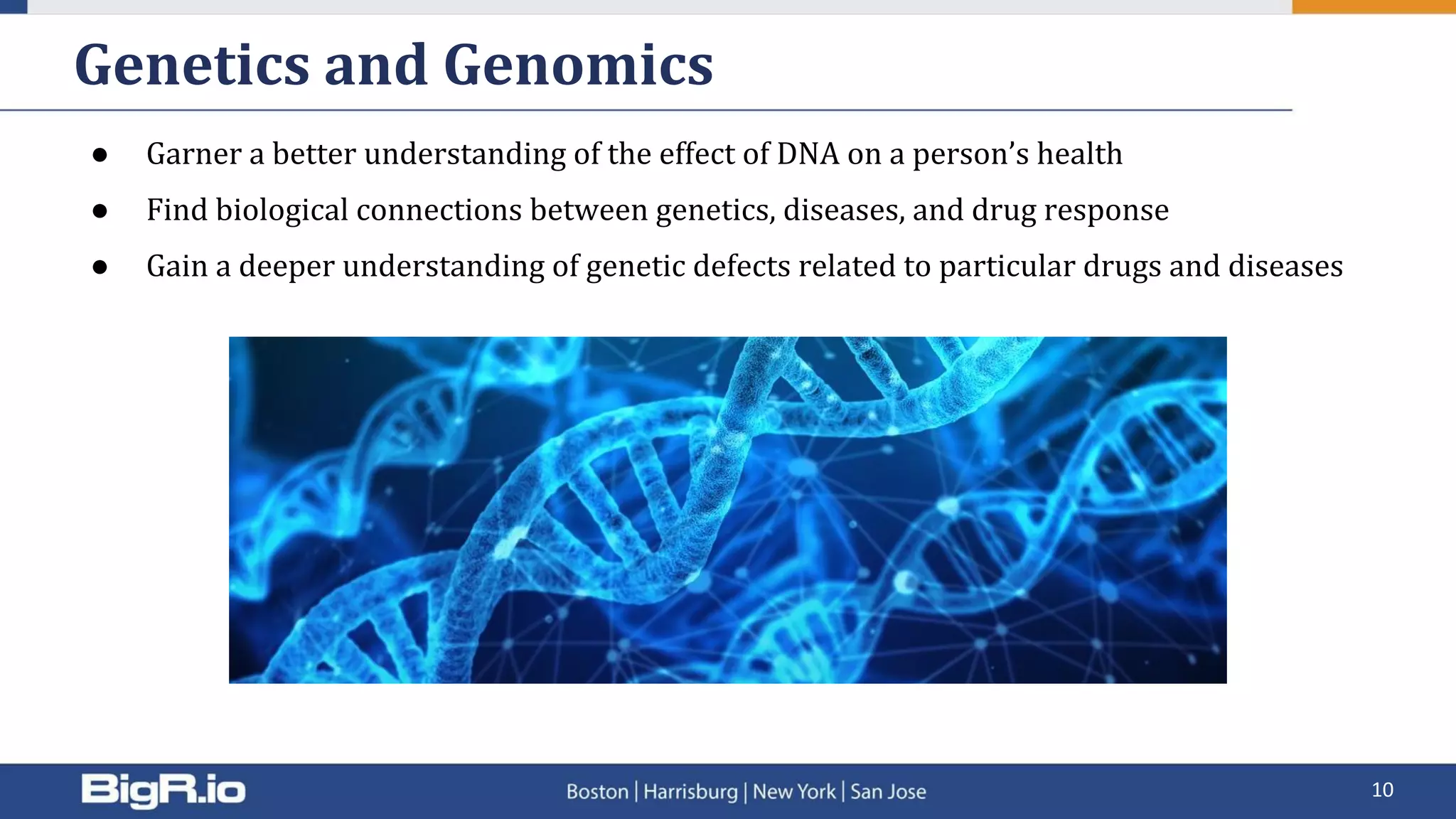
● Garner a better understanding of the effect of DNA on a person’s health
● Find biological connections between genetics, diseases, and drug response
● Gain a deeper understanding of genetic defects related to particular drugs and diseases
Genetics and Genomics
10
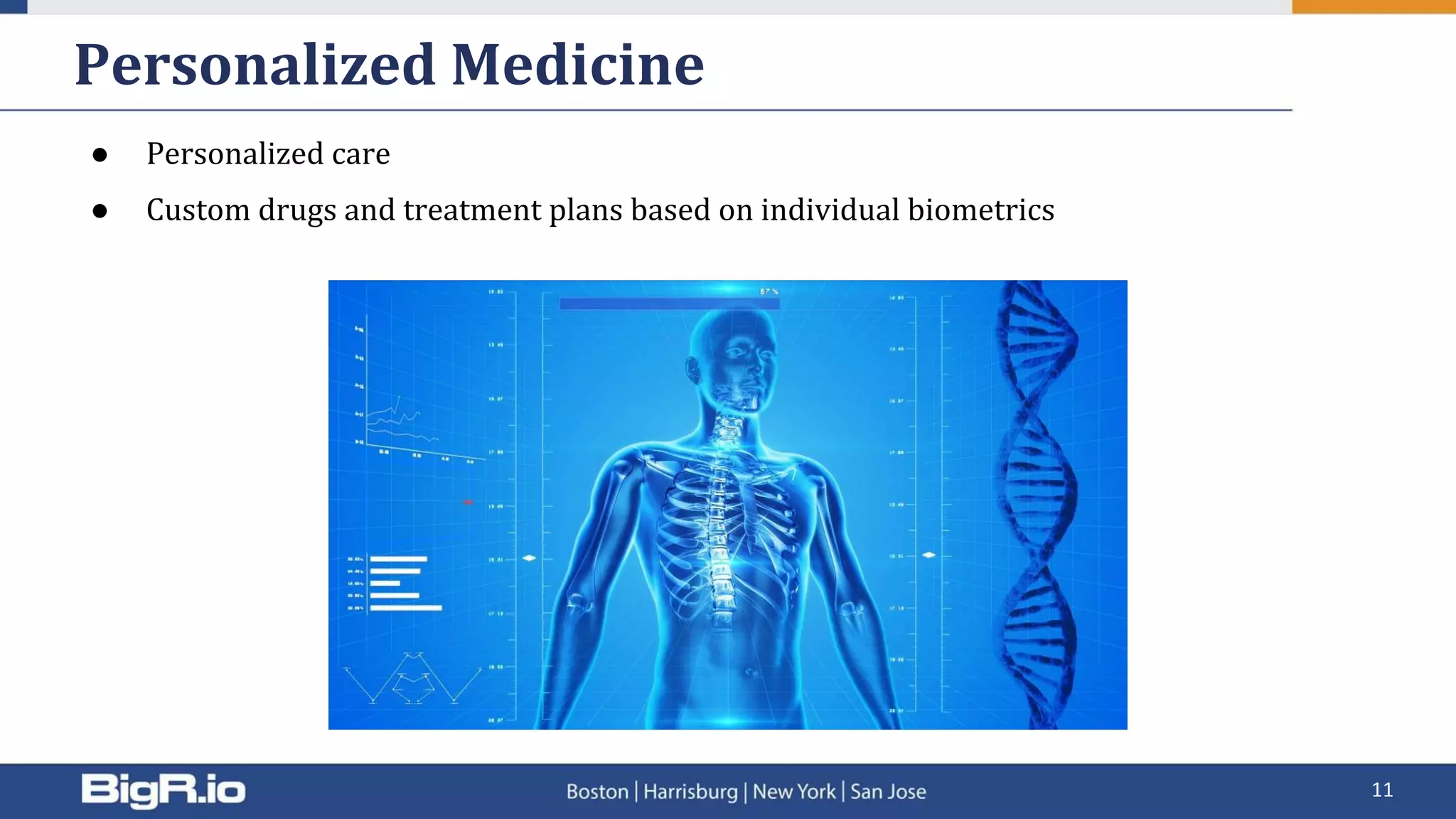
● Personalized care
● Custom drugs and treatment plans based on individual biometrics
Personalized Medicine
11
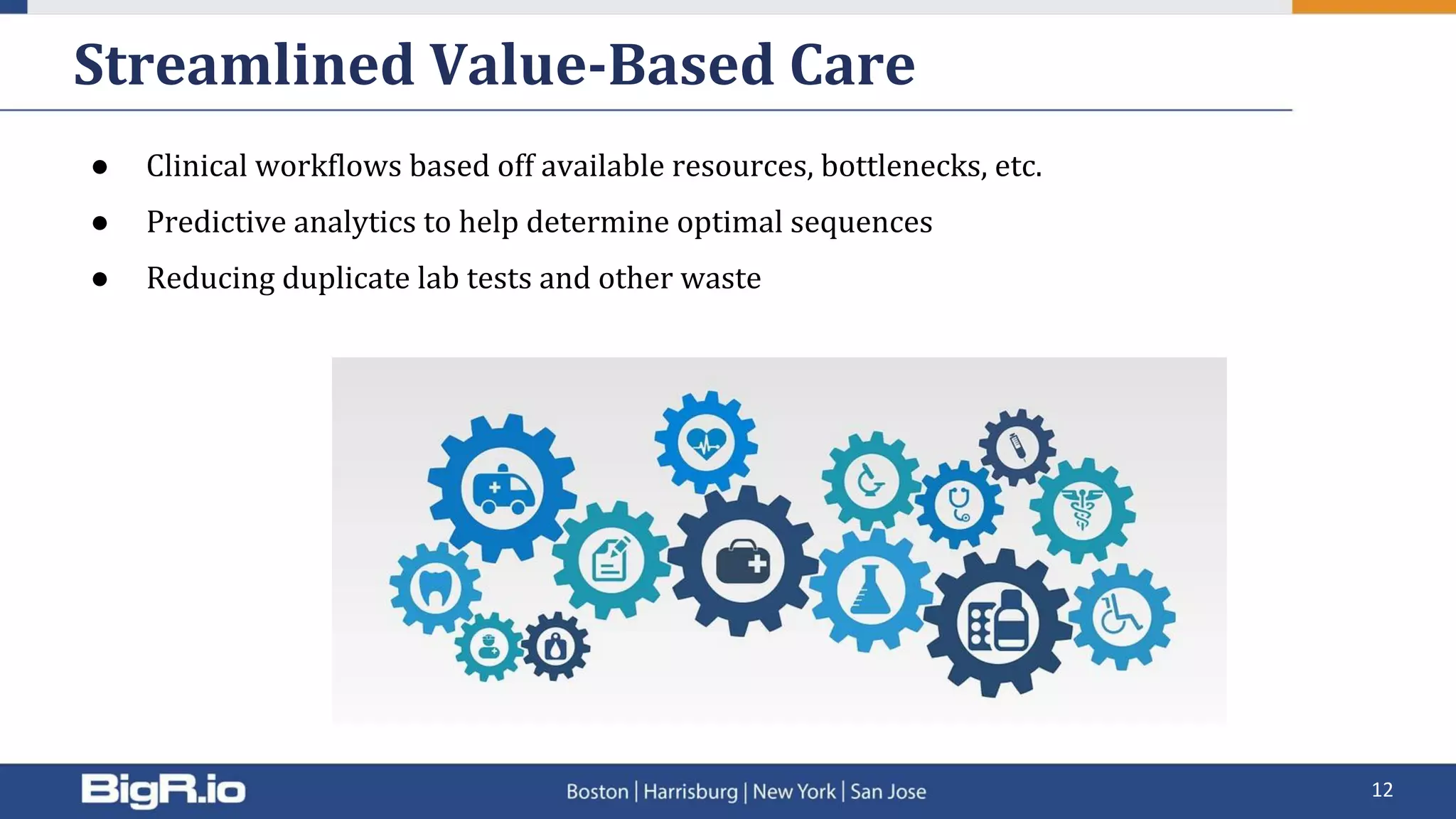
● Clinical workflows based off available resources, bottlenecks, etc.
● Predictive analytics to help determine optimal sequences
● Reducing duplicate lab tests and other waste
Streamlined Value-Based Care
12
Cognitive Radiology
13
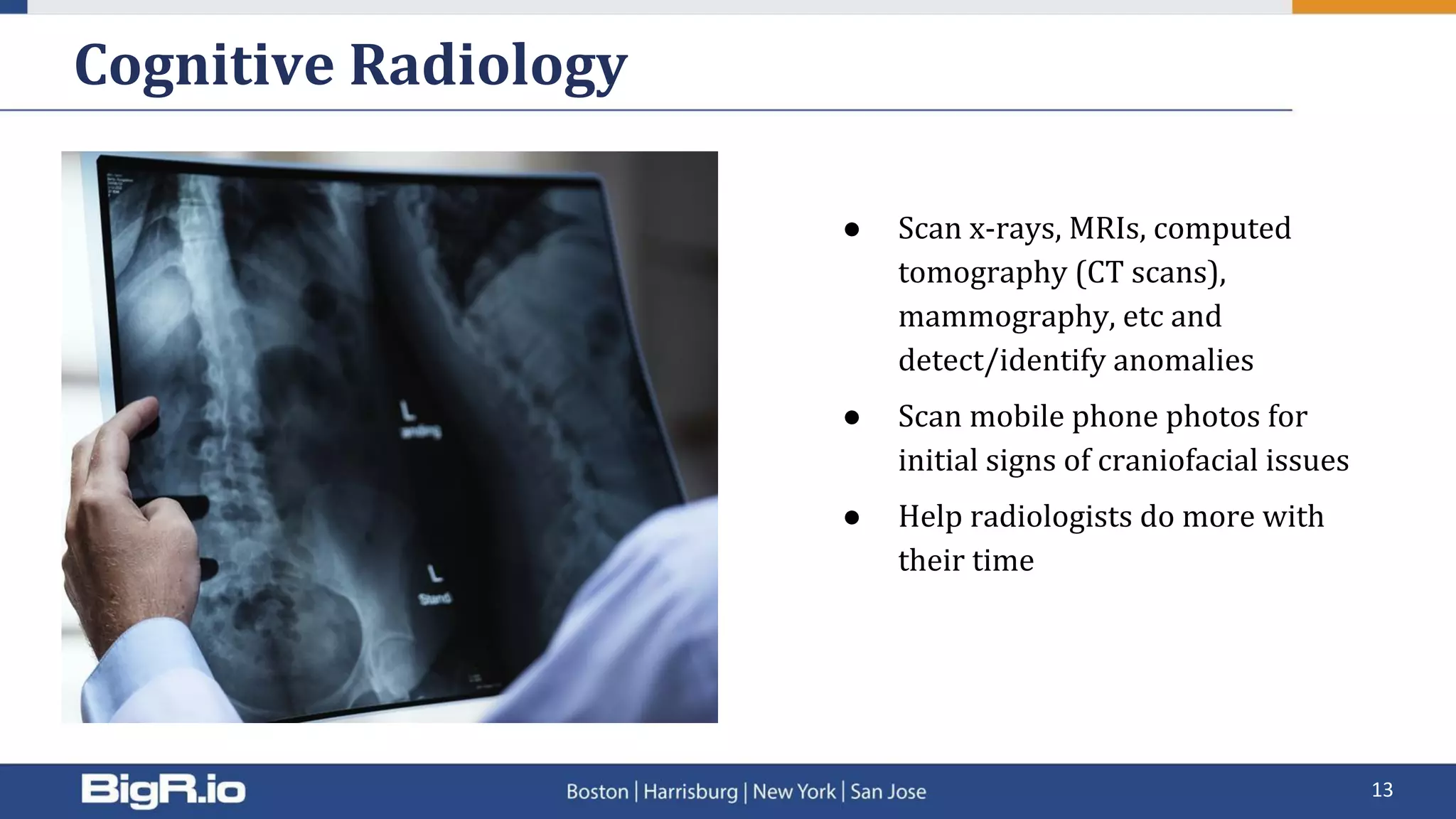
● Scan x-rays, MRIs, computed
tomography (CT scans),
mammography, etc and
detect/identify anomalies
● Scan mobile phone photos for
initial signs of craniofacial issues
● Help radiologists do more with
their time
Cognitive Radiology Cont’d
14
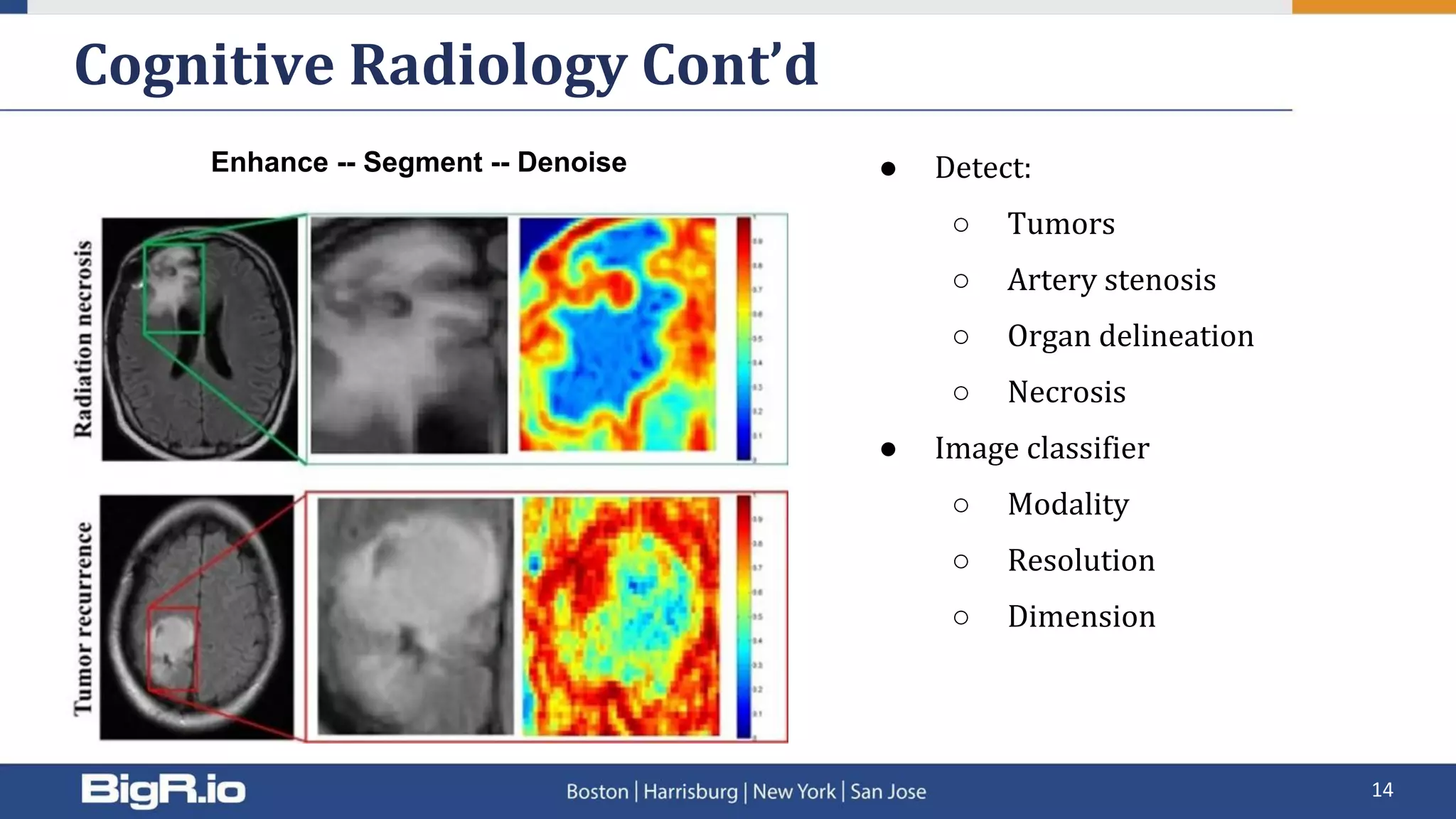
● Detect:
○ Tumors
○ Artery stenosis
○ Organ delineation
○ Necrosis
● Image classifier
○ Modality
○ Resolution
○ Dimension
Enhance -- Segment -- Denoise
Machine Learning in Healthcare

Machine Learning in Healthcare

  • 1.
    ML in Healthcare BigR.io,LLC | Boston | Harrisburg | New York | San Jose | www.bigr.io
  • 2.
    ● U.S. healthcarespending hit ~$3.5T in 2017* ● U.S. healthcare spending to climb 5.3 percent in 2018 ● Aging baby boomer population (retiring without proper knowledge transfer) ● Increasing drug prices and usage growth (especially for specialty drugs such as those for genetic disorders and oncology) ● EHR adoption was incentivised and then enforced with penalties for noncompliance ● Data disparity and information sharing challenges (poor business models) ● Doctors know best ● AI is estimated to save up to $150 billion annually for the U.S. healthcare by 2026** State of US Healthcare & the Call for AI *Source: US Centers for Medicare and Medicaid Services (CMS) **Source: Accenture report on “near-term value” of AI applications in healthcare 2
  • 3.
    10 Use Casesof AI in Healthcare 3 1. Robotic Surgeons 2. Physician’s Assistants 3. Virtual Nursing Assistants 4. Administrative Workflow 5. Revenue Cycle Management 6. Clinical Decision Support 7. Genetics and Genomics 8. Personalized Medicine 9. Streamlined Value-Based Care 10. Cognitive Radiology
  • 4.
    ● Cognitive surgicalrobotics ○ Integrate pre-op medical record data with real-time operating metrics to improve surgical outcomes ● The da Vinci technique ○ Robotic limbs with surgical instruments and a 3D view ● HeartLander ○ Miniature mobile robot to sense, map, and treat the heart Robotic Surgeons 4
  • 5.
    ● Order prescriptionsand lab tests ● Take comprehensive notes during in-person appointments ● Benchmarking: intelligent alerts informing doctors when they have gone off course from norms ○ E.g. the Lancet’s study on informing doctors who prescribe more antibiotics than their peers Physician’s Assistants 5
  • 6.
    ● Answer medicalquestions ● Triage and direct to the correct medical service (emergency or otherwise) ● Providing personalized medication and care instructions (post-surgery or routine) ● Receive smart notifications ● Wellness checks ○ Manage, monitor, and communicate Virtual Nursing Assistants 6
  • 7.
    Administrative Workflow ● Prioritizeurgent matters ● Cut documentation time and improve reporting quality ● Voice-to-text transcriptions that automate non-patient care activities: ○ Scheduling ○ Writing chart notes ○ Prescribing medications ○ Ordering tests ○ Automated check-ins 7
  • 8.
    Revenue Cycle Management Analysisof financial records to maximize book value. ● Selecting which past-due accounts need collections actions based on size and likelihood of payout (using demographics, psychographics, and historicals to make weighted predictions), and avoidance of negative PR situations. ● Analysis of missing charges based on common procedural groupings. 8
  • 9.
    ● Computerized alertsand reminders to care providers and patients ● Clinical guidelines ● Condition-specific orders ● Patient data reports and summaries ● Diagnostic support Clinical Decision Support 9
  • 10.
    ● Garner abetter understanding of the effect of DNA on a person’s health ● Find biological connections between genetics, diseases, and drug response ● Gain a deeper understanding of genetic defects related to particular drugs and diseases Genetics and Genomics 10
  • 11.
    ● Personalized care ●Custom drugs and treatment plans based on individual biometrics Personalized Medicine 11
  • 12.
    ● Clinical workflowsbased off available resources, bottlenecks, etc. ● Predictive analytics to help determine optimal sequences ● Reducing duplicate lab tests and other waste Streamlined Value-Based Care 12
  • 13.
    Cognitive Radiology 13 ● Scanx-rays, MRIs, computed tomography (CT scans), mammography, etc and detect/identify anomalies ● Scan mobile phone photos for initial signs of craniofacial issues ● Help radiologists do more with their time
  • 14.
    Cognitive Radiology Cont’d 14 ●Detect: ○ Tumors ○ Artery stenosis ○ Organ delineation ○ Necrosis ● Image classifier ○ Modality ○ Resolution ○ Dimension Enhance -- Segment -- Denoise