HEALTH CARE INDUSTRY
 India is expected to rank amongst the top three
healthcare markets in terms of incremental
growth by 2020
 • India was the sixth largest market globally in terms
of size in 2014
 Second largest service sector employer in the
country.
 Provides jobs for 4.5million people directly or
indirectly.
 The low cost of medical services has resulted in a
rise in the country’s medical tourism, attracting
patients from across the world.
 Moreover, India has emerged as a hub for R&D
activities for international players due to its relatively
low cost of clinical research
HEALTH CARE SYSTEMS
1. Public health sector
a. Primary health care
Primary health centres
Sub centres
b. Hospitals/Health centres
Community health centres
Rural hospitals
District hospitals/health centres
Specialist hospitals
Teaching hospitals
c. Health insurance schemes
Employees State Insurance
Central Govt. Health Schemes
d. Other agencies
Defense services
Railways
2. Private sector
a. Private hospitals, polyclinic, nursing homes and
dispensaries
b. General practitioners and clinics
3. Indigenous system of medicine
a. Ayurveda and Siddha
b. Unani and Tibbi
c. Homeopathy
d. Unregistered practitioners
4. Voluntary health agencies
5. National health programmes
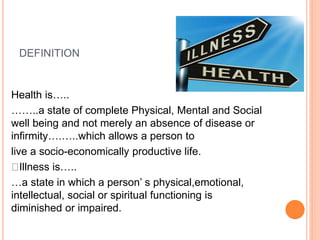
DEFINITION
Health is…..
……..a state of complete Physical, Mental and Social
well being and not merely an absence of disease or
infirmity….…..which allows a person to
live a socio-economically productive life.
Illness is…..
…a state in which a person’ s physical,emotional,
intellectual, social or spiritual functioning is
diminished or impaired.
Health care is...
…….multitude of services rendered to individuals or
communities by the agents of health services or
professional for the purpose of
 Promoting
 Restoring and
 Maintaining health
 Embraces all the goods and services
designed for “prevention, promotion and rehabilitation
interventions” includes Medical Care
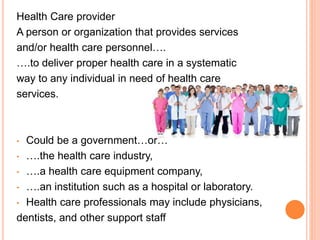
Health Care provider
A person or organization that provides services
and/or health care personnel….
….to deliver proper health care in a systematic
way to any individual in need of health care
services.
• Could be a government…or…
• ….the health care industry,
• ….a health care equipment company,
• ….an institution such as a hospital or laboratory.
• Health care professionals may include physicians,
dentists, and other support staff
PROCESS OF HEALTH CARE DELIVERY
Consists of two parts
Behavior of professionals
 Recognition of the problem i.e diagnosis
 Diagnostic procedure
 Recommendation of treatment or management
 Appropiate follow up
Participation of people
 Utilization of services
 Understanding the recommendations
 Satisfaction with the services
 Participation in decision making
LEVELS OF HEALTH CARE
Primary Health care
 Provided at the community level
Secondary health care
 Provided at PHC, CHC, DH etc.
Tertiary health care
 Provided at hospitals
FUNCTIONS
 International health relations and administration of port
quarintine
 Administration of Central Institutes
 Promotion of research
 Regulation and development of medical, pharmaceutical,
dental and nursing professions.
 Establishment and maintenance of drug standards.
 Census collection and publication of other statistical data.
 Coordination with states.
FUNCTIONS
 International health relations and quarantine of all
major ports in country and international airport.
 Control of drug standards
 Maintain medical store depots
 Administration of post graduate training programmes
 Administration of certain medical colleges in India
 Conducting medical research through Indian
Council of Medical Research ( ICMR )
Central Government Health Schemes
CONTD….
Implementation of national health programmes
 Preparation of health education material for
creating health awareness through Health
Education Bureau
o Collection, compilation, analysis, evaluation and
dissemination of information
o National Medical Library
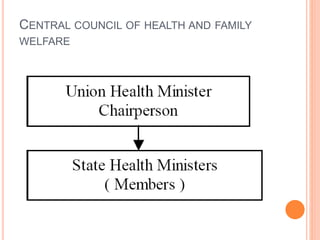
CENTRAL COUNCIL OF HEALTH AND FAMILY
WELFARE
FUNCTIONS
To consider and recommend broad outlines of
policy related to matters concerning health like
environment hygiene, nutrition and health
education.
To make proposals for legislation relating to
medical and public health matters.
To make recommendations to the Central
Government regarding distribution of grants-in aid.
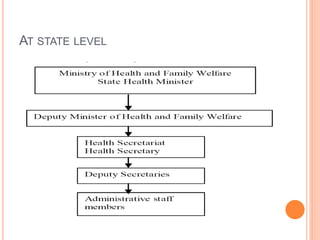
AT STATE LEVEL
HAZARDS
 Biological hazards
 blood borne pathogens
 natural latex rubber
 medical waste
 MRSA
 TB & other airborne diseases
o Chemical hazards
 cleaning agents & disinfectants
 mercury
 methyl metha acrylate & other glues
 surgical smoke
 Ergonomic hazards
 computer workstsations
 hand held devices
 laboratory
 laparoscopy
 patient handling
 radiology
 slips, trips & falls
HAZARDOUS DRUGS
 Aerosolized medications
 Anaesthetic gases
 Anti neoplastic & other hazardous drugs
 Nitric oxide
 Pentamidine
 Ribavirin
Radiation
 Ionising radiation
 Nuclear medicine and radiation therapy
 Non ionising radiation
CONTROLS OF BIOLOGICAL HAZARDS
 implementation of a needleless system and
transition to safety intravenous (IV) catheter
Products.
 implementation of vacuum systems
 replacement of conventional hollow-bore needles
with simultaneous introduction of safety engineered
devices (SEDs) such as retractable syringes,
needle-free intravenous (IV) systems, and safety
winged butterfly needles.
 Should receive training in using engineered devices
and devices to be made available in emergency
room and wards
FOR AIRBORNE PATHOGENS
 ventilation with air exchanges for air borne
pathogens
 Engineering: dedicated negative pressure isolation
rooms, local and dilution ventilation, HEPA filtration
 Administrative: restricted visitors, medical
surveillance, worker training, hazard
communication
 PPE: N-95 particulate respirators, double gowns
and gloves
FOR DISINFECTANTS
 Substitution: alternatives for glutaraldehyde were
researched, ortho-phthaladehyde is used in UK.
 Engineering: assessed the use of fully automated
washers and localized ventilation & compared manual
disinfecting techniques with automated machines.
 Work practices: evaluated disinfecting
procedures & closing containers.
 MERCURY - Engineering: water spray,
high volume evacuator, pre encapsulated
and screw-closed capsules of amalgam, various
Alloys.
MMA-Work practices: MSDS and labels in OT &
procedure room
Engineering controls: vacuum exhaust mixing bowls,
negative-pressure hoods.
Administrative controls: ensures more frequent air
monitoring.
SURGICAL SMOKE –
Engineering: smoke evacuator with HEPA and “odor
elimination” filter suctioning air at 50 cfm mounted at
distances of 2, 6,and 12 inches from laser cutting site
with evacuator on for entire measurement period of
laser operation.
Hand held devices - 94.5% of phones demonstrated
evidence of bacterial contamination with different
types of bacteria.
Decontamination of mobile phones with alcohol
disinfectant, antimicrobial additive materials with
alcohol cleansing disinfectant, protective material on
the mobile phone.
Work practice controls: training of HCPs about strict
infection control procedure, hand hygiene, and
environmental disinfection, restriction on use of
mobile phones near sensitive equipment and ICU.
LAPAROSCOPY-
 Video analysis of postures and a questionnaire
showed that the use of flat screen monitors placed over
the patient is better for the physical and psychological
comfort of the users even though the performance is
inferior compared to CRT monitors placed out of the sterile
zone.
 Table height should be 64 to 77 cm above floor level.
 Job strain scores were significantly lower for telerobotic
compared to manual tasks.
 Error rates and discomfort measures were
improved with use of arm rests.
HAZARDOUS DRUGS
 Anaesthetic agents- Engineering: ventilation rate of
22 changes/hour, proper maintenance of anesthesia
machines, use of double mask scavenging system.
 Administrative: anesthesiologists trained on proper
use of scavenging system
 Combination of engineering and administrative
controls resulted in reduction of nitrous oxide
exposure during adult surgeries from 61-90 ppm to 2-
15 ppm and during pediatric surgeries from 134-764
ppm to 9-42 ppm.
RADIATION
 Using low amperage technique and non-continual exposure
with the “quick-check” method reduced dose to radiologist.
 Compared to the use of a lead apron, the suspended suit
(suspended suit composed of apron, arm shields, and face
shield) reduced exposure by orders of magnitude at the
armpit, eyes, and gonads
 Engineering: Bismuth surgical drape and collimation;
Tungsten antimony shield ;
 Lead shield hung from tables with C-arm under couch
fluoroscopy systems- Lead shield reduced exposure at both
legs by 64%.

HEALTH CARE INDUSTRY.pptx

  • 1.
  • 2.
     India isexpected to rank amongst the top three healthcare markets in terms of incremental growth by 2020  • India was the sixth largest market globally in terms of size in 2014  Second largest service sector employer in the country.  Provides jobs for 4.5million people directly or indirectly.  The low cost of medical services has resulted in a rise in the country’s medical tourism, attracting patients from across the world.  Moreover, India has emerged as a hub for R&D activities for international players due to its relatively low cost of clinical research
  • 3.
    HEALTH CARE SYSTEMS 1.Public health sector a. Primary health care Primary health centres Sub centres b. Hospitals/Health centres Community health centres Rural hospitals District hospitals/health centres Specialist hospitals Teaching hospitals c. Health insurance schemes Employees State Insurance Central Govt. Health Schemes d. Other agencies Defense services Railways
  • 4.
    2. Private sector a.Private hospitals, polyclinic, nursing homes and dispensaries b. General practitioners and clinics 3. Indigenous system of medicine a. Ayurveda and Siddha b. Unani and Tibbi c. Homeopathy d. Unregistered practitioners 4. Voluntary health agencies 5. National health programmes
  • 5.
    DEFINITION Health is….. ……..a stateof complete Physical, Mental and Social well being and not merely an absence of disease or infirmity….…..which allows a person to live a socio-economically productive life. Illness is….. …a state in which a person’ s physical,emotional, intellectual, social or spiritual functioning is diminished or impaired.
  • 6.
    Health care is... …….multitudeof services rendered to individuals or communities by the agents of health services or professional for the purpose of  Promoting  Restoring and  Maintaining health  Embraces all the goods and services designed for “prevention, promotion and rehabilitation interventions” includes Medical Care
  • 7.
    Health Care provider Aperson or organization that provides services and/or health care personnel…. ….to deliver proper health care in a systematic way to any individual in need of health care services. • Could be a government…or… • ….the health care industry, • ….a health care equipment company, • ….an institution such as a hospital or laboratory. • Health care professionals may include physicians, dentists, and other support staff
  • 8.
    PROCESS OF HEALTHCARE DELIVERY Consists of two parts Behavior of professionals  Recognition of the problem i.e diagnosis  Diagnostic procedure  Recommendation of treatment or management  Appropiate follow up Participation of people  Utilization of services  Understanding the recommendations  Satisfaction with the services  Participation in decision making
  • 9.
    LEVELS OF HEALTHCARE Primary Health care  Provided at the community level Secondary health care  Provided at PHC, CHC, DH etc. Tertiary health care  Provided at hospitals
  • 10.
    FUNCTIONS  International healthrelations and administration of port quarintine  Administration of Central Institutes  Promotion of research  Regulation and development of medical, pharmaceutical, dental and nursing professions.  Establishment and maintenance of drug standards.  Census collection and publication of other statistical data.  Coordination with states.
  • 11.
    FUNCTIONS  International healthrelations and quarantine of all major ports in country and international airport.  Control of drug standards  Maintain medical store depots  Administration of post graduate training programmes  Administration of certain medical colleges in India  Conducting medical research through Indian Council of Medical Research ( ICMR ) Central Government Health Schemes
  • 12.
    CONTD…. Implementation of nationalhealth programmes  Preparation of health education material for creating health awareness through Health Education Bureau o Collection, compilation, analysis, evaluation and dissemination of information o National Medical Library
  • 13.
    CENTRAL COUNCIL OFHEALTH AND FAMILY WELFARE
  • 14.
    FUNCTIONS To consider andrecommend broad outlines of policy related to matters concerning health like environment hygiene, nutrition and health education. To make proposals for legislation relating to medical and public health matters. To make recommendations to the Central Government regarding distribution of grants-in aid.
  • 15.
  • 16.
    HAZARDS  Biological hazards blood borne pathogens  natural latex rubber  medical waste  MRSA  TB & other airborne diseases o Chemical hazards  cleaning agents & disinfectants  mercury  methyl metha acrylate & other glues  surgical smoke
  • 17.
     Ergonomic hazards computer workstsations  hand held devices  laboratory  laparoscopy  patient handling  radiology  slips, trips & falls
  • 18.
    HAZARDOUS DRUGS  Aerosolizedmedications  Anaesthetic gases  Anti neoplastic & other hazardous drugs  Nitric oxide  Pentamidine  Ribavirin Radiation  Ionising radiation  Nuclear medicine and radiation therapy  Non ionising radiation
  • 19.
    CONTROLS OF BIOLOGICALHAZARDS  implementation of a needleless system and transition to safety intravenous (IV) catheter Products.  implementation of vacuum systems  replacement of conventional hollow-bore needles with simultaneous introduction of safety engineered devices (SEDs) such as retractable syringes, needle-free intravenous (IV) systems, and safety winged butterfly needles.  Should receive training in using engineered devices and devices to be made available in emergency room and wards
  • 20.
    FOR AIRBORNE PATHOGENS ventilation with air exchanges for air borne pathogens  Engineering: dedicated negative pressure isolation rooms, local and dilution ventilation, HEPA filtration  Administrative: restricted visitors, medical surveillance, worker training, hazard communication  PPE: N-95 particulate respirators, double gowns and gloves
  • 21.
    FOR DISINFECTANTS  Substitution:alternatives for glutaraldehyde were researched, ortho-phthaladehyde is used in UK.  Engineering: assessed the use of fully automated washers and localized ventilation & compared manual disinfecting techniques with automated machines.  Work practices: evaluated disinfecting procedures & closing containers.  MERCURY - Engineering: water spray, high volume evacuator, pre encapsulated and screw-closed capsules of amalgam, various Alloys.
  • 22.
    MMA-Work practices: MSDSand labels in OT & procedure room Engineering controls: vacuum exhaust mixing bowls, negative-pressure hoods. Administrative controls: ensures more frequent air monitoring. SURGICAL SMOKE – Engineering: smoke evacuator with HEPA and “odor elimination” filter suctioning air at 50 cfm mounted at distances of 2, 6,and 12 inches from laser cutting site with evacuator on for entire measurement period of laser operation.
  • 23.
    Hand held devices- 94.5% of phones demonstrated evidence of bacterial contamination with different types of bacteria. Decontamination of mobile phones with alcohol disinfectant, antimicrobial additive materials with alcohol cleansing disinfectant, protective material on the mobile phone. Work practice controls: training of HCPs about strict infection control procedure, hand hygiene, and environmental disinfection, restriction on use of mobile phones near sensitive equipment and ICU.
  • 24.
    LAPAROSCOPY-  Video analysisof postures and a questionnaire showed that the use of flat screen monitors placed over the patient is better for the physical and psychological comfort of the users even though the performance is inferior compared to CRT monitors placed out of the sterile zone.  Table height should be 64 to 77 cm above floor level.  Job strain scores were significantly lower for telerobotic compared to manual tasks.  Error rates and discomfort measures were improved with use of arm rests.
  • 25.
    HAZARDOUS DRUGS  Anaestheticagents- Engineering: ventilation rate of 22 changes/hour, proper maintenance of anesthesia machines, use of double mask scavenging system.  Administrative: anesthesiologists trained on proper use of scavenging system  Combination of engineering and administrative controls resulted in reduction of nitrous oxide exposure during adult surgeries from 61-90 ppm to 2- 15 ppm and during pediatric surgeries from 134-764 ppm to 9-42 ppm.
  • 26.
    RADIATION  Using lowamperage technique and non-continual exposure with the “quick-check” method reduced dose to radiologist.  Compared to the use of a lead apron, the suspended suit (suspended suit composed of apron, arm shields, and face shield) reduced exposure by orders of magnitude at the armpit, eyes, and gonads  Engineering: Bismuth surgical drape and collimation; Tungsten antimony shield ;  Lead shield hung from tables with C-arm under couch fluoroscopy systems- Lead shield reduced exposure at both legs by 64%.