 The Inactive Ingredient Database (IID) contains inactive ingredients present in FDA-approved drug
products currently marketed for human use.
 Only inactive ingredients in the final dosage forms of drug products are in this database.
 –Once an inactive ingredient has appeared in an approved drug product for a particular route of
administration and dosage form, it is not considered new and may require a less extensive review in
a new drug product.
 We update the database quarterly, by the tenth working day of April, July, October, and January.
 The data file contains 7 fields (columns):
 Inactive Ingredient
 Route
 Dosage Form
 CAS Number
 UNII
 Potency Amount
 Potency Unit
 The Inactive Ingredient Database provides information on inactive ingredients present in FDA-
approved drug products. This information can be used by industry as an aid in developing drug
products. For new drug development purposes, once an inactive ingredient has appeared in an
approved drug product for a particular route of administration, the inactive ingredient is not
considered new and may require a less extensive review the next time it is included in a new
drug product. For example, if a particular inactive ingredient has been approved in a certain
dosage form at a certain potency, a sponsor could consider it safe for use in a similar manner for
a similar type of product.
 Maximum potency is the amount of the excipient used in the approved product that
is the basis for the IID listing. The IID lists the highest amount of the excipient per
unit dose in each dosage form in which it is used. The amounts shown for maximum
potency do not reflect the maximum daily intake (MDI) of the excipient unless the
maximum daily dose of the product that is the basis for the listing is only a single
unit. For topical products and other products where excipients are expressed as a
percentage of the product formula, maximum potency is the highest formula
percentage. Maximum potency of an excipient is a dynamic value that changes
when FDA approves products with new, higher levels of the excipient. After
approval, these new maximum potencies will appear in the next publication of the
IID.
 No. The Inactive Ingredients Database does not include contaminants found
in approved drug products.
 “UNII” stands for “Unique Ingredient Identifier”. The UNII is a part of the joint United States
Pharmacopeia (USP)/FDA Substance Registration System (SRS), which has been designed to support
health information technology initiatives by providing unique identifiers for substances in drugs,
biologics, foods, and devices based on molecular structure and/or descriptive information. The SRS is
used to generate permanent, unique, unambiguous identifiers for substances in regulated products, such as
ingredients in drug products. The UNII is being displayed in association with inactive ingredients to
facilitate Structured Product Labeling (SPL), which requires that a UNII be used for all ingredients,
including inactive ingredients.
Not all inactive ingredients will have a UNII. In order to receive a UNII, an ingredient must be a
‘substance’, which is defined as “Any physical material that has a discrete existence, irrespective of
origin.” Products will not be assigned a UNII. For example, “purified water” and “sterile water for
injection” are considered products within the context of the SRS because something is done to the
substance “water” in order to make it more useful. Proprietary ingredients, such as “OPADRY II 85F10919
BLUE”, are considered products and will not be assigned a UNII. Such products are denoted by "N/A".
 Inactive Ingredient: An inactive ingredient is any component of a drug product other than the
active ingredient. Only inactive ingredients in the final dosage forms of drug products are
included in this database.
 Route: A route of administration is a way of administering a drug to a site in a patient. A
comprehensive list of specific routes of administration appears in the Data Standards Manual.
 Dosage Form: A dosage form is a form in which a drug is produced and dispensed. A
comprehensive list of specific routes of administration appears in the Data Standards Manual.
 CAS Number: The acronym "CAS" stands for "Chemical Abstracts Service," a division of the
American Chemical Society that provides comprehensive electronic chemical information
services. CAS assigns unique CAS Registry Numbers to chemical substances. Many inactive
ingredients have CAS Registry Numbers, which are useful in searching other databases for
chemical information. The CAS Registry Number itself has no chemical significance.
 UNII
 The acronym “UNII” stands for “Unique Ingredient Identifier”
 The UNII is a part of the joint USP/FDA Substance Registration System (SRS), which has been
designed to support health information technology initiatives by providing unique identifiers for
substances in drugs, biologics, foods, and devices based on molecular structure and/or
descriptive information. The SRS is used to generate permanent, unique, unambiguous
identifiers for substances in regulated products, such as ingredients in drug products.
 More information about the UNII and the SRS is available on the Data Council SRS page. All
chemically-related questions about the UNII or the SRS that are not answered on the FDA
website should be directed fda-srs@fda.hhs.gov.
 Potency Amount: The "potency amount" field specifies the maximum amount of inactive
ingredient for each route/dosage form containing that ingredient. When there is no calculable
potency measurement for the inactive ingredient, the "potency amount" field will be blank.
 Potency Unit: The "potency unit" field specifes the unit type associated with the potency
amount. This field may be blank.
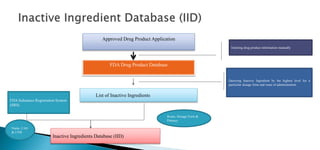
Approved Drug Product Application
FDA Drug Product Database
List of Inactive Ingredients
Entering drug product information manually
Querying Inactive Ingredient by the highest level for a
particular dosage form and route of administration
Route, Dosage Form &
Potency
Inactive Ingredients Database (IID)
FDA Substance Registration System
(SRS)
Name, CAS
& UNII
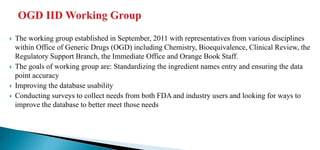
 The working group established in September, 2011 with representatives from various disciplines
within Office of Generic Drugs (OGD) including Chemistry, Bioequivalence, Clinical Review, the
Regulatory Support Branch, the Immediate Office and Orange Book Staff.
 The goals of working group are: Standardizing the ingredient names entry and ensuring the data
point accuracy
 Improving the database usability
 Conducting surveys to collect needs from both FDA and industry users and looking for ways to
improve the database to better meet those needs
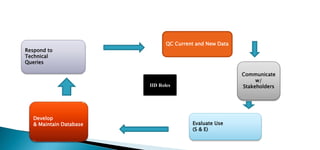
IID Roles
Respond to
Technical
Queries
QC Current and New Data
Communicate
w/
Stakeholders
Develop
& Maintain Database Evaluate Use
(S & E)
 Ingredient names are currently linked to the FDA Substance Registration System (SRS) database.
 Provision for including a listing for common, generic, compendia, cosmetic, brand and trade
names, as well as any other synonyms, will be built into an improved database that is under
development.
 With growing demands from generic drug companies and new challenges in the
pharmaceutical industry, OGD developed a prototype IID database to improve the
usability of IID. Includes Maximum Daily Intake (MDI) of excipients in addition to the
potency per unit used in the current IID
 Has more searchable functions and user-friendly interface

Inactive ingredients database

  • 2.
     The InactiveIngredient Database (IID) contains inactive ingredients present in FDA-approved drug products currently marketed for human use.  Only inactive ingredients in the final dosage forms of drug products are in this database.  –Once an inactive ingredient has appeared in an approved drug product for a particular route of administration and dosage form, it is not considered new and may require a less extensive review in a new drug product.  We update the database quarterly, by the tenth working day of April, July, October, and January.  The data file contains 7 fields (columns):  Inactive Ingredient  Route  Dosage Form  CAS Number  UNII  Potency Amount  Potency Unit
  • 3.
     The InactiveIngredient Database provides information on inactive ingredients present in FDA- approved drug products. This information can be used by industry as an aid in developing drug products. For new drug development purposes, once an inactive ingredient has appeared in an approved drug product for a particular route of administration, the inactive ingredient is not considered new and may require a less extensive review the next time it is included in a new drug product. For example, if a particular inactive ingredient has been approved in a certain dosage form at a certain potency, a sponsor could consider it safe for use in a similar manner for a similar type of product.
  • 4.
     Maximum potencyis the amount of the excipient used in the approved product that is the basis for the IID listing. The IID lists the highest amount of the excipient per unit dose in each dosage form in which it is used. The amounts shown for maximum potency do not reflect the maximum daily intake (MDI) of the excipient unless the maximum daily dose of the product that is the basis for the listing is only a single unit. For topical products and other products where excipients are expressed as a percentage of the product formula, maximum potency is the highest formula percentage. Maximum potency of an excipient is a dynamic value that changes when FDA approves products with new, higher levels of the excipient. After approval, these new maximum potencies will appear in the next publication of the IID.
  • 5.
     No. TheInactive Ingredients Database does not include contaminants found in approved drug products.
  • 6.
     “UNII” standsfor “Unique Ingredient Identifier”. The UNII is a part of the joint United States Pharmacopeia (USP)/FDA Substance Registration System (SRS), which has been designed to support health information technology initiatives by providing unique identifiers for substances in drugs, biologics, foods, and devices based on molecular structure and/or descriptive information. The SRS is used to generate permanent, unique, unambiguous identifiers for substances in regulated products, such as ingredients in drug products. The UNII is being displayed in association with inactive ingredients to facilitate Structured Product Labeling (SPL), which requires that a UNII be used for all ingredients, including inactive ingredients. Not all inactive ingredients will have a UNII. In order to receive a UNII, an ingredient must be a ‘substance’, which is defined as “Any physical material that has a discrete existence, irrespective of origin.” Products will not be assigned a UNII. For example, “purified water” and “sterile water for injection” are considered products within the context of the SRS because something is done to the substance “water” in order to make it more useful. Proprietary ingredients, such as “OPADRY II 85F10919 BLUE”, are considered products and will not be assigned a UNII. Such products are denoted by "N/A".
  • 7.
     Inactive Ingredient:An inactive ingredient is any component of a drug product other than the active ingredient. Only inactive ingredients in the final dosage forms of drug products are included in this database.  Route: A route of administration is a way of administering a drug to a site in a patient. A comprehensive list of specific routes of administration appears in the Data Standards Manual.  Dosage Form: A dosage form is a form in which a drug is produced and dispensed. A comprehensive list of specific routes of administration appears in the Data Standards Manual.  CAS Number: The acronym "CAS" stands for "Chemical Abstracts Service," a division of the American Chemical Society that provides comprehensive electronic chemical information services. CAS assigns unique CAS Registry Numbers to chemical substances. Many inactive ingredients have CAS Registry Numbers, which are useful in searching other databases for chemical information. The CAS Registry Number itself has no chemical significance.
  • 8.
     UNII  Theacronym “UNII” stands for “Unique Ingredient Identifier”  The UNII is a part of the joint USP/FDA Substance Registration System (SRS), which has been designed to support health information technology initiatives by providing unique identifiers for substances in drugs, biologics, foods, and devices based on molecular structure and/or descriptive information. The SRS is used to generate permanent, unique, unambiguous identifiers for substances in regulated products, such as ingredients in drug products.  More information about the UNII and the SRS is available on the Data Council SRS page. All chemically-related questions about the UNII or the SRS that are not answered on the FDA website should be directed fda-srs@fda.hhs.gov.  Potency Amount: The "potency amount" field specifies the maximum amount of inactive ingredient for each route/dosage form containing that ingredient. When there is no calculable potency measurement for the inactive ingredient, the "potency amount" field will be blank.  Potency Unit: The "potency unit" field specifes the unit type associated with the potency amount. This field may be blank.
  • 9.
    Approved Drug ProductApplication FDA Drug Product Database List of Inactive Ingredients Entering drug product information manually Querying Inactive Ingredient by the highest level for a particular dosage form and route of administration Route, Dosage Form & Potency Inactive Ingredients Database (IID) FDA Substance Registration System (SRS) Name, CAS & UNII
  • 10.
     The workinggroup established in September, 2011 with representatives from various disciplines within Office of Generic Drugs (OGD) including Chemistry, Bioequivalence, Clinical Review, the Regulatory Support Branch, the Immediate Office and Orange Book Staff.  The goals of working group are: Standardizing the ingredient names entry and ensuring the data point accuracy  Improving the database usability  Conducting surveys to collect needs from both FDA and industry users and looking for ways to improve the database to better meet those needs
  • 11.
    IID Roles Respond to Technical Queries QCCurrent and New Data Communicate w/ Stakeholders Develop & Maintain Database Evaluate Use (S & E)
  • 12.
     Ingredient namesare currently linked to the FDA Substance Registration System (SRS) database.  Provision for including a listing for common, generic, compendia, cosmetic, brand and trade names, as well as any other synonyms, will be built into an improved database that is under development.
  • 13.
     With growingdemands from generic drug companies and new challenges in the pharmaceutical industry, OGD developed a prototype IID database to improve the usability of IID. Includes Maximum Daily Intake (MDI) of excipients in addition to the potency per unit used in the current IID  Has more searchable functions and user-friendly interface