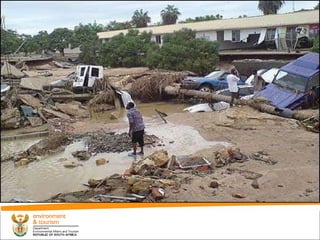
CLIMATE CHANGE RESPONSE Ernst & Young ®- Mashudu Mundalamo Department of Environmental Affairs and Tourism  23 October 2008 Mitigation and Adaptation Measures
Overview of the Presentation Science of Climate Change Climate Change Impacts Key Climate Change Response Measures Conclusion
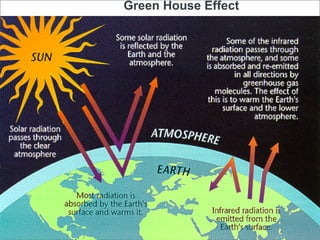
Climate Change Climate change is defined as a change of climate which is attributed directly or indirectly to human activity that alters the composition of the global atmosphere.
Green House Effect
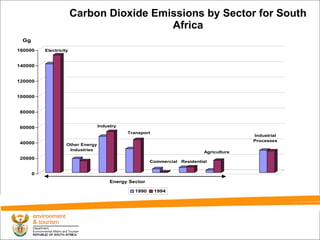
Carbon Dioxide Emissions by Sector for South Africa
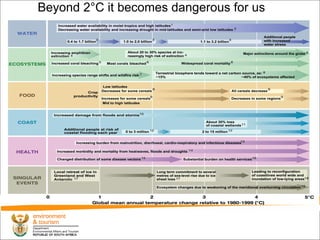
Beyond 2 °C it becomes dangerous for us
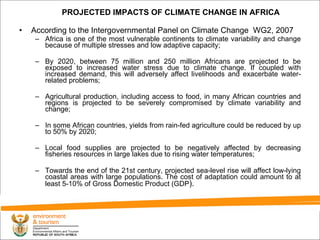
According to the Intergovernmental Panel on Climate Change  WG2, 2007 Africa is one of the most vulnerable continents to climate variability and change because of multiple  stresses and low adaptive capacity; By 2020, between 75 million and 250 million Africans are projected to be exposed to increased water stress due to climate change. If coupled with increased demand, this will adversely  affect livelihoods and exacerbate water-related problems; Agricultural production, including access to food, in many African countries and regions is projected to be severely compromised by climate variability and change; In some African countries, yields from rain-fed agriculture could be  reduced by up to 50% by 2020; Local food supplies are projected to be negatively affected by decreasing fisheries resources in large lakes due to rising water  temperatures; Towards the end of the 21st century, projected sea-level rise will affect low-lying coastal areas with large populations. The cost of adaptation could amount to at least 5-10% of Gross Domestic Product (GDP ). PROJECTED IMPACTS OF CLIMATE CHANGE IN AFRICA


Climate Change Response Climate Change adaptation and Mitigation are two types of policy response to climate change. even if we could stop all the concentration of GHGs emissions now, temperature will continue to rise – so we have to adapt to changes we have to mitigate to avoid unimaginable impacts MITIGATION Mitigation refers to a technological change and substitution that reduce resource inputs and emmissions per unit of output.
Key Mitigation technology and practices by sectors More fuel efficient vehicles.  hybrid vehicles, biofuel,  modal shifts from road transport to rail and public transport systerms, non motorized transport (cycling, walking)  TRANSPORT Improved supply and distribution efficiency Fuel switching from coal to gas Renewable heat and power (Hydropower, solar, wind and bioenergy) Early applications of Carbon Capture and storage on coal fired plants Carbon tax on energy intensive industry Feed in tariff in renewable energy Energy Mix i.e feeding of renewable energy into the national grid ENERGY  POSSIBLE MITIGATION MEASURE/S SECTORS
Key Mitigation technology and practices by sectors More efficient end use electrical equipment Heat and power recovery Material recycling and substitution Improved energy efficiency of lightning's INDUSTRIAL Improved energy efficiency of lightning's  Improved heat insulation and building designs Install geyser blanket Dont leave electrical appliances switched on when not in use RESIDENTIAL POSSIBLE MITIGATION MEASURE/S SECTORS
Key Mitigation technology and practices by sectors Landfill methane recovery Waste incineration with energy recovery] Controlled waste water treatment  Recycling and waste minimization WASTE afforestration, restoration and forest management  Use of forestry products for bioenergy to replace fossils fuels FORESTRY POSSIBLE MITIGATION MEASURE/S SECTORS
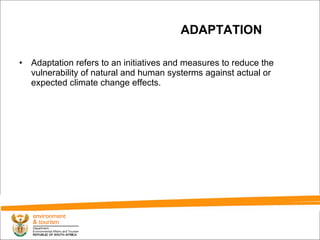
ADAPTATION Adaptation refers to an initiatives and measures to reduce the vulnerability of natural and human systerms against actual or expected climate change effects.
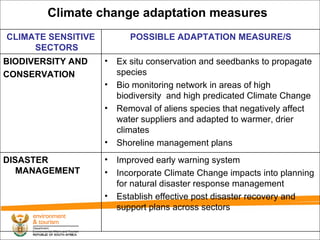
Climate change adaptation measures   Improved early warning system Incorporate Climate Change impacts into planning for natural disaster response management Establish effective post disaster recovery and support plans across sectors DISASTER MANAGEMENT Ex situ conservation and seedbanks to propagate species Bio monitoring network in areas of high biodiversity  and high predicated Climate Change Removal of aliens species that negatively affect water suppliers and adapted to warmer, drier climates Shoreline management plans BIODIVERSITY AND CONSERVATION POSSIBLE ADAPTATION MEASURE/S CLIMATE SENSITIVE SECTORS
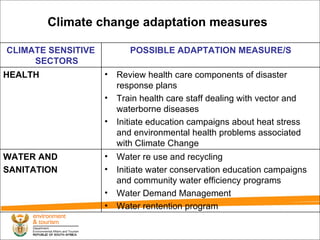
Climate change adaptation measures   Water re use and recycling Initiate water conservation education campaigns and community water efficiency programs Water Demand Management Water rentention program WATER AND SANITATION Review health care components of disaster response plans Train health care staff dealing with vector and waterborne diseases Initiate education campaigns about heat stress and environmental health problems associated with Climate Change HEALTH POSSIBLE ADAPTATION MEASURE/S CLIMATE SENSITIVE SECTORS
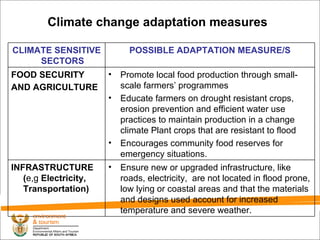
Climate change adaptation measures   Ensure new or upgraded infrastructure, like roads, electricity,  are not located in flood prone, low lying or coastal areas and that the materials and designs used account for increased temperature and severe weather. INFRASTRUCTURE ( e,g  Electricity, Transportation) Promote local food production through small- scale farmers’ programmes Educate farmers on drought resistant crops, erosion prevention and efficient water use practices to maintain production in a change climate Plant crops that are resistant to flood Encourages community food reserves for emergency situations. FOOD SECURITY AND AGRICULTURE   POSSIBLE ADAPTATION MEASURE/S CLIMATE SENSITIVE SECTORS
CONCLUSION Adaptation and Mitigation response should be balanced to meet the challenges of climate change in decades to come. Climate Change vulnerability studies should also be translated effectively into concrete guidance on adaptive responses. Climate Change adaptation needs to be brought into the mainstream of economic policies and  development projects
THANK  YOU

Climate Change Response Measures

  • 1.
    CLIMATE CHANGE RESPONSEErnst & Young ®- Mashudu Mundalamo Department of Environmental Affairs and Tourism 23 October 2008 Mitigation and Adaptation Measures
  • 2.
    Overview of thePresentation Science of Climate Change Climate Change Impacts Key Climate Change Response Measures Conclusion
  • 3.
    Climate Change Climatechange is defined as a change of climate which is attributed directly or indirectly to human activity that alters the composition of the global atmosphere.
  • 4.
  • 5.
    Carbon Dioxide Emissionsby Sector for South Africa
  • 6.
    Beyond 2 °Cit becomes dangerous for us
  • 7.
    According to theIntergovernmental Panel on Climate Change WG2, 2007 Africa is one of the most vulnerable continents to climate variability and change because of multiple stresses and low adaptive capacity; By 2020, between 75 million and 250 million Africans are projected to be exposed to increased water stress due to climate change. If coupled with increased demand, this will adversely affect livelihoods and exacerbate water-related problems; Agricultural production, including access to food, in many African countries and regions is projected to be severely compromised by climate variability and change; In some African countries, yields from rain-fed agriculture could be reduced by up to 50% by 2020; Local food supplies are projected to be negatively affected by decreasing fisheries resources in large lakes due to rising water temperatures; Towards the end of the 21st century, projected sea-level rise will affect low-lying coastal areas with large populations. The cost of adaptation could amount to at least 5-10% of Gross Domestic Product (GDP ). PROJECTED IMPACTS OF CLIMATE CHANGE IN AFRICA
  • 8.
  • 9.
  • 10.
  • 11.
  • 12.
  • 13.
  • 14.
    Climate Change ResponseClimate Change adaptation and Mitigation are two types of policy response to climate change. even if we could stop all the concentration of GHGs emissions now, temperature will continue to rise – so we have to adapt to changes we have to mitigate to avoid unimaginable impacts MITIGATION Mitigation refers to a technological change and substitution that reduce resource inputs and emmissions per unit of output.
  • 15.
    Key Mitigation technologyand practices by sectors More fuel efficient vehicles. hybrid vehicles, biofuel, modal shifts from road transport to rail and public transport systerms, non motorized transport (cycling, walking) TRANSPORT Improved supply and distribution efficiency Fuel switching from coal to gas Renewable heat and power (Hydropower, solar, wind and bioenergy) Early applications of Carbon Capture and storage on coal fired plants Carbon tax on energy intensive industry Feed in tariff in renewable energy Energy Mix i.e feeding of renewable energy into the national grid ENERGY POSSIBLE MITIGATION MEASURE/S SECTORS
  • 16.
    Key Mitigation technologyand practices by sectors More efficient end use electrical equipment Heat and power recovery Material recycling and substitution Improved energy efficiency of lightning's INDUSTRIAL Improved energy efficiency of lightning's Improved heat insulation and building designs Install geyser blanket Dont leave electrical appliances switched on when not in use RESIDENTIAL POSSIBLE MITIGATION MEASURE/S SECTORS
  • 17.
    Key Mitigation technologyand practices by sectors Landfill methane recovery Waste incineration with energy recovery] Controlled waste water treatment Recycling and waste minimization WASTE afforestration, restoration and forest management Use of forestry products for bioenergy to replace fossils fuels FORESTRY POSSIBLE MITIGATION MEASURE/S SECTORS
  • 18.
    ADAPTATION Adaptation refersto an initiatives and measures to reduce the vulnerability of natural and human systerms against actual or expected climate change effects.
  • 19.
    Climate change adaptationmeasures Improved early warning system Incorporate Climate Change impacts into planning for natural disaster response management Establish effective post disaster recovery and support plans across sectors DISASTER MANAGEMENT Ex situ conservation and seedbanks to propagate species Bio monitoring network in areas of high biodiversity and high predicated Climate Change Removal of aliens species that negatively affect water suppliers and adapted to warmer, drier climates Shoreline management plans BIODIVERSITY AND CONSERVATION POSSIBLE ADAPTATION MEASURE/S CLIMATE SENSITIVE SECTORS
  • 20.
    Climate change adaptationmeasures Water re use and recycling Initiate water conservation education campaigns and community water efficiency programs Water Demand Management Water rentention program WATER AND SANITATION Review health care components of disaster response plans Train health care staff dealing with vector and waterborne diseases Initiate education campaigns about heat stress and environmental health problems associated with Climate Change HEALTH POSSIBLE ADAPTATION MEASURE/S CLIMATE SENSITIVE SECTORS
  • 21.
    Climate change adaptationmeasures Ensure new or upgraded infrastructure, like roads, electricity, are not located in flood prone, low lying or coastal areas and that the materials and designs used account for increased temperature and severe weather. INFRASTRUCTURE ( e,g Electricity, Transportation) Promote local food production through small- scale farmers’ programmes Educate farmers on drought resistant crops, erosion prevention and efficient water use practices to maintain production in a change climate Plant crops that are resistant to flood Encourages community food reserves for emergency situations. FOOD SECURITY AND AGRICULTURE POSSIBLE ADAPTATION MEASURE/S CLIMATE SENSITIVE SECTORS
  • 22.
    CONCLUSION Adaptation andMitigation response should be balanced to meet the challenges of climate change in decades to come. Climate Change vulnerability studies should also be translated effectively into concrete guidance on adaptive responses. Climate Change adaptation needs to be brought into the mainstream of economic policies and development projects
  • 23.