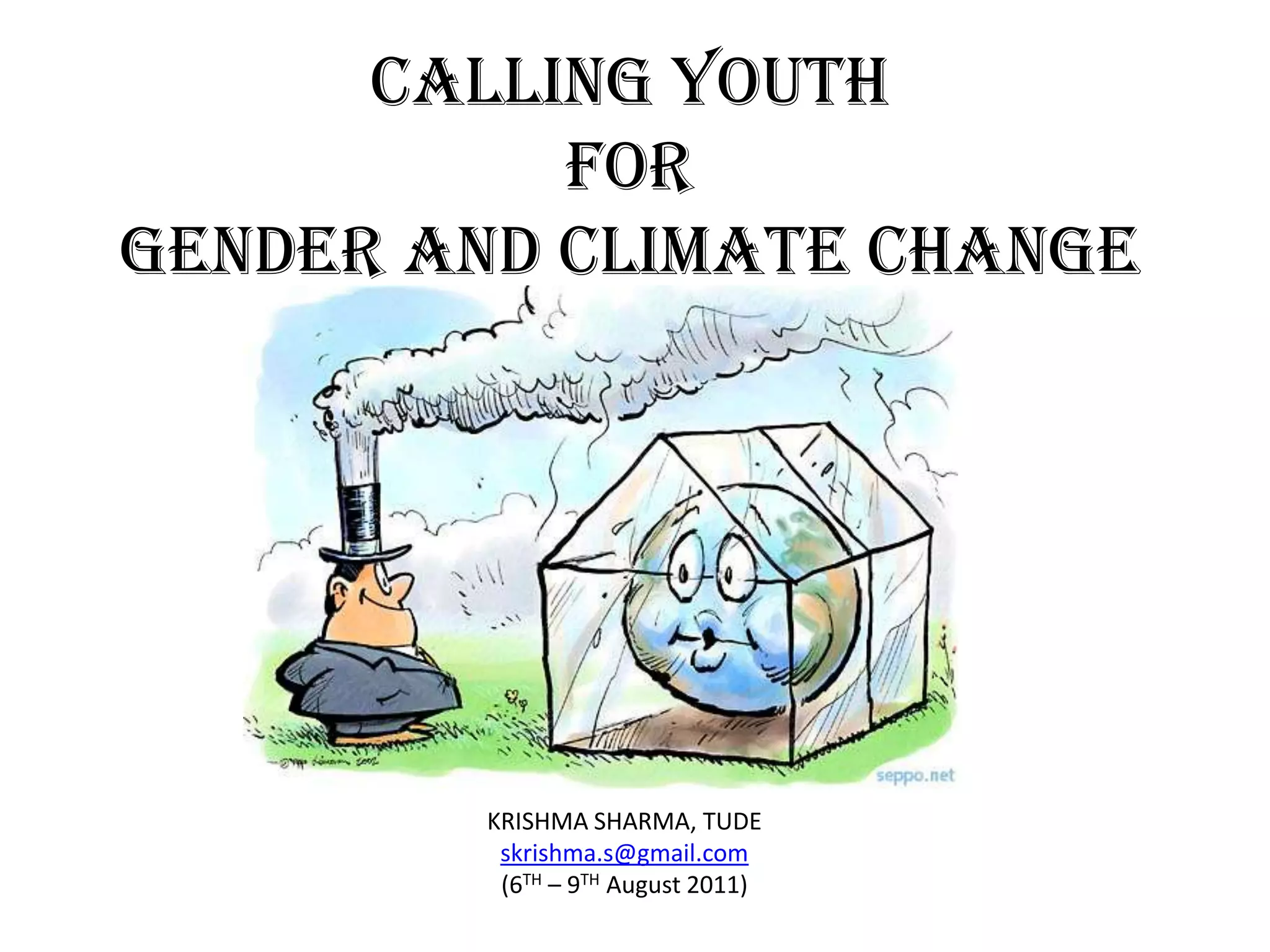
Calling Youth forGender and Climate ChangeKRISHMA SHARMA, TUDEskrishma.s@gmail.com(6TH – 9TH August 2011)
Understanding GenderSex refers to biological differences : male and femaleGender refers to the differences in socially constructed ideas and practices, roles and opportunities associated with being a man or a womanSex as male or female is a biological fact that is the same in any culturewhat that sex means in terms of your gender role as a 'man' or a 'woman' in society can be quite different cross culturally.
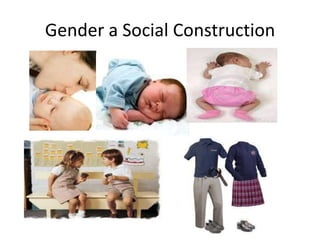
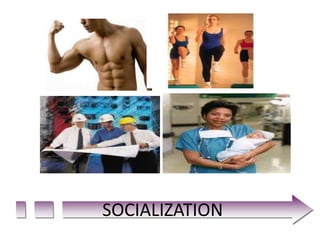
Gender a Social Construction
SOCIALIZATION
Mixed doubles require two of each (sports)
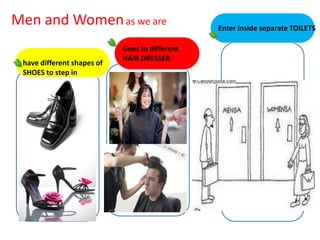
Men and Womenas we areEnter inside separate TOILETSGoes to different HAIR DRESSERhave different shapes of SHOESto step inexampleexample
 Gender is not only about womenGender is socially made expectations and learned roles that has defined how female and male in any society interact, live their lives and workGender determines what is expected, permitted and valued in a woman or a man in a determined context.
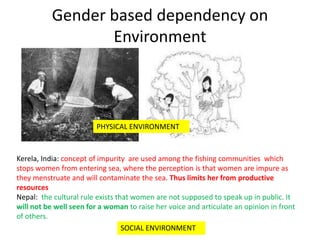
Gender based dependency on EnvironmentPHYSICAL ENVIRONMENTKerela, India: concept of impurity  are used among the fishing communities  which stops women from entering sea, where the perception is that women are impure as they menstruate and will contaminate the sea. Thus limits her from productive resourcesNepal:  the cultural rule exists that women are not supposed to speak up in public. It will not be well seen for a woman to raise her voice and articulate an opinion in front of others.  SOCIAL ENVIRONMENT
Development approach should not just take physical environment into consideration rather should also take in account and make an effort to make a conducive social environment so that the outcome of development is shared equally among all irrespective of age, class, religion, location, gender, caste, ethnicity and so forth.
Climate Change “Any change in the climate, whether due to its natural variability or as a result of human activity” Also a reminder to human beings that we are ecologically interdependentHuman activities have impacts (usually negative) on environment
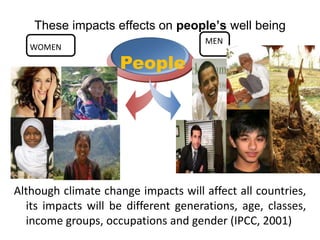
These impacts effects on people’s well beingPeopleMENWOMENAlthough climate change impacts will affect all countries, its impacts will be different generations, age, classes, income groups, occupations and gender (IPCC, 2001)
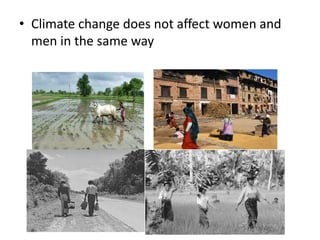
Climate change does not affect women and men in the same way
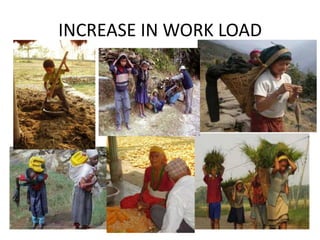
Who are vulnerable to Climate Change??Among all, women and men along with children in rural and developing countries are highly vulnerable because their livelihood is based on natural resources. Among them women and girl child face greater challenges and are more affected. Firstly because they are the household managers and are charged with the complementary roles and responsibilities to secure water, food, fuel wood for cooking, heating, collecting fodders for livestock and so forth
INCREASE IN WORK LOAD
Secondly, when coupled with unequal access to resources and to decision-making processes, limited mobility places women in rural areas in a position where they are disproportionately affected by climate change. It is thus important to identify gender-sensitive strategies to respond to the environmental and humanitarian crises caused by climate change.
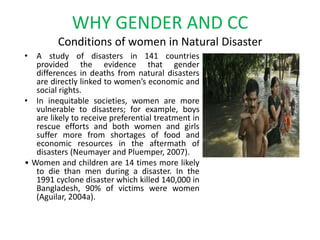
WHY GENDER AND CC Conditions of women in Natural Disaster A study of disasters in 141 countries provided the evidence that gender differences in deaths from natural disasters are directly linked to women’s economic and social rights. In inequitable societies, women are more vulnerable to disasters; for example, boys are likely to receive preferential treatment in rescue efforts and both women and girls suffer more from shortages of food and economic resources in the aftermath of disasters (Neumayer and Pluemper, 2007).• Women and children are 14 times more likely to die than men during a disaster. In the 1991 cyclone disaster which killed 140,000 in Bangladesh, 90% of victims were women (Aguilar, 2004a).
 Women are vulnerable not because they are “naturally weaker,” but because they face different conditions of vulnerability than men. Women often live in conditions of social exclusion, such as cultural limitations to mobilize outside their immediate environment; have less access to information to early warning systems in times of disasters
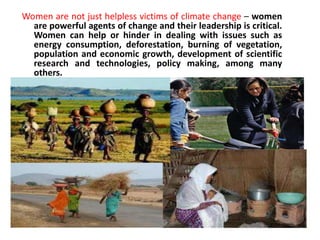
Women are not just helpless victims of climate change – women are powerful agents of change and their leadership is critical. Women can help or hinder in dealing with issues such as energy consumption, deforestation, burning of vegetation, population and economic growth, development of scientific research and technologies, policy making, among many others.
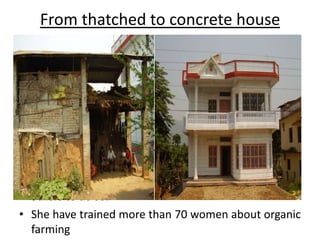
From thatched to concrete houseMs Durga was a poor daily wage laborer. She loved cultivation. She took the challenge of starting organic farming in a small rented piece of land. “I am now able to buy a plot of land and I am constructing a modern house next to my thatched house from the savings I made from four years of organic farming. I agree that we all are facing impacts of climate change. Since I am into organic farming, climate change is not impacting my farming. I find it as a sustainable method and thus encourage others to do so.”She have trained more than 70 women about organic farming
Role of youth….Taking action and making differenceYouth have develop  creative ways raise awareness, built capacities, share information and work together on climate change mitigation  and adaptation practicesYoung people need to affirm the status as key stakeholders in the fight against climate changeYoung people must continue to move forward, strengthening their position until they occupy a secure place in the decision-making process.
Youth are minority, but  their behavior has the greatest environmental impactMany young people around the world feel the need to compete in the race for the latest gadgets and the “newest” and “coolest” products on the market.Young people must realize that their lifestyles and consumption patterns are having a substantial impact on overall environmental sustainability even now.The most popular consumption items for young people in these contexts are clothes, entertainment and communications equipment, and food.
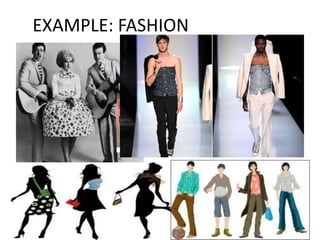
EXAMPLE: FASHION
Fashion changes constantly			what is “in” and what is “out”Generates a “need” to buy the latest stylesExcess production and waste occur as outmoded products are discarded—not because they no longer fulfill their main functional purpose, but simply because they are no longer deemed desirable.Meeting strong consumer demand can put a strain on the environment.
The industrial manufactureof fabric and other fashion goods can undermine air quality; dyeing and printing use vast amounts of water and chemicals, and shipping garments around the world is energy-intensive and constitutes a source of GHG emissionsTechnology, like fashion, is constantly evolving. New technology items are becoming increasingly important to young people for the management of their leisure time and social relations. It is not surprising that youth are among the main consumers of mobile telephones, computers, video games, and other electronic equipments.
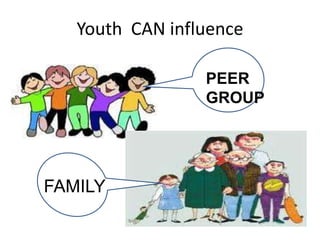
Youth  CAN influence PEER GROUPFAMILY
Why….???Although climate change affects individuals of all ages, young people can expect to bear a particularly heavy burden because they will live longer and will face this challenge throughout their lifetimes. Youth have long been involved in environmental protection activities at the school and community levels, but the time has come for them to participate more actively in shaping global decisions relating to climate change. Young people must contribute to the process of addressing this critical challenge, as they will feel its impact most acutely throughout their lives
The younger generation needs to promote change and embrace innovative values. Climate change messengers are to be the initiators of social movements that can bring cultural and social transformationsTHE MOST FUN YOU EVER HAD SAVING THE PLANET

Gender and Climate Change- Krishma Sharma

  • 1.
    Calling Youth forGenderand Climate ChangeKRISHMA SHARMA, TUDEskrishma.s@gmail.com(6TH – 9TH August 2011)
  • 2.
    Understanding GenderSex refersto biological differences : male and femaleGender refers to the differences in socially constructed ideas and practices, roles and opportunities associated with being a man or a womanSex as male or female is a biological fact that is the same in any culturewhat that sex means in terms of your gender role as a 'man' or a 'woman' in society can be quite different cross culturally.
  • 3.
    Gender a SocialConstruction
  • 4.
  • 5.
    Mixed doubles requiretwo of each (sports)
  • 6.
    Men and Womenaswe areEnter inside separate TOILETSGoes to different HAIR DRESSERhave different shapes of SHOESto step inexampleexample
  • 7.
    Gender isnot only about womenGender is socially made expectations and learned roles that has defined how female and male in any society interact, live their lives and workGender determines what is expected, permitted and valued in a woman or a man in a determined context.
  • 8.
    Gender based dependencyon EnvironmentPHYSICAL ENVIRONMENTKerela, India: concept of impurity are used among the fishing communities which stops women from entering sea, where the perception is that women are impure as they menstruate and will contaminate the sea. Thus limits her from productive resourcesNepal: the cultural rule exists that women are not supposed to speak up in public. It will not be well seen for a woman to raise her voice and articulate an opinion in front of others. SOCIAL ENVIRONMENT
  • 9.
    Development approach shouldnot just take physical environment into consideration rather should also take in account and make an effort to make a conducive social environment so that the outcome of development is shared equally among all irrespective of age, class, religion, location, gender, caste, ethnicity and so forth.
  • 10.
    Climate Change “Anychange in the climate, whether due to its natural variability or as a result of human activity” Also a reminder to human beings that we are ecologically interdependentHuman activities have impacts (usually negative) on environment
  • 11.
    These impacts effectson people’s well beingPeopleMENWOMENAlthough climate change impacts will affect all countries, its impacts will be different generations, age, classes, income groups, occupations and gender (IPCC, 2001)
  • 12.
    Climate change doesnot affect women and men in the same way
  • 13.
    Who are vulnerableto Climate Change??Among all, women and men along with children in rural and developing countries are highly vulnerable because their livelihood is based on natural resources. Among them women and girl child face greater challenges and are more affected. Firstly because they are the household managers and are charged with the complementary roles and responsibilities to secure water, food, fuel wood for cooking, heating, collecting fodders for livestock and so forth
  • 14.
  • 15.
    Secondly, when coupledwith unequal access to resources and to decision-making processes, limited mobility places women in rural areas in a position where they are disproportionately affected by climate change. It is thus important to identify gender-sensitive strategies to respond to the environmental and humanitarian crises caused by climate change.
  • 16.
    WHY GENDER ANDCC Conditions of women in Natural Disaster A study of disasters in 141 countries provided the evidence that gender differences in deaths from natural disasters are directly linked to women’s economic and social rights. In inequitable societies, women are more vulnerable to disasters; for example, boys are likely to receive preferential treatment in rescue efforts and both women and girls suffer more from shortages of food and economic resources in the aftermath of disasters (Neumayer and Pluemper, 2007).• Women and children are 14 times more likely to die than men during a disaster. In the 1991 cyclone disaster which killed 140,000 in Bangladesh, 90% of victims were women (Aguilar, 2004a).
  • 17.
    Women arevulnerable not because they are “naturally weaker,” but because they face different conditions of vulnerability than men. Women often live in conditions of social exclusion, such as cultural limitations to mobilize outside their immediate environment; have less access to information to early warning systems in times of disasters
  • 18.
    Women are notjust helpless victims of climate change – women are powerful agents of change and their leadership is critical. Women can help or hinder in dealing with issues such as energy consumption, deforestation, burning of vegetation, population and economic growth, development of scientific research and technologies, policy making, among many others.
  • 19.
    From thatched toconcrete houseMs Durga was a poor daily wage laborer. She loved cultivation. She took the challenge of starting organic farming in a small rented piece of land. “I am now able to buy a plot of land and I am constructing a modern house next to my thatched house from the savings I made from four years of organic farming. I agree that we all are facing impacts of climate change. Since I am into organic farming, climate change is not impacting my farming. I find it as a sustainable method and thus encourage others to do so.”She have trained more than 70 women about organic farming
  • 20.
    Role of youth….Takingaction and making differenceYouth have develop creative ways raise awareness, built capacities, share information and work together on climate change mitigation and adaptation practicesYoung people need to affirm the status as key stakeholders in the fight against climate changeYoung people must continue to move forward, strengthening their position until they occupy a secure place in the decision-making process.
  • 21.
    Youth are minority,but their behavior has the greatest environmental impactMany young people around the world feel the need to compete in the race for the latest gadgets and the “newest” and “coolest” products on the market.Young people must realize that their lifestyles and consumption patterns are having a substantial impact on overall environmental sustainability even now.The most popular consumption items for young people in these contexts are clothes, entertainment and communications equipment, and food.
  • 22.
  • 23.
    Fashion changes constantly whatis “in” and what is “out”Generates a “need” to buy the latest stylesExcess production and waste occur as outmoded products are discarded—not because they no longer fulfill their main functional purpose, but simply because they are no longer deemed desirable.Meeting strong consumer demand can put a strain on the environment.
  • 24.
    The industrial manufactureoffabric and other fashion goods can undermine air quality; dyeing and printing use vast amounts of water and chemicals, and shipping garments around the world is energy-intensive and constitutes a source of GHG emissionsTechnology, like fashion, is constantly evolving. New technology items are becoming increasingly important to young people for the management of their leisure time and social relations. It is not surprising that youth are among the main consumers of mobile telephones, computers, video games, and other electronic equipments.
  • 26.
    Youth CANinfluence PEER GROUPFAMILY
  • 27.
    Why….???Although climate changeaffects individuals of all ages, young people can expect to bear a particularly heavy burden because they will live longer and will face this challenge throughout their lifetimes. Youth have long been involved in environmental protection activities at the school and community levels, but the time has come for them to participate more actively in shaping global decisions relating to climate change. Young people must contribute to the process of addressing this critical challenge, as they will feel its impact most acutely throughout their lives
  • 28.
    The younger generationneeds to promote change and embrace innovative values. Climate change messengers are to be the initiators of social movements that can bring cultural and social transformationsTHE MOST FUN YOU EVER HAD SAVING THE PLANET